Equations of motion
Motion in one dimension
What is motion?
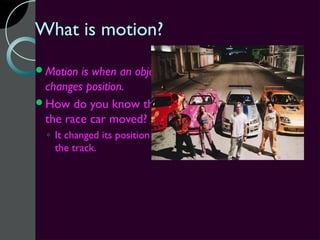
Motion is when an object
 changes position.
How do you know that
 the race car moved?
  ◦ It changed its position on
    the track.
How can you tell something has
changed position?
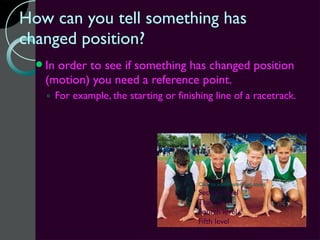
  Inorder to see if something has changed position
   (motion) you need a reference point.
   ◦ For example, the starting or finishing line of a racetrack.


                                        Click to edit Master text styles
                                        Second level
                                        Third level
                                        Fourth level
                                        Fifth level
Position
Ifsomething moves, it constantly changes
 position.
When you describe position, you refer to
 a point of reference/origin (zero).
When you have chosen your point of
 reference all positions will be chosen
 relative to this point of origin.
Position is the place where an object is as
 observed from a point of reference.
Frame of reference


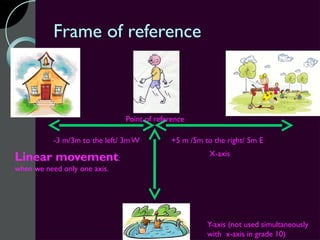
                                Point of reference

           -3 m/3m to the left/ 3m W          +5 m /5m to the right/ 5m E
                                                         X-axis
Linear movement:
when we need only one axis.


                                                        Y-axis (not used simultaneously
                                                        with x-axis in grade 10)
GPS
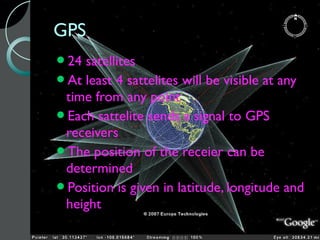
24 satellites
At least 4 sattelites will be visible at any
 time from any point
Each sattelite sends a signal to GPS
 receivers
The position of the receier can be
 determined
Position is given in latitude, longitude and
 height
Distance and
displacement
What is distance?
Easy question!
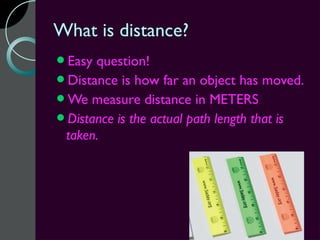
Distance is how far an object has moved.
We measure distance in METERS!
Distance is the actual path length that is
 taken.
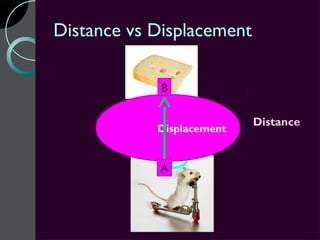
Distance vs Displacement

             B

                           Distance
            Displacement


            A
What is displacement?

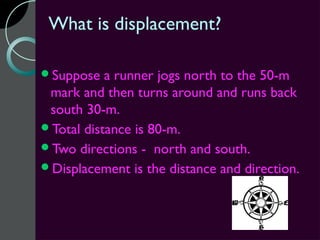
Suppose   a runner jogs north to the 50-m
 mark and then turns around and runs back
 south 30-m.
Total distance is 80-m.
Two directions - north and south.
Displacement is the distance and direction.
Displacement
Displacement   is the change in position of the
 object.
In other words, a straight line.
The magnitude of the displacement will
 be smaller than or equal to the distance
 that was covered.
Displacement will be represented by Δx
 on the horisontal line, and Δy on the
 vertical.
Calculating distance and displacement
     Δx = xf – xi = _m
     Let’s try this:
     You move from your front porch to your
     neighbours’ house 400 m away. Now
     calculate your displacement.

     Moving from your front door (xi = 0 m ), and
     to your neighbours’ house (xf = 400 m).
     Δx = xf – xi = 400 – 0 = 400 m to the right
Calculating distance and displacement II
      Now, you move from your neighbours’ house
      and move back towards your house, but move
      beyond and travel to the cafe 600 m from your
      home. Now calculate your displacement from
      the moment you left home.

      Moving from your front door (xi = 0 m ), and to
      the cafe (xf = 600 m).
      Δx = xf – xi = 600 – 0 = 600 m to the left.
Scalars and vectors
Scalars
       are quantities that has only magnitude.
Examples: distance time mass volume, energy, work and
  potential difference


Vectors are quantities that posesses both
  magnitude and direction.

Examples: displacement velocity acceleration force weight
Speed and velocity
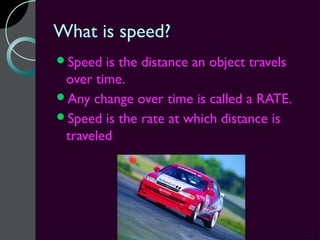
What is speed?
Speed  is the distance an object travels
 over time.
Any change over time is called a RATE.
Speed is the rate at which distance is
 traveled.
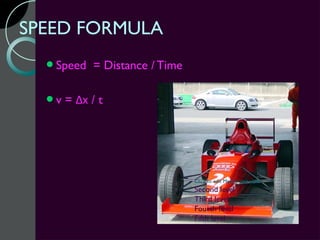
SPEED FORMULA
  Speed    = Distance / Time

  v   = Δx / t


                                Click to edit Master text styles
                                Second level
                                Third level
                                Fourth level
                                Fifth level
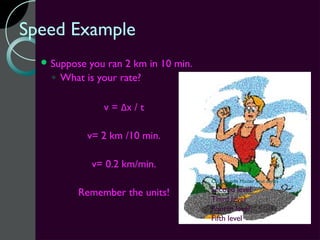
Speed Example
   Suppose you ran 2 km in 10 min.
    ◦ What is your rate?

                 v = Δx / t

              v= 2 km /10 min.

              v= 0.2 km/min.
                                      Click to edit Master text styles

         Remember the units!          Second level
                                      Third level
                                      Fourth level
                                      Fifth level
Constant Speed…
What    does constant mean?

Ifyou are driving on the highway and you
 set your cruise control, you are driving at
 a constant speed.

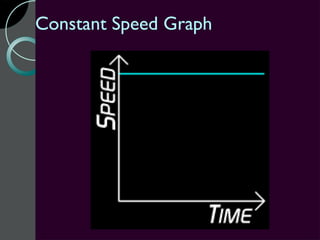
What    would a constant speed graph look
 like?
Constant Speed Graph
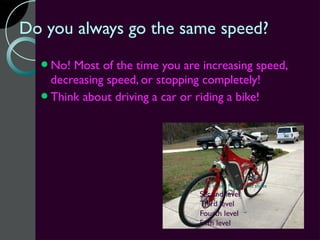
Do you always go the same speed?
  No! Most of the time you are increasing speed,
   decreasing speed, or stopping completely!
  Think about driving a car or riding a bike!


                                Click to edit Master text styles
                                Second level
                                Third level
                                Fourth level
                                Fifth level
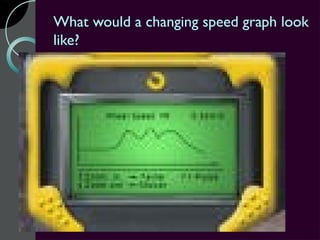
What would a changing speed graph look
like?
What is average speed?
How     do you find an average?

Average  speed is the total distance
 traveled over the total time

v   = Δxtotal / ttotal
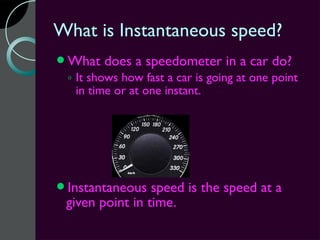
What is Instantaneous speed?
What   does a speedometer in a car do?
 ◦ It shows how fast a car is going at one point
   in time or at one instant.


Instantaneous   speed is the speed at a
 given point in time.
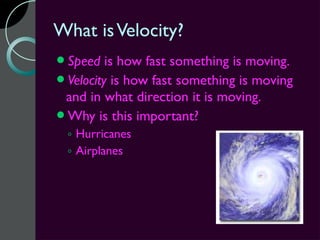
What is Velocity?
Speed   is how fast something is moving.
Velocity is how fast something is moving
 and in what direction it is moving.
Why is this important?
 ◦ Hurricanes
 ◦ Airplanes
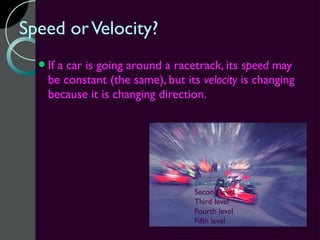
Speed or Velocity?
  Ifa car is going around a racetrack, its speed may
   be constant (the same), but its velocity is changing
   because it is changing direction.


                                 Click to edit Master text styles
                                 Second level
                                 Third level
                                 Fourth level
                                 Fifth level
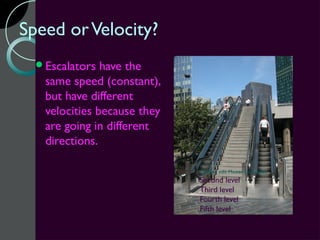
Speed or Velocity?
  Escalators  have the
   same speed (constant),
   but have different
   velocities because they
   are going in different
   directions.

                             Click to edit Master text styles
                             Second level
                             Third level
                             Fourth level
                             Fifth level
acceleration
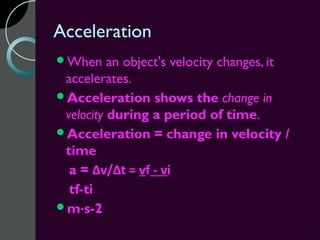
Acceleration
When     an object's velocity changes, it
 accelerates.
Acceleration shows the change in
 velocity during a period of time.
Acceleration = change in velocity /
 time
  a = Δv/Δt = vf - vi
  tf-ti
m·s-2
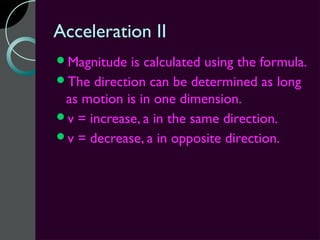
Acceleration II
Magnitude  is calculated using the formula.
The direction can be determined as long
 as motion is in one dimension.
v = increase, a in the same direction.
v = decrease, a in opposite direction.
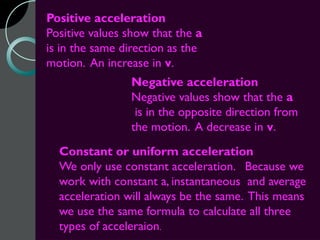
Positive acceleration
Positive values show that the a
is in the same direction as the
motion. An increase in v.
                Negative acceleration
                Negative values show that the a
                 is in the opposite direction from
                the motion. A decrease in v.
  Constant or uniform acceleration
  We only use constant acceleration. Because we
  work with constant a, instantaneous and average
  acceleration will always be the same. This means
  we use the same formula to calculate all three
  types of acceleraion.
Describing motion with
diagrams
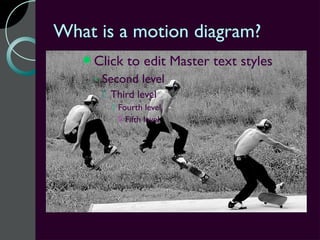
What is a motion diagram?
   Click   to edit Master text styles
    ◦ Second level
      Third level
        Fourth level
          Fifth level
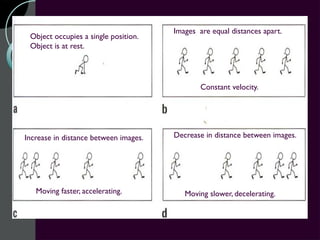
Images are equal distances apart.
 Object occupies a single position.
 Object is at rest.


                                               Constant velocity.


Increase in distance between images.   Decrease in distance between images.


   Moving faster, accelerating.           Moving slower, decelerating.
Sketches and uses
Sketch   a row of dots to represent the
 object.
Refer to previous slide to get the spaces
 right.
Draw a vector from each dot to show
 velocity.
If acceleration occurs, add one more
 vector to illustrate acceleration.
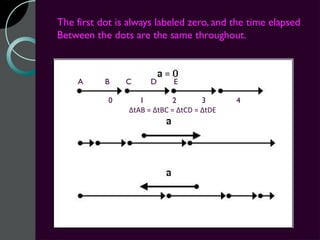
The first dot is always labeled zero, and the time elapsed
Between the dots are the same throughout.


    A      B    C      D     E

            0       1         2       3      4
                 ΔtAB = ΔtBC = ΔtCD = ΔtDE
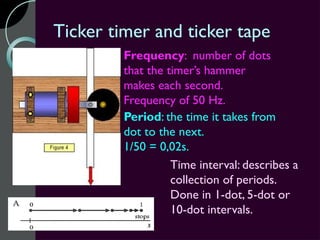
Ticker timer and ticker tape
         Frequency: number of dots
         that the timer’s hammer
         makes each second.
         Frequency of 50 Hz.
         Period: the time it takes from
         dot to the next.
         1/50 = 0,02s.
                   Time interval: describes a
                   collection of periods.
                   Done in 1-dot, 5-dot or
                   10-dot intervals.
Determine the magnitude of the avg
velocity
You  will need Δx and Δt for each specific
 interval.
Δx = determined by measuring spaces
 between intervals.
Δt = determined by multiplying the
 spaces with the period.
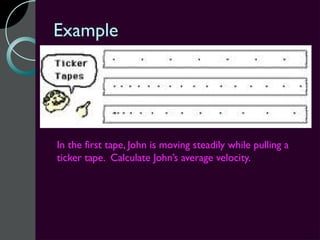
Example


In the first tape, John is moving steadily while pulling a
ticker tape. Calculate John’s average velocity.
Determining the avg acceleration
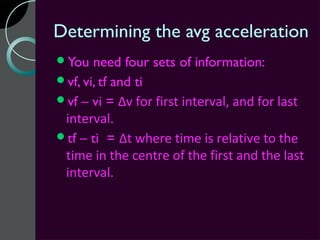
You   need four sets of information:
vf, vi, tf and ti
vf – vi = Δv for first interval, and for last
 interval.
tf – ti = Δt where time is relative to the
 time in the centre of the first and the last
 interval.
Example
     Click     to edit Master text styles
        ◦ Second level
           Third level
             Fourth level
               Fifth level


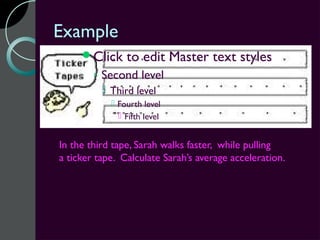
In the third tape, Sarah walks faster, while pulling
a ticker tape. Calculate Sarah’s average acceleration.
Description of motion
using graphs
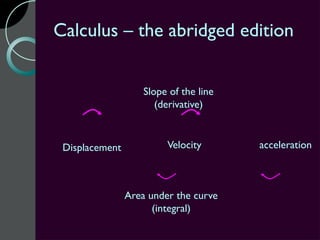
Calculus – the abridged edition


                    Slope of the line
                       (derivative)


 Displacement            Velocity       acceleration


                Area under the curve
                      (integral)
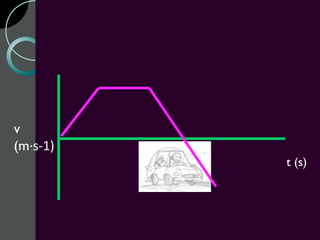
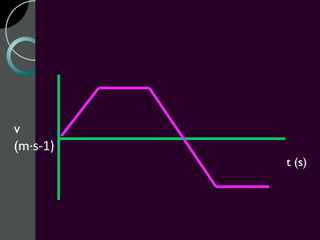
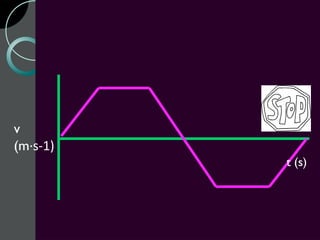
Movement and velocity
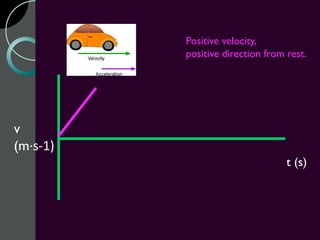
Positive velocity,
          positive direction from rest.


v
(m·s-1)
                                  t (s)
v
(m·s-1)
          t (s)
v
(m·s-1)
          t (s)
v
(m·s-1)
          t (s)
v
(m·s-1)
          t (s)
v
(m·s-1)
          t (s)
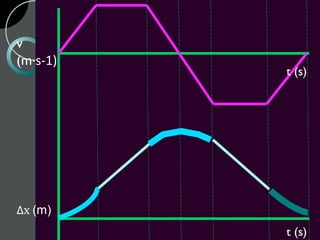
Position-time graphs for velocity
v
(m·s-1)
          t (s)


Δx (m)
          t (s)
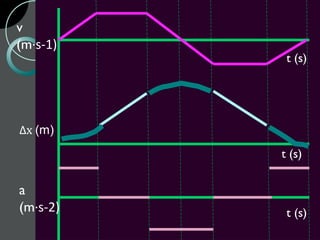
Movement with acceleration
v
(m·s-1)
           t (s)


Δx (m)
          t (s)

a
(m·s-2)    t (s)
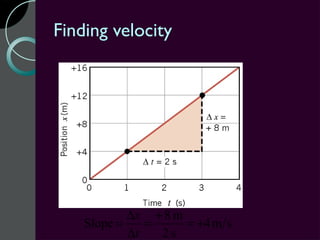
Finding velocity


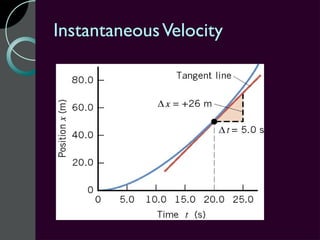
            ∆x + 8 m
    Slope =    =     = +4 m s
            ∆t   2s
Instantaneous Velocity
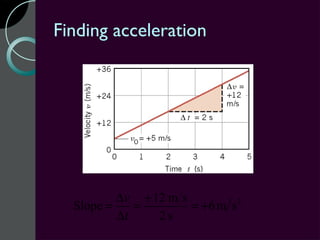
Finding acceleration


          ∆v + 12 m s
  Slope =    =        = +6 m s 2
          ∆t    2s
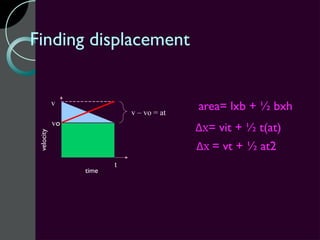
Finding displacement


            v
                            v – vo = at
                                          area= lxb + ½ bxh
            vo
                                          Δx= vit + ½ t(at)
 velocity


                                          Δx = vt + ½ at2
                        t
                 time
Equations of motion
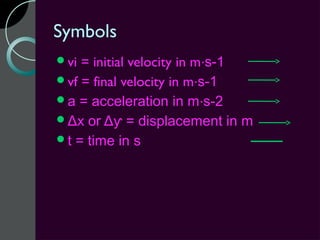
Symbols
vi = initial velocity in m·s-1
vf = final velocity in m·s-1
a = acceleration in m·s-2
Δx or Δƴ = displacement in m
t = time in s
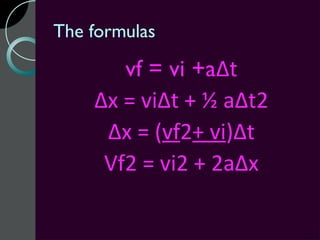
The formulas

       vf = vi +aΔt
    Δx = viΔt + ½ aΔt2
     Δx = (vf2+ vi)Δt
     Vf2 = vi2 + 2aΔx
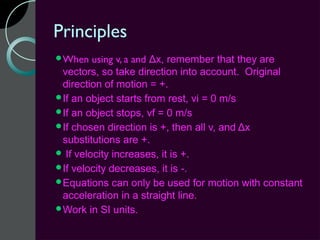
Principles
When    using v, a and Δx, remember that they are
 vectors, so take direction into account. Original
 direction of motion = +.
If an object starts from rest, vi = 0 m/s
If an object stops, vf = 0 m/s
If chosen direction is +, then all v, and Δx
 substitutions are +.
 If velocity increases, it is +.
If velocity decreases, it is -.
Equations can only be used for motion with constant
 acceleration in a straight line.
Work in SI units.

Equations of motion

  • 1.
  • 2.
    Motion in onedimension
  • 3.
    What is motion? Motionis when an object changes position. How do you know that the race car moved? ◦ It changed its position on the track.
  • 4.
    How can youtell something has changed position? Inorder to see if something has changed position (motion) you need a reference point. ◦ For example, the starting or finishing line of a racetrack. Click to edit Master text styles Second level Third level Fourth level Fifth level
  • 5.
    Position Ifsomething moves, itconstantly changes position. When you describe position, you refer to a point of reference/origin (zero). When you have chosen your point of reference all positions will be chosen relative to this point of origin. Position is the place where an object is as observed from a point of reference.
  • 6.
    Frame of reference Point of reference -3 m/3m to the left/ 3m W +5 m /5m to the right/ 5m E X-axis Linear movement: when we need only one axis. Y-axis (not used simultaneously with x-axis in grade 10)
  • 7.
    GPS 24 satellites At least4 sattelites will be visible at any time from any point Each sattelite sends a signal to GPS receivers The position of the receier can be determined Position is given in latitude, longitude and height
  • 8.
  • 9.
    What is distance? Easyquestion! Distance is how far an object has moved. We measure distance in METERS! Distance is the actual path length that is taken.
  • 10.
    Distance vs Displacement B Distance Displacement A
  • 11.
    What is displacement? Suppose a runner jogs north to the 50-m mark and then turns around and runs back south 30-m. Total distance is 80-m. Two directions - north and south. Displacement is the distance and direction.
  • 12.
    Displacement Displacement is the change in position of the object. In other words, a straight line. The magnitude of the displacement will be smaller than or equal to the distance that was covered. Displacement will be represented by Δx on the horisontal line, and Δy on the vertical.
  • 13.
    Calculating distance anddisplacement Δx = xf – xi = _m Let’s try this: You move from your front porch to your neighbours’ house 400 m away. Now calculate your displacement. Moving from your front door (xi = 0 m ), and to your neighbours’ house (xf = 400 m). Δx = xf – xi = 400 – 0 = 400 m to the right
  • 14.
    Calculating distance anddisplacement II Now, you move from your neighbours’ house and move back towards your house, but move beyond and travel to the cafe 600 m from your home. Now calculate your displacement from the moment you left home. Moving from your front door (xi = 0 m ), and to the cafe (xf = 600 m). Δx = xf – xi = 600 – 0 = 600 m to the left.
  • 15.
    Scalars and vectors Scalars are quantities that has only magnitude. Examples: distance time mass volume, energy, work and potential difference Vectors are quantities that posesses both magnitude and direction. Examples: displacement velocity acceleration force weight
  • 16.
  • 17.
    What is speed? Speed is the distance an object travels over time. Any change over time is called a RATE. Speed is the rate at which distance is traveled.
  • 18.
    SPEED FORMULA Speed = Distance / Time v = Δx / t Click to edit Master text styles Second level Third level Fourth level Fifth level
  • 19.
    Speed Example  Suppose you ran 2 km in 10 min. ◦ What is your rate? v = Δx / t v= 2 km /10 min. v= 0.2 km/min. Click to edit Master text styles Remember the units! Second level Third level Fourth level Fifth level
  • 20.
    Constant Speed… What does constant mean? Ifyou are driving on the highway and you set your cruise control, you are driving at a constant speed. What would a constant speed graph look like?
  • 21.
  • 22.
    Do you alwaysgo the same speed? No! Most of the time you are increasing speed, decreasing speed, or stopping completely! Think about driving a car or riding a bike! Click to edit Master text styles Second level Third level Fourth level Fifth level
  • 23.
    What would achanging speed graph look like?
  • 24.
    What is averagespeed? How do you find an average? Average speed is the total distance traveled over the total time v = Δxtotal / ttotal
  • 25.
    What is Instantaneousspeed? What does a speedometer in a car do? ◦ It shows how fast a car is going at one point in time or at one instant. Instantaneous speed is the speed at a given point in time.
  • 26.
    What is Velocity? Speed is how fast something is moving. Velocity is how fast something is moving and in what direction it is moving. Why is this important? ◦ Hurricanes ◦ Airplanes
  • 27.
    Speed or Velocity? Ifa car is going around a racetrack, its speed may be constant (the same), but its velocity is changing because it is changing direction. Click to edit Master text styles Second level Third level Fourth level Fifth level
  • 28.
    Speed or Velocity? Escalators have the same speed (constant), but have different velocities because they are going in different directions. Click to edit Master text styles Second level Third level Fourth level Fifth level
  • 29.
  • 30.
    Acceleration When an object's velocity changes, it accelerates. Acceleration shows the change in velocity during a period of time. Acceleration = change in velocity / time a = Δv/Δt = vf - vi tf-ti m·s-2
  • 31.
    Acceleration II Magnitude is calculated using the formula. The direction can be determined as long as motion is in one dimension. v = increase, a in the same direction. v = decrease, a in opposite direction.
  • 32.
    Positive acceleration Positive valuesshow that the a is in the same direction as the motion. An increase in v. Negative acceleration Negative values show that the a is in the opposite direction from the motion. A decrease in v. Constant or uniform acceleration We only use constant acceleration. Because we work with constant a, instantaneous and average acceleration will always be the same. This means we use the same formula to calculate all three types of acceleraion.
  • 33.
  • 34.
    What is amotion diagram? Click to edit Master text styles ◦ Second level  Third level  Fourth level  Fifth level
  • 35.
    Images are equaldistances apart. Object occupies a single position. Object is at rest. Constant velocity. Increase in distance between images. Decrease in distance between images. Moving faster, accelerating. Moving slower, decelerating.
  • 36.
    Sketches and uses Sketch a row of dots to represent the object. Refer to previous slide to get the spaces right. Draw a vector from each dot to show velocity. If acceleration occurs, add one more vector to illustrate acceleration.
  • 37.
    The first dotis always labeled zero, and the time elapsed Between the dots are the same throughout. A B C D E 0 1 2 3 4 ΔtAB = ΔtBC = ΔtCD = ΔtDE
  • 38.
    Ticker timer andticker tape Frequency: number of dots that the timer’s hammer makes each second. Frequency of 50 Hz. Period: the time it takes from dot to the next. 1/50 = 0,02s. Time interval: describes a collection of periods. Done in 1-dot, 5-dot or 10-dot intervals.
  • 39.
    Determine the magnitudeof the avg velocity You will need Δx and Δt for each specific interval. Δx = determined by measuring spaces between intervals. Δt = determined by multiplying the spaces with the period.
  • 40.
    Example In the firsttape, John is moving steadily while pulling a ticker tape. Calculate John’s average velocity.
  • 41.
    Determining the avgacceleration You need four sets of information: vf, vi, tf and ti vf – vi = Δv for first interval, and for last interval. tf – ti = Δt where time is relative to the time in the centre of the first and the last interval.
  • 42.
    Example Click to edit Master text styles ◦ Second level  Third level  Fourth level  Fifth level In the third tape, Sarah walks faster, while pulling a ticker tape. Calculate Sarah’s average acceleration.
  • 43.
  • 44.
    Calculus – theabridged edition Slope of the line (derivative) Displacement Velocity acceleration Area under the curve (integral)
  • 45.
  • 46.
    Positive velocity, positive direction from rest. v (m·s-1) t (s)
  • 47.
  • 48.
  • 49.
  • 50.
  • 51.
  • 52.
  • 53.
    v (m·s-1) t (s) Δx (m) t (s)
  • 54.
  • 55.
    v (m·s-1) t (s) Δx (m) t (s) a (m·s-2) t (s)
  • 56.
    Finding velocity ∆x + 8 m Slope = = = +4 m s ∆t 2s
  • 57.
  • 58.
    Finding acceleration ∆v + 12 m s Slope = = = +6 m s 2 ∆t 2s
  • 59.
    Finding displacement v v – vo = at area= lxb + ½ bxh vo Δx= vit + ½ t(at) velocity Δx = vt + ½ at2 t time
  • 60.
  • 61.
    Symbols vi = initialvelocity in m·s-1 vf = final velocity in m·s-1 a = acceleration in m·s-2 Δx or Δƴ = displacement in m t = time in s
  • 62.
    The formulas vf = vi +aΔt Δx = viΔt + ½ aΔt2 Δx = (vf2+ vi)Δt Vf2 = vi2 + 2aΔx
  • 63.
    Principles When using v, a and Δx, remember that they are vectors, so take direction into account. Original direction of motion = +. If an object starts from rest, vi = 0 m/s If an object stops, vf = 0 m/s If chosen direction is +, then all v, and Δx substitutions are +.  If velocity increases, it is +. If velocity decreases, it is -. Equations can only be used for motion with constant acceleration in a straight line. Work in SI units.