
Objectives:
ď‚´Describe why pharmacy students and pharmacist should
be knowledgeable about their personal finance situation.
ď‚´Identify and describe each component of the financial
planning process.
ď‚´Identify and describe the components of personal
financial statements and budgeting.
ď‚´Identify sources of credit and the costs of credit
alternatives.
ď‚´Describe factors that influence the amount of money
needed for retirement. Compare and contrast methods
of saving money for retirement.
ď‚´Describe and discern among alternative
asset classes.
ď‚´Describe and explain asset allocation and its
importance in reaching one’s financial goals.
ď‚´Compare index mutual fund investing with
managed mutual fund investing.
ď‚´List and explain the seven principles of
effective personal finance.
Financial matters affect not only one’s personal and
family life but also one’s workplace behavior. Brown
(1979) reported that workers who experience financial
problems negatively affect their employers. This results to
the following:
ď‚´One or more counterproductive work behaviors.
ď‚´Job productivity suffers because of the impact poor
personal financial behaviors have on family life.
(Garman, Leech, and Grable,1996)
ď‚´Financial Illiteracy-refers to an inadequate knowledge
of personal finance facts and concepts for successful
personal financial management.
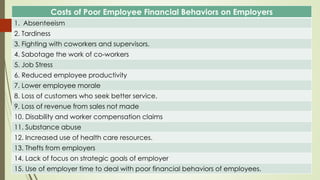
Costs of Poor Employee Financial Behaviors on Employers
1. Absenteeism
2. Tardiness
3. Fighting with coworkers and supervisors.
4. Sabotage the work of co-workers
5. Job Stress
6. Reduced employee productivity
7. Lower employee morale
8. Loss of customers who seek better service.
9. Loss of revenue from sales not made
10. Disability and worker compensation claims
11. Substance abuse
12. Increased use of health care resources.
13. Thefts from employers
14. Lack of focus on strategic goals of employer
15. Use of employer time to deal with poor financial behaviors of employees.
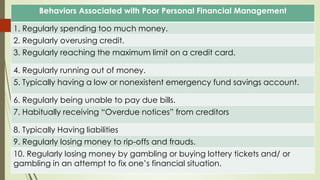
Behaviors Associated with Poor Personal Financial Management
1. Regularly spending too much money.
2. Regularly overusing credit.
3. Regularly reaching the maximum limit on a credit card.
4. Regularly running out of money.
5. Typically having a low or nonexistent emergency fund savings account.
6. Regularly being unable to pay due bills.
7. Habitually receiving “Overdue notices” from creditors
8. Typically Having liabilities
9. Regularly losing money to rip-offs and frauds.
10. Regularly losing money by gambling or buying lottery tickets and/ or
gambling in an attempt to fix one’s financial situation.
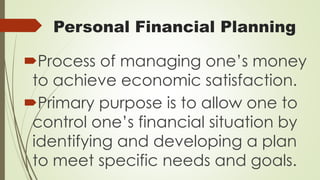
Personal Financial Planning
Process of managing one’s money
to achieve economic satisfaction.
ď‚´Primary purpose is to allow one to
control one’s financial situation by
identifying and developing a plan
to meet specific needs and goals.
Step 1: Determine Your
Financial Situation
One assess one’s current situation
regarding income, savings, living
expenses and debts along with
present expenditures.
Step 2: Develop
Financial Goals
Differentiate a person’s
needs from his or her
wants.
Step 3: Identify Alternative
Courses of Action
ď‚´Continuing along the same course of
action.
ď‚´Expanding the current situation.
ď‚´Changing the current situation.
ď‚´Taking a new course of action.
Step 4: Evaluate
Alternatives
ď‚´People need to evaluate from among
their possible courses of action. Life
situation, personal values, current
economic conditions, and many other
factors can be taken into consideration.
Step 5: Create and Implement
a Financial Action Plan
ď‚´Develop an action plan. Goals already
have been decided on, and decision
must be made on how to achieve
them.
Step 6: Reevaluate
and Revise Your Plan
ď‚´Personal Financial
planning is a dynamic
process.
Personal Balance Sheet
ď‚´What is owned (assets)--- What is owed (liabilities) = net worth
ď‚´Assets- are cash and other tangible property with monetary
value.
Example: current assets, long-term assets
ď‚´ Liquid assets- current assets that are easily converted to cash.
Example: checking account
ď‚´Long-term assets- as real estate, personal possessions, and
investment assets.
ď‚´Liabilities- categorized as current and long term.
ď‚´Current liabilities- debts that must be paid within
a year.
It includes: credit-card balances, balance due on
your automobile loan, tax payments and insurance
premiums.
ď‚´Long-term liabilities- include mortgage and
student loans.
Cash-Flow Statement
 This statement answer the question, “Where did all my money go?”
ď‚´ Cash Flow- simply the inflow and outflow of cash during a period of time.
Cash inflow Includes: income from salary and interest and investment
earnings.
Cash out flow:
• Fixed expenses- stable expenses that do not vary frequently and include
rent or mortgage payments, loan payments, cable television payments,
and insurance premium.
• Variable expenses: Include items that one might have control over, such
as food purchases, entertainment, and clothing purchases.
Budget

Personal finance

  • 2.
    Objectives: ď‚´Describe why pharmacystudents and pharmacist should be knowledgeable about their personal finance situation. ď‚´Identify and describe each component of the financial planning process. ď‚´Identify and describe the components of personal financial statements and budgeting. ď‚´Identify sources of credit and the costs of credit alternatives. ď‚´Describe factors that influence the amount of money needed for retirement. Compare and contrast methods of saving money for retirement.
  • 3.
    Describe and discernamong alternative asset classes. Describe and explain asset allocation and its importance in reaching one’s financial goals. Compare index mutual fund investing with managed mutual fund investing. List and explain the seven principles of effective personal finance.
  • 5.
    Financial matters affectnot only one’s personal and family life but also one’s workplace behavior. Brown (1979) reported that workers who experience financial problems negatively affect their employers. This results to the following: One or more counterproductive work behaviors. Job productivity suffers because of the impact poor personal financial behaviors have on family life. (Garman, Leech, and Grable,1996) Financial Illiteracy-refers to an inadequate knowledge of personal finance facts and concepts for successful personal financial management.
  • 6.
    Costs of PoorEmployee Financial Behaviors on Employers 1. Absenteeism 2. Tardiness 3. Fighting with coworkers and supervisors. 4. Sabotage the work of co-workers 5. Job Stress 6. Reduced employee productivity 7. Lower employee morale 8. Loss of customers who seek better service. 9. Loss of revenue from sales not made 10. Disability and worker compensation claims 11. Substance abuse 12. Increased use of health care resources. 13. Thefts from employers 14. Lack of focus on strategic goals of employer 15. Use of employer time to deal with poor financial behaviors of employees.
  • 7.
    Behaviors Associated withPoor Personal Financial Management 1. Regularly spending too much money. 2. Regularly overusing credit. 3. Regularly reaching the maximum limit on a credit card. 4. Regularly running out of money. 5. Typically having a low or nonexistent emergency fund savings account. 6. Regularly being unable to pay due bills. 7. Habitually receiving “Overdue notices” from creditors 8. Typically Having liabilities 9. Regularly losing money to rip-offs and frauds. 10. Regularly losing money by gambling or buying lottery tickets and/ or gambling in an attempt to fix one’s financial situation.
  • 9.
    Personal Financial Planning Processof managing one’s money to achieve economic satisfaction. Primary purpose is to allow one to control one’s financial situation by identifying and developing a plan to meet specific needs and goals.
  • 10.
    Step 1: DetermineYour Financial Situation One assess one’s current situation regarding income, savings, living expenses and debts along with present expenditures.
  • 11.
    Step 2: Develop FinancialGoals Differentiate a person’s needs from his or her wants.
  • 12.
    Step 3: IdentifyAlternative Courses of Action ď‚´Continuing along the same course of action. ď‚´Expanding the current situation. ď‚´Changing the current situation. ď‚´Taking a new course of action.
  • 13.
    Step 4: Evaluate Alternatives ď‚´Peopleneed to evaluate from among their possible courses of action. Life situation, personal values, current economic conditions, and many other factors can be taken into consideration.
  • 14.
    Step 5: Createand Implement a Financial Action Plan ď‚´Develop an action plan. Goals already have been decided on, and decision must be made on how to achieve them.
  • 15.
    Step 6: Reevaluate andRevise Your Plan ď‚´Personal Financial planning is a dynamic process.
  • 16.
    Personal Balance Sheet ď‚´Whatis owned (assets)--- What is owed (liabilities) = net worth ď‚´Assets- are cash and other tangible property with monetary value. Example: current assets, long-term assets ď‚´ Liquid assets- current assets that are easily converted to cash. Example: checking account ď‚´Long-term assets- as real estate, personal possessions, and investment assets.
  • 17.
    ď‚´Liabilities- categorized ascurrent and long term. ď‚´Current liabilities- debts that must be paid within a year. It includes: credit-card balances, balance due on your automobile loan, tax payments and insurance premiums. ď‚´Long-term liabilities- include mortgage and student loans.
  • 18.
    Cash-Flow Statement  Thisstatement answer the question, “Where did all my money go?”  Cash Flow- simply the inflow and outflow of cash during a period of time. Cash inflow Includes: income from salary and interest and investment earnings. Cash out flow: • Fixed expenses- stable expenses that do not vary frequently and include rent or mortgage payments, loan payments, cable television payments, and insurance premium. • Variable expenses: Include items that one might have control over, such as food purchases, entertainment, and clothing purchases.
  • 19.