REDUCTION AND
REDUCING AGENTS
Outline
Definition
Identification
Position in periodic table
Examples
PRESENTED TO:
MAM RUBINA
MUKHTAR
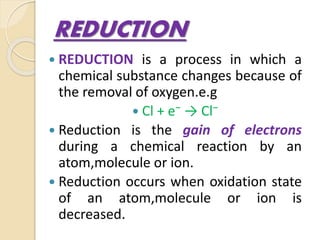
REDUCTION
 REDUCTION is a process in which a
chemical substance changes because of
the removal of oxygen.e.g
 Cl + e⁻ → Cl⁻
 Reduction is the gain of electrons
during a chemical reaction by an
atom,molecule or ion.
 Reduction occurs when oxidation state
of an atom,molecule or ion is
decreased.
REDUCING REAGENTS
 A reducing reagent is a substance
that has the ability to reduce other
substances.
 The reagents lose electrons and are
oxidized in a chemical reaction.
 In organic chemistry Reduction
specifically refers to addition of
hydrogen to a molecule.
 Basically in a chemical reaction
reducing reagent is that one
having more no. of electrons
comparitively to other reactant
which it can donate and oxidizes
itself.
GOOD REDUCING AGENTS
 Good reducing agents are those having
low electronegetivity and comparitively
low ionization energies.
 An atom with a relatively large atomic
radius tends to be a better reductant.
EXAMPLE
 Zn + Cu²ᶧ→ Zn²ᶧ + Cu
 Reduction Half Reaction:
Cu²ᶧ→ Cu
Copper ion is gaining electrons so is reduced
to copper metal.
 Oxidation State: is changed from +2 → 0
Hence Cu is oxidizing agent.
Oxidation Half Reaction:
Zn → Zn²ᶧ
Zinc metal is losing electrons and is oxidized
to zinc ion.
 Oxidation State: is changed from 0 → +2
Hence Zn is reducing agent.
SOME COMMON REDUCING
REAGENTS
 Sodium amalgam (Na(Hg))
 Zinc amalgam(Zn(Hg)) used in Clemmensen
reduction.
 Sulfite compounds
 Sodium lead alloy (Na+Pb)
 Hydrazine used in Wolff-kishner reduction.
 Dithiothreitol (DTT) used to avoid S-S bonds.
 Cyanides
 TCEP
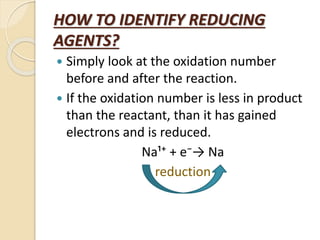
HOW TO IDENTIFY REDUCING
AGENTS?
 Simply look at the oxidation number
before and after the reaction.
 If the oxidation number is less in product
than the reactant, than it has gained
electrons and is reduced.
Na¹⁺ + e⁻→ Na
reduction
REDUCING REAGENTS IN
PERIODIC TABLE
 Oxidizing reagents are electron donors.
Elements which readily donate electrons
to achieve a full shell and become
positive ions.
 Such elements comprise those on the
extreme left of the periodic table.
Elements of group I and II will be
reducing agents.
 Such as Na, K, Rb, Ca, Mg, Ba are
reducing agents.
ELECTRON DONORS
 Electron donors participate in electron
transfer reactions. So in this sense
reducing reagents are also known as
electron donors.
 A well known reducing agent is
ferrocyanide [Fe(CN)₆]⁴⁻. It oxidizes or
donates an electron to form
ferricyanide[Fe(CN)₆]ᶟ⁻.
ATOM TRANSFER REAGENTS
 In common usage reducing reagents transfer
hydrogen atoms to a substrate. So in this relation
they can be termed as hydrogenation reagents or
hydrogen atom transfers.
 EXAMPLES:
LiAlH₄
Lindlar catalyst
NaBH₄
DIBAL-H
Formic acid (HCOOH)
Ascorbic acid(C₆H₈O₆)
APPLICATIONS OF REDUCING
REAGENTS
 IN INDUSTRIES:
 The principle industrial reducing agents
are carbon and hydrogen.
Hydrogen is used in smaller scale
metallurgical processes and in cases
where a metal might react with carbon.
E.g tungsten metal is produced by
passing a stream of H₂ over the oxide of
tungsten at 1200°C.
 EXTRACTION OF METALS:
 Carbon is used extensively in large scale
metallurgical operations.
 By using a suitable reducing agent, metal
oxides can be reduced to metals. E.g Fe₂O₃ is
reduced to iron in the blast furnace using
coke as reducing agent.
Fe₂O₃ + 3C → 2Fe + 3CO
Iron oxide Iron
Here happens the removal of
oxygen(reduction).
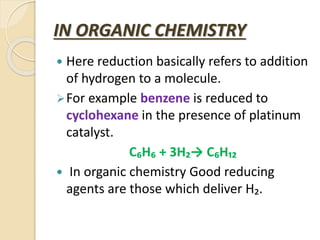
IN ORGANIC CHEMISTRY
 Here reduction basically refers to addition
of hydrogen to a molecule.
For example benzene is reduced to
cyclohexane in the presence of platinum
catalyst.
C₆H₆ + 3H₂→ C₆H₁₂
 In organic chemistry Good reducing
agents are those which deliver H₂.
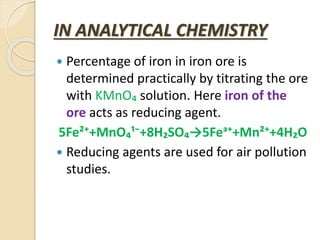
IN ANALYTICAL CHEMISTRY
 Percentage of iron in iron ore is
determined practically by titrating the ore
with KMnO₄ solution. Here iron of the
ore acts as reducing agent.
5Fe²⁺+MnO₄¹⁻+8H₂SO₄→5Feᶟ⁺+Mn²⁺+4H₂O
 Reducing agents are used for air pollution
studies.
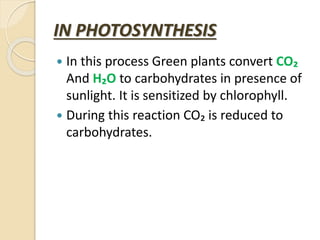
IN PHOTOSYNTHESIS
 In this process Green plants convert CO₂
And H₂O to carbohydrates in presence of
sunlight. It is sensitized by chlorophyll.
 During this reaction CO₂ is reduced to
carbohydrates.
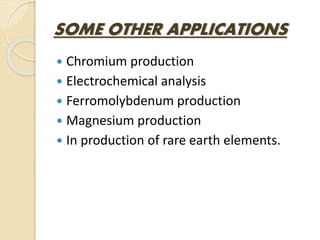
SOME OTHER APPLICATIONS
 Chromium production
 Electrochemical analysis
 Ferromolybdenum production
 Magnesium production
 In production of rare earth elements.
REDUCTION AND REDUCING AGENTS

REDUCTION AND REDUCING AGENTS

  • 1.
  • 2.
  • 3.
    REDUCTION  REDUCTION isa process in which a chemical substance changes because of the removal of oxygen.e.g  Cl + e⁻ → Cl⁻  Reduction is the gain of electrons during a chemical reaction by an atom,molecule or ion.  Reduction occurs when oxidation state of an atom,molecule or ion is decreased.
  • 4.
    REDUCING REAGENTS  Areducing reagent is a substance that has the ability to reduce other substances.  The reagents lose electrons and are oxidized in a chemical reaction.  In organic chemistry Reduction specifically refers to addition of hydrogen to a molecule.
  • 5.
     Basically ina chemical reaction reducing reagent is that one having more no. of electrons comparitively to other reactant which it can donate and oxidizes itself.
  • 6.
    GOOD REDUCING AGENTS Good reducing agents are those having low electronegetivity and comparitively low ionization energies.  An atom with a relatively large atomic radius tends to be a better reductant.
  • 7.
    EXAMPLE  Zn +Cu²ᶧ→ Zn²ᶧ + Cu  Reduction Half Reaction: Cu²ᶧ→ Cu Copper ion is gaining electrons so is reduced to copper metal.  Oxidation State: is changed from +2 → 0 Hence Cu is oxidizing agent.
  • 8.
    Oxidation Half Reaction: Zn→ Zn²ᶧ Zinc metal is losing electrons and is oxidized to zinc ion.  Oxidation State: is changed from 0 → +2 Hence Zn is reducing agent.
  • 9.
    SOME COMMON REDUCING REAGENTS Sodium amalgam (Na(Hg))  Zinc amalgam(Zn(Hg)) used in Clemmensen reduction.  Sulfite compounds  Sodium lead alloy (Na+Pb)  Hydrazine used in Wolff-kishner reduction.  Dithiothreitol (DTT) used to avoid S-S bonds.  Cyanides  TCEP
  • 10.
    HOW TO IDENTIFYREDUCING AGENTS?  Simply look at the oxidation number before and after the reaction.  If the oxidation number is less in product than the reactant, than it has gained electrons and is reduced. Na¹⁺ + e⁻→ Na reduction
  • 11.
    REDUCING REAGENTS IN PERIODICTABLE  Oxidizing reagents are electron donors. Elements which readily donate electrons to achieve a full shell and become positive ions.  Such elements comprise those on the extreme left of the periodic table. Elements of group I and II will be reducing agents.  Such as Na, K, Rb, Ca, Mg, Ba are reducing agents.
  • 12.
    ELECTRON DONORS  Electrondonors participate in electron transfer reactions. So in this sense reducing reagents are also known as electron donors.  A well known reducing agent is ferrocyanide [Fe(CN)₆]⁴⁻. It oxidizes or donates an electron to form ferricyanide[Fe(CN)₆]ᶟ⁻.
  • 13.
    ATOM TRANSFER REAGENTS In common usage reducing reagents transfer hydrogen atoms to a substrate. So in this relation they can be termed as hydrogenation reagents or hydrogen atom transfers.  EXAMPLES: LiAlH₄ Lindlar catalyst NaBH₄ DIBAL-H Formic acid (HCOOH) Ascorbic acid(C₆H₈O₆)
  • 14.
    APPLICATIONS OF REDUCING REAGENTS IN INDUSTRIES:  The principle industrial reducing agents are carbon and hydrogen. Hydrogen is used in smaller scale metallurgical processes and in cases where a metal might react with carbon. E.g tungsten metal is produced by passing a stream of H₂ over the oxide of tungsten at 1200°C.
  • 15.
     EXTRACTION OFMETALS:  Carbon is used extensively in large scale metallurgical operations.  By using a suitable reducing agent, metal oxides can be reduced to metals. E.g Fe₂O₃ is reduced to iron in the blast furnace using coke as reducing agent. Fe₂O₃ + 3C → 2Fe + 3CO Iron oxide Iron Here happens the removal of oxygen(reduction).
  • 16.
    IN ORGANIC CHEMISTRY Here reduction basically refers to addition of hydrogen to a molecule. For example benzene is reduced to cyclohexane in the presence of platinum catalyst. C₆H₆ + 3H₂→ C₆H₁₂  In organic chemistry Good reducing agents are those which deliver H₂.
  • 17.
    IN ANALYTICAL CHEMISTRY Percentage of iron in iron ore is determined practically by titrating the ore with KMnO₄ solution. Here iron of the ore acts as reducing agent. 5Fe²⁺+MnO₄¹⁻+8H₂SO₄→5Feᶟ⁺+Mn²⁺+4H₂O  Reducing agents are used for air pollution studies.
  • 18.
    IN PHOTOSYNTHESIS  Inthis process Green plants convert CO₂ And H₂O to carbohydrates in presence of sunlight. It is sensitized by chlorophyll.  During this reaction CO₂ is reduced to carbohydrates.
  • 19.
    SOME OTHER APPLICATIONS Chromium production  Electrochemical analysis  Ferromolybdenum production  Magnesium production  In production of rare earth elements.