Halogens and Interhalogens
Dr. Mithil Fal Desai
Shree Mallikarjun and Shri Chetan Manju Desai College Canacona
Goa
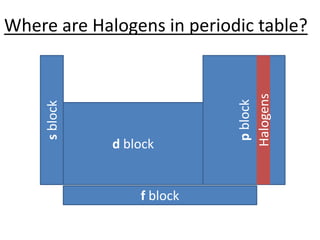
s
block
d block
p
block
Halogens
f block
Where are Halogens in periodic table?
Atomic
number
Halogen Symbol Electronic
configuration
9 Fluorine F [He]2s22p5
17 Chlorine Cl [Ne]3s23p5
35 Bromine Br [Ar] 3d104s24p5
53 Iodine I [Kr] 4d105s25p5
85 Astatine At [Xe] 4f145d106s26p5
Halogens
Halogen Electronic
configuration
Oxidation state
F [He]2s22p5 -1, 0
Cl [Ne]3s23p5 -1, 0, +1, +3, +4, +5, +6, +7
Br [Ar] 3d104s24p5 -1, 0, +1, +3, +4, +5, +6
I [Kr] 4d105s25p5 -1, 0, +1, +3, +5, +7
Oxidation state
Most common and stable oxidation state among halogen is -1
as after acquiring one electron they get their octet complete.
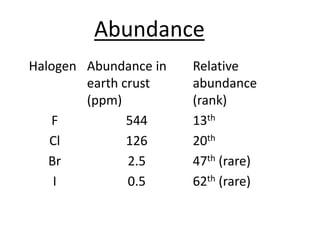
Halogen Abundance in
earth crust
(ppm)
Relative
abundance
(rank)
F 544 13th
Cl 126 20th
Br 2.5 47th (rare)
I 0.5 62th (rare)
Abundance
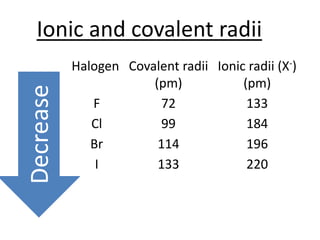
Halogen Covalent radii
(pm)
Ionic radii (X-)
(pm)
F 72 133
Cl 99 184
Br 114 196
I 133 220
Ionic and covalent radii
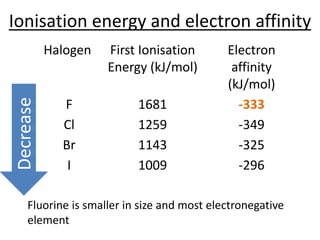
Decrease
Halogen First Ionisation
Energy (kJ/mol)
Electron
affinity
(kJ/mol)
F 1681 -333
Cl 1259 -349
Br 1143 -325
I 1009 -296
Ionisation energy and electron affinity
Decrease
Fluorine is smaller in size and most electronegative
element
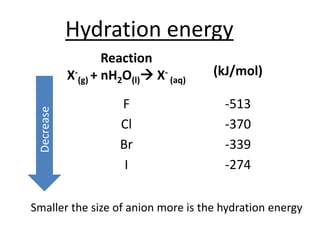
Reaction
X-
(g) + nH2O(l) X-
(aq)
(kJ/mol)
F -513
Cl -370
Br -339
I -274
Hydration energy
Decrease
Smaller the size of anion more is the hydration energy
Reaction
X-
(g) + nH2O(l) X-
(aq)
(kJ/mol)
F -513
Cl -370
Br -339
I -274
Hydration energy
Decrease
Smaller the size of anion more is the hydration energy
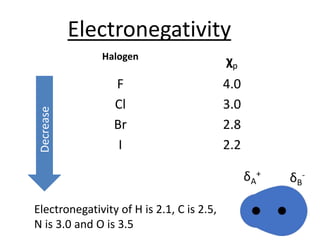
Halogen
χp
F 4.0
Cl 3.0
Br 2.8
I 2.2
Electronegativity
Decrease
Electronegativity of H is 2.1, C is 2.5,
N is 3.0 and O is 3.5
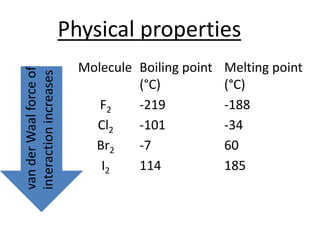
van
der
Waal
force
of
interaction
increases
Molecule Boiling point
(°C)
Melting point
(°C)
F2 -219 -188
Cl2 -101 -34
Br2 -7 60
I2 114 185
Physical properties
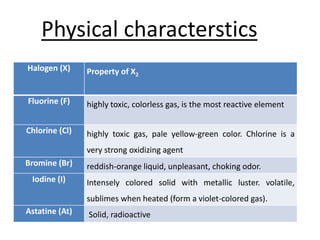
Physical characterstics
Halogen (X) Property of X2
Fluorine (F) highly toxic, colorless gas, is the most reactive element
Chlorine (Cl) highly toxic gas, pale yellow-green color. Chlorine is a
very strong oxidizing agent
Bromine (Br) reddish-orange liquid, unpleasant, choking odor.
Iodine (I) Intensely colored solid with metallic luster. volatile,
sublimes when heated (form a violet-colored gas).
Astatine (At) Solid, radioactive
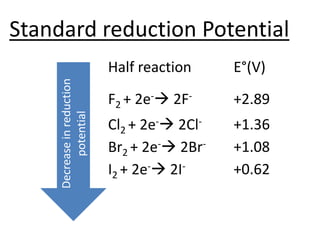
Half reaction E°(V)
F2 + 2e- 2F- +2.89
Cl2 + 2e- 2Cl- +1.36
Br2 + 2e- 2Br- +1.08
I2 + 2e- 2I- +0.62
Standard reduction Potential
Decrease
in
reduction
potential

Halogens

  • 1.
    Halogens and Interhalogens Dr.Mithil Fal Desai Shree Mallikarjun and Shri Chetan Manju Desai College Canacona Goa
  • 2.
    s block d block p block Halogens f block Whereare Halogens in periodic table?
  • 3.
    Atomic number Halogen Symbol Electronic configuration 9Fluorine F [He]2s22p5 17 Chlorine Cl [Ne]3s23p5 35 Bromine Br [Ar] 3d104s24p5 53 Iodine I [Kr] 4d105s25p5 85 Astatine At [Xe] 4f145d106s26p5 Halogens
  • 4.
    Halogen Electronic configuration Oxidation state F[He]2s22p5 -1, 0 Cl [Ne]3s23p5 -1, 0, +1, +3, +4, +5, +6, +7 Br [Ar] 3d104s24p5 -1, 0, +1, +3, +4, +5, +6 I [Kr] 4d105s25p5 -1, 0, +1, +3, +5, +7 Oxidation state Most common and stable oxidation state among halogen is -1 as after acquiring one electron they get their octet complete.
  • 5.
    Halogen Abundance in earthcrust (ppm) Relative abundance (rank) F 544 13th Cl 126 20th Br 2.5 47th (rare) I 0.5 62th (rare) Abundance
  • 6.
    Halogen Covalent radii (pm) Ionicradii (X-) (pm) F 72 133 Cl 99 184 Br 114 196 I 133 220 Ionic and covalent radii Decrease
  • 7.
    Halogen First Ionisation Energy(kJ/mol) Electron affinity (kJ/mol) F 1681 -333 Cl 1259 -349 Br 1143 -325 I 1009 -296 Ionisation energy and electron affinity Decrease Fluorine is smaller in size and most electronegative element
  • 8.
    Reaction X- (g) + nH2O(l)X- (aq) (kJ/mol) F -513 Cl -370 Br -339 I -274 Hydration energy Decrease Smaller the size of anion more is the hydration energy
  • 9.
    Reaction X- (g) + nH2O(l)X- (aq) (kJ/mol) F -513 Cl -370 Br -339 I -274 Hydration energy Decrease Smaller the size of anion more is the hydration energy
  • 10.
    Halogen χp F 4.0 Cl 3.0 Br2.8 I 2.2 Electronegativity Decrease Electronegativity of H is 2.1, C is 2.5, N is 3.0 and O is 3.5
  • 11.
    van der Waal force of interaction increases Molecule Boiling point (°C) Meltingpoint (°C) F2 -219 -188 Cl2 -101 -34 Br2 -7 60 I2 114 185 Physical properties
  • 12.
    Physical characterstics Halogen (X)Property of X2 Fluorine (F) highly toxic, colorless gas, is the most reactive element Chlorine (Cl) highly toxic gas, pale yellow-green color. Chlorine is a very strong oxidizing agent Bromine (Br) reddish-orange liquid, unpleasant, choking odor. Iodine (I) Intensely colored solid with metallic luster. volatile, sublimes when heated (form a violet-colored gas). Astatine (At) Solid, radioactive
  • 13.
    Half reaction E°(V) F2+ 2e- 2F- +2.89 Cl2 + 2e- 2Cl- +1.36 Br2 + 2e- 2Br- +1.08 I2 + 2e- 2I- +0.62 Standard reduction Potential Decrease in reduction potential