BY:
CRAIG HORTALEZA
PHOTOGRAPHER
“YOUR LIKE
DENTURES, I
CAN’T SMILE
WITHOUT YOU

PHOTOJOURNALISM
• Is about capturing the human experience and making your own art; not just
capturing the creations of others.
• Is a particular form of journalism (the collecting, editing, and presenting of
news material for publication or broadcast) that creates images in order to
tell a news story.
• It is telling a story with images and visuals rather than with words.
• It is providing information, while conveying the truth to give insight to the
viewer.
ELEMENTS OF PHOTOJOURNALISM
 Timeliness
 The images have meaning in the context of a recently published record of
events
 Objectivity
 The situation implied by the images is a fair and accurate representation
of the events they depict in both content and tone.
 Narrative
 The images combine with other news elements to make facts relatable to
the viewer or reader on a cultural level.
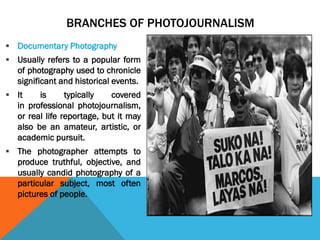
BRANCHES OF PHOTOJOURNALISM
 Documentary Photography
 Usually refers to a popular form
of photography used to chronicle
significant and historical events.
 It is typically covered
in professional photojournalism,
or real life reportage, but it may
also be an amateur, artistic, or
academic pursuit.
 The photographer attempts to
produce truthful, objective, and
usually candid photography of a
particular subject, most often
pictures of people.
BRANCHES OF PHOTOJOURNALISM
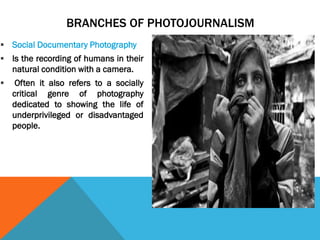
 Social Documentary Photography
 Is the recording of humans in their
natural condition with a camera.
 Often it also refers to a socially
critical genre of photography
dedicated to showing the life of
underprivileged or disadvantaged
people.
BRANCHES OF PHOTOJOURNALISM
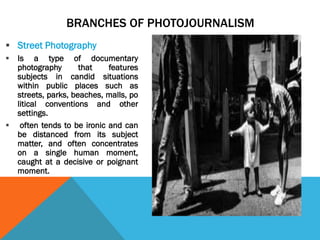
 Street Photography
 Is a type of documentary
photography that features
subjects in candid situations
within public places such as
streets, parks, beaches, malls, po
litical conventions and other
settings.
 often tends to be ironic and can
be distanced from its subject
matter, and often concentrates
on a single human moment,
caught at a decisive or poignant
moment.
BRANCHES OF PHOTOJOURNALISM
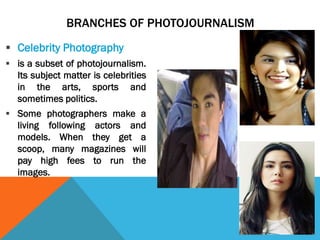
 Celebrity Photography
 is a subset of photojournalism.
Its subject matter is celebrities
in the arts, sports and
sometimes politics.
 Some photographers make a
living following actors and
models. When they get a
scoop, many magazines will
pay high fees to run the
images.
PHOTOJOURNALIST
• A journalist tells stories. A photographer takes pictures of nouns (people,
places and things). A photojournalist takes the best of both and locks it into
the most powerful medium available.
• Photojournalists capture "verbs." They hunt them, shoot them and show
them to their readers. Then, they hunt more.
• A photojournalist has thousands of pairs of eyes looking over his shoulder
constantly and should be answer these key questions:
• What are they doing?
• What do they see?
• What Happened?
PHOTOJOURNALIST
• A photojournalist is a visual reporter of facts. The public places trust in its
reporters to tell the truth. The same trust is extended to photojournalists as
visual reporters.
• The photojournalist constantly hunts for the images (or verbs), which tell of
the day-to-day struggles and accomplishments of his community.
• These occurrences happen naturally. There is no need to "set up" reality.
There is no need to lie to a community that bestows its trust.
• The photojournalist's concern is his community even if that means
sacrificing comfort or life.
PHOTOJOURNALIST
• A photojournalist is a servant (like a waitress or a sanitation worker). They're
expected to be on the job around the clock to serve the public.
• Photojournalists are role models. They don't want to be, but they are.
TIPS
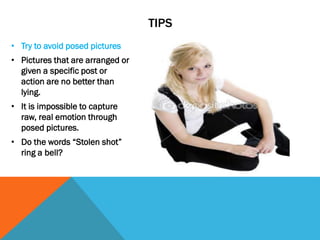
• Try to avoid posed pictures
• Pictures that are arranged or
given a specific post or
action are no better than
lying.
• It is impossible to capture
raw, real emotion through
posed pictures.
• Do the words “Stolen shot”
ring a bell?
TIPS
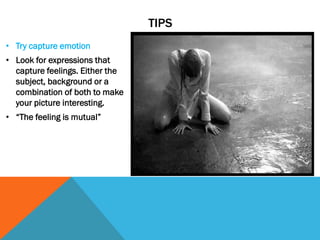
• Try capture emotion
• Look for expressions that
capture feelings. Either the
subject, background or a
combination of both to make
your picture interesting.
• “The feeling is mutual”
TIPS
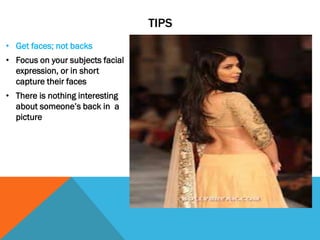
• Get faces; not backs
• Focus on your subjects facial
expression, or in short
capture their faces
• There is nothing interesting
about someone’s back in a
picture
TIPS
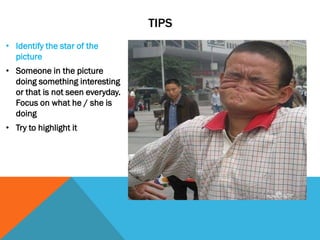
• Identify the star of the
picture
• Someone in the picture
doing something interesting
or that is not seen everyday.
Focus on what he / she is
doing
• Try to highlight it
TIPS
• Get up close
• Pictures from too far away
loose focus and clarity
• As the song say “I wanna get
close to you”
TIPS
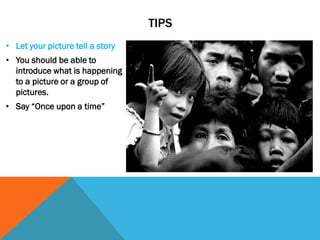
• Let your picture tell a story
• You should be able to
introduce what is happening
to a picture or a group of
pictures.
• Say “Once upon a time”
TIPS
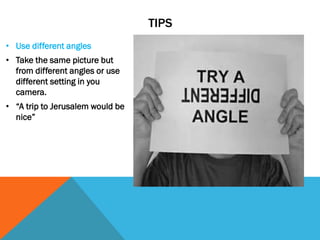
• Use different angles
• Take the same picture but
from different angles or use
different setting in you
camera.
• “A trip to Jerusalem would be
nice”
TIPS
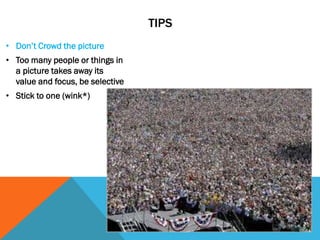
• Don’t Crowd the picture
• Too many people or things in
a picture takes away its
value and focus, be selective
• Stick to one (wink*)
TIPS
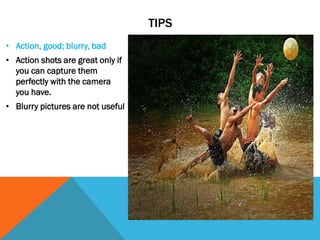
• Action, good; blurry, bad
• Action shots are great only if
you can capture them
perfectly with the camera
you have.
• Blurry pictures are not useful
TIPS
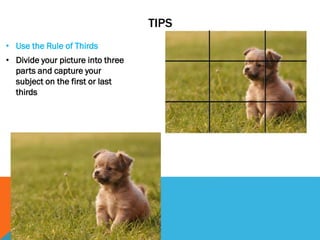
• Use the Rule of Thirds
• Divide your picture into three
parts and capture your
subject on the first or last
thirds
TIPS
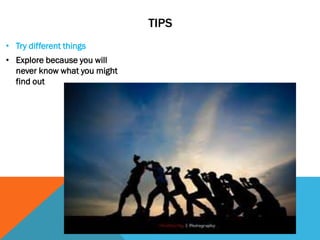
• Try different things
• Explore because you will
never know what you might
find out
PHOTOJOURNALIST
 Photojournalists have a moral responsibility to decide what pictures to take,
what picture to stage, and what pictures to show the public. A lot of
controversy arises when deciding which photographs are too violent to
show the public.
• Other issues involving photojournalism include the right to privacy and the
compensation of the news subject. The person’s right to privacy is
sometimes not addressed or the picture is printed without their knowledge
or consent.
PHOTOJOURNALIST
 Photojournalism affords an opportunity to serve the public that is equalled
by few other vocations and all members of the profession should strive by
example and influence to maintain high standards of ethical conduct.
• It is the individual responsibility of every photojournalist at all times to strive
for pictures that report truthfully, honestly and objectively
• It is the duty of every photojournalist to work to preserve all freedom-of-the-
press rights recognized by law and to work to protect and expand freedom-
of-access to all sources of news and visual information
A PICTURE IS WORTH A
THOUSAND WORDS
SO JUST KEEP ON
SHOOTING AND LET THE
PICTURES DO THE TALKING


Photojournalism

  • 1.
  • 2.
    PHOTOJOURNALISM • Is aboutcapturing the human experience and making your own art; not just capturing the creations of others. • Is a particular form of journalism (the collecting, editing, and presenting of news material for publication or broadcast) that creates images in order to tell a news story. • It is telling a story with images and visuals rather than with words. • It is providing information, while conveying the truth to give insight to the viewer.
  • 3.
    ELEMENTS OF PHOTOJOURNALISM Timeliness  The images have meaning in the context of a recently published record of events  Objectivity  The situation implied by the images is a fair and accurate representation of the events they depict in both content and tone.  Narrative  The images combine with other news elements to make facts relatable to the viewer or reader on a cultural level.
  • 4.
    BRANCHES OF PHOTOJOURNALISM Documentary Photography  Usually refers to a popular form of photography used to chronicle significant and historical events.  It is typically covered in professional photojournalism, or real life reportage, but it may also be an amateur, artistic, or academic pursuit.  The photographer attempts to produce truthful, objective, and usually candid photography of a particular subject, most often pictures of people.
  • 5.
    BRANCHES OF PHOTOJOURNALISM Social Documentary Photography  Is the recording of humans in their natural condition with a camera.  Often it also refers to a socially critical genre of photography dedicated to showing the life of underprivileged or disadvantaged people.
  • 6.
    BRANCHES OF PHOTOJOURNALISM Street Photography  Is a type of documentary photography that features subjects in candid situations within public places such as streets, parks, beaches, malls, po litical conventions and other settings.  often tends to be ironic and can be distanced from its subject matter, and often concentrates on a single human moment, caught at a decisive or poignant moment.
  • 7.
    BRANCHES OF PHOTOJOURNALISM Celebrity Photography  is a subset of photojournalism. Its subject matter is celebrities in the arts, sports and sometimes politics.  Some photographers make a living following actors and models. When they get a scoop, many magazines will pay high fees to run the images.
  • 9.
    PHOTOJOURNALIST • A journalisttells stories. A photographer takes pictures of nouns (people, places and things). A photojournalist takes the best of both and locks it into the most powerful medium available. • Photojournalists capture "verbs." They hunt them, shoot them and show them to their readers. Then, they hunt more. • A photojournalist has thousands of pairs of eyes looking over his shoulder constantly and should be answer these key questions: • What are they doing? • What do they see? • What Happened?
  • 10.
    PHOTOJOURNALIST • A photojournalistis a visual reporter of facts. The public places trust in its reporters to tell the truth. The same trust is extended to photojournalists as visual reporters. • The photojournalist constantly hunts for the images (or verbs), which tell of the day-to-day struggles and accomplishments of his community. • These occurrences happen naturally. There is no need to "set up" reality. There is no need to lie to a community that bestows its trust. • The photojournalist's concern is his community even if that means sacrificing comfort or life.
  • 11.
    PHOTOJOURNALIST • A photojournalistis a servant (like a waitress or a sanitation worker). They're expected to be on the job around the clock to serve the public. • Photojournalists are role models. They don't want to be, but they are.
  • 13.
    TIPS • Try toavoid posed pictures • Pictures that are arranged or given a specific post or action are no better than lying. • It is impossible to capture raw, real emotion through posed pictures. • Do the words “Stolen shot” ring a bell?
  • 14.
    TIPS • Try captureemotion • Look for expressions that capture feelings. Either the subject, background or a combination of both to make your picture interesting. • “The feeling is mutual”
  • 15.
    TIPS • Get faces;not backs • Focus on your subjects facial expression, or in short capture their faces • There is nothing interesting about someone’s back in a picture
  • 16.
    TIPS • Identify thestar of the picture • Someone in the picture doing something interesting or that is not seen everyday. Focus on what he / she is doing • Try to highlight it
  • 17.
    TIPS • Get upclose • Pictures from too far away loose focus and clarity • As the song say “I wanna get close to you”
  • 18.
    TIPS • Let yourpicture tell a story • You should be able to introduce what is happening to a picture or a group of pictures. • Say “Once upon a time”
  • 19.
    TIPS • Use differentangles • Take the same picture but from different angles or use different setting in you camera. • “A trip to Jerusalem would be nice”
  • 20.
    TIPS • Don’t Crowdthe picture • Too many people or things in a picture takes away its value and focus, be selective • Stick to one (wink*)
  • 21.
    TIPS • Action, good;blurry, bad • Action shots are great only if you can capture them perfectly with the camera you have. • Blurry pictures are not useful
  • 22.
    TIPS • Use theRule of Thirds • Divide your picture into three parts and capture your subject on the first or last thirds
  • 23.
    TIPS • Try differentthings • Explore because you will never know what you might find out
  • 25.
    PHOTOJOURNALIST  Photojournalists havea moral responsibility to decide what pictures to take, what picture to stage, and what pictures to show the public. A lot of controversy arises when deciding which photographs are too violent to show the public. • Other issues involving photojournalism include the right to privacy and the compensation of the news subject. The person’s right to privacy is sometimes not addressed or the picture is printed without their knowledge or consent.
  • 26.
    PHOTOJOURNALIST  Photojournalism affordsan opportunity to serve the public that is equalled by few other vocations and all members of the profession should strive by example and influence to maintain high standards of ethical conduct. • It is the individual responsibility of every photojournalist at all times to strive for pictures that report truthfully, honestly and objectively • It is the duty of every photojournalist to work to preserve all freedom-of-the- press rights recognized by law and to work to protect and expand freedom- of-access to all sources of news and visual information
  • 27.
    A PICTURE ISWORTH A THOUSAND WORDS SO JUST KEEP ON SHOOTING AND LET THE PICTURES DO THE TALKING 