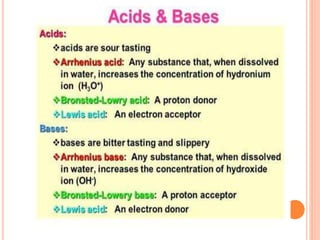
Dr. Satish S. Kola
(Assistant professor )
Department of chemistry
M.G. Arts, Science and Late N.P. Commerce
College Armori
Hard & Soft Acids and Bases
(HSAB)
HARD & SOFT ACIDS AND BASES
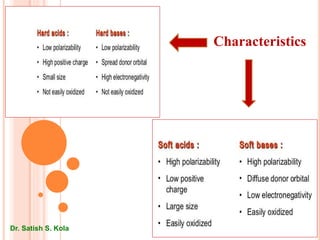
 Characteristics of hard acids:
 The hard acids are cations with small size.
 Wherever different oxidation states are possible the hard acids
are cations of higher oxidation states.
 The hard acids do not possess large number of valence
electrons.
 Absence of d-electrons.
 Characteristics of soft acids:
 The soft acids have cations of large size.
 The cations have usually zero or low oxidation states.
 The soft acids have usually large number of valence electrons.
 With nearly full d-electron.
Dr. Satish S. Kola
Hard Acids Soft Acids
1) Small size 1) Large size
2) High positive oxidation state. 2) Zero or low positive oxidation state
3) Absence of any outer electrons Whichare easily
excited to higher States.
3) Presence of several excitable valenceshell
electrons.
4) Absence of d-electrons. 4) With nearly full d-electrons.
5) Usually light metal ions. 5) Mostly heavy metal ions.
6) Know as Lewis acids which Are not easily
polarizable Prefer to coordinate withhard
6) Known as Lewis acids and are easilypolarizable.
Prefer to coordinate with soft bases.
Dr. Satish S. Kola
Characteristics
Dr. Satish S. Kola
Dr. Satish S. Kola
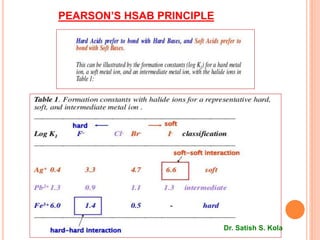
PEARSON’S HSAB PRINCIPLE
Dr. Satish S. Kola
Dr. Satish S. Kola
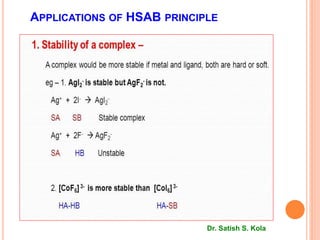
APPLICATIONS OF HSAB PRINCIPLE
Dr. Satish S. Kola
2. Prediction of coordination in complexes of ambidentate ligands-
The HSAB principle can also predict the formation of various metal ion
complexes with ambidentate ligands. An ambidentate ligands is a mono
dentate ligand which can coordinate to metal ion through more than one
coordinating atoms e.g SCN- ion is an ambidentate ligands as it can
coordinate through N or S.
Dr. Satish S. Kola
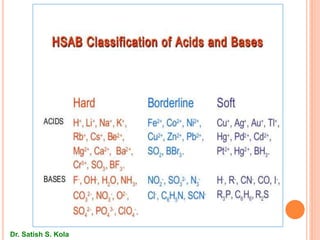
3. Classification of Acids and bases
The acids and bases can be classified as hard and soft
depending upon their preference for hard or soft
reactants .
Dr. Satish S. Kola
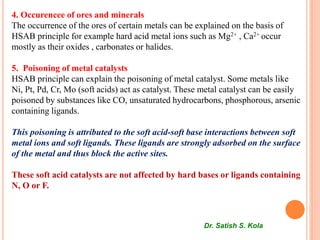
4. Occurencee of ores and minerals
The occurrence of the ores of certain metals can be explained on the basis of
HSAB principle for example hard acid metal ions such as Mg2+ , Ca2+ occur
mostly as their oxides , carbonates or halides.
5. Poisoning of metal catalysts
HSAB principle can explain the poisoning of metal catalyst. Some metals like
Ni, Pt, Pd, Cr, Mo (soft acids) act as catalyst. These metal catalyst can be easily
poisoned by substances like CO, unsaturated hydrocarbons, phosphorous, arsenic
containing ligands.
This poisoning is attributed to the soft acid-soft base interactions between soft
metal ions and soft ligands. These ligands are strongly adsorbed on the surface
of the metal and thus block the active sites.
These soft acid catalysts are not affected by hard bases or ligands containing
N, O or F.
Dr. Satish S. Kola
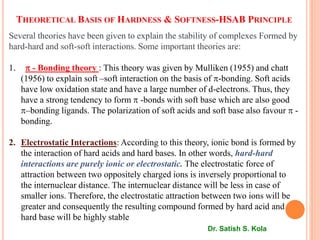
THEORETICAL BASIS OF HARDNESS & SOFTNESS-HSAB PRINCIPLE
Several theories have been given to explain the stability of complexes Formed by
hard-hard and soft-soft interactions. Some important theories are:
1.  - Bonding theory : This theory was given by Mulliken (1955) and chatt
(1956) to explain soft –soft interaction on the basis of -bonding. Soft acids
have low oxidation state and have a large number of d-electrons. Thus, they
have a strong tendency to form  -bonds with soft base which are also good
–bonding ligands. The polarization of soft acids and soft base also favour  -
bonding.
2. Electrostatic Interactions: According to this theory, ionic bond is formed by
the interaction of hard acids and hard bases. In other words, hard-hard
interactions are purely ionic or electrostatic. The electrostatic force of
attraction between two oppositely charged ions is inversely proportional to
the internuclear distance. The internuclear distance will be less in case of
smaller ions. Therefore, the electrostatic attraction between two ions will be
greater and consequently the resulting compound formed by hard acid and
hard base will be highly stable
Dr. Satish S. Kola
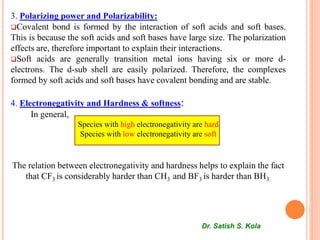
3. Polarizing power and Polarizability:
Covalent bond is formed by the interaction of soft acids and soft bases.
This is because the soft acids and soft bases have large size. The polarization
effects are, therefore important to explain their interactions.
Soft acids are generally transition metal ions having six or more d-
electrons. The d-sub shell are easily polarized. Therefore, the complexes
formed by soft acids and soft bases have covalent bonding and are stable.
4. Electronegativity and Hardness & softness:
In general,
Species with high electronegativity are hard
Species with low electronegativity are soft
The relation between electronegativity and hardness helps to explain the fact
that CF3 is considerably harder than CH3 and BF3 is harder than BH3.
Dr. Satish S. Kola
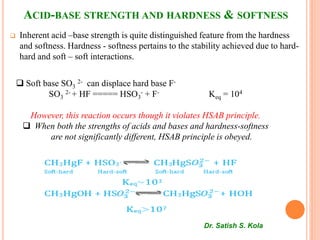
ACID-BASE STRENGTH AND HARDNESS & SOFTNESS
 Inherent acid –base strength is quite distinguished feature from the hardness
and softness. Hardness - softness pertains to the stability achieved due to hard-
hard and soft – soft interactions.
 Soft base SO3
2- can displace hard base F-
SO3
2- + HF ===== HSO3
- + F- Keq = 104
However, this reaction occurs though it violates HSAB principle.
 When both the strengths of acids and bases and hardness-softness
are not significantly different, HSAB principle is obeyed.
Dr. Satish S. Kola
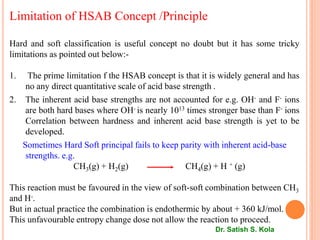
Limitation of HSAB Concept /Principle
Hard and soft classification is useful concept no doubt but it has some tricky
limitations as pointed out below:-
1. The prime limitation f the HSAB concept is that it is widely general and has
no any direct quantitative scale of acid base strength .
2. The inherent acid base strengths are not accounted for e.g. OH- and F- ions
are both hard bases where OH- is nearly 1013 times stronger base than F- ions
Correlation between hardness and inherent acid base strength is yet to be
developed.
Sometimes Hard Soft principal fails to keep parity with inherent acid-base
strengths. e.g.
CH3(g) + H2(g) CH4(g) + H + (g)
This reaction must be favoured in the view of soft-soft combination between CH3
and H-.
But in actual practice the combination is endothermic by about + 360 kJ/mol.
This unfavourable entropy change dose not allow the reaction to proceed.
Dr. Satish S. Kola
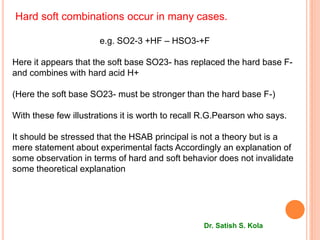
Hard soft combinations occur in many cases.
e.g. SO2-3 +HF – HSO3-+F
Here it appears that the soft base SO23- has replaced the hard base F-
and combines with hard acid H+
(Here the soft base SO23- must be stronger than the hard base F-)
With these few illustrations it is worth to recall R.G.Pearson who says.
It should be stressed that the HSAB principal is not a theory but is a
mere statement about experimental facts Accordingly an explanation of
some observation in terms of hard and soft behavior does not invalidate
some theoretical explanation
Dr. Satish S. Kola
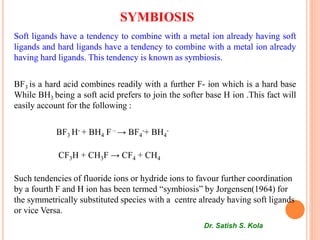
SYMBIOSIS
Soft ligands have a tendency to combine with a metal ion already having soft
ligands and hard ligands have a tendency to combine with a metal ion already
having hard ligands. This tendency is known as symbiosis.
BF3 is a hard acid combines readily with a further F- ion which is a hard base
While BH3 being a soft acid prefers to join the softer base H ion .This fact will
easily account for the following :
BF3 H- + BH4 F – → BF4
-+ BH4
-
CF3H + CH3F → CF4 + CH4
Such tendencies of fluoride ions or hydride ions to favour further coordination
by a fourth F and H ion has been termed “symbiosis” by Jorgensen(1964) for
the symmetrically substituted species with a centre already having soft ligands
or vice Versa.
Dr. Satish S. Kola
ELECTRONEGATIVITY AND HARDNESS & SOFTNESS
 The most important atomic property which helps in classifying hard
and soft acids and bases is the electronegativity.
 It may be noted that in this electronegativity does not mean the power of
an atom in a molecule to attract electrons towards itself but it refers also
to the power of an individual ion participating in a reaction.
 For example lithium has low electronegativity, Li+ has relatively high
tendency to attract electrons toward itself, and therefore, it has high
electronegativity. This is because of extremely high second ionisation
potential. Consequently, Li+ is hard acid.
 On the other hand, transition metal ions in low oxidation state such as
Cu+ , Hg+ , Ag+ , Cd2+ etc have relatively high second ionisation energies
and therefore have low value of electronegativity. Therefore, they are
considered as soft acids. The same way we can consider hard and soft
bases.
Dr. Satish S. Kola

Hard-Soft-Acids-and-Bases-HSAB.pptx

  • 1.
    Dr. Satish S.Kola (Assistant professor ) Department of chemistry M.G. Arts, Science and Late N.P. Commerce College Armori Hard & Soft Acids and Bases (HSAB)
  • 3.
    HARD & SOFTACIDS AND BASES  Characteristics of hard acids:  The hard acids are cations with small size.  Wherever different oxidation states are possible the hard acids are cations of higher oxidation states.  The hard acids do not possess large number of valence electrons.  Absence of d-electrons.  Characteristics of soft acids:  The soft acids have cations of large size.  The cations have usually zero or low oxidation states.  The soft acids have usually large number of valence electrons.  With nearly full d-electron. Dr. Satish S. Kola
  • 4.
    Hard Acids SoftAcids 1) Small size 1) Large size 2) High positive oxidation state. 2) Zero or low positive oxidation state 3) Absence of any outer electrons Whichare easily excited to higher States. 3) Presence of several excitable valenceshell electrons. 4) Absence of d-electrons. 4) With nearly full d-electrons. 5) Usually light metal ions. 5) Mostly heavy metal ions. 6) Know as Lewis acids which Are not easily polarizable Prefer to coordinate withhard 6) Known as Lewis acids and are easilypolarizable. Prefer to coordinate with soft bases. Dr. Satish S. Kola
  • 5.
  • 6.
  • 7.
  • 8.
  • 9.
    APPLICATIONS OF HSABPRINCIPLE Dr. Satish S. Kola
  • 10.
    2. Prediction ofcoordination in complexes of ambidentate ligands- The HSAB principle can also predict the formation of various metal ion complexes with ambidentate ligands. An ambidentate ligands is a mono dentate ligand which can coordinate to metal ion through more than one coordinating atoms e.g SCN- ion is an ambidentate ligands as it can coordinate through N or S. Dr. Satish S. Kola
  • 11.
    3. Classification ofAcids and bases The acids and bases can be classified as hard and soft depending upon their preference for hard or soft reactants . Dr. Satish S. Kola
  • 12.
    4. Occurencee ofores and minerals The occurrence of the ores of certain metals can be explained on the basis of HSAB principle for example hard acid metal ions such as Mg2+ , Ca2+ occur mostly as their oxides , carbonates or halides. 5. Poisoning of metal catalysts HSAB principle can explain the poisoning of metal catalyst. Some metals like Ni, Pt, Pd, Cr, Mo (soft acids) act as catalyst. These metal catalyst can be easily poisoned by substances like CO, unsaturated hydrocarbons, phosphorous, arsenic containing ligands. This poisoning is attributed to the soft acid-soft base interactions between soft metal ions and soft ligands. These ligands are strongly adsorbed on the surface of the metal and thus block the active sites. These soft acid catalysts are not affected by hard bases or ligands containing N, O or F. Dr. Satish S. Kola
  • 13.
    THEORETICAL BASIS OFHARDNESS & SOFTNESS-HSAB PRINCIPLE Several theories have been given to explain the stability of complexes Formed by hard-hard and soft-soft interactions. Some important theories are: 1.  - Bonding theory : This theory was given by Mulliken (1955) and chatt (1956) to explain soft –soft interaction on the basis of -bonding. Soft acids have low oxidation state and have a large number of d-electrons. Thus, they have a strong tendency to form  -bonds with soft base which are also good –bonding ligands. The polarization of soft acids and soft base also favour  - bonding. 2. Electrostatic Interactions: According to this theory, ionic bond is formed by the interaction of hard acids and hard bases. In other words, hard-hard interactions are purely ionic or electrostatic. The electrostatic force of attraction between two oppositely charged ions is inversely proportional to the internuclear distance. The internuclear distance will be less in case of smaller ions. Therefore, the electrostatic attraction between two ions will be greater and consequently the resulting compound formed by hard acid and hard base will be highly stable Dr. Satish S. Kola
  • 14.
    3. Polarizing powerand Polarizability: Covalent bond is formed by the interaction of soft acids and soft bases. This is because the soft acids and soft bases have large size. The polarization effects are, therefore important to explain their interactions. Soft acids are generally transition metal ions having six or more d- electrons. The d-sub shell are easily polarized. Therefore, the complexes formed by soft acids and soft bases have covalent bonding and are stable. 4. Electronegativity and Hardness & softness: In general, Species with high electronegativity are hard Species with low electronegativity are soft The relation between electronegativity and hardness helps to explain the fact that CF3 is considerably harder than CH3 and BF3 is harder than BH3. Dr. Satish S. Kola
  • 15.
    ACID-BASE STRENGTH ANDHARDNESS & SOFTNESS  Inherent acid –base strength is quite distinguished feature from the hardness and softness. Hardness - softness pertains to the stability achieved due to hard- hard and soft – soft interactions.  Soft base SO3 2- can displace hard base F- SO3 2- + HF ===== HSO3 - + F- Keq = 104 However, this reaction occurs though it violates HSAB principle.  When both the strengths of acids and bases and hardness-softness are not significantly different, HSAB principle is obeyed. Dr. Satish S. Kola
  • 16.
    Limitation of HSABConcept /Principle Hard and soft classification is useful concept no doubt but it has some tricky limitations as pointed out below:- 1. The prime limitation f the HSAB concept is that it is widely general and has no any direct quantitative scale of acid base strength . 2. The inherent acid base strengths are not accounted for e.g. OH- and F- ions are both hard bases where OH- is nearly 1013 times stronger base than F- ions Correlation between hardness and inherent acid base strength is yet to be developed. Sometimes Hard Soft principal fails to keep parity with inherent acid-base strengths. e.g. CH3(g) + H2(g) CH4(g) + H + (g) This reaction must be favoured in the view of soft-soft combination between CH3 and H-. But in actual practice the combination is endothermic by about + 360 kJ/mol. This unfavourable entropy change dose not allow the reaction to proceed. Dr. Satish S. Kola
  • 17.
    Hard soft combinationsoccur in many cases. e.g. SO2-3 +HF – HSO3-+F Here it appears that the soft base SO23- has replaced the hard base F- and combines with hard acid H+ (Here the soft base SO23- must be stronger than the hard base F-) With these few illustrations it is worth to recall R.G.Pearson who says. It should be stressed that the HSAB principal is not a theory but is a mere statement about experimental facts Accordingly an explanation of some observation in terms of hard and soft behavior does not invalidate some theoretical explanation Dr. Satish S. Kola
  • 18.
    SYMBIOSIS Soft ligands havea tendency to combine with a metal ion already having soft ligands and hard ligands have a tendency to combine with a metal ion already having hard ligands. This tendency is known as symbiosis. BF3 is a hard acid combines readily with a further F- ion which is a hard base While BH3 being a soft acid prefers to join the softer base H ion .This fact will easily account for the following : BF3 H- + BH4 F – → BF4 -+ BH4 - CF3H + CH3F → CF4 + CH4 Such tendencies of fluoride ions or hydride ions to favour further coordination by a fourth F and H ion has been termed “symbiosis” by Jorgensen(1964) for the symmetrically substituted species with a centre already having soft ligands or vice Versa. Dr. Satish S. Kola
  • 19.
    ELECTRONEGATIVITY AND HARDNESS& SOFTNESS  The most important atomic property which helps in classifying hard and soft acids and bases is the electronegativity.  It may be noted that in this electronegativity does not mean the power of an atom in a molecule to attract electrons towards itself but it refers also to the power of an individual ion participating in a reaction.  For example lithium has low electronegativity, Li+ has relatively high tendency to attract electrons toward itself, and therefore, it has high electronegativity. This is because of extremely high second ionisation potential. Consequently, Li+ is hard acid.  On the other hand, transition metal ions in low oxidation state such as Cu+ , Hg+ , Ag+ , Cd2+ etc have relatively high second ionisation energies and therefore have low value of electronegativity. Therefore, they are considered as soft acids. The same way we can consider hard and soft bases. Dr. Satish S. Kola