Defination
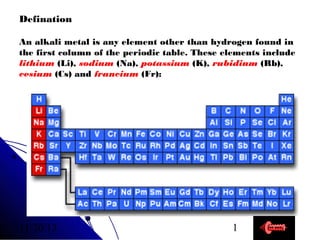
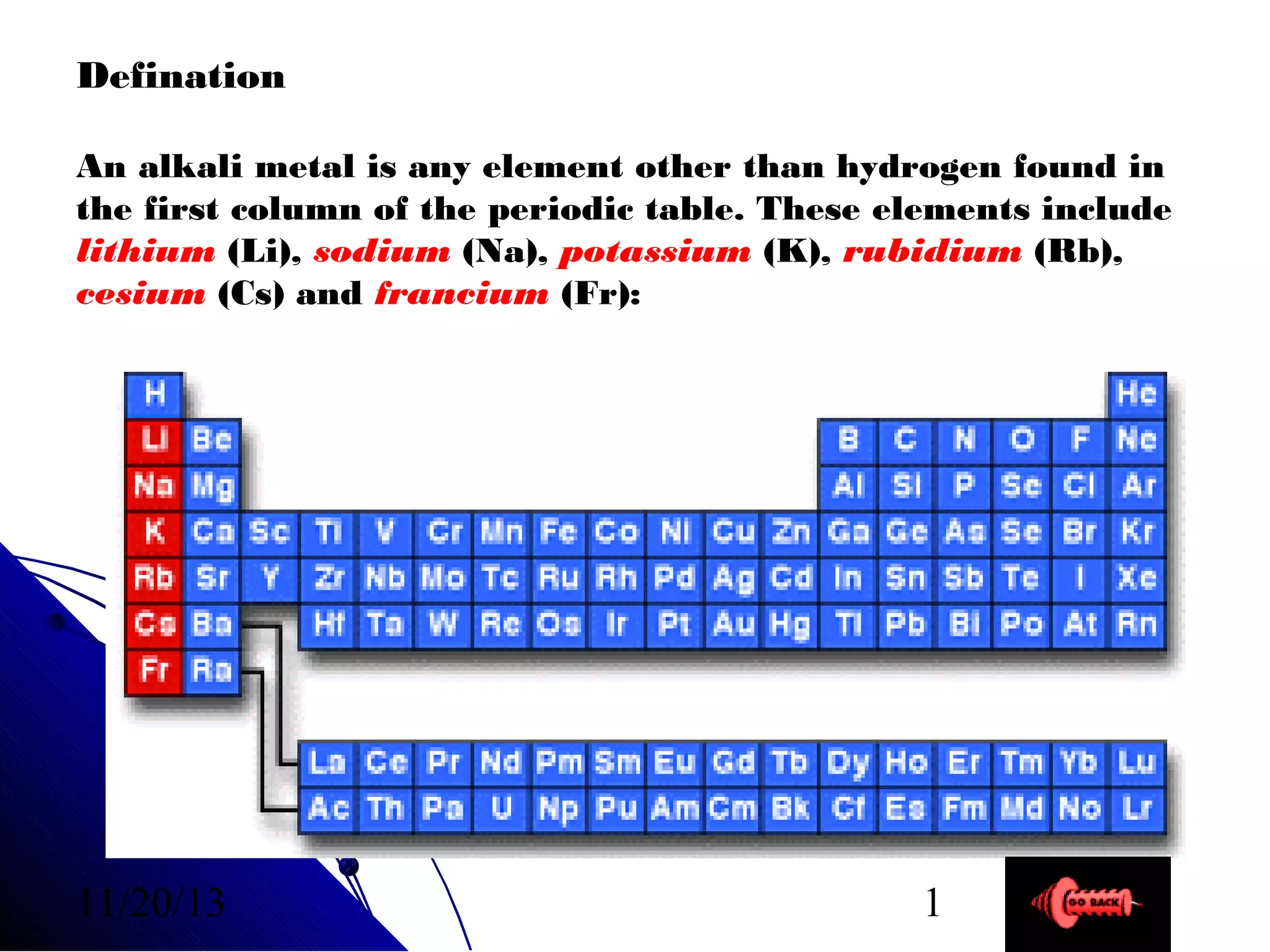
An alkali metal is any element other than hydrogen found in
the first column of the periodic table. These elements include
lithium (Li), sodium (Na), potassium (K), rubidium (Rb),
cesium (Cs) and francium (Fr):

11/20/13

1
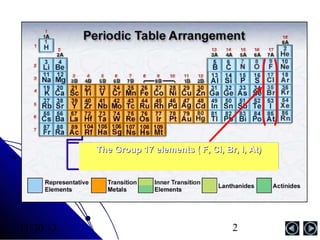
The Group 17 elements ( F, Cl, Br, I, At)

11/20/13

2
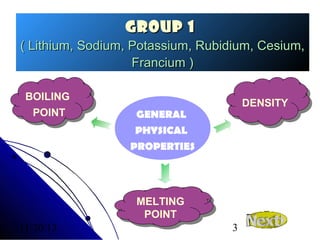
GROUP 1
( Lithium, Sodium, Potassium, Rubidium, Cesium,
Francium )
BOILING
BOILING
POINT
POINT

11/20/13

DENSITY
DENSITY

GENERAL
PHYSICAL
PROPERTIES

MELTING
MELTING
POINT
POINT

3
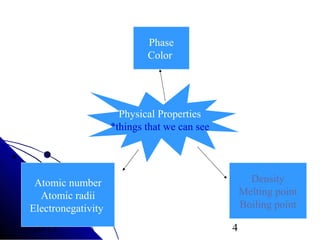
Phase
Color

Physical Properties
*things that we can see

Density
Melting point
Boiling point

Atomic number
Atomic radii
Electronegativity
11/20/13

4
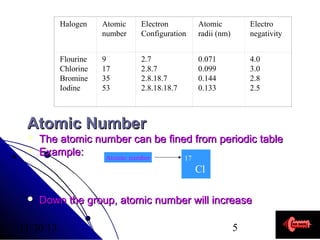
Halogen

Atomic
number

Electron
Configuration

Atomic
radii (nm)

Electro
negativity

Flourine
Chlorine
Bromine
Iodine

9
17
35
53

2.7
2.8.7
2.8.18.7
2.8.18.18.7

0.071
0.099
0.144
0.133

4.0
3.0
2.8
2.5

Atomic Number



The atomic number can be fined from periodic table
Example:
Atomic number
17
Cl



Down the group, atomic number will increase

11/20/13

5
Atomic radii or Atomic Size







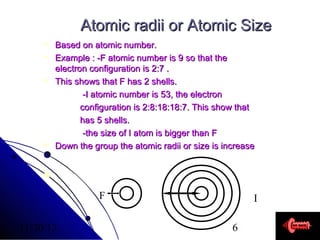
Based on atomic number.
Example : -F atomic number is 9 so that the
electron configuration is 2:7 .
This shows that F has 2 shells.
-I atomic number is 53, the electron
configuration is 2:8:18:18:7. This show that
has 5 shells.
-the size of I atom is bigger than F
Down the group the atomic radii or size is increase


F
11/20/13

I
6
Electronegativity
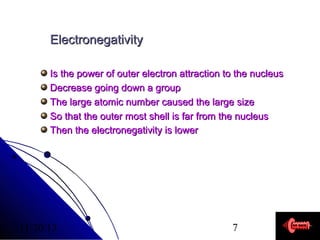
Is the power of outer electron attraction to the nucleus
Decrease going down a group
The large atomic number caused the large size
So that the outer most shell is far from the nucleus
Then the electronegativity is lower

11/20/13

7
Density
 Has

lower density
 But density is increase when going down
the group

Melting and Boiling Point.
 Has

lower melting and boiling point
 Because of the lower Van der Waals
force between the molecule.
 But the melting and boiling point
increase when going down the group.
 Parallel to the density of each elements .
11/20/13

8
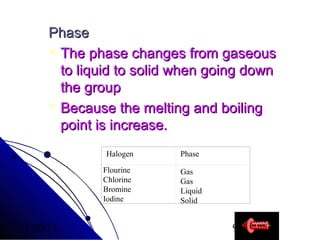
Phase
 The phase changes from gaseous
to liquid to solid when going down
the group
 Because the melting and boiling
point is increase.
Halogen
Flourine
Chlorine
Bromine
Iodine

11/20/13

Phase
Gas
Gas
Liquid
Solid

9
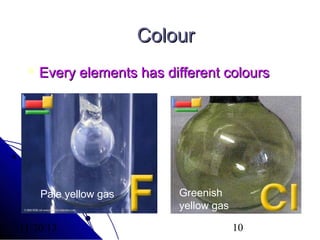
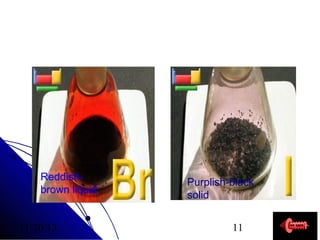
Colour
 Every

elements has different colours

Pale yellow gas
11/20/13

Greenish
yellow gas
10
Reddishbrown liquid
11/20/13

Purplish-black
solid
11
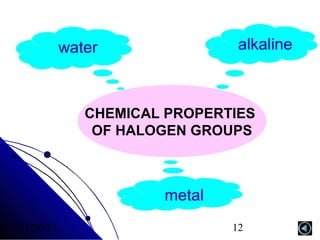
alkaline

water

CHEMICAL PROPERTIES
OF HALOGEN GROUPS

metal
11/20/13

12
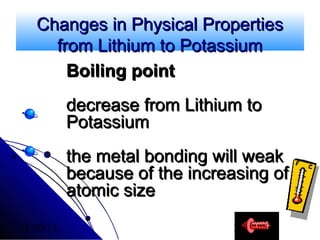
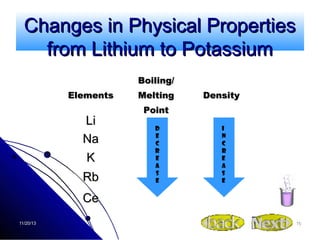
Changes in Physical Properties
from Lithium to Potassium
Boiling point
decrease from Lithium to
Potassium
the metal bonding will weak
because of the increasing of
atomic size
11/20/13

13
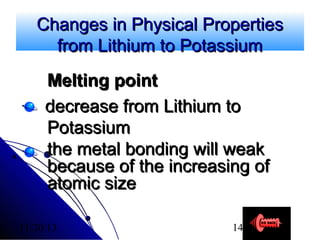
Changes in Physical Properties
from Lithium Potassium
from Lithium toto Kalium
Melting point
decrease from Lithium to
Potassium
the metal bonding will weak
because of the increasing of
atomic size
11/20/13

14
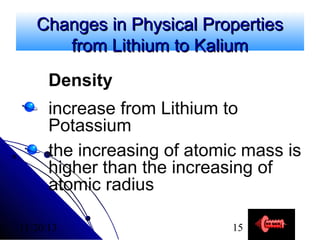
Changes in Physical Properties
from Lithium to Kalium
Density
increase from Lithium to
Potassium
the increasing of atomic mass is
higher than the increasing of
atomic radius
11/20/13

15
Changes in Physical Properties
from Lithium to Potassium
Boiling/
Elements

Li
Na
K
Rb

Melting

Density

Point
D
e
c
r
e
a
s
e

I
n
c
r
e
a
s
e

Ce
11/20/13

16
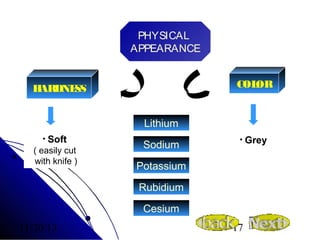
PHYSICAL
APPEARANCE
COL
OR

H DNE
AR
SS
Lithium
• Soft

( easily cut
with knife )

Sodium

• Grey

Potassium
Rubidium
Cesium

11/20/13

17
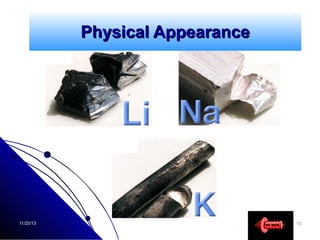
Physical Appearance

11/20/13

18
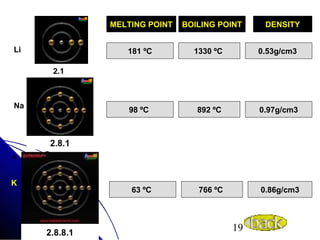
MELTING POINT
Li

BOILING POINT

DENSITY

181 ºC

1330 ºC

0.53g/cm3

98 ºC

892 ºC

0.97g/cm3

766 ºC

0.86g/cm3

2.1

Na

2.8.1

K

63 ºC

11/20/13
2.8.8.1

19
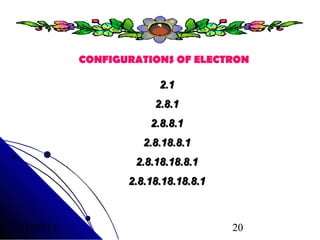
CONFIGURATIONS OF ELECTRON
2.1
2.8.1
2.8.8.1
2.8.18.8.1
2.8.18.18.8.1
2.8.18.18.18.8.1

11/20/13

20

4.3 (a) group 1