Halogens
Group VIIA
Properties in Common
★ six elements
★ all form diatomic molecules (H2, F2, Cl2, Br2, I2, and At2)
★ all form negatively charged ions (H-, F-, Cl-, Br-, I-, and At-
★ Astatine is ignored because it is radioactive
★ salt formers
★ none of the halogens can be found in nature in their elemental
form.
★ found as salts of the halide ions
The Halogens in their Elemental Form
Fluorine (F2)
❏ highly toxic, colorless gas, is the most reactive element known
❏ so reactive it even forms compounds with Kr, Xe, and Rn
❏ attacks both glass and quartz
❏ difficult to find a container in which it can be stored
❏ powerful oxidizing agent
❏ handled in equipment built out of certain alloys of copper and
nickel
❏ used in the manufacture of Teflon and freons
Chlorine (Cl2)
● highly toxic gas with a pale yellow-green color
● strong oxidizing agent
● used commercially as a bleaching agent and disinfectant
● used to make solvents such as:
1. carbon tetrachloride (CCl4),
2. chloroform (CHCl3),
3. dichloroethylene (C2H2Cl2), and
4. trichloroethylene (C2HCl3)
Bromine (Br2)
❏ reddish-orange liquid with an unpleasant, choking odor
❏ Name- Greek stem bromos, "stench."
❏ used to prepare flame retardants, fire-extinguishing agents,
sedatives, antiknock agents for gasoline, and insecticides.
Iodine
❏ intensely colored solid with an almost metallic luster
❏ relatively volatile, and it sublimes when heated to form a violet-colored
gas
❏ Used as disinfectant in "tincture of iodine."
❏ compounds are used as catalysts, drugs, and dyes
❏ Silver iodide (AgI) plays an important role in the photographic process
and in attempts to make rain by seeding clouds.
❏ Iodide is also added to salt to protect against goiter, an iodine deficiency
disease characterized by a swelling of the thyroid gland.
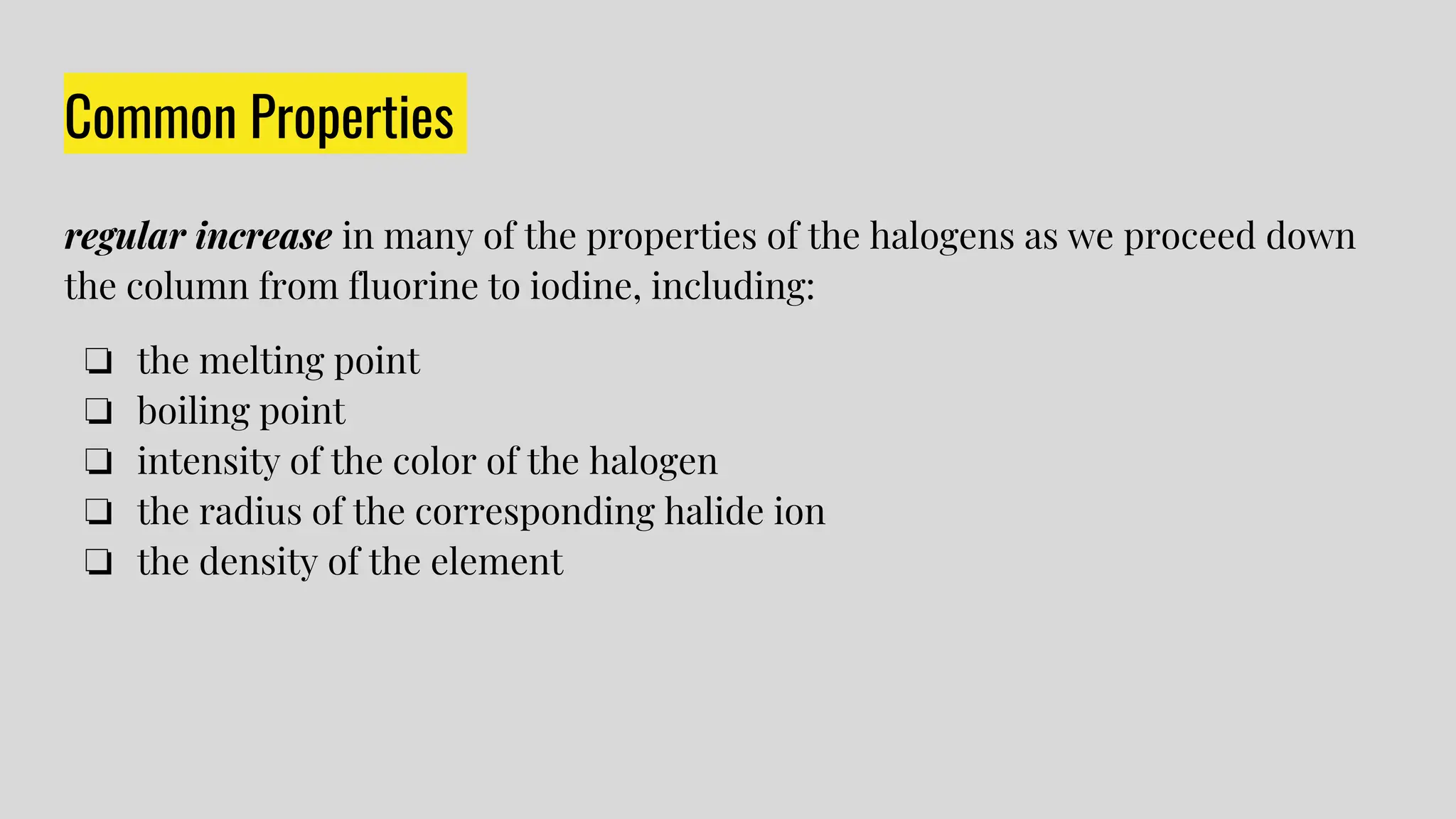
Common Properties
regular increase in many of the properties of the halogens as we proceed down
the column from fluorine to iodine, including:
❏ the melting point
❏ boiling point
❏ intensity of the color of the halogen
❏ the radius of the corresponding halide ion
❏ the density of the element
Common Properties
regular decrease in the first ionization energy as we go down this
column, therefore;
F2 > Cl2 > Br2 > I2
oxidizing strength
And
I- > Br- > Cl- > F-
reducing strength
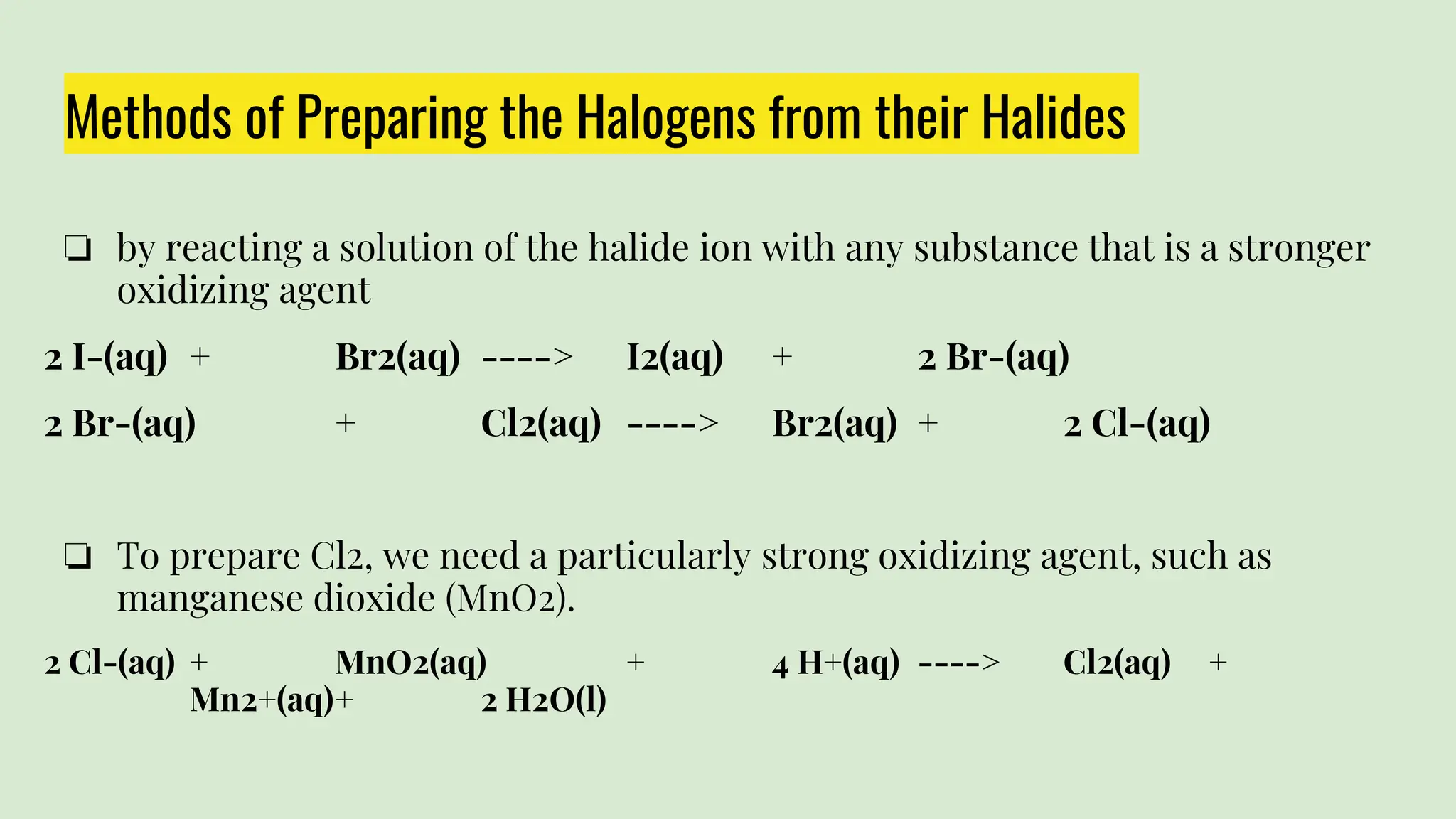
Methods of Preparing the Halogens from their Halides
❏ by reacting a solution of the halide ion with any substance that is a stronger
oxidizing agent
2 I-(aq) + Br2(aq) ----> I2(aq) + 2 Br-(aq)
2 Br-(aq) + Cl2(aq) ----> Br2(aq) + 2 Cl-(aq)
❏ To prepare Cl2, we need a particularly strong oxidizing agent, such as
manganese dioxide (MnO2).
2 Cl-(aq) + MnO2(aq) + 4 H+(aq) ----> Cl2(aq) +
Mn2+(aq)+ 2 H2O(l)
❏ The synthesis of fluorine escaped the efforts of chemists for almost 100
years.
❏ The best way of producing a strong reducing agent is to pass an electric
current through a salt of the metal. Sodium, for example, can be prepared by
the electrolysis of molten sodium chloride.
electrolysis
2 NaCl(l) ----> 2 Na(s) + Cl2(g)
❏ In theory, the same process can be used to generate strong oxidizing agents,
such as F2.
Halogens - Chemistry and Properties.pptx

Halogens - Chemistry and Properties.pptx

  • 1.
  • 2.
    Properties in Common ★six elements ★ all form diatomic molecules (H2, F2, Cl2, Br2, I2, and At2) ★ all form negatively charged ions (H-, F-, Cl-, Br-, I-, and At- ★ Astatine is ignored because it is radioactive ★ salt formers ★ none of the halogens can be found in nature in their elemental form. ★ found as salts of the halide ions
  • 3.
    The Halogens intheir Elemental Form Fluorine (F2) ❏ highly toxic, colorless gas, is the most reactive element known ❏ so reactive it even forms compounds with Kr, Xe, and Rn ❏ attacks both glass and quartz ❏ difficult to find a container in which it can be stored ❏ powerful oxidizing agent ❏ handled in equipment built out of certain alloys of copper and nickel ❏ used in the manufacture of Teflon and freons
  • 4.
    Chlorine (Cl2) ● highlytoxic gas with a pale yellow-green color ● strong oxidizing agent ● used commercially as a bleaching agent and disinfectant ● used to make solvents such as: 1. carbon tetrachloride (CCl4), 2. chloroform (CHCl3), 3. dichloroethylene (C2H2Cl2), and 4. trichloroethylene (C2HCl3)
  • 5.
    Bromine (Br2) ❏ reddish-orangeliquid with an unpleasant, choking odor ❏ Name- Greek stem bromos, "stench." ❏ used to prepare flame retardants, fire-extinguishing agents, sedatives, antiknock agents for gasoline, and insecticides.
  • 6.
    Iodine ❏ intensely coloredsolid with an almost metallic luster ❏ relatively volatile, and it sublimes when heated to form a violet-colored gas ❏ Used as disinfectant in "tincture of iodine." ❏ compounds are used as catalysts, drugs, and dyes ❏ Silver iodide (AgI) plays an important role in the photographic process and in attempts to make rain by seeding clouds. ❏ Iodide is also added to salt to protect against goiter, an iodine deficiency disease characterized by a swelling of the thyroid gland.
  • 7.
    Common Properties regular increasein many of the properties of the halogens as we proceed down the column from fluorine to iodine, including: ❏ the melting point ❏ boiling point ❏ intensity of the color of the halogen ❏ the radius of the corresponding halide ion ❏ the density of the element
  • 8.
    Common Properties regular decreasein the first ionization energy as we go down this column, therefore; F2 > Cl2 > Br2 > I2 oxidizing strength And I- > Br- > Cl- > F- reducing strength
  • 9.
    Methods of Preparingthe Halogens from their Halides ❏ by reacting a solution of the halide ion with any substance that is a stronger oxidizing agent 2 I-(aq) + Br2(aq) ----> I2(aq) + 2 Br-(aq) 2 Br-(aq) + Cl2(aq) ----> Br2(aq) + 2 Cl-(aq) ❏ To prepare Cl2, we need a particularly strong oxidizing agent, such as manganese dioxide (MnO2). 2 Cl-(aq) + MnO2(aq) + 4 H+(aq) ----> Cl2(aq) + Mn2+(aq)+ 2 H2O(l)
  • 10.
    ❏ The synthesisof fluorine escaped the efforts of chemists for almost 100 years. ❏ The best way of producing a strong reducing agent is to pass an electric current through a salt of the metal. Sodium, for example, can be prepared by the electrolysis of molten sodium chloride. electrolysis 2 NaCl(l) ----> 2 Na(s) + Cl2(g) ❏ In theory, the same process can be used to generate strong oxidizing agents, such as F2.