Probing the Dayside Magnetosphere:
Measurements by ACE soon after launch,
August 25, 1997
Travis Glines
Heather Briggs
Introduction
Launched on August 25, 1997
It crossed through:
the dayside magnetosphere
entered a region around the magnetosphere called the
magnetosheath (twice)
eventually crossed a weak bowshock into the
interplanetary medium exposed to the solar wind.
WIND was also making measurements.
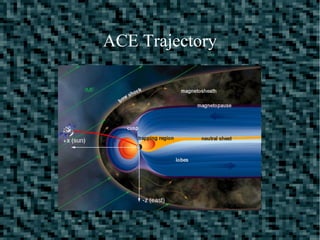
The three regions of Earth's dayside magnetosphere
encountered by ACE are defined by different magnetic
properties as observed by our data.
Normal Dipole
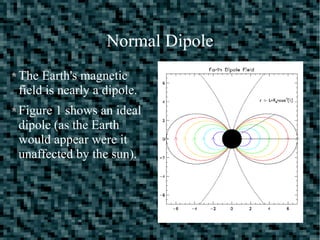
The Earth's magnetic
field is nearly a dipole.
Figure 1 shows an ideal
dipole (as the Earth
would appear were it
unaffected by the sun).
Dipole Formula
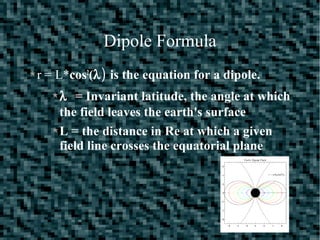
r = L*cos2
(λ) is the equation for a dipole.
λ = Invariant latitude, the angle at which
the field leaves the earth's surface
L = the distance in Re at which a given
field line crosses the equatorial plane
Solar Influence
ACE Trajectory
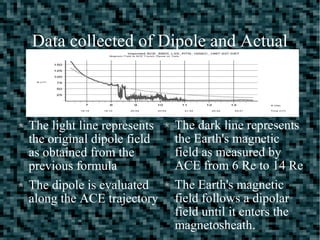
Data collected of Dipole and Actual
The light line represents
the original dipole field
as obtained from the
previous formula
The dipole is evaluated
along the ACE trajectory
The dark line represents
the Earth's magnetic
field as measured by
ACE from 6 Re to 14 Re
The Earth's magnetic
field follows a dipolar
field until it enters the
magnetosheath.
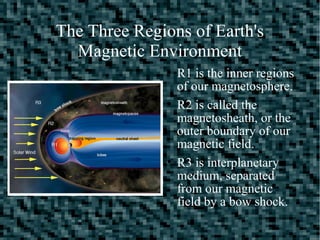
The Three Regions of Earth's
Magnetic Environment
●
R1 is the inner regions
of our magnetosphere.
●
R2 is called the
magnetosheath, or the
outer boundary of our
magnetic field.
●
R3 is interplanetary
medium, separated
from our magnetic
field by a bow shock.
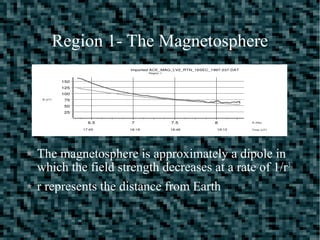
Region 1- The Magnetosphere
The magnetosphere is approximately a dipole in
which the field strength decreases at a rate of 1/r3
r represents the distance from Earth
Entering the Magnetosheath
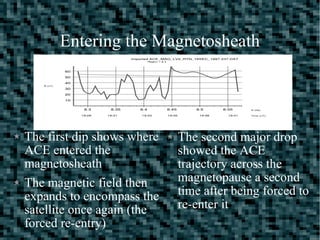
The first dip shows where
ACE entered the
magnetosheath
The magnetic field then
expands to encompass the
satellite once again (the
forced re-entry)
The second major drop
showed the ACE
trajectory across the
magnetopause a second
time after being forced to
re-enter it
WIND Data
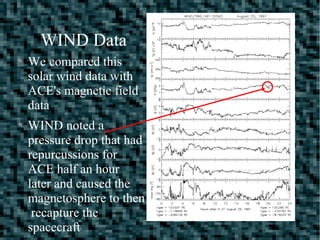
We compared this
solar wind data with
ACE's magnetic field
data
WIND noted a
pressure drop that had
repurcussions for
ACE half an hour
later and caused the
magnetosphere to then
recapture the
spacecraft
Region 2- The Magnetosheath
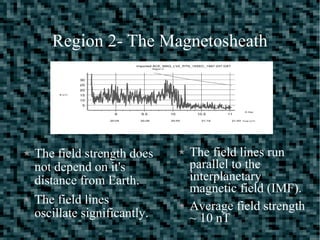
The field strength does
not depend on it's
distance from Earth.
The field lines
oscillate significantly.
The field lines run
parallel to the
interplanetary
magnetic field (IMF).
Average field strength
~ 10 nT
Region 3- Interplanetary Medium
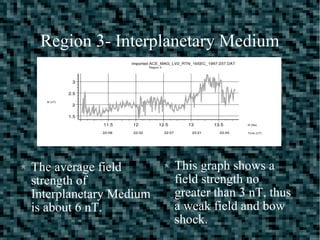
The average field
strength of
Interplanetary Medium
is about 6 nT.
This graph shows a
field strength no
greater than 3 nT, thus
a weak field and bow
shock.
Bow Shock
The bow shock is a boundary area where the
interplanetary wind slows down to subsonic
speeds
This shock is produced when the wind slows
down and is thus diverted around the Earth so it
does not hit us head on
Our graph shows a weak bow shock due most
likely to the unusually low magnetic field
strength of the solar wind
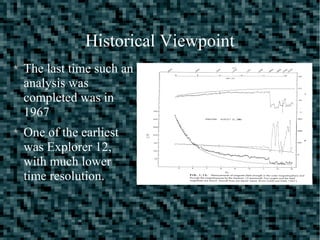
Historical Viewpoint
The last time such an
analysis was
completed was in
1967
One of the earliest
was Explorer 12,
with much lower
time resolution.
Conclusion
Through ACE's measurements, we have verified
that the three specific regions associated with the
magnetosphere have difinitive properties singular
to those areas
In correlation with data obtained by WIND, we
have observed the effect of the solar wind on the
magnetosphere and verified that it is a fluctuating
boundary that is affected greatly by solar and
interplanetary radiation.
THE END

Travis heather

  • 1.
    Probing the DaysideMagnetosphere: Measurements by ACE soon after launch, August 25, 1997 Travis Glines Heather Briggs
  • 2.
    Introduction Launched on August25, 1997 It crossed through: the dayside magnetosphere entered a region around the magnetosphere called the magnetosheath (twice) eventually crossed a weak bowshock into the interplanetary medium exposed to the solar wind. WIND was also making measurements. The three regions of Earth's dayside magnetosphere encountered by ACE are defined by different magnetic properties as observed by our data.
  • 3.
    Normal Dipole The Earth'smagnetic field is nearly a dipole. Figure 1 shows an ideal dipole (as the Earth would appear were it unaffected by the sun).
  • 4.
    Dipole Formula r =L*cos2 (λ) is the equation for a dipole. λ = Invariant latitude, the angle at which the field leaves the earth's surface L = the distance in Re at which a given field line crosses the equatorial plane
  • 5.
  • 6.
  • 7.
    Data collected ofDipole and Actual The light line represents the original dipole field as obtained from the previous formula The dipole is evaluated along the ACE trajectory The dark line represents the Earth's magnetic field as measured by ACE from 6 Re to 14 Re The Earth's magnetic field follows a dipolar field until it enters the magnetosheath.
  • 8.
    The Three Regionsof Earth's Magnetic Environment ● R1 is the inner regions of our magnetosphere. ● R2 is called the magnetosheath, or the outer boundary of our magnetic field. ● R3 is interplanetary medium, separated from our magnetic field by a bow shock.
  • 9.
    Region 1- TheMagnetosphere The magnetosphere is approximately a dipole in which the field strength decreases at a rate of 1/r3 r represents the distance from Earth
  • 10.
    Entering the Magnetosheath Thefirst dip shows where ACE entered the magnetosheath The magnetic field then expands to encompass the satellite once again (the forced re-entry) The second major drop showed the ACE trajectory across the magnetopause a second time after being forced to re-enter it
  • 11.
    WIND Data We comparedthis solar wind data with ACE's magnetic field data WIND noted a pressure drop that had repurcussions for ACE half an hour later and caused the magnetosphere to then recapture the spacecraft
  • 12.
    Region 2- TheMagnetosheath The field strength does not depend on it's distance from Earth. The field lines oscillate significantly. The field lines run parallel to the interplanetary magnetic field (IMF). Average field strength ~ 10 nT
  • 13.
    Region 3- InterplanetaryMedium The average field strength of Interplanetary Medium is about 6 nT. This graph shows a field strength no greater than 3 nT, thus a weak field and bow shock.
  • 14.
    Bow Shock The bowshock is a boundary area where the interplanetary wind slows down to subsonic speeds This shock is produced when the wind slows down and is thus diverted around the Earth so it does not hit us head on Our graph shows a weak bow shock due most likely to the unusually low magnetic field strength of the solar wind
  • 15.
    Historical Viewpoint The lasttime such an analysis was completed was in 1967 One of the earliest was Explorer 12, with much lower time resolution.
  • 16.
    Conclusion Through ACE's measurements,we have verified that the three specific regions associated with the magnetosphere have difinitive properties singular to those areas In correlation with data obtained by WIND, we have observed the effect of the solar wind on the magnetosphere and verified that it is a fluctuating boundary that is affected greatly by solar and interplanetary radiation.
  • 17.