GROUND WATER ENGINEERING(3360609)
PREPARED BY KEYUR J PANSARA
5.1 INTRODUCTION
Almost two thirds of the world's population lives within 400 km of the ocean
shoreline; just over half live within 200 km, an area only taking up 10% of the earth's
surface (Hinrichsen, 2007).
Most of these coastal regions rely on groundwater as their main source of fresh
water for domestic, industrial and agricultural purposes.
As the world's population continues to grow at an alarming rate, fresh water supplies
are constantly being depleted, bringing with it issues such as saltwater intrusion and
increasing the importance of groundwater monitoring, management, and
conservation.
Saltwater intrusion is a major concern commonly found in coastal aquifers around
the world.
The movement of saline water into a freshwater aquifer or surface reservoir is
known as saltwater intrusion and if the source of this saline water is sea water, then
this process is known as seawater intrusion. Freshwater is slightly less dense (lighter)
than saltwater, which tends it to float on top of the saltwater when both fluids are
present in an aquifer. The relationship based on the density difference between
saltwater and freshwater is used to estimate the depth to saltwater based on the
thickness of the freshwater zone above sea level. The relationship is known as the
Ghyben-Herzberg relation (Figure 1). In the coastal area of Bangladesh, hydro-
geological conditions vary considerably even within short distances. Ground water,
with gradient about 1:20000, flows from north to south having localised outflow into
rivers and ponds in dry season and inflow into the aquifer from surface water sources
in the rainy season. Transmissivities of the main aquifer in the coastal area ranges
from 250m2/day to 10000m2/day with an average value of 1000m2/day. The storage
capacity of the aquifer generally increases with depth with the increase in the size of
aquifer materials. The entire area is underlain by thick water bearing formations of
varying depths and the regional hydrogeology is very complex (Ahmed, 1996).
Shamsuddin (1986) observed that the salinity distributions in Khulna, Barisal and
Patuakhali regions were not in agreement with the Ghyben-Herzberg theory.
GROUND WATER ENGINEERING(3360609)
PREPARED BY KEYUR J PANSARA
5.2 CAUSE OF SALTWATER INTRUSION
 Rising of sea water level
sea level rise caused by global warming has become a root cause, pressure
from the increase in the quantity of saltwater that many will try to enter the
fresh water aquifer
 high consumption of fresh water
Excessive consumption of fresh water caused a shortage of freshwater in
that area and cause the waters invaded by salt water.
 oil drilling
Oil ring usually use oil pipeline under the ground to deliver oil from drilling
site to storage tanks on the beach, as the result and the more easy to salt
water to insult the freshwater.
 lack of rain
lack of rain causes replacement of fresh water consumption was slow
while the uses are increased.in this case it will reduce the amout of fresh water
in the ground and it will be replace by sea water.
 Agriculture
Agriculture is human activity that require lot amout of fresh water,it will
not suitable at area that near the sea.
 Pumping
Pumping of fresh water from an aquifer reduces the water pressure and
intensifies the effect, drawing salt water into new areas. When freshwater
levels drop, saltwater intrusion can proceed inland, reaching the pumped well
 Lack of knowledge
Human greed for money and lack of knowledge caused us to be blind to
the importance of to keep our only living place.
GROUND WATER ENGINEERING(3360609)
PREPARED BY KEYUR J PANSARA
5.3 ILL-effects of sea water intrusion
Pumping groundwater at a faster rate than it can be recharged can have some
negative effects of the environment and the people who make use of the
water:
Lowering of the water table
The most severe consequence of excessive groundwater pumping is that the
water table, below which the ground is saturated with water, can be lowered.
For water to be withdrawn from the ground, water must be pumped from a
well that reaches below the water table. If groundwater levels decline too far,
then the well owner might have to deepen the well, drill a new well, or, at
least, attempt to lower the pump. Also, as water levels decline, the rate of
water the well can yield may decline.
Increased costs for the user
As the depth to water increases, the water must be lifted higher to reach the
land surface. If pumps are used to lift the water (as opposed to artesian wells),
more energy is required to drive the pump. Using the well can become
prohibitively expensive.
Reduction of water in streams and lakes
There is more of an interaction between the water in lakes and rivers and
groundwater than most people think. Some, and often a great deal, of the
water flowing in rivers comes from seepage of groundwater into the
streambed. Groundwater contributes to streams in most physiographic and
climatic settings. The proportion of stream water that comes from
groundwater inflow varies according to a region's geography, geology, and
climate.
Groundwater pumping can alter how water moves between an aquifer and a
stream, lake, or wetland by either intercepting groundwater flow that
discharges into the surface-water body under natural conditions, or by
increasing the rate of water movement from the surface-water body into an
aquifer. A related effect of groundwater pumping is the lowering of
groundwater levels below the depth that streamside or wetland vegetation
GROUND WATER ENGINEERING(3360609)
PREPARED BY KEYUR J PANSARA
needs to survive. The overall effect is a loss of riparian vegetation and wildlife
habitat.
Land subsidence
The basic cause of land subsidence is a loss of support below ground. In other
words, sometimes when water is taken out of the soil, the soil collapses,
compacts, and drops. This depends on a number of factors, such as the type of
soil and rock below the surface. Land subsidence is most often caused by
human activities, mainly from the removal of subsurface water.
Deterioration of water quality
One water-quality threat to fresh groundwater supplies is contamination from
saltwater intrusion. All of the water in the ground is not fresh water; much of
the very deep groundwater and water below oceans is saline. In fact, an
estimated 3.1 million cubic miles (12.9 cubic kilometers) of saline groundwater
exists compared to about 2.6 million cubic miles (10.5 million cubic kilometers)
of fresh groundwater (Gleick, P. H., 1996: Water resources. In Encyclopedia of
Climate and Weather, ed. by S. H. Schneider, Oxford University Press, New
York, vol. 2, pp. 817-823). Under natural conditions the boundary between the
freshwater and saltwater tends to be relatively stable, but pumping can cause
saltwater to migrate inland and upward, resulting in saltwater contamination
of the water supply.
5.4 Mechanism of sea water intrusion
 Saltwater intrusion is the movement of saline water into freshwater aquifers.
 Most often, it is caused by ground-water pumping from coastal wells, or from
construction of navigation channels or oil field canals.
 Saltwater intrusion occurs in virtually all coastal aquifers, where they are
in hydraulic continuity with seawater.
GROUND WATER ENGINEERING(3360609)
PREPARED BY KEYUR J PANSARA
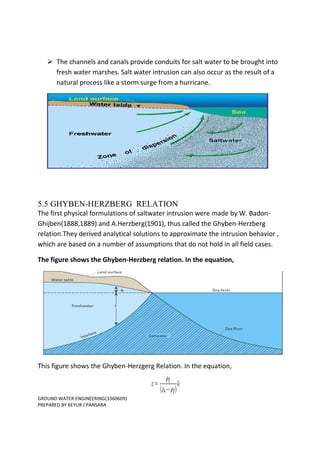
 The channels and canals provide conduits for salt water to be brought into
fresh water marshes. Salt water intrusion can also occur as the result of a
natural process like a storm surge from a hurricane.
5.5 GHYBEN-HERZBERG RELATION
The first physical formulations of saltwater intrusion were made by W. Badon-
Ghijben(1888,1889) and A.Herzberg(1901), thus called the Ghyben-Herzberg
relation.They derived analytical solutions to approximate the intrusion behavior ,
which are based on a number of assumptions that do not hold in all field cases.
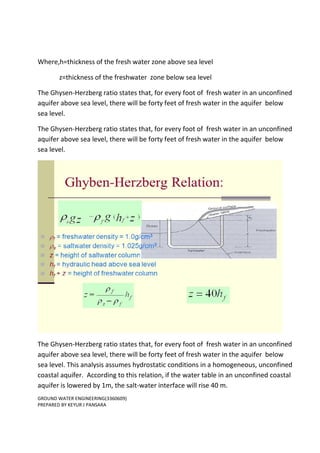
The figure shows the Ghyben-Herzberg relation. In the equation,
This figure shows the Ghyben-Herzgerg Relation. In the equation,
GROUND WATER ENGINEERING(3360609)
PREPARED BY KEYUR J PANSARA
Where,h=thickness of the fresh water zone above sea level
z=thickness of the freshwater zone below sea level
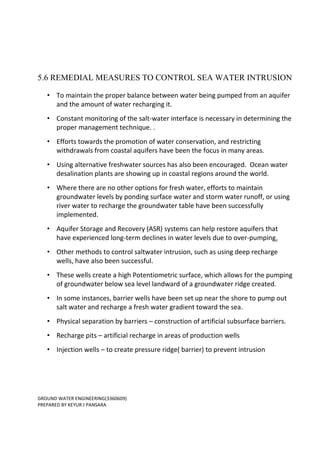
The Ghysen-Herzberg ratio states that, for every foot of fresh water in an unconfined
aquifer above sea level, there will be forty feet of fresh water in the aquifer below
sea level.
The Ghysen-Herzberg ratio states that, for every foot of fresh water in an unconfined
aquifer above sea level, there will be forty feet of fresh water in the aquifer below
sea level.
The Ghysen-Herzberg ratio states that, for every foot of fresh water in an unconfined
aquifer above sea level, there will be forty feet of fresh water in the aquifer below
sea level. This analysis assumes hydrostatic conditions in a homogeneous, unconfined
coastal aquifer. According to this relation, if the water table in an unconfined coastal
aquifer is lowered by 1m, the salt-water interface will rise 40 m.
GROUND WATER ENGINEERING(3360609)
PREPARED BY KEYUR J PANSARA
5.6 REMEDIAL MEASURES TO CONTROL SEA WATER INTRUSION
• To maintain the proper balance between water being pumped from an aquifer
and the amount of water recharging it.
• Constant monitoring of the salt-water interface is necessary in determining the
proper management technique. .
• Efforts towards the promotion of water conservation, and restricting
withdrawals from coastal aquifers have been the focus in many areas.
• Using alternative freshwater sources has also been encouraged. Ocean water
desalination plants are showing up in coastal regions around the world.
• Where there are no other options for fresh water, efforts to maintain
groundwater levels by ponding surface water and storm water runoff, or using
river water to recharge the groundwater table have been successfully
implemented.
• Aquifer Storage and Recovery (ASR) systems can help restore aquifers that
have experienced long-term declines in water levels due to over-pumping.
• Other methods to control saltwater intrusion, such as using deep recharge
wells, have also been successful.
• These wells create a high Potentiometric surface, which allows for the pumping
of groundwater below sea level landward of a groundwater ridge created.
• In some instances, barrier wells have been set up near the shore to pump out
salt water and recharge a fresh water gradient toward the sea.
• Physical separation by barriers – construction of artificial subsurface barriers.
• Recharge pits – artificial recharge in areas of production wells
• Injection wells – to create pressure ridge( barrier) to prevent intrusion
GROUND WATER ENGINEERING(3360609)
PREPARED BY KEYUR J PANSARA
• Deep recharge well
Monitoring well networks allow continuous observation of the saltwater interface,
after management strategies have been put in place. This provides early warnings of
saltwater intrusion and tracks the effectiveness of the strategy. Overall, proper
groundwater monitoring techniques and groundwater management, combined with
groundwater conservation are needed to keep saltwater intrusion under control, and
ensure fresh water supplies are sustained for future generations.

Sea Water Intrusion

  • 1.
    GROUND WATER ENGINEERING(3360609) PREPAREDBY KEYUR J PANSARA 5.1 INTRODUCTION Almost two thirds of the world's population lives within 400 km of the ocean shoreline; just over half live within 200 km, an area only taking up 10% of the earth's surface (Hinrichsen, 2007). Most of these coastal regions rely on groundwater as their main source of fresh water for domestic, industrial and agricultural purposes. As the world's population continues to grow at an alarming rate, fresh water supplies are constantly being depleted, bringing with it issues such as saltwater intrusion and increasing the importance of groundwater monitoring, management, and conservation. Saltwater intrusion is a major concern commonly found in coastal aquifers around the world. The movement of saline water into a freshwater aquifer or surface reservoir is known as saltwater intrusion and if the source of this saline water is sea water, then this process is known as seawater intrusion. Freshwater is slightly less dense (lighter) than saltwater, which tends it to float on top of the saltwater when both fluids are present in an aquifer. The relationship based on the density difference between saltwater and freshwater is used to estimate the depth to saltwater based on the thickness of the freshwater zone above sea level. The relationship is known as the Ghyben-Herzberg relation (Figure 1). In the coastal area of Bangladesh, hydro- geological conditions vary considerably even within short distances. Ground water, with gradient about 1:20000, flows from north to south having localised outflow into rivers and ponds in dry season and inflow into the aquifer from surface water sources in the rainy season. Transmissivities of the main aquifer in the coastal area ranges from 250m2/day to 10000m2/day with an average value of 1000m2/day. The storage capacity of the aquifer generally increases with depth with the increase in the size of aquifer materials. The entire area is underlain by thick water bearing formations of varying depths and the regional hydrogeology is very complex (Ahmed, 1996). Shamsuddin (1986) observed that the salinity distributions in Khulna, Barisal and Patuakhali regions were not in agreement with the Ghyben-Herzberg theory.
  • 2.
    GROUND WATER ENGINEERING(3360609) PREPAREDBY KEYUR J PANSARA 5.2 CAUSE OF SALTWATER INTRUSION  Rising of sea water level sea level rise caused by global warming has become a root cause, pressure from the increase in the quantity of saltwater that many will try to enter the fresh water aquifer  high consumption of fresh water Excessive consumption of fresh water caused a shortage of freshwater in that area and cause the waters invaded by salt water.  oil drilling Oil ring usually use oil pipeline under the ground to deliver oil from drilling site to storage tanks on the beach, as the result and the more easy to salt water to insult the freshwater.  lack of rain lack of rain causes replacement of fresh water consumption was slow while the uses are increased.in this case it will reduce the amout of fresh water in the ground and it will be replace by sea water.  Agriculture Agriculture is human activity that require lot amout of fresh water,it will not suitable at area that near the sea.  Pumping Pumping of fresh water from an aquifer reduces the water pressure and intensifies the effect, drawing salt water into new areas. When freshwater levels drop, saltwater intrusion can proceed inland, reaching the pumped well  Lack of knowledge Human greed for money and lack of knowledge caused us to be blind to the importance of to keep our only living place.
  • 3.
    GROUND WATER ENGINEERING(3360609) PREPAREDBY KEYUR J PANSARA 5.3 ILL-effects of sea water intrusion Pumping groundwater at a faster rate than it can be recharged can have some negative effects of the environment and the people who make use of the water: Lowering of the water table The most severe consequence of excessive groundwater pumping is that the water table, below which the ground is saturated with water, can be lowered. For water to be withdrawn from the ground, water must be pumped from a well that reaches below the water table. If groundwater levels decline too far, then the well owner might have to deepen the well, drill a new well, or, at least, attempt to lower the pump. Also, as water levels decline, the rate of water the well can yield may decline. Increased costs for the user As the depth to water increases, the water must be lifted higher to reach the land surface. If pumps are used to lift the water (as opposed to artesian wells), more energy is required to drive the pump. Using the well can become prohibitively expensive. Reduction of water in streams and lakes There is more of an interaction between the water in lakes and rivers and groundwater than most people think. Some, and often a great deal, of the water flowing in rivers comes from seepage of groundwater into the streambed. Groundwater contributes to streams in most physiographic and climatic settings. The proportion of stream water that comes from groundwater inflow varies according to a region's geography, geology, and climate. Groundwater pumping can alter how water moves between an aquifer and a stream, lake, or wetland by either intercepting groundwater flow that discharges into the surface-water body under natural conditions, or by increasing the rate of water movement from the surface-water body into an aquifer. A related effect of groundwater pumping is the lowering of groundwater levels below the depth that streamside or wetland vegetation
  • 4.
    GROUND WATER ENGINEERING(3360609) PREPAREDBY KEYUR J PANSARA needs to survive. The overall effect is a loss of riparian vegetation and wildlife habitat. Land subsidence The basic cause of land subsidence is a loss of support below ground. In other words, sometimes when water is taken out of the soil, the soil collapses, compacts, and drops. This depends on a number of factors, such as the type of soil and rock below the surface. Land subsidence is most often caused by human activities, mainly from the removal of subsurface water. Deterioration of water quality One water-quality threat to fresh groundwater supplies is contamination from saltwater intrusion. All of the water in the ground is not fresh water; much of the very deep groundwater and water below oceans is saline. In fact, an estimated 3.1 million cubic miles (12.9 cubic kilometers) of saline groundwater exists compared to about 2.6 million cubic miles (10.5 million cubic kilometers) of fresh groundwater (Gleick, P. H., 1996: Water resources. In Encyclopedia of Climate and Weather, ed. by S. H. Schneider, Oxford University Press, New York, vol. 2, pp. 817-823). Under natural conditions the boundary between the freshwater and saltwater tends to be relatively stable, but pumping can cause saltwater to migrate inland and upward, resulting in saltwater contamination of the water supply. 5.4 Mechanism of sea water intrusion  Saltwater intrusion is the movement of saline water into freshwater aquifers.  Most often, it is caused by ground-water pumping from coastal wells, or from construction of navigation channels or oil field canals.  Saltwater intrusion occurs in virtually all coastal aquifers, where they are in hydraulic continuity with seawater.
  • 5.
    GROUND WATER ENGINEERING(3360609) PREPAREDBY KEYUR J PANSARA  The channels and canals provide conduits for salt water to be brought into fresh water marshes. Salt water intrusion can also occur as the result of a natural process like a storm surge from a hurricane. 5.5 GHYBEN-HERZBERG RELATION The first physical formulations of saltwater intrusion were made by W. Badon- Ghijben(1888,1889) and A.Herzberg(1901), thus called the Ghyben-Herzberg relation.They derived analytical solutions to approximate the intrusion behavior , which are based on a number of assumptions that do not hold in all field cases. The figure shows the Ghyben-Herzberg relation. In the equation, This figure shows the Ghyben-Herzgerg Relation. In the equation,
  • 6.
    GROUND WATER ENGINEERING(3360609) PREPAREDBY KEYUR J PANSARA Where,h=thickness of the fresh water zone above sea level z=thickness of the freshwater zone below sea level The Ghysen-Herzberg ratio states that, for every foot of fresh water in an unconfined aquifer above sea level, there will be forty feet of fresh water in the aquifer below sea level. The Ghysen-Herzberg ratio states that, for every foot of fresh water in an unconfined aquifer above sea level, there will be forty feet of fresh water in the aquifer below sea level. The Ghysen-Herzberg ratio states that, for every foot of fresh water in an unconfined aquifer above sea level, there will be forty feet of fresh water in the aquifer below sea level. This analysis assumes hydrostatic conditions in a homogeneous, unconfined coastal aquifer. According to this relation, if the water table in an unconfined coastal aquifer is lowered by 1m, the salt-water interface will rise 40 m.
  • 7.
    GROUND WATER ENGINEERING(3360609) PREPAREDBY KEYUR J PANSARA 5.6 REMEDIAL MEASURES TO CONTROL SEA WATER INTRUSION • To maintain the proper balance between water being pumped from an aquifer and the amount of water recharging it. • Constant monitoring of the salt-water interface is necessary in determining the proper management technique. . • Efforts towards the promotion of water conservation, and restricting withdrawals from coastal aquifers have been the focus in many areas. • Using alternative freshwater sources has also been encouraged. Ocean water desalination plants are showing up in coastal regions around the world. • Where there are no other options for fresh water, efforts to maintain groundwater levels by ponding surface water and storm water runoff, or using river water to recharge the groundwater table have been successfully implemented. • Aquifer Storage and Recovery (ASR) systems can help restore aquifers that have experienced long-term declines in water levels due to over-pumping. • Other methods to control saltwater intrusion, such as using deep recharge wells, have also been successful. • These wells create a high Potentiometric surface, which allows for the pumping of groundwater below sea level landward of a groundwater ridge created. • In some instances, barrier wells have been set up near the shore to pump out salt water and recharge a fresh water gradient toward the sea. • Physical separation by barriers – construction of artificial subsurface barriers. • Recharge pits – artificial recharge in areas of production wells • Injection wells – to create pressure ridge( barrier) to prevent intrusion
  • 8.
    GROUND WATER ENGINEERING(3360609) PREPAREDBY KEYUR J PANSARA • Deep recharge well Monitoring well networks allow continuous observation of the saltwater interface, after management strategies have been put in place. This provides early warnings of saltwater intrusion and tracks the effectiveness of the strategy. Overall, proper groundwater monitoring techniques and groundwater management, combined with groundwater conservation are needed to keep saltwater intrusion under control, and ensure fresh water supplies are sustained for future generations.