Groundwater
• Found in the subsurface, inside pores within soil
and rock
• Groundwater is the largest source of freshwater on
earth, and was little used until recently.
• It is usually much cleaner than surface water.
• The depth at which soil pore spaces or fractures and
voids in rock become completely saturated with
water is called the water table
Aquifers
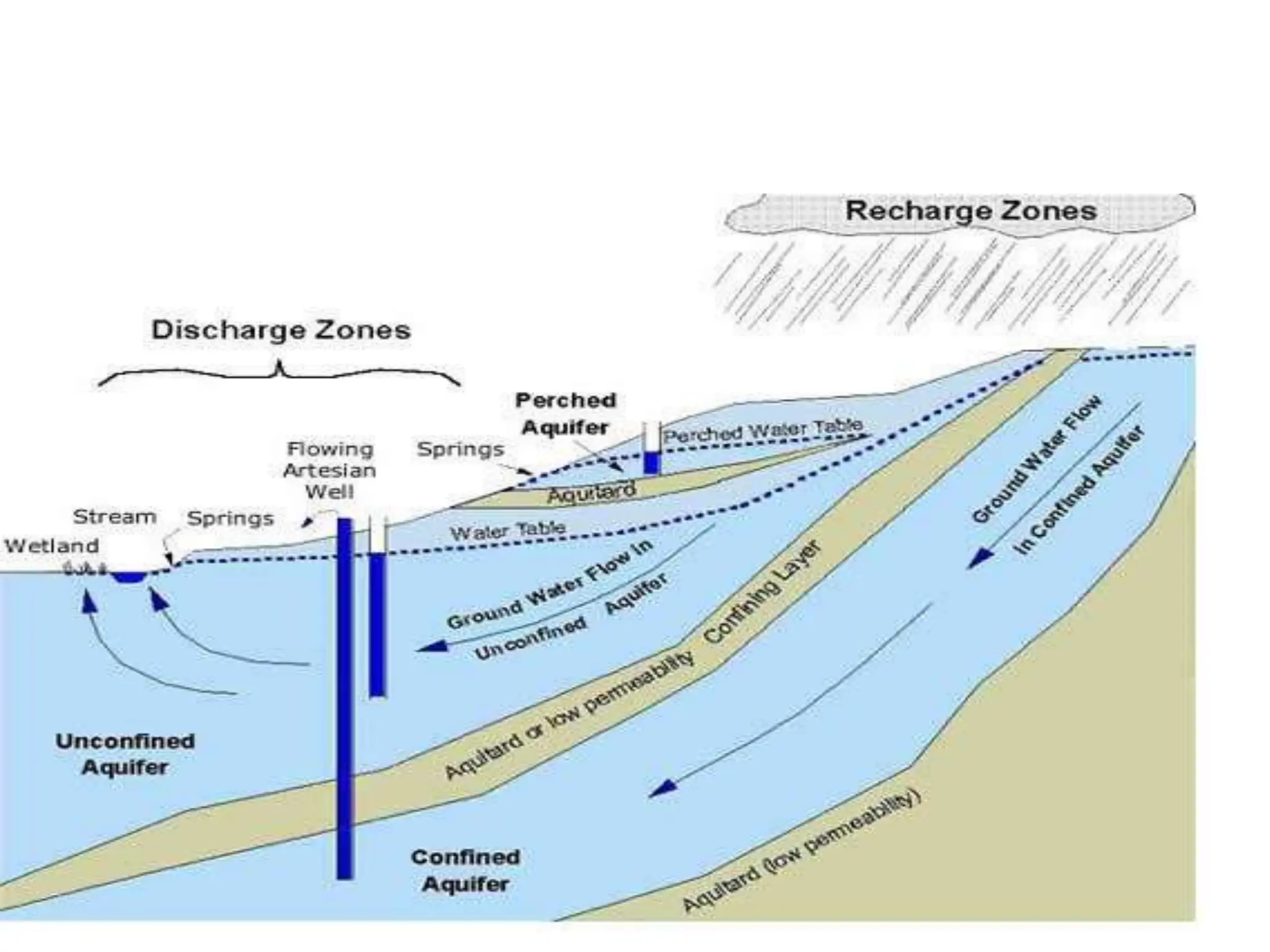
• A geologic formation which contains water and
transmits it from one point to another in quantities
sufficient to permit economic development is called an
aquifer.
• Water-bearing geologic formation that can store and
yield usable amounts of water
• Aquifers are usually saturated sands, gravel, fractured
rock, or cavernous and vesicular rock.
• Aquifers may occur at various depths
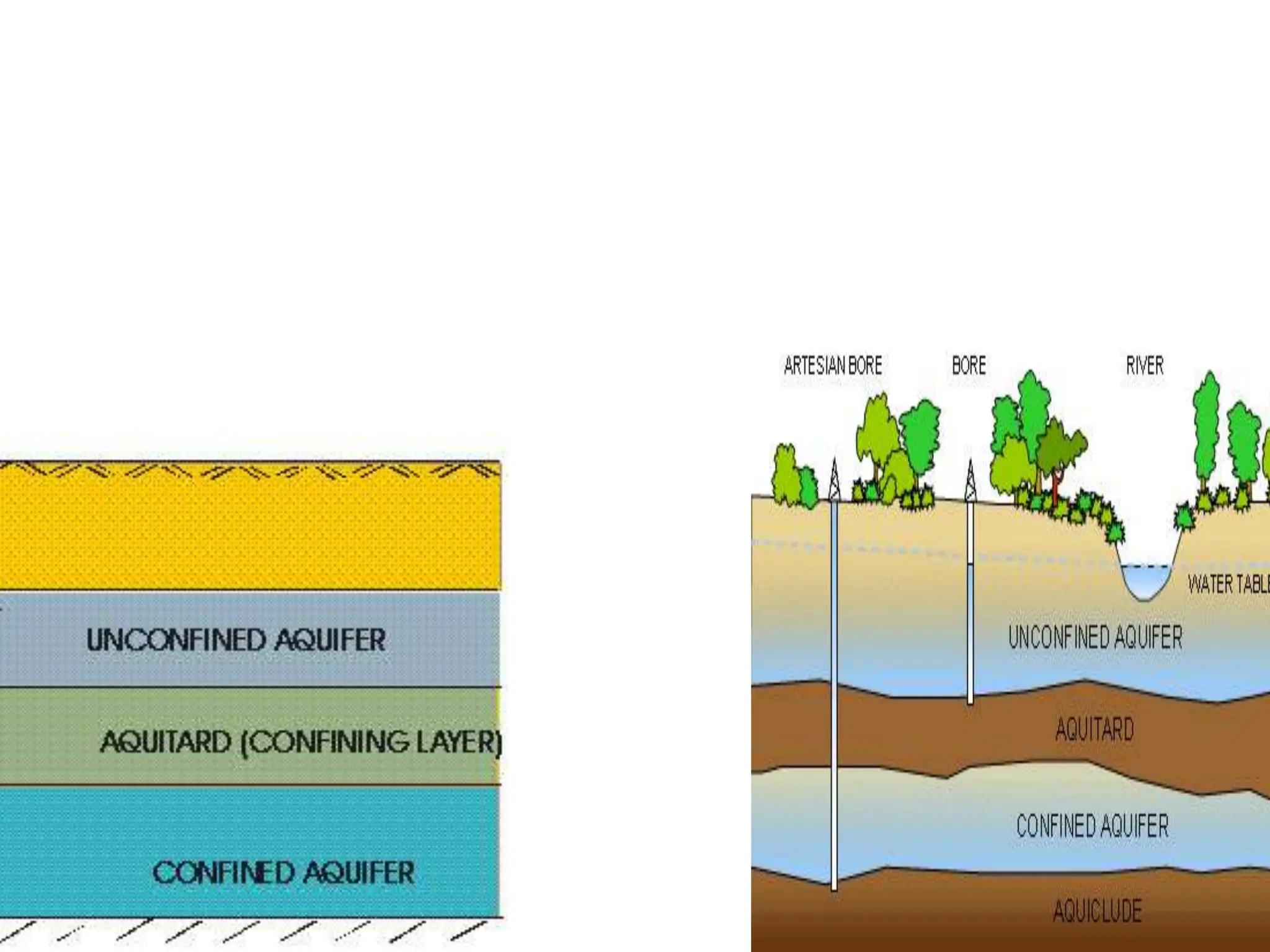
Types of Aquifers
1- Confined Aquifer
2- Unconfined Aquifer
Aquifers
Aquifers
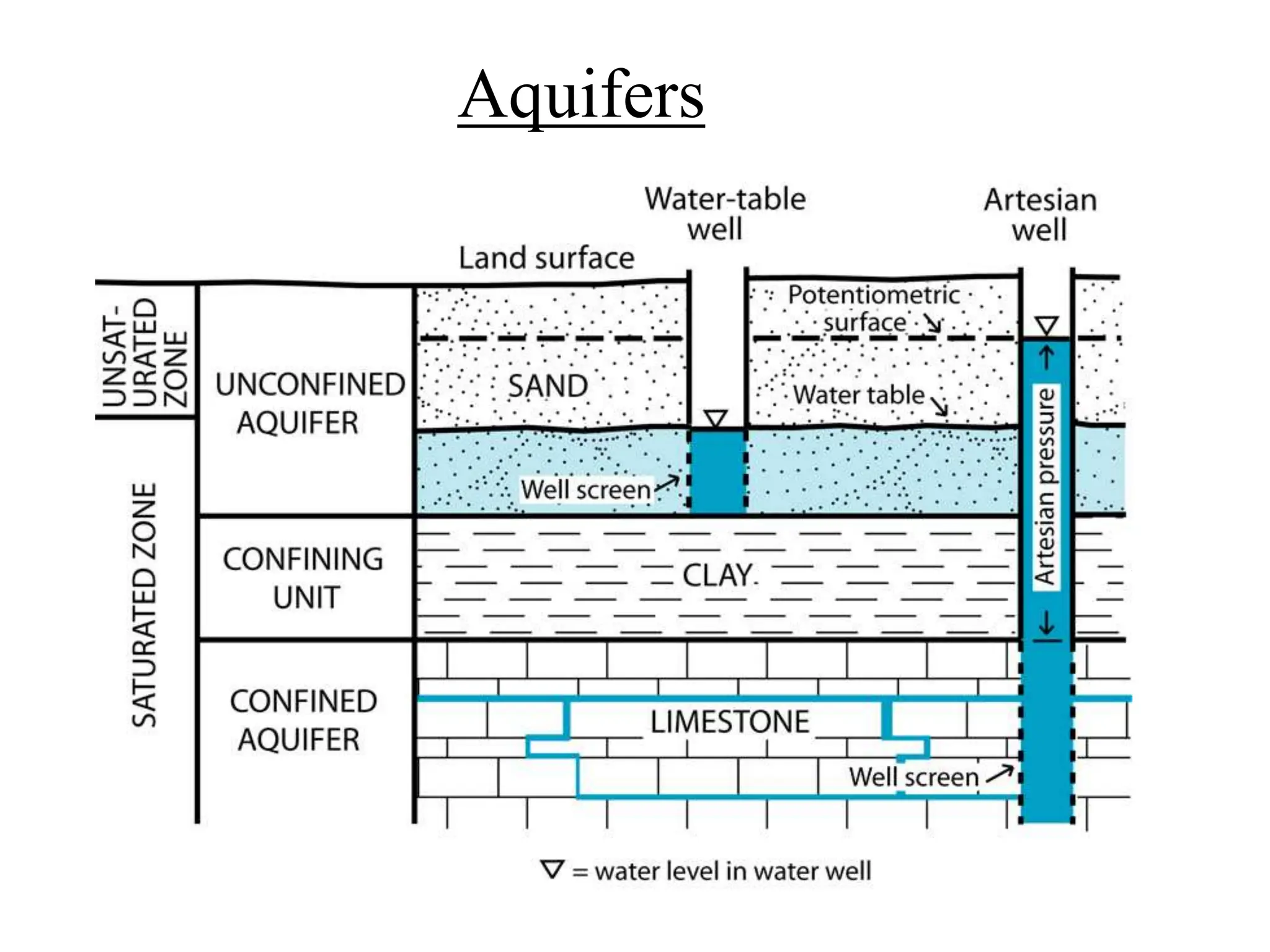
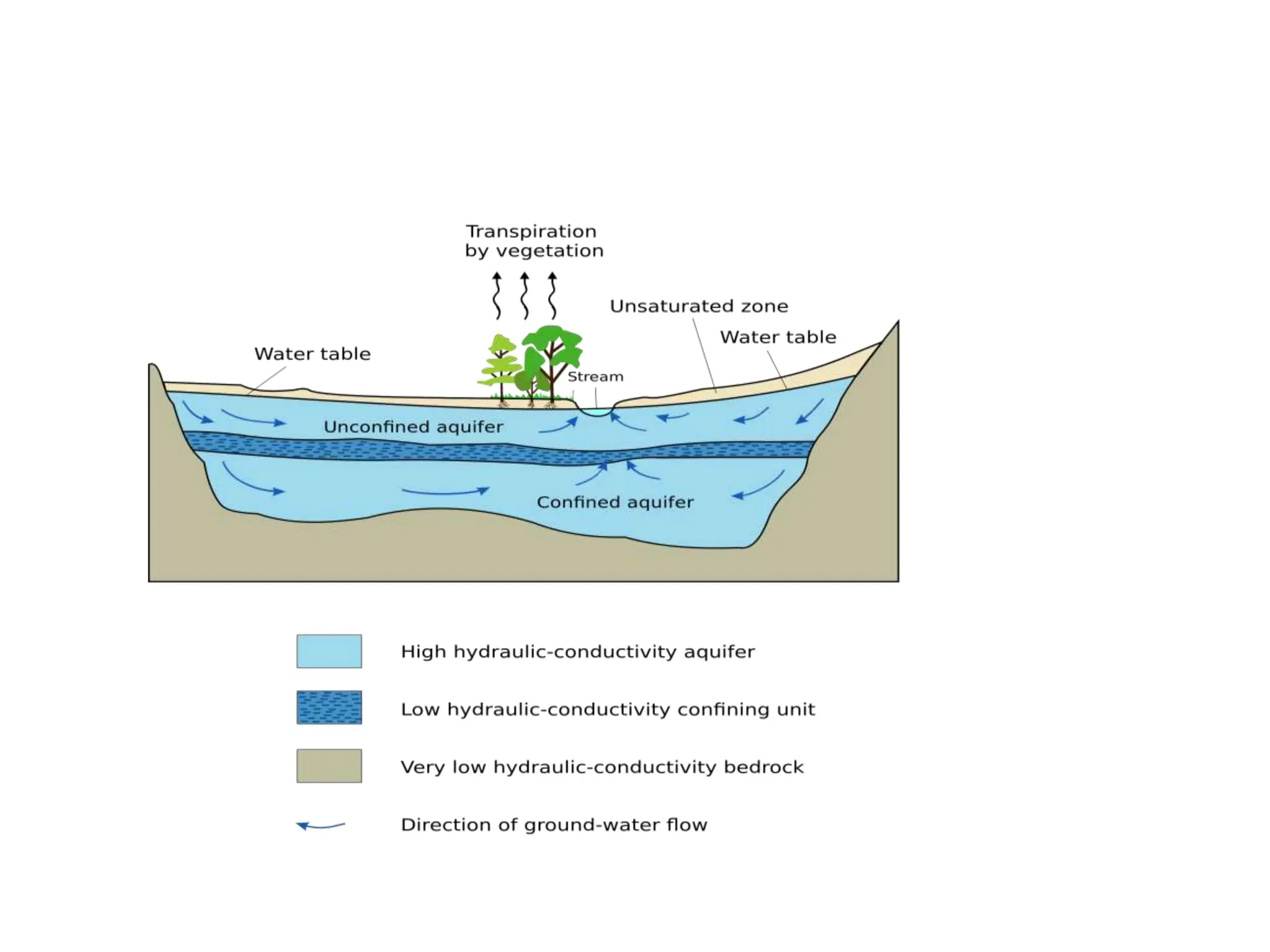
Confined aquifer
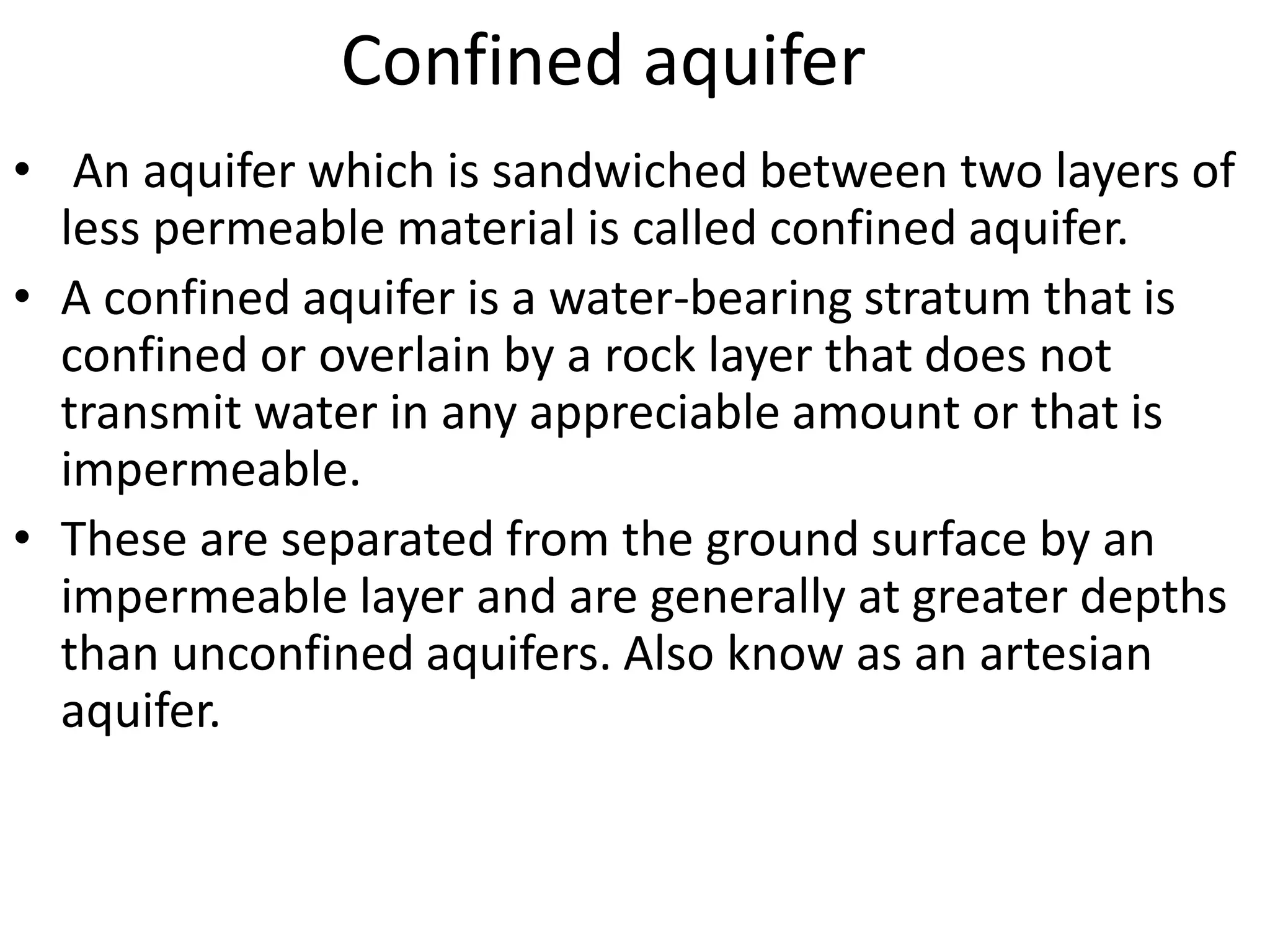
• An aquifer which is sandwiched between two layers of
less permeable material is called confined aquifer.
• A confined aquifer is a water-bearing stratum that is
confined or overlain by a rock layer that does not
transmit water in any appreciable amount or that is
impermeable.
• These are separated from the ground surface by an
impermeable layer and are generally at greater depths
than unconfined aquifers. Also know as an artesian
aquifer.
Unconfined aquifer
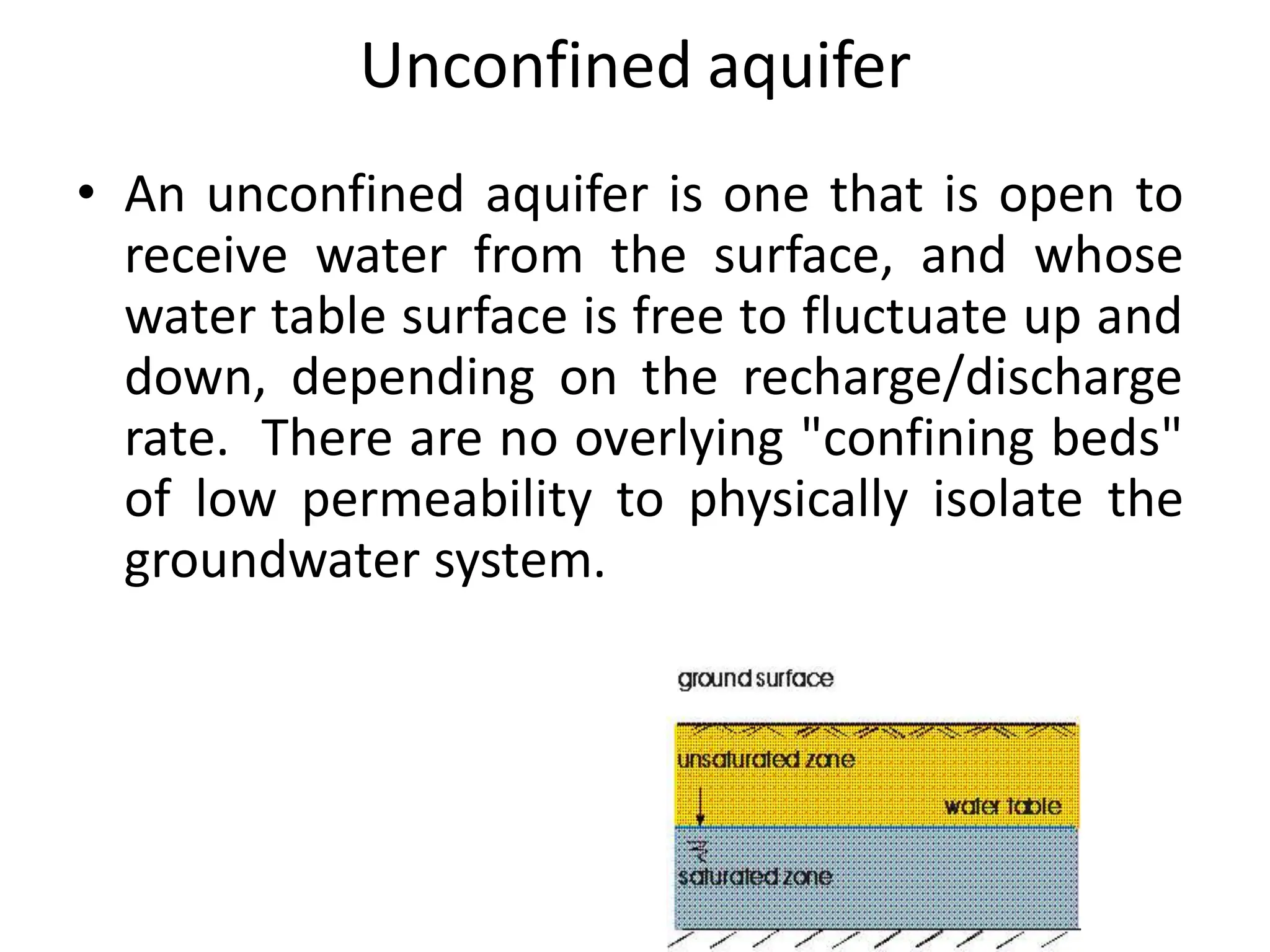
• An unconfined aquifer is one that is open to
receive water from the surface, and whose
water table surface is free to fluctuate up and
down, depending on the recharge/discharge
rate. There are no overlying "confining beds"
of low permeability to physically isolate the
groundwater system.
• Unconfined aquifers are sometimes also called
water table or phreatic aquifers, because their
upper boundary is the water table
• When water can flow directly between the
surface and the saturated zone of an aquifer, the
aquifer is unconfined.
• The deeper parts of unconfined aquifers are
usually more saturated since gravity causes water
to flow downward.
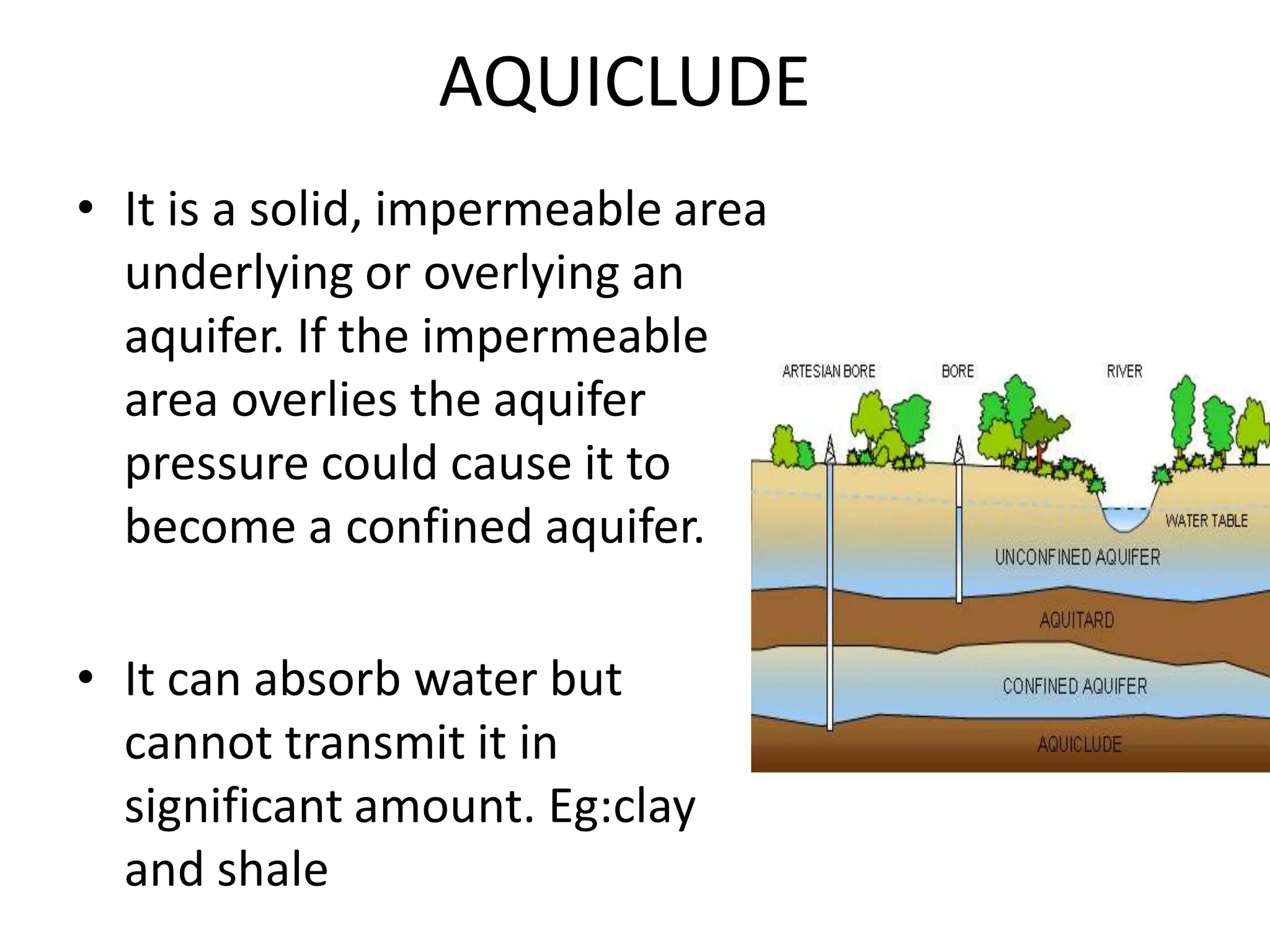
AQUICLUDE
• It is a solid, impermeable area
underlying or overlying an
aquifer. If the impermeable
area overlies the aquifer
pressure could cause it to
become a confined aquifer.
• It can absorb water but
cannot transmit it in
significant amount. Eg:clay
and shale
AQUIFUGE:
• An impermeable body of
rock which contains no
interconnected openings
or interstices and
therefore neither
absorbs nor transmits
water. Example: compact
interlocking granite
AQUITARD:
• A bed of low
permeability and yield
water slowly in
comparison to t he
adjoining aquifer is
known as aquitard.
Sandy clay is an example
of aquitard.
PROPERTIES OF THE AQUIFER
i) Porosity
ii) Specific yield
iii) Specific retention
iv) Storage by efficiency ( field capacity)
v) Permeability
vi) Transmissibility
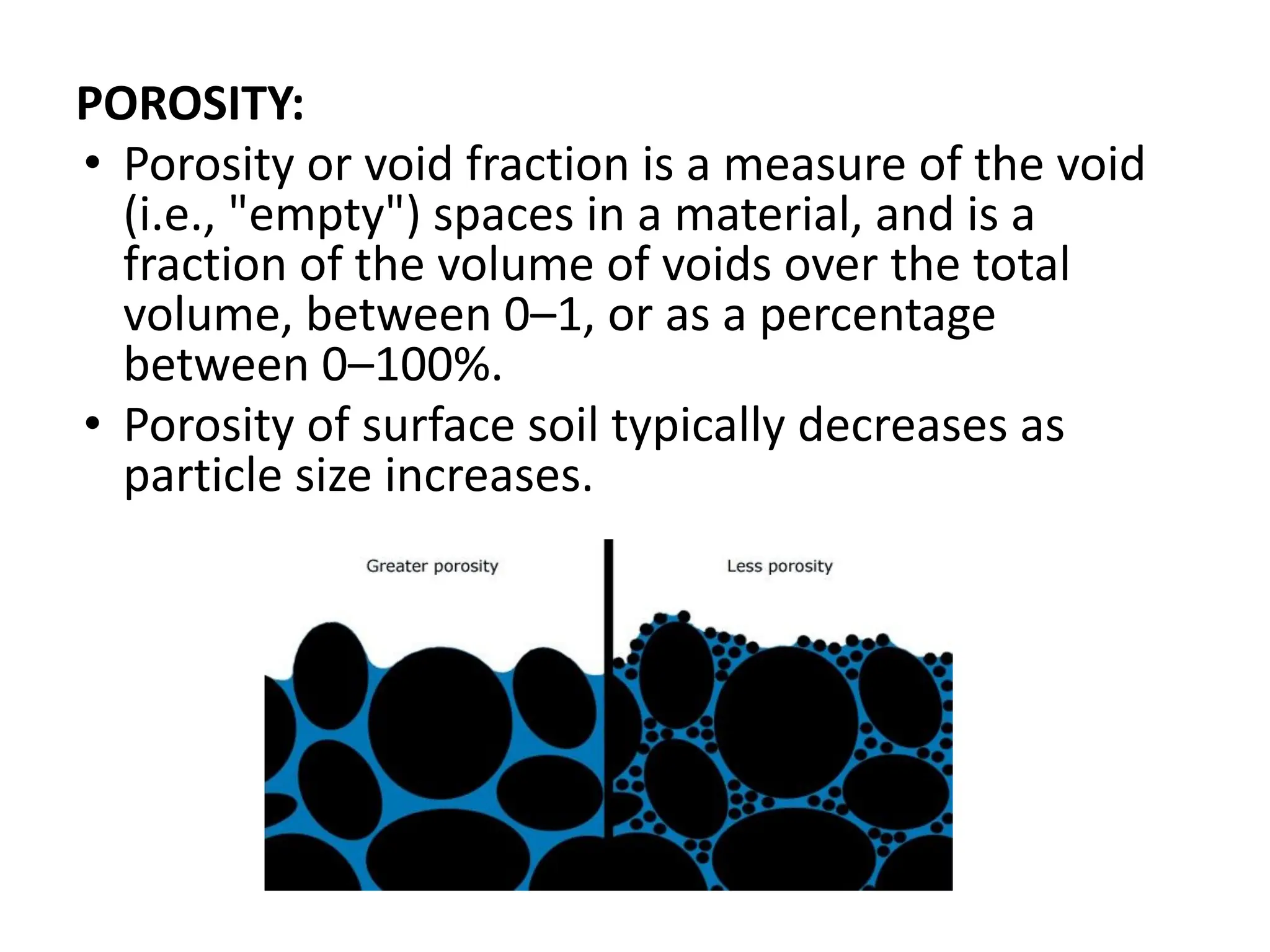
POROSITY:
• Porosity or void fraction is a measure of the void
(i.e., "empty") spaces in a material, and is a
fraction of the volume of voids over the total
volume, between 0–1, or as a percentage
between 0–100%.
• Porosity of surface soil typically decreases as
particle size increases.
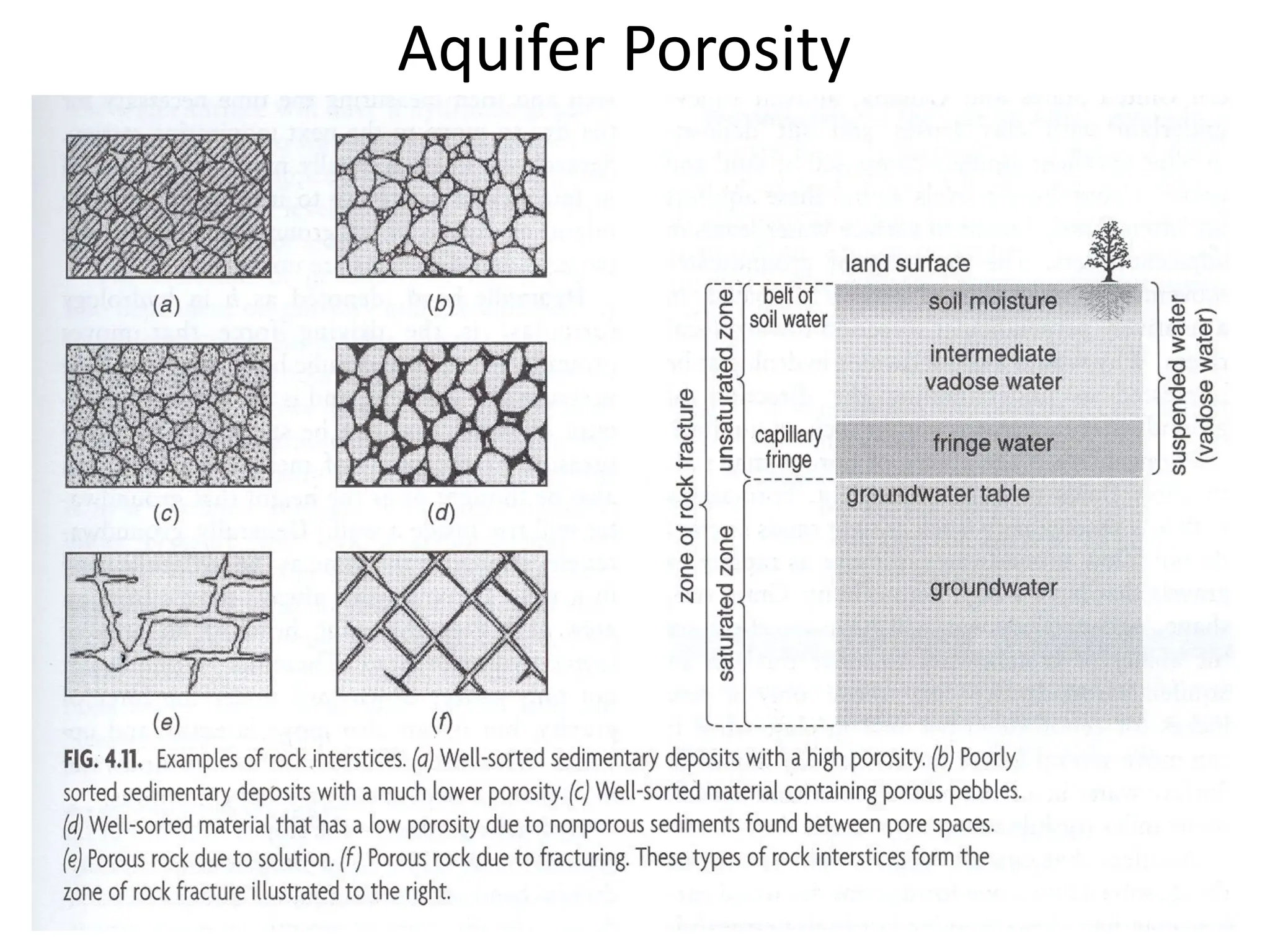
Aquifer Porosity
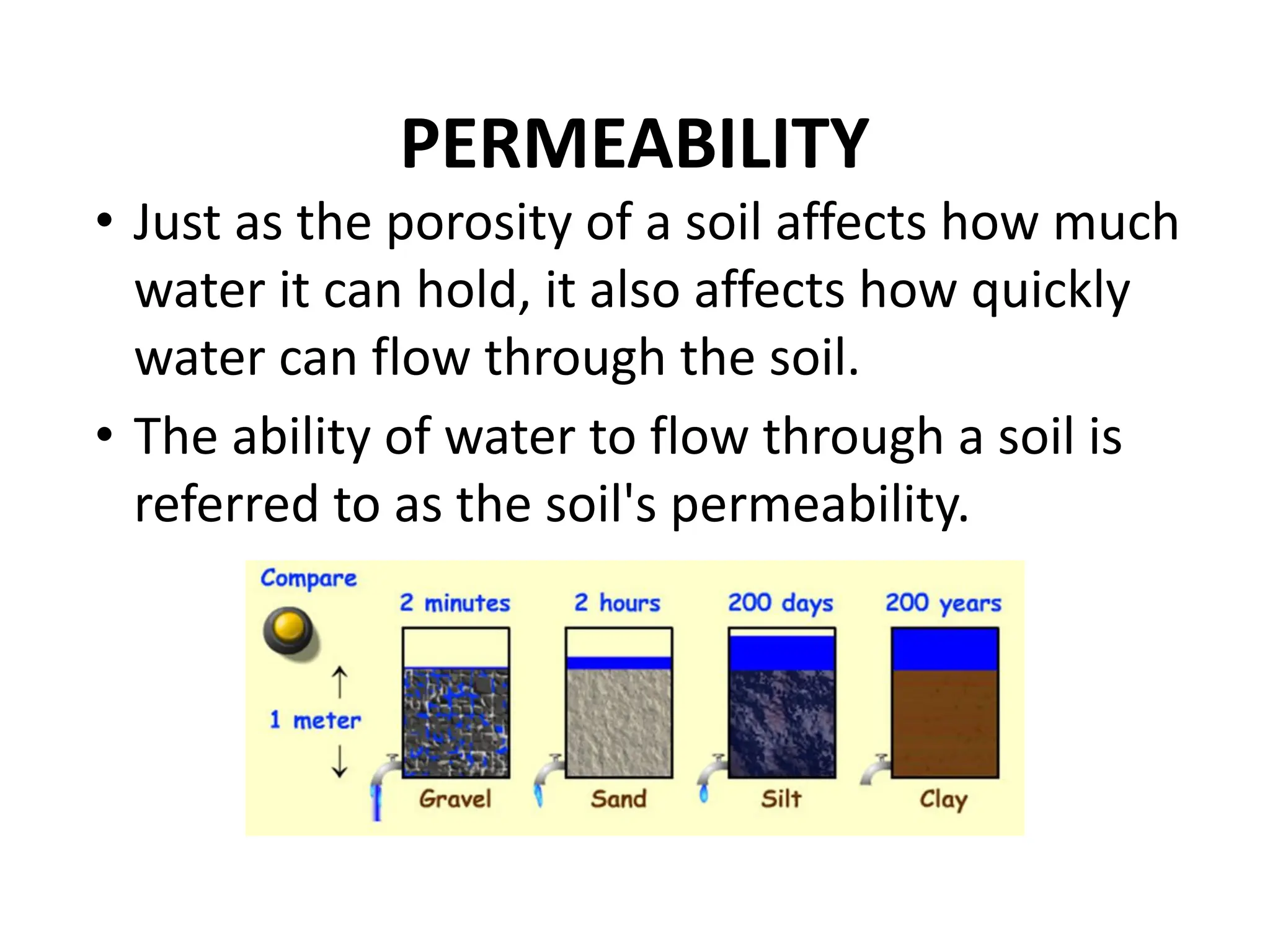
PERMEABILITY
• Just as the porosity of a soil affects how much
water it can hold, it also affects how quickly
water can flow through the soil.
• The ability of water to flow through a soil is
referred to as the soil's permeability.
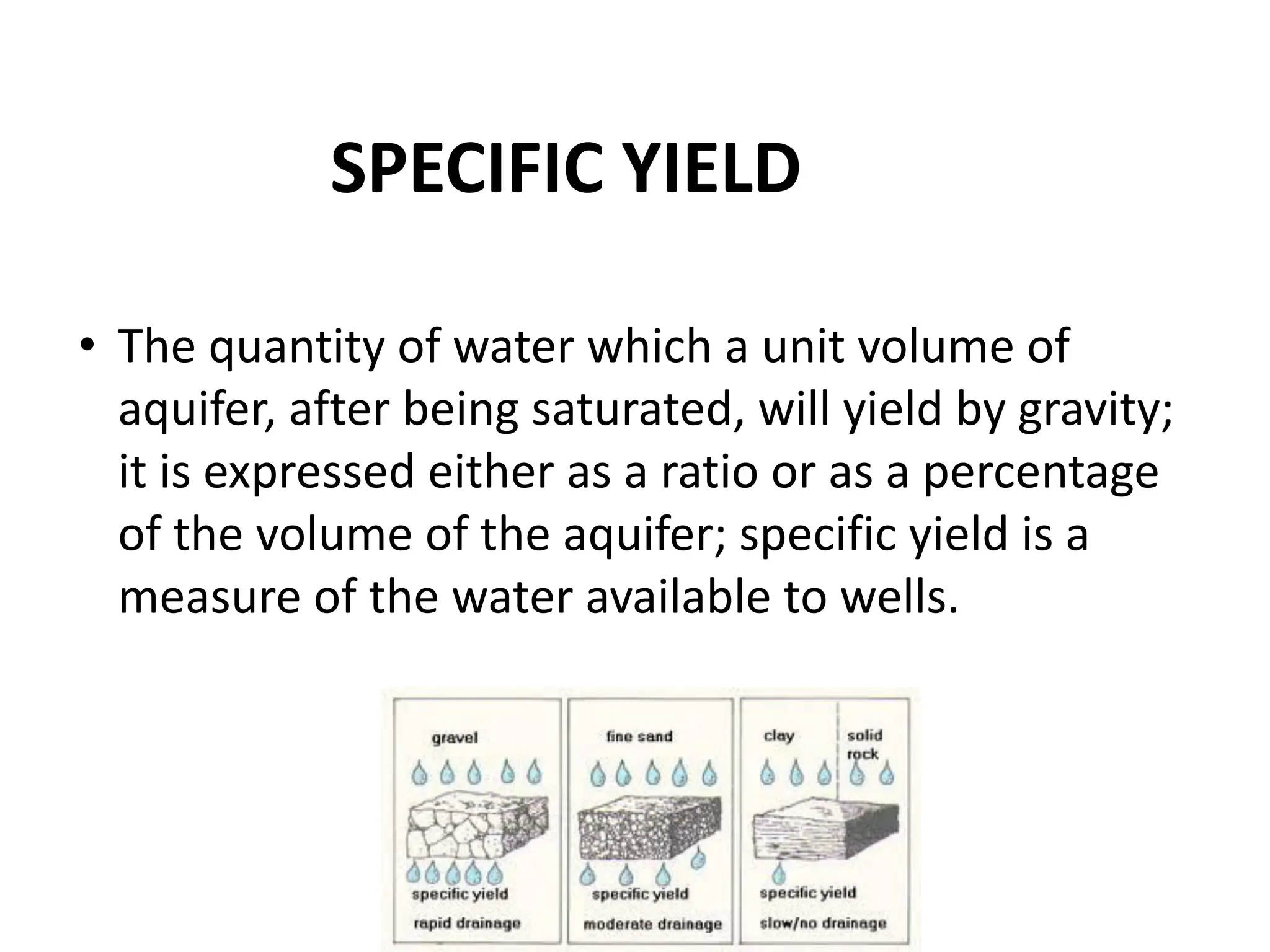
SPECIFIC YIELD
• The quantity of water which a unit volume of
aquifer, after being saturated, will yield by gravity;
it is expressed either as a ratio or as a percentage
of the volume of the aquifer; specific yield is a
measure of the water available to wells.
SPECIFIC RETENTION:
• The ratio of the volume of
water that a given body of
rock or soil will hold against
the pull of gravity to the
volume of the body itself. It
is usually expressed as a
percentage
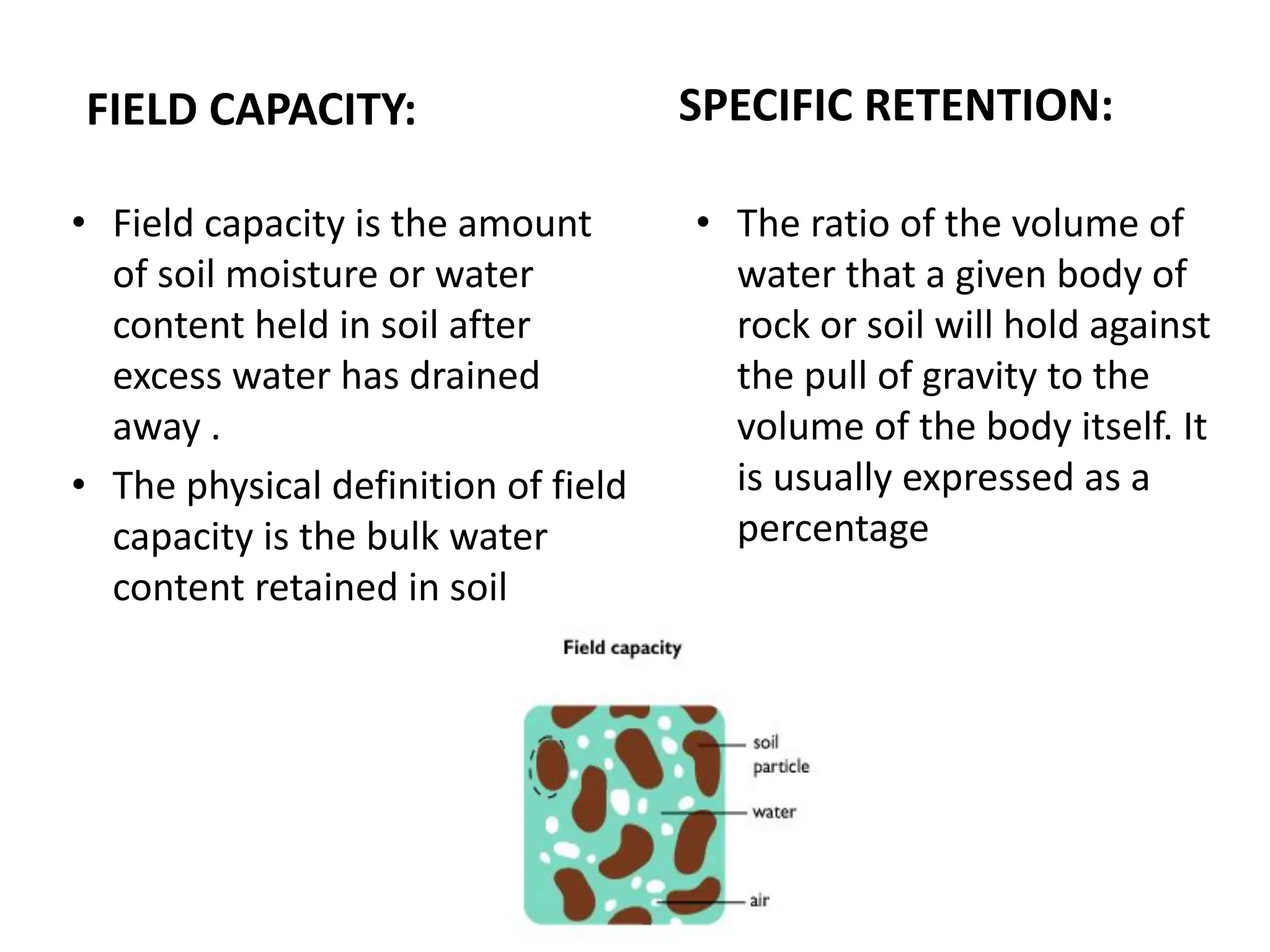
FIELD CAPACITY:
• Field capacity is the amount
of soil moisture or water
content held in soil after
excess water has drained
away .
• The physical definition of field
capacity is the bulk water
content retained in soil
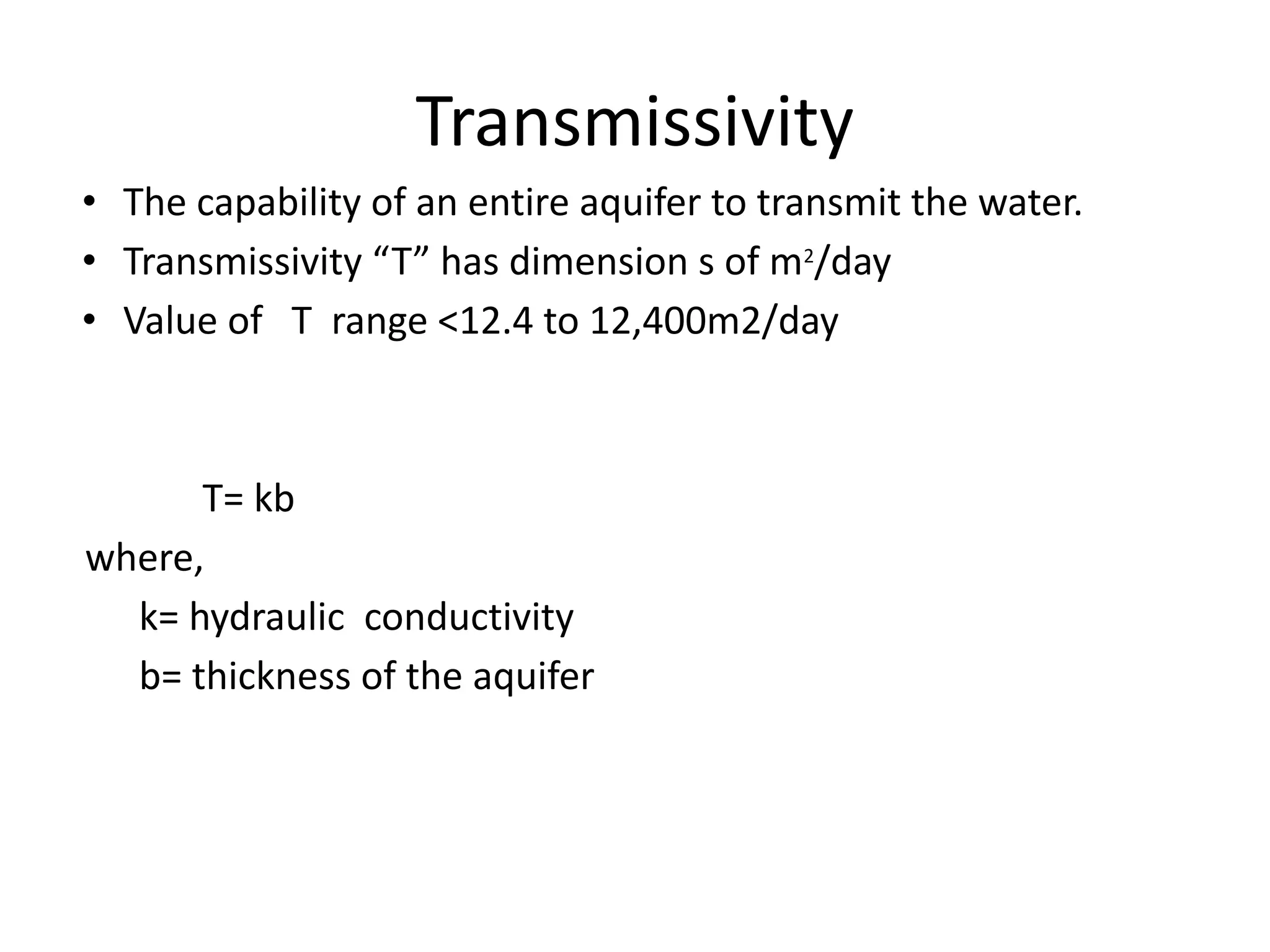
Transmissivity
• The capability of an entire aquifer to transmit the water.
• Transmissivity “T” has dimension s of m2
/day
• Value of T range <12.4 to 12,400m2/day
T= kb
where,
k= hydraulic conductivity
b= thickness of the aquifer
Hydraulic conductivity
• The hydraulic conductivity K, may be defined as the flow
velocity per unit hydraulic gradient. expressed as
meters/day or meters /second.
• The quantitative measurement of flow or water is
generally expressed by the term hydraulic conductivity
rather than permeability.
Artesian aquifer
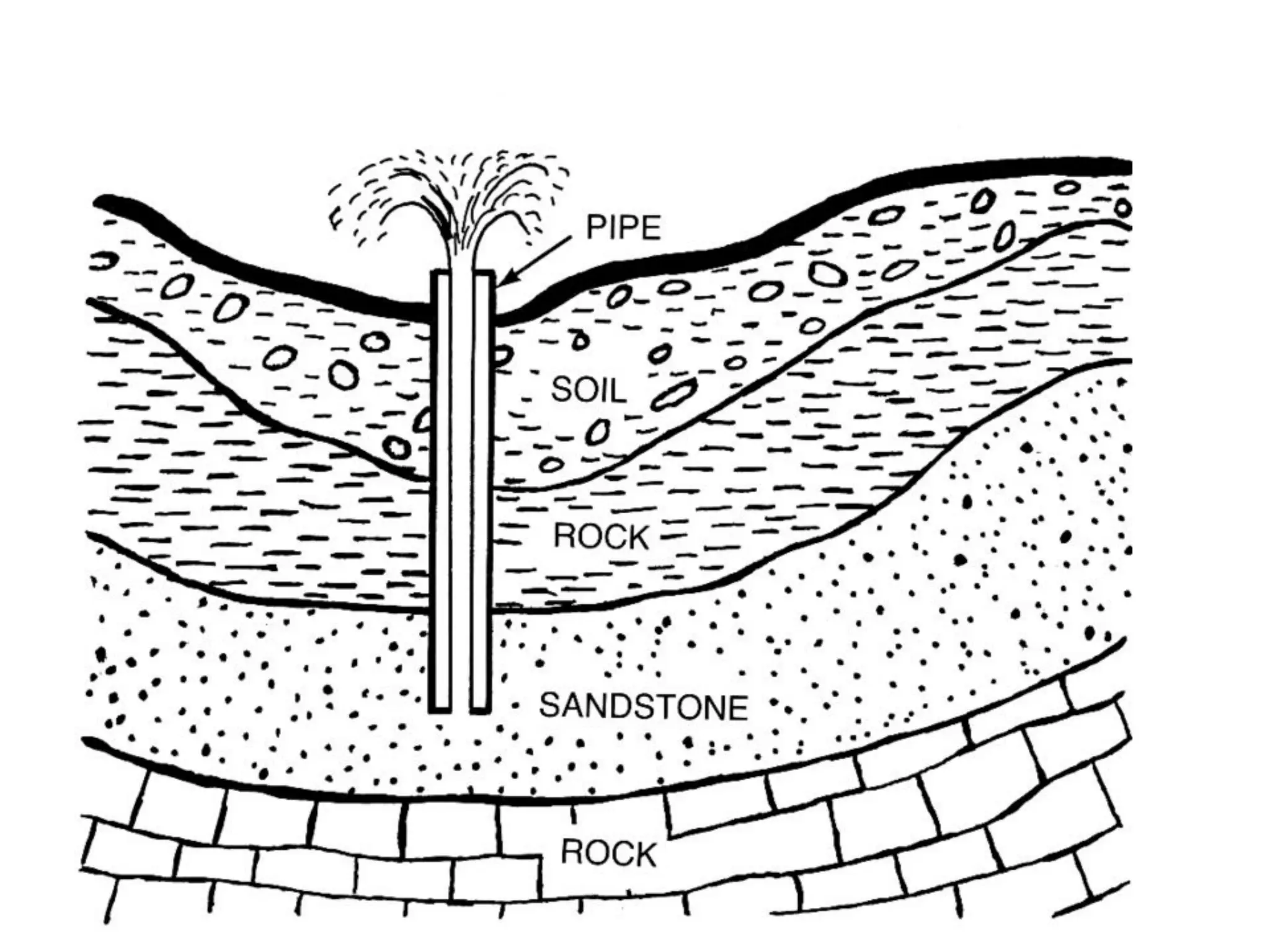
• An artesian aquifer is a
confinedaquifer containing groundwater under positive
pressure.
• A well drilled into such an aquifer is called an artesian well. If
water reaches the ground surface under the natural pressure of
the aquifer, the well is called a flowing artesian well
SEA WATER INTRUSION
Sea water Intrusion
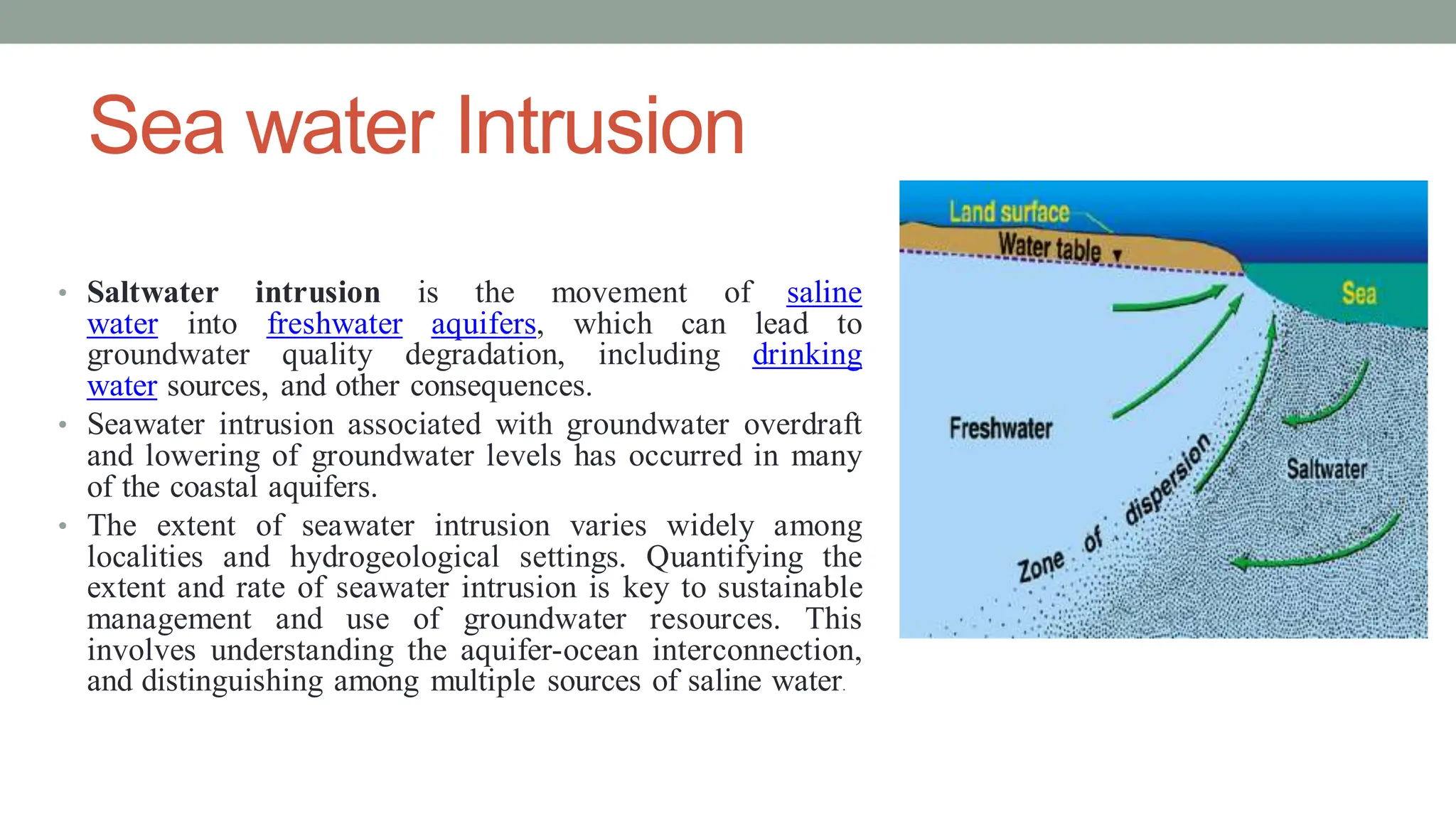
• Saltwater intrusion is the movement of saline
water into freshwater aquifers, which can lead to
groundwater quality degradation, including drinking
water sources, and other consequences.
• Seawater intrusion associated with groundwater overdraft
and lowering of groundwater levels has occurred in many
of the coastal aquifers.
• The extent of seawater intrusion varies widely among
localities and hydrogeological settings. Quantifying the
extent and rate of seawater intrusion is key to sustainable
management and use of groundwater resources. This
involves understanding the aquifer-ocean interconnection,
and distinguishing among multiple sources of saline water.
Process of Sea water Intrusion
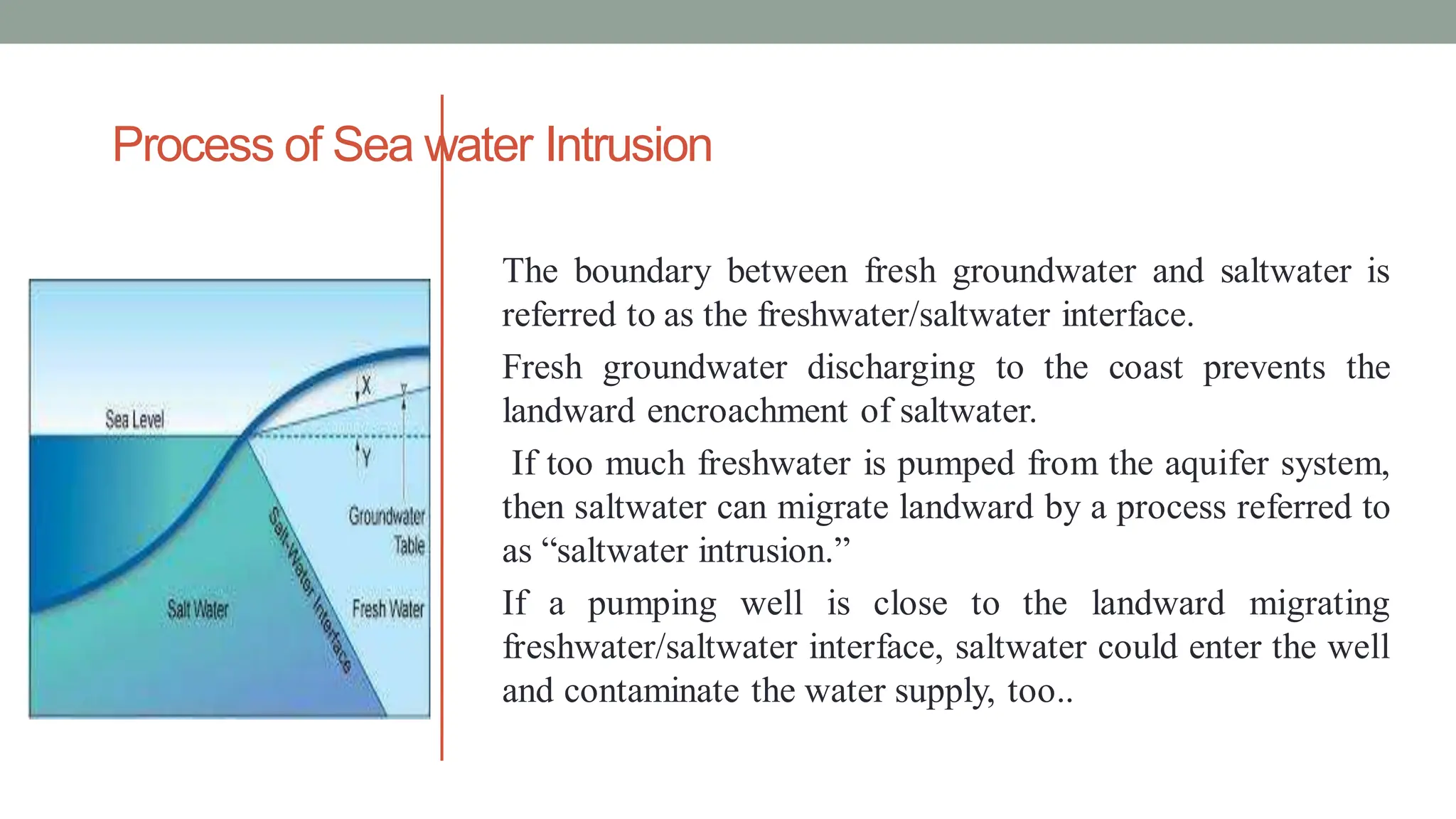
The boundary between fresh groundwater and saltwater is
referred to as the freshwater/saltwater interface.
Fresh groundwater discharging to the coast prevents the
landward encroachment of saltwater.
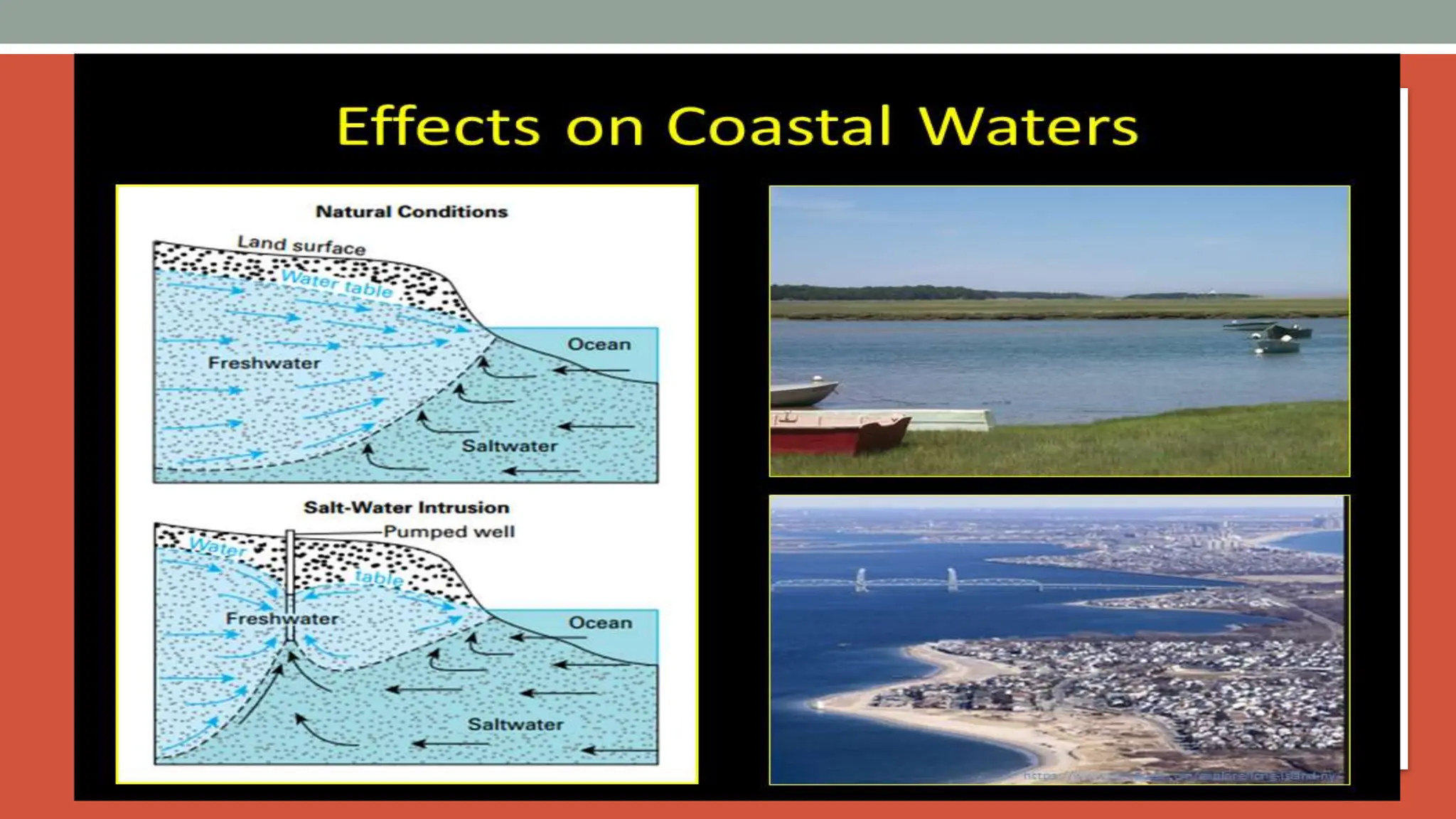
If too much freshwater is pumped from the aquifer system,
then saltwater can migrate landward by a process referred to
as “saltwater intrusion.”
If a pumping well is close to the landward migrating
freshwater/saltwater interface, saltwater could enter the well
and contaminate the water supply, too..
• https://youtu.be/8zxZUSVjg10
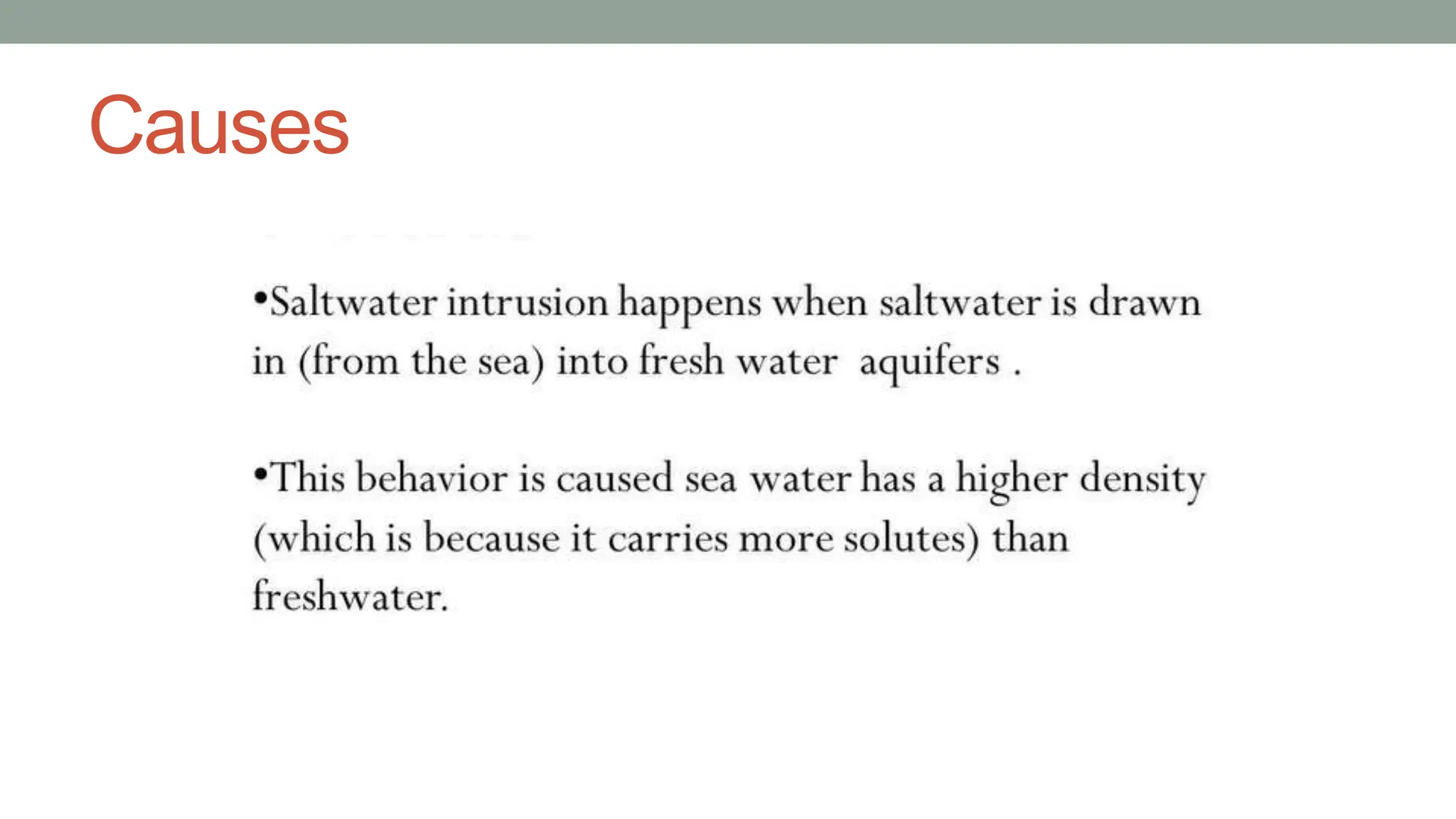
Causes
Causes
Causes
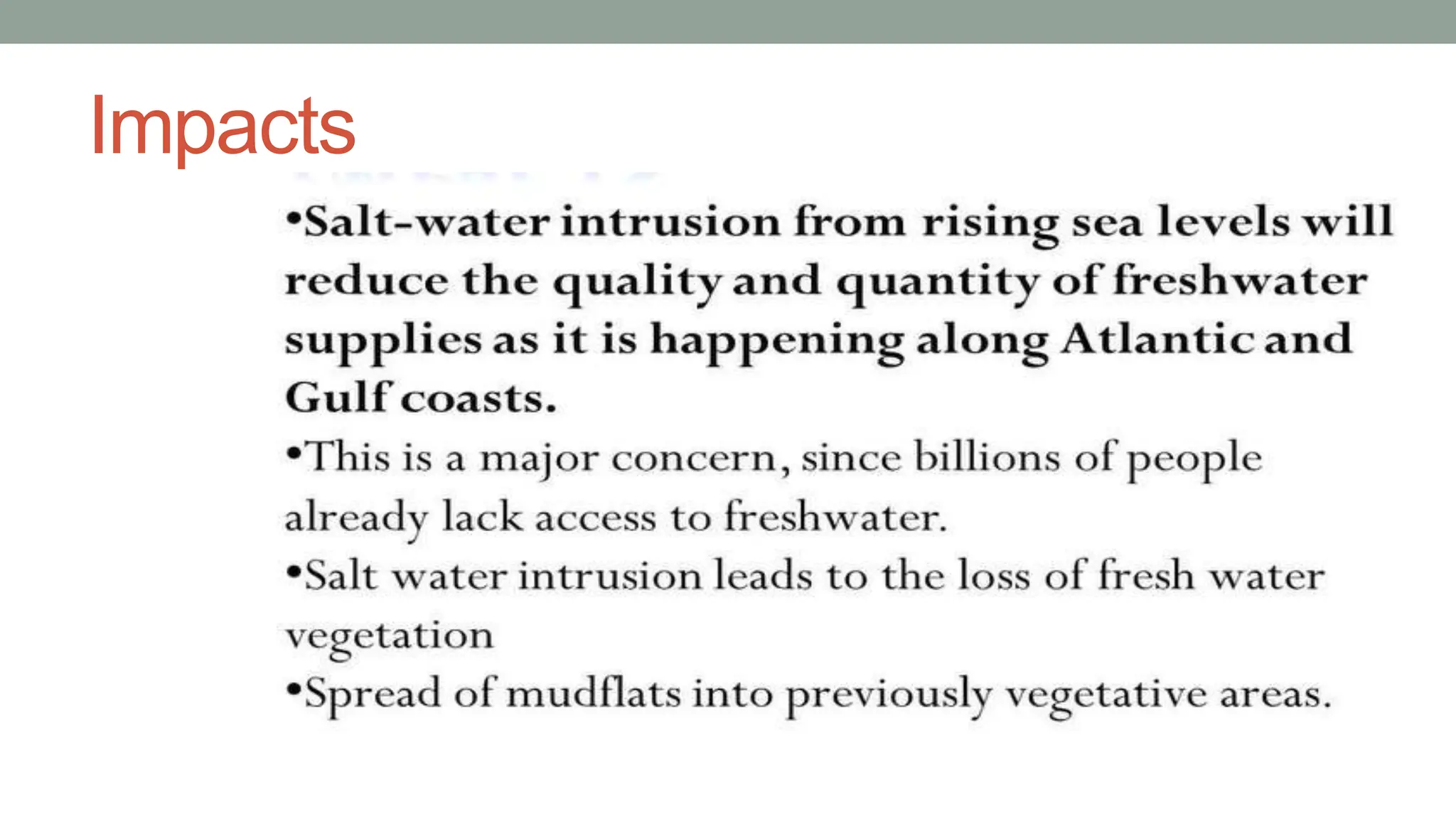
Impacts
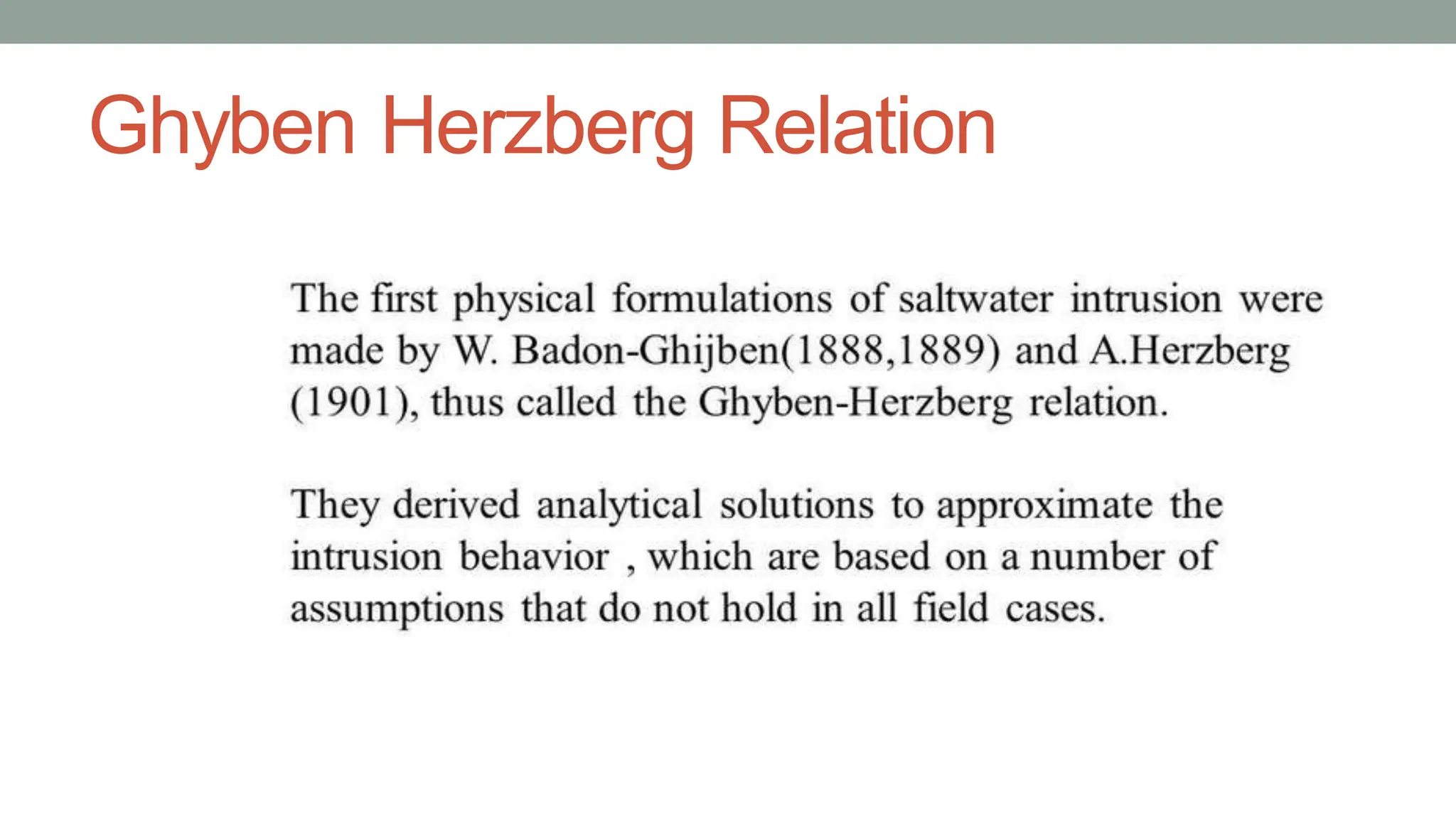
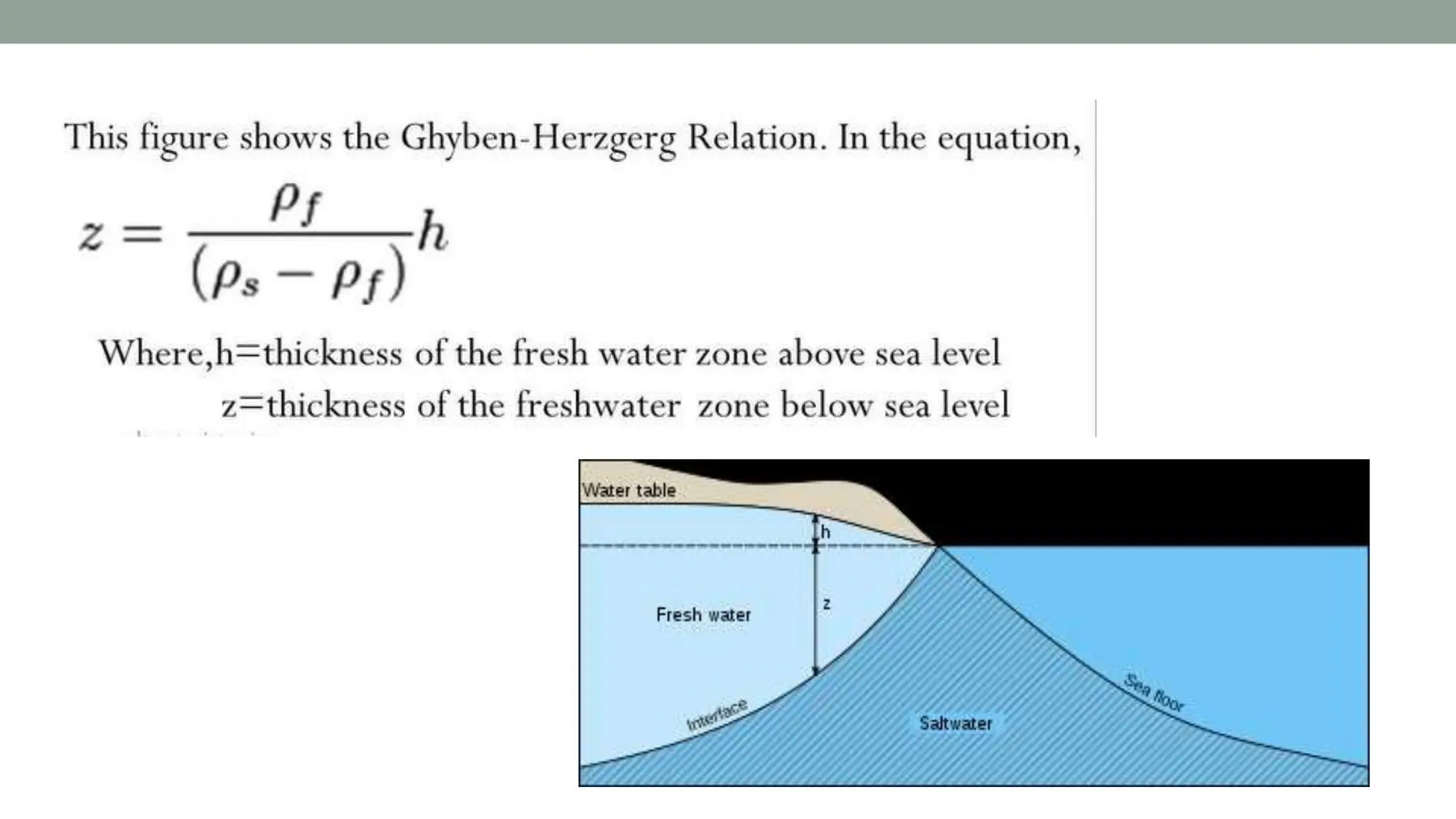
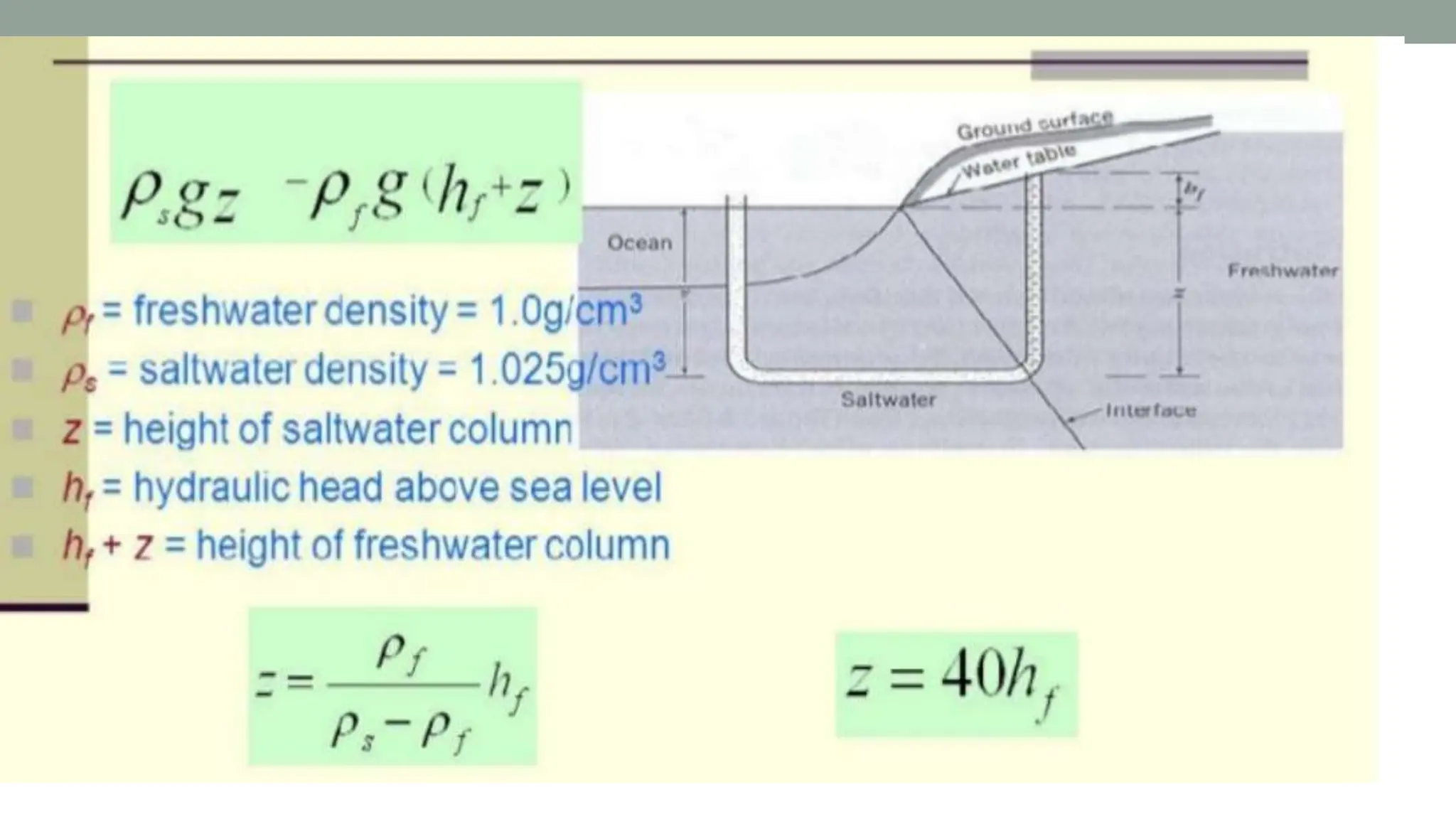
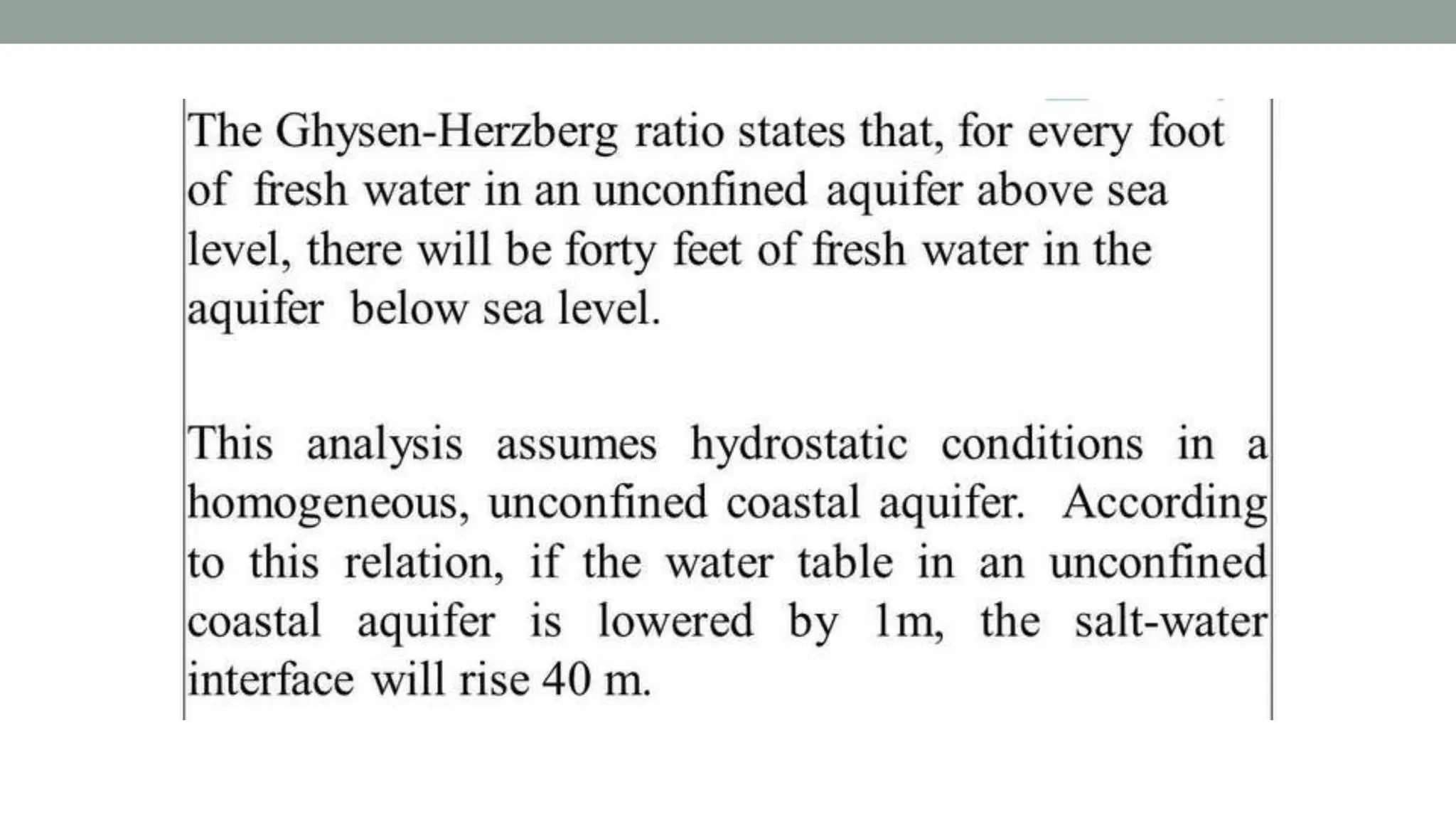
Ghyben Herzberg Relation
GEOPHYSICAL METHODS
OF GROUND WATER
EXPLORATION
Module 3 Part 6
GEOPHYSICAL METHODS OF GROUND WATER
EXPLORATION
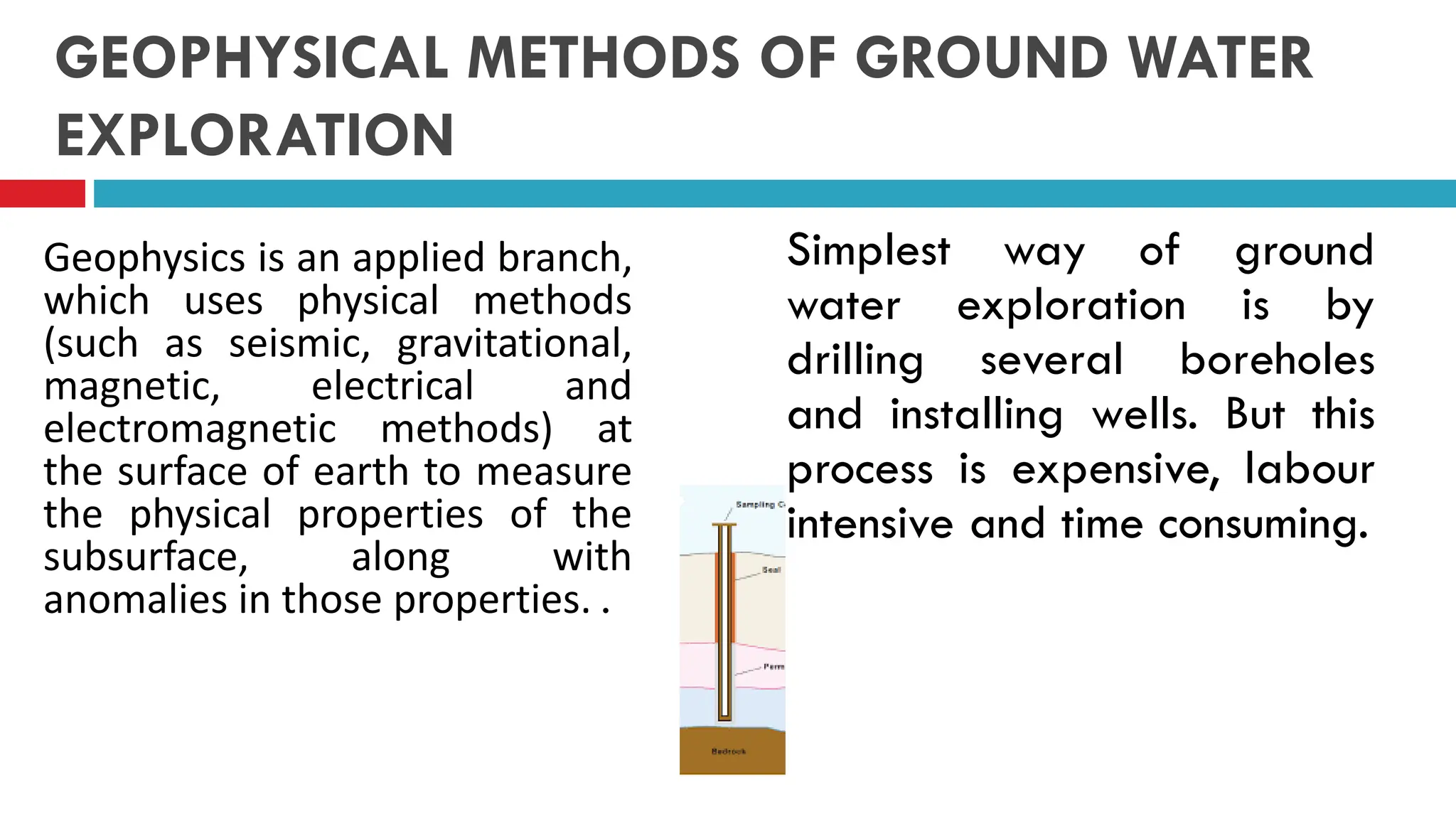
Geophysics is an applied branch,
which uses physical methods
(such as seismic, gravitational,
magnetic, electrical and
electromagnetic methods) at
the surface of earth to measure
the physical properties of the
subsurface, along with
anomalies in those properties. .
Simplest way of ground
water exploration is by
drilling several boreholes
and installing wells. But this
process is expensive, labour
intensive and time consuming.
 Geophysical investigations involve simple methods of study
made on the surface with the aim of ascertaining
subsurface details.
 This is achieved by measuring certain physical properties
and interpreting them mainly in terms of subsurface
geology.
The main advantages of geophysical investigation are,
 These investigation are carried out quickly.
 This means large area can be investigated in a
reasonable short period and hence time is saved
 The geophysical instruments are simple, portable and
can be operated easily
 Less labour involved
 Well-instrumented geophysical surveys provide indirect
evidence of groundwater occurrence at depth.
 The physical, chemical and magnetic properties of soil and
rock formations continuously vary from place to place.
 The electrical and magnetic characteristics are significantly
influenced by presence or absence of saturation in the
formations.
 The electrical conductance of a geological formation varies in
relation to its porosity, saturation and salinity of water it is
holding or transmitting.
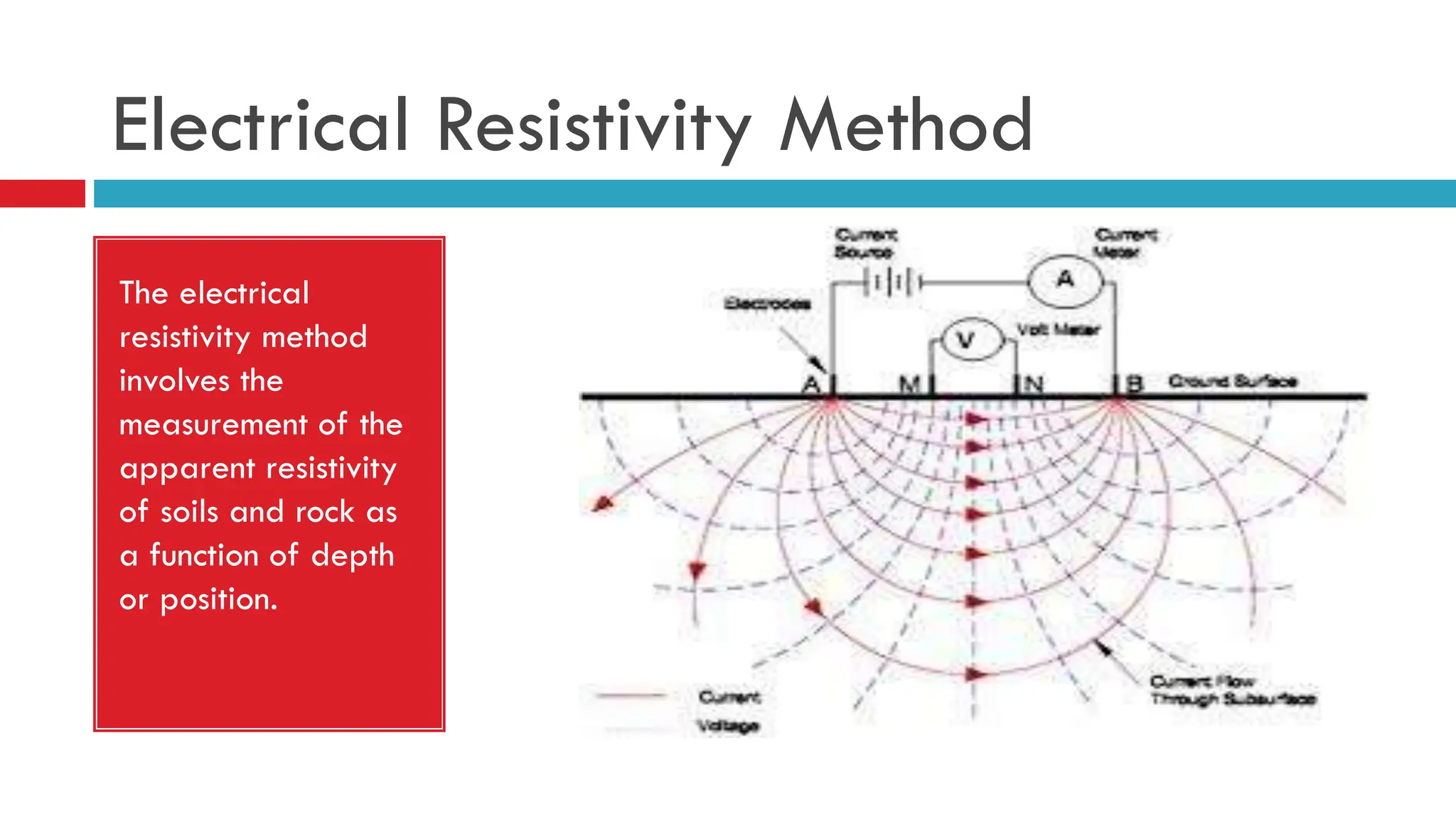
Electrical Resistivity Method
The electrical
resistivity method
involves the
measurement of the
apparent resistivity
of soils and rock as
a function of depth
or position.
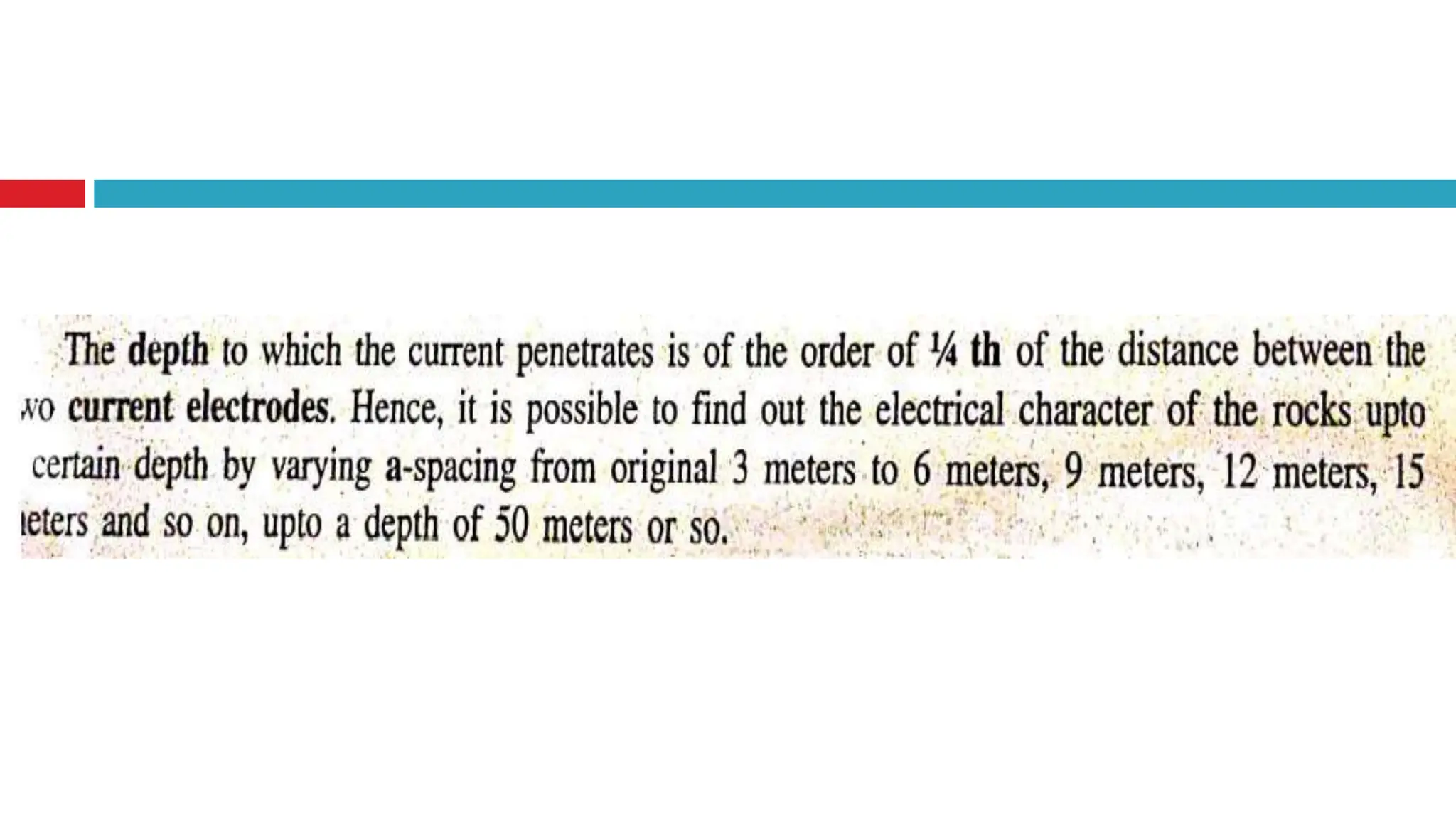
It is based on the observation that water bearing formations are more
conductive and dry zones are resistive to the passage of electric
current.
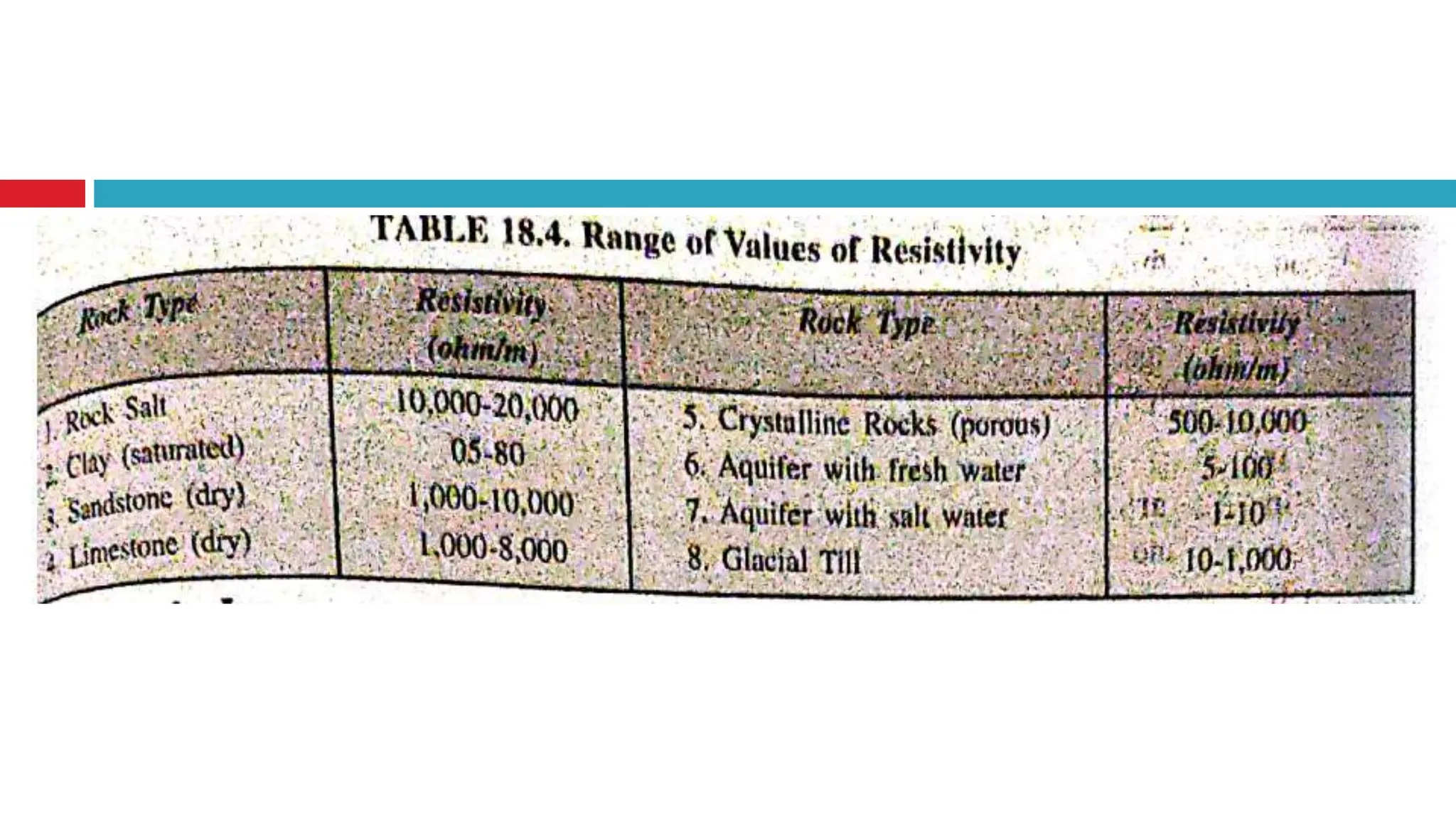
The resistivity of natural materials to the flow of electric current varies
through a wide range.
Passing an electric current of a known quantity through the medium,
and measuring the potential difference between the two points would
determine apparent resistance of sub-surface formations.
By this procedure, it is possible to approximate the saturation or the
dryness of the medium through which the current is transmitting.
Electrical Resistivity Method
Methodology
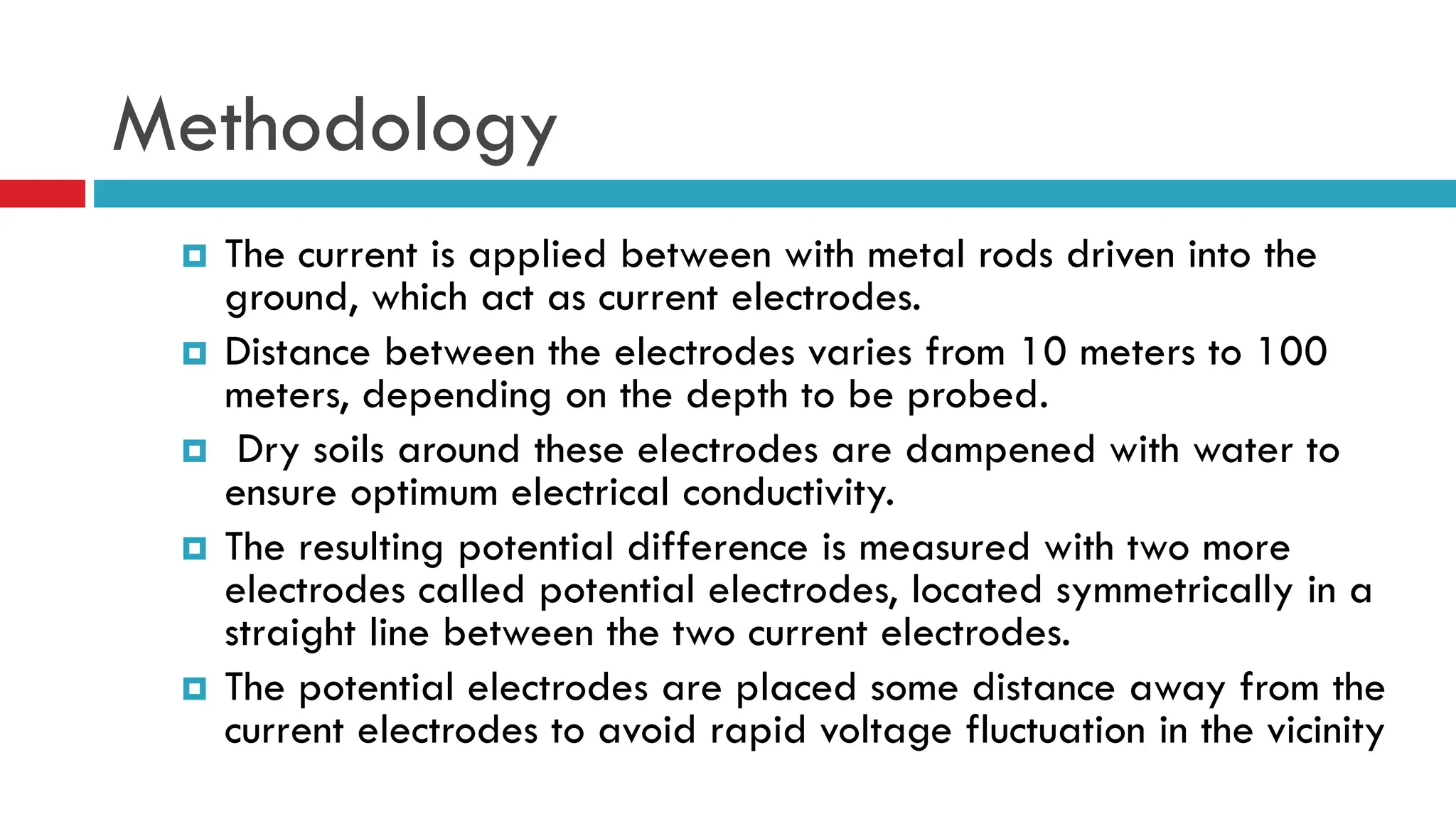
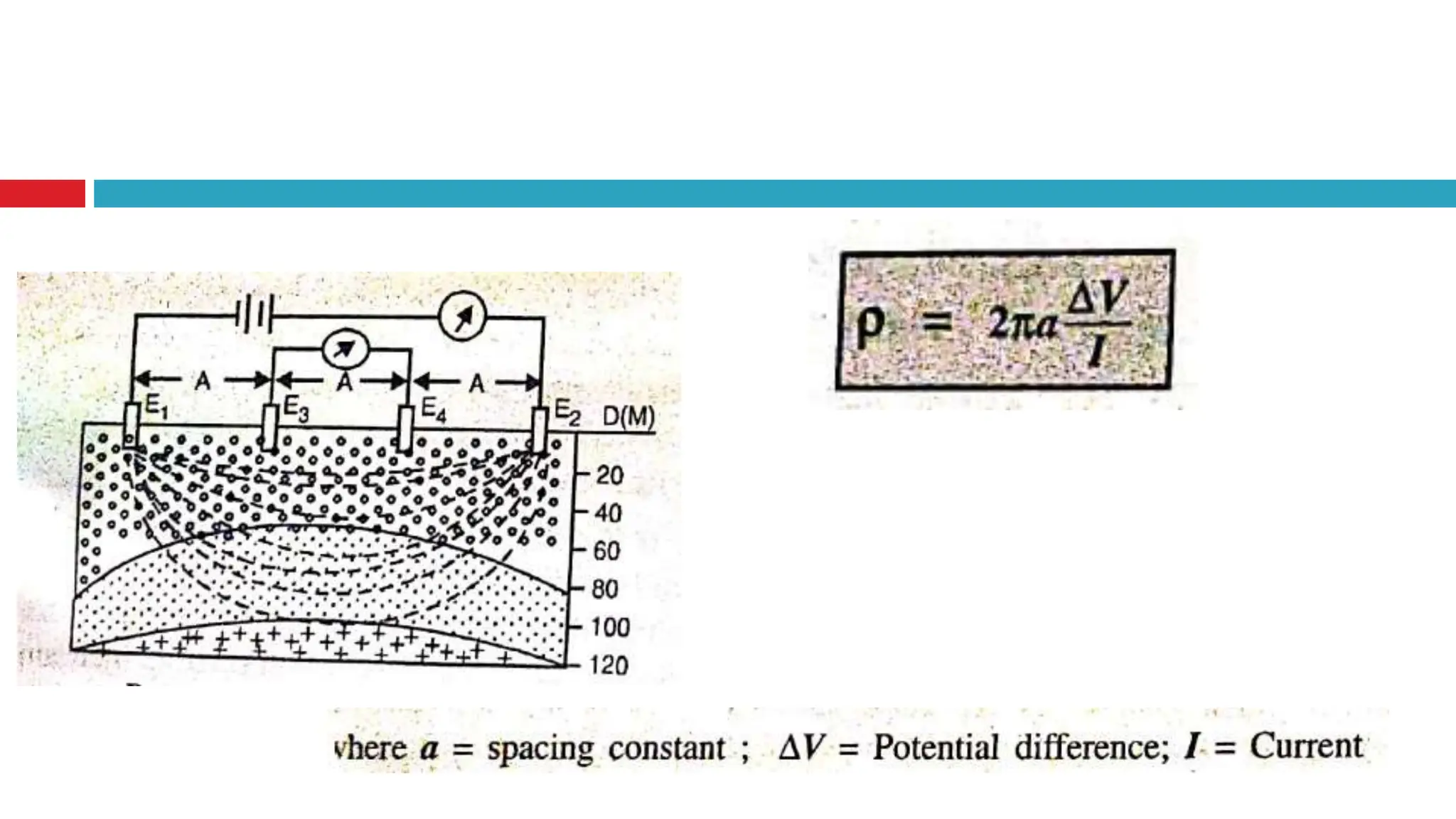
 The current is applied between with metal rods driven into the
ground, which act as current electrodes.
 Distance between the electrodes varies from 10 meters to 100
meters, depending on the depth to be probed.
 Dry soils around these electrodes are dampened with water to
ensure optimum electrical conductivity.
 The resulting potential difference is measured with two more
electrodes called potential electrodes, located symmetrically in a
straight line between the two current electrodes.
 The potential electrodes are placed some distance away from the
current electrodes to avoid rapid voltage fluctuation in the vicinity
Methodology
Electrical Resistivity Method
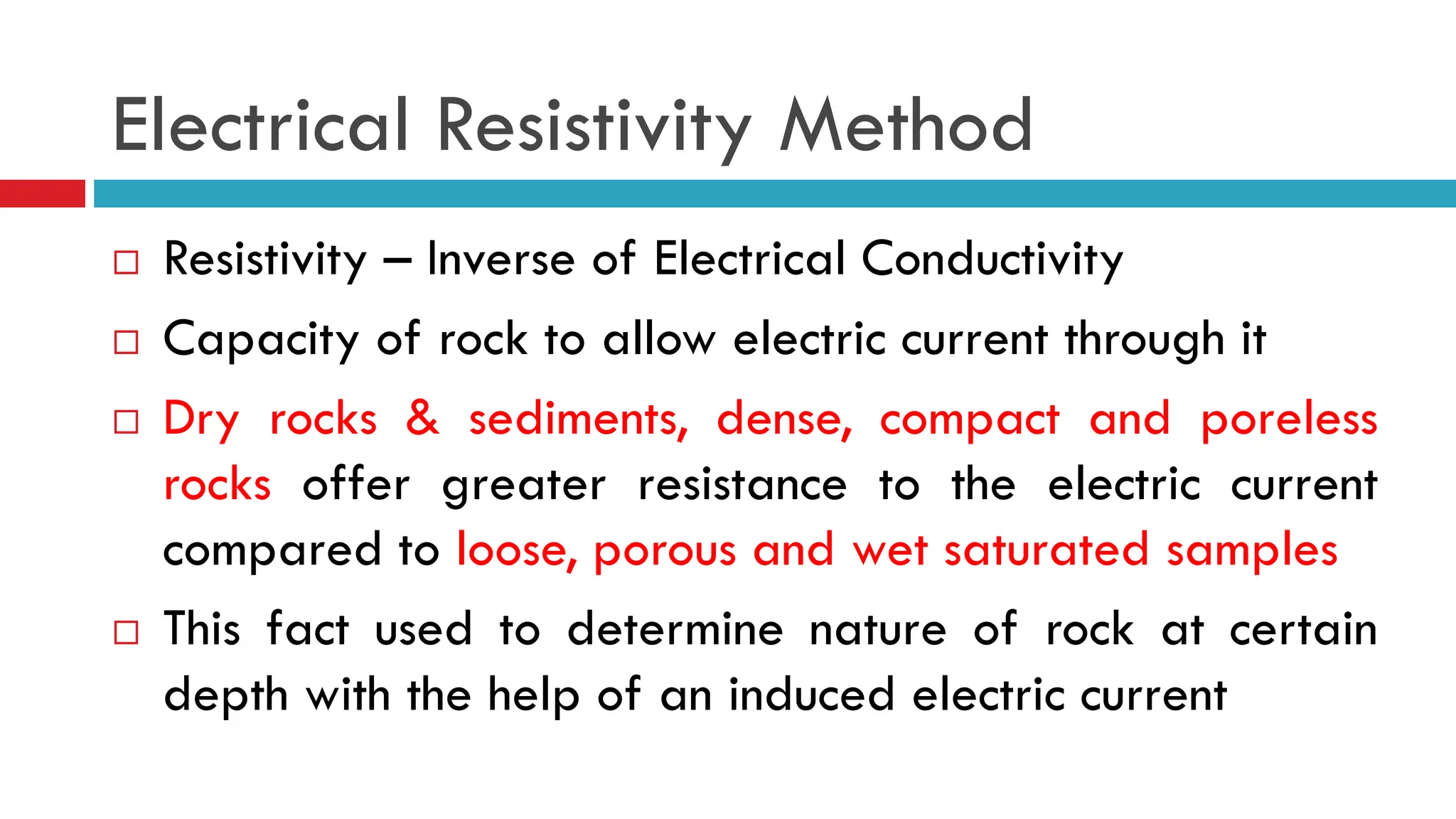
 Resistivity – Inverse of Electrical Conductivity
 Capacity of rock to allow electric current through it
 Dry rocks & sediments, dense, compact and poreless
rocks offer greater resistance to the electric current
compared to loose, porous and wet saturated samples
 This fact used to determine nature of rock at certain
depth with the help of an induced electric current
Types
 Two variations - Electrical sounding & Electrical
Profiling
 Electrical sounding - technique is used to determine
variation in the nature of subsurface material with
increasing depth
 Electrical Profiling – used to determine the areal
extent of various formations upto the same depth
Wenner Configuration
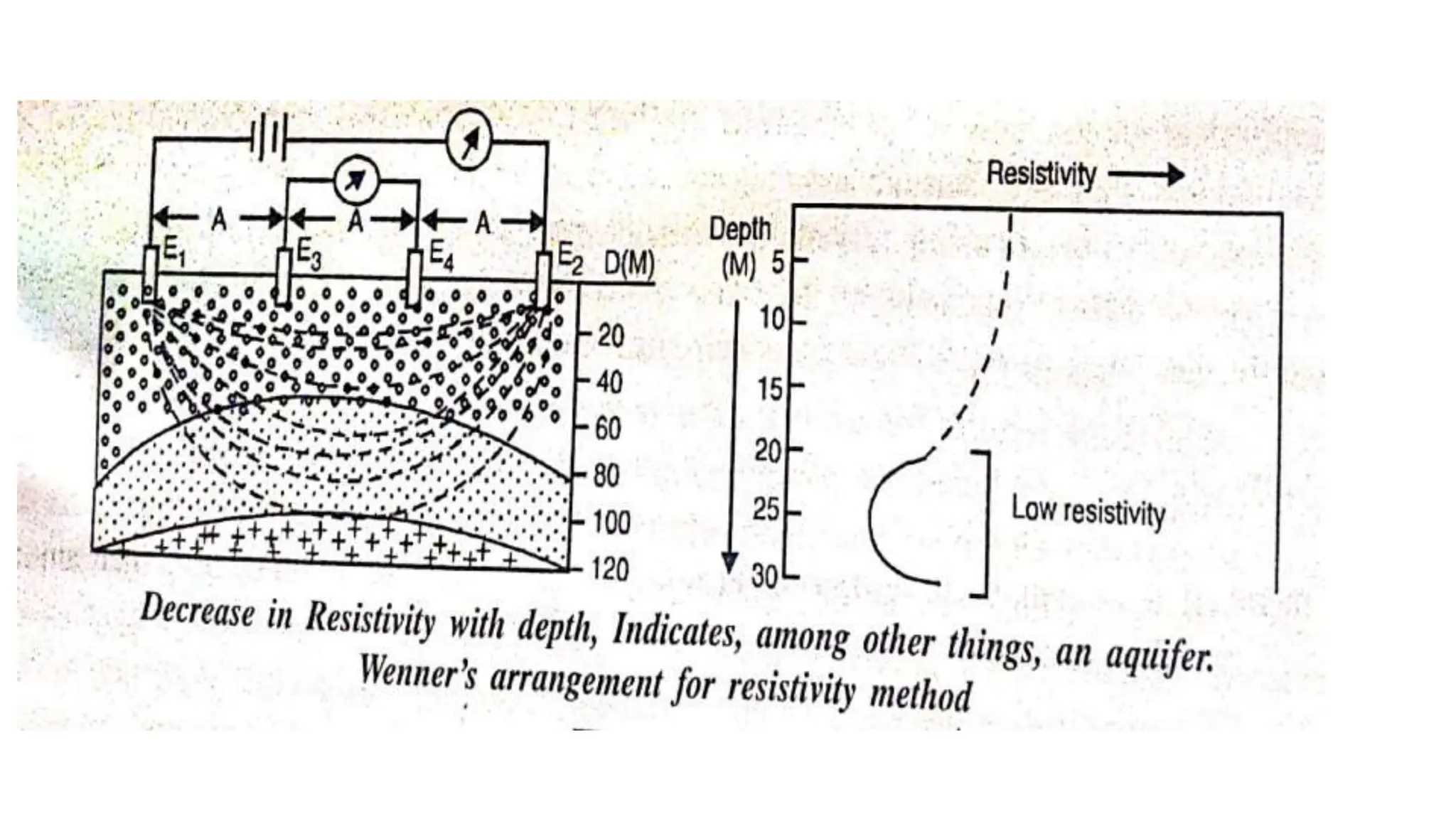
 Procedure – inserting 2 electrodes into the ground
at a specific distance from each other. Direct current
or low frequency AC current is to be introduced
through these electrodes – Current Electrodes
 As the current introduced travels from one electrode
, passes through the material and leaves ground at
other current electrode
 In between the current will meet resistance from the
material and there will be a drop in its potential
 This potential drop is measured through two more
electrodes called potential electrodes that are
inserted in between
 The resistivity measured by these – Apparent
Resistivity
Resistivity Logs
 Obtained by using electrical methods for subsurface
explorations
 Resistivity of rocks depend on their composition,
texture, electrolyte content etc
 Variation in resistivity of rocks encountered in a
borehole is a useful indication of presence of an
aquifer up to the depth of the borehole
Hydrogeology, 431/531 - University of Arizona - Fall 2014 Dr. Marek Zreda
PART 18 Salt-water intrusion
In coastal areas salt water is in contact with fresh ground water. An interface between them can be
described using different fprmulations. Two of them are described below.
Ghyben-Herzberg relation
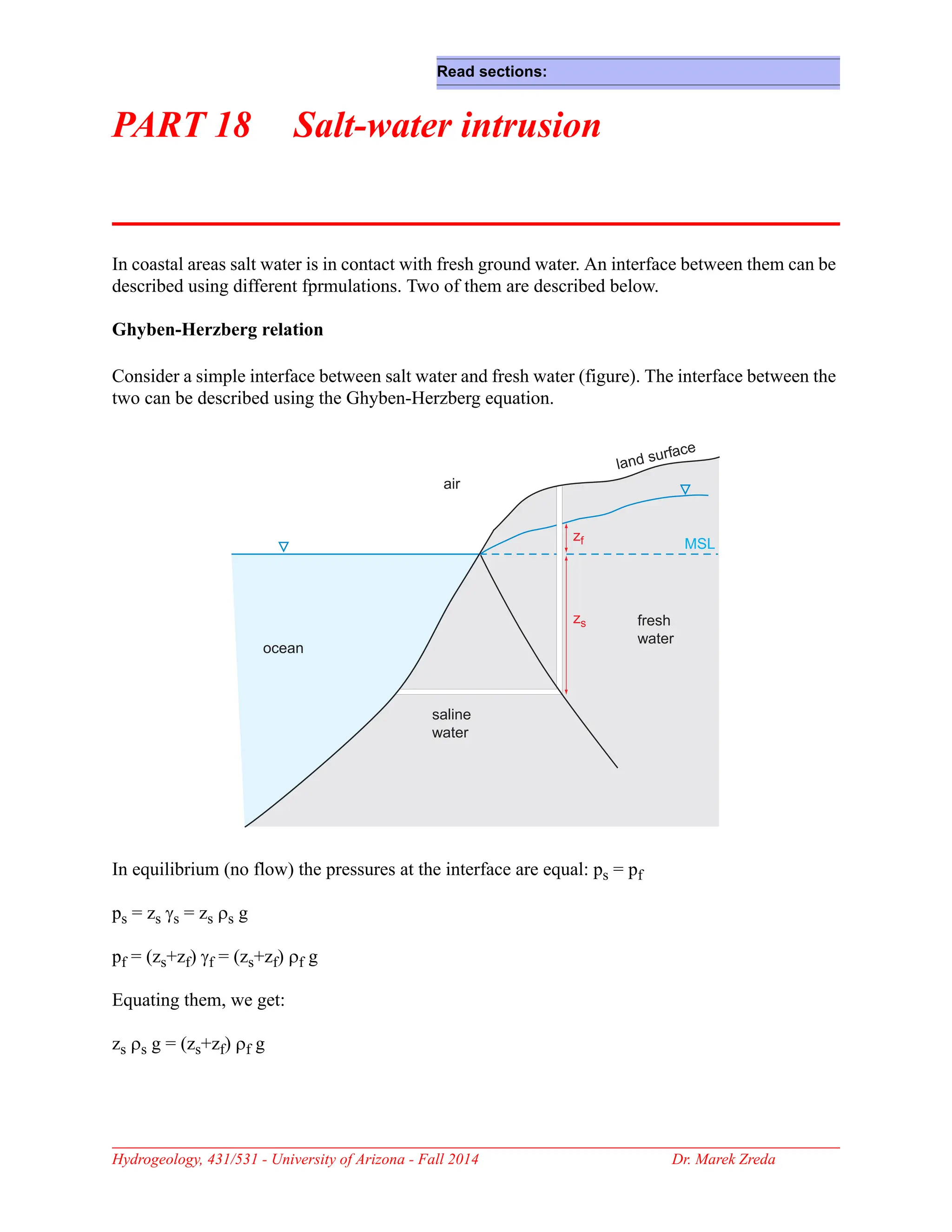
Consider a simple interface between salt water and fresh water (figure). The interface between the
two can be described using the Ghyben-Herzberg equation.
In equilibrium (no flow) the pressures at the interface are equal: ps = pf
ps = zs γs = zs ρs g
pf = (zs+zf) γf = (zs+zf) ρf g
Equating them, we get:
zs ρs g = (zs+zf) ρf g
MSL
ocean
ocean
saline
water
fresh
water
air
zf
zs
land surface
Read sections:
Salt-water intrusion 148
Hydrogeology, 431/531 - University of Arizona - Fall 2014 Dr. Marek Zreda
and solving for zs, we get:
Look at water densities:
sea water: ρs = 1.025 g/cm3
fresh water: ρf = 1.000 g/cm3
Put them in the Ghyben-Herzberg relation:
zs = 1/(1.025-1.000) zf = 40 zf
Thus, there is 40 times more fresh water below the mean sea level than above it. In other words,
for every 1 m of water table elevation above sea level there is 40 m of fresh water below it.
This relation assumes a sharp boundary between salt and fresh water and no dispersion. It also
assumes that fresh water forms a wedge into sea water, and that fresh water discharges into the
ocean at a single point - an impossibility. Other relationships take these into account.
Glover relation
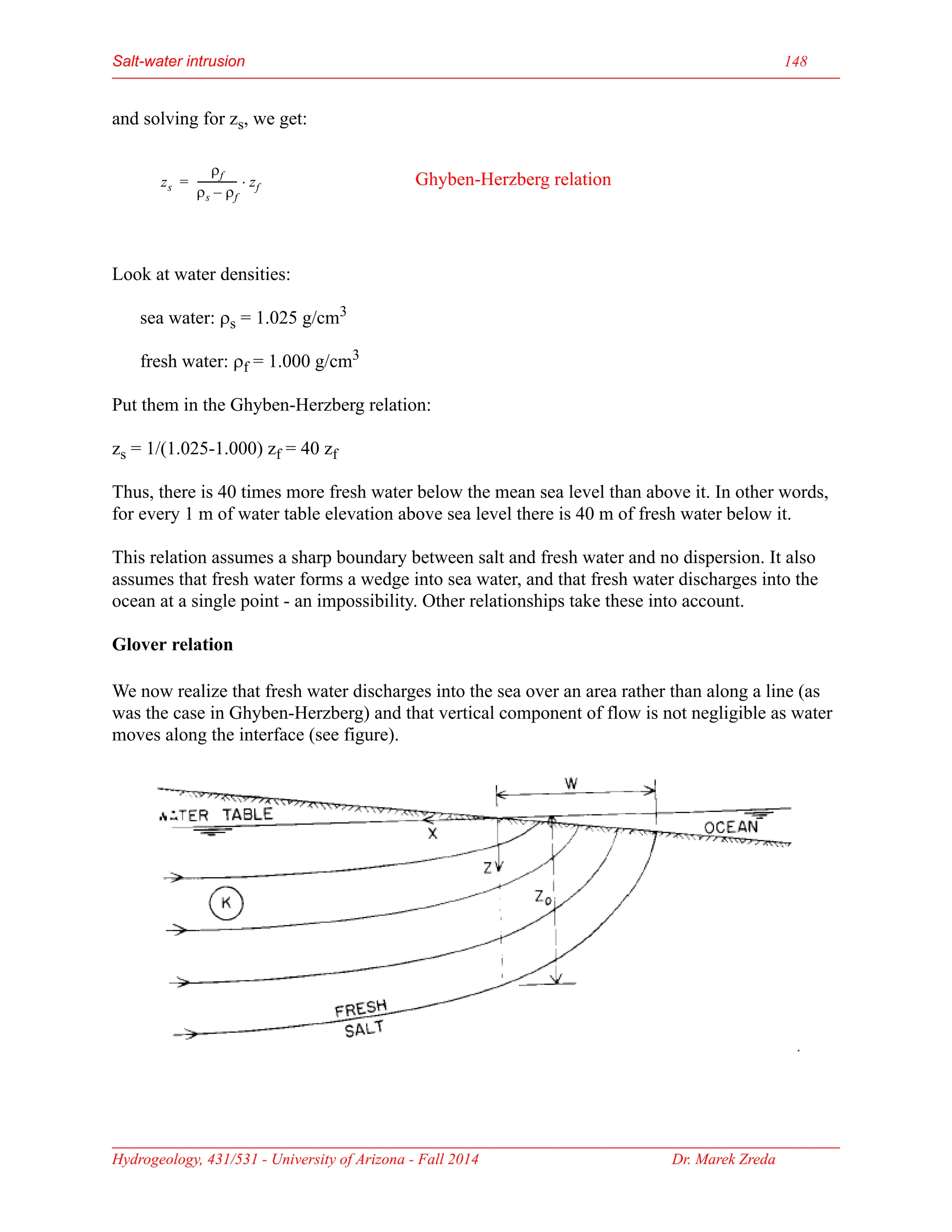
We now realize that fresh water discharges into the sea over an area rather than along a line (as
was the case in Ghyben-Herzberg) and that vertical component of flow is not negligible as water
moves along the interface (see figure).
zs
ρf
ρs ρf
–
--------------- zf
⋅
= Ghyben-Herzberg relation
Hydrogeology, 431/531 - University of Arizona - Fall 2014 Dr. Marek Zreda
Salt-water intrusion 149
Glover developed the following equation for the shape of the freshwater-saltwater interface:
where:Q = flow in aquifer per unit length of shoreline;
K = hydraulic conductivity of aquifer;
x, z = coordinate distances from shoreline (figure).
Using the density of salt water of 1.025 g/cm3 and that of freshwater of 1 g/cm3 and substituting
z=0 into the Glover equation, we compute the width W of the zone through which fresh water
flows into the sea:
By substituting x=0 in the Glover equation, we can compute the depth z0 of the freshwater-saltwa-
ter interface beneath the shoreline:
z
2 2 Q x ρf
⋅ ⋅ ⋅
ρs ρf
–
( ) K
⋅
----------------------------
-
Q ρf
⋅
ρs ρf
–
( ) K
⋅
----------------------------
-
 
 
2
+
= Glover equation
W
Q ρf
⋅
2 ρs ρf
–
( ) K
⋅
-------------------------------
-
=
z0
Q ρf
⋅
ρs ρf
–
( ) K
⋅
----------------------------
-
=
Salt-water intrusion 150
Hydrogeology, 431/531 - University of Arizona - Fall 2014 Dr. Marek Zreda
Pumping of coastal aquifer
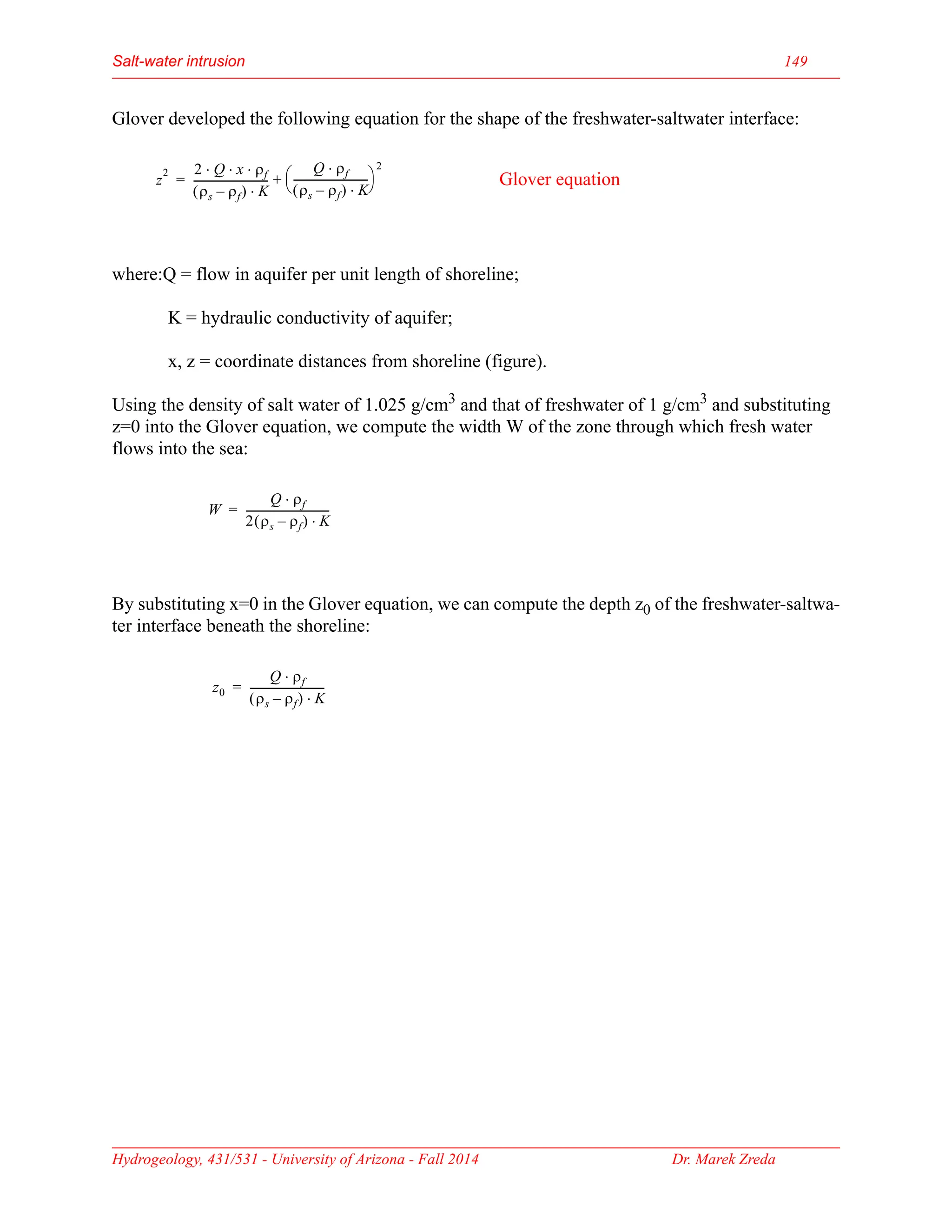
Pumping results in declining water table (cone of depression). Because for every meter of drop of
the water table the salt water will rise 40 m (see Ghyben-Herzberg equation), the depth to fresh-
water-saltwater interface will decrease fast and so will the volume of freshwater in the aquifer.
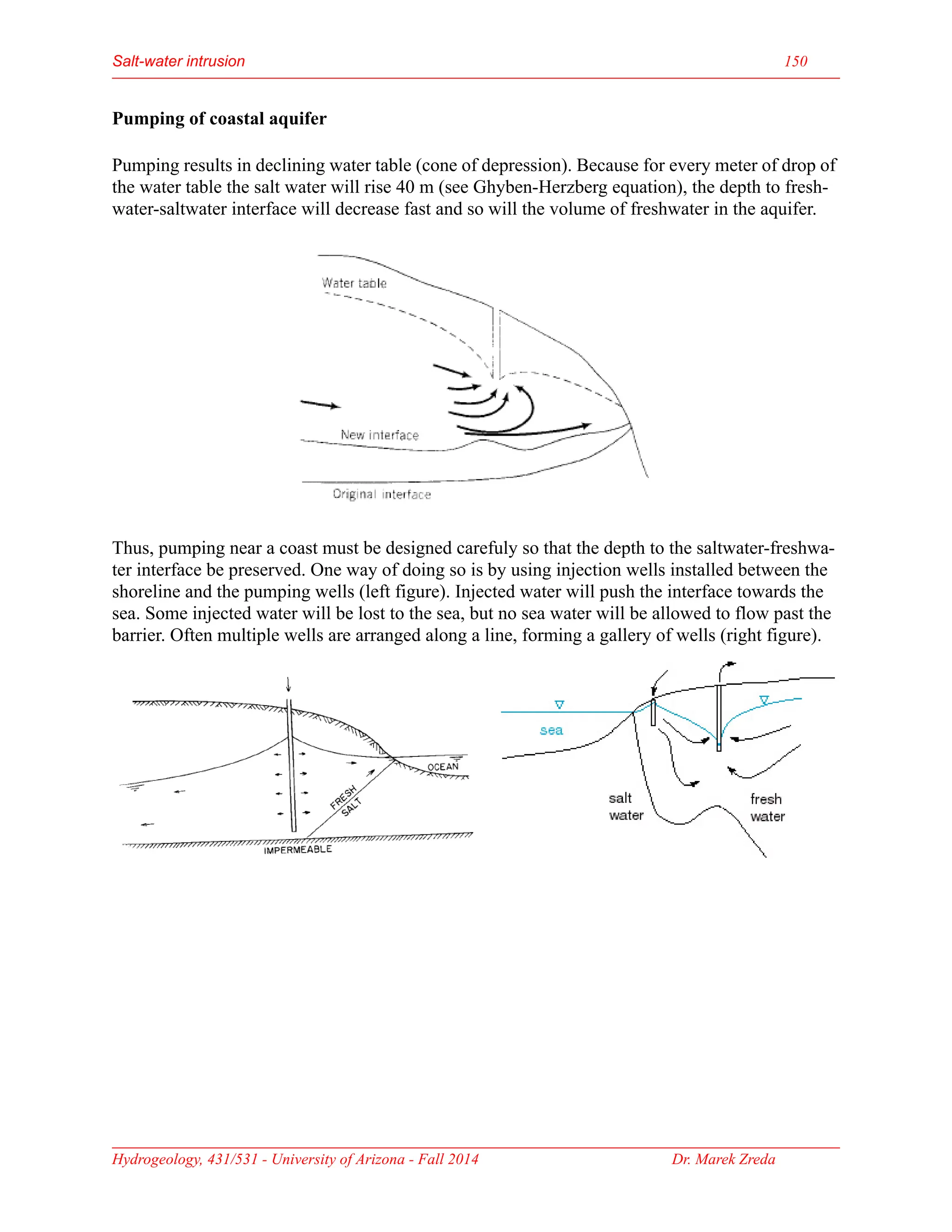
Thus, pumping near a coast must be designed carefuly so that the depth to the saltwater-freshwa-
ter interface be preserved. One way of doing so is by using injection wells installed between the
shoreline and the pumping wells (left figure). Injected water will push the interface towards the
sea. Some injected water will be lost to the sea, but no sea water will be allowed to flow past the
barrier. Often multiple wells are arranged along a line, forming a gallery of wells (right figure).

module 4 geology apj Abdul kalam university ktu part 2

  • 1.
    Groundwater • Found inthe subsurface, inside pores within soil and rock • Groundwater is the largest source of freshwater on earth, and was little used until recently. • It is usually much cleaner than surface water. • The depth at which soil pore spaces or fractures and voids in rock become completely saturated with water is called the water table
  • 2.
    Aquifers • A geologicformation which contains water and transmits it from one point to another in quantities sufficient to permit economic development is called an aquifer. • Water-bearing geologic formation that can store and yield usable amounts of water • Aquifers are usually saturated sands, gravel, fractured rock, or cavernous and vesicular rock. • Aquifers may occur at various depths
  • 3.
    Types of Aquifers 1-Confined Aquifer 2- Unconfined Aquifer
  • 4.
  • 6.
    Confined aquifer • Anaquifer which is sandwiched between two layers of less permeable material is called confined aquifer. • A confined aquifer is a water-bearing stratum that is confined or overlain by a rock layer that does not transmit water in any appreciable amount or that is impermeable. • These are separated from the ground surface by an impermeable layer and are generally at greater depths than unconfined aquifers. Also know as an artesian aquifer.
  • 8.
    Unconfined aquifer • Anunconfined aquifer is one that is open to receive water from the surface, and whose water table surface is free to fluctuate up and down, depending on the recharge/discharge rate. There are no overlying "confining beds" of low permeability to physically isolate the groundwater system.
  • 9.
    • Unconfined aquifersare sometimes also called water table or phreatic aquifers, because their upper boundary is the water table • When water can flow directly between the surface and the saturated zone of an aquifer, the aquifer is unconfined. • The deeper parts of unconfined aquifers are usually more saturated since gravity causes water to flow downward.
  • 10.
    AQUICLUDE • It isa solid, impermeable area underlying or overlying an aquifer. If the impermeable area overlies the aquifer pressure could cause it to become a confined aquifer. • It can absorb water but cannot transmit it in significant amount. Eg:clay and shale
  • 11.
    AQUIFUGE: • An impermeablebody of rock which contains no interconnected openings or interstices and therefore neither absorbs nor transmits water. Example: compact interlocking granite AQUITARD: • A bed of low permeability and yield water slowly in comparison to t he adjoining aquifer is known as aquitard. Sandy clay is an example of aquitard.
  • 13.
    PROPERTIES OF THEAQUIFER i) Porosity ii) Specific yield iii) Specific retention iv) Storage by efficiency ( field capacity) v) Permeability vi) Transmissibility
  • 14.
    POROSITY: • Porosity orvoid fraction is a measure of the void (i.e., "empty") spaces in a material, and is a fraction of the volume of voids over the total volume, between 0–1, or as a percentage between 0–100%. • Porosity of surface soil typically decreases as particle size increases.
  • 15.
  • 16.
    PERMEABILITY • Just asthe porosity of a soil affects how much water it can hold, it also affects how quickly water can flow through the soil. • The ability of water to flow through a soil is referred to as the soil's permeability.
  • 17.
    SPECIFIC YIELD • Thequantity of water which a unit volume of aquifer, after being saturated, will yield by gravity; it is expressed either as a ratio or as a percentage of the volume of the aquifer; specific yield is a measure of the water available to wells.
  • 18.
    SPECIFIC RETENTION: • Theratio of the volume of water that a given body of rock or soil will hold against the pull of gravity to the volume of the body itself. It is usually expressed as a percentage FIELD CAPACITY: • Field capacity is the amount of soil moisture or water content held in soil after excess water has drained away . • The physical definition of field capacity is the bulk water content retained in soil
  • 19.
    Transmissivity • The capabilityof an entire aquifer to transmit the water. • Transmissivity “T” has dimension s of m2 /day • Value of T range <12.4 to 12,400m2/day T= kb where, k= hydraulic conductivity b= thickness of the aquifer
  • 20.
    Hydraulic conductivity • Thehydraulic conductivity K, may be defined as the flow velocity per unit hydraulic gradient. expressed as meters/day or meters /second. • The quantitative measurement of flow or water is generally expressed by the term hydraulic conductivity rather than permeability.
  • 21.
    Artesian aquifer • Anartesian aquifer is a confinedaquifer containing groundwater under positive pressure. • A well drilled into such an aquifer is called an artesian well. If water reaches the ground surface under the natural pressure of the aquifer, the well is called a flowing artesian well
  • 23.
  • 25.
    Sea water Intrusion •Saltwater intrusion is the movement of saline water into freshwater aquifers, which can lead to groundwater quality degradation, including drinking water sources, and other consequences. • Seawater intrusion associated with groundwater overdraft and lowering of groundwater levels has occurred in many of the coastal aquifers. • The extent of seawater intrusion varies widely among localities and hydrogeological settings. Quantifying the extent and rate of seawater intrusion is key to sustainable management and use of groundwater resources. This involves understanding the aquifer-ocean interconnection, and distinguishing among multiple sources of saline water.
  • 26.
    Process of Seawater Intrusion The boundary between fresh groundwater and saltwater is referred to as the freshwater/saltwater interface. Fresh groundwater discharging to the coast prevents the landward encroachment of saltwater. If too much freshwater is pumped from the aquifer system, then saltwater can migrate landward by a process referred to as “saltwater intrusion.” If a pumping well is close to the landward migrating freshwater/saltwater interface, saltwater could enter the well and contaminate the water supply, too..
  • 27.
  • 29.
  • 30.
  • 32.
  • 35.
  • 40.
  • 44.
    GEOPHYSICAL METHODS OF GROUNDWATER EXPLORATION Module 3 Part 6
  • 45.
    GEOPHYSICAL METHODS OFGROUND WATER EXPLORATION Geophysics is an applied branch, which uses physical methods (such as seismic, gravitational, magnetic, electrical and electromagnetic methods) at the surface of earth to measure the physical properties of the subsurface, along with anomalies in those properties. . Simplest way of ground water exploration is by drilling several boreholes and installing wells. But this process is expensive, labour intensive and time consuming.
  • 46.
     Geophysical investigationsinvolve simple methods of study made on the surface with the aim of ascertaining subsurface details.  This is achieved by measuring certain physical properties and interpreting them mainly in terms of subsurface geology.
  • 47.
    The main advantagesof geophysical investigation are,  These investigation are carried out quickly.  This means large area can be investigated in a reasonable short period and hence time is saved  The geophysical instruments are simple, portable and can be operated easily  Less labour involved
  • 48.
     Well-instrumented geophysicalsurveys provide indirect evidence of groundwater occurrence at depth.  The physical, chemical and magnetic properties of soil and rock formations continuously vary from place to place.  The electrical and magnetic characteristics are significantly influenced by presence or absence of saturation in the formations.  The electrical conductance of a geological formation varies in relation to its porosity, saturation and salinity of water it is holding or transmitting.
  • 49.
    Electrical Resistivity Method Theelectrical resistivity method involves the measurement of the apparent resistivity of soils and rock as a function of depth or position.
  • 50.
    It is basedon the observation that water bearing formations are more conductive and dry zones are resistive to the passage of electric current. The resistivity of natural materials to the flow of electric current varies through a wide range. Passing an electric current of a known quantity through the medium, and measuring the potential difference between the two points would determine apparent resistance of sub-surface formations. By this procedure, it is possible to approximate the saturation or the dryness of the medium through which the current is transmitting. Electrical Resistivity Method
  • 51.
    Methodology  The currentis applied between with metal rods driven into the ground, which act as current electrodes.  Distance between the electrodes varies from 10 meters to 100 meters, depending on the depth to be probed.  Dry soils around these electrodes are dampened with water to ensure optimum electrical conductivity.  The resulting potential difference is measured with two more electrodes called potential electrodes, located symmetrically in a straight line between the two current electrodes.  The potential electrodes are placed some distance away from the current electrodes to avoid rapid voltage fluctuation in the vicinity
  • 52.
  • 53.
    Electrical Resistivity Method Resistivity – Inverse of Electrical Conductivity  Capacity of rock to allow electric current through it  Dry rocks & sediments, dense, compact and poreless rocks offer greater resistance to the electric current compared to loose, porous and wet saturated samples  This fact used to determine nature of rock at certain depth with the help of an induced electric current
  • 54.
    Types  Two variations- Electrical sounding & Electrical Profiling  Electrical sounding - technique is used to determine variation in the nature of subsurface material with increasing depth  Electrical Profiling – used to determine the areal extent of various formations upto the same depth
  • 55.
    Wenner Configuration  Procedure– inserting 2 electrodes into the ground at a specific distance from each other. Direct current or low frequency AC current is to be introduced through these electrodes – Current Electrodes  As the current introduced travels from one electrode , passes through the material and leaves ground at other current electrode
  • 56.
     In betweenthe current will meet resistance from the material and there will be a drop in its potential  This potential drop is measured through two more electrodes called potential electrodes that are inserted in between  The resistivity measured by these – Apparent Resistivity
  • 60.
    Resistivity Logs  Obtainedby using electrical methods for subsurface explorations  Resistivity of rocks depend on their composition, texture, electrolyte content etc  Variation in resistivity of rocks encountered in a borehole is a useful indication of presence of an aquifer up to the depth of the borehole
  • 62.
    Hydrogeology, 431/531 -University of Arizona - Fall 2014 Dr. Marek Zreda PART 18 Salt-water intrusion In coastal areas salt water is in contact with fresh ground water. An interface between them can be described using different fprmulations. Two of them are described below. Ghyben-Herzberg relation Consider a simple interface between salt water and fresh water (figure). The interface between the two can be described using the Ghyben-Herzberg equation. In equilibrium (no flow) the pressures at the interface are equal: ps = pf ps = zs γs = zs ρs g pf = (zs+zf) γf = (zs+zf) ρf g Equating them, we get: zs ρs g = (zs+zf) ρf g MSL ocean ocean saline water fresh water air zf zs land surface Read sections:
  • 63.
    Salt-water intrusion 148 Hydrogeology,431/531 - University of Arizona - Fall 2014 Dr. Marek Zreda and solving for zs, we get: Look at water densities: sea water: ρs = 1.025 g/cm3 fresh water: ρf = 1.000 g/cm3 Put them in the Ghyben-Herzberg relation: zs = 1/(1.025-1.000) zf = 40 zf Thus, there is 40 times more fresh water below the mean sea level than above it. In other words, for every 1 m of water table elevation above sea level there is 40 m of fresh water below it. This relation assumes a sharp boundary between salt and fresh water and no dispersion. It also assumes that fresh water forms a wedge into sea water, and that fresh water discharges into the ocean at a single point - an impossibility. Other relationships take these into account. Glover relation We now realize that fresh water discharges into the sea over an area rather than along a line (as was the case in Ghyben-Herzberg) and that vertical component of flow is not negligible as water moves along the interface (see figure). zs ρf ρs ρf – --------------- zf ⋅ = Ghyben-Herzberg relation
  • 64.
    Hydrogeology, 431/531 -University of Arizona - Fall 2014 Dr. Marek Zreda Salt-water intrusion 149 Glover developed the following equation for the shape of the freshwater-saltwater interface: where:Q = flow in aquifer per unit length of shoreline; K = hydraulic conductivity of aquifer; x, z = coordinate distances from shoreline (figure). Using the density of salt water of 1.025 g/cm3 and that of freshwater of 1 g/cm3 and substituting z=0 into the Glover equation, we compute the width W of the zone through which fresh water flows into the sea: By substituting x=0 in the Glover equation, we can compute the depth z0 of the freshwater-saltwa- ter interface beneath the shoreline: z 2 2 Q x ρf ⋅ ⋅ ⋅ ρs ρf – ( ) K ⋅ ---------------------------- - Q ρf ⋅ ρs ρf – ( ) K ⋅ ---------------------------- -     2 + = Glover equation W Q ρf ⋅ 2 ρs ρf – ( ) K ⋅ ------------------------------- - = z0 Q ρf ⋅ ρs ρf – ( ) K ⋅ ---------------------------- - =
  • 65.
    Salt-water intrusion 150 Hydrogeology,431/531 - University of Arizona - Fall 2014 Dr. Marek Zreda Pumping of coastal aquifer Pumping results in declining water table (cone of depression). Because for every meter of drop of the water table the salt water will rise 40 m (see Ghyben-Herzberg equation), the depth to fresh- water-saltwater interface will decrease fast and so will the volume of freshwater in the aquifer. Thus, pumping near a coast must be designed carefuly so that the depth to the saltwater-freshwa- ter interface be preserved. One way of doing so is by using injection wells installed between the shoreline and the pumping wells (left figure). Injected water will push the interface towards the sea. Some injected water will be lost to the sea, but no sea water will be allowed to flow past the barrier. Often multiple wells are arranged along a line, forming a gallery of wells (right figure).