Graphical representation of
water quality data
Ishica
M.Sc. Geology 3rd Semester
Department of Geology, University of Delhi
Contents
• Concept of hydro chemical sequence and facies
• Graphical representation
• Case study
• Conclusion
• Groundwater: moves along flowlines from recharge to discharge areas, and its chemistry is altered by the effects of a
variety of geochemical processes.
Chemistry of Precipitation
• The chemical composition of water that arrives on the ground surface can be determined by inspection of chemical
analyses of rain and snow.
• The rain and snowmelt are extremely dilute, slightly to moderately acidic, oxidizing solutions that can quickly cause
chemical alterations in soils or in geological materials into which they infiltrate.
Carbon dioxide in soil zone
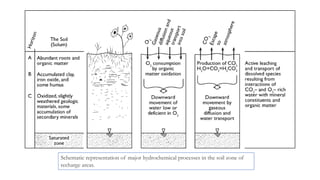
• The soil has a capability to generate relatively large amounts of acid and to consume much or all of the available
dissolved oxygen in the water that infiltrates it.
• Geochemically, the most important acid produced in the soil zone is H2CO3, derived from the reaction of CO2 and
H2O.As new water from recharge events passes through the soil, biochemical and hydro-chemical processes in the soil
are therefore capable of providing a continuing supply of acidity to promote mineral-water reactions.
• Organic acids : Humic acids and fulvic acids, plays a major role in the development of soil profiles and in the
transport of dissolved constituents downward toward the water table
Concept of hydro-chemical sequence
Schematic representation of major hydrochemical processes in the soil zone of
recharge areas.
Major-Ion Evolution Sequence
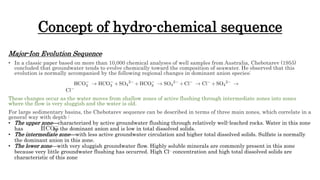
• In a classic paper based on more than 10,000 chemical analyses of well samples from Australia, Chebotarev (1955)
concluded that groundwater tends to evolve chemically toward the composition of seawater. He observed that this
evolution is normally accompanied by the following regional changes in dominant anion species:
These changes occur as the water moves from shallow zones of active flushing through intermediate zones into zones
where the flow is very sluggish and the water is old.
For large sedimentary basins, the Chebotarev sequence can be described in terms of three main zones, which correlate in a
general way with depth :
• The upper zone—characterized by active groundwater flushing through relatively well-leached rocks. Water in this zone
has as the dominant anion and is low in total dissolved solids.
• The intermediate zone—with less active groundwater circulation and higher total dissolved solids. Sulfate is normally
the dominant anion in this zone.
• The lower zone—with very sluggish groundwater flow. Highly soluble minerals are commonly present in this zone
because very little groundwater flushing has occurred. High Cl– concentration and high total dissolved solids are
characteristic of this zone
Concept of hydro-chemical sequence
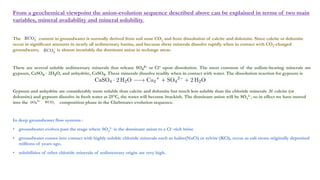
From a geochemical viewpoint the anion-evolution sequence described above can be explained in terms of two main
variables, mineral availability and mineral solubility.
The content in groundwater is normally derived from soil zone CO2 and from dissolution of calcite and dolomite. Since calcite or dolomite
occur in significant amounts in nearly all sedimentary basins, and because these minerals dissolve rapidly when in contact with CO2-charged
groundwater, is almost invariably the dominant anion in recharge areas.
There are several soluble sedimentary minerals that release SO4
2– or Cl– upon dissolution. The most common of the sulfate-bearing minerals are
gypsum, CaSO4 · 2H2O, and anhydrite, CaSO4. These minerals dissolve readily when in contact with water. The dissolution reaction for gypsum is
Gypsum and anhydrite are considerably more soluble than calcite and dolomite but much less soluble than the chloride minerals .If calcite (or
dolomite) and gypsum dissolve in fresh water at 25°C, the water will become brackish. The dominant anion will be SO4
2–, so in effect we have moved
into the composition phase in the Chebotarev evolution sequence.
In deep groundwater flow systems :
• groundwater evolves past the stage where SO4
2– is the dominant anion to a Cl–-rich brine
• groundwater comes into contact with highly soluble chloride minerals such as halite(NaCl) or sylvite (KCl), occur as salt strata originally deposited
millions of years ago.
• solubilities of other chloride minerals of sedimentary origin are very high.
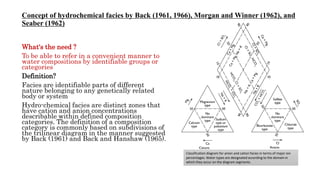
Concept of hydrochemical facies by Back (1961, 1966), Morgan and Winner (1962), and
Seaber (1962)
What's the need ?
To be able to refer in a convenient manner to
water compositions by identifiable groups or
categories
Definition?
Facies are identifiable parts of different
nature belonging to any genetically related
body or system
Hydro-chemical facies are distinct zones that
have cation and anion concentrations
describable within defined composition
categories. The definition of a composition
category is commonly based on subdivisions of
the trilinear diagram in the manner suggested
by Back (1961) and Back and Hanshaw (1965).
Classification diagram for anion and cation facies in terms of major ion
percentages. Water types are designated according to the domain in
which they occur on the diagram segments.
Graphical
Representation
Compiling and presenting chemical data in a simple format for visual inspection is a
crucial responsibility in groundwater research. Several widely used graphical
approaches are available for this purpose.
The quality of the groundwater resources is deduced from their interpretation.
They can be used to compare analyses, highlight similarities and contrasts, and for
presentation reasons.
They describes variations in groundwater flow systems' major-ion chemistry.
Graphical method are used in representing groundwater samples, of which the most
used are:
• Vertical bar chart
• Radiating vector plots
• Circular diagram
• Stiff diagrams
• Piper trilinear diagram
• Schoeller semi log diagram
• Durov’s diagram
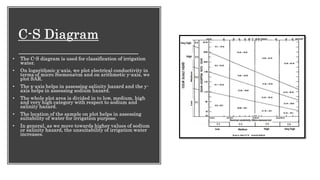
• CS diagram
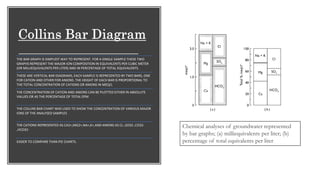
THE BAR GRAPH IS SIMPLEST WAY TO REPRESENT. FOR A SINGLE SAMPLE THESE TWO
GRAPHS REPRESENT THE MAJOR-ION COMPOSITION IN EQUIVALENTS PER CUBIC METER
(OR MILLIEQUIVALENTS PER LITER) AND IN PERCENTAGE OF TOTAL EQUIVALENTS.
THESE ARE VERTICAL BAR DIAGRAMS, EACH SAMPLE IS REPRESENTED BY TWO BARS, ONE
FOR CATION AND OTHER FOR ANIONS. THE HEIGHT OF EACH BAR IS PROPORTIONAL TO
THE TOTAL CONCENTRATION OF CATIONS OR ANIONS IN MEQ/L
THE CONCENTRATION OF CATION AND ANIONS CAN BE PLOTTED EITHER IN ABSOLUTE
VALUES OR AS THE PERCENTAGE OF TOTAL EPM
THE COLLINS BAR CHART WAS USED TO SHOW THE CONCENTRATION OF VARIOUS MAJOR
IONS OF THE ANALYSED SAMPLES
THE CATIONS REPRESENTED AS CA2+,MG2+,NA+,K+,AND ANIONS AS CL-,SO32-,CO32-
,HCO32-
EASIER TO COMPARE THAN PIE CHARTS.
Chemical analyses of groundwater represented
by bar graphs; (a) milliequivalents per liter; (b)
percentage of total equivalents per liter
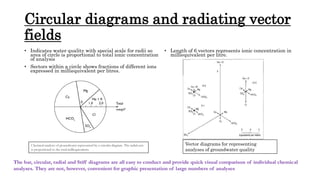
Circular diagrams and radiating vector
fields
• Indicates water quality with special scale for radii so
area of circle is proportional to total ionic concentration
of analysis
• Sectors within a circle shows fractions of different ions
expressed in milliequivalent per litres.
• Length of 6 vectors represents ionic concentration in
milliequivalent per litre.
Chemical analysis of groundwater represented by a circular diagram. The radial axis
is proportional to the total milliequivalents.
Vector diagrams for representing
analyses of groundwater quality
The bar, circular, radial and Stiff diagrams are all easy to conduct and provide quick visual comparison of individual chemical
analyses. They are not, however, convenient for graphic presentation of large numbers of analyses
Stiff Diagram
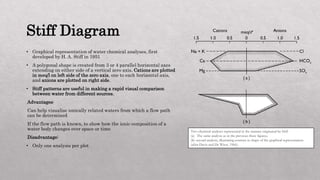
• Graphical representation of water chemical analyses, first
developed by H. A. Stiff in 1951
• A polygonal shape is created from 3 or 4 parallel horizontal axes
extending on either side of a vertical zero axis. Cations are plotted
in meq/l on left side of the zero axis, one to each horizontal axis,
and anions are plotted on right side.
• Stiff patterns are useful in making a rapid visual comparison
between water from different sources.
Advantages:
Can help visualise ionically related waters from which a flow path
can be determined
If the flow path is known, to show how the ionic composition of a
water body changes over space or time
Disadvantage:
• Only one analysis per plot
Two chemical analyses represented in the manner originated by Stiff.
(a) The same analysis as in the previous three figures;
(b) second analysis, illustrating contrast in shape of the graphical representation
(after Davis and De Wiest, 1966).
Piper Tri-linear
Diagram
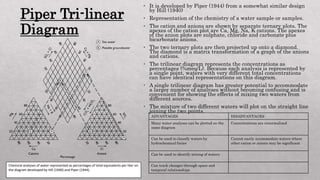
• It is developed by Piper (1944) from a somewhat similar design
by Hill (1940)
• Representation of the chemistry of a water sample or samples.
• The cation and anions are shown by separate ternary plots. The
apexes of the cation plot are Ca, Mg, Na, K cations. The apexes
of the anion plots are sulphate, chloride and carbonate plus
bicarbonate anions.
• The two ternary plots are then projected up onto a diamond.
The diamond is a matrix transformation of a graph of the anions
and cations.
• The trilinear diagram represents the concentrations as
percentages (%meq/L). Because each analysis is represented by
a single point, waters with very different total concentrations
can have identical representations on this diagram.
• A single trilinear diagram has greater potential to accommodate
a larger number of analyses without becoming confusing and is
convenient for showing the effects of mixing two waters from
different sources.
• The mixture of two different waters will plot on the straight line
joining the two points.
Chemical analyses of water represented as percentages of total equivalents per liter on
the diagram developed by Hill (1940) and Piper (1944).
ADVANTAGES DISADVANTAGES
Many water analyses can be plotted on the
same diagram
Concentrations are renormalized
Can be used to classify waters by
hydrochemical facies
Cannot easily accommodate waters where
other cation or anions may be significant
Can be used to identify mixing of waters
Can track changes through space and
temporal relationships
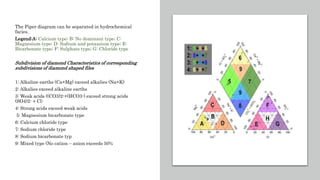
The Piper diagram can be separated in hydrochemical
facies.
Legend:A: Calcium type; B: No dominant type; C:
Magnesium type; D: Sodium and potassium type; E:
Bicarbonate type; F: Sulphate type; G: Chloride type
Subdivision of diamond Characteristics of corresponding
subdivisions of diamond shaped files
1: Alkaline earths (Ca+Mg) exceed alkalies (Na+K)
2: Alkalies exceed alkaline earths
3: Weak acids ((CO3)2-+(HCO3-) exceed strong acids
(SO4)2- + Cl-
4: Strong acids exceed weak acids
5: Magnesium bicarbonate type
6: Calcium chloride type
7: Sodium chloride type
8: Sodium bicarbonate typ
9: Mixed type (No cation – anion exceeds 50%
Schoeller Diagram
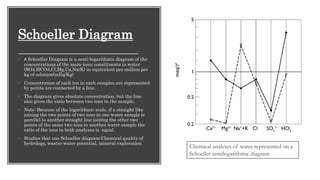
• A Schoeller Diagram is a semi-logarithmic diagram of the
concentrations of the main ionic constituents in water
(SO4,HCO3,Cl,Mg,Ca,Na/K) in equivalent per million per
kg of solution(mEq/Kg)
• Concentration of each ion in each samples are represented
by points are connected by a line.
• The diagram gives absolute concentration, but the line
also gives the ratio between two ions in the sample.
• Note: Because of the logarithmic scale, if a straight like
joining the two points of two ions in one water sample is
parellel to another straight line joining the other two
points of the same two ions in another water sample the
ratio of the ions in both analyses is equal.
• Studies that use Schoeller diagram:Chemical quality of
hydrology, waster water potential, mineral exploration
Chemical analyses of water represented on a
Schoeller semilogarithmic diagram
Durov’s Diagram
Shortcomings of the trilinear graphs of the type developed by Hill
and Piper are removed in the diagram introduced into the Soviet
literature by S. A. Durov
• Description/Type of data: a composite plot consisting of 2
ternary diagrams where the cations of interest are plotted
against the anions of interest( data is normalized to
100%);sides from a binary plot of total cation vs total anion
concentrations ;expanded version includes TDS(mg/L) and pH
data added to the sides of the binary plot allow further
comparisons.
• Primary: Cations(Na,K,Ca,Mg) and anions (Cl,HCO3 and SO4)
and total cations vs total anions only.
• Expanded : TDS and pH added
• The intersection of lines extended from the two samples points
on the triangle to the central rectangle gives a point that
represents the major ion compositions on a percentage basis.
From the point the lines extending to the adjacent scaled
rectangles provide for representations of the analyses in terms
of two parameters selected from various possibilities, such as a
total major ion concentrations, total dissolved solids, ionic
strength, specific conductance, hardness, total dissolved
inorganic carbon or pH.
Chemical analyses represented as millequivalents
per liter on the diagram originated by Durvov as
described by Zaporozec (1972).
Case Study
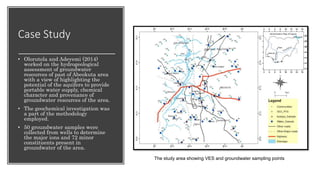
• Olorutola and Adeyemi (2014)
worked on the hydrogeological
assessment of groundwater
resources of past of Abeokuta area
with a view of highlighting the
potential of the aquifers to provide
portable water supply, chemical
character and provenance of
groundwater resources of the area.
• The geochemical investigation was
a part of the methodology
employed.
• 50 groundwater samples were
collected from wells to determine
the major ions and 72 minor
constituents present in
groundwater of the area.
The study area showing VES and groundwater sampling points
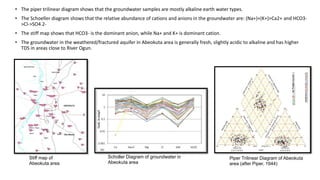
• The piper trilinear diagram shows that the groundwater samples are mostly alkaline earth water types.
• The Schoeller diagram shows that the relative abundance of cations and anions in the groundwater are: (Na+)+(K+)>Ca2+ and HCO3-
>Cl->SO4 2-
• The stiff map shows that HCO3- is the dominant anion, while Na+ and K+ is dominant cation.
• The groundwater in the weathered/fractured aquifer in Abeokuta area is generally fresh, slightly acidic to alkaline and has higher
TDS in areas close to River Ogun.
Stiff map of
Abeokuta area
Piper Trilinear Diagram of Abeokuta
area (after Piper, 1944)
Scholler Diagram of groundwater in
Abeokuta area
Conclusion
It provides a quick processing and interpretation of a lot of complete water analysis and a
short, concise presentation of the results in graphical form makes understanding of complex.
Groundwater system simpler and quicker.
This study illustrated the usefulness of multivariate statistical techniques in the water quality
assessment and identification of pollution sources.
Accuracy assessment of the classification process using different classification algorithms is
always recommended for the assessment of Ground water quality.
A graphical classification approach by using geochemical analysis of the ground water in order
to estimate potential quality of the groundwater resources.
THANK YOU!

Graphical representation of water quality data.pptx

  • 1.
    Graphical representation of waterquality data Ishica M.Sc. Geology 3rd Semester Department of Geology, University of Delhi
  • 2.
    Contents • Concept ofhydro chemical sequence and facies • Graphical representation • Case study • Conclusion
  • 3.
    • Groundwater: movesalong flowlines from recharge to discharge areas, and its chemistry is altered by the effects of a variety of geochemical processes. Chemistry of Precipitation • The chemical composition of water that arrives on the ground surface can be determined by inspection of chemical analyses of rain and snow. • The rain and snowmelt are extremely dilute, slightly to moderately acidic, oxidizing solutions that can quickly cause chemical alterations in soils or in geological materials into which they infiltrate. Carbon dioxide in soil zone • The soil has a capability to generate relatively large amounts of acid and to consume much or all of the available dissolved oxygen in the water that infiltrates it. • Geochemically, the most important acid produced in the soil zone is H2CO3, derived from the reaction of CO2 and H2O.As new water from recharge events passes through the soil, biochemical and hydro-chemical processes in the soil are therefore capable of providing a continuing supply of acidity to promote mineral-water reactions. • Organic acids : Humic acids and fulvic acids, plays a major role in the development of soil profiles and in the transport of dissolved constituents downward toward the water table Concept of hydro-chemical sequence
  • 4.
    Schematic representation ofmajor hydrochemical processes in the soil zone of recharge areas.
  • 5.
    Major-Ion Evolution Sequence •In a classic paper based on more than 10,000 chemical analyses of well samples from Australia, Chebotarev (1955) concluded that groundwater tends to evolve chemically toward the composition of seawater. He observed that this evolution is normally accompanied by the following regional changes in dominant anion species: These changes occur as the water moves from shallow zones of active flushing through intermediate zones into zones where the flow is very sluggish and the water is old. For large sedimentary basins, the Chebotarev sequence can be described in terms of three main zones, which correlate in a general way with depth : • The upper zone—characterized by active groundwater flushing through relatively well-leached rocks. Water in this zone has as the dominant anion and is low in total dissolved solids. • The intermediate zone—with less active groundwater circulation and higher total dissolved solids. Sulfate is normally the dominant anion in this zone. • The lower zone—with very sluggish groundwater flow. Highly soluble minerals are commonly present in this zone because very little groundwater flushing has occurred. High Cl– concentration and high total dissolved solids are characteristic of this zone Concept of hydro-chemical sequence
  • 6.
    From a geochemicalviewpoint the anion-evolution sequence described above can be explained in terms of two main variables, mineral availability and mineral solubility. The content in groundwater is normally derived from soil zone CO2 and from dissolution of calcite and dolomite. Since calcite or dolomite occur in significant amounts in nearly all sedimentary basins, and because these minerals dissolve rapidly when in contact with CO2-charged groundwater, is almost invariably the dominant anion in recharge areas. There are several soluble sedimentary minerals that release SO4 2– or Cl– upon dissolution. The most common of the sulfate-bearing minerals are gypsum, CaSO4 · 2H2O, and anhydrite, CaSO4. These minerals dissolve readily when in contact with water. The dissolution reaction for gypsum is Gypsum and anhydrite are considerably more soluble than calcite and dolomite but much less soluble than the chloride minerals .If calcite (or dolomite) and gypsum dissolve in fresh water at 25°C, the water will become brackish. The dominant anion will be SO4 2–, so in effect we have moved into the composition phase in the Chebotarev evolution sequence. In deep groundwater flow systems : • groundwater evolves past the stage where SO4 2– is the dominant anion to a Cl–-rich brine • groundwater comes into contact with highly soluble chloride minerals such as halite(NaCl) or sylvite (KCl), occur as salt strata originally deposited millions of years ago. • solubilities of other chloride minerals of sedimentary origin are very high.
  • 7.
    Concept of hydrochemicalfacies by Back (1961, 1966), Morgan and Winner (1962), and Seaber (1962) What's the need ? To be able to refer in a convenient manner to water compositions by identifiable groups or categories Definition? Facies are identifiable parts of different nature belonging to any genetically related body or system Hydro-chemical facies are distinct zones that have cation and anion concentrations describable within defined composition categories. The definition of a composition category is commonly based on subdivisions of the trilinear diagram in the manner suggested by Back (1961) and Back and Hanshaw (1965). Classification diagram for anion and cation facies in terms of major ion percentages. Water types are designated according to the domain in which they occur on the diagram segments.
  • 8.
    Graphical Representation Compiling and presentingchemical data in a simple format for visual inspection is a crucial responsibility in groundwater research. Several widely used graphical approaches are available for this purpose. The quality of the groundwater resources is deduced from their interpretation. They can be used to compare analyses, highlight similarities and contrasts, and for presentation reasons. They describes variations in groundwater flow systems' major-ion chemistry. Graphical method are used in representing groundwater samples, of which the most used are: • Vertical bar chart • Radiating vector plots • Circular diagram • Stiff diagrams • Piper trilinear diagram • Schoeller semi log diagram • Durov’s diagram • CS diagram
  • 9.
    THE BAR GRAPHIS SIMPLEST WAY TO REPRESENT. FOR A SINGLE SAMPLE THESE TWO GRAPHS REPRESENT THE MAJOR-ION COMPOSITION IN EQUIVALENTS PER CUBIC METER (OR MILLIEQUIVALENTS PER LITER) AND IN PERCENTAGE OF TOTAL EQUIVALENTS. THESE ARE VERTICAL BAR DIAGRAMS, EACH SAMPLE IS REPRESENTED BY TWO BARS, ONE FOR CATION AND OTHER FOR ANIONS. THE HEIGHT OF EACH BAR IS PROPORTIONAL TO THE TOTAL CONCENTRATION OF CATIONS OR ANIONS IN MEQ/L THE CONCENTRATION OF CATION AND ANIONS CAN BE PLOTTED EITHER IN ABSOLUTE VALUES OR AS THE PERCENTAGE OF TOTAL EPM THE COLLINS BAR CHART WAS USED TO SHOW THE CONCENTRATION OF VARIOUS MAJOR IONS OF THE ANALYSED SAMPLES THE CATIONS REPRESENTED AS CA2+,MG2+,NA+,K+,AND ANIONS AS CL-,SO32-,CO32- ,HCO32- EASIER TO COMPARE THAN PIE CHARTS. Chemical analyses of groundwater represented by bar graphs; (a) milliequivalents per liter; (b) percentage of total equivalents per liter
  • 10.
    Circular diagrams andradiating vector fields • Indicates water quality with special scale for radii so area of circle is proportional to total ionic concentration of analysis • Sectors within a circle shows fractions of different ions expressed in milliequivalent per litres. • Length of 6 vectors represents ionic concentration in milliequivalent per litre. Chemical analysis of groundwater represented by a circular diagram. The radial axis is proportional to the total milliequivalents. Vector diagrams for representing analyses of groundwater quality The bar, circular, radial and Stiff diagrams are all easy to conduct and provide quick visual comparison of individual chemical analyses. They are not, however, convenient for graphic presentation of large numbers of analyses
  • 11.
    Stiff Diagram • Graphicalrepresentation of water chemical analyses, first developed by H. A. Stiff in 1951 • A polygonal shape is created from 3 or 4 parallel horizontal axes extending on either side of a vertical zero axis. Cations are plotted in meq/l on left side of the zero axis, one to each horizontal axis, and anions are plotted on right side. • Stiff patterns are useful in making a rapid visual comparison between water from different sources. Advantages: Can help visualise ionically related waters from which a flow path can be determined If the flow path is known, to show how the ionic composition of a water body changes over space or time Disadvantage: • Only one analysis per plot Two chemical analyses represented in the manner originated by Stiff. (a) The same analysis as in the previous three figures; (b) second analysis, illustrating contrast in shape of the graphical representation (after Davis and De Wiest, 1966).
  • 12.
    Piper Tri-linear Diagram • Itis developed by Piper (1944) from a somewhat similar design by Hill (1940) • Representation of the chemistry of a water sample or samples. • The cation and anions are shown by separate ternary plots. The apexes of the cation plot are Ca, Mg, Na, K cations. The apexes of the anion plots are sulphate, chloride and carbonate plus bicarbonate anions. • The two ternary plots are then projected up onto a diamond. The diamond is a matrix transformation of a graph of the anions and cations. • The trilinear diagram represents the concentrations as percentages (%meq/L). Because each analysis is represented by a single point, waters with very different total concentrations can have identical representations on this diagram. • A single trilinear diagram has greater potential to accommodate a larger number of analyses without becoming confusing and is convenient for showing the effects of mixing two waters from different sources. • The mixture of two different waters will plot on the straight line joining the two points. Chemical analyses of water represented as percentages of total equivalents per liter on the diagram developed by Hill (1940) and Piper (1944). ADVANTAGES DISADVANTAGES Many water analyses can be plotted on the same diagram Concentrations are renormalized Can be used to classify waters by hydrochemical facies Cannot easily accommodate waters where other cation or anions may be significant Can be used to identify mixing of waters Can track changes through space and temporal relationships
  • 13.
    The Piper diagramcan be separated in hydrochemical facies. Legend:A: Calcium type; B: No dominant type; C: Magnesium type; D: Sodium and potassium type; E: Bicarbonate type; F: Sulphate type; G: Chloride type Subdivision of diamond Characteristics of corresponding subdivisions of diamond shaped files 1: Alkaline earths (Ca+Mg) exceed alkalies (Na+K) 2: Alkalies exceed alkaline earths 3: Weak acids ((CO3)2-+(HCO3-) exceed strong acids (SO4)2- + Cl- 4: Strong acids exceed weak acids 5: Magnesium bicarbonate type 6: Calcium chloride type 7: Sodium chloride type 8: Sodium bicarbonate typ 9: Mixed type (No cation – anion exceeds 50%
  • 14.
    Schoeller Diagram • ASchoeller Diagram is a semi-logarithmic diagram of the concentrations of the main ionic constituents in water (SO4,HCO3,Cl,Mg,Ca,Na/K) in equivalent per million per kg of solution(mEq/Kg) • Concentration of each ion in each samples are represented by points are connected by a line. • The diagram gives absolute concentration, but the line also gives the ratio between two ions in the sample. • Note: Because of the logarithmic scale, if a straight like joining the two points of two ions in one water sample is parellel to another straight line joining the other two points of the same two ions in another water sample the ratio of the ions in both analyses is equal. • Studies that use Schoeller diagram:Chemical quality of hydrology, waster water potential, mineral exploration Chemical analyses of water represented on a Schoeller semilogarithmic diagram
  • 15.
    Durov’s Diagram Shortcomings ofthe trilinear graphs of the type developed by Hill and Piper are removed in the diagram introduced into the Soviet literature by S. A. Durov • Description/Type of data: a composite plot consisting of 2 ternary diagrams where the cations of interest are plotted against the anions of interest( data is normalized to 100%);sides from a binary plot of total cation vs total anion concentrations ;expanded version includes TDS(mg/L) and pH data added to the sides of the binary plot allow further comparisons. • Primary: Cations(Na,K,Ca,Mg) and anions (Cl,HCO3 and SO4) and total cations vs total anions only. • Expanded : TDS and pH added • The intersection of lines extended from the two samples points on the triangle to the central rectangle gives a point that represents the major ion compositions on a percentage basis. From the point the lines extending to the adjacent scaled rectangles provide for representations of the analyses in terms of two parameters selected from various possibilities, such as a total major ion concentrations, total dissolved solids, ionic strength, specific conductance, hardness, total dissolved inorganic carbon or pH. Chemical analyses represented as millequivalents per liter on the diagram originated by Durvov as described by Zaporozec (1972).
  • 17.
    Case Study • Olorutolaand Adeyemi (2014) worked on the hydrogeological assessment of groundwater resources of past of Abeokuta area with a view of highlighting the potential of the aquifers to provide portable water supply, chemical character and provenance of groundwater resources of the area. • The geochemical investigation was a part of the methodology employed. • 50 groundwater samples were collected from wells to determine the major ions and 72 minor constituents present in groundwater of the area. The study area showing VES and groundwater sampling points
  • 18.
    • The pipertrilinear diagram shows that the groundwater samples are mostly alkaline earth water types. • The Schoeller diagram shows that the relative abundance of cations and anions in the groundwater are: (Na+)+(K+)>Ca2+ and HCO3- >Cl->SO4 2- • The stiff map shows that HCO3- is the dominant anion, while Na+ and K+ is dominant cation. • The groundwater in the weathered/fractured aquifer in Abeokuta area is generally fresh, slightly acidic to alkaline and has higher TDS in areas close to River Ogun. Stiff map of Abeokuta area Piper Trilinear Diagram of Abeokuta area (after Piper, 1944) Scholler Diagram of groundwater in Abeokuta area
  • 19.
    Conclusion It provides aquick processing and interpretation of a lot of complete water analysis and a short, concise presentation of the results in graphical form makes understanding of complex. Groundwater system simpler and quicker. This study illustrated the usefulness of multivariate statistical techniques in the water quality assessment and identification of pollution sources. Accuracy assessment of the classification process using different classification algorithms is always recommended for the assessment of Ground water quality. A graphical classification approach by using geochemical analysis of the ground water in order to estimate potential quality of the groundwater resources.
  • 20.