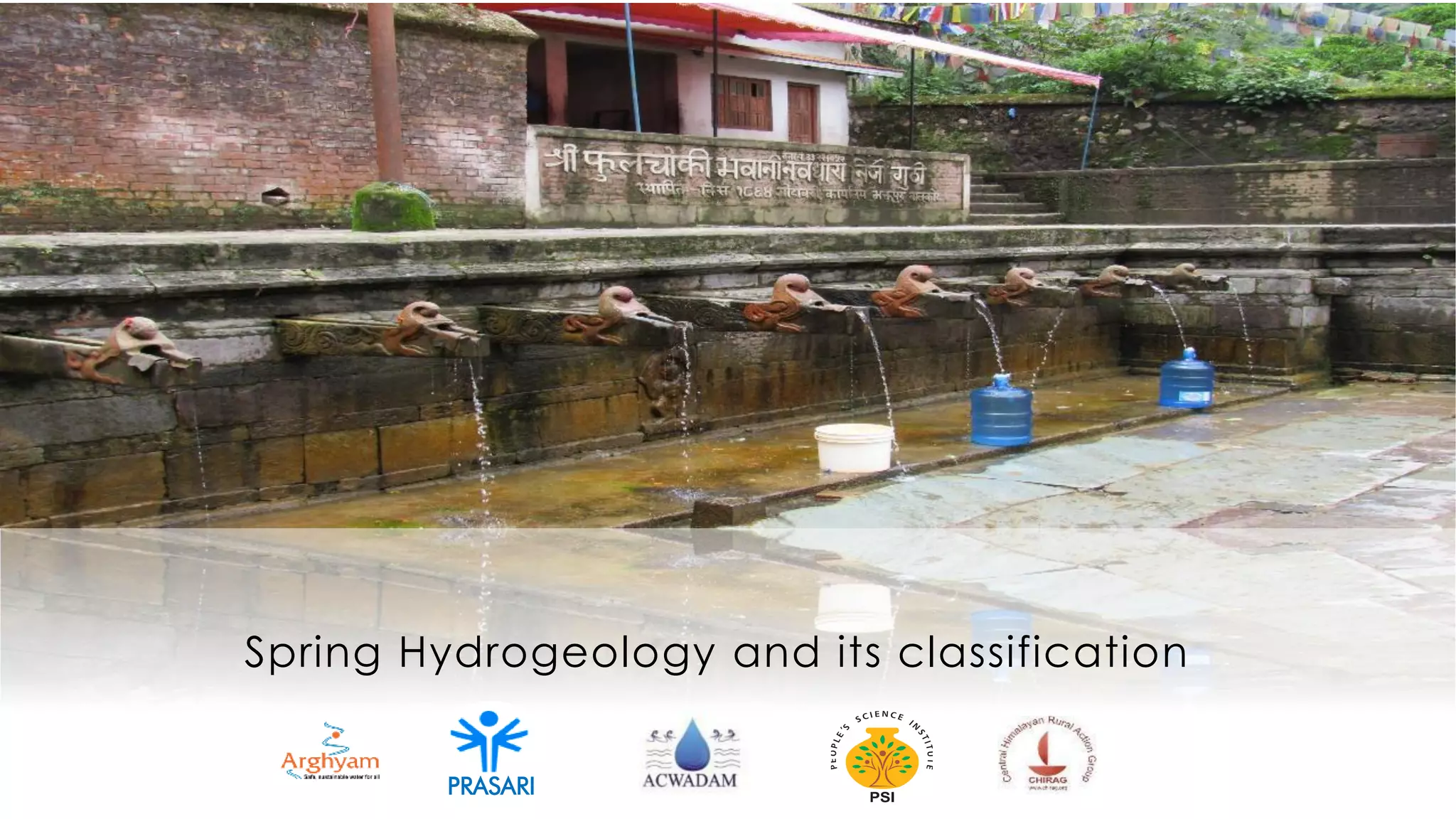
Spring Hydrogeology and its classification
PRASARI
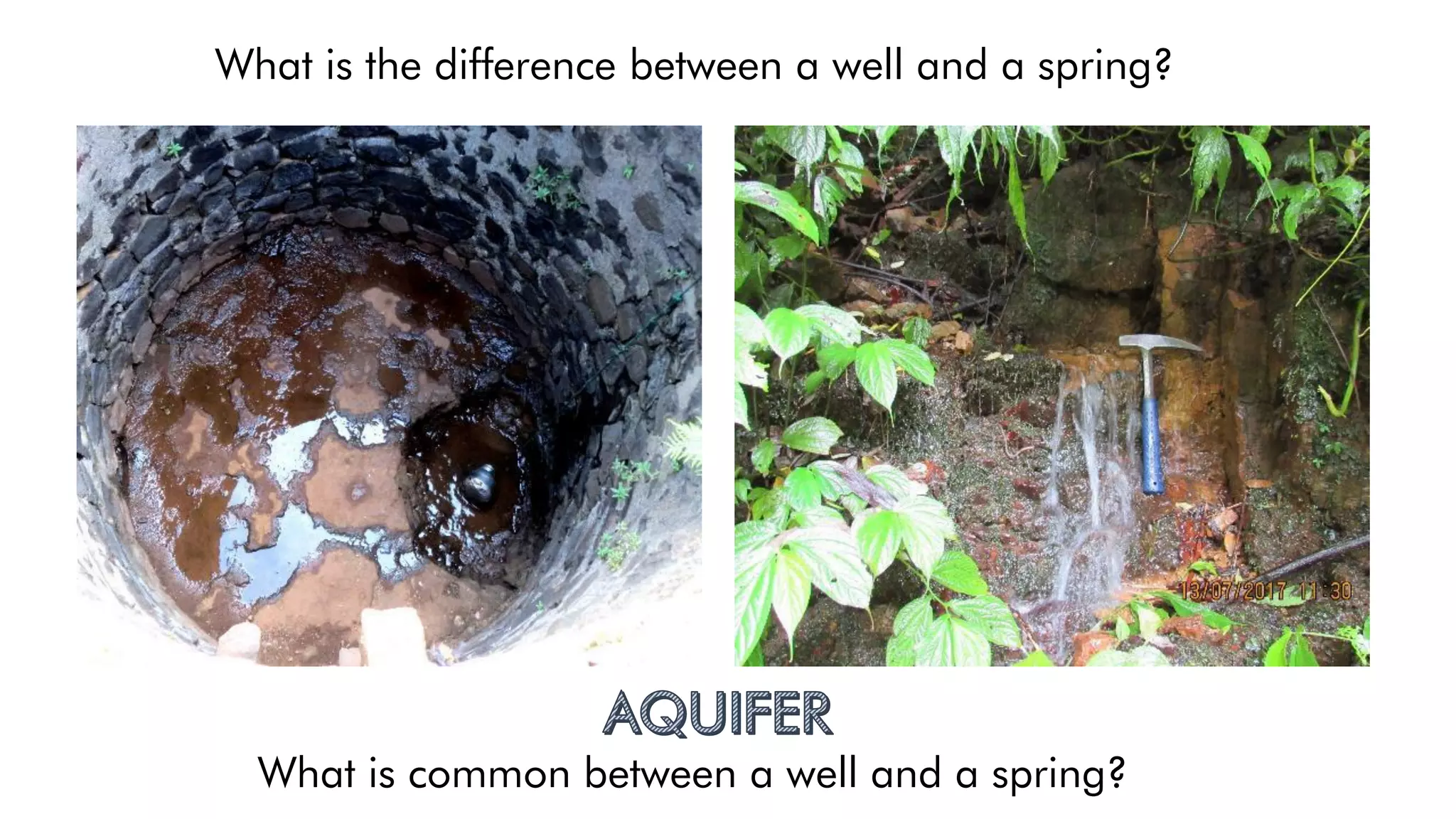
What is the difference between a well and a spring?
What is common between a well and a spring?
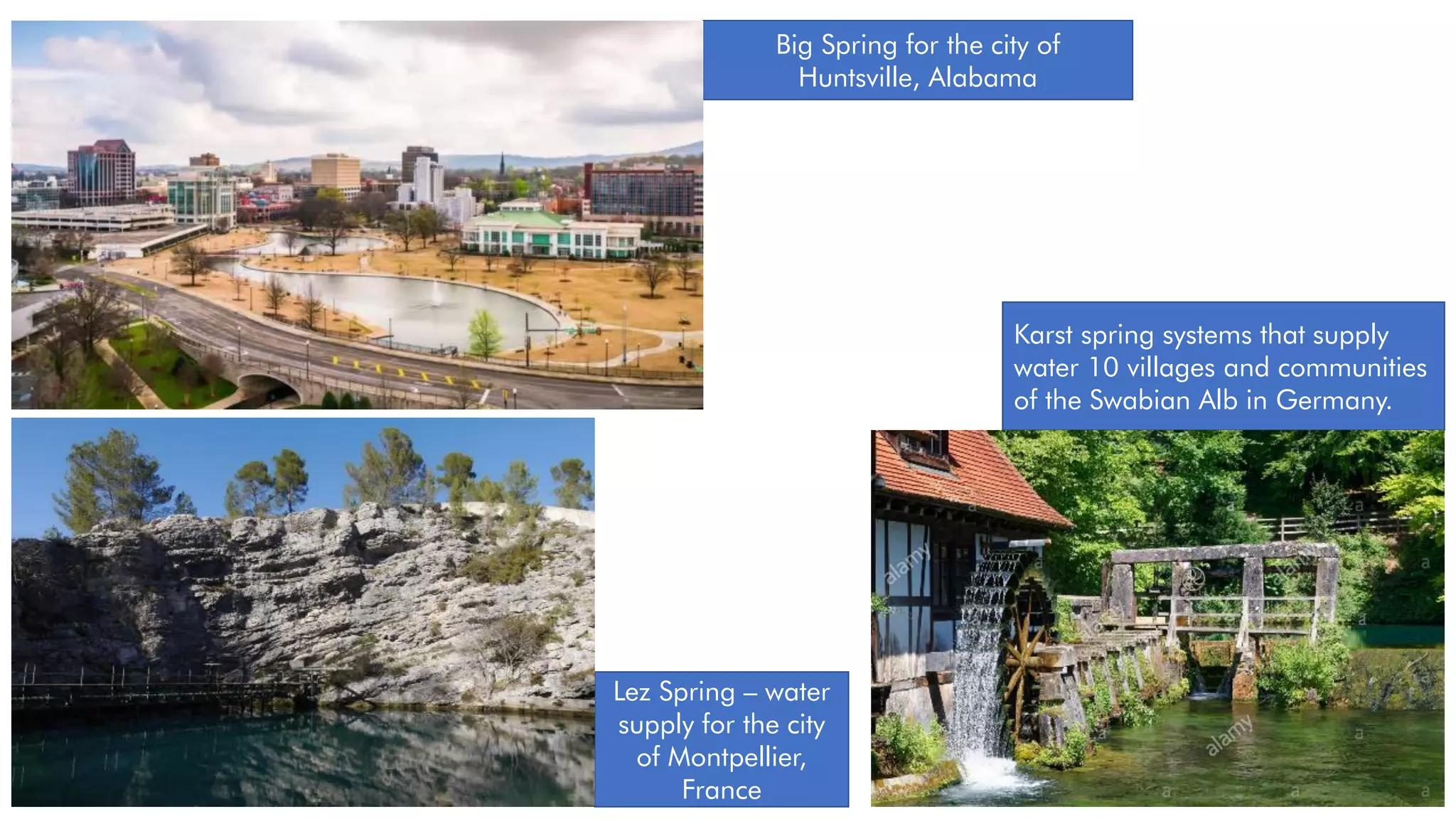
Lez Spring – water
supply for the city
of Montpellier,
France
Big Spring for the city of
Huntsville, Alabama
Karst spring systems that supply
water 10 villages and communities
of the Swabian Alb in Germany.
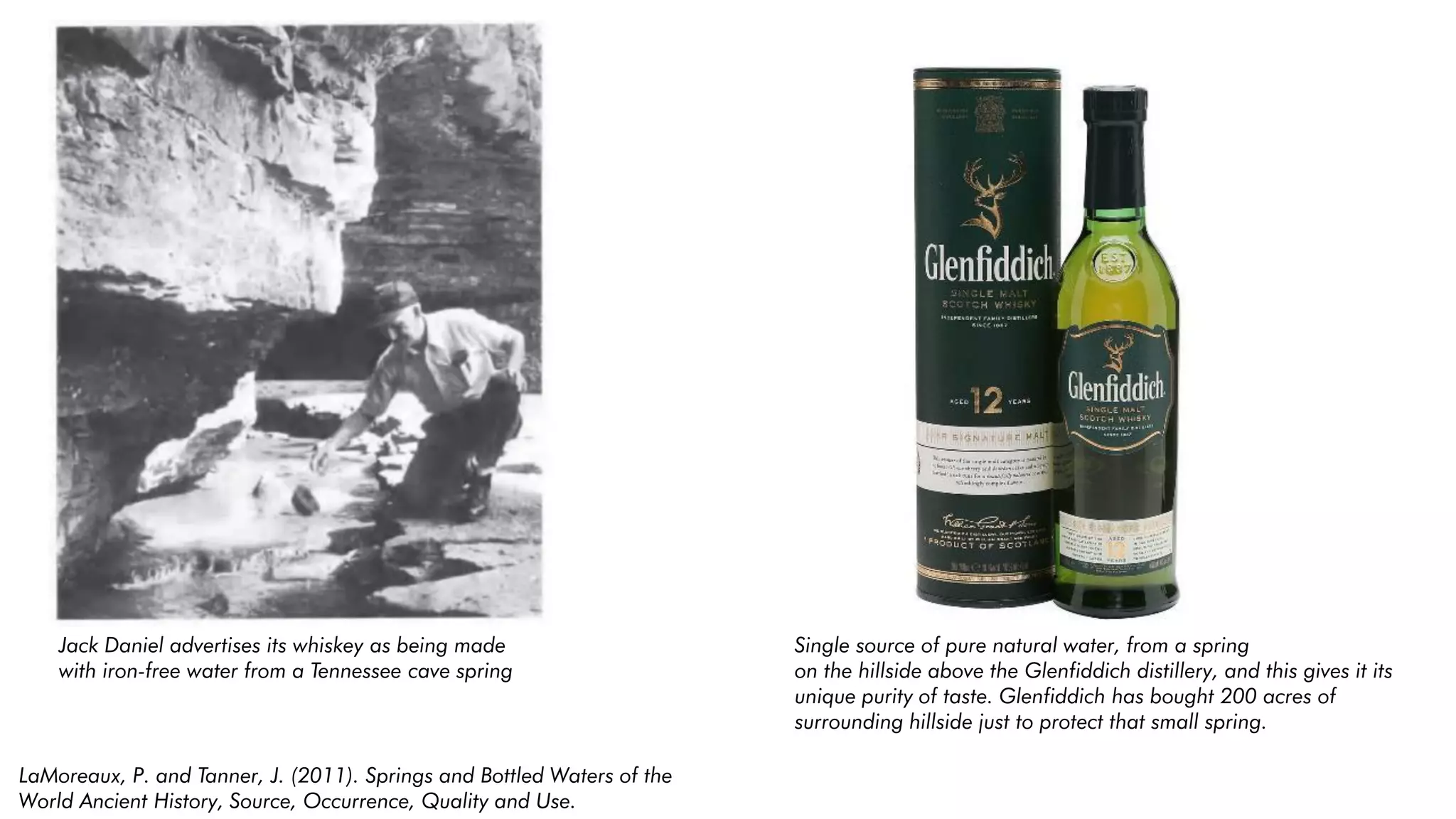
Jack Daniel advertises its whiskey as being made
with iron-free water from a Tennessee cave spring
Single source of pure natural water, from a spring
on the hillside above the Glenfiddich distillery, and this gives it its
unique purity of taste. Glenfiddich has bought 200 acres of
surrounding hillside just to protect that small spring.
LaMoreaux, P. and Tanner, J. (2011). Springs and Bottled Waters of the
World Ancient History, Source, Occurrence, Quality and Use.
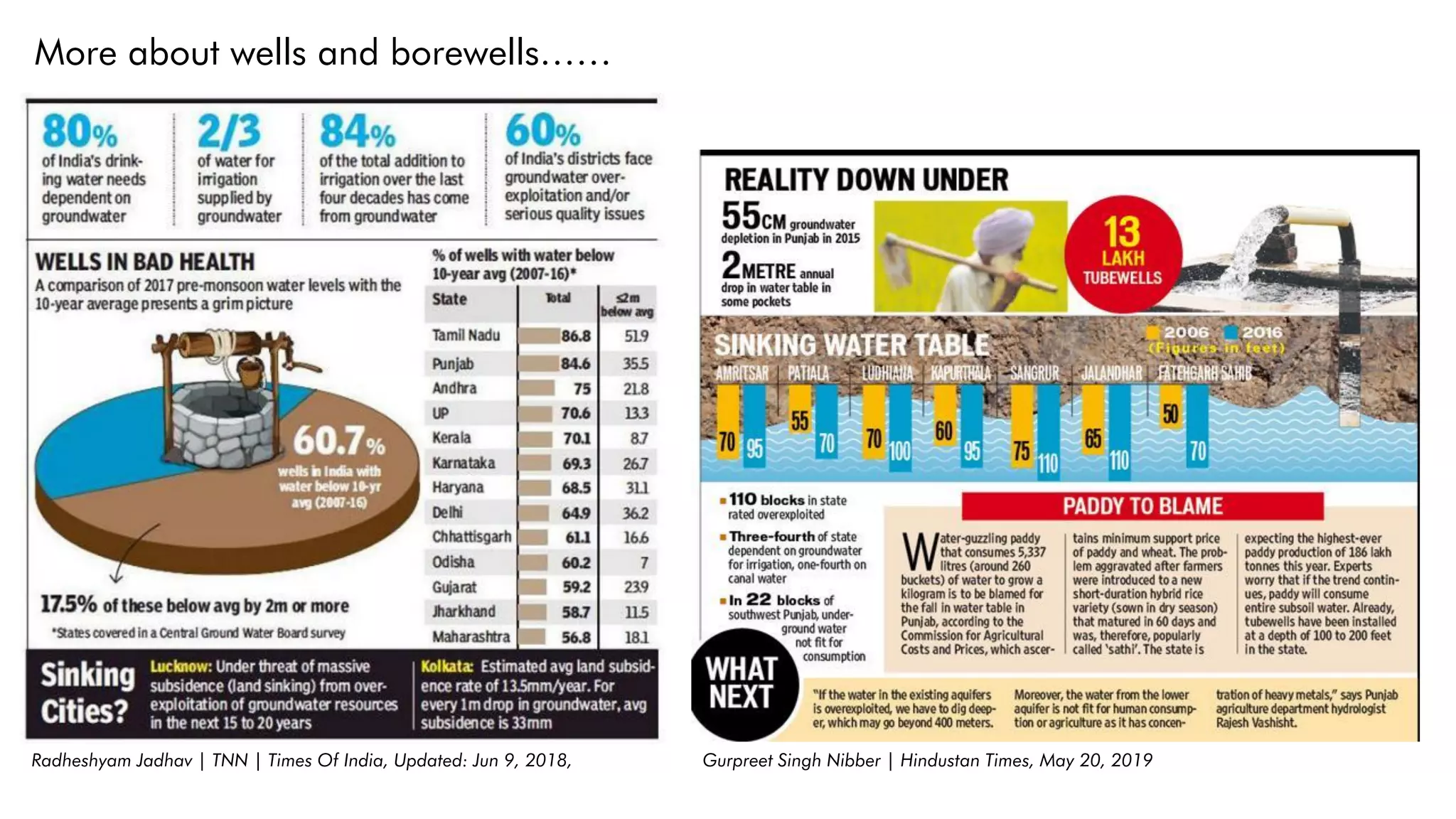
Gurpreet Singh Nibber | Hindustan Times, May 20, 2019
Radheshyam Jadhav | TNN | Times Of India, Updated: Jun 9, 2018,
More about wells and borewells……
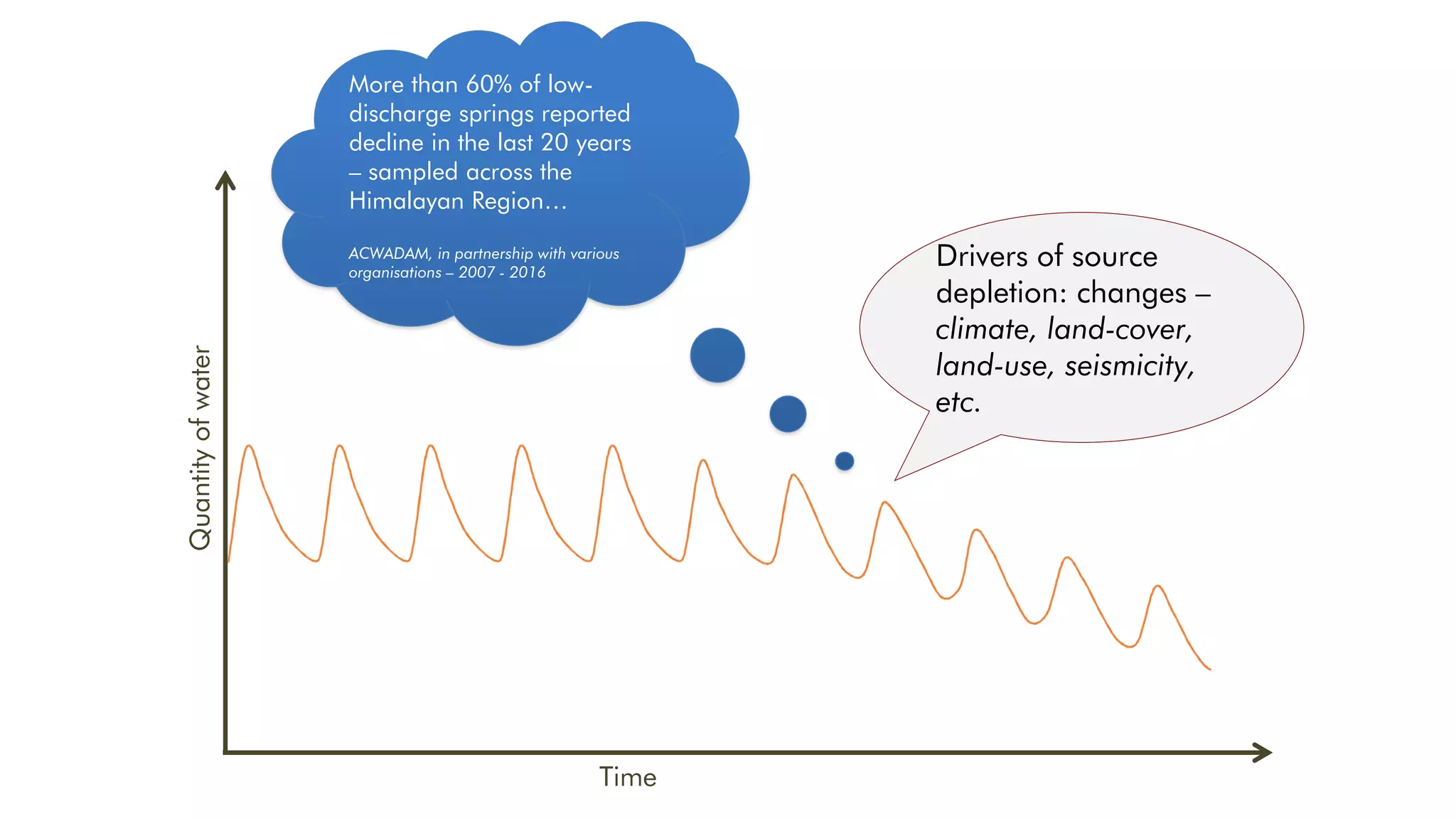
Time
Quantity
of
water
Drivers of source
depletion: changes –
climate, land-cover,
land-use, seismicity,
etc.
More than 60% of low-
discharge springs reported
decline in the last 20 years
– sampled across the
Himalayan Region…
ACWADAM, in partnership with various
organisations – 2007 - 2016
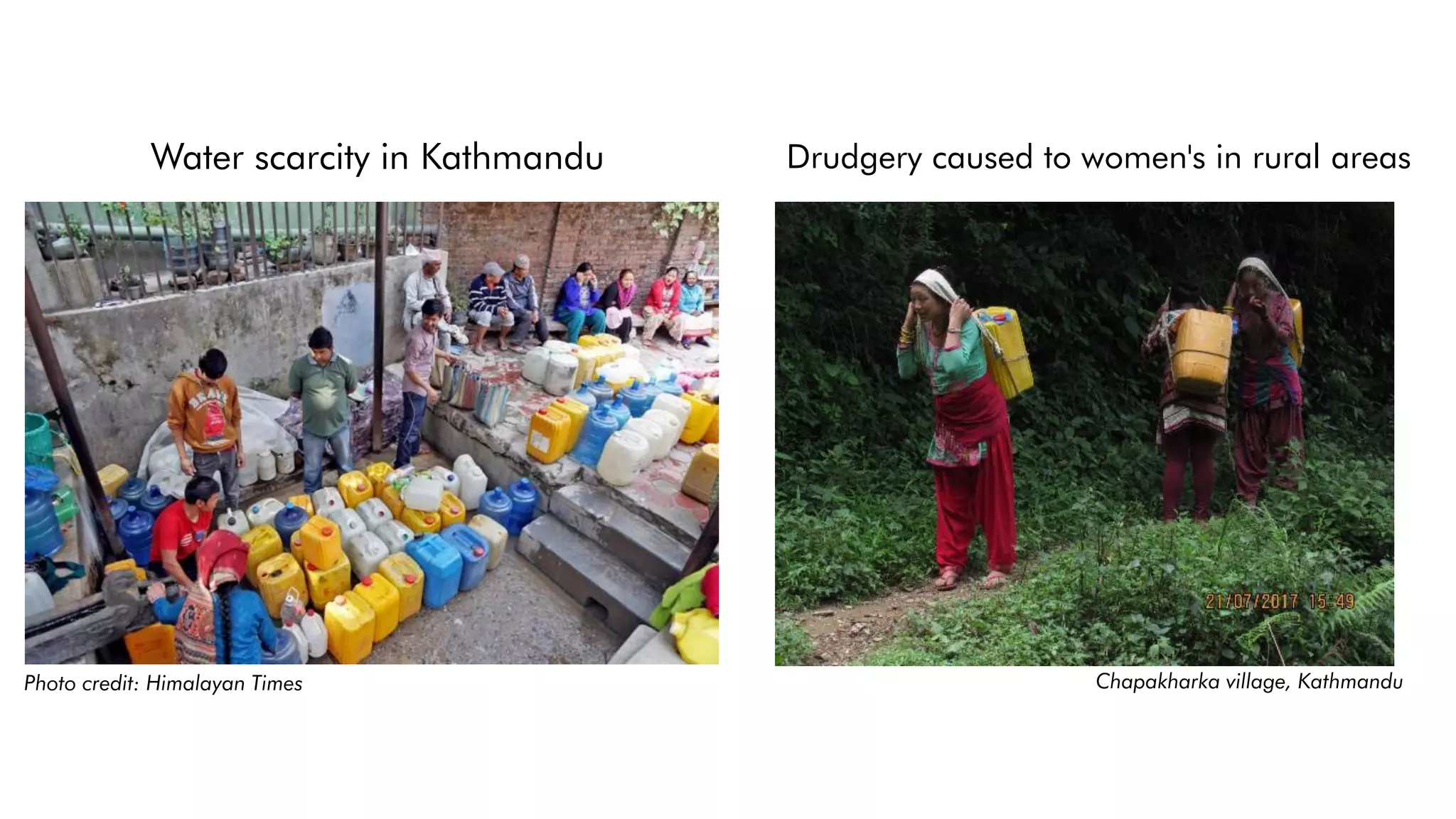
Water scarcity in Kathmandu
Photo credit: Himalayan Times
Drudgery caused to women's in rural areas
Chapakharka village, Kathmandu
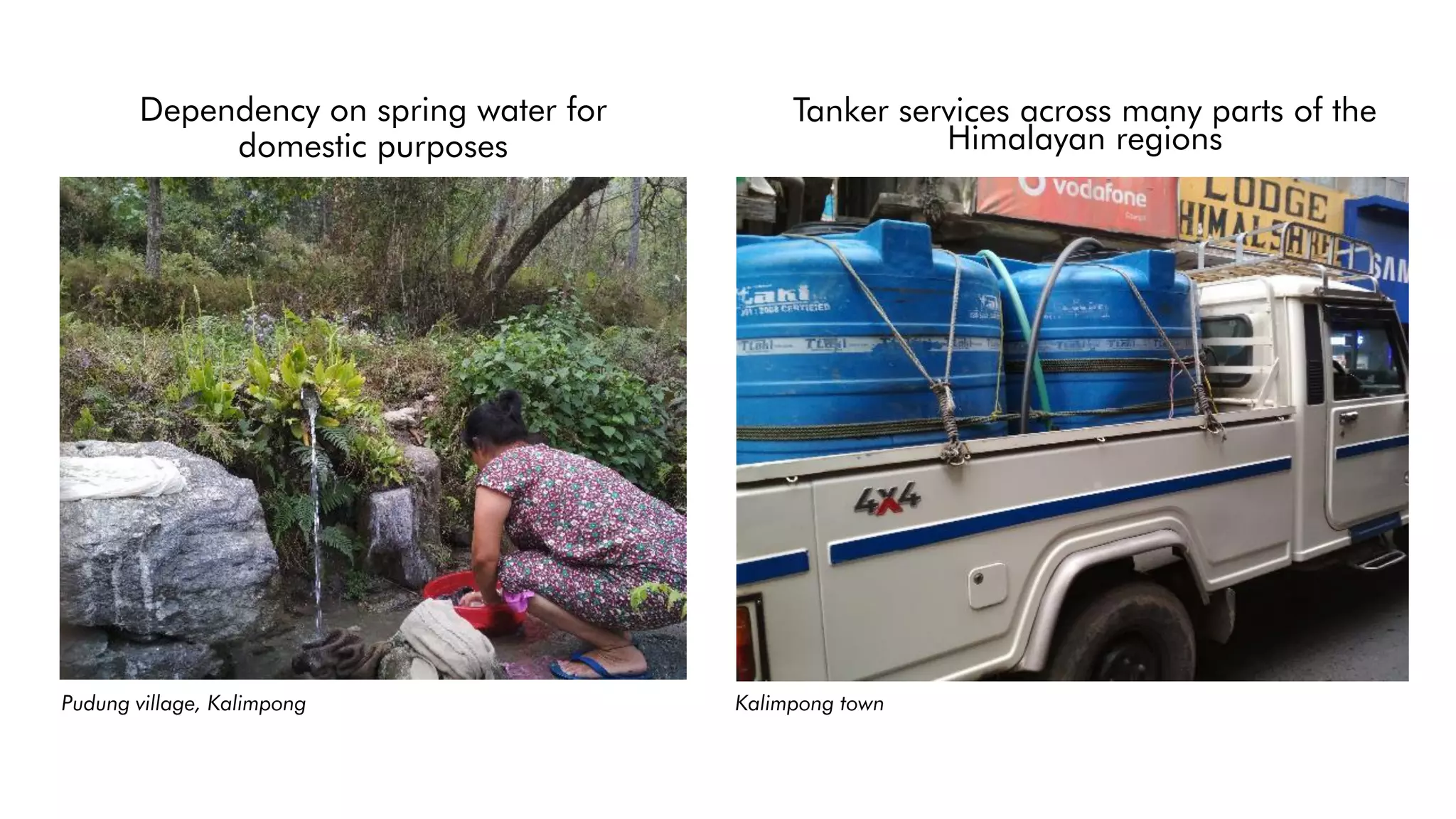
Dependency on spring water for
domestic purposes
Tanker services across many parts of the
Himalayan regions
Pudung village, Kalimpong Kalimpong town
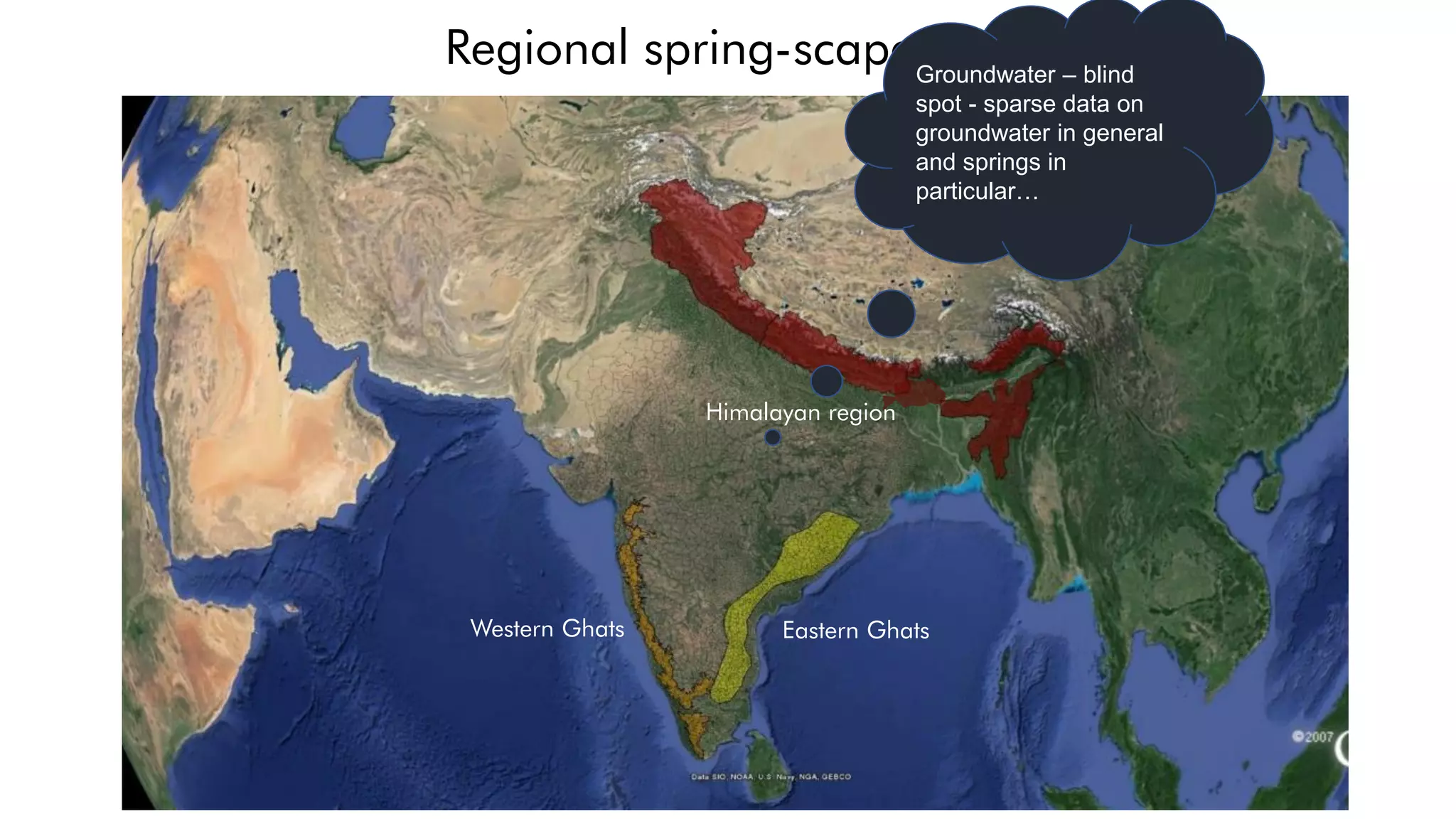
Regional spring-scapes
Western Ghats Eastern Ghats
Himalayan region
Groundwater – blind
spot - sparse data on
groundwater in general
and springs in
particular…
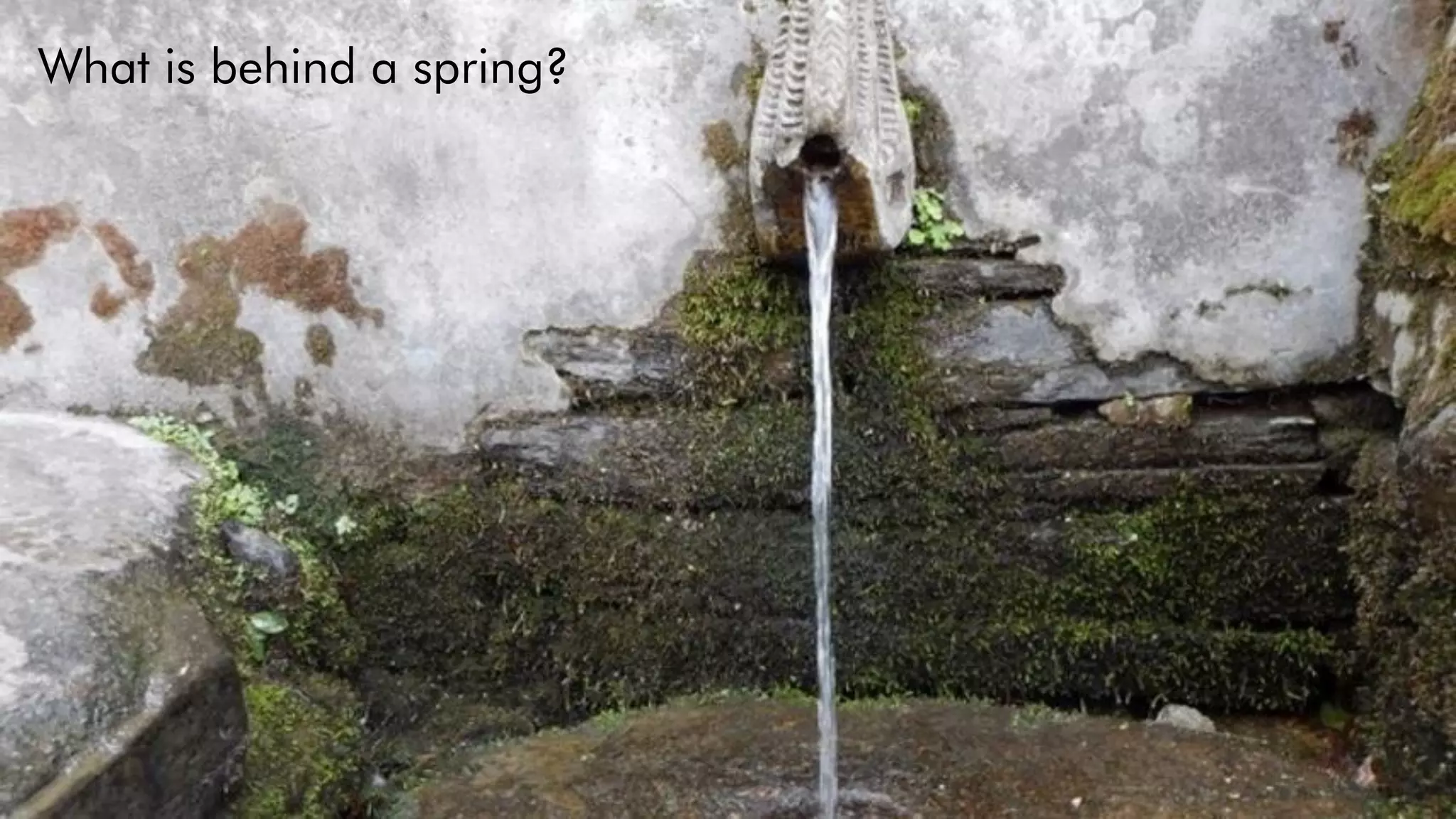
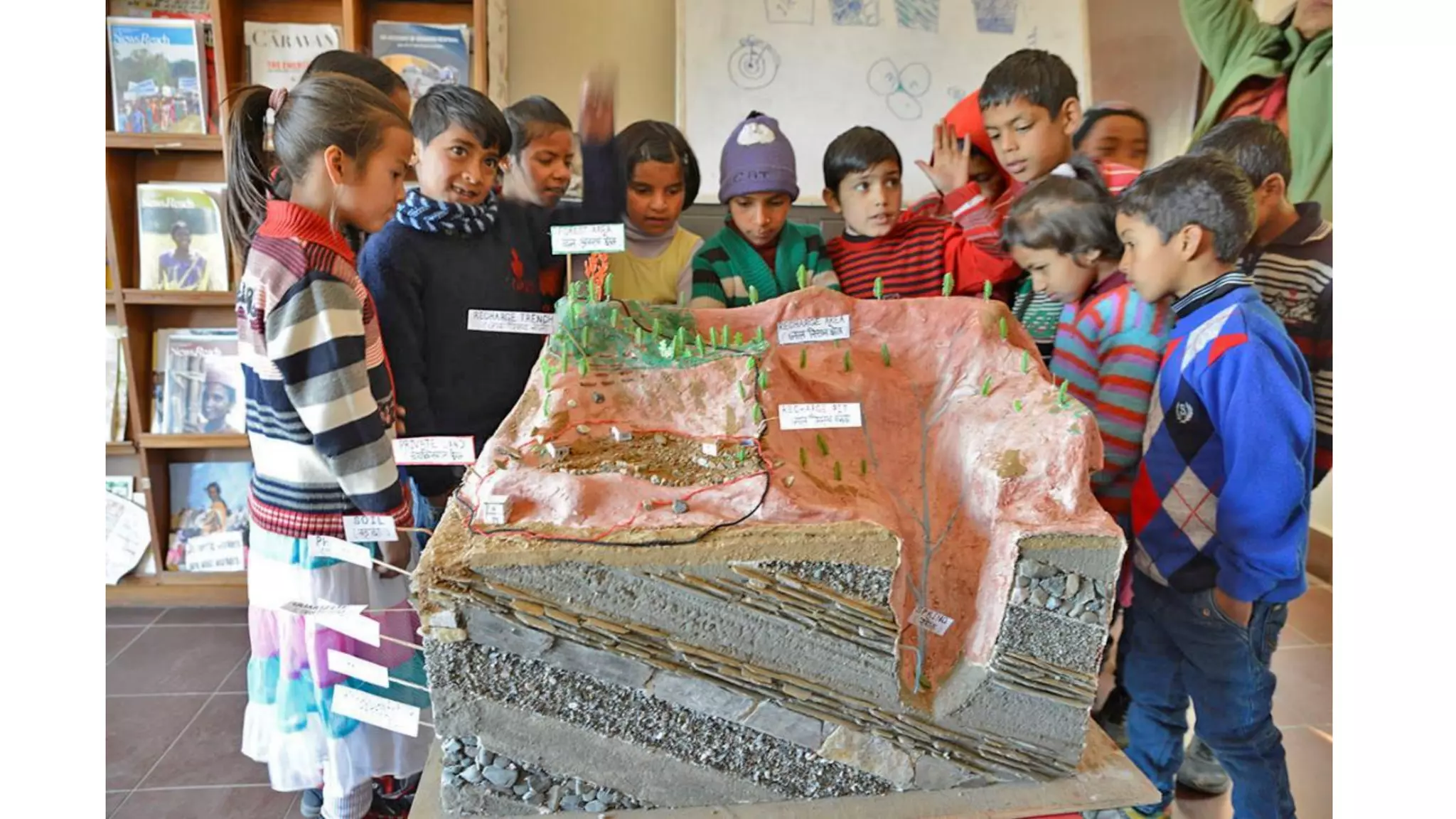
What is behind a spring?
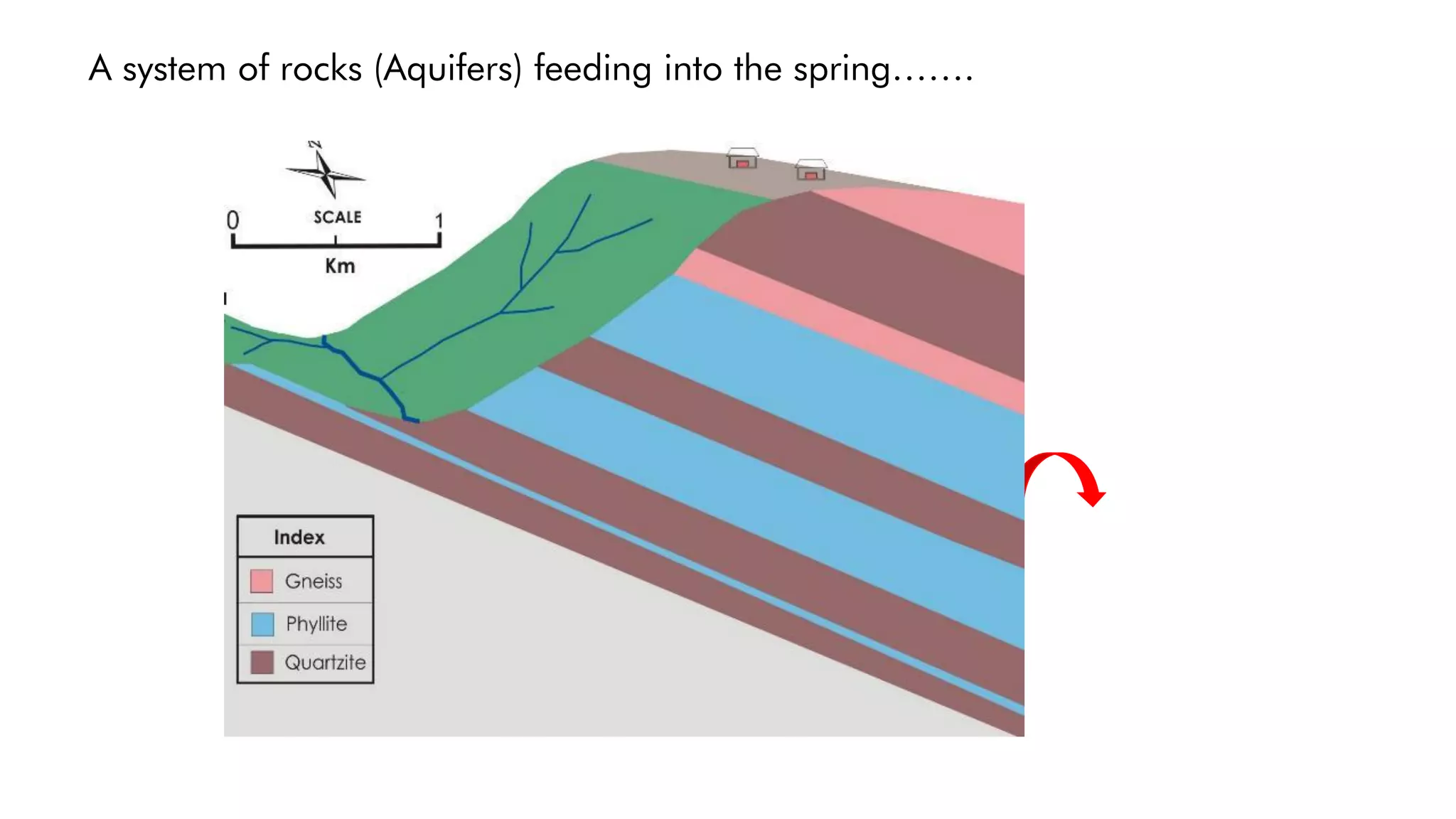
A system of rocks (Aquifers) feeding into the spring…….
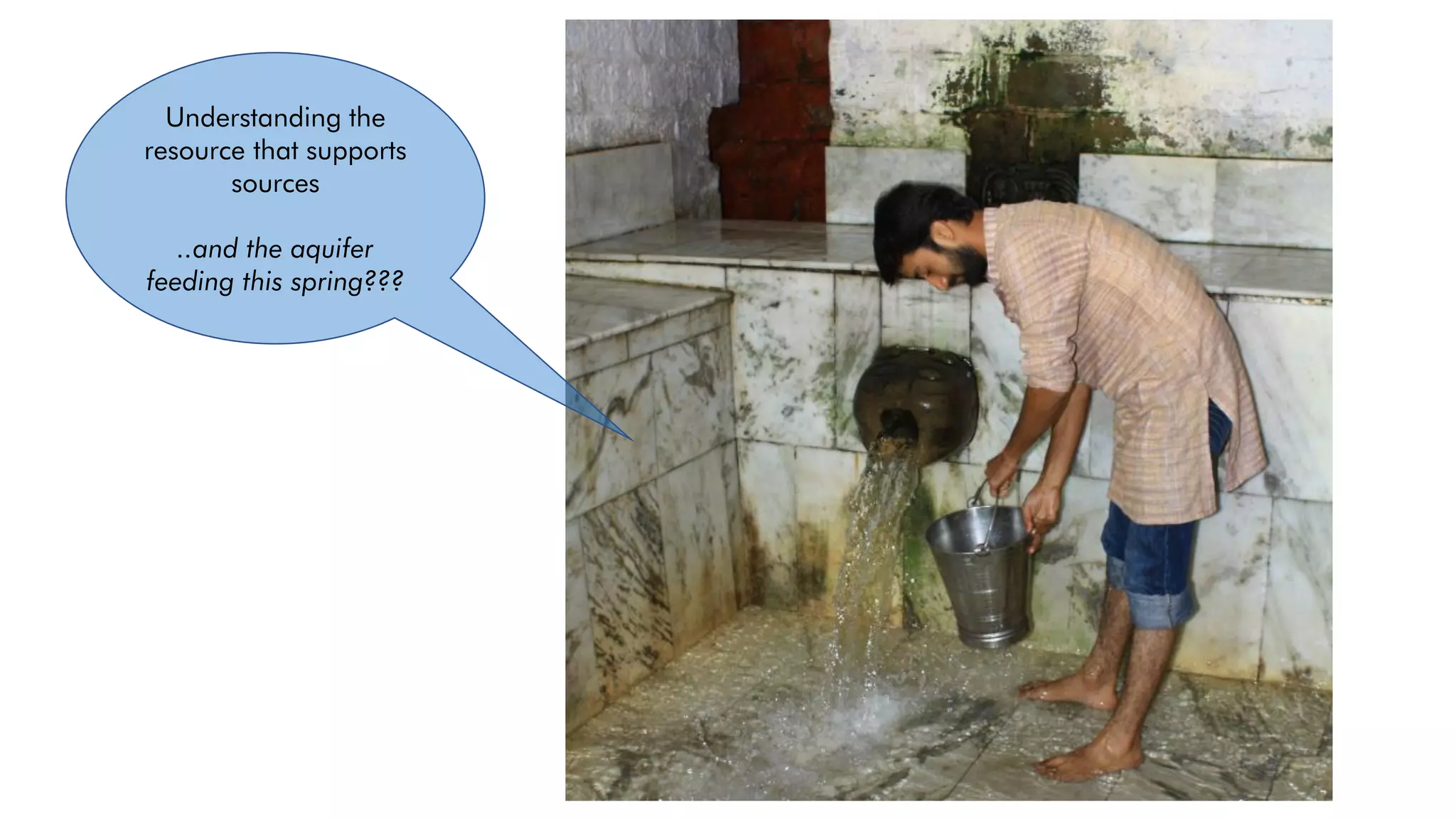
Understanding the
resource that supports
sources
..and the aquifer
feeding this spring???
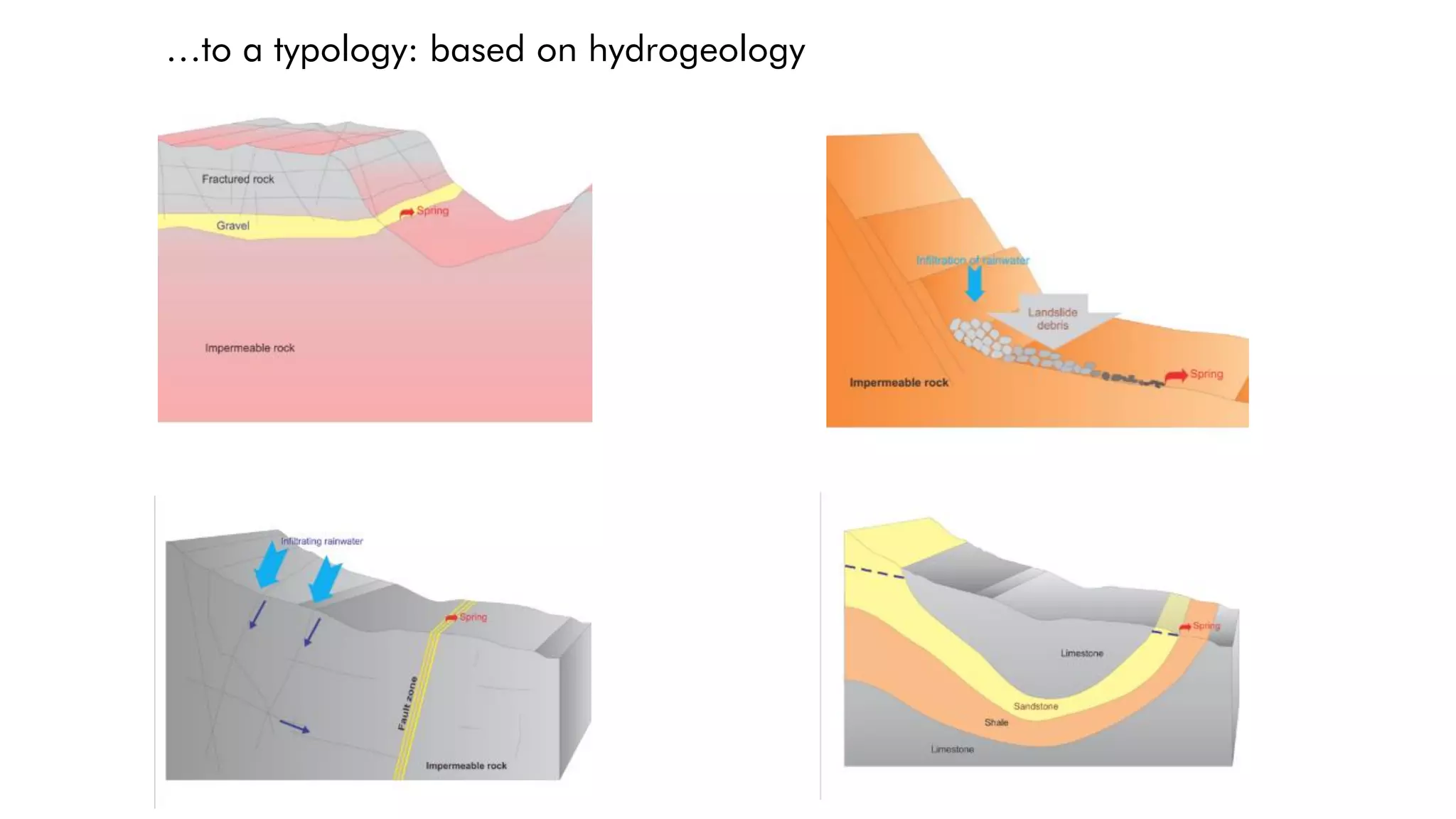
…to a typology: based on hydrogeology
Classification of Springs
• Geology
• Magnitude, variation, and permanence of flow
• Quality and mineralization of the spring water
• Temperature of the spring water.
(Fetter, 1980; Tolman, 1937; Meinzer, 1923)
Gravity Springs
Gravity springs emerge under unconfined conditions where water table intersects land surface. They
are also called descending springs.
Artesian Springs
Artesian springs discharge under pressure due to confined conditions in the underlying aquifer. They
are also called ascending or rising springs.
Classification based on nature of the hydraulic head in the underlying aquifer at the
point of discharge
Types of Springs
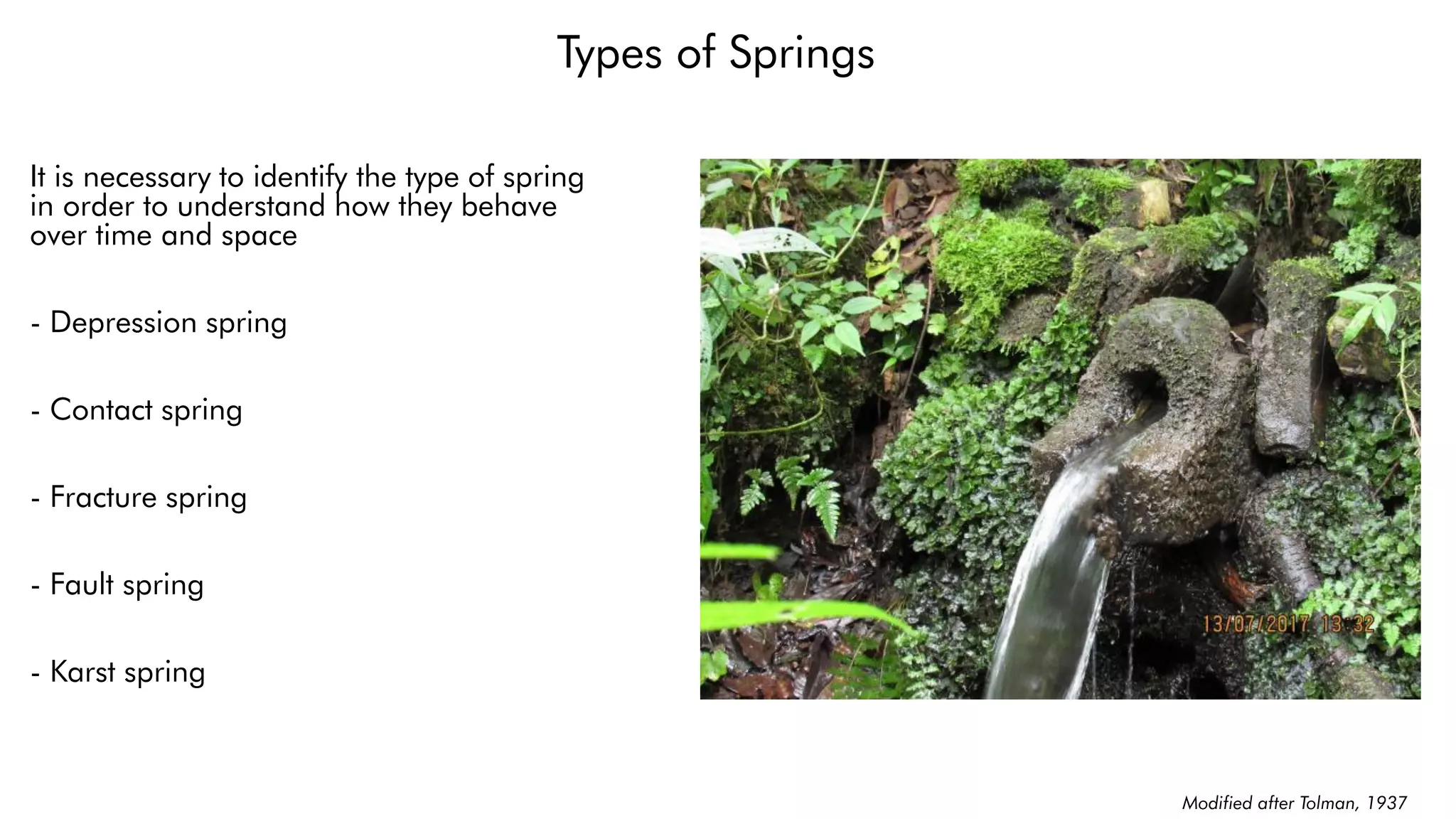
It is necessary to identify the type of spring
in order to understand how they behave
over time and space
- Depression spring
- Contact spring
- Fracture spring
- Fault spring
- Karst spring
Modified after Tolman, 1937
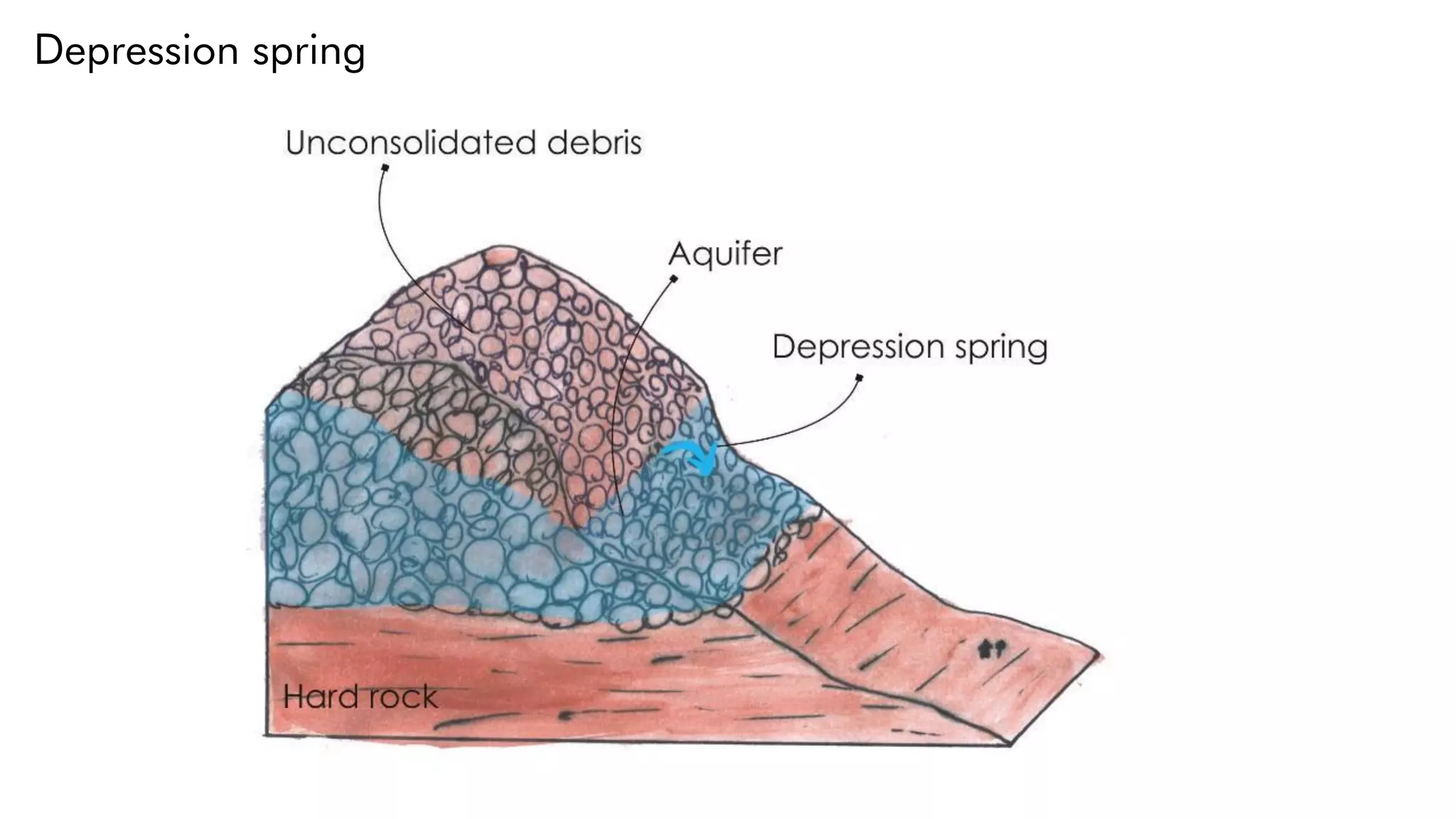
Depression spring
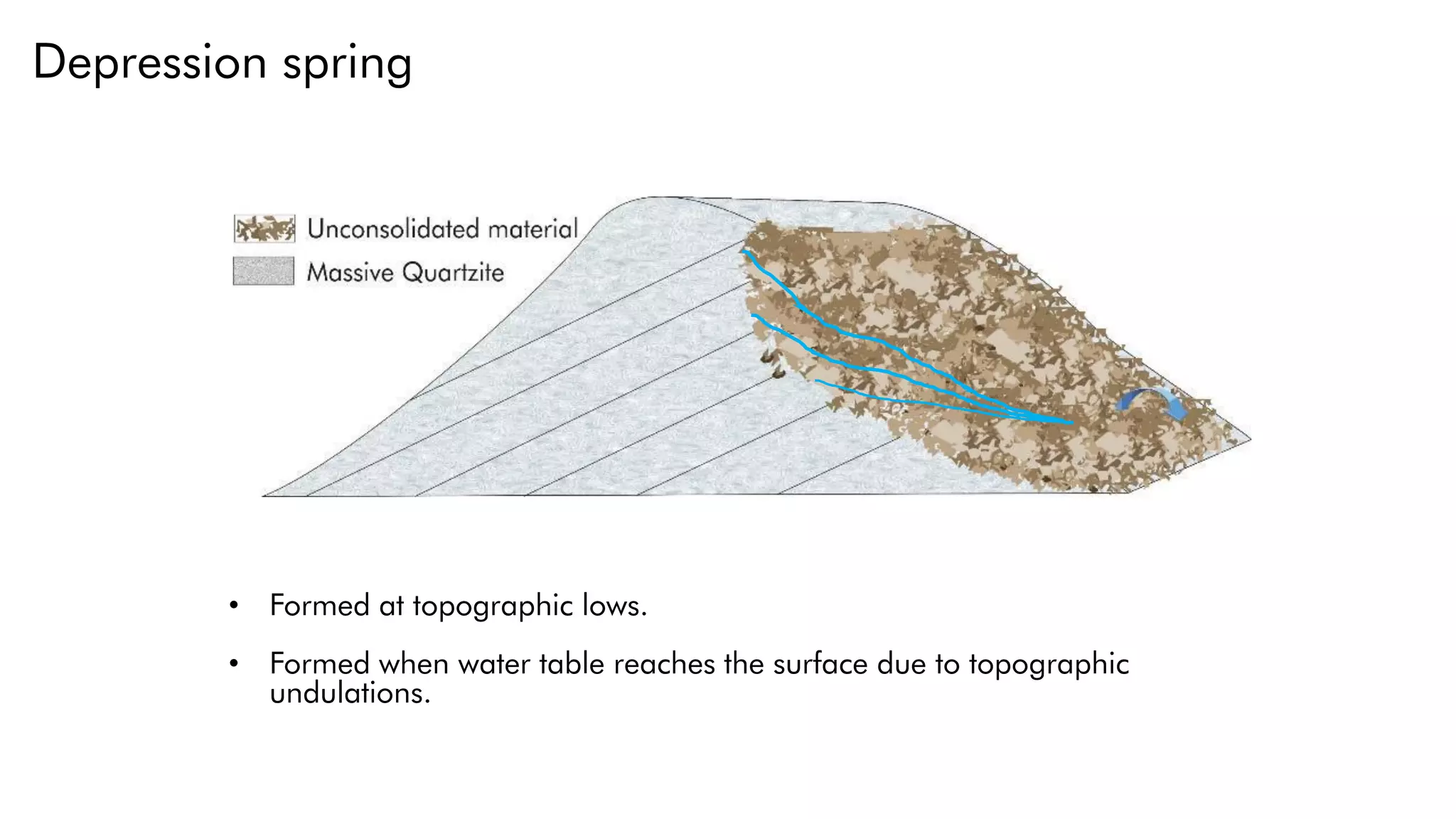
Depression spring
• Formed at topographic lows.
• Formed when water table reaches the surface due to topographic
undulations.
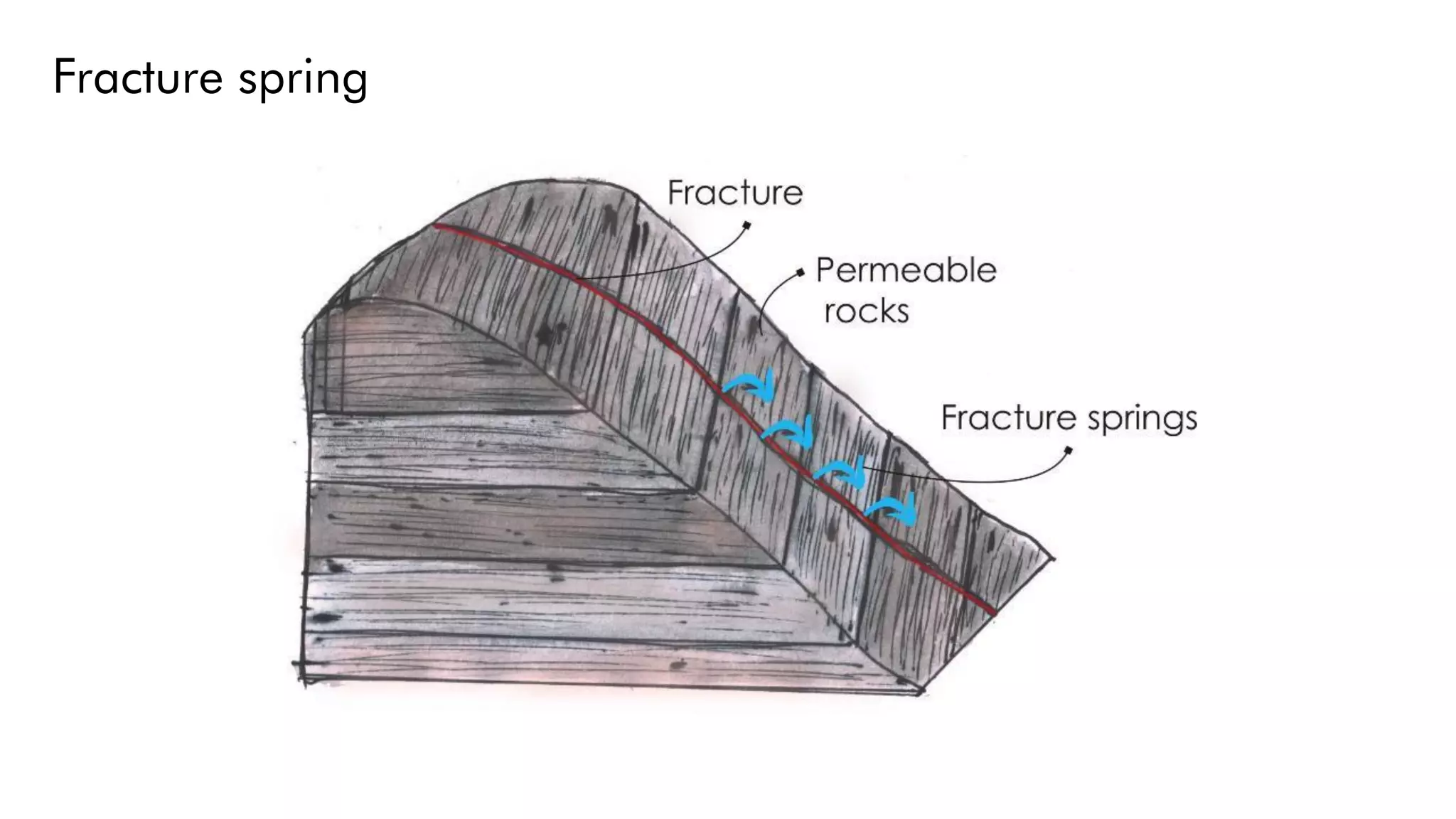
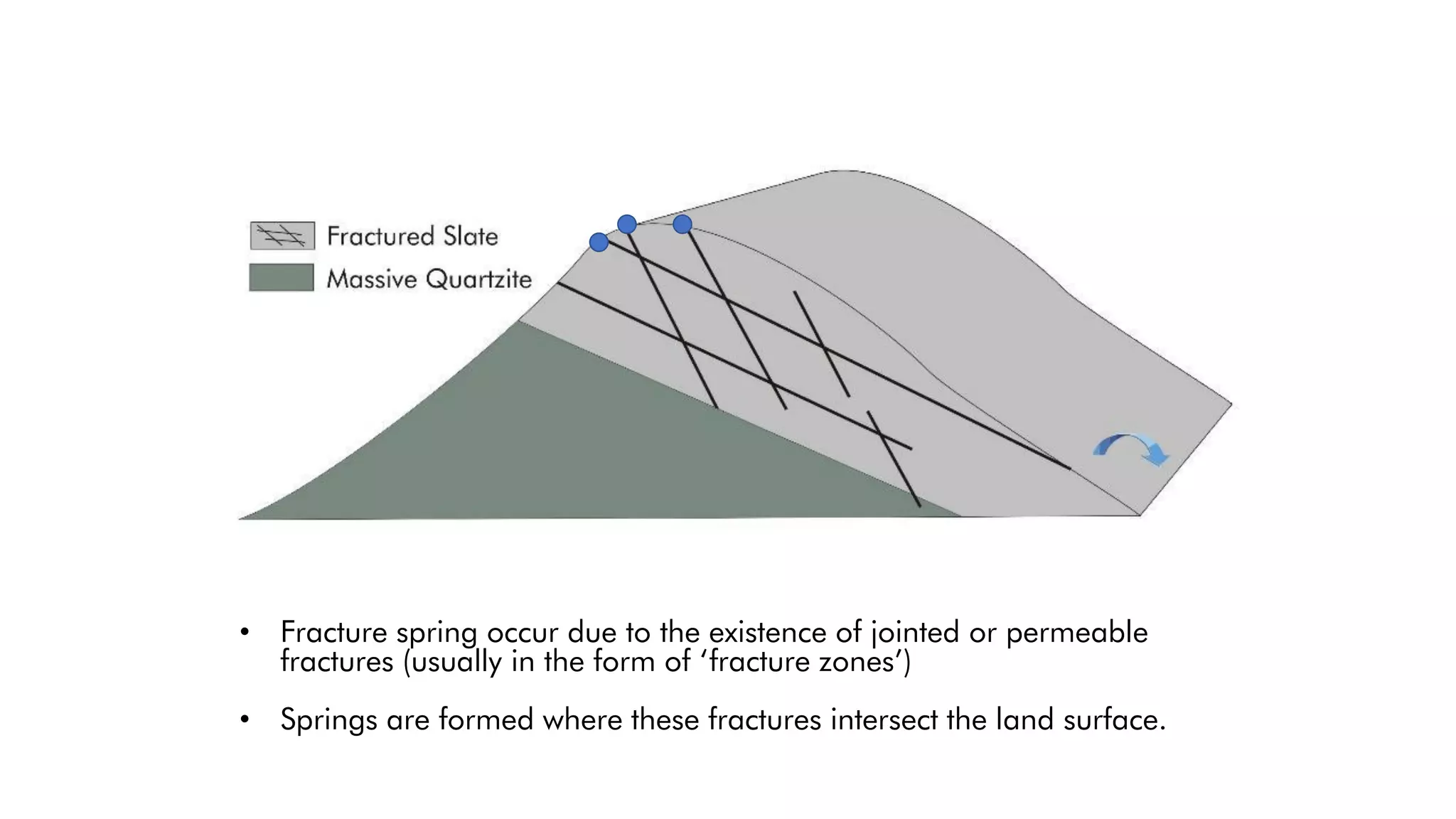
Fracture spring
• Fracture spring occur due to the existence of jointed or permeable
fractures (usually in the form of ‘fracture zones’)
• Springs are formed where these fractures intersect the land surface.
Fracture Spring
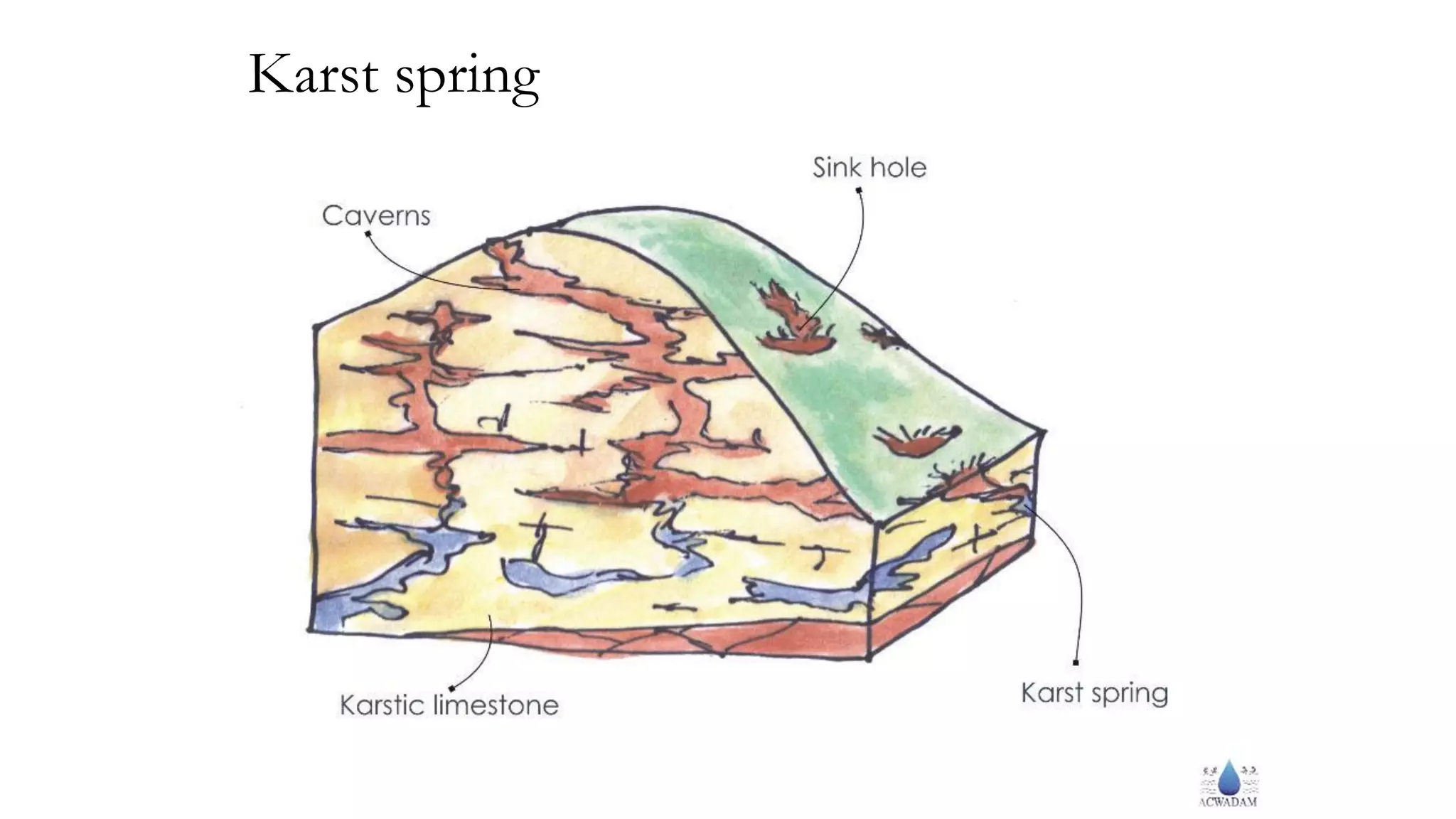
Karst spring
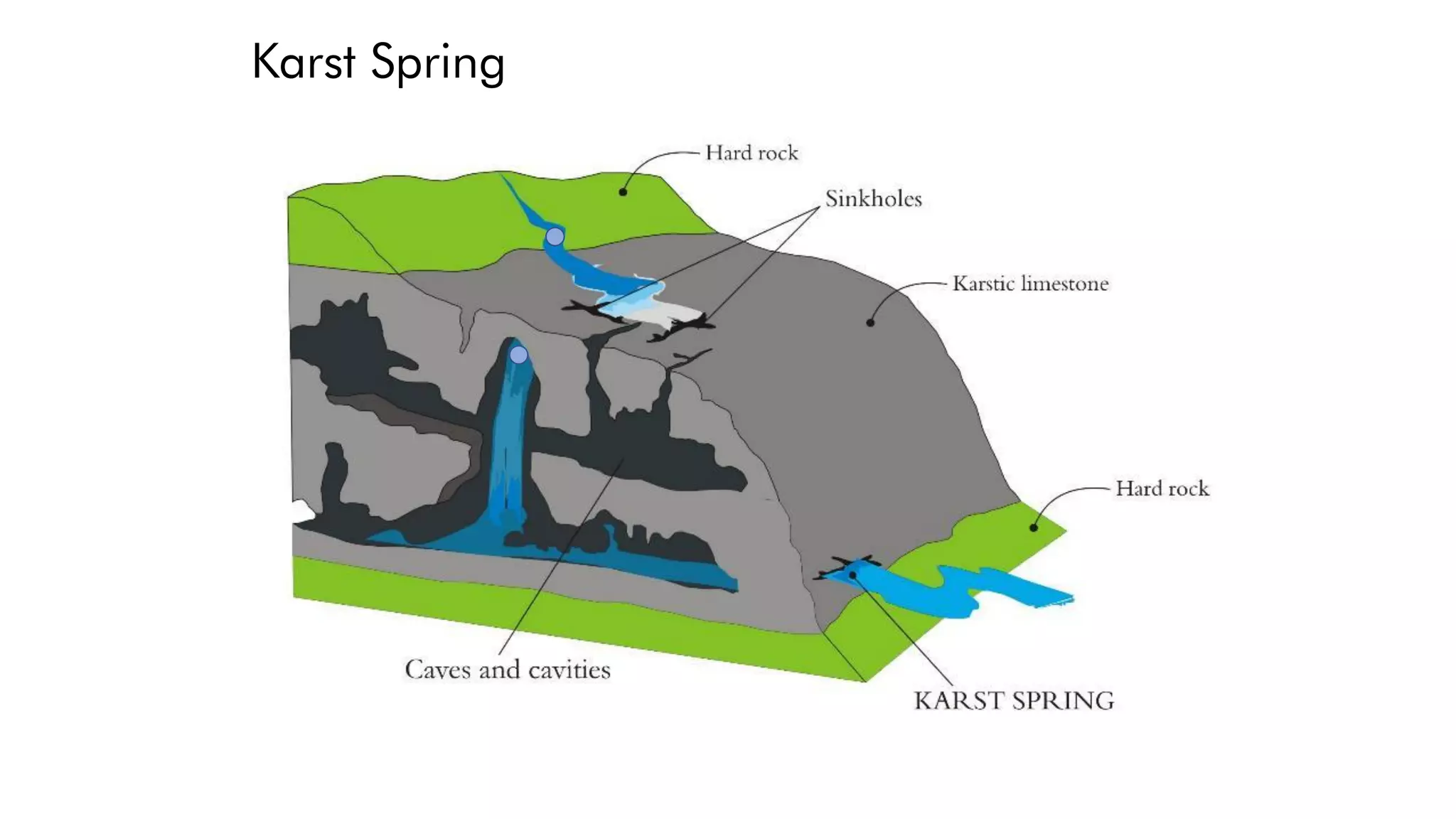
Karst Spring
Karst spring
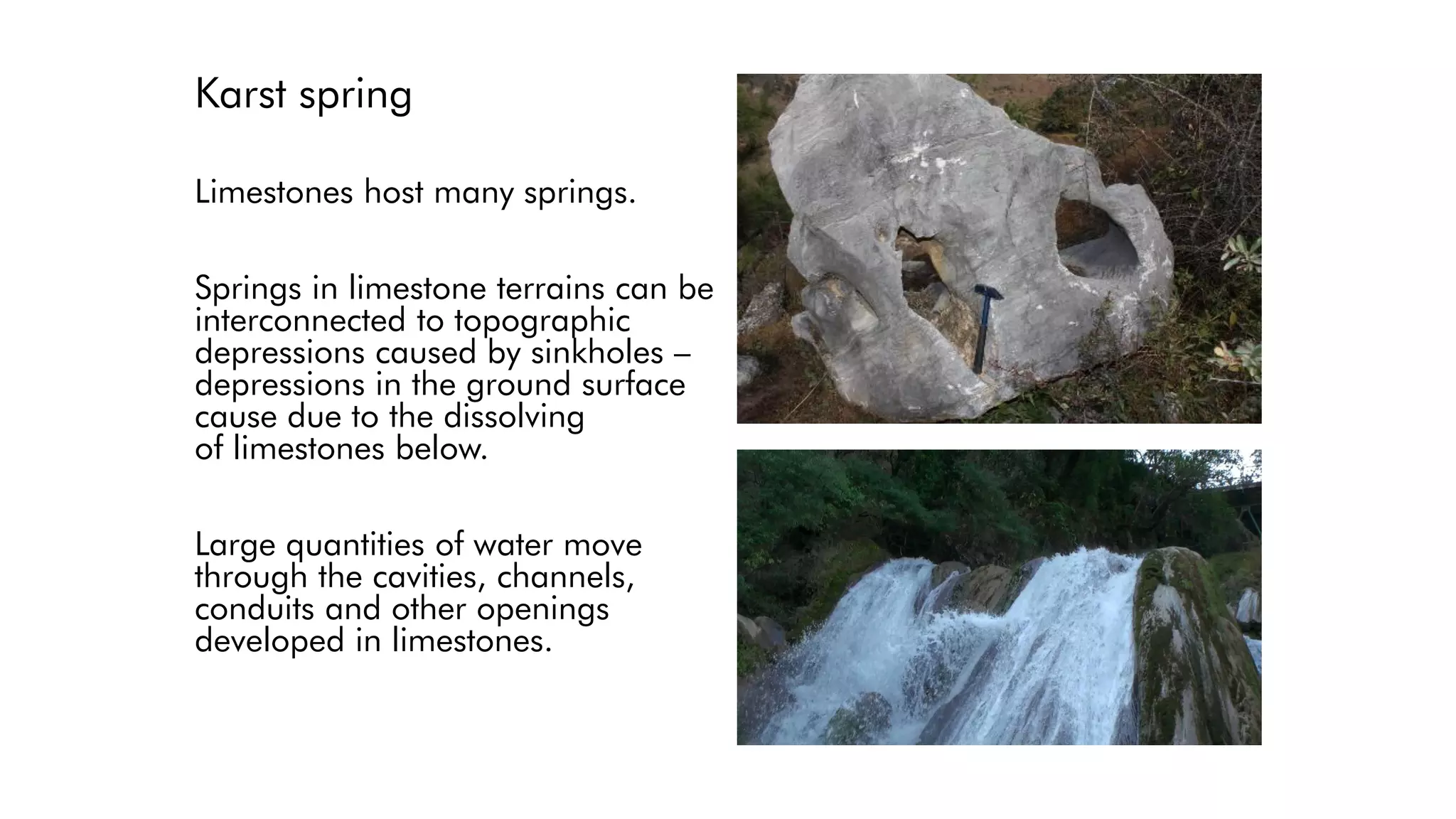
Limestones host many springs.
Springs in limestone terrains can be
interconnected to topographic
depressions caused by sinkholes –
depressions in the ground surface
cause due to the dissolving
of limestones below.
Large quantities of water move
through the cavities, channels,
conduits and other openings
developed in limestones.
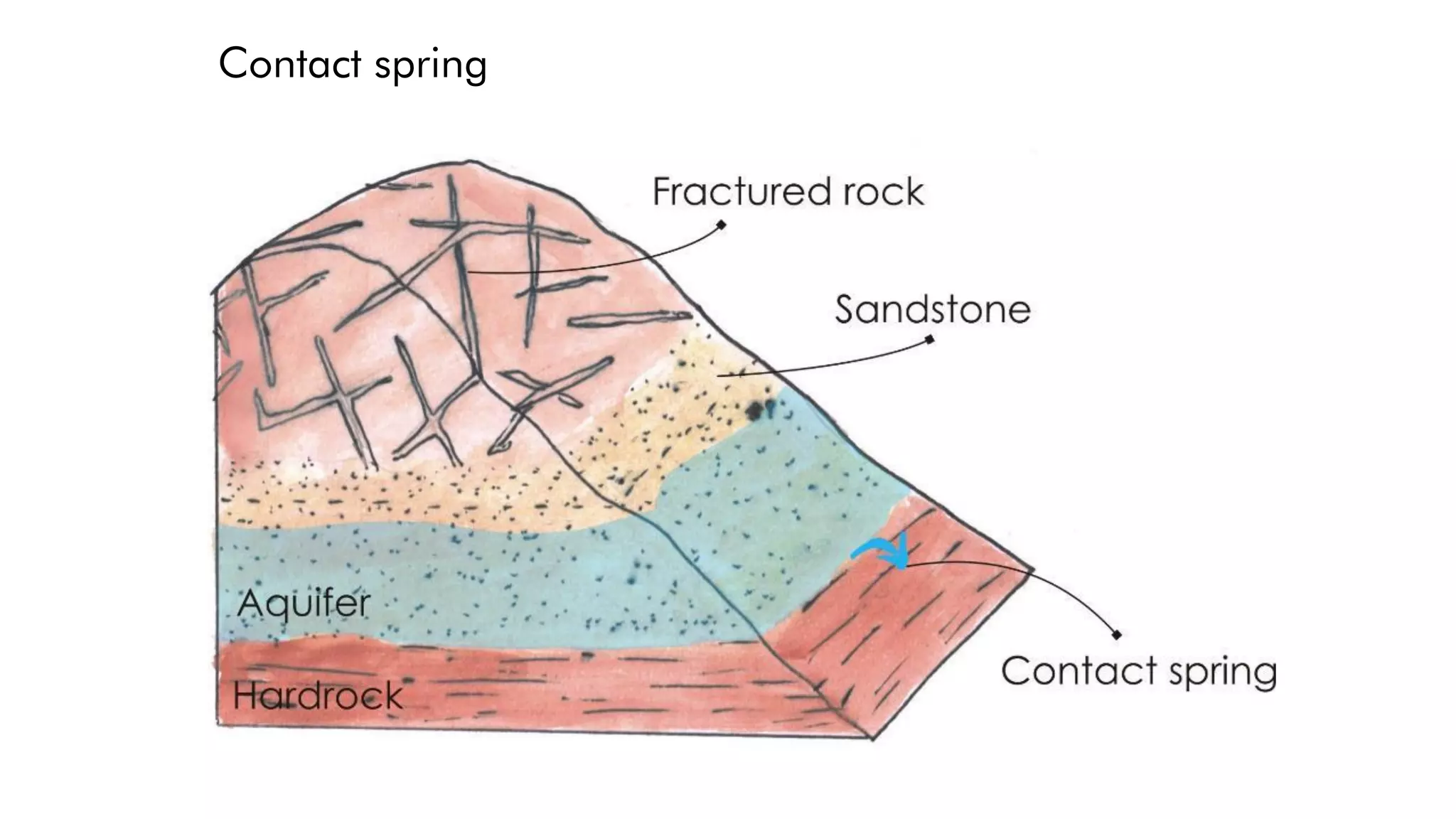
Contact spring
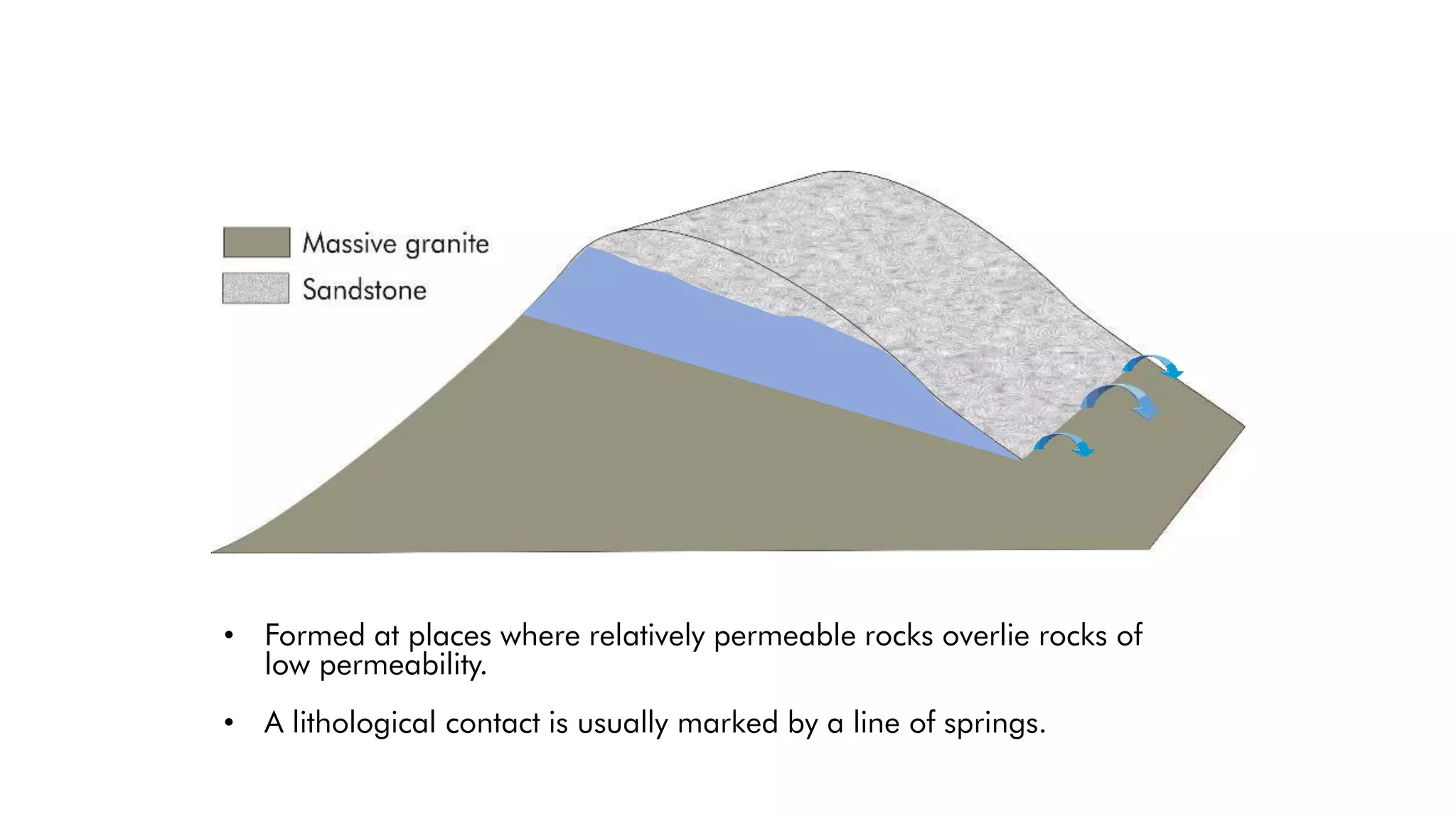
Contact Spring
• Formed at places where relatively permeable rocks overlie rocks of
low permeability.
• A lithological contact is usually marked by a line of springs.
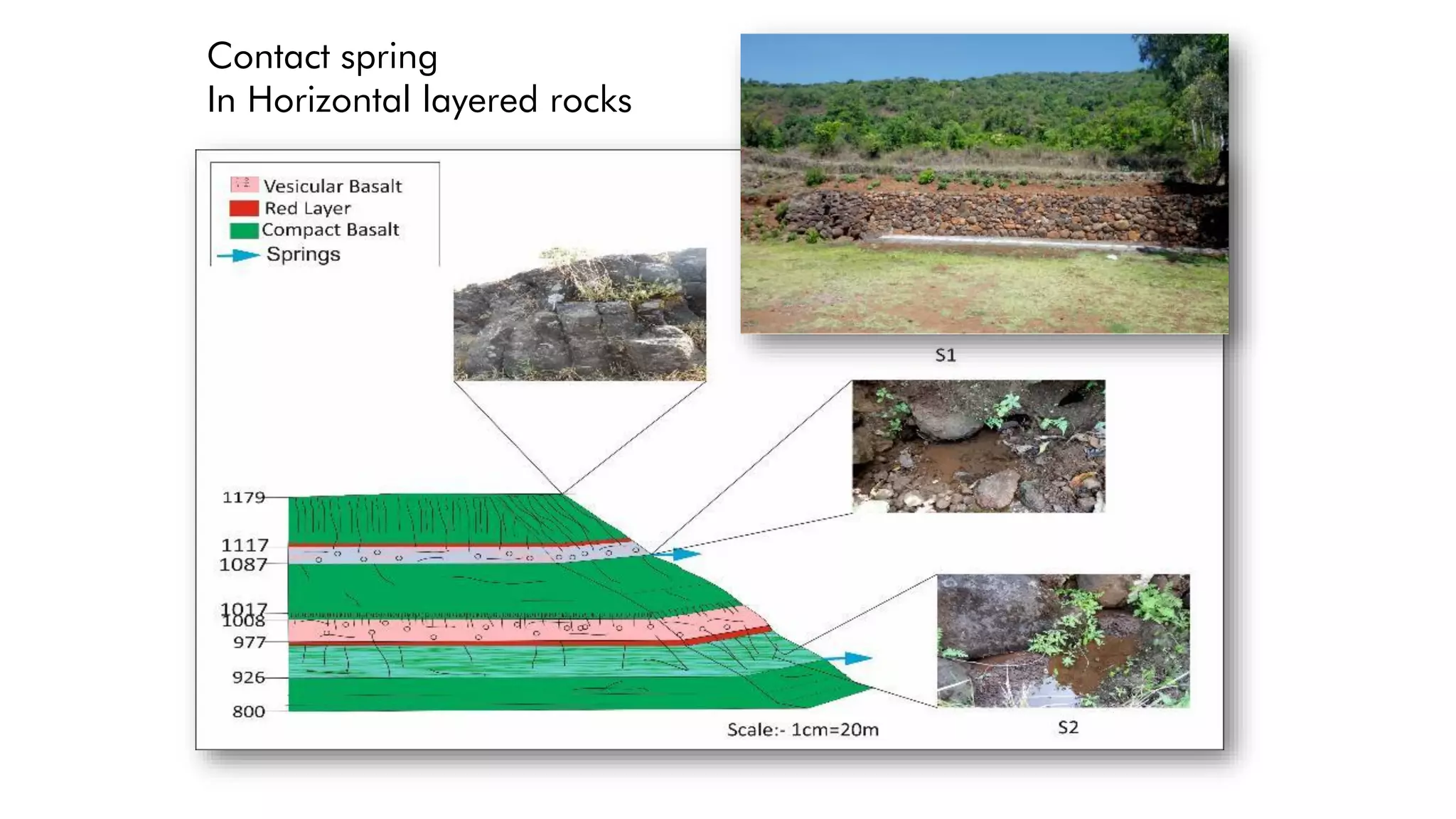
Contact spring
In Horizontal layered rocks
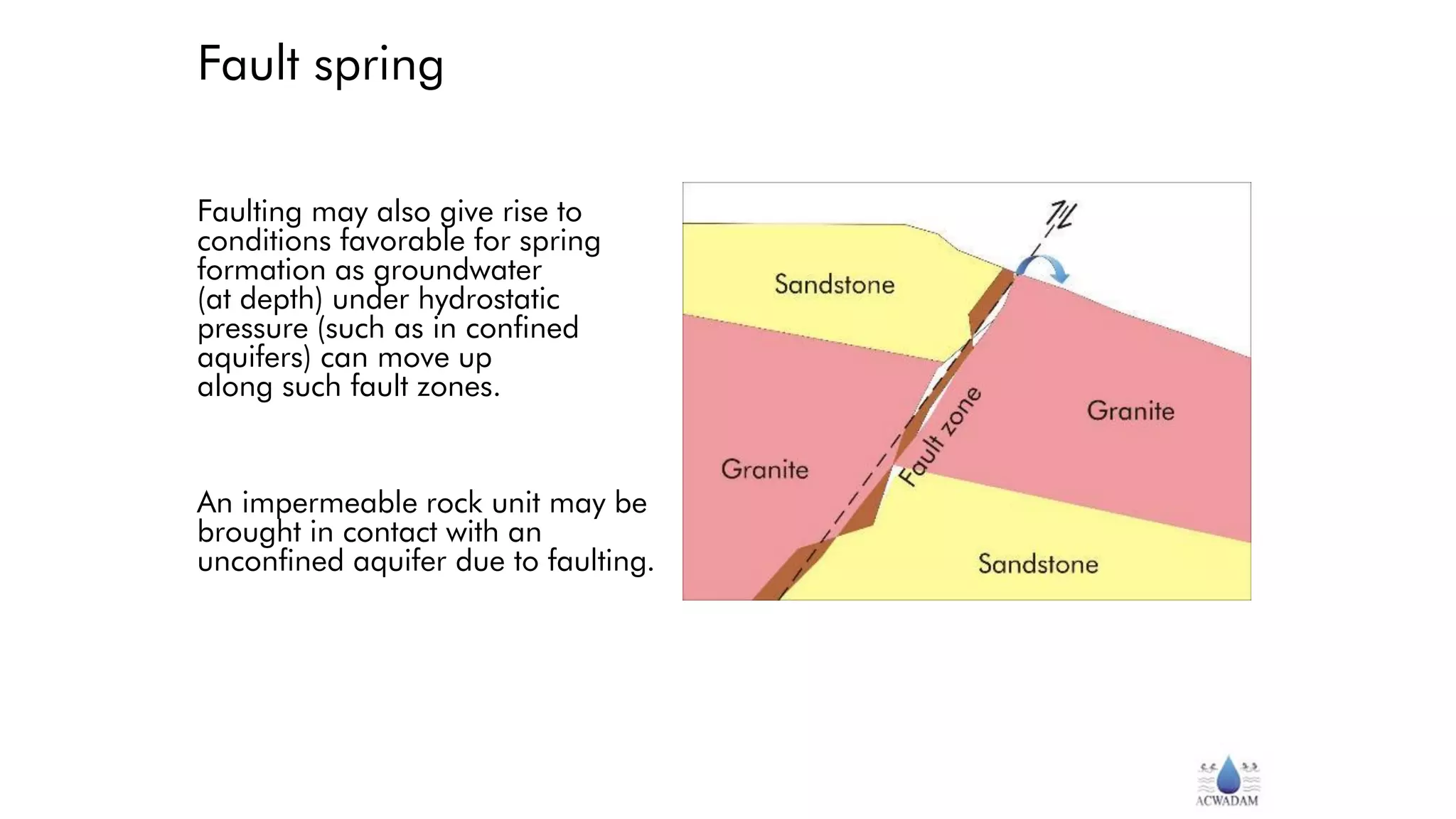
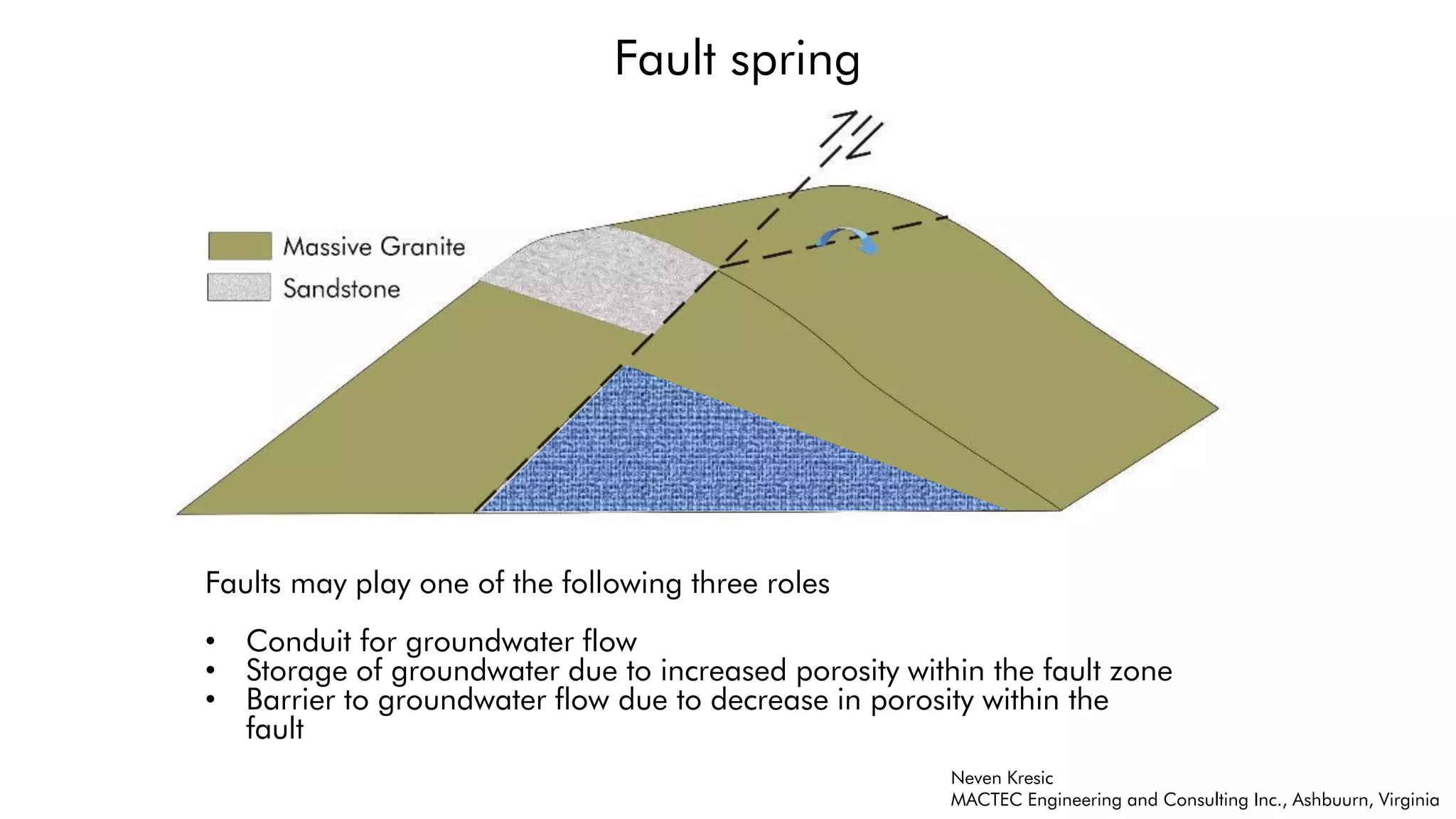
Fault spring
Faulting may also give rise to
conditions favorable for spring
formation as groundwater
(at depth) under hydrostatic
pressure (such as in confined
aquifers) can move up
along such fault zones.
An impermeable rock unit may be
brought in contact with an
unconfined aquifer due to faulting.
Fault spring
Faults may play one of the following three roles
• Conduit for groundwater flow
• Storage of groundwater due to increased porosity within the fault zone
• Barrier to groundwater flow due to decrease in porosity within the
fault
Neven Kresic
MACTEC Engineering and Consulting Inc., Ashbuurn, Virginia
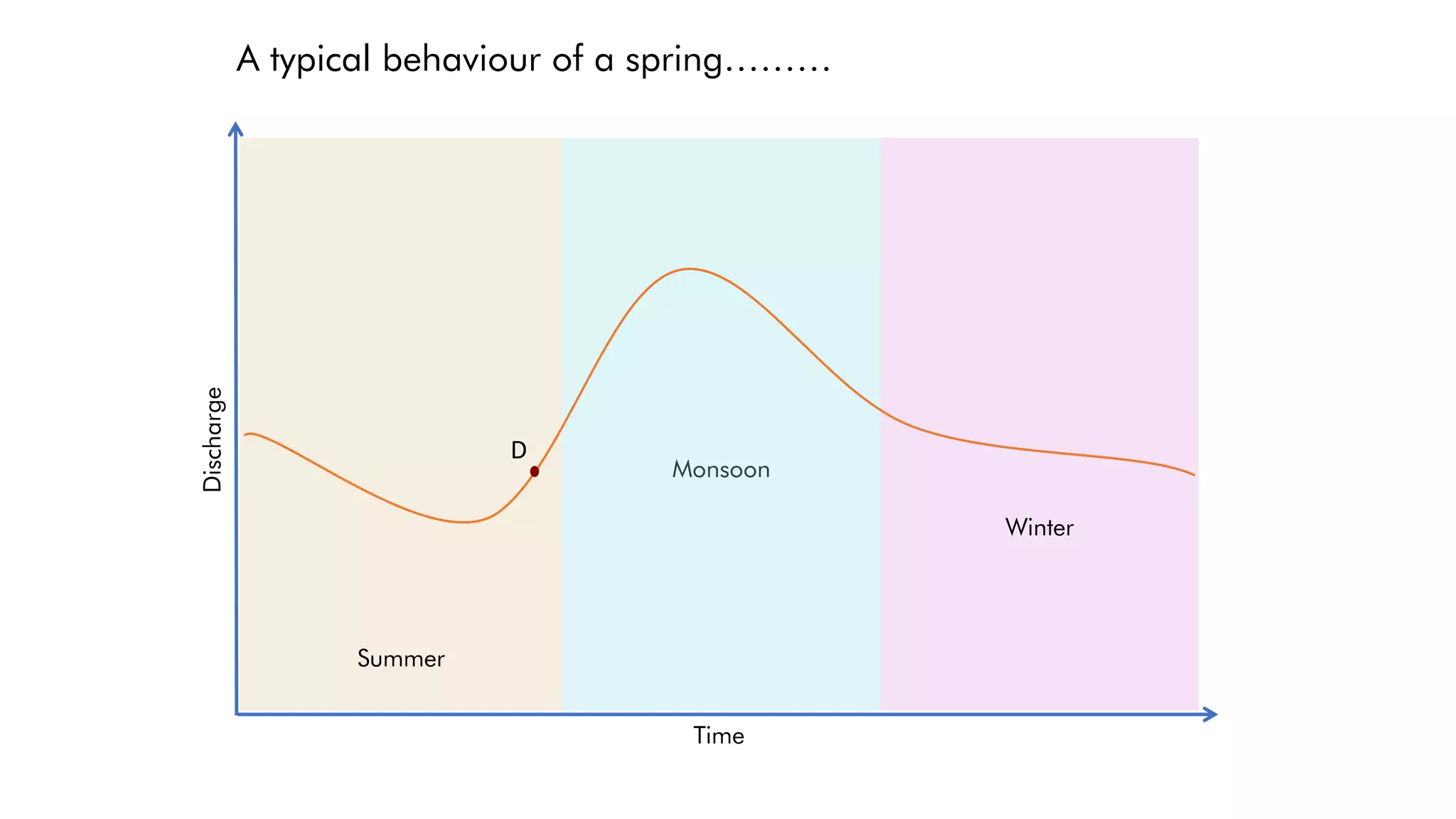
Summer
Monsoon
Winter
Time
Discharge
D
A typical behaviour of a spring………
0
20
40
60
80
100
120
140
160
Apr-15 May-15 Jul-15 Sep-15 Oct-15 Dec-15 Jan-16 Mar-16 May-16 Jun-16
Discharge
in
volume
per
time
Time
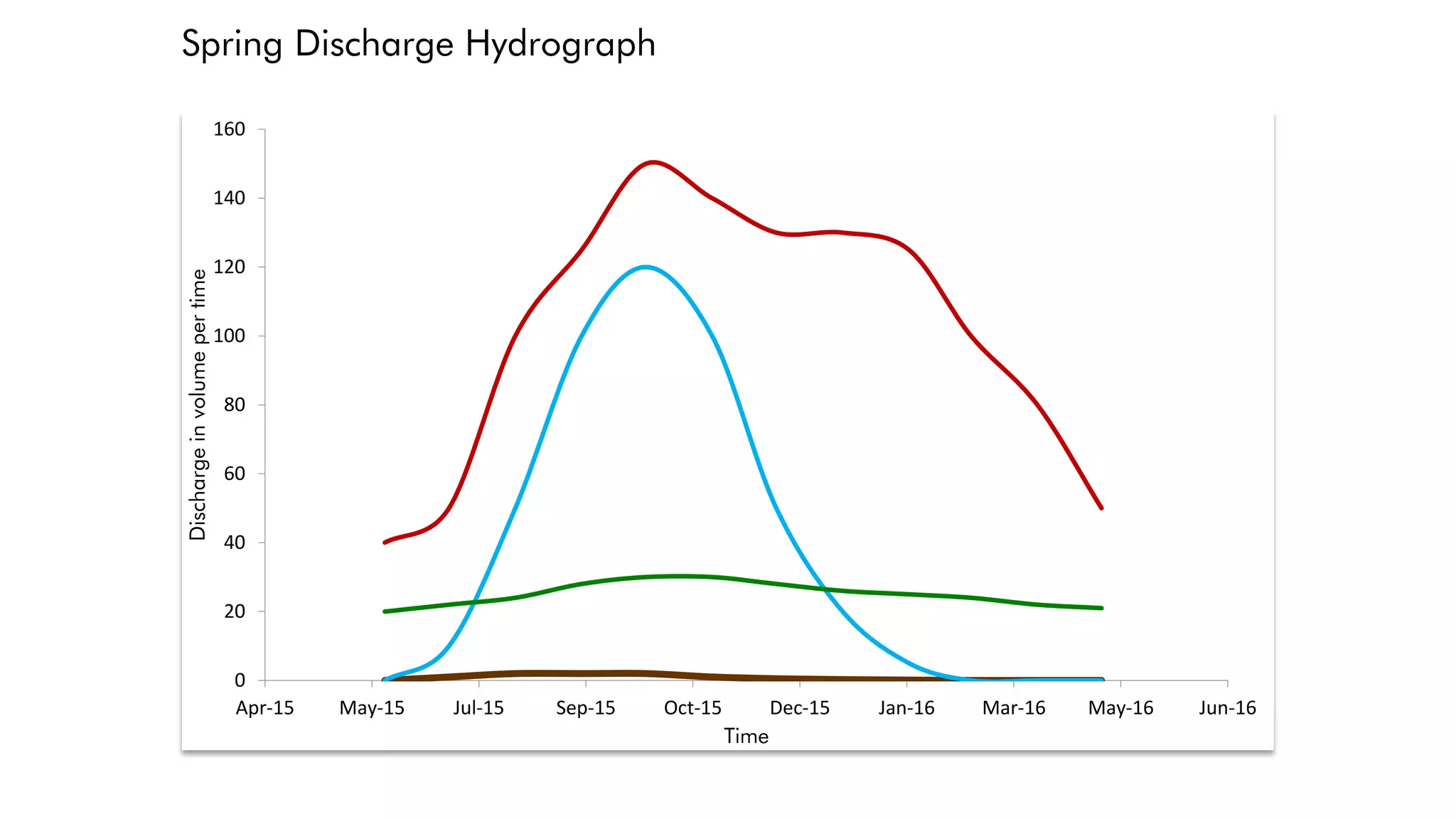
Spring Discharge Hydrograph
0
20
40
60
80
100
120
140
160
Apr-15 May-15 Jul-15 Sep-15 Oct-15 Dec-15 Jan-16 Mar-16 May-16 Jun-16
Discharge
in
volume
per
time
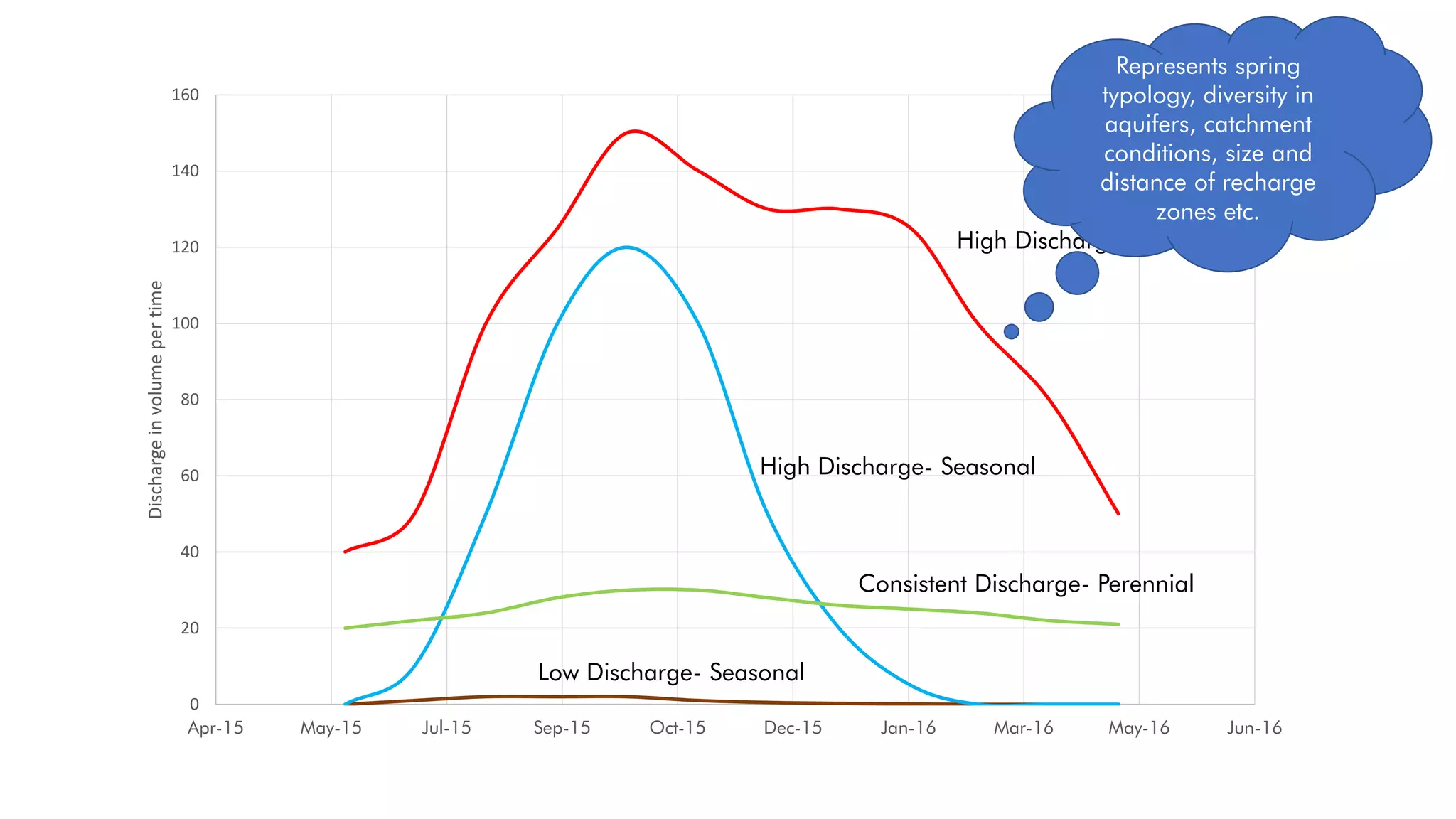
High Discharge- Perennial
High Discharge- Seasonal
Consistent Discharge- Perennial
Low Discharge- Seasonal
Represents spring
typology, diversity in
aquifers, catchment
conditions, size and
distance of recharge
zones etc.
0
20
40
60
80
100
120
140
160
Apr-15 May-15 Jul-15 Sep-15 Oct-15 Dec-15 Jan-16 Mar-16 May-16 Jun-16
Discharge
in
volume
per
time
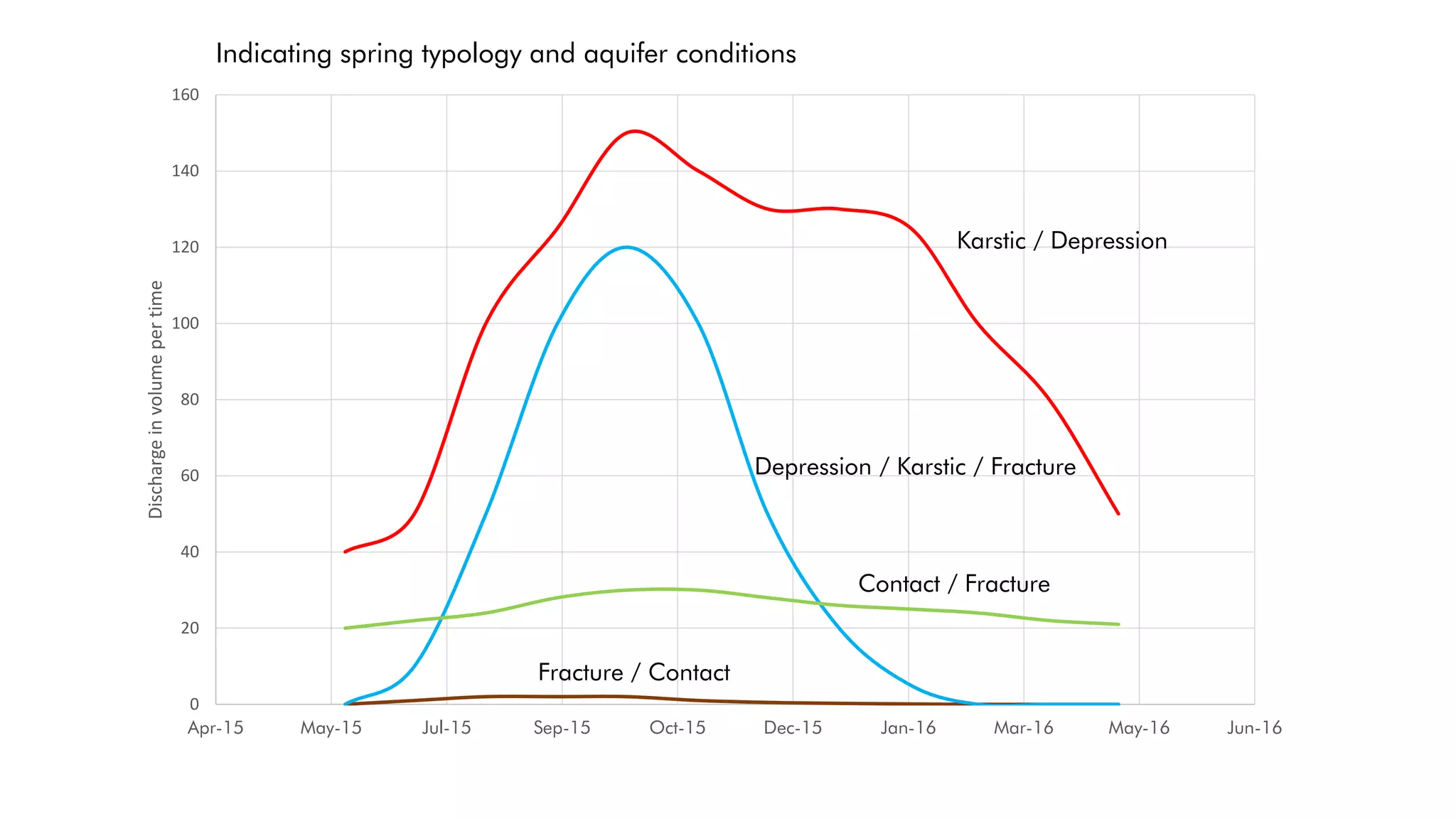
Karstic / Depression
Depression / Karstic / Fracture
Contact / Fracture
Fracture / Contact
Indicating spring typology and aquifer conditions
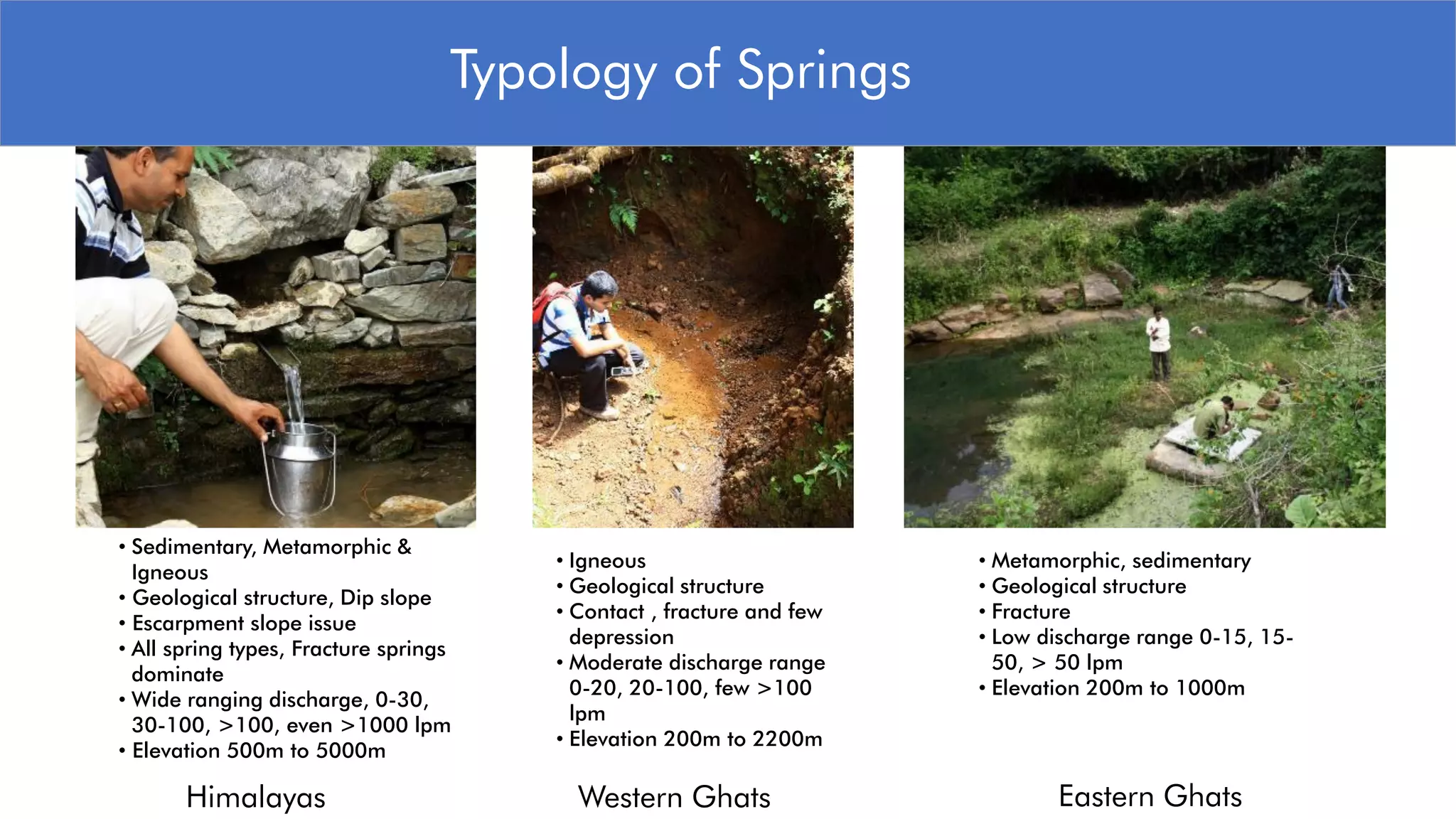
Typology of Springs
• Sedimentary, Metamorphic &
Igneous
• Geological structure, Dip slope
• Escarpment slope issue
• All spring types, Fracture springs
dominate
• Wide ranging discharge, 0-30,
30-100, >100, even >1000 lpm
• Elevation 500m to 5000m
• Igneous
• Geological structure
• Contact , fracture and few
depression
• Moderate discharge range
0-20, 20-100, few >100
lpm
• Elevation 200m to 2200m
• Metamorphic, sedimentary
• Geological structure
• Fracture
• Low discharge range 0-15, 15-
50, > 50 lpm
• Elevation 200m to 1000m
Himalayas Western Ghats Eastern Ghats
Advanced Center for Water Resources Development And Management

Spring hydrogeology and its classification

  • 1.
    Spring Hydrogeology andits classification PRASARI
  • 2.
    What is thedifference between a well and a spring? What is common between a well and a spring?
  • 4.
    Lez Spring –water supply for the city of Montpellier, France Big Spring for the city of Huntsville, Alabama Karst spring systems that supply water 10 villages and communities of the Swabian Alb in Germany.
  • 5.
    Jack Daniel advertisesits whiskey as being made with iron-free water from a Tennessee cave spring Single source of pure natural water, from a spring on the hillside above the Glenfiddich distillery, and this gives it its unique purity of taste. Glenfiddich has bought 200 acres of surrounding hillside just to protect that small spring. LaMoreaux, P. and Tanner, J. (2011). Springs and Bottled Waters of the World Ancient History, Source, Occurrence, Quality and Use.
  • 6.
    Gurpreet Singh Nibber| Hindustan Times, May 20, 2019 Radheshyam Jadhav | TNN | Times Of India, Updated: Jun 9, 2018, More about wells and borewells……
  • 7.
    Time Quantity of water Drivers of source depletion:changes – climate, land-cover, land-use, seismicity, etc. More than 60% of low- discharge springs reported decline in the last 20 years – sampled across the Himalayan Region… ACWADAM, in partnership with various organisations – 2007 - 2016
  • 8.
    Water scarcity inKathmandu Photo credit: Himalayan Times Drudgery caused to women's in rural areas Chapakharka village, Kathmandu
  • 9.
    Dependency on springwater for domestic purposes Tanker services across many parts of the Himalayan regions Pudung village, Kalimpong Kalimpong town
  • 10.
    Regional spring-scapes Western GhatsEastern Ghats Himalayan region Groundwater – blind spot - sparse data on groundwater in general and springs in particular…
  • 11.
    What is behinda spring?
  • 12.
    A system ofrocks (Aquifers) feeding into the spring…….
  • 13.
    Understanding the resource thatsupports sources ..and the aquifer feeding this spring???
  • 14.
    …to a typology:based on hydrogeology
  • 15.
    Classification of Springs •Geology • Magnitude, variation, and permanence of flow • Quality and mineralization of the spring water • Temperature of the spring water. (Fetter, 1980; Tolman, 1937; Meinzer, 1923)
  • 16.
    Gravity Springs Gravity springsemerge under unconfined conditions where water table intersects land surface. They are also called descending springs. Artesian Springs Artesian springs discharge under pressure due to confined conditions in the underlying aquifer. They are also called ascending or rising springs. Classification based on nature of the hydraulic head in the underlying aquifer at the point of discharge
  • 17.
    Types of Springs Itis necessary to identify the type of spring in order to understand how they behave over time and space - Depression spring - Contact spring - Fracture spring - Fault spring - Karst spring Modified after Tolman, 1937
  • 18.
  • 19.
    Depression spring • Formedat topographic lows. • Formed when water table reaches the surface due to topographic undulations.
  • 20.
  • 21.
    • Fracture springoccur due to the existence of jointed or permeable fractures (usually in the form of ‘fracture zones’) • Springs are formed where these fractures intersect the land surface. Fracture Spring
  • 22.
  • 23.
  • 24.
    Karst spring Limestones hostmany springs. Springs in limestone terrains can be interconnected to topographic depressions caused by sinkholes – depressions in the ground surface cause due to the dissolving of limestones below. Large quantities of water move through the cavities, channels, conduits and other openings developed in limestones.
  • 25.
  • 26.
    Contact Spring • Formedat places where relatively permeable rocks overlie rocks of low permeability. • A lithological contact is usually marked by a line of springs.
  • 27.
  • 28.
    Fault spring Faulting mayalso give rise to conditions favorable for spring formation as groundwater (at depth) under hydrostatic pressure (such as in confined aquifers) can move up along such fault zones. An impermeable rock unit may be brought in contact with an unconfined aquifer due to faulting.
  • 29.
    Fault spring Faults mayplay one of the following three roles • Conduit for groundwater flow • Storage of groundwater due to increased porosity within the fault zone • Barrier to groundwater flow due to decrease in porosity within the fault Neven Kresic MACTEC Engineering and Consulting Inc., Ashbuurn, Virginia
  • 30.
  • 31.
    0 20 40 60 80 100 120 140 160 Apr-15 May-15 Jul-15Sep-15 Oct-15 Dec-15 Jan-16 Mar-16 May-16 Jun-16 Discharge in volume per time Time Spring Discharge Hydrograph
  • 32.
    0 20 40 60 80 100 120 140 160 Apr-15 May-15 Jul-15Sep-15 Oct-15 Dec-15 Jan-16 Mar-16 May-16 Jun-16 Discharge in volume per time High Discharge- Perennial High Discharge- Seasonal Consistent Discharge- Perennial Low Discharge- Seasonal Represents spring typology, diversity in aquifers, catchment conditions, size and distance of recharge zones etc.
  • 33.
    0 20 40 60 80 100 120 140 160 Apr-15 May-15 Jul-15Sep-15 Oct-15 Dec-15 Jan-16 Mar-16 May-16 Jun-16 Discharge in volume per time Karstic / Depression Depression / Karstic / Fracture Contact / Fracture Fracture / Contact Indicating spring typology and aquifer conditions
  • 34.
    Typology of Springs •Sedimentary, Metamorphic & Igneous • Geological structure, Dip slope • Escarpment slope issue • All spring types, Fracture springs dominate • Wide ranging discharge, 0-30, 30-100, >100, even >1000 lpm • Elevation 500m to 5000m • Igneous • Geological structure • Contact , fracture and few depression • Moderate discharge range 0-20, 20-100, few >100 lpm • Elevation 200m to 2200m • Metamorphic, sedimentary • Geological structure • Fracture • Low discharge range 0-15, 15- 50, > 50 lpm • Elevation 200m to 1000m Himalayas Western Ghats Eastern Ghats
  • 36.
    Advanced Center forWater Resources Development And Management