1
GROUND WATER ENGINEERING (3360609)
PREPARED BY KEYUR J PANSARA
4.5 Specific Capacity
The Specific Capacity of a well is simply the pumping rate (yield) divided by the
drawdown . It is a very valuable number that can be used to provide the design
pumping rate or maximum yield for the well. It can be used to identify potential
well, pump, or aquifer problems, and accordingly to develop a proper well
maintenance schedule. It can also be used to estimate the transmissivity of the
aquifer(s) tapped by the well's perforations. Transmissivity is the rate water is
transmitted through an aquifer under a unit width and a unit hydraulic gradient. It
equals the aquifer's hydraulic conductivity (permeability) times the aquifer
thickness. The higher the transmissivity, the more prolific the aquifer and the less
drawdown observed in the well.
Typically, a well should run continuously for at least 24 hours at a constant yield
before recording the drawdown. The same time frame should be used for each
subsequent test for equal comparisons to the initial test. Shorter time frames are
sometimes used from electric company pump efficiency tests or Step-Drawdown
tests, but these shorter times may not sufficiently allow the water levels to
stabilize for a reliable Specific Capacity calculation.
The Specific Capacity obtained just after a well is drilled and properly developed is
typically the highest value that will be produced and is the benchmark with which
to compare all future values. As time goes by, the Specific Capacity will decline as
plugging of the well's perforations or filter pack occurs, as the pump starts to fail,
or as static water levels change. Specific Capacity tests should be performed at
least semi-annually and water levels (static and pumping) should be collected
monthly to provide early detection of potential well problems. Rehabilitation
work should be initiated when a well's Specific Capacity drops by 25% (Driscoll,
1986).
The initial value can also be used to estimate the maximum pumping rate for the
well. Using the above example and assuming that only 50 feet of drawdown is
available in the well, the maximum yield is calculated as the Specific Capacity
times the maximum drawdown, or 119 gpm/ft * 50 ft, = 5,950 gpm. This should
be verified with an actual field test.
2
GROUND WATER ENGINEERING (3360609)
PREPARED BY KEYUR J PANSARA
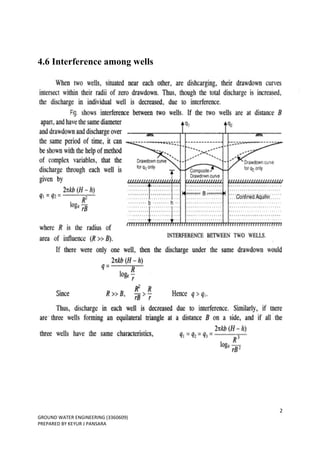
4.6 Interference among wells
3
GROUND WATER ENGINEERING (3360609)
PREPARED BY KEYUR J PANSARA
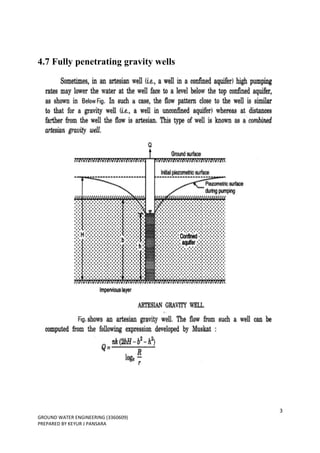
4.7 Fully penetrating gravity wells
4
GROUND WATER ENGINEERING (3360609)
PREPARED BY KEYUR J PANSARA
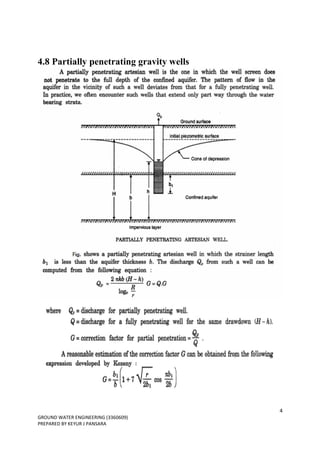
4.8 Partially penetrating gravity wells
5
GROUND WATER ENGINEERING (3360609)
PREPARED BY KEYUR J PANSARA
4.10 Method of construction of wells
The initial investment for a properly designed and constructed well pays off by
ensuring:
 A reliable and sustainable water supply consistent with your needs and the
capability of the aquifer
 Good quality water that is free of sediment and contaminants
 Increased life expectancy of the well
 Reduced operating and maintenance costs
 Ease of monitoring well performance.

 Steps considered in Well Construction
1. Choosing a drilling contractor
2. Choosing a well site
3. Well design considerations
4. Well completion
1. Choosing a Drilling Contractor
Choose a licensed water well contractor who has experience in your
area and knows the local geology. Provincial regulation requires that
drilling companies have an approval to drill water wells and their
drillers must be certified journeyman water well drillers. A list of
approval holders is available through Alberta Environment and
Sustainable Resource Development (AESRD). You can also contact the
Alberta Water Well Drilling Association for a list of approval holders in
your area. Refer to Module 11 “Contacts for More Information”.
Either you or the licensed water well contractor should complete a
survey of existing wells in your area. It will provide important
information about:
 Typical yields and water quality
 Which aquifer to tap into
 Trends in well design and construction
 Prior drilling success rates
6
GROUND WATER ENGINEERING (3360609)
PREPARED BY KEYUR J PANSARA
2. Choosing a Well Site
Your choice of well site will affect the safety and performance of your
well. As you examine various sites, remember to consider any future
development plans for your farm or acreage such as barns, storage
sheds and bulk fuel tanks. You must also consider provincial
regulations that dictate well location.
Most contaminants enter the well either through the top or around
the outside of the casing. Sewage or other contaminants may
percolate down through the upper layers of the ground surface to the
aquifer. The following criteria are intended to prevent possible
contamination of your well and the aquifer. It is both your and the
driller’s responsibility to
ensure that:
 The well is accessible for cleaning, testing, monitoring,
maintenance and repair
 The ground surrounding the well is sloped away from the
well to prevent any surface run off from collecting or
ponding
 The well is up-slope and as far as possible from potential
contamination sources such as septic systems, barnyards or
surface water bodies
 The well is not housed in any building other than a bona
fide pump house.
3. Well Design Considerations
Well design and construction details are determined after a test hole
has been completed and the geological zones have been logged. There
are many components to well design the driller must take into
account. Decisions will be made about:
 Type of well
 Intended use
 Well depth
 Casing material, size and wall thickness
7
GROUND WATER ENGINEERING (3360609)
PREPARED BY KEYUR J PANSARA

 Intake design
 Annular seal
 Monitoring and preventive maintenance provisions.
Well Depth
During the test hole drilling, the licensed water well contractor will complete a
lithologic or formation log. Soil and rock samples are taken at various depths
and the type of geologic material is recorded. This allows the driller to identify
zones with the best potential for water supply. Some drillers also run a
geophysical (electric) log in the test hole to further define the geology. This
gives them more accurate information about aquifer location. Generally a well
is completed to the bottom of the aquifer. This allows more of the aquifer to be
utilized and ensures the highest possible production from the well.
Types of Wells
There are two main types of wells, each distinguished by the diameter of the
bore hole. The two types are bored wells and drilled wells.
Bored wells
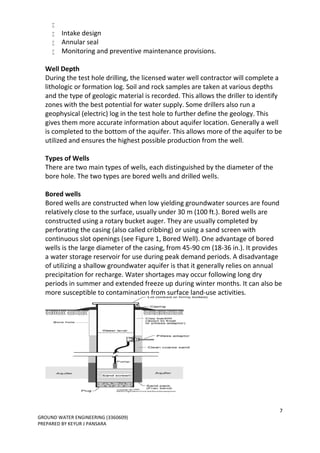
Bored wells are constructed when low yielding groundwater sources are found
relatively close to the surface, usually under 30 m (100 ft.). Bored wells are
constructed using a rotary bucket auger. They are usually completed by
perforating the casing (also called cribbing) or using a sand screen with
continuous slot openings (see Figure 1, Bored Well). One advantage of bored
wells is the large diameter of the casing, from 45-90 cm (18-36 in.). It provides
a water storage reservoir for use during peak demand periods. A disadvantage
of utilizing a shallow groundwater aquifer is that it generally relies on annual
precipitation for recharge. Water shortages may occur following long dry
periods in summer and extended freeze up during winter months. It can also be
more susceptible to contamination from surface land-use activities.
8
GROUND WATER ENGINEERING (3360609)
PREPARED BY KEYUR J PANSARA
Drilled wells
Drilled wells are smaller in diameter, usually ranging from 10-20 cm (4-8 in.),
and completed to much greater depths than bored wells, up to several hundred
metres. The producing aquifer is generally less susceptible to pollution from
surface sources because of the depth. Also, the water supply tends to be more
reliable since it is less affected by seasonal
weather patterns.
There are two primary methods of drilling:
 Rotary
 Cable tool.
Rotary drilled wells are constructed using a drill bit on the end of a rotating drill
stem. Drilling fluid or air is circulated down through the drill stem in the hole
and back to the surface to remove cuttings. Rotary drilling rigs operate quickly
and can reach depths of over 300 m (1000 ft.), with casing diameters of 10-45
cm (4-18 in.).
Cable tool drilled wells are constructed by lifting and dropping a heavy drill bit
in the bore hole. The resulting loose material, mixed with water, is removed
using a bailer or sand pump. This method, also called percussion drilling,
reaches depths up to 300 m (1000 ft.). Well diameters can range from 10-45 cm
(4-18 in.). The drilling rate is typically much slower than for a rotary rig, but
when aquifers are low yielding, they may be more easily identified using this
method.
4. Well Completion
Once the well has been drilled and the equipment is in place, there are
several procedures the licensed water well contractor must complete
before the well is ready to use. The driller is responsible for:
 Developing the well
 Disinfecting the well
 Conducting a yield test.
Well Development
Well development is the process of removing fine sediment and drilling fluid
from the area immediately surrounding the perforations. This increases the
9
GROUND WATER ENGINEERING (3360609)
PREPARED BY KEYUR J PANSARA
well’s ability to produce water and maximize production from the aquifer. If the
aquifer formation does not naturally have any relatively coarse particles to form
a filter, it may be necessary for the driller to install an artificial filter pack. This
pack is placed around the screen or perforations so the well can be developed.
For example, this procedure is necessary when the aquifer is composed of fine
sand and the individual grains are uniform
in size. It is important to match the grain size of the filter pack material with the
size of the slot openings of the screen to attain maximum yield from the well.
Typically the slot size of the screen is selected so that 85 percent of the artificial
pack material will remain outside of the screen after well development.
Yield Test
A yield test is important because the information gathered during the test
assists the driller in determining the:
 Rate at which to pump the well
 Depth at which to place the pump.
10
GROUND WATER ENGINEERING (3360609)
PREPARED BY KEYUR J PANSARA
4.11 Selection of pump sets
Plunger pump
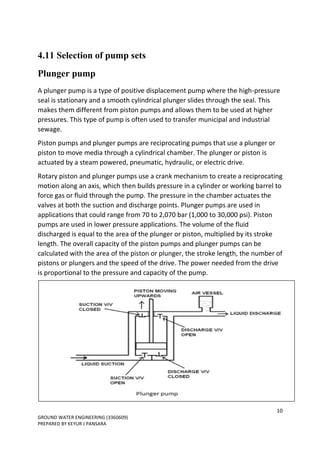
A plunger pump is a type of positive displacement pump where the high-pressure
seal is stationary and a smooth cylindrical plunger slides through the seal. This
makes them different from piston pumps and allows them to be used at higher
pressures. This type of pump is often used to transfer municipal and industrial
sewage.
Piston pumps and plunger pumps are reciprocating pumps that use a plunger or
piston to move media through a cylindrical chamber. The plunger or piston is
actuated by a steam powered, pneumatic, hydraulic, or electric drive.
Rotary piston and plunger pumps use a crank mechanism to create a reciprocating
motion along an axis, which then builds pressure in a cylinder or working barrel to
force gas or fluid through the pump. The pressure in the chamber actuates the
valves at both the suction and discharge points. Plunger pumps are used in
applications that could range from 70 to 2,070 bar (1,000 to 30,000 psi). Piston
pumps are used in lower pressure applications. The volume of the fluid
discharged is equal to the area of the plunger or piston, multiplied by its stroke
length. The overall capacity of the piston pumps and plunger pumps can be
calculated with the area of the piston or plunger, the stroke length, the number of
pistons or plungers and the speed of the drive. The power needed from the drive
is proportional to the pressure and capacity of the pump.
11
GROUND WATER ENGINEERING (3360609)
PREPARED BY KEYUR J PANSARA
Seals are an integral part of piston pumps and plunger pumps to separate the
power fluid from the media that is being pumped. A stuffing box or packing is
used to seal the joint between the vessel where the media is transferred and the
plunger or piston. A stuffing box may be composed of bushings, packing or seal
rings, and a gland.
Plunger pumps component materials are chosen for wear and contact with the
media type. Component materials include bronze, brass, steel, stainless steel,
iron, nickel alloy, or other material. For example, plunger pumps that function in
general service or oil service applications often have an iron cylinder and plunger.
The plunger, discharge valves, and suction valves come in contact with the media
type transferred, and material choices are based on the fluid transferred. In
power applications where continuous duty plunger pumps are needed, solid
ceramic plungers may be used when in contact with water and oil, but may not be
compatible for use with highly acidic media types.
Submersible pump
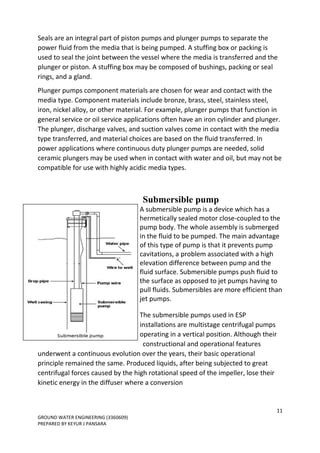
A submersible pump is a device which has a
hermetically sealed motor close-coupled to the
pump body. The whole assembly is submerged
in the fluid to be pumped. The main advantage
of this type of pump is that it prevents pump
cavitations, a problem associated with a high
elevation difference between pump and the
fluid surface. Submersible pumps push fluid to
the surface as opposed to jet pumps having to
pull fluids. Submersibles are more efficient than
jet pumps.
The submersible pumps used in ESP
installations are multistage centrifugal pumps
operating in a vertical position. Although their
constructional and operational features
underwent a continuous evolution over the years, their basic operational
principle remained the same. Produced liquids, after being subjected to great
centrifugal forces caused by the high rotational speed of the impeller, lose their
kinetic energy in the diffuser where a conversion
12
GROUND WATER ENGINEERING (3360609)
PREPARED BY KEYUR J PANSARA
Of kinetic to pressure energy takes place. This is the main operational mechanism
of radial and mixed flow pumps.
The pump shaft is connected to the gas separator or the protector by a
mechanical coupling at the bottom of the pump. When fluids enter the pump
through an intake screen and are lifted by the pump stages. Other parts include
the radial bearings (bushings) distributed along the length of the shaft providing
radial support to the pump shaft turning at high rotational speeds. An optional
thrust bearing takes up part of the axial forces arising in the pump but most of
those forces are absorbed by the protector’s thrust bearing.
Submersible pumps are found in many applications. Single stage pumps are used
for drainage, sewage pumping, general industrial pumping and slurry pumping.
They are also popular with pond filters. Multiple stage submersible pumps are
typically lowered down a borehole and most typically used for residential,
commercial, municipal and industrial water extraction (abstraction), water wells
and in oil wells.
Other uses for submersible pumps include sewage treatment plants, seawater
handling, firefighting (since it is flame retardant cable), water well and deep well
drilling, offshore drilling rigs, artificial lifts, mine dewatering, and irrigation
systems.
Special attention to the type of submersible pump is required when using certain
types of liquids. Pumps used for combustible liquids or for water that may be
contaminated with combustible liquids must be designed not to ignite the liquid
or vapors.
13
GROUND WATER ENGINEERING (3360609)
PREPARED BY KEYUR J PANSARA
Air lift pump
An airlift pump is a pump that has low
suction and moderate discharge of liquid and
entrained solids. The pump injects
compressed air at the bottom of the
discharge pipe which is immersed in the
liquid. The compressed air mixes with the
liquid causing the air-water mixture to be
less dense than the rest of the liquid around
it and therefore is displaced upwards
through the discharge pipe by the
surrounding liquid of higher density. Solids
may be entrained in the flow and if small enough to fit through the pipe, will be
discharged with the rest of the flow at a shallower depth or above the surface.
Airlift pumps are widely used in aquaculture to pump, circulate and aerate water
in closed, recirculating systems and ponds. Other applications include dredging,
underwater archaeology, salvage operations and collection of scientific
specimens.
The only energy required is provided by compressed air.[citation needed] This air
is usually compressed by a compressor or a blower. The air is injected in the lower
part of a pipe that transports a liquid. By buoyancy the air, which has a lower
density than the liquid, rises quickly. By fluid pressure, the liquid is taken in the
ascendant air flow and moves in the same direction as the air. The calculation of
the volume flow of the liquid is possible thanks to the physics of two-phase flow.
Airlift pumps are often used in deep dirty wells where sand would quickly abrade
mechanical parts. However airlift wells must be much deeper than the water
table to allow for submergence. Air is generally pumped at least as deep under
the water as the water is to be lifted. (If the water table is 50 ft below, the air
should be pumped 100 feet deep).It is also sometimes used in part of the process
on a wastewater treatment plant if a small head is required (typically around 1
foot head).

Well Hydraulics

  • 1.
    1 GROUND WATER ENGINEERING(3360609) PREPARED BY KEYUR J PANSARA 4.5 Specific Capacity The Specific Capacity of a well is simply the pumping rate (yield) divided by the drawdown . It is a very valuable number that can be used to provide the design pumping rate or maximum yield for the well. It can be used to identify potential well, pump, or aquifer problems, and accordingly to develop a proper well maintenance schedule. It can also be used to estimate the transmissivity of the aquifer(s) tapped by the well's perforations. Transmissivity is the rate water is transmitted through an aquifer under a unit width and a unit hydraulic gradient. It equals the aquifer's hydraulic conductivity (permeability) times the aquifer thickness. The higher the transmissivity, the more prolific the aquifer and the less drawdown observed in the well. Typically, a well should run continuously for at least 24 hours at a constant yield before recording the drawdown. The same time frame should be used for each subsequent test for equal comparisons to the initial test. Shorter time frames are sometimes used from electric company pump efficiency tests or Step-Drawdown tests, but these shorter times may not sufficiently allow the water levels to stabilize for a reliable Specific Capacity calculation. The Specific Capacity obtained just after a well is drilled and properly developed is typically the highest value that will be produced and is the benchmark with which to compare all future values. As time goes by, the Specific Capacity will decline as plugging of the well's perforations or filter pack occurs, as the pump starts to fail, or as static water levels change. Specific Capacity tests should be performed at least semi-annually and water levels (static and pumping) should be collected monthly to provide early detection of potential well problems. Rehabilitation work should be initiated when a well's Specific Capacity drops by 25% (Driscoll, 1986). The initial value can also be used to estimate the maximum pumping rate for the well. Using the above example and assuming that only 50 feet of drawdown is available in the well, the maximum yield is calculated as the Specific Capacity times the maximum drawdown, or 119 gpm/ft * 50 ft, = 5,950 gpm. This should be verified with an actual field test.
  • 2.
    2 GROUND WATER ENGINEERING(3360609) PREPARED BY KEYUR J PANSARA 4.6 Interference among wells
  • 3.
    3 GROUND WATER ENGINEERING(3360609) PREPARED BY KEYUR J PANSARA 4.7 Fully penetrating gravity wells
  • 4.
    4 GROUND WATER ENGINEERING(3360609) PREPARED BY KEYUR J PANSARA 4.8 Partially penetrating gravity wells
  • 5.
    5 GROUND WATER ENGINEERING(3360609) PREPARED BY KEYUR J PANSARA 4.10 Method of construction of wells The initial investment for a properly designed and constructed well pays off by ensuring:  A reliable and sustainable water supply consistent with your needs and the capability of the aquifer  Good quality water that is free of sediment and contaminants  Increased life expectancy of the well  Reduced operating and maintenance costs  Ease of monitoring well performance.   Steps considered in Well Construction 1. Choosing a drilling contractor 2. Choosing a well site 3. Well design considerations 4. Well completion 1. Choosing a Drilling Contractor Choose a licensed water well contractor who has experience in your area and knows the local geology. Provincial regulation requires that drilling companies have an approval to drill water wells and their drillers must be certified journeyman water well drillers. A list of approval holders is available through Alberta Environment and Sustainable Resource Development (AESRD). You can also contact the Alberta Water Well Drilling Association for a list of approval holders in your area. Refer to Module 11 “Contacts for More Information”. Either you or the licensed water well contractor should complete a survey of existing wells in your area. It will provide important information about:  Typical yields and water quality  Which aquifer to tap into  Trends in well design and construction  Prior drilling success rates
  • 6.
    6 GROUND WATER ENGINEERING(3360609) PREPARED BY KEYUR J PANSARA 2. Choosing a Well Site Your choice of well site will affect the safety and performance of your well. As you examine various sites, remember to consider any future development plans for your farm or acreage such as barns, storage sheds and bulk fuel tanks. You must also consider provincial regulations that dictate well location. Most contaminants enter the well either through the top or around the outside of the casing. Sewage or other contaminants may percolate down through the upper layers of the ground surface to the aquifer. The following criteria are intended to prevent possible contamination of your well and the aquifer. It is both your and the driller’s responsibility to ensure that:  The well is accessible for cleaning, testing, monitoring, maintenance and repair  The ground surrounding the well is sloped away from the well to prevent any surface run off from collecting or ponding  The well is up-slope and as far as possible from potential contamination sources such as septic systems, barnyards or surface water bodies  The well is not housed in any building other than a bona fide pump house. 3. Well Design Considerations Well design and construction details are determined after a test hole has been completed and the geological zones have been logged. There are many components to well design the driller must take into account. Decisions will be made about:  Type of well  Intended use  Well depth  Casing material, size and wall thickness
  • 7.
    7 GROUND WATER ENGINEERING(3360609) PREPARED BY KEYUR J PANSARA   Intake design  Annular seal  Monitoring and preventive maintenance provisions. Well Depth During the test hole drilling, the licensed water well contractor will complete a lithologic or formation log. Soil and rock samples are taken at various depths and the type of geologic material is recorded. This allows the driller to identify zones with the best potential for water supply. Some drillers also run a geophysical (electric) log in the test hole to further define the geology. This gives them more accurate information about aquifer location. Generally a well is completed to the bottom of the aquifer. This allows more of the aquifer to be utilized and ensures the highest possible production from the well. Types of Wells There are two main types of wells, each distinguished by the diameter of the bore hole. The two types are bored wells and drilled wells. Bored wells Bored wells are constructed when low yielding groundwater sources are found relatively close to the surface, usually under 30 m (100 ft.). Bored wells are constructed using a rotary bucket auger. They are usually completed by perforating the casing (also called cribbing) or using a sand screen with continuous slot openings (see Figure 1, Bored Well). One advantage of bored wells is the large diameter of the casing, from 45-90 cm (18-36 in.). It provides a water storage reservoir for use during peak demand periods. A disadvantage of utilizing a shallow groundwater aquifer is that it generally relies on annual precipitation for recharge. Water shortages may occur following long dry periods in summer and extended freeze up during winter months. It can also be more susceptible to contamination from surface land-use activities.
  • 8.
    8 GROUND WATER ENGINEERING(3360609) PREPARED BY KEYUR J PANSARA Drilled wells Drilled wells are smaller in diameter, usually ranging from 10-20 cm (4-8 in.), and completed to much greater depths than bored wells, up to several hundred metres. The producing aquifer is generally less susceptible to pollution from surface sources because of the depth. Also, the water supply tends to be more reliable since it is less affected by seasonal weather patterns. There are two primary methods of drilling:  Rotary  Cable tool. Rotary drilled wells are constructed using a drill bit on the end of a rotating drill stem. Drilling fluid or air is circulated down through the drill stem in the hole and back to the surface to remove cuttings. Rotary drilling rigs operate quickly and can reach depths of over 300 m (1000 ft.), with casing diameters of 10-45 cm (4-18 in.). Cable tool drilled wells are constructed by lifting and dropping a heavy drill bit in the bore hole. The resulting loose material, mixed with water, is removed using a bailer or sand pump. This method, also called percussion drilling, reaches depths up to 300 m (1000 ft.). Well diameters can range from 10-45 cm (4-18 in.). The drilling rate is typically much slower than for a rotary rig, but when aquifers are low yielding, they may be more easily identified using this method. 4. Well Completion Once the well has been drilled and the equipment is in place, there are several procedures the licensed water well contractor must complete before the well is ready to use. The driller is responsible for:  Developing the well  Disinfecting the well  Conducting a yield test. Well Development Well development is the process of removing fine sediment and drilling fluid from the area immediately surrounding the perforations. This increases the
  • 9.
    9 GROUND WATER ENGINEERING(3360609) PREPARED BY KEYUR J PANSARA well’s ability to produce water and maximize production from the aquifer. If the aquifer formation does not naturally have any relatively coarse particles to form a filter, it may be necessary for the driller to install an artificial filter pack. This pack is placed around the screen or perforations so the well can be developed. For example, this procedure is necessary when the aquifer is composed of fine sand and the individual grains are uniform in size. It is important to match the grain size of the filter pack material with the size of the slot openings of the screen to attain maximum yield from the well. Typically the slot size of the screen is selected so that 85 percent of the artificial pack material will remain outside of the screen after well development. Yield Test A yield test is important because the information gathered during the test assists the driller in determining the:  Rate at which to pump the well  Depth at which to place the pump.
  • 10.
    10 GROUND WATER ENGINEERING(3360609) PREPARED BY KEYUR J PANSARA 4.11 Selection of pump sets Plunger pump A plunger pump is a type of positive displacement pump where the high-pressure seal is stationary and a smooth cylindrical plunger slides through the seal. This makes them different from piston pumps and allows them to be used at higher pressures. This type of pump is often used to transfer municipal and industrial sewage. Piston pumps and plunger pumps are reciprocating pumps that use a plunger or piston to move media through a cylindrical chamber. The plunger or piston is actuated by a steam powered, pneumatic, hydraulic, or electric drive. Rotary piston and plunger pumps use a crank mechanism to create a reciprocating motion along an axis, which then builds pressure in a cylinder or working barrel to force gas or fluid through the pump. The pressure in the chamber actuates the valves at both the suction and discharge points. Plunger pumps are used in applications that could range from 70 to 2,070 bar (1,000 to 30,000 psi). Piston pumps are used in lower pressure applications. The volume of the fluid discharged is equal to the area of the plunger or piston, multiplied by its stroke length. The overall capacity of the piston pumps and plunger pumps can be calculated with the area of the piston or plunger, the stroke length, the number of pistons or plungers and the speed of the drive. The power needed from the drive is proportional to the pressure and capacity of the pump.
  • 11.
    11 GROUND WATER ENGINEERING(3360609) PREPARED BY KEYUR J PANSARA Seals are an integral part of piston pumps and plunger pumps to separate the power fluid from the media that is being pumped. A stuffing box or packing is used to seal the joint between the vessel where the media is transferred and the plunger or piston. A stuffing box may be composed of bushings, packing or seal rings, and a gland. Plunger pumps component materials are chosen for wear and contact with the media type. Component materials include bronze, brass, steel, stainless steel, iron, nickel alloy, or other material. For example, plunger pumps that function in general service or oil service applications often have an iron cylinder and plunger. The plunger, discharge valves, and suction valves come in contact with the media type transferred, and material choices are based on the fluid transferred. In power applications where continuous duty plunger pumps are needed, solid ceramic plungers may be used when in contact with water and oil, but may not be compatible for use with highly acidic media types. Submersible pump A submersible pump is a device which has a hermetically sealed motor close-coupled to the pump body. The whole assembly is submerged in the fluid to be pumped. The main advantage of this type of pump is that it prevents pump cavitations, a problem associated with a high elevation difference between pump and the fluid surface. Submersible pumps push fluid to the surface as opposed to jet pumps having to pull fluids. Submersibles are more efficient than jet pumps. The submersible pumps used in ESP installations are multistage centrifugal pumps operating in a vertical position. Although their constructional and operational features underwent a continuous evolution over the years, their basic operational principle remained the same. Produced liquids, after being subjected to great centrifugal forces caused by the high rotational speed of the impeller, lose their kinetic energy in the diffuser where a conversion
  • 12.
    12 GROUND WATER ENGINEERING(3360609) PREPARED BY KEYUR J PANSARA Of kinetic to pressure energy takes place. This is the main operational mechanism of radial and mixed flow pumps. The pump shaft is connected to the gas separator or the protector by a mechanical coupling at the bottom of the pump. When fluids enter the pump through an intake screen and are lifted by the pump stages. Other parts include the radial bearings (bushings) distributed along the length of the shaft providing radial support to the pump shaft turning at high rotational speeds. An optional thrust bearing takes up part of the axial forces arising in the pump but most of those forces are absorbed by the protector’s thrust bearing. Submersible pumps are found in many applications. Single stage pumps are used for drainage, sewage pumping, general industrial pumping and slurry pumping. They are also popular with pond filters. Multiple stage submersible pumps are typically lowered down a borehole and most typically used for residential, commercial, municipal and industrial water extraction (abstraction), water wells and in oil wells. Other uses for submersible pumps include sewage treatment plants, seawater handling, firefighting (since it is flame retardant cable), water well and deep well drilling, offshore drilling rigs, artificial lifts, mine dewatering, and irrigation systems. Special attention to the type of submersible pump is required when using certain types of liquids. Pumps used for combustible liquids or for water that may be contaminated with combustible liquids must be designed not to ignite the liquid or vapors.
  • 13.
    13 GROUND WATER ENGINEERING(3360609) PREPARED BY KEYUR J PANSARA Air lift pump An airlift pump is a pump that has low suction and moderate discharge of liquid and entrained solids. The pump injects compressed air at the bottom of the discharge pipe which is immersed in the liquid. The compressed air mixes with the liquid causing the air-water mixture to be less dense than the rest of the liquid around it and therefore is displaced upwards through the discharge pipe by the surrounding liquid of higher density. Solids may be entrained in the flow and if small enough to fit through the pipe, will be discharged with the rest of the flow at a shallower depth or above the surface. Airlift pumps are widely used in aquaculture to pump, circulate and aerate water in closed, recirculating systems and ponds. Other applications include dredging, underwater archaeology, salvage operations and collection of scientific specimens. The only energy required is provided by compressed air.[citation needed] This air is usually compressed by a compressor or a blower. The air is injected in the lower part of a pipe that transports a liquid. By buoyancy the air, which has a lower density than the liquid, rises quickly. By fluid pressure, the liquid is taken in the ascendant air flow and moves in the same direction as the air. The calculation of the volume flow of the liquid is possible thanks to the physics of two-phase flow. Airlift pumps are often used in deep dirty wells where sand would quickly abrade mechanical parts. However airlift wells must be much deeper than the water table to allow for submergence. Air is generally pumped at least as deep under the water as the water is to be lifted. (If the water table is 50 ft below, the air should be pumped 100 feet deep).It is also sometimes used in part of the process on a wastewater treatment plant if a small head is required (typically around 1 foot head).