Presented by :
ANKIT SAINI
M.TECH IST YEAR
CIVIL ENGINEERING
(HYDRAULIC ENGINEERING)
G.B.P.U.A.T ,PANTNAGAR
Presented to :
Dr. P.S. Mahar
Head Of Department
CIVIL ENGINEERING
(HYDRAULIC ENGINEERING)
G.B.P.U.A.T ,PANTNAGAR
CONTENT
 What is Ground Water.
 What is Artificial Ground Water Recharge.
 Advantages of artificial recharge.
 Why Artificial Recharge.
 Identification Of Areas For Recharge.
 Quality of source water .
 Methods of artificial recharge.
 Conclusion.
 References.
Ground water
1)Groundwater is the underground water which occurs
in the saturated zone of earth surface.
2)Cracks and pores in existing rocks makes this ground
water reservoir.
3)Ground water utilized through wells and tube wells.
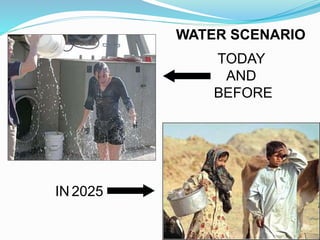
WATER SCENARIO
IN 2025
TODAY
AND
BEFORE
Present water availability
 India’s population is 16% of the world population,
whereas, water resources are only 4% that of the
world.
 Present water demand is 1122 billion m3 (Surface
water690 billion m3 and groundwater 432 billion m3).
 By 2010, groundwater demand would increase to 710
billion m3.
 By 2050, it would be 1180 billion m3 i.e. less than
availability.
 Out of 236 blocks, 204 blocks are over-exploited due
to above situation. The demand in 2025 would be
doubled, we can imagine scenario of 2050.
 In Rajasthan, total water availability is 10382 million
m3 at present, whereas the requirement is 12999 m3.
Future Water Scenario
 Water availability will be to 1 person out of 3.
 Water quality will become unsafe in majority of the
places.
 No food to 1/3 of the population.
 Many water borne diseases like Fluorosis, Dementia,
Diarrhea, Cancer etc. will be order of the day.
 There will be fight for water between
 Man to man.
 City to city.
 State to state.
 Country to country
 Possible third world war?
What is Artificial Recharge
 Artificial recharge is the process by which the ground
water recharge is augmented at the rate much higher
then those under natural condition of percolation.
Advantage of artificial recharge
 To enhance the groundwater yield in depleted the
aquifer due to urbanization .
 Conservation and storage of excess surface water for
future requirements.
 To improve the quality of existing groundwater
through dilution
 To improve bacteriological and other impurities
from sewage and waste water by natural filtration , so
that water is suitable for re use .
Why Artificial Recharge
 In most low rainfall areas of the country the
availability of utilizable surface water is so low that
people have to depend largely on ground water for
agriculture and domestic uses.
 So in order to improve the ground water situation it is
necessary to artificially recharge the depleted ground
water aquifer.
Identification of areas for recharge
 Where ground water level are declining due to over
exploitation.
 Where substantial part of aquifer has already been
desaturated i.e. regeneration of water in wells and
hand pumps is slow after some water has been drawn.
 Where availability of water from wells and hand
pumps inadequate during the lean months.
 Where ground water quality is poor and there is no
alternative source of water .
Quality of source water
 Problems which arise as a result of recharge to ground
water are mainly related to the quality of raw waters
that are available for recharge and which generally
require some source of treatment before being used
to recharge installations.
 A major requirement of waters that are to be used in
recharge projects is that they be silt free.
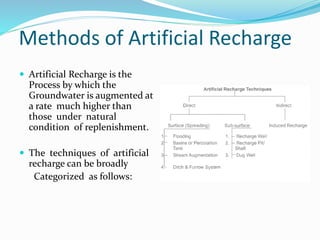
Methods of Artificial Recharge
 Artificial Recharge is the
Process by which the
Groundwater is augmented at
a rate much higher than
those under natural
condition of replenishment.
 The techniques of artificial
recharge can be broadly
Categorized as follows:
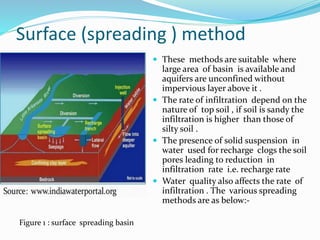
Surface (spreading ) method
 These methods are suitable where
large area of basin is available and
aquifers are unconfined without
impervious layer above it .
 The rate of infiltration depend on the
nature of top soil , if soil is sandy the
infiltration is higher than those of
silty soil .
 The presence of solid suspension in
water used for recharge clogs the soil
pores leading to reduction in
infiltration rate i.e. recharge rate
 Water quality also affects the rate of
infiltration . The various spreading
methods are as below:-
Figure 1 : surface spreading basin
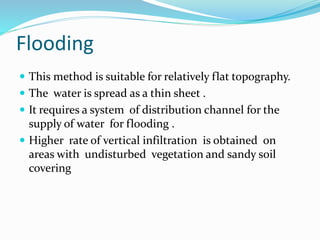
Flooding
 This method is suitable for relatively flat topography.
 The water is spread as a thin sheet .
 It requires a system of distribution channel for the
supply of water for flooding .
 Higher rate of vertical infiltration is obtained on
areas with undisturbed vegetation and sandy soil
covering
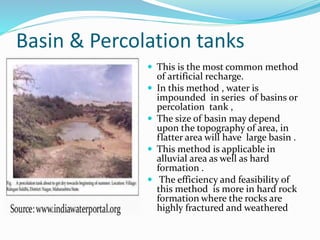
Basin & Percolation tanks
 This is the most common method
of artificial recharge.
 In this method , water is
impounded in series of basins or
percolation tank ,
 The size of basin may depend
upon the topography of area, in
flatter area will have large basin .
 This method is applicable in
alluvial area as well as hard
formation .
 The efficiency and feasibility of
this method is more in hard rock
formation where the rocks are
highly fractured and weathered
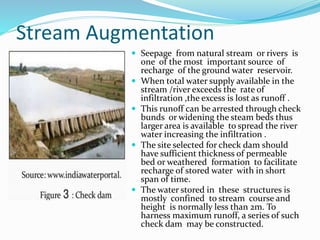
Stream Augmentation
 Seepage from natural stream or rivers is
one of the most important source of
recharge of the ground water reservoir.
 When total water supply available in the
stream /river exceeds the rate of
infiltration ,the excess is lost as runoff .
 This runoff can be arrested through check
bunds or widening the steam beds thus
larger area is available to spread the river
water increasing the infiltration .
 The site selected for check dam should
have sufficient thickness of permeable
bed or weathered formation to facilitate
recharge of stored water with in short
span of time.
 The water stored in these structures is
mostly confined to stream course and
height is normally less than 2m. To
harness maximum runoff, a series of such
check dam may be constructed.
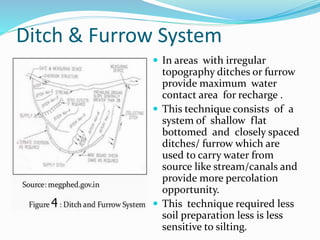
Ditch & Furrow System
 In areas with irregular
topography ditches or furrow
provide maximum water
contact area for recharge .
 This technique consists of a
system of shallow flat
bottomed and closely spaced
ditches/ furrow which are
used to carry water from
source like stream/canals and
provide more percolation
opportunity.
 This technique required less
soil preparation less is less
sensitive to silting.
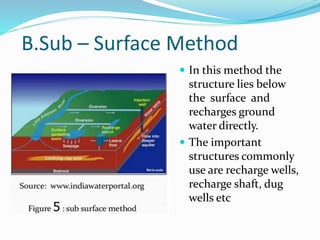
B.Sub – Surface Method
 In this method the
structure lies below
the surface and
recharges ground
water directly.
 The important
structures commonly
use are recharge wells,
recharge shaft, dug
wells etc
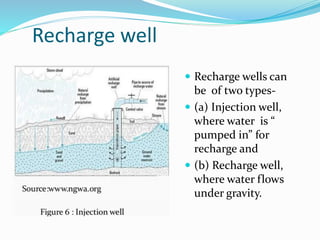
Recharge well
 Recharge wells can
be of two types-
 (a) Injection well,
where water is “
pumped in” for
recharge and
 (b) Recharge well,
where water flows
under gravity.
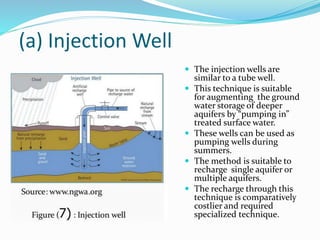
(a) Injection Well
 The injection wells are
similar to a tube well.
 This technique is suitable
for augmenting the ground
water storage of deeper
aquifers by “pumping in”
treated surface water.
 These wells can be used as
pumping wells during
summers.
 The method is suitable to
recharge single aquifer or
multiple aquifers.
 The recharge through this
technique is comparatively
costlier and required
specialized technique.
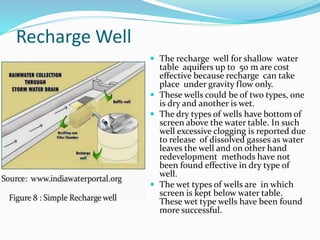
Recharge Well
 The recharge well for shallow water
table aquifers up to 50 m are cost
effective because recharge can take
place under gravity flow only.
 These wells could be of two types, one
is dry and another is wet.
 The dry types of wells have bottom of
screen above the water table. In such
well excessive clogging is reported due
to release of dissolved gasses as water
leaves the well and on other hand
redevelopment methods have not
been found effective in dry type of
well.
 The wet types of wells are in which
screen is kept below water table.
These wet type wells have been found
more successful.
2.Pitch & Shafts
 In area where impervious layer is
encountered at shallow depth the
pits & shafts are suitable structure
for artificial recharge.
 These structures are cost effective to
recharge the aquifer directly.
 The diameter of shaft should
normally be more than 2m to
accommodate more water.
 The advantage of shafts/ pits
structures is that they do not
requires large pieces of land like
percolation tank & other spreading
method.
 There are practically no losses of
water in form of soil moisture and
evaporation like other methods of
spreading.
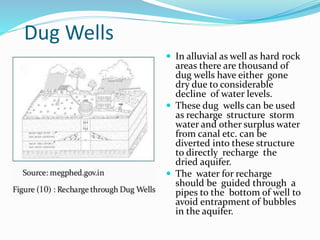
Dug Wells
 In alluvial as well as hard rock
areas there are thousand of
dug wells have either gone
dry due to considerable
decline of water levels.
 These dug wells can be used
as recharge structure storm
water and other surplus water
from canal etc. can be
diverted into these structure
to directly recharge the
dried aquifer.
 The water for recharge
should be guided through a
pipes to the bottom of well to
avoid entrapment of bubbles
in the aquifer.
C. Induced Recharge
 It is an indirect method of
artificial recharge involving
pumping from aquifer
hydraulically connected with
surface water such as perennial
streams, unlined canal or lakes.
 The heavy pumping lowers the
groundwater level and cone of
depression is created .
Lowering of water levels
induces the surface water to
replenish this ground water .
 This method is effective where
stream bed is connected to
aquifer by sandy formation .
Conclusion
 Thus it can be concluded that artificial recharge give
the reduction of runoff, increased availability of
groundwater especially in summer month , increase
in irrigation , revival of springs, improvement of
groundwater quality .
 Yet even full development of artificial recharge ,
ground availability would remain limited .
 Though ground water recharge scheme either
naturally or artificially may not the final answer.
 But they do call for the community effort and create
the spirit of cooperation needed to subsequently
manage sustainably ground water as a community
resource.
Artificial ground water recharge

Artificial ground water recharge

  • 1.
    Presented by : ANKITSAINI M.TECH IST YEAR CIVIL ENGINEERING (HYDRAULIC ENGINEERING) G.B.P.U.A.T ,PANTNAGAR Presented to : Dr. P.S. Mahar Head Of Department CIVIL ENGINEERING (HYDRAULIC ENGINEERING) G.B.P.U.A.T ,PANTNAGAR
  • 2.
    CONTENT  What isGround Water.  What is Artificial Ground Water Recharge.  Advantages of artificial recharge.  Why Artificial Recharge.  Identification Of Areas For Recharge.  Quality of source water .  Methods of artificial recharge.  Conclusion.  References.
  • 3.
    Ground water 1)Groundwater isthe underground water which occurs in the saturated zone of earth surface. 2)Cracks and pores in existing rocks makes this ground water reservoir. 3)Ground water utilized through wells and tube wells.
  • 5.
  • 6.
    Present water availability India’s population is 16% of the world population, whereas, water resources are only 4% that of the world.  Present water demand is 1122 billion m3 (Surface water690 billion m3 and groundwater 432 billion m3).  By 2010, groundwater demand would increase to 710 billion m3.  By 2050, it would be 1180 billion m3 i.e. less than availability.  Out of 236 blocks, 204 blocks are over-exploited due to above situation. The demand in 2025 would be doubled, we can imagine scenario of 2050.  In Rajasthan, total water availability is 10382 million m3 at present, whereas the requirement is 12999 m3.
  • 7.
    Future Water Scenario Water availability will be to 1 person out of 3.  Water quality will become unsafe in majority of the places.  No food to 1/3 of the population.  Many water borne diseases like Fluorosis, Dementia, Diarrhea, Cancer etc. will be order of the day.  There will be fight for water between  Man to man.  City to city.  State to state.  Country to country  Possible third world war?
  • 8.
    What is ArtificialRecharge  Artificial recharge is the process by which the ground water recharge is augmented at the rate much higher then those under natural condition of percolation.
  • 9.
    Advantage of artificialrecharge  To enhance the groundwater yield in depleted the aquifer due to urbanization .  Conservation and storage of excess surface water for future requirements.  To improve the quality of existing groundwater through dilution  To improve bacteriological and other impurities from sewage and waste water by natural filtration , so that water is suitable for re use .
  • 10.
    Why Artificial Recharge In most low rainfall areas of the country the availability of utilizable surface water is so low that people have to depend largely on ground water for agriculture and domestic uses.  So in order to improve the ground water situation it is necessary to artificially recharge the depleted ground water aquifer.
  • 11.
    Identification of areasfor recharge  Where ground water level are declining due to over exploitation.  Where substantial part of aquifer has already been desaturated i.e. regeneration of water in wells and hand pumps is slow after some water has been drawn.  Where availability of water from wells and hand pumps inadequate during the lean months.  Where ground water quality is poor and there is no alternative source of water .
  • 12.
    Quality of sourcewater  Problems which arise as a result of recharge to ground water are mainly related to the quality of raw waters that are available for recharge and which generally require some source of treatment before being used to recharge installations.  A major requirement of waters that are to be used in recharge projects is that they be silt free.
  • 13.
    Methods of ArtificialRecharge  Artificial Recharge is the Process by which the Groundwater is augmented at a rate much higher than those under natural condition of replenishment.  The techniques of artificial recharge can be broadly Categorized as follows:
  • 14.
    Surface (spreading )method  These methods are suitable where large area of basin is available and aquifers are unconfined without impervious layer above it .  The rate of infiltration depend on the nature of top soil , if soil is sandy the infiltration is higher than those of silty soil .  The presence of solid suspension in water used for recharge clogs the soil pores leading to reduction in infiltration rate i.e. recharge rate  Water quality also affects the rate of infiltration . The various spreading methods are as below:- Figure 1 : surface spreading basin
  • 15.
    Flooding  This methodis suitable for relatively flat topography.  The water is spread as a thin sheet .  It requires a system of distribution channel for the supply of water for flooding .  Higher rate of vertical infiltration is obtained on areas with undisturbed vegetation and sandy soil covering
  • 16.
    Basin & Percolationtanks  This is the most common method of artificial recharge.  In this method , water is impounded in series of basins or percolation tank ,  The size of basin may depend upon the topography of area, in flatter area will have large basin .  This method is applicable in alluvial area as well as hard formation .  The efficiency and feasibility of this method is more in hard rock formation where the rocks are highly fractured and weathered
  • 17.
    Stream Augmentation  Seepagefrom natural stream or rivers is one of the most important source of recharge of the ground water reservoir.  When total water supply available in the stream /river exceeds the rate of infiltration ,the excess is lost as runoff .  This runoff can be arrested through check bunds or widening the steam beds thus larger area is available to spread the river water increasing the infiltration .  The site selected for check dam should have sufficient thickness of permeable bed or weathered formation to facilitate recharge of stored water with in short span of time.  The water stored in these structures is mostly confined to stream course and height is normally less than 2m. To harness maximum runoff, a series of such check dam may be constructed.
  • 18.
    Ditch & FurrowSystem  In areas with irregular topography ditches or furrow provide maximum water contact area for recharge .  This technique consists of a system of shallow flat bottomed and closely spaced ditches/ furrow which are used to carry water from source like stream/canals and provide more percolation opportunity.  This technique required less soil preparation less is less sensitive to silting.
  • 19.
    B.Sub – SurfaceMethod  In this method the structure lies below the surface and recharges ground water directly.  The important structures commonly use are recharge wells, recharge shaft, dug wells etc
  • 20.
    Recharge well  Rechargewells can be of two types-  (a) Injection well, where water is “ pumped in” for recharge and  (b) Recharge well, where water flows under gravity.
  • 21.
    (a) Injection Well The injection wells are similar to a tube well.  This technique is suitable for augmenting the ground water storage of deeper aquifers by “pumping in” treated surface water.  These wells can be used as pumping wells during summers.  The method is suitable to recharge single aquifer or multiple aquifers.  The recharge through this technique is comparatively costlier and required specialized technique.
  • 22.
    Recharge Well  Therecharge well for shallow water table aquifers up to 50 m are cost effective because recharge can take place under gravity flow only.  These wells could be of two types, one is dry and another is wet.  The dry types of wells have bottom of screen above the water table. In such well excessive clogging is reported due to release of dissolved gasses as water leaves the well and on other hand redevelopment methods have not been found effective in dry type of well.  The wet types of wells are in which screen is kept below water table. These wet type wells have been found more successful.
  • 23.
    2.Pitch & Shafts In area where impervious layer is encountered at shallow depth the pits & shafts are suitable structure for artificial recharge.  These structures are cost effective to recharge the aquifer directly.  The diameter of shaft should normally be more than 2m to accommodate more water.  The advantage of shafts/ pits structures is that they do not requires large pieces of land like percolation tank & other spreading method.  There are practically no losses of water in form of soil moisture and evaporation like other methods of spreading.
  • 24.
    Dug Wells  Inalluvial as well as hard rock areas there are thousand of dug wells have either gone dry due to considerable decline of water levels.  These dug wells can be used as recharge structure storm water and other surplus water from canal etc. can be diverted into these structure to directly recharge the dried aquifer.  The water for recharge should be guided through a pipes to the bottom of well to avoid entrapment of bubbles in the aquifer.
  • 25.
    C. Induced Recharge It is an indirect method of artificial recharge involving pumping from aquifer hydraulically connected with surface water such as perennial streams, unlined canal or lakes.  The heavy pumping lowers the groundwater level and cone of depression is created . Lowering of water levels induces the surface water to replenish this ground water .  This method is effective where stream bed is connected to aquifer by sandy formation .
  • 26.
    Conclusion  Thus itcan be concluded that artificial recharge give the reduction of runoff, increased availability of groundwater especially in summer month , increase in irrigation , revival of springs, improvement of groundwater quality .  Yet even full development of artificial recharge , ground availability would remain limited .  Though ground water recharge scheme either naturally or artificially may not the final answer.  But they do call for the community effort and create the spirit of cooperation needed to subsequently manage sustainably ground water as a community resource.