5S
Submited by-
Divya Shukla
1
What is 5S?
5S is a workplace organization methodology that
uses a list of five Japanese words which are-
• SEIRI – Sorting.
• SEITON –Systemize/Orderliness.
• SEISO – Sweeping/The Cleaning.
• SEIKETSU – Simplification/Standardize.
• SHITSUKE – Self Discipline .
2
3
Idea Behind 5s
• In order to achieve high levels of quality, safety and
productivity, workers must have a conducive working
environment.
• Helps create a better working environment and a
consistently high quality process.
4
Objectives Of 5s
• Productivity
• Safety
• Reduced Waste
• Worker Commitment
5
1s- Sorting (Seiri)
• Eliminate all unnecessary tools, parts, and
instructions.
• Keep only essential items and eliminate what
is not required
• Prioritizing things per requirements and
keeping them in easily-accessible places.
• Everything else is stored or discarded.
6
Sorting
Before After
7
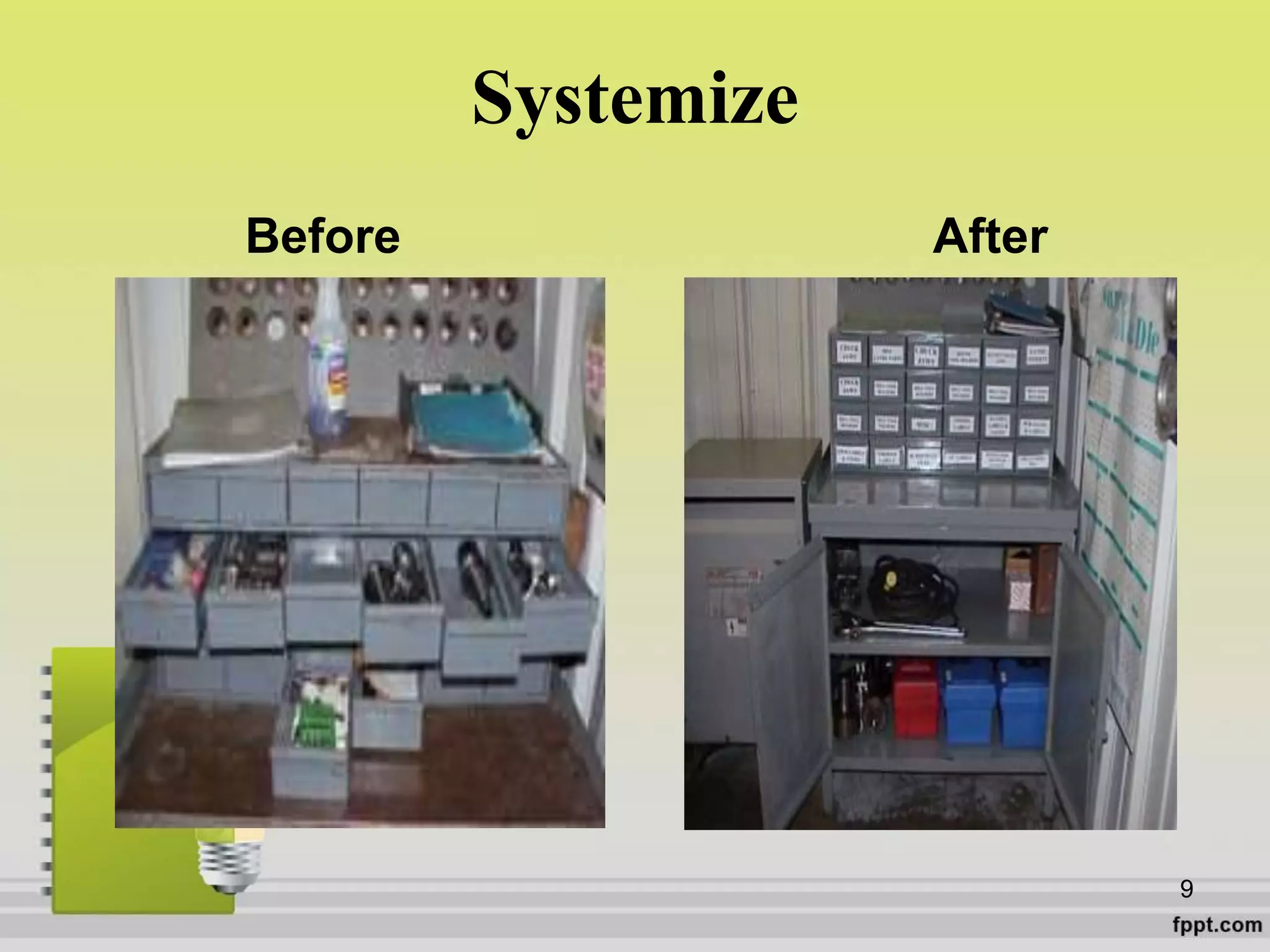
2s- Systemize (Seiton)
• There should be a place for everything and everything
should be in its place.
• The place for each item should be clearly labelled or
demarcated.
• Items should be arranged in a manner that promotes
efficient work flow, with equipment used most often
being the most easily accessible.
8
Systemize
Before After
9
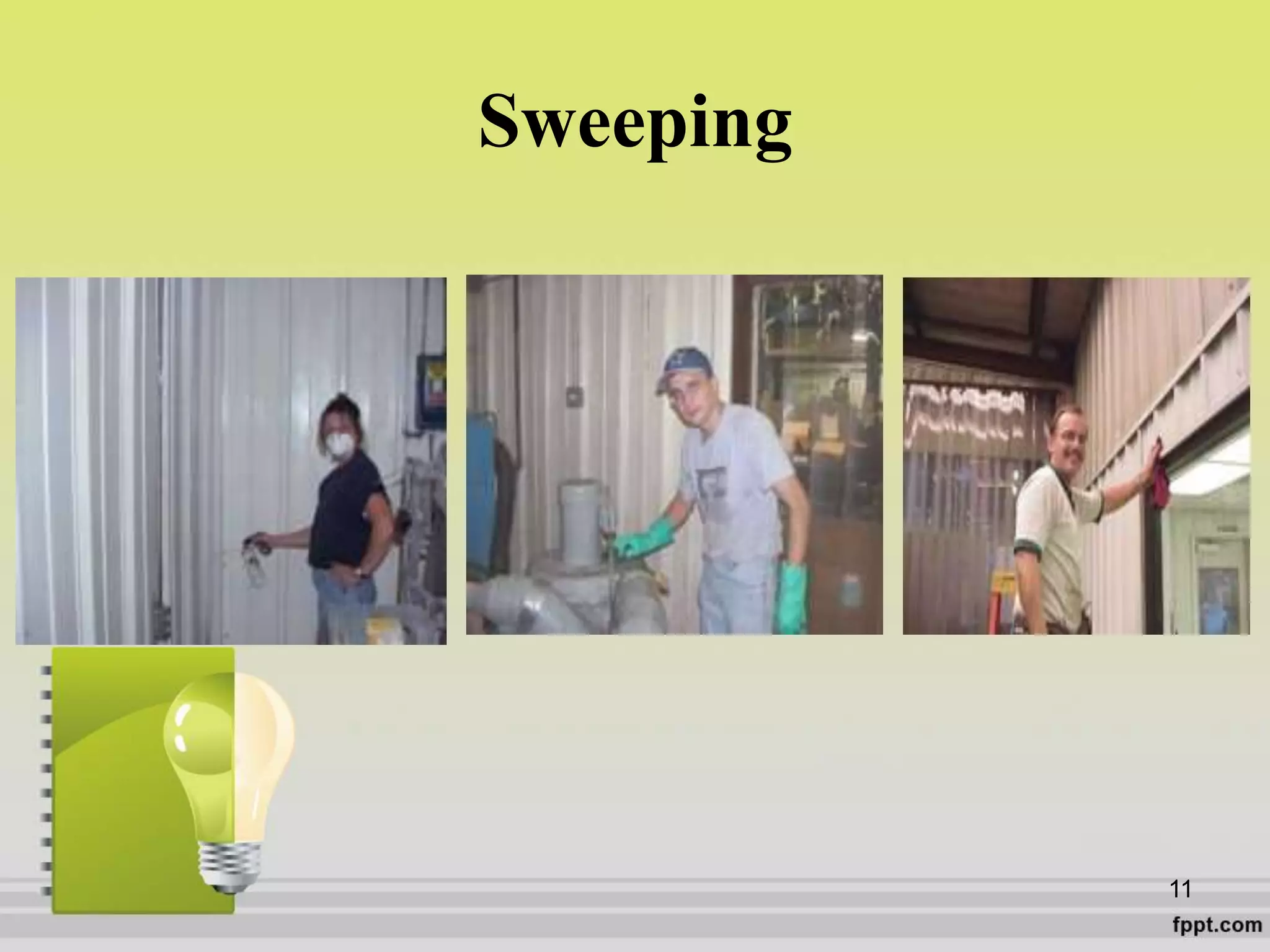
3s- Sweeping (Seiso)
• Clean the workspace and all equipment, and keep it
clean, tidy and organized.
• At the end of each shift, clean the work area and be
sure everything is restored to its place.
• Maintaining cleanliness should be part of the daily
work – not an occasional activity initiated when
things get too messy.
Focus on removing the need to clean
Create a spotless workplace
10
Sweeping
11
4s- Simplification (Seiketsu)
• All work stations for a particular job should be
identical.
• All employees doing the same job should be
able to work in any station with the same tools
that are in the same location in every station.
• Everyone should know exactly what his or her
responsibilities are for adhering to the first 3
S's.
12
Simplification
13
5s- Self-discipline (Shitsuke)
• Maintain and review standards.
• Maintain focus on this new way and do not
allow a gradual decline back to the old ways.
• While thinking about the new way, also be
thinking about yet better ways.
14
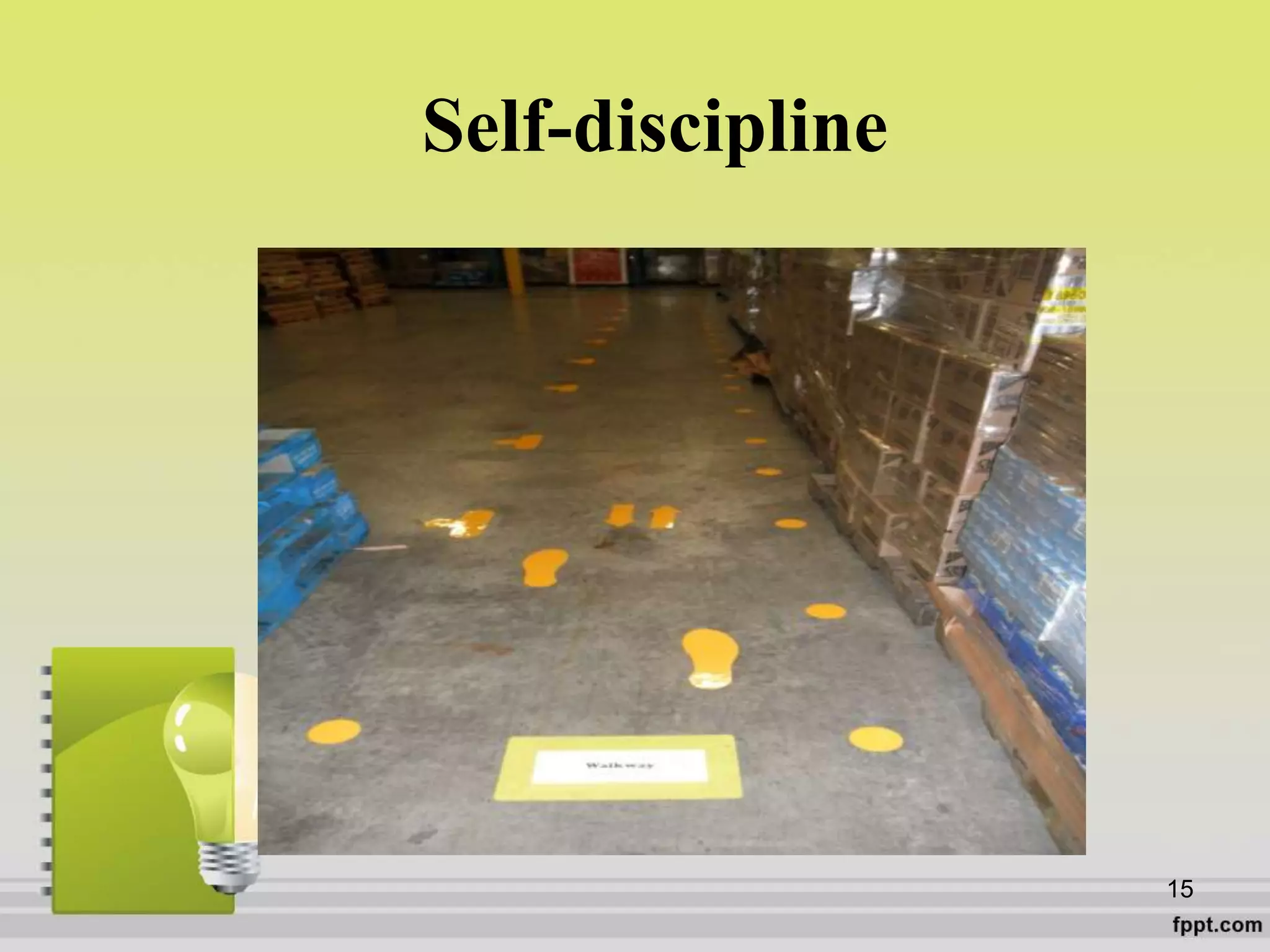
Self-discipline
15
Benefits Of 5s
 Improves organizational efficiency
 Reduces waste in all forms
 Improves speed and quality of work
performance
 Improves safety
 Creates a visually attractive environment
16
Contd..
 Health and Safety is ensured
 Machine maintenance
 Quality
 Productivity
 Lean Manufacturing
17
Contd..
 Time saving.
 Quick retrieval.
 Accidents & mistakes minimized.
 Increases space.
 Creates workplace ownership.
18
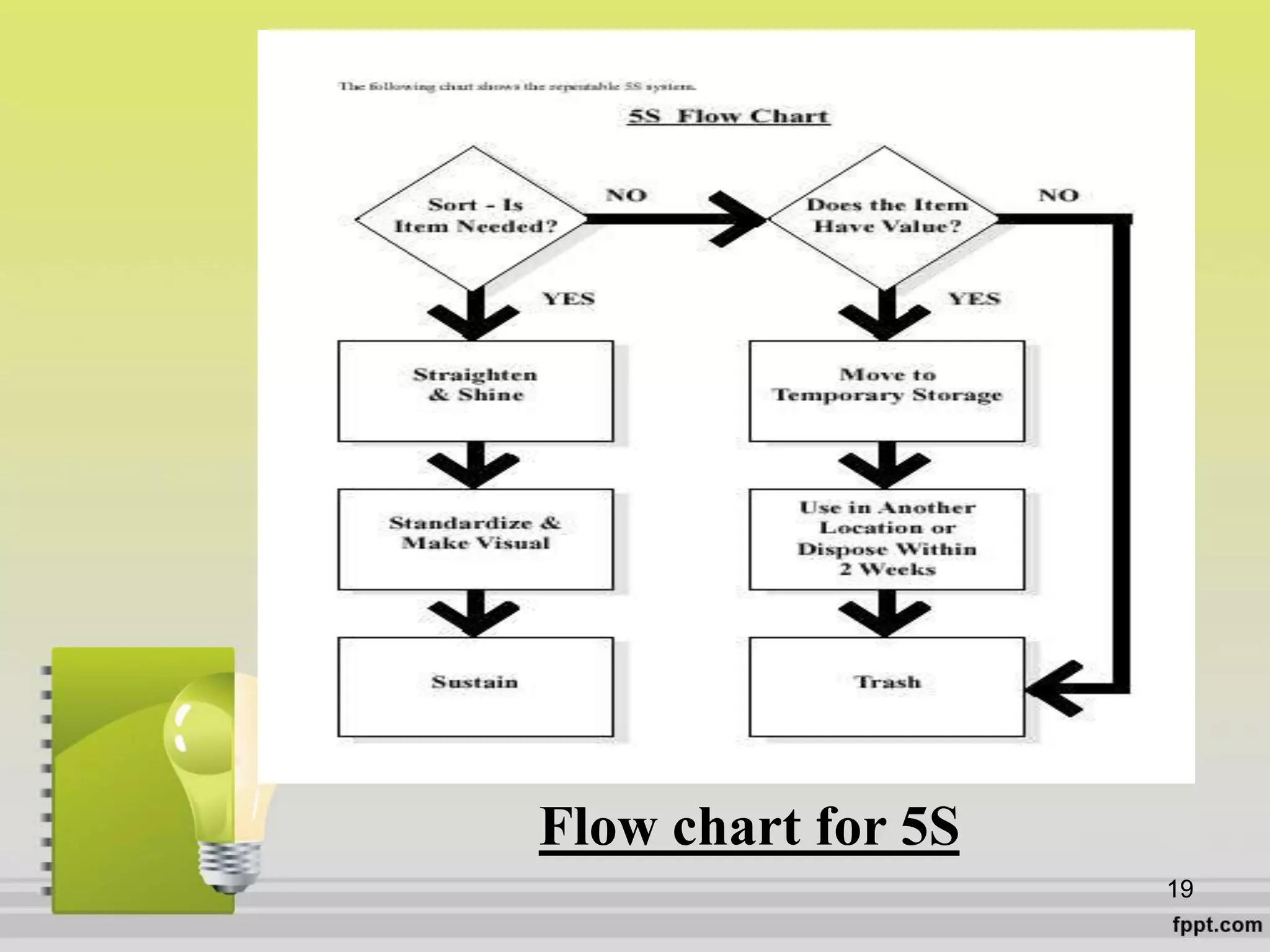
Flow chart for 5S
19
Conclusion
1. The 5-S practice is a well-recognised
methodology used by the Japanese for
improving the work environment.
2. It was found to be key to quality and
productivity.
3. The 5-S practice helps everyone in the
organisation to live a better life.
20
Conclusion contd.
Followings can be harnessed form the 5S-
1. Neat & clean workplace
2. Smooth working
3. No obstruction
4. Safety increases
5. Productivity improves
21
Cont.
5. Quality improves
6. Wastage decrease
7. Machine maintenance
8. Visual control system
9. Employees motivated
10. Workstations become spacious
22
THANK YOU..!!
23

5s

  • 1.
  • 2.
    What is 5S? 5Sis a workplace organization methodology that uses a list of five Japanese words which are- • SEIRI – Sorting. • SEITON –Systemize/Orderliness. • SEISO – Sweeping/The Cleaning. • SEIKETSU – Simplification/Standardize. • SHITSUKE – Self Discipline . 2
  • 3.
  • 4.
    Idea Behind 5s •In order to achieve high levels of quality, safety and productivity, workers must have a conducive working environment. • Helps create a better working environment and a consistently high quality process. 4
  • 5.
    Objectives Of 5s •Productivity • Safety • Reduced Waste • Worker Commitment 5
  • 6.
    1s- Sorting (Seiri) •Eliminate all unnecessary tools, parts, and instructions. • Keep only essential items and eliminate what is not required • Prioritizing things per requirements and keeping them in easily-accessible places. • Everything else is stored or discarded. 6
  • 7.
  • 8.
    2s- Systemize (Seiton) •There should be a place for everything and everything should be in its place. • The place for each item should be clearly labelled or demarcated. • Items should be arranged in a manner that promotes efficient work flow, with equipment used most often being the most easily accessible. 8
  • 9.
  • 10.
    3s- Sweeping (Seiso) •Clean the workspace and all equipment, and keep it clean, tidy and organized. • At the end of each shift, clean the work area and be sure everything is restored to its place. • Maintaining cleanliness should be part of the daily work – not an occasional activity initiated when things get too messy. Focus on removing the need to clean Create a spotless workplace 10
  • 11.
  • 12.
    4s- Simplification (Seiketsu) •All work stations for a particular job should be identical. • All employees doing the same job should be able to work in any station with the same tools that are in the same location in every station. • Everyone should know exactly what his or her responsibilities are for adhering to the first 3 S's. 12
  • 13.
  • 14.
    5s- Self-discipline (Shitsuke) •Maintain and review standards. • Maintain focus on this new way and do not allow a gradual decline back to the old ways. • While thinking about the new way, also be thinking about yet better ways. 14
  • 15.
  • 16.
    Benefits Of 5s Improves organizational efficiency  Reduces waste in all forms  Improves speed and quality of work performance  Improves safety  Creates a visually attractive environment 16
  • 17.
    Contd..  Health andSafety is ensured  Machine maintenance  Quality  Productivity  Lean Manufacturing 17
  • 18.
    Contd..  Time saving. Quick retrieval.  Accidents & mistakes minimized.  Increases space.  Creates workplace ownership. 18
  • 19.
  • 20.
    Conclusion 1. The 5-Spractice is a well-recognised methodology used by the Japanese for improving the work environment. 2. It was found to be key to quality and productivity. 3. The 5-S practice helps everyone in the organisation to live a better life. 20
  • 21.
    Conclusion contd. Followings canbe harnessed form the 5S- 1. Neat & clean workplace 2. Smooth working 3. No obstruction 4. Safety increases 5. Productivity improves 21
  • 22.
    Cont. 5. Quality improves 6.Wastage decrease 7. Machine maintenance 8. Visual control system 9. Employees motivated 10. Workstations become spacious 22
  • 23.

Editor's Notes

  • #9 Organise layout of tools and equipment Designated locations Use tapes and labels Ensure everything is available as it is needed and at the “point of use”
  • #11 Create a spotless workplace Identify and eliminate causes of dirt and grime – remove the need to clean Sweep, dust, polish and paint Divide areas into zones Define responsibilities for cleaning Tools and equipment must be owned by an individual Focus on removing the need to clean