Mastertitelformat bearbeiten
LEAN & 5S TN plant


 5S Training for the Shop Floor


      1
LEAN & 5S TN plant


                 Agenda
• Welcome
• Why Lean
• What is 5S?
  – What are the 5S’s?
  – Where do they apply?
• Teamwork and our project
LEAN & 5S TN plant

              DISCOVERY OF 5S
• The secret of Japanese manufacturing
  companies success was studied
• 5S turned out to be the most impressive
  "secret"
• The factories were so well organized that
  abnormal situations were readily
  apparent
• This passion of cleanliness and
  orderliness became a hallmark of
  Japanese organizations
LEAN & 5S TN plant

 Lean Mission Statement
 • To Improve Product, Reduce Cost,
   and WOW customers.


 Lean Vision Statement
• To be an industry leader in Quality,
  Cost, Delivery & Customer satisfaction.
LEAN & 5S TN plant

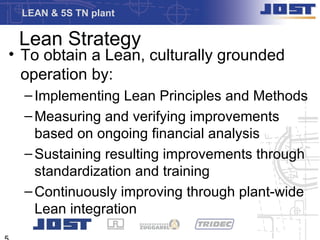
 Lean Strategy
• To obtain a Lean, culturally grounded
  operation by:
  – Implementing Lean Principles and Methods
  – Measuring and verifying improvements
    based on ongoing financial analysis
  – Sustaining resulting improvements through
    standardization and training
  – Continuously improving through plant-wide
    Lean integration
LEAN & 5S TN plant


             Objectives
• To understand the importance of
  5S to our lean initiatives
• To know what the 5S’s are and
  the key benefits of each
• To be able to implement 5S
  across the facility
LEAN & 5S TN plant

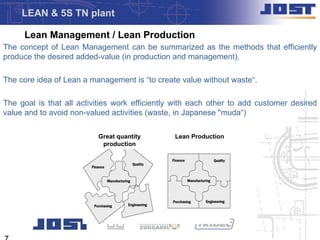
     Lean Management / Lean Production
The concept of Lean Management can be summarized as the methods that efficiently
produce the desired added-value (in production and management).

The core idea of Lean a management is “to create value without waste“.

The goal is that all activities work efficiently with each other to add customer desired
value and to avoid non-valued activities (waste, in Japanese "muda“)

                          Great quantity        Lean Production
                           production
LEAN & 5S TN plant

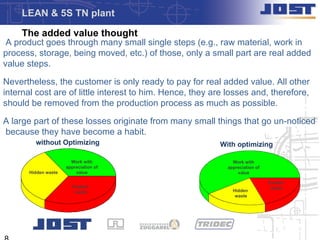
     The added value thought
 A product goes through many small single steps (e.g., raw material, work in
process, storage, being moved, etc.) of those, only a small part are real added
value steps.

Nevertheless, the customer is only ready to pay for real added value. All other
internal cost are of little interest to him. Hence, they are losses and, therefore,
should be removed from the production process as much as possible.

A large part of these losses originate from many small things that go un-noticed
because they have become a habit.
         without Optimizing                               With optimizing

                        Work with                             Work with
                      appreciation of                       appreciation of
       Hidden waste       value                                 value

                                                                              Evident
                         Evident                                               waste
                          waste                               Hidden
                                                               waste
LEAN & 5S TN plant


              What is Lean?
 “ A systematic approach to identifying
    and eliminating waste (non-value-
   added activities) through continuous
       improvement. To remove any
  expenditure of resources for any goal
    other than the creation of value for
            the end customer.”
LEAN & 5S TN plant

                     8 WASTES
       •   Defect / Correction
       •   Overproduction
       •   Waiting
       •   Not utilizing employee talents
       •   Transportation / material movement
       •   Inventory
       •   Motion
       •   Excessive processing
LEAN & 5S TN plant

                 What is 5S?
•   It is a tool to make our plant more lean
•   It organizes the area, less time looking
•   It standardizes the area, helps training
•   It reduces waste, of all kinds
•   It improves safety and quality
•   It reduces space and time requirements
•   It separates value from non value added
LEAN & 5S TN plant


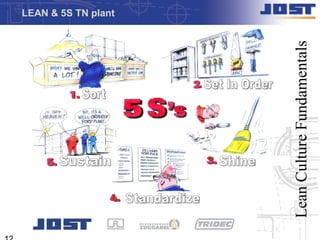
Lean Culture Fundamentals
LEAN & 5S TN plant


           What are the 5 S’s
• Sort (What you do)
  – Red tag for remove anything from the
    area that is not needed for the
    immediate process.
  – Keep what is needed
  – Reduce the on hand inventory, parts
    and tools to what is needed for the
    immediate work
LEAN & 5S TN plant


           What are the 5 S’s
• Sort (how we will do it)
    Red Tag known unneeded items, note
    were they belong (parts to stock, turn
    tools in)
    Red Tag unknown or items you are
    uncertain about note reason for tagging
    Remove all red tagged items to the local
    red tag area/cart. (If a needed, they can
    be removed)
LEAN & 5S TN plant

                   Sort: Red Tag
• Sort items to:
   – generally needed
   – sometimes needed
   – unnecessary items.
• Persons that know the job review the red
  tags. Determine sometimes need storage
• Evaluate all needed items for placement
• Size workbenches/areas (what is actually needed)
• Apply this to everything (not just supplies & materials)
LEAN & 5S TN plant

            Identify Red Tag Targets
       What to tag            Where to Look
•   Inventory            • Under stacks of inventory
•   Equipment            • Unlabeled boxes or containers
                         • Under machines or cabinets
•   Furniture
                         • In corners and dark areas
•   Storage              • Behind equipment or cabinets
•   Fixtures and jigs    • Under tables and conveyors
•   Clutter              • Along walls
•   Defects              • In draws and storage cabinets
•   Outdated signs or posters
•   Wall hangings
LEAN & 5S TN plant

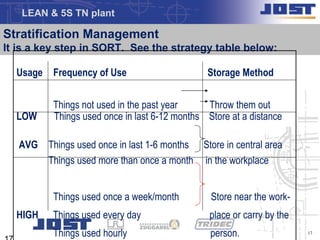
Stratification Management
It is a key step in SORT. See the strategy table below:

  Usage Frequency of Use                       Storage Method


          Things not used in the past year     Throw them out
  LOW     Things used once in last 6-12 months Store at a distance

   AVG Things used once in last 1-6 months Store in central area
       Things used more than once a month in the workplace


          Things used once a week/month         Store near the work-
  HIGH    Things used every day                 place or carry by the
          Things used hourly                    person.                 17
LEAN & 5S TN plant

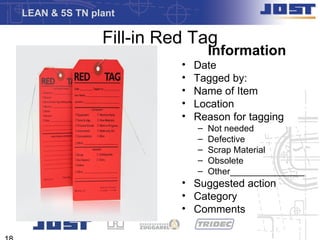
               Fill-in Red Tag
                                 Information
                         •   Date
                         •   Tagged by:
                         •   Name of Item
                         •   Location
                         •   Reason for tagging
                             –   Not needed
                             –   Defective
                             –   Scrap Material
                             –   Obsolete
                             –   Other_______________
                         • Suggested action
                         • Category
                         • Comments
LEAN & 5S TN plant

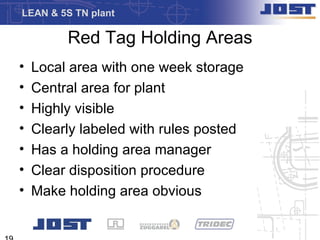
         Red Tag Holding Areas
•   Local area with one week storage
•   Central area for plant
•   Highly visible
•   Clearly labeled with rules posted
•   Has a holding area manager
•   Clear disposition procedure
•   Make holding area obvious
LEAN & 5S TN plant

                What are the 5 S’s
•   Sort     (We get rid of the clutter)
• Set in Order
    – Organize the way we keep necessary things
    – Make it easy for anyone to find and use them
    – A place for everything & everything in its place.
    – Position items by where they are used
    – Store seldom used items to be findable
    – Label or outline items to identify when missing
    – Analyze why getting /returning takes so long
    – Devise a system everyone gets, use 4 step plan
LEAN & 5S TN plant


What are the four steps in SET IN ORDER?
 Step 1: Analyze the status quo.

 Step 2: Decide where things belong.

 Step 3: Decide how things should be put away.

 Step 4: Obey the put-away rules.

 Now let us understand each step in detail.

                                                 21
LEAN & 5S TN plant

Step 1 of 4: Analyze the status quo
 Start by analyzing how people get things out and put them
 away, and why it takes so long.
 - Time spent getting things out and putting them away is
   the time lost. If this unproductive time could be reduced,
   there will be substantial savings .
 - Typical reasons for delay in retrieving things:
    > Not knowing what things are called (daily usage name)
    > Not sure where things are kept, Item not labeled
    > Storage site far away / scattered all around, Repeated trips
    > Unclear if spare parts exist (no ledger and nowhere to ask)
    > Too big / heavy to carry, and transport

                                                                     22
LEAN & 5S TN plant

Step 2 of 4: Decide where things belong
- Develop criteria for deciding where things belong
- Selecting a suitable criteria will require some study
- If an item has two names (its real name and what
everybody calls it), select one and stick to it.
- Identify each item by a unique name or code. (Do not
  give same name to items with minor differences. For
  example, two ball bearings of same diameter but
different ball hardness must be given different names)

                                                          23
LEAN & 5S TN plant

Step 3 of 4: Decide how items to be stored
- This is critical to functional storage.
- Storage has to done with retrieval in mind.
- Items must have a location. Name alone is not sufficient.
- List the storage location and identifying name on item.
Adhere to the following:
   - A place for everything and in its place
   - Quick identification: Arrows / lamps.
   - Frequent-use items to be retrieved easily
   - Safe storage : Heavy things on the bottom
   - Rack height: Knee to shoulder height is most convenient


                                                               24
LEAN & 5S TN plant

Step 4 of 4: Obey the put-away rules
- Always put things back to where they belong
- Manage inventories to prevent stock-out
 > Out of stock
   >> Decide on minimum stock level
   >> Indicate that more are on order
 > Somebody is using it
   >> Have an indication of who is using it & when they will return it

> Lost
  >> Decide how many there should be .
  >> Draw a shadow outline indicating clearly what is missing


                                                                         25
LEAN & 5S TN plant

                            Set in Order
1.       Make a list of what you use to do the job:
     •     Tools
     •     Parts
     •     Data/Information
2.       Place these items to best help work flow through area:
     •     Easy to locate
     •     Easy to reach
     •     Easy to use
3.       Include communal areas, use teams on these areas:
     •     Establish locations for shared items, tools, and information
     •     Establish min/max levels for work in process, parts, & supplies
     •     Think about the flow of the process
LEAN & 5S TN plant

              Setting in Order
1. Decide where to keep needed items
   – Locate items according to their frequency of use
     (higher frequency = closer to you)
   – Store items together if they are used together
     (i.e. – ratchets with bolts)
   – Store them in the sequence they are used
   – Consider tools on retractable cords (overhead)
   – Simplify – use one tool for multiple functions
LEAN & 5S TN plant

               Setting in Order
1. Identify locations
   – Once the best locations have been chosen we
     need to identify these locations so that everyone
     will know what goes where and how many of
     each belong there
   – Make it easy for anyone to find them, use them
     and put them back after use
   – Make it obvious when items are not in their
     correct place
LEAN & 5S TN plant


          Identifying Locations
• Signboards
• Labeling
• Painting
  – Color Coding
  – Outlining
LEAN & 5S TN plant

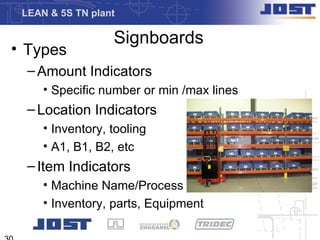
                  Signboards
• Types
  – Amount Indicators
     • Specific number or min /max lines
  – Location Indicators
     • Inventory, tooling
     • A1, B1, B2, etc
  – Item Indicators
     • Machine Name/Process
     • Inventory, parts, Equipment
LEAN & 5S TN plant

            Painting / Marking
• Used for identifying locations on floors
  and walkways
• Mark off working areas from walk ways
• May show:
  – Flow direction
  – Storage locations
  – Hazards or safety call outs
  – Areas where items should not be stored
LEAN & 5S TN plant

            Painting / Marking
• Color coding
  – Shows which parts, tools, etc are used for
    which purpose or used together
  – Used for storage containers
     • Coating containers color of coating
• Outlining
  – Way to show what parts, tools go where
LEAN & 5S TN plant

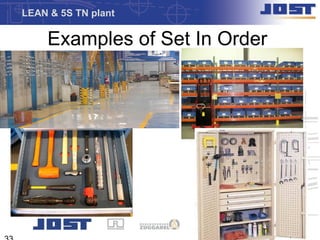
    Examples of Set In Order
LEAN & 5S TN plant

                    Set in Order
•   You set-up how your workplace will be.
•   Make it visual, work flow should be clear
•   Set locations and min/max levels
•   Make each job as easy as possible:
    • Parts in easy reach
    • Tools in easy reach
    • Clear access, no obstructions in your path
LEAN & 5S TN plant

          What are the 5 S’s
Sort       Set in Order

• Shine
   – We keep everything swept and clean
   – Keep everything in top condition so that
     when we need to use it, it is ready to be
     used
   – A clean workplace implies quality work
LEAN & 5S TN plant


• Safety Benefits of Shine
  – No debris, fluids or materials on floor to
    cause slips, trips or falls
• Morale
  – Dirty work places lead to low morale and
    pride for what we do
• Customer Service / Satisfaction
  – Customers touring a clean and organized
    facility are more likely to appreciate the
    efforts
LEAN & 5S TN plant

             Shine Activities
• Make a list of Shine Targets
   – Warehouse items, equipment, space
• Decide Shine assignments and methods
   – Who will do what, what is needed and how
     will it be done
• Prepare Shine tools
   – Make sure we have what we need
   – Remember Set in Order – easy access
• Start Shining
LEAN & 5S TN plant

                What are the 5 S’s
•   Sort     Set in Order   Shine
• Standardize
  – Establish a baseline to know how we are doing.
  – Use accepted visual controls (labels, outlines, tape)
  – Document who does what to maintain area(check
    list)
  – Makes implementing Sort, Set in Order and Shine a
    daily habit so that conditions are maintained
  – Each standard set should be continuously improved
  – Get agreement before any change is implemented
LEAN & 5S TN plant

       Establishing the Habits
1. Decide who is responsible for which
   activities
  • Activity Charts, Checklists, Schedules
2. Integrate duties into regular work
   activities
  • 5 Minute 5S, Cleaning / Inspection
3. Check that conditions are maintained
  • Identify locations and flow (Label, Outline,ect)
  • 5S Audits
LEAN & 5S TN plant

 1. Designate responsibility for activities
• People need to know exactly what
   they are responsible for doing and
   exactly when, where and how to do it
  – Standard procedures for how things are
    done should be developed
• 5S Schedules
  – Shows who is responsible for cleaning
    which areas and when they must do it
LEAN & 5S TN plant


•   Sort
                 What are the 5 S’s
             Set in Order Shine   Standardize

• Sustain
     – Setting high standards from first 4 S’s
     – Having discipline to maintain these standards
     – Involve the whole workforce
     – Management support and drive
     – Creating conditions that keep good habits
     – Constancy of purpose
LEAN & 5S TN plant

            Favorable Conditions
•   Workforce that knows the benefits of 5S
•   Time allowed to practice and maintain
•   Organized, focused effort
•   Management support and drive
•   Results that are publicly documented
•   Efforts that are recognized & rewarded
•   Needs to be beneficial and satisfying
LEAN & 5S TN plant

                    The Rules…
•   Remove fixed ideas
•   Think of ways to make it possible
•   No excuses needed
•   Go for the simple solution, not the perfect
    one
•   Correct mistakes right away
•   Repeat ‘Why’ 5 times
•   Ask ideas from many people
•   There is no end to improvement
LEAN & 5S TN plant

5 s training shop floor 4

  • 1.
    Mastertitelformat bearbeiten LEAN &5S TN plant 5S Training for the Shop Floor 1
  • 2.
    LEAN & 5STN plant Agenda • Welcome • Why Lean • What is 5S? – What are the 5S’s? – Where do they apply? • Teamwork and our project
  • 3.
    LEAN & 5STN plant DISCOVERY OF 5S • The secret of Japanese manufacturing companies success was studied • 5S turned out to be the most impressive "secret" • The factories were so well organized that abnormal situations were readily apparent • This passion of cleanliness and orderliness became a hallmark of Japanese organizations
  • 4.
    LEAN & 5STN plant Lean Mission Statement • To Improve Product, Reduce Cost, and WOW customers. Lean Vision Statement • To be an industry leader in Quality, Cost, Delivery & Customer satisfaction.
  • 5.
    LEAN & 5STN plant Lean Strategy • To obtain a Lean, culturally grounded operation by: – Implementing Lean Principles and Methods – Measuring and verifying improvements based on ongoing financial analysis – Sustaining resulting improvements through standardization and training – Continuously improving through plant-wide Lean integration
  • 6.
    LEAN & 5STN plant Objectives • To understand the importance of 5S to our lean initiatives • To know what the 5S’s are and the key benefits of each • To be able to implement 5S across the facility
  • 7.
    LEAN & 5STN plant Lean Management / Lean Production The concept of Lean Management can be summarized as the methods that efficiently produce the desired added-value (in production and management). The core idea of Lean a management is “to create value without waste“. The goal is that all activities work efficiently with each other to add customer desired value and to avoid non-valued activities (waste, in Japanese "muda“) Great quantity Lean Production production
  • 8.
    LEAN & 5STN plant The added value thought A product goes through many small single steps (e.g., raw material, work in process, storage, being moved, etc.) of those, only a small part are real added value steps. Nevertheless, the customer is only ready to pay for real added value. All other internal cost are of little interest to him. Hence, they are losses and, therefore, should be removed from the production process as much as possible. A large part of these losses originate from many small things that go un-noticed because they have become a habit. without Optimizing With optimizing Work with Work with appreciation of appreciation of Hidden waste value value Evident Evident waste waste Hidden waste
  • 9.
    LEAN & 5STN plant What is Lean? “ A systematic approach to identifying and eliminating waste (non-value- added activities) through continuous improvement. To remove any expenditure of resources for any goal other than the creation of value for the end customer.”
  • 10.
    LEAN & 5STN plant 8 WASTES • Defect / Correction • Overproduction • Waiting • Not utilizing employee talents • Transportation / material movement • Inventory • Motion • Excessive processing
  • 11.
    LEAN & 5STN plant What is 5S? • It is a tool to make our plant more lean • It organizes the area, less time looking • It standardizes the area, helps training • It reduces waste, of all kinds • It improves safety and quality • It reduces space and time requirements • It separates value from non value added
  • 12.
    LEAN & 5STN plant Lean Culture Fundamentals
  • 13.
    LEAN & 5STN plant What are the 5 S’s • Sort (What you do) – Red tag for remove anything from the area that is not needed for the immediate process. – Keep what is needed – Reduce the on hand inventory, parts and tools to what is needed for the immediate work
  • 14.
    LEAN & 5STN plant What are the 5 S’s • Sort (how we will do it) Red Tag known unneeded items, note were they belong (parts to stock, turn tools in) Red Tag unknown or items you are uncertain about note reason for tagging Remove all red tagged items to the local red tag area/cart. (If a needed, they can be removed)
  • 15.
    LEAN & 5STN plant Sort: Red Tag • Sort items to: – generally needed – sometimes needed – unnecessary items. • Persons that know the job review the red tags. Determine sometimes need storage • Evaluate all needed items for placement • Size workbenches/areas (what is actually needed) • Apply this to everything (not just supplies & materials)
  • 16.
    LEAN & 5STN plant Identify Red Tag Targets What to tag Where to Look • Inventory • Under stacks of inventory • Equipment • Unlabeled boxes or containers • Under machines or cabinets • Furniture • In corners and dark areas • Storage • Behind equipment or cabinets • Fixtures and jigs • Under tables and conveyors • Clutter • Along walls • Defects • In draws and storage cabinets • Outdated signs or posters • Wall hangings
  • 17.
    LEAN & 5STN plant Stratification Management It is a key step in SORT. See the strategy table below: Usage Frequency of Use Storage Method Things not used in the past year Throw them out LOW Things used once in last 6-12 months Store at a distance AVG Things used once in last 1-6 months Store in central area Things used more than once a month in the workplace Things used once a week/month Store near the work- HIGH Things used every day place or carry by the Things used hourly person. 17
  • 18.
    LEAN & 5STN plant Fill-in Red Tag Information • Date • Tagged by: • Name of Item • Location • Reason for tagging – Not needed – Defective – Scrap Material – Obsolete – Other_______________ • Suggested action • Category • Comments
  • 19.
    LEAN & 5STN plant Red Tag Holding Areas • Local area with one week storage • Central area for plant • Highly visible • Clearly labeled with rules posted • Has a holding area manager • Clear disposition procedure • Make holding area obvious
  • 20.
    LEAN & 5STN plant What are the 5 S’s • Sort (We get rid of the clutter) • Set in Order – Organize the way we keep necessary things – Make it easy for anyone to find and use them – A place for everything & everything in its place. – Position items by where they are used – Store seldom used items to be findable – Label or outline items to identify when missing – Analyze why getting /returning takes so long – Devise a system everyone gets, use 4 step plan
  • 21.
    LEAN & 5STN plant What are the four steps in SET IN ORDER? Step 1: Analyze the status quo. Step 2: Decide where things belong. Step 3: Decide how things should be put away. Step 4: Obey the put-away rules. Now let us understand each step in detail. 21
  • 22.
    LEAN & 5STN plant Step 1 of 4: Analyze the status quo Start by analyzing how people get things out and put them away, and why it takes so long. - Time spent getting things out and putting them away is the time lost. If this unproductive time could be reduced, there will be substantial savings . - Typical reasons for delay in retrieving things: > Not knowing what things are called (daily usage name) > Not sure where things are kept, Item not labeled > Storage site far away / scattered all around, Repeated trips > Unclear if spare parts exist (no ledger and nowhere to ask) > Too big / heavy to carry, and transport 22
  • 23.
    LEAN & 5STN plant Step 2 of 4: Decide where things belong - Develop criteria for deciding where things belong - Selecting a suitable criteria will require some study - If an item has two names (its real name and what everybody calls it), select one and stick to it. - Identify each item by a unique name or code. (Do not give same name to items with minor differences. For example, two ball bearings of same diameter but different ball hardness must be given different names) 23
  • 24.
    LEAN & 5STN plant Step 3 of 4: Decide how items to be stored - This is critical to functional storage. - Storage has to done with retrieval in mind. - Items must have a location. Name alone is not sufficient. - List the storage location and identifying name on item. Adhere to the following: - A place for everything and in its place - Quick identification: Arrows / lamps. - Frequent-use items to be retrieved easily - Safe storage : Heavy things on the bottom - Rack height: Knee to shoulder height is most convenient 24
  • 25.
    LEAN & 5STN plant Step 4 of 4: Obey the put-away rules - Always put things back to where they belong - Manage inventories to prevent stock-out > Out of stock >> Decide on minimum stock level >> Indicate that more are on order > Somebody is using it >> Have an indication of who is using it & when they will return it > Lost >> Decide how many there should be . >> Draw a shadow outline indicating clearly what is missing 25
  • 26.
    LEAN & 5STN plant Set in Order 1. Make a list of what you use to do the job: • Tools • Parts • Data/Information 2. Place these items to best help work flow through area: • Easy to locate • Easy to reach • Easy to use 3. Include communal areas, use teams on these areas: • Establish locations for shared items, tools, and information • Establish min/max levels for work in process, parts, & supplies • Think about the flow of the process
  • 27.
    LEAN & 5STN plant Setting in Order 1. Decide where to keep needed items – Locate items according to their frequency of use (higher frequency = closer to you) – Store items together if they are used together (i.e. – ratchets with bolts) – Store them in the sequence they are used – Consider tools on retractable cords (overhead) – Simplify – use one tool for multiple functions
  • 28.
    LEAN & 5STN plant Setting in Order 1. Identify locations – Once the best locations have been chosen we need to identify these locations so that everyone will know what goes where and how many of each belong there – Make it easy for anyone to find them, use them and put them back after use – Make it obvious when items are not in their correct place
  • 29.
    LEAN & 5STN plant Identifying Locations • Signboards • Labeling • Painting – Color Coding – Outlining
  • 30.
    LEAN & 5STN plant Signboards • Types – Amount Indicators • Specific number or min /max lines – Location Indicators • Inventory, tooling • A1, B1, B2, etc – Item Indicators • Machine Name/Process • Inventory, parts, Equipment
  • 31.
    LEAN & 5STN plant Painting / Marking • Used for identifying locations on floors and walkways • Mark off working areas from walk ways • May show: – Flow direction – Storage locations – Hazards or safety call outs – Areas where items should not be stored
  • 32.
    LEAN & 5STN plant Painting / Marking • Color coding – Shows which parts, tools, etc are used for which purpose or used together – Used for storage containers • Coating containers color of coating • Outlining – Way to show what parts, tools go where
  • 33.
    LEAN & 5STN plant Examples of Set In Order
  • 34.
    LEAN & 5STN plant Set in Order • You set-up how your workplace will be. • Make it visual, work flow should be clear • Set locations and min/max levels • Make each job as easy as possible: • Parts in easy reach • Tools in easy reach • Clear access, no obstructions in your path
  • 35.
    LEAN & 5STN plant What are the 5 S’s Sort Set in Order • Shine – We keep everything swept and clean – Keep everything in top condition so that when we need to use it, it is ready to be used – A clean workplace implies quality work
  • 36.
    LEAN & 5STN plant • Safety Benefits of Shine – No debris, fluids or materials on floor to cause slips, trips or falls • Morale – Dirty work places lead to low morale and pride for what we do • Customer Service / Satisfaction – Customers touring a clean and organized facility are more likely to appreciate the efforts
  • 37.
    LEAN & 5STN plant Shine Activities • Make a list of Shine Targets – Warehouse items, equipment, space • Decide Shine assignments and methods – Who will do what, what is needed and how will it be done • Prepare Shine tools – Make sure we have what we need – Remember Set in Order – easy access • Start Shining
  • 38.
    LEAN & 5STN plant What are the 5 S’s • Sort Set in Order Shine • Standardize – Establish a baseline to know how we are doing. – Use accepted visual controls (labels, outlines, tape) – Document who does what to maintain area(check list) – Makes implementing Sort, Set in Order and Shine a daily habit so that conditions are maintained – Each standard set should be continuously improved – Get agreement before any change is implemented
  • 39.
    LEAN & 5STN plant Establishing the Habits 1. Decide who is responsible for which activities • Activity Charts, Checklists, Schedules 2. Integrate duties into regular work activities • 5 Minute 5S, Cleaning / Inspection 3. Check that conditions are maintained • Identify locations and flow (Label, Outline,ect) • 5S Audits
  • 40.
    LEAN & 5STN plant 1. Designate responsibility for activities • People need to know exactly what they are responsible for doing and exactly when, where and how to do it – Standard procedures for how things are done should be developed • 5S Schedules – Shows who is responsible for cleaning which areas and when they must do it
  • 41.
    LEAN & 5STN plant • Sort What are the 5 S’s Set in Order Shine Standardize • Sustain – Setting high standards from first 4 S’s – Having discipline to maintain these standards – Involve the whole workforce – Management support and drive – Creating conditions that keep good habits – Constancy of purpose
  • 42.
    LEAN & 5STN plant Favorable Conditions • Workforce that knows the benefits of 5S • Time allowed to practice and maintain • Organized, focused effort • Management support and drive • Results that are publicly documented • Efforts that are recognized & rewarded • Needs to be beneficial and satisfying
  • 43.
    LEAN & 5STN plant The Rules… • Remove fixed ideas • Think of ways to make it possible • No excuses needed • Go for the simple solution, not the perfect one • Correct mistakes right away • Repeat ‘Why’ 5 times • Ask ideas from many people • There is no end to improvement
  • 44.
    LEAN & 5STN plant

Editor's Notes

  • #11 (Slide will cycle down for three second each line to expose each waste) (Presenter may voice-over the animation of the slide) COMMWIPT is a silly acronym for a very serious issue. It will be a memory aid to direct opportunities for continuous improvement. C orrection-make the produce correct the first time with out additional resources. O ver production--making too many to compensate for unreliable processes. M otion-excessive operator movement to transport the product or perform the operation M aterial movement-excessive transporting the product about the plant due to plant layout W aiting--either machine or operator time lost due to insufficient product when the process must be performed I nventory--create excessive product to cover unreliable process or volatile customer order requirements P rocessing--additional resources applied to the process that do not increase the value perceived by the customer T alent--when untapped potential of all employees to continuously improve the process CLICK
  • #28 Storage by (what makes sense) Function - storing tools together when they have similar functions Product base – storing tools together that are used on the same product
  • #29 Consider overhead storage for tools w/ retractable cords
  • #30 Signboards – Location indicators (A1, B5) think of Battleship, Min / Max lines Painting – Lines for aisles, hazards, color coding, outlining Post Spaghetti – Map of what’s where
  • #31 Inventory ones are the most important b/c they show us where things go and how much should be there Try to put signs where they can easily be seen – hanging from ceiling, perpendicular to walls or shelves While already an improvement over the old system, there are some things we could do to improve this layout even more: Make Location bigger Mark the locations on the shelf bigger and make them stand out more than they do Hang #’s from ceiling, signs on columns for letters Free us to place part number on shelf below where bin is located
  • #32 Called painting but could use tape, or other markers
  • #34 Why do we do these things? Organized tools Think back to the kitchen example we talked about earlier. When you put your forks, spoons and knives away do you just throw them in a drawer? Why? It’s easier to find what you need if it’s organized
  • #37 While we’re cleaning a machine or area it’s inevitable that we will also start inspecting it
  • #38 Things to pay attention to: Be sure to sweep dirt from floor cracks, wall corners and around pillars Wipe dust and dirt from walls, windows, doors and equipment Be thorough Use cleaning agents if wiping or sweeping are not enough
  • #41 Schedules are posted so everyone knows their responsibilities
  • #43 If we just see this as something else to do and do not recognize the benefits of having effectively implemented 5S then it will not stick