By
A. masooth mohamed
SYSTEM
The Flow
• Introduction to the system
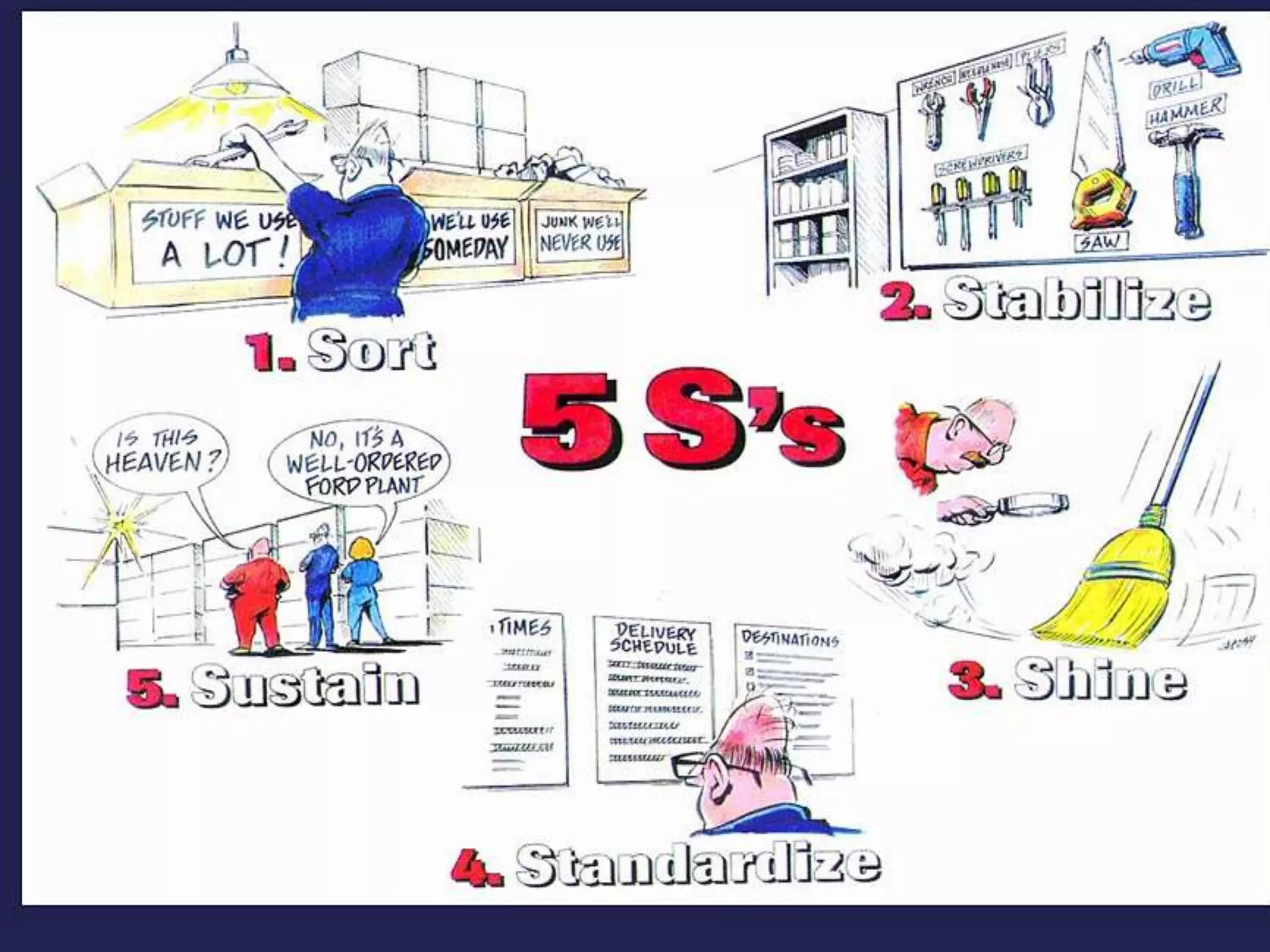
• Elements of 5S system
• Case Study
Introduction to the System
• The original concept of 5S was developed
by Takashi Osadka during the early 1980s
• The 5S system is designed to create a
visual workplace—that is, a work environment
that is self-explaining, selfordering, and self-
improving.
• Fundamentally, 5S is a housekeeping
technique that enables orderly and neat
• management of items for ensuring their
immediate retrieval.
Introduction to the System
contd.
• situation is immediately obvious and
employees can easily correct it.
• Used for achieving: Continuous
quality improvement
• Faster Services
• Waste Elimination
What 5S can Do?
• Improves profits, quality and safety
• Reduces wasted time and materials
• Reduce lead time and cost
• Improves efficiency and morale of
• workers
• Simplifies work environment
Why 5S?
• Impact on Safety
• Help us identify and eliminate waste
• Low cost and high impact/aesthetic
• value
• Faster services
The 5S Elements
• The 5S is a deceptively simple system
• comprising the following system
• Seiri (Sort)
• Seiton (Set in Order)
• Seiso (Shine)
• Seiketsu (Standardize)
• Shitsuke (Sustain
S1—Sort (Seiri)
• If in doubt, throw it out. --Red-tagging rule of
• thumb
• The first principle of visual order is to sort out what
• you don't need
• The workplace can get overrun with stuff—parts,
• work in process, scrap, jigs, storage shelves, bins,
• filing cabinets, documents, desks, chairs, racks,
• cabinets, phones, packaging material, tools,
• machinery, equipment, and so on.
• Piles of stuff accumulate and impede the flow of
• work. Hassles increase, and long lead times
• become chronic.
S1—Sort (Seiri)
• Learn how to identify and eliminate waste
• Organize your business
• Learn fundamentals for future efforts
Red Tagging
• Define what you need to meet your production
• objectives and clear out everything else.
• The key S1 tool is red tagging.
• The red tag is a simple tag containing the following
• information:
• Item classification.
• Item ID and quantity.
• Reason for red tagging.
• Work section.
• Date.
• Red tags are attached to unneeded items during the
• sort phase of 5S.
S2—Set in Order (Seiton)
• A place for everything, and everything in its
place. --------Proverb
• Now we are ready to organize what's left so
as to minimize wasted motion.
• How do we place our machines, tools, storage
shelves, and so on, to reduce the muda of
motion?
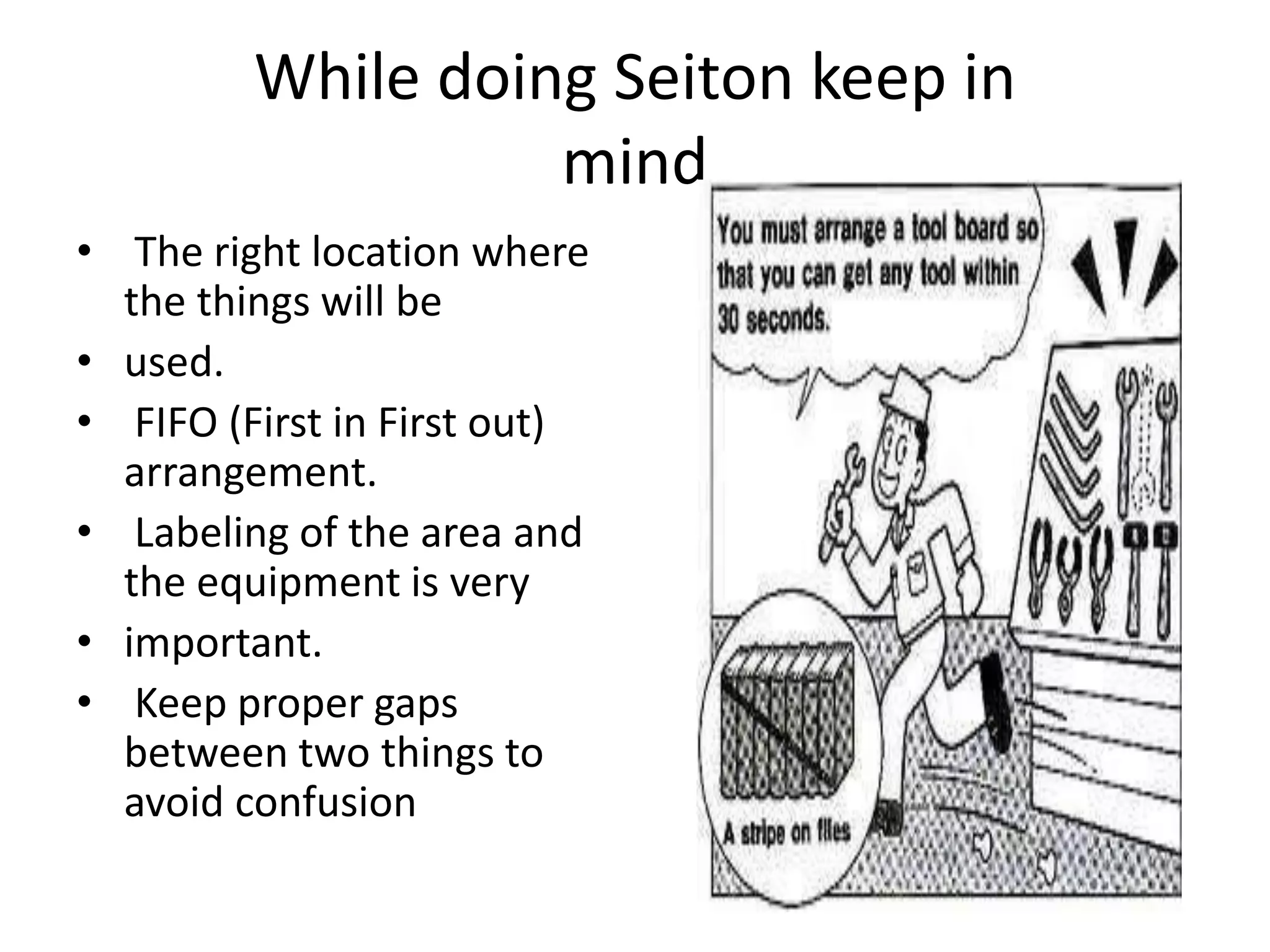
While doing Seiton keep in
mind
• The right location where
the things will be
• used.
• FIFO (First in First out)
arrangement.
• Labeling of the area and
the equipment is very
• important.
• Keep proper gaps
between two things to
avoid confusion
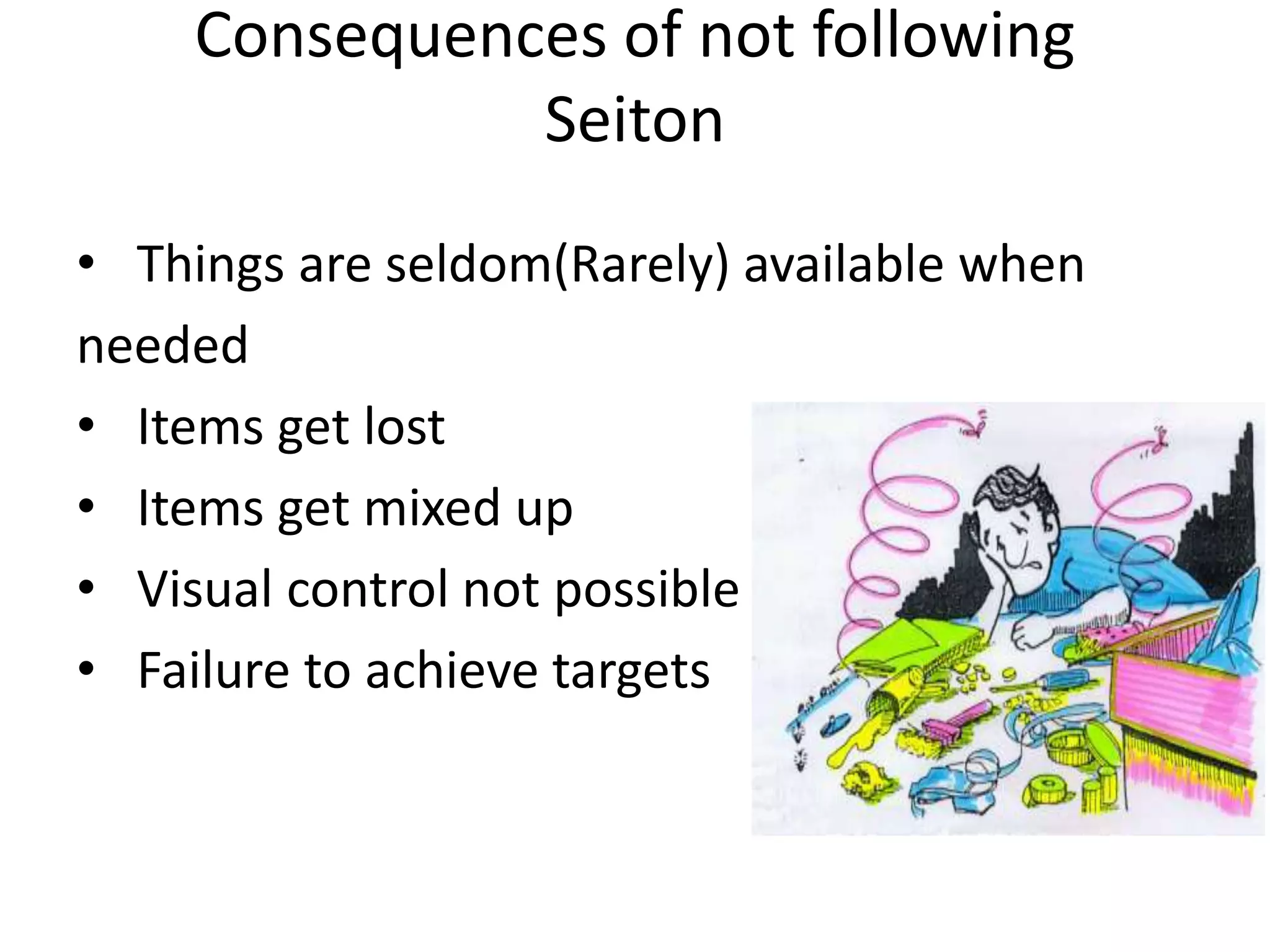
Consequences of not following
Seiton
• Things are seldom(Rarely) available when
needed
• Items get lost
• Items get mixed up
• Visual control not possible
• Failure to achieve targets
S3—Shine (and Inspect)
• Nothing raises your team's spirit like a clean,
• well-ordered workplace. Nothing depresses
• the spirit more than a bleak, filthy workplace.
• What is our standard? Our 5S team has to
• decide:
• What to clean?
• How to clean?
• Who will do the cleaning?
• How clean is clean?
S3—Shine (and Inspect
• Cleaning responsibilities and schedules should
• be prominently posted.
• Team members should sign off on the sheets
• when they have completed their cleaning
• schedules.
• Make "5S-minute cleaning" a part of each job.
• This enhances ownership and mutual respect
• among your team members.
• We want our team members to feel that, "This
• is my work area and my machinery and I am
• going to take care of it."
S3—Shine (and Inspect)
• S3 also means inspect. Your production team
• members need to regularly check the condition of
their equipment.
• Train them so they can recognize minor changes
in sound, smell, vibration, temperature, or other
telltale signs.
• Develop inspection check-sheets for machinery to
support this activity.
• Finally train your team members to solve the root
cause of cleanliness problems.
• Why are the chips there? What is causing that
leak? How can we prevent these dust emissions?
While Doing Seiso, keep in
mind:
• Cleaning should be done regularly.
• Use the best cleaning agent .
• All the nooks and corners should be cleaned.
• Keep all the labels intact.
• All the labels should correct, visible and
legible
• to all.
Consequences of Not Practicing
Seiso:
• Performance of machines deteriorates.
• The quality/aesthetic quality deteriorates.
• Dirty place is unpleasant and hazardous to
• health.
• Sends uncaring and irresponsible message to
• the team members and society at large.
• People working at dirty areas are generally
• found to have low desire to excel and their
• motivation level is low.
S4—Standardize (Seiketsu)
• We have achieved a good condition: a clean
• well-ordered workplace that speaks to us.
• But things tend to fall apart. This is the second
law of thermodynamics (or Murphy's Law).
• We must develop and apply standards for S1
to S3. Then, develop standards for how we do
our work. This is standardized work, our
playbook, so to speak.
• The best standards are clear, simple, and
visual.
While doing Seiketsu keep in
mind
• The standards should be arrived at
unanimously.
• Always keep the standards flexible to changes
and improvements.
• Standards should be known to all and
displayed.
Consequences of not following
Seiketsu
• Dual standards yield multiple results.
• Multiple results lead to conflicts and
• confusions.
• Rework increases.
• Rework increases the basic cost of the
• finished product without any value addition
S5—Sustain (Shitsuke)
• If you are disciplined. :
• Rules will always be followed.
• Laid down targets will be achieved.
• Improvements will be promoted .
• The no. of defects will be reduced.
• The cost will not increase.
How to practice Shitsuke
• Train all team members on 4-S.
• Correct wrong practices on the spot.
• Punctuality is the backbone of 5S.
• Follow work instructions.
5S Promotion and
Communication
Here are some 5S promotional ideas:
5S Report boards.
5S Catch of the month.
5S Slogan or Logo Contests.
5S core group
5s system
5s system

5s system

  • 1.
  • 2.
    The Flow • Introductionto the system • Elements of 5S system • Case Study
  • 3.
    Introduction to theSystem • The original concept of 5S was developed by Takashi Osadka during the early 1980s • The 5S system is designed to create a visual workplace—that is, a work environment that is self-explaining, selfordering, and self- improving. • Fundamentally, 5S is a housekeeping technique that enables orderly and neat • management of items for ensuring their immediate retrieval.
  • 4.
    Introduction to theSystem contd. • situation is immediately obvious and employees can easily correct it. • Used for achieving: Continuous quality improvement • Faster Services • Waste Elimination
  • 5.
    What 5S canDo? • Improves profits, quality and safety • Reduces wasted time and materials • Reduce lead time and cost • Improves efficiency and morale of • workers • Simplifies work environment
  • 6.
    Why 5S? • Impacton Safety • Help us identify and eliminate waste • Low cost and high impact/aesthetic • value • Faster services
  • 7.
    The 5S Elements •The 5S is a deceptively simple system • comprising the following system • Seiri (Sort) • Seiton (Set in Order) • Seiso (Shine) • Seiketsu (Standardize) • Shitsuke (Sustain
  • 8.
    S1—Sort (Seiri) • Ifin doubt, throw it out. --Red-tagging rule of • thumb • The first principle of visual order is to sort out what • you don't need • The workplace can get overrun with stuff—parts, • work in process, scrap, jigs, storage shelves, bins, • filing cabinets, documents, desks, chairs, racks, • cabinets, phones, packaging material, tools, • machinery, equipment, and so on. • Piles of stuff accumulate and impede the flow of • work. Hassles increase, and long lead times • become chronic.
  • 9.
    S1—Sort (Seiri) • Learnhow to identify and eliminate waste • Organize your business • Learn fundamentals for future efforts
  • 10.
    Red Tagging • Definewhat you need to meet your production • objectives and clear out everything else. • The key S1 tool is red tagging. • The red tag is a simple tag containing the following • information: • Item classification. • Item ID and quantity. • Reason for red tagging. • Work section. • Date. • Red tags are attached to unneeded items during the • sort phase of 5S.
  • 11.
    S2—Set in Order(Seiton) • A place for everything, and everything in its place. --------Proverb • Now we are ready to organize what's left so as to minimize wasted motion. • How do we place our machines, tools, storage shelves, and so on, to reduce the muda of motion?
  • 12.
    While doing Seitonkeep in mind • The right location where the things will be • used. • FIFO (First in First out) arrangement. • Labeling of the area and the equipment is very • important. • Keep proper gaps between two things to avoid confusion
  • 13.
    Consequences of notfollowing Seiton • Things are seldom(Rarely) available when needed • Items get lost • Items get mixed up • Visual control not possible • Failure to achieve targets
  • 14.
    S3—Shine (and Inspect) •Nothing raises your team's spirit like a clean, • well-ordered workplace. Nothing depresses • the spirit more than a bleak, filthy workplace. • What is our standard? Our 5S team has to • decide: • What to clean? • How to clean? • Who will do the cleaning? • How clean is clean?
  • 15.
    S3—Shine (and Inspect •Cleaning responsibilities and schedules should • be prominently posted. • Team members should sign off on the sheets • when they have completed their cleaning • schedules. • Make "5S-minute cleaning" a part of each job. • This enhances ownership and mutual respect • among your team members. • We want our team members to feel that, "This • is my work area and my machinery and I am • going to take care of it."
  • 16.
    S3—Shine (and Inspect) •S3 also means inspect. Your production team • members need to regularly check the condition of their equipment. • Train them so they can recognize minor changes in sound, smell, vibration, temperature, or other telltale signs. • Develop inspection check-sheets for machinery to support this activity. • Finally train your team members to solve the root cause of cleanliness problems. • Why are the chips there? What is causing that leak? How can we prevent these dust emissions?
  • 17.
    While Doing Seiso,keep in mind: • Cleaning should be done regularly. • Use the best cleaning agent . • All the nooks and corners should be cleaned. • Keep all the labels intact. • All the labels should correct, visible and legible • to all.
  • 18.
    Consequences of NotPracticing Seiso: • Performance of machines deteriorates. • The quality/aesthetic quality deteriorates. • Dirty place is unpleasant and hazardous to • health. • Sends uncaring and irresponsible message to • the team members and society at large. • People working at dirty areas are generally • found to have low desire to excel and their • motivation level is low.
  • 19.
    S4—Standardize (Seiketsu) • Wehave achieved a good condition: a clean • well-ordered workplace that speaks to us. • But things tend to fall apart. This is the second law of thermodynamics (or Murphy's Law). • We must develop and apply standards for S1 to S3. Then, develop standards for how we do our work. This is standardized work, our playbook, so to speak. • The best standards are clear, simple, and visual.
  • 20.
    While doing Seiketsukeep in mind • The standards should be arrived at unanimously. • Always keep the standards flexible to changes and improvements. • Standards should be known to all and displayed.
  • 21.
    Consequences of notfollowing Seiketsu • Dual standards yield multiple results. • Multiple results lead to conflicts and • confusions. • Rework increases. • Rework increases the basic cost of the • finished product without any value addition
  • 22.
    S5—Sustain (Shitsuke) • Ifyou are disciplined. : • Rules will always be followed. • Laid down targets will be achieved. • Improvements will be promoted . • The no. of defects will be reduced. • The cost will not increase.
  • 23.
    How to practiceShitsuke • Train all team members on 4-S. • Correct wrong practices on the spot. • Punctuality is the backbone of 5S. • Follow work instructions.
  • 24.
    5S Promotion and Communication Hereare some 5S promotional ideas: 5S Report boards. 5S Catch of the month. 5S Slogan or Logo Contests. 5S core group