Presentation
• Topic 5S
• Presented To Engr.Arbab Shahid
• Presented By Umar Farooq
• Reg. No 2016-BT-Mech-726
• Deprt Mechanical
M.N.S UET MULTAN
WHAT IS 5S
It is the name of a workplace organization
method that uses a list of five Japanese words:
SEIRI, SEITON, SEISO, SEIKETSU, and
SHITSUKE
• It is a structured program to systematically
achieve total organization, cleanliness, and
standardization in the workplace.
Discovery of 5S
• Thirty years ago, researchers started studying the
secret of success of Japanese manufacturing
companies.
• It was Hiroyuki Hirano who developed 5s within his
overall approach to production systems.
• Hirano provided a structure for improvement
programs. He pointed out a series of identifiable
steps, each building on its predecessor.
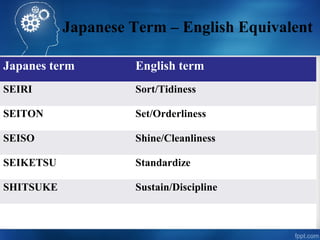
Japanese Term – English Equivalent
Japanes term English term
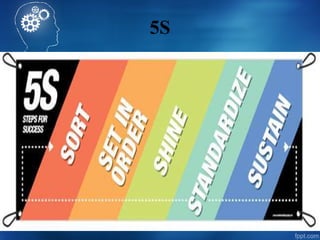
SEIRI Sort/Tidiness
SEITON Set/Orderliness
SEISO Shine/Cleanliness
SEIKETSU Standardize
SHITSUKE Sustain/Discipline
5S
SEIRI (Sort)
How to sort things:
Decide what you need.
Remove unnecessary clutter.
Throw away all rubbish and
unrelated materials in the workplace.
All tools and materials must be classified
and stored.
Remove items which are
broken unusable or occasionally used.
SEITON (Set in Order)
How to set things in order:
Once you have eliminated all the unneeded
items, turn to the left over items.
Set everything in proper place for
Quick retrieval and storage.
Arrange tools, parts, and instructions
in such a way that the most
Frequently used items are he
easiest and quickest to locate.
SEISO (Shine)
How to shine your things:
Clean the workspace and all equipment, and keep it clean
tidy and organized.
Identify and eliminate causes of dirt and grime – remove the
need to clean
At the end of each shift, clean the work area and be sure
everything is restored to its place
SEIKETSU (Standardize)
How to standardize:
Simplify the way of maintaining cleanliness.
Develop procedures, schedules, practices.
Continue to assess the use and disposal
of items.
All employees doing the same job
Should be able to work in any station
with the same tools that are in the same
location in every station.
SHITSUKE (Sustain)
• How to sustain
 Maintain and review standards. Once the previous 4 S's have
been established, they become the new way to operate.
 Maintain focus on this new way and do not allow a gradual
decline back to the old ways.
 While thinking about the new way, also think of better ways.
 When an issue arises such as a suggested improvement, a new
way of working, a new tool or a new output requirement,
review the first 4 S's and make changes as appropriate.
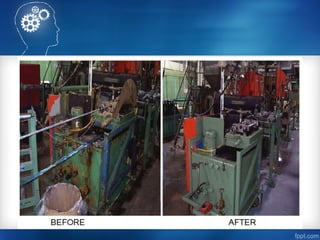
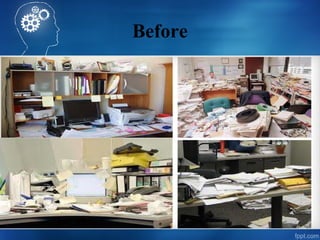
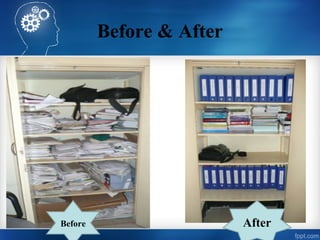
Before
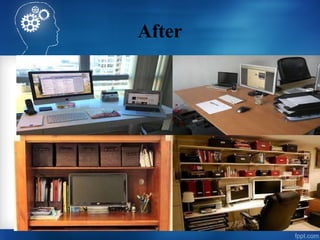
After
Before & After
Before After
Advantages of 5S
 Increases space
 Machine maintenance
 Productivity
 Smooth working and time saving due to
quick retrieval
 Accidents and mistakes minimized
Advantages of 5S
 Results in a place easier to manage
 A clean and tidy workplace leads to greater
well being and increased motivation
 Creates workplace ownership
 Company image improves
Thank you for listening !

5s

  • 1.
    Presentation • Topic 5S •Presented To Engr.Arbab Shahid • Presented By Umar Farooq • Reg. No 2016-BT-Mech-726 • Deprt Mechanical M.N.S UET MULTAN
  • 2.
    WHAT IS 5S Itis the name of a workplace organization method that uses a list of five Japanese words: SEIRI, SEITON, SEISO, SEIKETSU, and SHITSUKE • It is a structured program to systematically achieve total organization, cleanliness, and standardization in the workplace.
  • 3.
    Discovery of 5S •Thirty years ago, researchers started studying the secret of success of Japanese manufacturing companies. • It was Hiroyuki Hirano who developed 5s within his overall approach to production systems. • Hirano provided a structure for improvement programs. He pointed out a series of identifiable steps, each building on its predecessor.
  • 4.
    Japanese Term –English Equivalent Japanes term English term SEIRI Sort/Tidiness SEITON Set/Orderliness SEISO Shine/Cleanliness SEIKETSU Standardize SHITSUKE Sustain/Discipline
  • 5.
  • 6.
    SEIRI (Sort) How tosort things: Decide what you need. Remove unnecessary clutter. Throw away all rubbish and unrelated materials in the workplace. All tools and materials must be classified and stored. Remove items which are broken unusable or occasionally used.
  • 7.
    SEITON (Set inOrder) How to set things in order: Once you have eliminated all the unneeded items, turn to the left over items. Set everything in proper place for Quick retrieval and storage. Arrange tools, parts, and instructions in such a way that the most Frequently used items are he easiest and quickest to locate.
  • 8.
    SEISO (Shine) How toshine your things: Clean the workspace and all equipment, and keep it clean tidy and organized. Identify and eliminate causes of dirt and grime – remove the need to clean At the end of each shift, clean the work area and be sure everything is restored to its place
  • 10.
    SEIKETSU (Standardize) How tostandardize: Simplify the way of maintaining cleanliness. Develop procedures, schedules, practices. Continue to assess the use and disposal of items. All employees doing the same job Should be able to work in any station with the same tools that are in the same location in every station.
  • 11.
    SHITSUKE (Sustain) • Howto sustain  Maintain and review standards. Once the previous 4 S's have been established, they become the new way to operate.  Maintain focus on this new way and do not allow a gradual decline back to the old ways.  While thinking about the new way, also think of better ways.  When an issue arises such as a suggested improvement, a new way of working, a new tool or a new output requirement, review the first 4 S's and make changes as appropriate.
  • 12.
  • 13.
  • 14.
  • 15.
    Advantages of 5S Increases space  Machine maintenance  Productivity  Smooth working and time saving due to quick retrieval  Accidents and mistakes minimized
  • 16.
    Advantages of 5S Results in a place easier to manage  A clean and tidy workplace leads to greater well being and increased motivation  Creates workplace ownership  Company image improves
  • 17.
    Thank you forlistening !