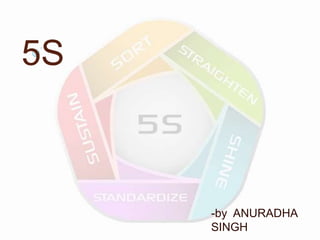
5S
-by ANURADHA
SINGH
What is 5S?
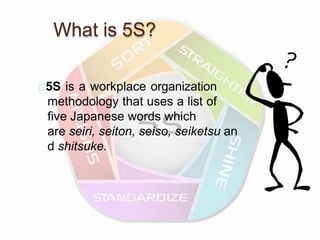
5S is a workplace organization
methodology that uses a list of
five Japanese words which
are seiri, seiton, seiso, seiketsu an
d shitsuke.
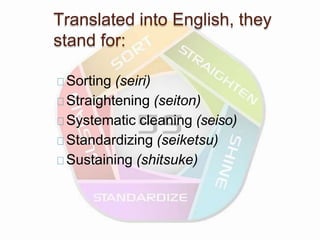
Translated into English, they
stand for:
Sorting (seiri)
Straightening (seiton)
Systematic cleaning (seiso)
Standardizing (seiketsu)
Sustaining (shitsuke)
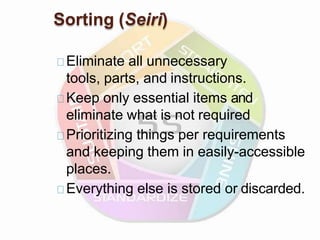
Sorting (Seiri)
Eliminate all unnecessary
tools, parts, and instructions.
Keep only essential items and
eliminate what is not required
Prioritizing things per requirements
and keeping them in easily-accessible
places.
Everything else is stored or discarded.
Straightening or setting in
order / stabilize (Seiton)
There should be a place for everything
and everything should be in its place.
The place for each item should be
clearly labelled or demarcated.
Items should be arranged in a manner
that promotes efficient work flow, with
equipment used most often being the
most easily accessible.
shining or systematic cleaning
(Seiso)
Clean the workspace and all
equipment, and keep it clean, tidy and
organized.
At the end of each shift, clean the
work area and be sure everything is
restored to its place.
Maintaining cleanliness should be part
of the daily work – not an occasional
activity initiated when things get too
messy.
Standardizing (Seiketsu)
All work stations for a particular job
should be identical.
All employees doing the same job
should be able to work in any station
with the same tools that are in the
same location in every station.
Everyone should know exactly what
his or her responsibilities are for
adhering to the first 3 S's.
Sustaining the discipline or
self-discipline (Shitsuke)
Maintain and review standards.
Maintain focus on this new way and
do not allow a gradual decline back to
the old ways.
While thinking about the new
way, also be thinking about yet better
ways.
BENEFITS OF 5S
improves organizational efficiency
reduces waste in all forms
cuts down employee frustration when
"the system doesn’t work"
improves speed and quality of work
performance
improves safety
creates a visually attractive
environment
OBJECTIVES OF 5S
Productivity
Safety
Reduced Waste
Worker Commitment
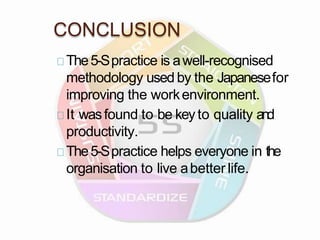
CONCLUSION
The5-Spractice is awell-recognised
methodology used by the Japanesefor
improving the workenvironment.
It wasfound to be keyto quality and
productivity.
The5-Spractice helps everyone in the
organisation to live abetter life.
THANK YOU

5s

  • 1.
  • 2.
    What is 5S? 5Sis a workplace organization methodology that uses a list of five Japanese words which are seiri, seiton, seiso, seiketsu an d shitsuke.
  • 3.
    Translated into English,they stand for: Sorting (seiri) Straightening (seiton) Systematic cleaning (seiso) Standardizing (seiketsu) Sustaining (shitsuke)
  • 4.
    Sorting (Seiri) Eliminate allunnecessary tools, parts, and instructions. Keep only essential items and eliminate what is not required Prioritizing things per requirements and keeping them in easily-accessible places. Everything else is stored or discarded.
  • 6.
    Straightening or settingin order / stabilize (Seiton) There should be a place for everything and everything should be in its place. The place for each item should be clearly labelled or demarcated. Items should be arranged in a manner that promotes efficient work flow, with equipment used most often being the most easily accessible.
  • 8.
    shining or systematiccleaning (Seiso) Clean the workspace and all equipment, and keep it clean, tidy and organized. At the end of each shift, clean the work area and be sure everything is restored to its place. Maintaining cleanliness should be part of the daily work – not an occasional activity initiated when things get too messy.
  • 10.
    Standardizing (Seiketsu) All workstations for a particular job should be identical. All employees doing the same job should be able to work in any station with the same tools that are in the same location in every station. Everyone should know exactly what his or her responsibilities are for adhering to the first 3 S's.
  • 12.
    Sustaining the disciplineor self-discipline (Shitsuke) Maintain and review standards. Maintain focus on this new way and do not allow a gradual decline back to the old ways. While thinking about the new way, also be thinking about yet better ways.
  • 14.
    BENEFITS OF 5S improvesorganizational efficiency reduces waste in all forms cuts down employee frustration when "the system doesn’t work" improves speed and quality of work performance improves safety creates a visually attractive environment
  • 15.
  • 18.
    CONCLUSION The5-Spractice is awell-recognised methodologyused by the Japanesefor improving the workenvironment. It wasfound to be keyto quality and productivity. The5-Spractice helps everyone in the organisation to live abetter life.
  • 19.