‘Multiplexing and Multiple
Access Techniques’
Divya Shukla
A2315315010
OUTLINE
 Multiplexing
 Multiple access
 Various Multiple Access Techniques.
• TDMA
• FDMA
 Types of TDMA & FDMA
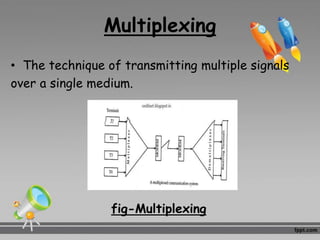
Multiplexing
• The technique of transmitting multiple signals
over a single medium.
fig-Multiplexing
Objective
• Better utilization of channel capacity.
• Cost effective.
Application
• Video processing
• Digital broadcasting
• Telephone network
Multiplexing Techniques
2 TECHNIQUES-
• FDM -(ANALOG)- Shares the frequency.
• TDM -(DIGITAL)- Shares the time slots.
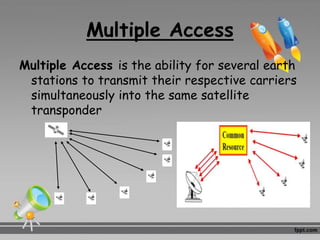
Multiple Access
Multiple Access is the ability for several earth
stations to transmit their respective carriers
simultaneously into the same satellite
transponder
Need to optimize
• Interconnectivity.
• Spectrum utilization.
• Adaptability to network growth.
• Handling of different types of traffic.
• Economic.
MA Techniques
3 Techniques-
– Unique frequency slot FDMA
– Unique time slot TDMA
– Unique code CDMA
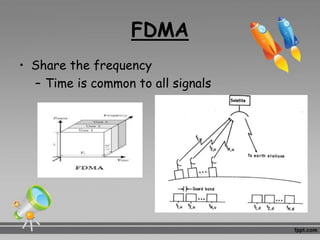
FDMA
• Share the frequency
– Time is common to all signals
• FDMA may be –
1. Fixed-Assigned Multiple Access (FAMA).
1. Demand-Assigned Multiple Access (DAMA).
Fixed-Assigned(FAMA)
Description-
• Channels permanently assigned to terminals
• Also known pre-assigned MA
Advantages-
• Simple to implement
• Channel use is contention-free
Disadvantages-
• Not available for general use.
Demand Assignment(DAMA)
Description-
• Terminals dynamically request capacity from a
scheduler, which assigns channels based on these
requests.
Advantages-
• Stability guaranteed.
• Utility can be maximized.
• Technique is fair to all terminals
Disadvantages-
• More costly and complicated to implement.
• Experiences high delay for low loads (due to the need
to wait for requests to be orderd)
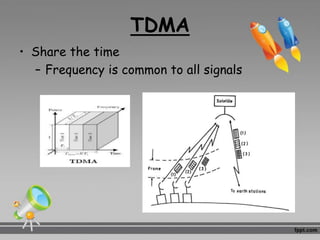
TDMA
• Share the time
– Frequency is common to all signals
TDMA can be of two ways :
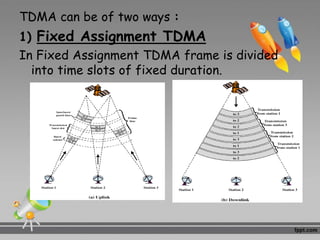
1) Fixed Assignment TDMA
In Fixed Assignment TDMA frame is divided
into time slots of fixed duration.
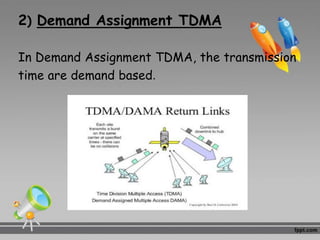
2) Demand Assignment TDMA
In Demand Assignment TDMA, the transmission
time are demand based.
Conclusion
• We have limited bandwidth and infinite
number of users, hence multiple accessing
technique is very essential.FDMA, TDMA
these are the widely used multiple accessing
techniques in communication.
• Hence, by using these techniques satellite
channel is best utilized and allows to widely
cover geographical area.
THANK YOU
For Your Patience Listening..!

Satellite ppt

  • 1.
    ‘Multiplexing and Multiple AccessTechniques’ Divya Shukla A2315315010
  • 2.
    OUTLINE  Multiplexing  Multipleaccess  Various Multiple Access Techniques. • TDMA • FDMA  Types of TDMA & FDMA
  • 3.
    Multiplexing • The techniqueof transmitting multiple signals over a single medium. fig-Multiplexing
  • 4.
    Objective • Better utilizationof channel capacity. • Cost effective. Application • Video processing • Digital broadcasting • Telephone network
  • 5.
    Multiplexing Techniques 2 TECHNIQUES- •FDM -(ANALOG)- Shares the frequency. • TDM -(DIGITAL)- Shares the time slots.
  • 6.
    Multiple Access Multiple Accessis the ability for several earth stations to transmit their respective carriers simultaneously into the same satellite transponder
  • 7.
    Need to optimize •Interconnectivity. • Spectrum utilization. • Adaptability to network growth. • Handling of different types of traffic. • Economic.
  • 8.
    MA Techniques 3 Techniques- –Unique frequency slot FDMA – Unique time slot TDMA – Unique code CDMA
  • 9.
    FDMA • Share thefrequency – Time is common to all signals
  • 10.
    • FDMA maybe – 1. Fixed-Assigned Multiple Access (FAMA). 1. Demand-Assigned Multiple Access (DAMA).
  • 11.
    Fixed-Assigned(FAMA) Description- • Channels permanentlyassigned to terminals • Also known pre-assigned MA Advantages- • Simple to implement • Channel use is contention-free Disadvantages- • Not available for general use.
  • 12.
    Demand Assignment(DAMA) Description- • Terminalsdynamically request capacity from a scheduler, which assigns channels based on these requests. Advantages- • Stability guaranteed. • Utility can be maximized. • Technique is fair to all terminals Disadvantages- • More costly and complicated to implement. • Experiences high delay for low loads (due to the need to wait for requests to be orderd)
  • 13.
    TDMA • Share thetime – Frequency is common to all signals
  • 14.
    TDMA can beof two ways : 1) Fixed Assignment TDMA In Fixed Assignment TDMA frame is divided into time slots of fixed duration.
  • 15.
    2) Demand AssignmentTDMA In Demand Assignment TDMA, the transmission time are demand based.
  • 16.
    Conclusion • We havelimited bandwidth and infinite number of users, hence multiple accessing technique is very essential.FDMA, TDMA these are the widely used multiple accessing techniques in communication. • Hence, by using these techniques satellite channel is best utilized and allows to widely cover geographical area.
  • 17.
    THANK YOU For YourPatience Listening..!