HYPERBOLIC FUNCTION
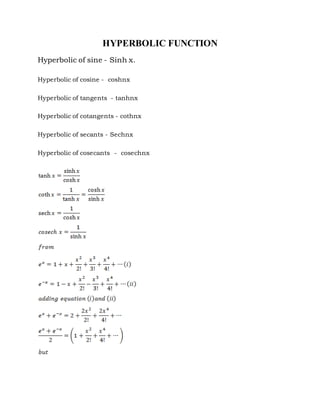
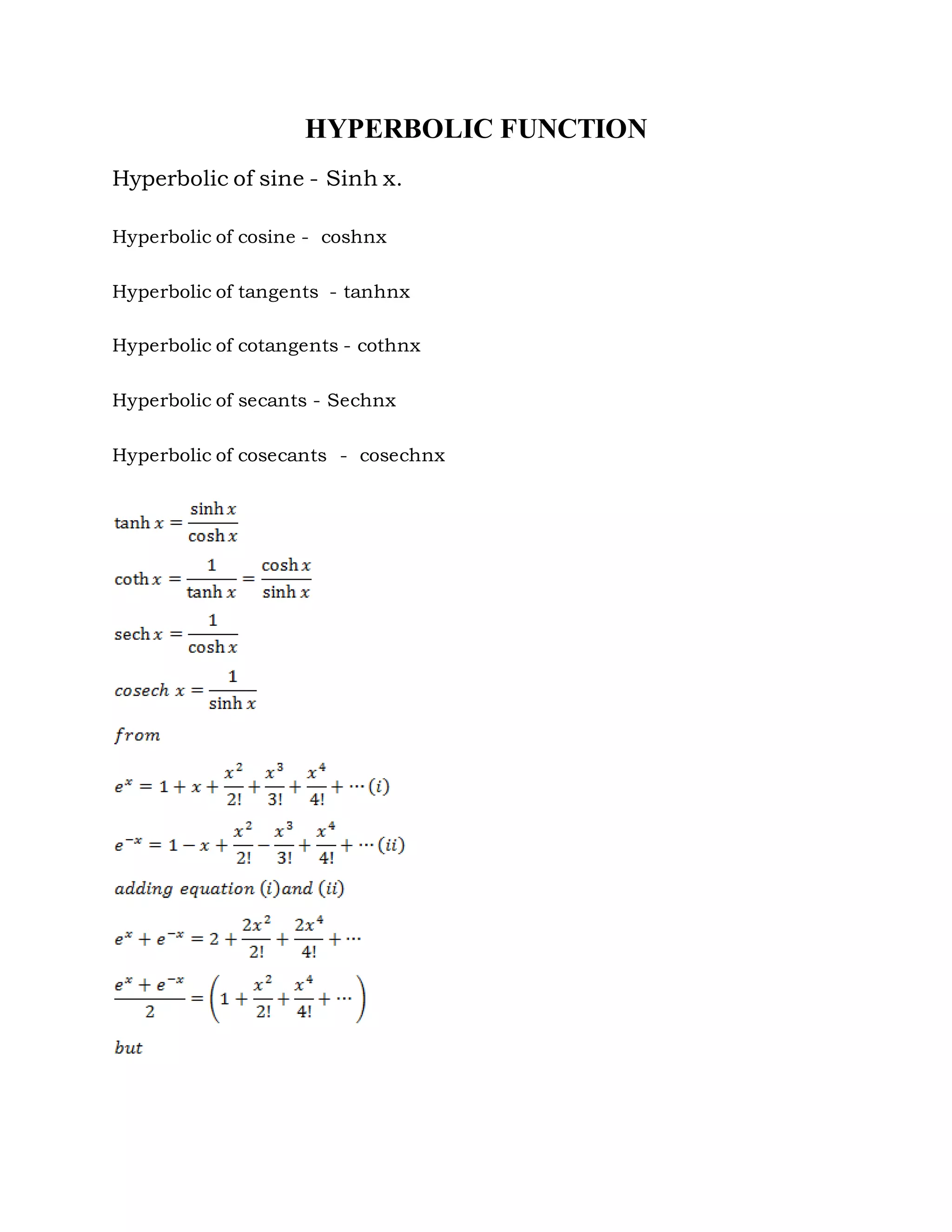
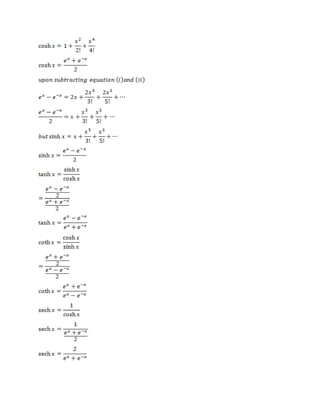
Hyperbolic of sine - Sinh x.
Hyperbolic of cosine - coshnx
Hyperbolic of tangents - tanhnx
Hyperbolic of cotangents - cothnx
Hyperbolic of secants - Sechnx
Hyperbolic of cosecants - cosechnx
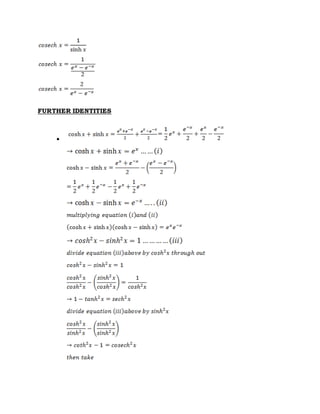
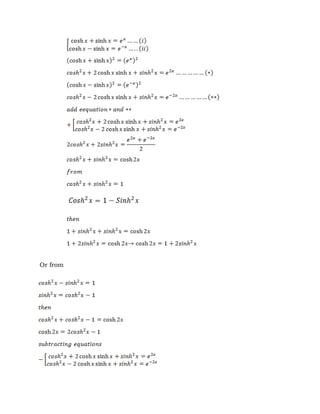
FURTHER IDENTITIES

Or from
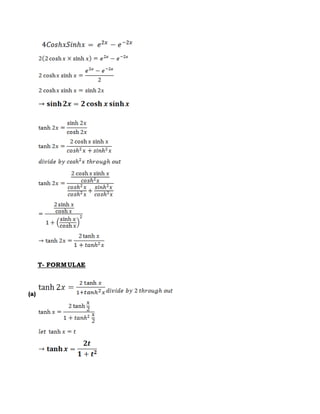
T- FORMULAE
(a)
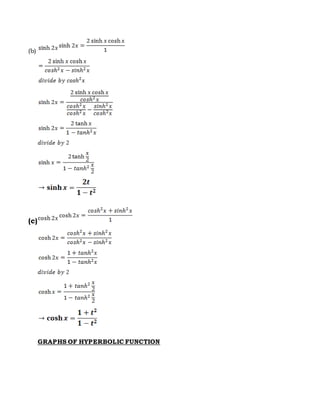
(b)
(c)
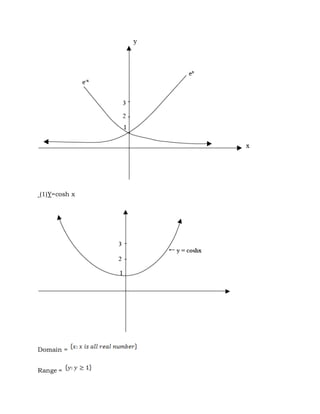
GRAPHS OF HYPERBOLIC FUNCTION
(1)Y=cosh x
Domain =
Range =
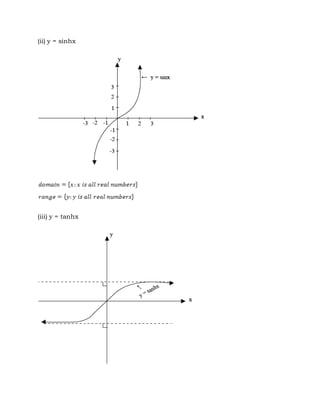
(ii) y = sinhx
(iii) y = tanhx
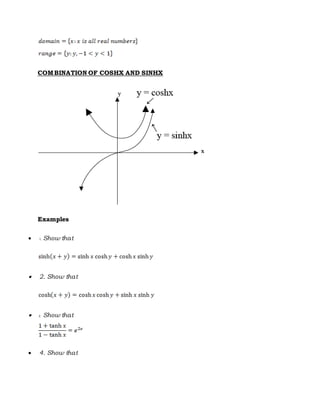
COMBINATION OF COSHX AND SINHX
Examples
 1. Show that
 2. Show that
 3. Show that
 4. Show that
 5. Find the expression that equation has equal roots

 6. Show that the point lies between
 7. Solve the following
(i)

8.Solve the following equation give the roots in terms
of natural logarithms
 if
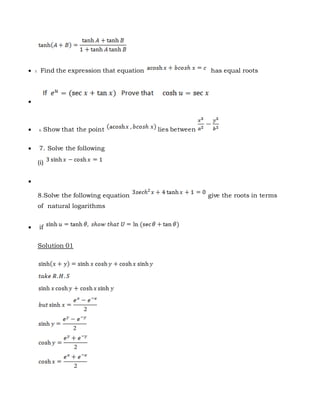
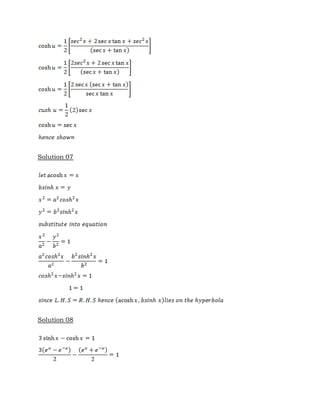
Solution 01
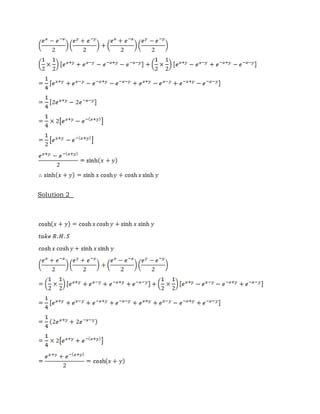
Solution 2
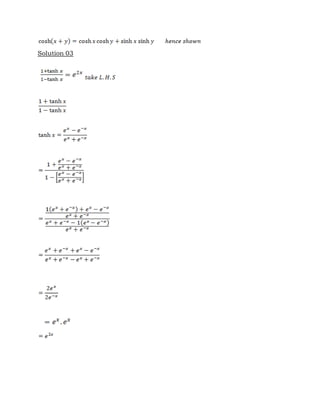
Solution 03
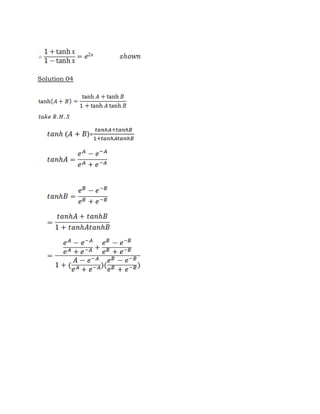
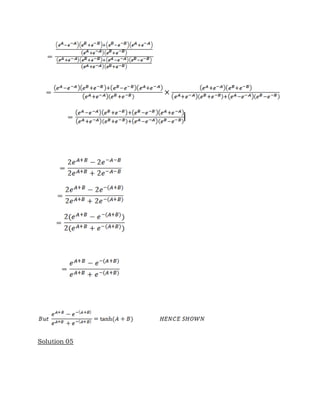
Solution 04
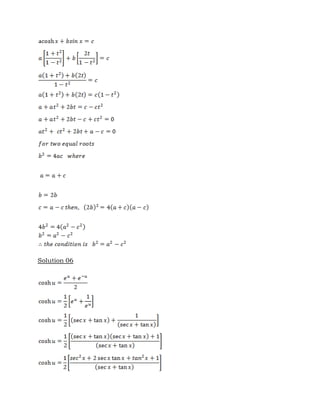
Solution 05
Solution 06
Solution 07
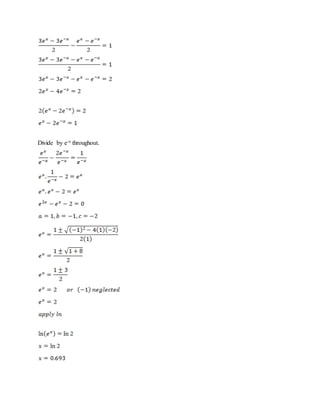
Solution 08
Divide by e-x throughout.
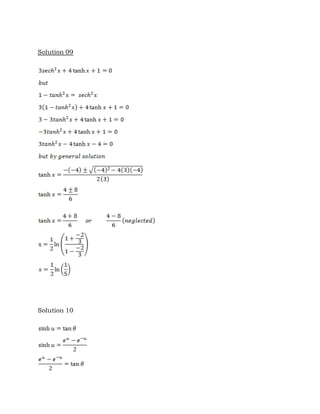
Solution 09
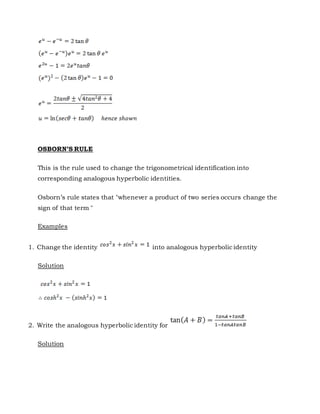
Solution 10
OSBORN’S RULE
This is the rule used to change the trigonometrical identification into
corresponding analogous hyperbolic identities.
Osborn’s rule states that "whenever a product of two series occurs change the
sign of that term "
Examples
1. Change the identity into analogous hyperbolic identity
Solution
2. Write the analogous hyperbolic identity for
Solution
3. Change into a corresponding hyperbolic identity
Solution
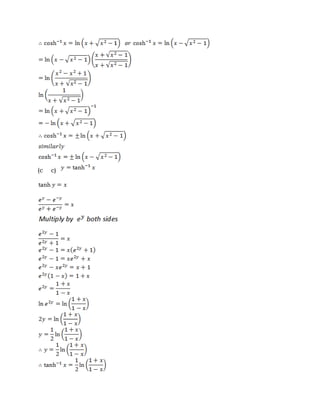
INVERSE OF HYPERBOLIC FUNCTION
The inverse of or
The inverse of is denoted by
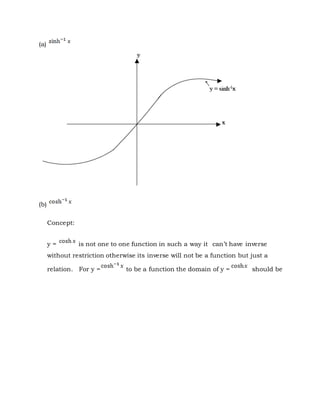
GRAPHS OF INVERSE OF HYPERBOLIC FUNCTIONS
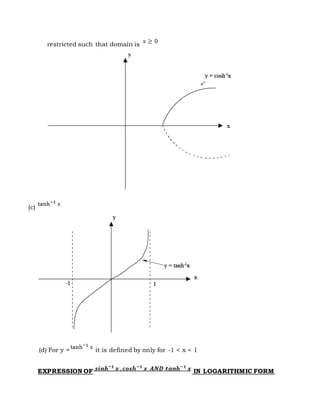
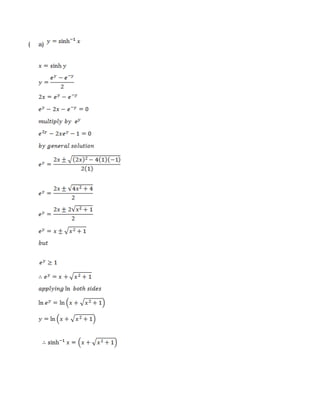
The graph of the inverse of hyperbolic functions is a reflection of graphs of
hyperbolic function on the inverse of y = x
(a)
(b)
Concept:
y = is not one to one function in such a way it can’t have inverse
without restriction otherwise its inverse will not be a function but just a
relation. For y = to be a function the domain of y = should be
restricted such that domain is
(c)
(d) For y = it is defined by only for -1 < x < 1
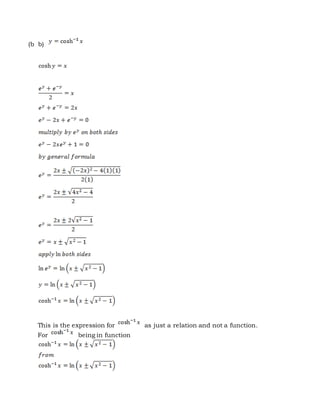
EXPRESSION OF IN LOGARITHMIC FORM
( a)
(b b)
This is the expression for as just a relation and not a function.
For being in function
(c c)
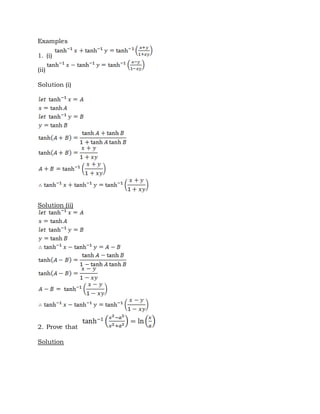
Examples
1. (i)
(ii)
Solution (i)
Solution (ii)
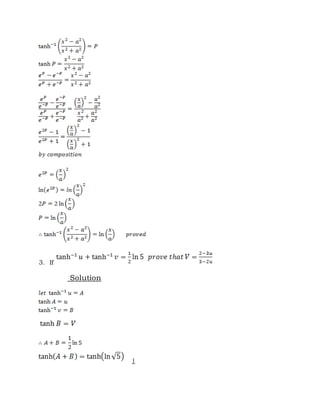
2. Prove that
Solution
3. If
Solution
1
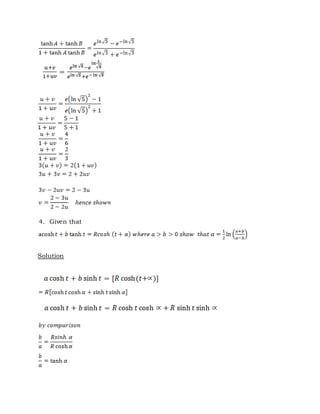
4.. Given that
Solution
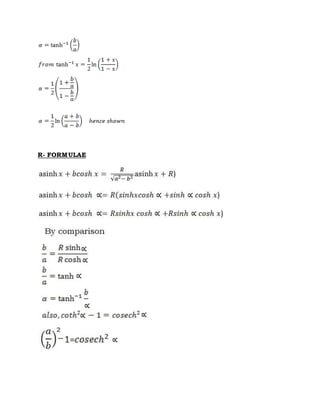
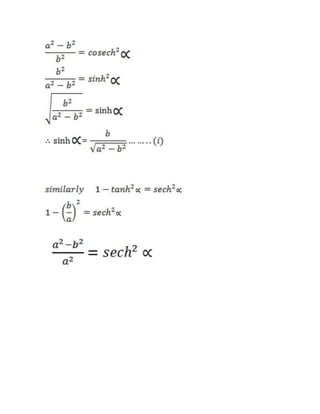
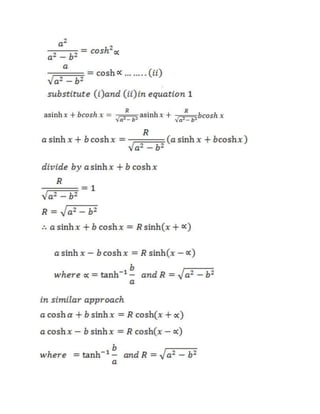
R- FORMULAE
Examples
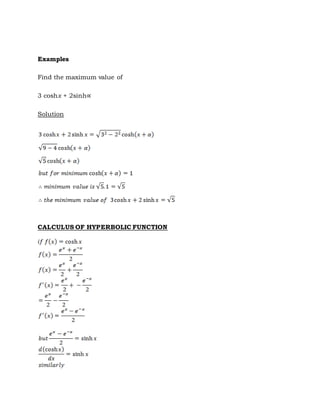
Find the maximum value of
3 coshx + 2sinh∝
Solution
CALCULUS OF HYPERBOLIC FUNCTION
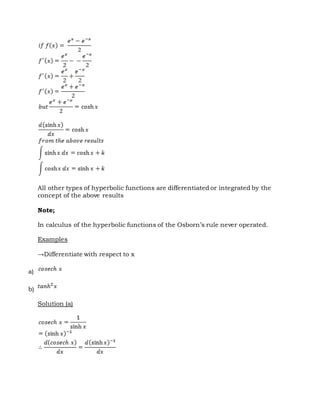
All other types of hyperbolic functions are differentiated or integrated by the
concept of the above results
Note;
In calculus of the hyperbolic functions of the Osborn’s rule never operated.
Examples
→Differentiate with respect to x
a)
b)
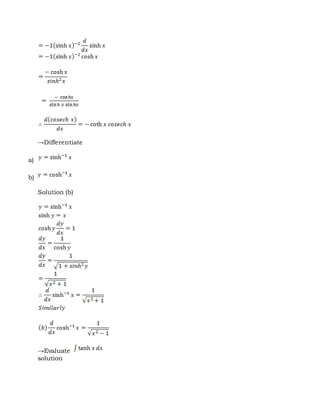
Solution (a)
→Differentiate
a)
b)
Solution (b)
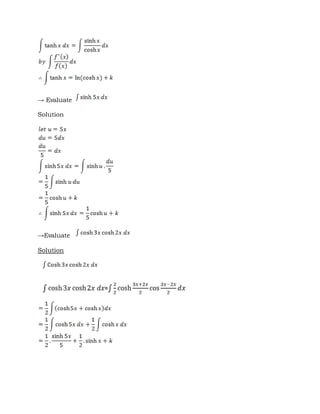
→Evaluate
solution
→ Evaluate
Solution
→Evaluate
Solution
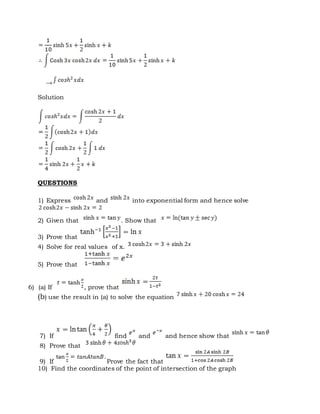
→
Solution
QUESTIONS
1) Express and into exponential form and hence solve
2) Given that . Show that
3) Prove that
4) Solve for real values of x.
5) Prove that
6) (a) If , prove that
(b) use the result in (a) to solve the equation
7) If find and and hence show that
8) Prove that
9) If Prove the fact that
10) Find the coordinates of the point of intersection of the graph
and
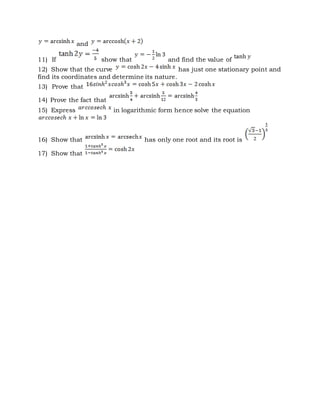
11) If show that and find the value of
12) Show that the curve has just one stationary point and
find its coordinates and determine its nature.
13) Prove that
14) Prove the fact that
15) Express in logarithmic form hence solve the equation
16) Show that has only one root and its root is
17) Show that

HYPERBOLIC FUNCTION