Solving Exponential and
Logarithmic Equations
SECTION 6.4
2
Learning Objectives
1 State and use the rules of logarithms
2 Solve exponential equations using logarithms
and interpret the real-world meaning of the
results
3 Solve logarithmic equations using
exponentiation and interpret the real-world
meaning of the results
3
Logarithms
4
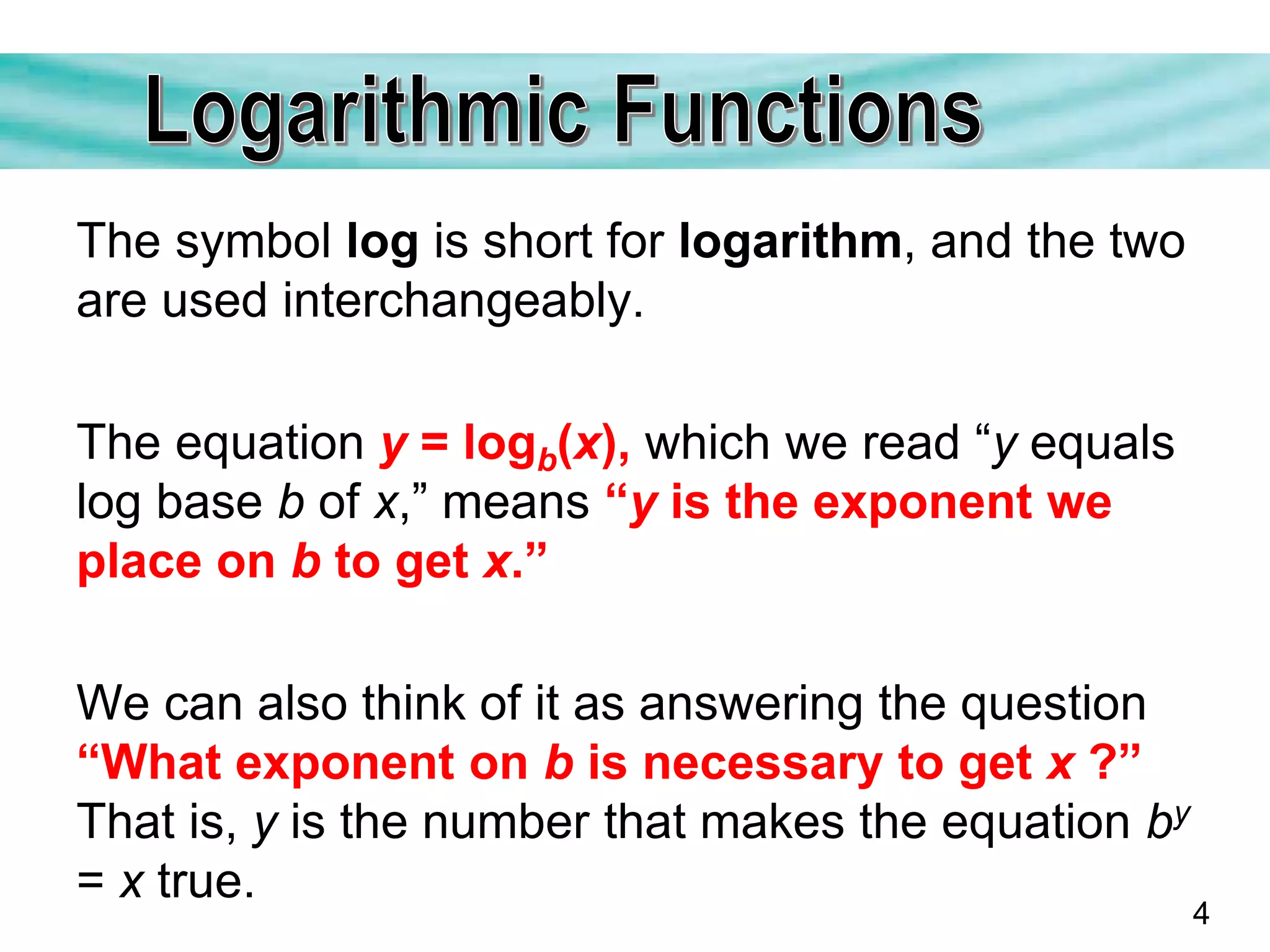
The symbol log is short for logarithm, and the two
are used interchangeably.
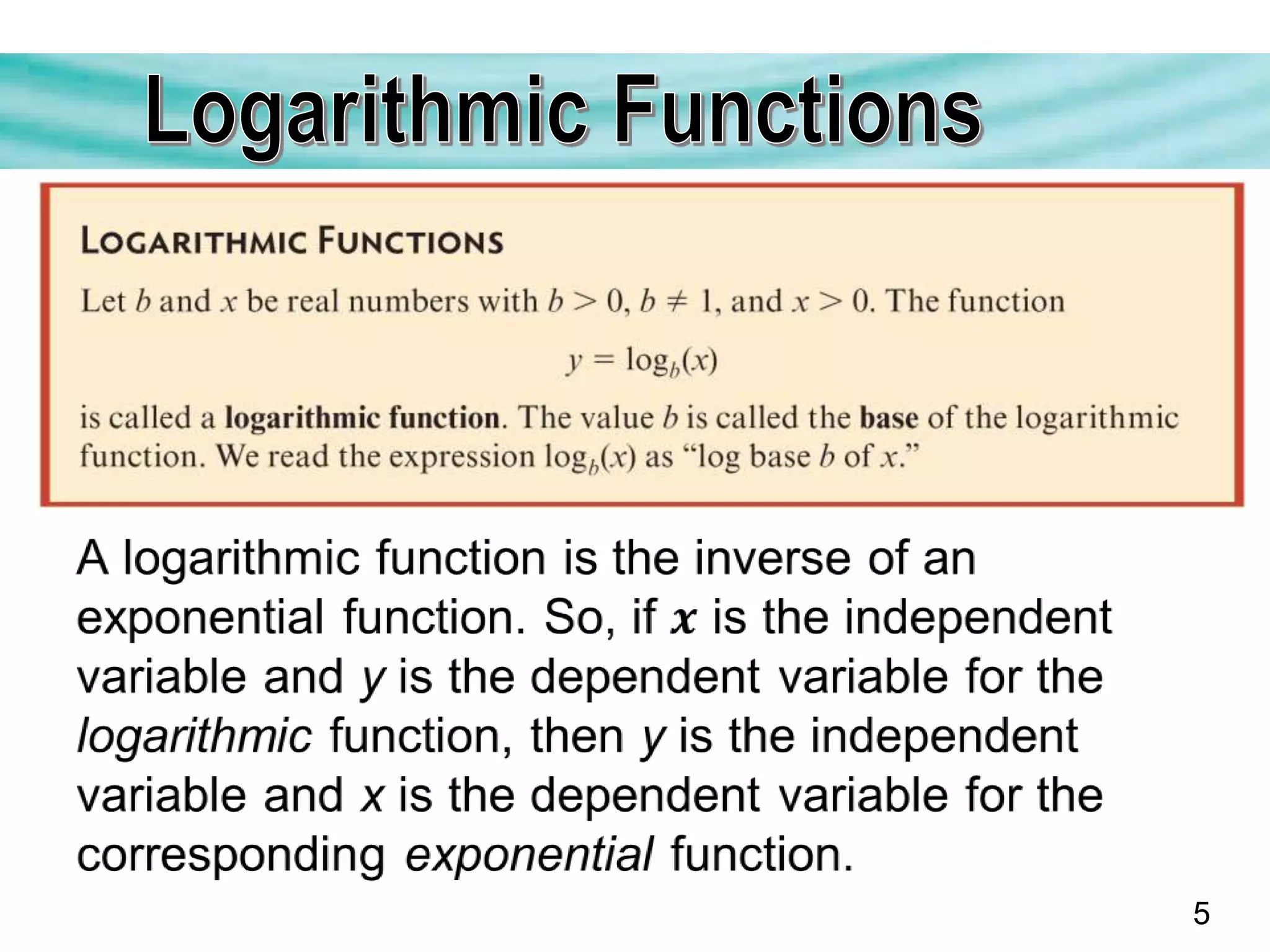
The equation y = logb(x), which we read “y equals
log base b of x,” means “y is the exponent we
place on b to get x.”
We can also think of it as answering the question
“What exponent on b is necessary to get x ?”
That is, y is the number that makes the equation by
= x true.
5
6
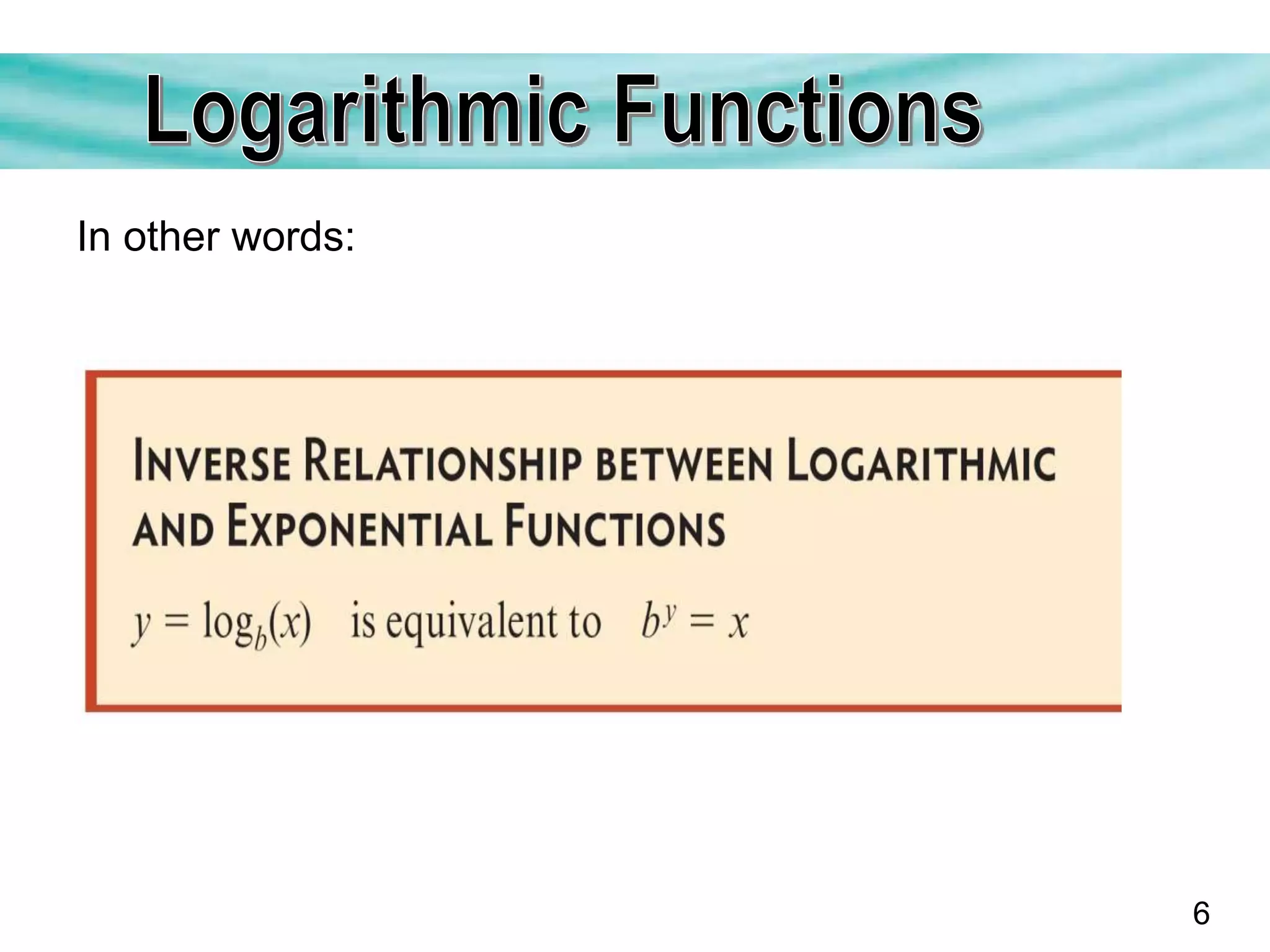
In other words:
7
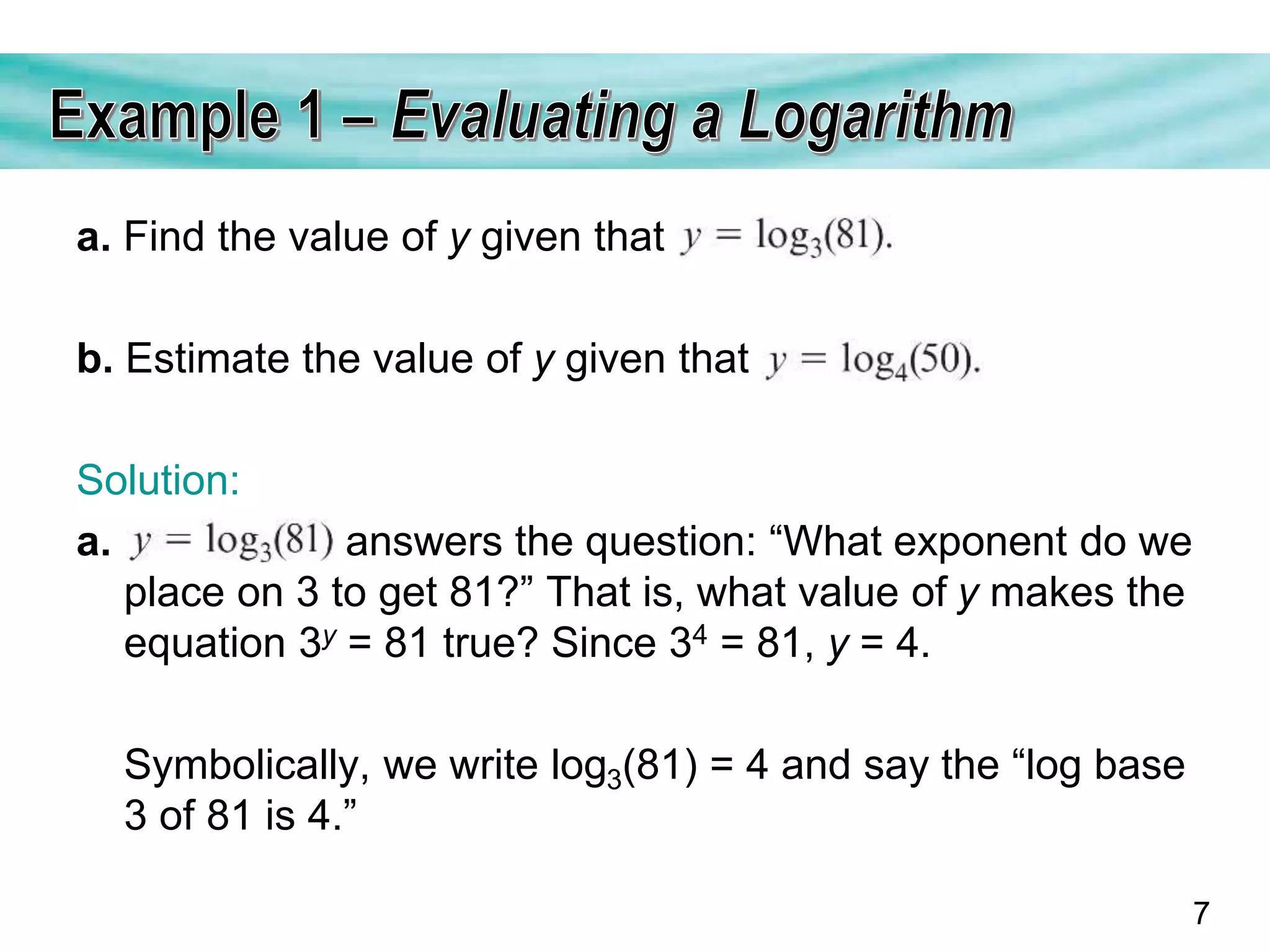
a. Find the value of y given that
b. Estimate the value of y given that
Solution:
a. answers the question: “What exponent do we
place on 3 to get 81?” That is, what value of y makes the
equation 3y = 81 true? Since 34 = 81, y = 4.
Symbolically, we write log3(81) = 4 and say the “log base
3 of 81 is 4.”
8
b. answers the question: “What exponent do
we place on 4 to get 50?” That is, what value of y makes
the equation 4y = 50 true? The answer to this question is
not a whole number.
Since 42 = 16, 43 = 64, we know y is a number between
2 and 3.
cont’d
9
10
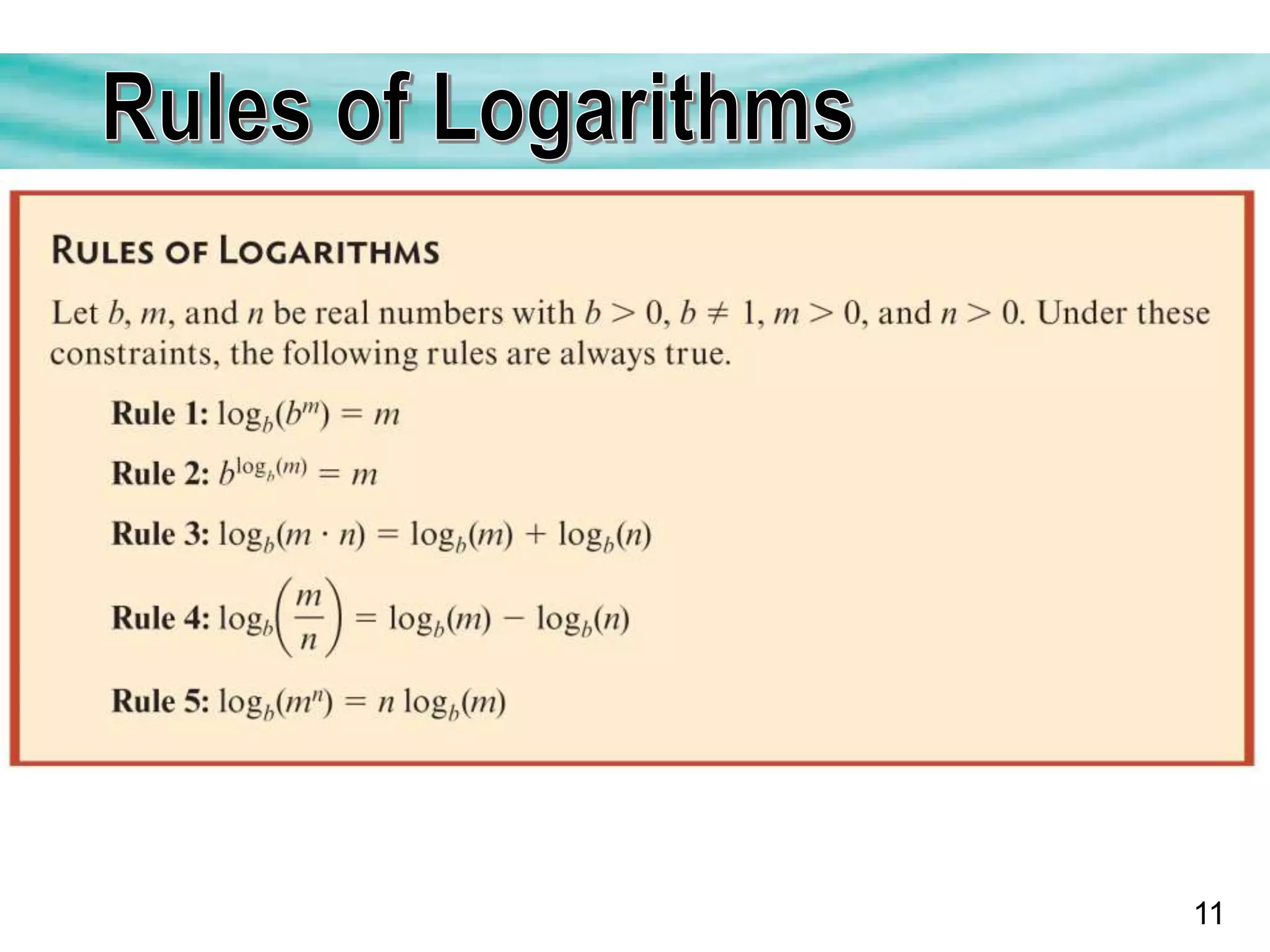
When equations involving logarithms become
more complex, we use established rules of
logarithms to manipulate or simplify the equations.
There are two keys to understanding these rules;
1.) Logarithms are exponents. Thus, the rules of
logarithms come from the properties of exponents.
2.) Any number may be written as an exponential
of any base.
11
12
The total annual health-related costs in the United States in
billions of dollars may be modeled by the function
where t is the number of years since
1960. According to the model, when will health-related
costs in the United States reach 250 billion dollars?
Solution:
13
According to the model, 21.66 years after 1960 (8 months
into 1982), the health-related costs in the United States
reached 250 billion dollars.
cont’d
14
15
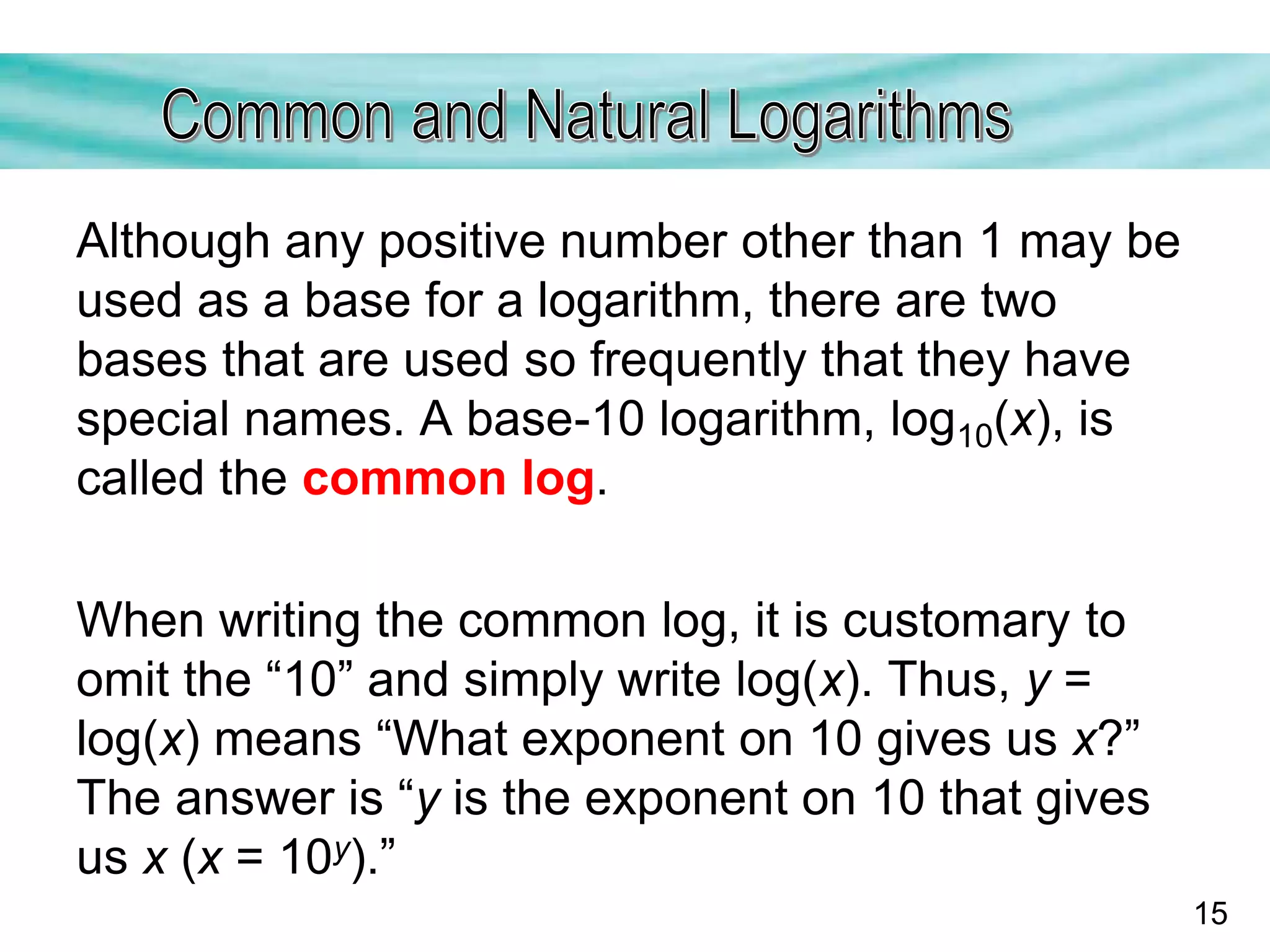
Although any positive number other than 1 may be
used as a base for a logarithm, there are two
bases that are used so frequently that they have
special names. A base-10 logarithm, log10(x), is
called the common log.
When writing the common log, it is customary to
omit the “10” and simply write log(x). Thus, y =
log(x) means “What exponent on 10 gives us x?”
The answer is “y is the exponent on 10 that gives
us x (x = 10y).”
16
A base-e logarithm, loge(x), is called the
natural log (so named because e  2.71828
is called the natural number).
When writing the natural log we write ln(x)
instead of loge(x). Thus, y = ln(x) asks “What
exponent on e gives us x?” and the answer
is “y is the exponent on e that gives us x (x =
ey).”
17
18
Evaluate each of the following expressions:
19
a.
b.
20
c.
d.
cont’d
21
Finding Logarithms Using a
Calculator
22
When logarithms do not evaluate to
integers, a calculator can help us find
accurate decimal approximations.
We use the and buttons on
the calculator to find the common and
natural logs of any number.
23
Use a calculator to find log(600) and ln(100). Then interpret
and check your answers.
Solution:
Using a calculator, we get the results shown in Figure 6.12.
This tells us that 102.778  600 and e4.605  100.
Figure 6.12
24
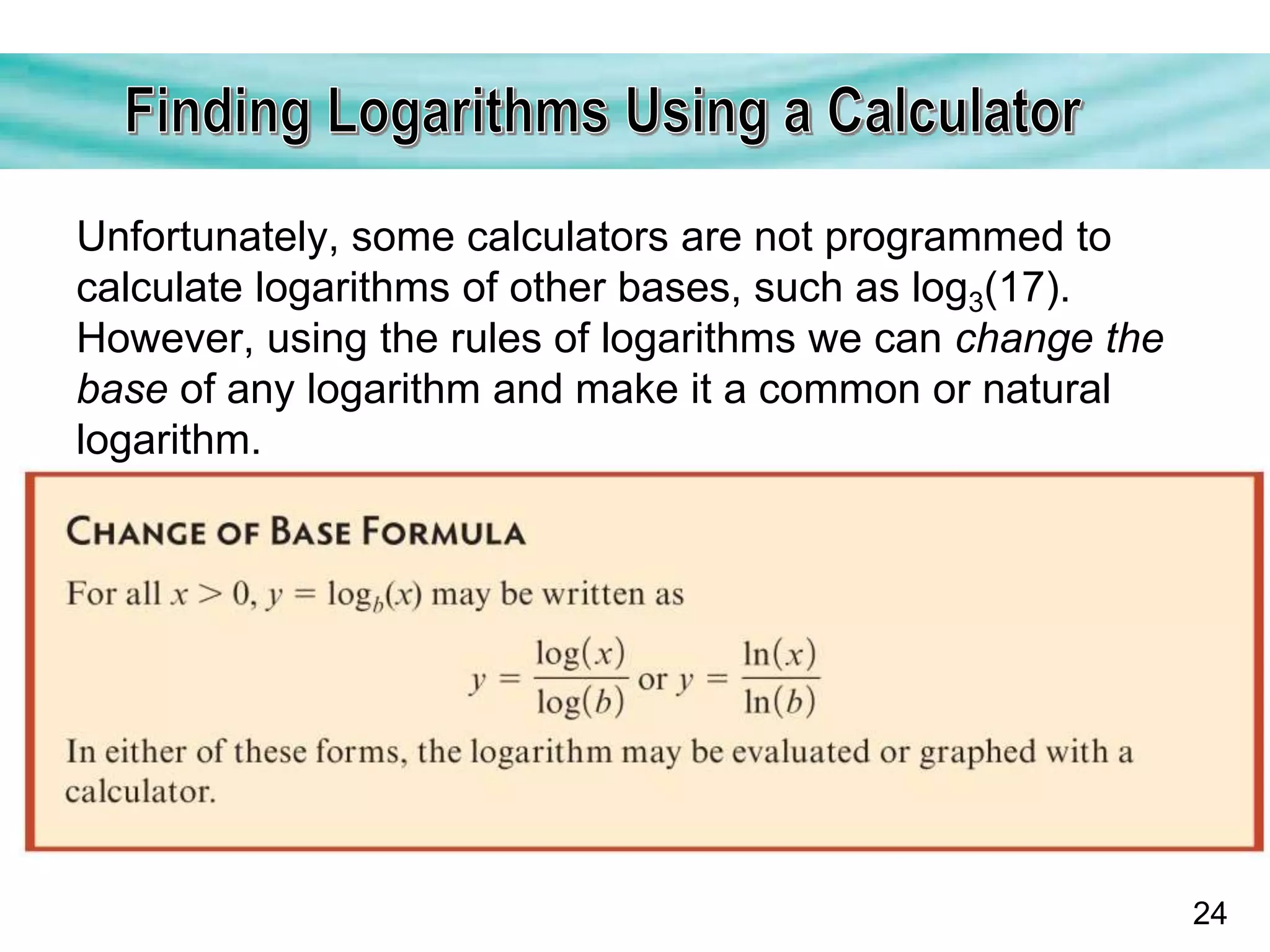
Unfortunately, some calculators are not programmed to
calculate logarithms of other bases, such as log3(17).
However, using the rules of logarithms we can change the
base of any logarithm and make it a common or natural
logarithm.
25
Using the rules of logarithms, solve the logarithmic
equation y = log3(17).
Solution:
We know from the definition of a logarithm y = log3(17)
means 3y = 17. We also know 2 < y < 3 since 32 = 9,
33 = 27, and 9 < 17 < 27. To determine the exact value for
y we apply the change of base formula.
26
This tells us that log3(17)  2.579, so 32.579  17. The same
formula can be used with natural logs, yielding the same
result.
cont’d
27
Solving Exponential and
Logarithmic Equations
28
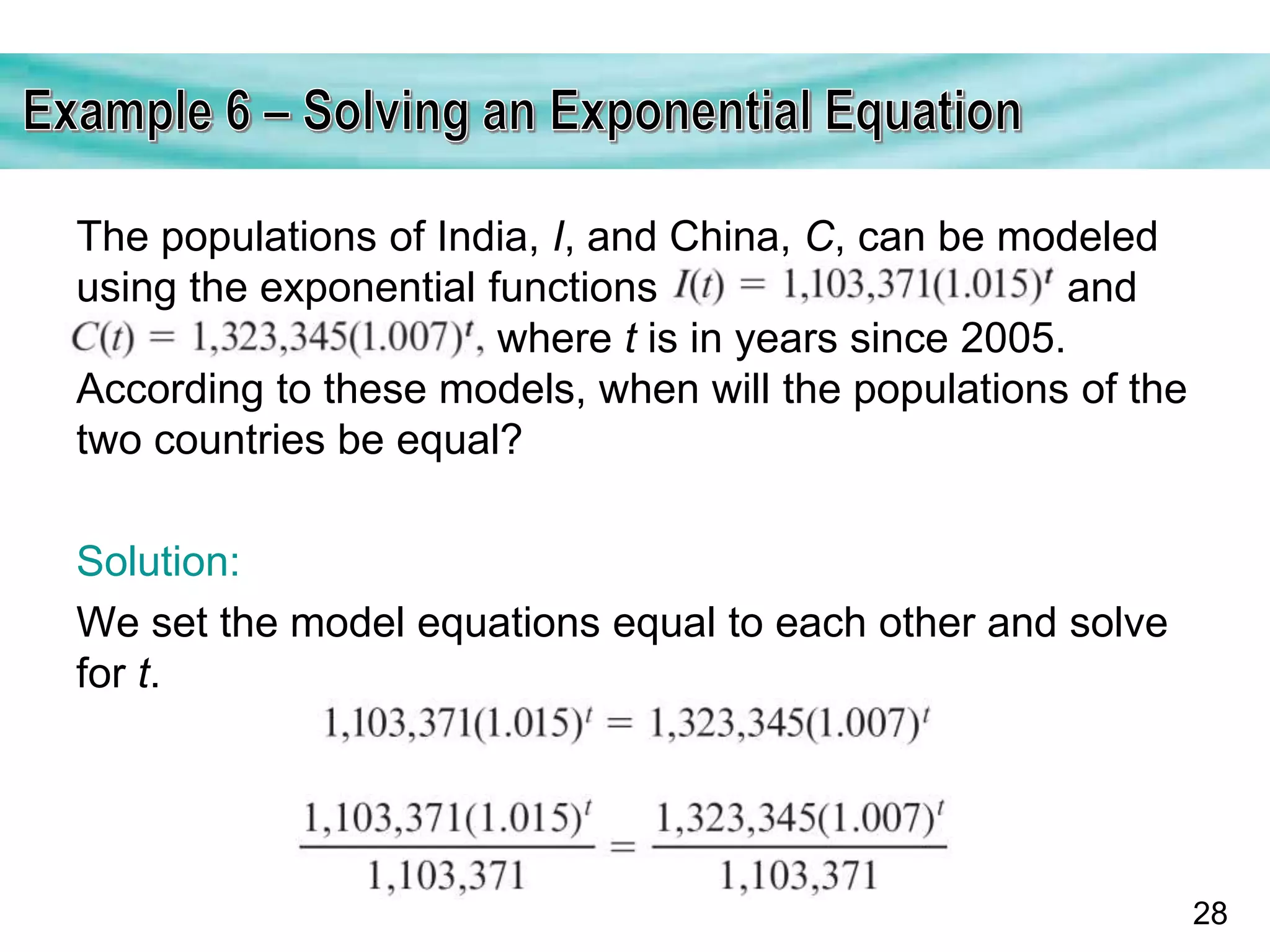
The populations of India, I, and China, C, can be modeled
using the exponential functions and
where t is in years since 2005.
According to these models, when will the populations of the
two countries be equal?
Solution:
We set the model equations equal to each other and solve
for t.
29
cont’d
30
Almost 23 years after 2005, or just before the end of 2028,
we expect China and India to have the same population.
cont’d
31
Solve the equation for x.
Solution:
32
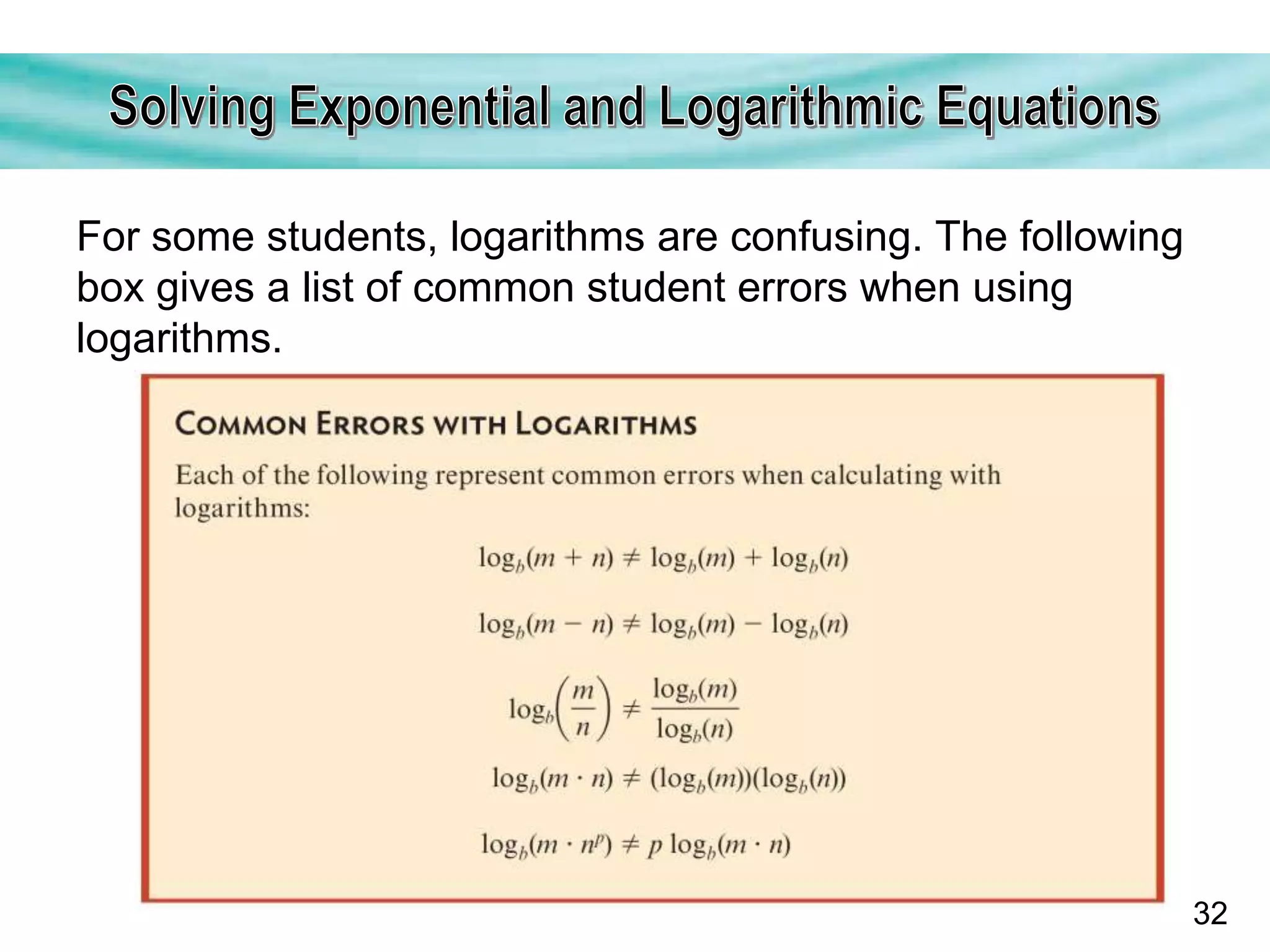
For some students, logarithms are confusing. The following
box gives a list of common student errors when using
logarithms.

LOGARITHMIC AND EXPONENTIAL FUNCTIONS.ppt

  • 1.
  • 2.
    2 Learning Objectives 1 Stateand use the rules of logarithms 2 Solve exponential equations using logarithms and interpret the real-world meaning of the results 3 Solve logarithmic equations using exponentiation and interpret the real-world meaning of the results
  • 3.
  • 4.
    4 The symbol logis short for logarithm, and the two are used interchangeably. The equation y = logb(x), which we read “y equals log base b of x,” means “y is the exponent we place on b to get x.” We can also think of it as answering the question “What exponent on b is necessary to get x ?” That is, y is the number that makes the equation by = x true.
  • 5.
  • 6.
  • 7.
    7 a. Find thevalue of y given that b. Estimate the value of y given that Solution: a. answers the question: “What exponent do we place on 3 to get 81?” That is, what value of y makes the equation 3y = 81 true? Since 34 = 81, y = 4. Symbolically, we write log3(81) = 4 and say the “log base 3 of 81 is 4.”
  • 8.
    8 b. answers thequestion: “What exponent do we place on 4 to get 50?” That is, what value of y makes the equation 4y = 50 true? The answer to this question is not a whole number. Since 42 = 16, 43 = 64, we know y is a number between 2 and 3. cont’d
  • 9.
  • 10.
    10 When equations involvinglogarithms become more complex, we use established rules of logarithms to manipulate or simplify the equations. There are two keys to understanding these rules; 1.) Logarithms are exponents. Thus, the rules of logarithms come from the properties of exponents. 2.) Any number may be written as an exponential of any base.
  • 11.
  • 12.
    12 The total annualhealth-related costs in the United States in billions of dollars may be modeled by the function where t is the number of years since 1960. According to the model, when will health-related costs in the United States reach 250 billion dollars? Solution:
  • 13.
    13 According to themodel, 21.66 years after 1960 (8 months into 1982), the health-related costs in the United States reached 250 billion dollars. cont’d
  • 14.
  • 15.
    15 Although any positivenumber other than 1 may be used as a base for a logarithm, there are two bases that are used so frequently that they have special names. A base-10 logarithm, log10(x), is called the common log. When writing the common log, it is customary to omit the “10” and simply write log(x). Thus, y = log(x) means “What exponent on 10 gives us x?” The answer is “y is the exponent on 10 that gives us x (x = 10y).”
  • 16.
    16 A base-e logarithm,loge(x), is called the natural log (so named because e  2.71828 is called the natural number). When writing the natural log we write ln(x) instead of loge(x). Thus, y = ln(x) asks “What exponent on e gives us x?” and the answer is “y is the exponent on e that gives us x (x = ey).”
  • 17.
  • 18.
    18 Evaluate each ofthe following expressions:
  • 19.
  • 20.
  • 21.
  • 22.
    22 When logarithms donot evaluate to integers, a calculator can help us find accurate decimal approximations. We use the and buttons on the calculator to find the common and natural logs of any number.
  • 23.
    23 Use a calculatorto find log(600) and ln(100). Then interpret and check your answers. Solution: Using a calculator, we get the results shown in Figure 6.12. This tells us that 102.778  600 and e4.605  100. Figure 6.12
  • 24.
    24 Unfortunately, some calculatorsare not programmed to calculate logarithms of other bases, such as log3(17). However, using the rules of logarithms we can change the base of any logarithm and make it a common or natural logarithm.
  • 25.
    25 Using the rulesof logarithms, solve the logarithmic equation y = log3(17). Solution: We know from the definition of a logarithm y = log3(17) means 3y = 17. We also know 2 < y < 3 since 32 = 9, 33 = 27, and 9 < 17 < 27. To determine the exact value for y we apply the change of base formula.
  • 26.
    26 This tells usthat log3(17)  2.579, so 32.579  17. The same formula can be used with natural logs, yielding the same result. cont’d
  • 27.
  • 28.
    28 The populations ofIndia, I, and China, C, can be modeled using the exponential functions and where t is in years since 2005. According to these models, when will the populations of the two countries be equal? Solution: We set the model equations equal to each other and solve for t.
  • 29.
  • 30.
    30 Almost 23 yearsafter 2005, or just before the end of 2028, we expect China and India to have the same population. cont’d
  • 31.
    31 Solve the equationfor x. Solution:
  • 32.
    32 For some students,logarithms are confusing. The following box gives a list of common student errors when using logarithms.