Exponential and Logarithmic
Equations
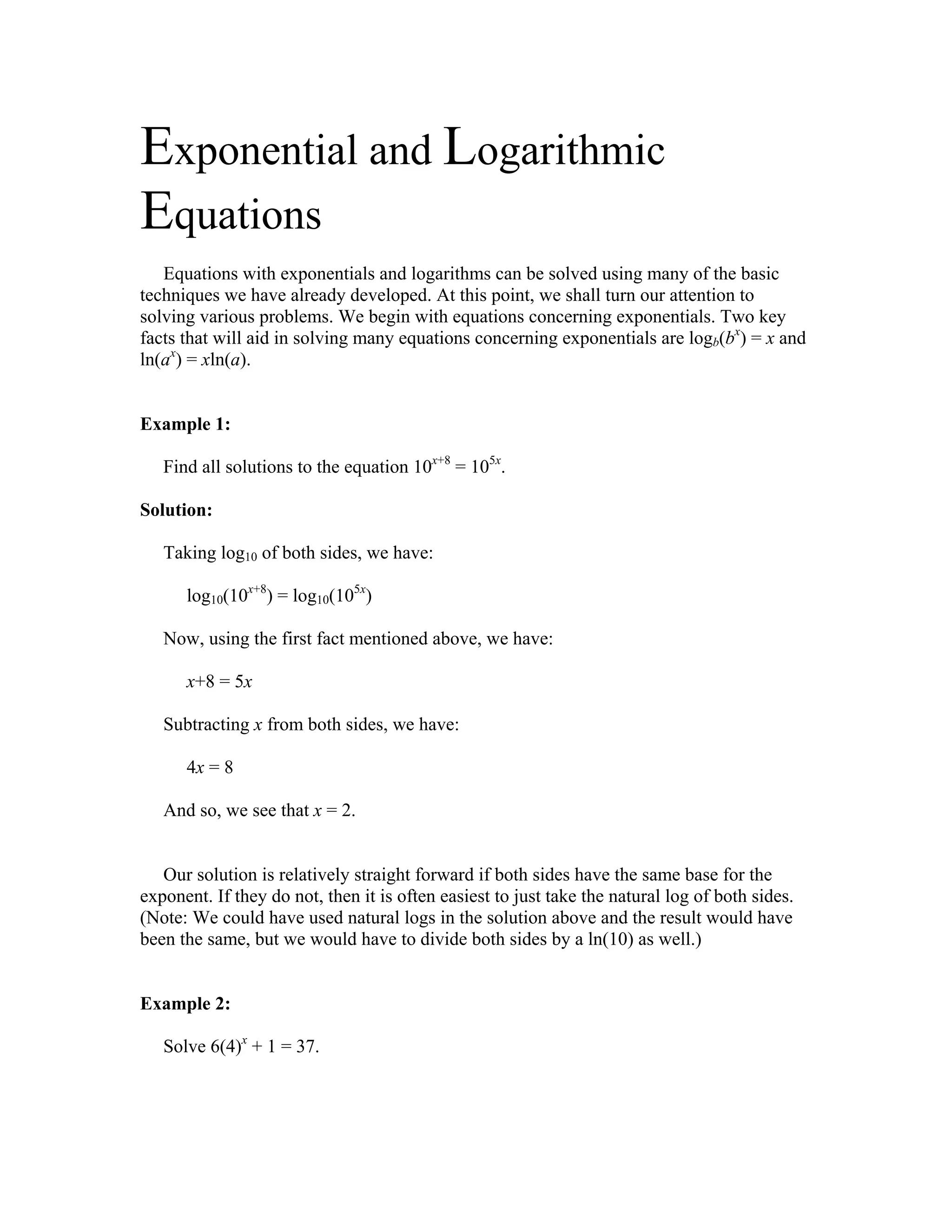
   Equations with exponentials and logarithms can be solved using many of the basic
techniques we have already developed. At this point, we shall turn our attention to
solving various problems. We begin with equations concerning exponentials. Two key
facts that will aid in solving many equations concerning exponentials are logb(bx) = x and
ln(ax) = xln(a).


Example 1:

   Find all solutions to the equation 10x+8 = 105x.

Solution:

   Taking log10 of both sides, we have:

      log10(10x+8) = log10(105x)

   Now, using the first fact mentioned above, we have:

      x+8 = 5x

   Subtracting x from both sides, we have:

      4x = 8

   And so, we see that x = 2.


   Our solution is relatively straight forward if both sides have the same base for the
exponent. If they do not, then it is often easiest to just take the natural log of both sides.
(Note: We could have used natural logs in the solution above and the result would have
been the same, but we would have to divide both sides by a ln(10) as well.)


Example 2:

   Solve 6(4)x + 1 = 37.
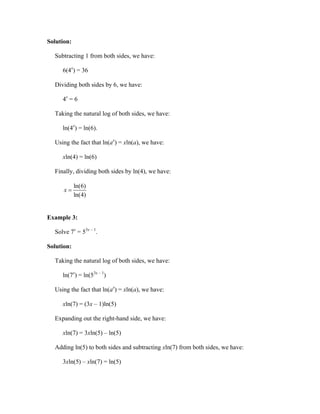
Solution:

  Subtracting 1 from both sides, we have:

     6(4x) = 36

  Dividing both sides by 6, we have:

     4x = 6

  Taking the natural log of both sides, we have:

     ln(4x) = ln(6).

  Using the fact that ln(ax) = xln(a), we have:

     xln(4) = ln(6)

  Finally, dividing both sides by ln(4), we have:

            ln(6)
      x
            ln(4)


Example 3:

  Solve 7x = 53x – 1.

Solution:

  Taking the natural log of both sides, we have:

     ln(7x) = ln(53x – 1)

  Using the fact that ln(ax) = xln(a), we have:

     xln(7) = (3x – 1)ln(5)

  Expanding out the right-hand side, we have:

     xln(7) = 3xln(5) – ln(5)

  Adding ln(5) to both sides and subtracting xln(7) from both sides, we have:

     3xln(5) – xln(7) = ln(5)
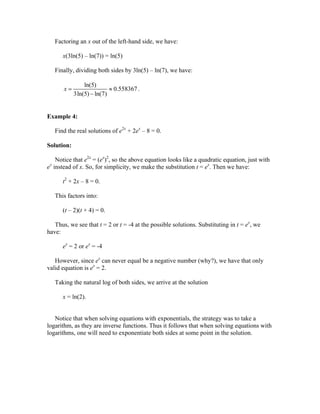
Factoring an x out of the left-hand side, we have:

      x(3ln(5) – ln(7)) = ln(5)

   Finally, dividing both sides by 3ln(5) – ln(7), we have:

                ln(5)
       x                  ļ‚» 0.558367 .
            3ln(5)  ln(7)


Example 4:

   Find the real solutions of e2x + 2ex – 8 = 0.

Solution:

    Notice that e2x = (ex)2, so the above equation looks like a quadratic equation, just with
ex instead of x. So, for simplicity, we make the substitution t = ex. Then we have:

      t2 + 2x – 8 = 0.

   This factors into:

      (t – 2)(t + 4) = 0.

   Thus, we see that t = 2 or t = -4 at the possible solutions. Substituting in t = ex, we
have:

      ex = 2 or ex = -4

   However, since ex can never equal be a negative number (why?), we have that only
valid equation is ex = 2.

   Taking the natural log of both sides, we arrive at the solution

      x = ln(2).


   Notice that when solving equations with exponentials, the strategy was to take a
logarithm, as they are inverse functions. Thus it follows that when solving equations with
logarithms, one will need to exponentiate both sides at some point in the solution.
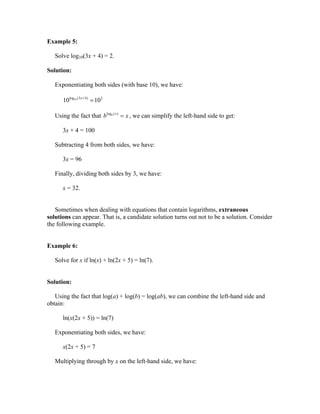
Example 5:

   Solve log10(3x + 4) = 2.

Solution:

   Exponentiating both sides (with base 10), we have:

      10log10 (3 x 4)  102

   Using the fact that blogb ( x )  x , we can simplify the left-hand side to get:

      3x + 4 = 100

   Subtracting 4 from both sides, we have:

      3x = 96

   Finally, dividing both sides by 3, we have:

      x = 32.


   Sometimes when dealing with equations that contain logarithms, extraneous
solutions can appear. That is, a candidate solution turns out not to be a solution. Consider
the following example.


Example 6:

   Solve for x if ln(x) + ln(2x + 5) = ln(7).


Solution:

   Using the fact that log(a) + log(b) = log(ab), we can combine the left-hand side and
obtain:

      ln(x(2x + 5)) = ln(7)

   Exponentiating both sides, we have:

      x(2x + 5) = 7

   Multiplying through by x on the left-hand side, we have:
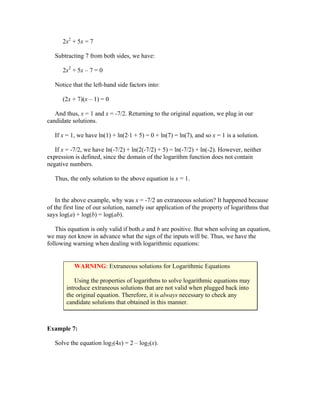
2x2 + 5x = 7

   Subtracting 7 from both sides, we have:

      2x2 + 5x – 7 = 0

   Notice that the left-hand side factors into:

      (2x + 7)(x – 1) = 0

   And thus, x = 1 and x = -7/2. Returning to the original equation, we plug in our
candidate solutions.

   If x = 1, we have ln(1) + ln(2Ćæ1 + 5) = 0 + ln(7) = ln(7), and so x = 1 is a solution.

   If x = -7/2, we have ln(-7/2) + ln(2(-7/2) + 5) = ln(-7/2) + ln(-2). However, neither
expression is defined, since the domain of the logarithm function does not contain
negative numbers.

   Thus, the only solution to the above equation is x = 1.


    In the above example, why was x = -7/2 an extraneous solution? It happened because
of the first line of our solution, namely our application of the property of logarithms that
says log(a) + log(b) = log(ab).

   This equation is only valid if both a and b are positive. But when solving an equation,
we may not know in advance what the sign of the inputs will be. Thus, we have the
following warning when dealing with logarithmic equations:


           WARNING: Extraneous solutions for Logarithmic Equations

            Using the properties of logarithms to solve logarithmic equations may
        introduce extraneous solutions that are not valid when plugged back into
        the original equation. Therefore, it is always necessary to check any
        candidate solutions that obtained in this manner.


Example 7:

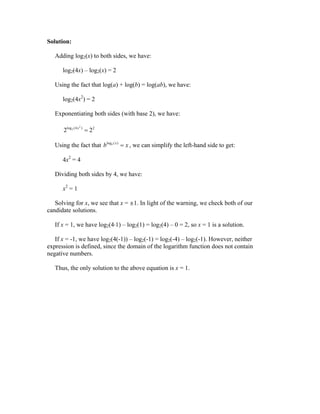
   Solve the equation log2(4x) = 2 – log2(x).
Solution:

   Adding log2(x) to both sides, we have:

      log2(4x) – log2(x) = 2

   Using the fact that log(a) + log(b) = log(ab), we have:

      log2(4x2) = 2

   Exponentiating both sides (with base 2), we have:

      2log 2 (4 x )  22
               2


   Using the fact that blogb ( x )  x , we can simplify the left-hand side to get:

      4x2 = 4

   Dividing both sides by 4, we have:

      x2 = 1

   Solving for x, we see that x = ≤1. In light of the warning, we check both of our
candidate solutions.

   If x = 1, we have log2(4Ćæ1) – log2(1) = log2(4) – 0 = 2, so x = 1 is a solution.

   If x = -1, we have log2(4(-1)) – log2(-1) = log2(-4) – log2(-1). However, neither
expression is defined, since the domain of the logarithm function does not contain
negative numbers.

   Thus, the only solution to the above equation is x = 1.

Exp log equations

  • 1.
    Exponential and Logarithmic Equations Equations with exponentials and logarithms can be solved using many of the basic techniques we have already developed. At this point, we shall turn our attention to solving various problems. We begin with equations concerning exponentials. Two key facts that will aid in solving many equations concerning exponentials are logb(bx) = x and ln(ax) = xln(a). Example 1: Find all solutions to the equation 10x+8 = 105x. Solution: Taking log10 of both sides, we have: log10(10x+8) = log10(105x) Now, using the first fact mentioned above, we have: x+8 = 5x Subtracting x from both sides, we have: 4x = 8 And so, we see that x = 2. Our solution is relatively straight forward if both sides have the same base for the exponent. If they do not, then it is often easiest to just take the natural log of both sides. (Note: We could have used natural logs in the solution above and the result would have been the same, but we would have to divide both sides by a ln(10) as well.) Example 2: Solve 6(4)x + 1 = 37.
  • 2.
    Solution: Subtracting1 from both sides, we have: 6(4x) = 36 Dividing both sides by 6, we have: 4x = 6 Taking the natural log of both sides, we have: ln(4x) = ln(6). Using the fact that ln(ax) = xln(a), we have: xln(4) = ln(6) Finally, dividing both sides by ln(4), we have: ln(6) x ln(4) Example 3: Solve 7x = 53x – 1. Solution: Taking the natural log of both sides, we have: ln(7x) = ln(53x – 1) Using the fact that ln(ax) = xln(a), we have: xln(7) = (3x – 1)ln(5) Expanding out the right-hand side, we have: xln(7) = 3xln(5) – ln(5) Adding ln(5) to both sides and subtracting xln(7) from both sides, we have: 3xln(5) – xln(7) = ln(5)
  • 3.
    Factoring an xout of the left-hand side, we have: x(3ln(5) – ln(7)) = ln(5) Finally, dividing both sides by 3ln(5) – ln(7), we have: ln(5) x ļ‚» 0.558367 . 3ln(5)  ln(7) Example 4: Find the real solutions of e2x + 2ex – 8 = 0. Solution: Notice that e2x = (ex)2, so the above equation looks like a quadratic equation, just with ex instead of x. So, for simplicity, we make the substitution t = ex. Then we have: t2 + 2x – 8 = 0. This factors into: (t – 2)(t + 4) = 0. Thus, we see that t = 2 or t = -4 at the possible solutions. Substituting in t = ex, we have: ex = 2 or ex = -4 However, since ex can never equal be a negative number (why?), we have that only valid equation is ex = 2. Taking the natural log of both sides, we arrive at the solution x = ln(2). Notice that when solving equations with exponentials, the strategy was to take a logarithm, as they are inverse functions. Thus it follows that when solving equations with logarithms, one will need to exponentiate both sides at some point in the solution.
  • 4.
    Example 5: Solve log10(3x + 4) = 2. Solution: Exponentiating both sides (with base 10), we have: 10log10 (3 x 4)  102 Using the fact that blogb ( x )  x , we can simplify the left-hand side to get: 3x + 4 = 100 Subtracting 4 from both sides, we have: 3x = 96 Finally, dividing both sides by 3, we have: x = 32. Sometimes when dealing with equations that contain logarithms, extraneous solutions can appear. That is, a candidate solution turns out not to be a solution. Consider the following example. Example 6: Solve for x if ln(x) + ln(2x + 5) = ln(7). Solution: Using the fact that log(a) + log(b) = log(ab), we can combine the left-hand side and obtain: ln(x(2x + 5)) = ln(7) Exponentiating both sides, we have: x(2x + 5) = 7 Multiplying through by x on the left-hand side, we have:
  • 5.
    2x2 + 5x= 7 Subtracting 7 from both sides, we have: 2x2 + 5x – 7 = 0 Notice that the left-hand side factors into: (2x + 7)(x – 1) = 0 And thus, x = 1 and x = -7/2. Returning to the original equation, we plug in our candidate solutions. If x = 1, we have ln(1) + ln(2Ćæ1 + 5) = 0 + ln(7) = ln(7), and so x = 1 is a solution. If x = -7/2, we have ln(-7/2) + ln(2(-7/2) + 5) = ln(-7/2) + ln(-2). However, neither expression is defined, since the domain of the logarithm function does not contain negative numbers. Thus, the only solution to the above equation is x = 1. In the above example, why was x = -7/2 an extraneous solution? It happened because of the first line of our solution, namely our application of the property of logarithms that says log(a) + log(b) = log(ab). This equation is only valid if both a and b are positive. But when solving an equation, we may not know in advance what the sign of the inputs will be. Thus, we have the following warning when dealing with logarithmic equations: WARNING: Extraneous solutions for Logarithmic Equations Using the properties of logarithms to solve logarithmic equations may introduce extraneous solutions that are not valid when plugged back into the original equation. Therefore, it is always necessary to check any candidate solutions that obtained in this manner. Example 7: Solve the equation log2(4x) = 2 – log2(x).
  • 6.
    Solution: Adding log2(x) to both sides, we have: log2(4x) – log2(x) = 2 Using the fact that log(a) + log(b) = log(ab), we have: log2(4x2) = 2 Exponentiating both sides (with base 2), we have: 2log 2 (4 x )  22 2 Using the fact that blogb ( x )  x , we can simplify the left-hand side to get: 4x2 = 4 Dividing both sides by 4, we have: x2 = 1 Solving for x, we see that x = ≤1. In light of the warning, we check both of our candidate solutions. If x = 1, we have log2(4Ćæ1) – log2(1) = log2(4) – 0 = 2, so x = 1 is a solution. If x = -1, we have log2(4(-1)) – log2(-1) = log2(-4) – log2(-1). However, neither expression is defined, since the domain of the logarithm function does not contain negative numbers. Thus, the only solution to the above equation is x = 1.