5S is the name of a workplace organization
method that uses a list of five Japanese
words.
 It was translated into English words that all
star ted with letter “S”.
 The list describes how to organize a work
space for efficiency and effectiveness by
identifying and storing the items used,
maintaining the area and items, and
sustaining the new order.

5S was developed in Japan. It was first heard of
as one of the techniques that enabled what was
then termed 'Just in Time Manufacturing'.
 5S was developed by Hiroyuki Hirano within
his overall approach to production systems.
 Hirano provided a structure for improvement
programs. He pointed out a series of
identifiable steps, each building on its
predecessor.

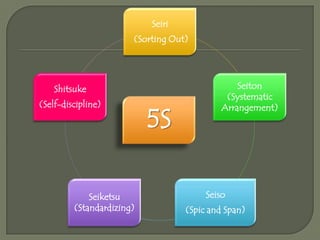
Seiri
(Sorting Out)

Shitsuke
(Self-discipline)

Seiketsu
(Standardizing)

5S

Seiton
(Systematic
Arrangement)

Seiso
(Spic and Span)
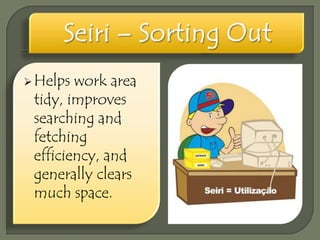
 Helps

work area
tidy, improves
searching and
fetching
efficiency, and
generally clears
much space.
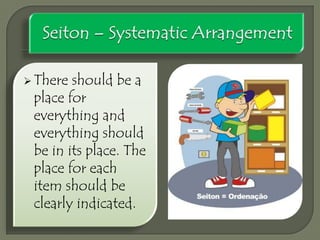
 There

should be a
place for
everything and
everything should
be in its place. The
place for each
item should be
clearly indicated.
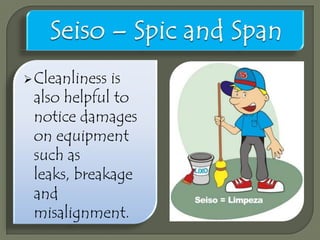
 Cleanliness

is
also helpful to
notice damages
on equipment
such as
leaks, breakage
and
misalignment.
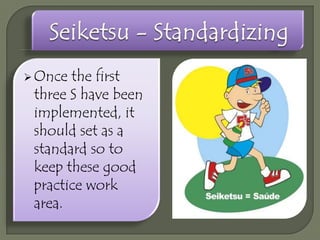
 Once

the first
three S have been
implemented, it
should set as a
standard so to
keep these good
practice work
area.


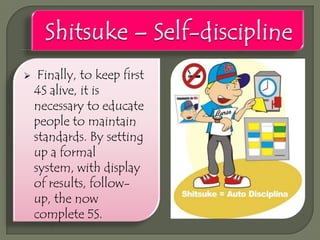
Finally, to keep first
4S alive, it is
necessary to educate
people to maintain
standards. By setting
up a formal
system, with display
of results, followup, the now
complete 5S.
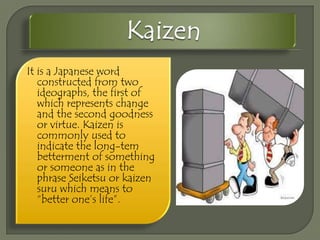
It is a Japanese word
constructed from two
ideographs, the first of
which represents change
and the second goodness
or virtue. Kaizen is
commonly used to
indicate the long-tem
betterment of something
or someone as in the
phrase Seiketsu or kaizen
suru which means to
“better one’s life”.
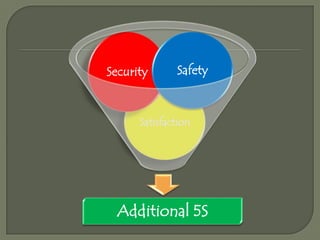
Security

Safety

Satisfaction

Additional 5S
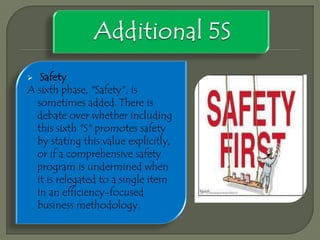
Safety
A sixth phase, "Safety", is
sometimes added. There is
debate over whether including
this sixth "S" promotes safety
by stating this value explicitly,
or if a comprehensive safety
program is undermined when
it is relegated to a single item
in an efficiency-focused
business methodology.

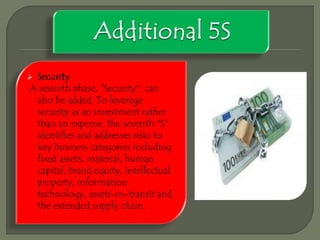
Security
A seventh phase, "Security", can
also be added. To leverage
security as an investment rather
than an expense, the seventh "S"
identifies and addresses risks to
key business categories including
fixed assets, material, human
capital, brand equity, intellectual
property, information
technology, assets-in-transit and
the extended supply chain.


Satisfaction
An eight
phase, "Satisfaction", can
be included. Employee
Satisfaction and
engagement in
continuous improvement
activities ensures the
improvements will be
sustained and improved
upon.

1.
2.
3.
4.
5.
6.
7.
8.
9.
10.
11.

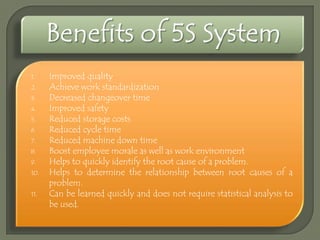
Improved quality
Achieve work standardization
Decreased changeover time
Improved safety
Reduced storage costs
Reduced cycle time
Reduced machine down time
Boost employee morale as well as work environment
Helps to quickly identify the root cause of a problem.
Helps to determine the relationship between root causes of a
problem.
Can be learned quickly and does not require statistical analysis to
be used.
1.
2.

3.
4.
5.
6.
7.

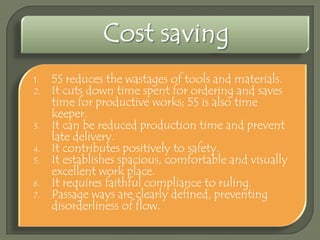
5S reduces the wastages of tools and materials.
It cuts down time spent for ordering and saves
time for productive works; 5S is also time
keeper.
It can be reduced production time and prevent
late delivery.
It contributes positively to safety.
It establishes spacious, comfortable and visually
excellent work place.
It requires faithful compliance to ruling.
Passage ways are clearly defined, preventing
disorderliness of flow.
1.
2.
3.
4.
5.

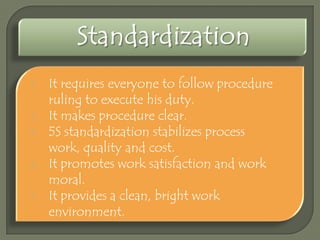
It requires everyone to follow procedure
ruling to execute his duty.
It makes procedure clear.
5S standardization stabilizes process
work, quality and cost.
It promotes work satisfaction and work
moral.
It provides a clean, bright work
environment.
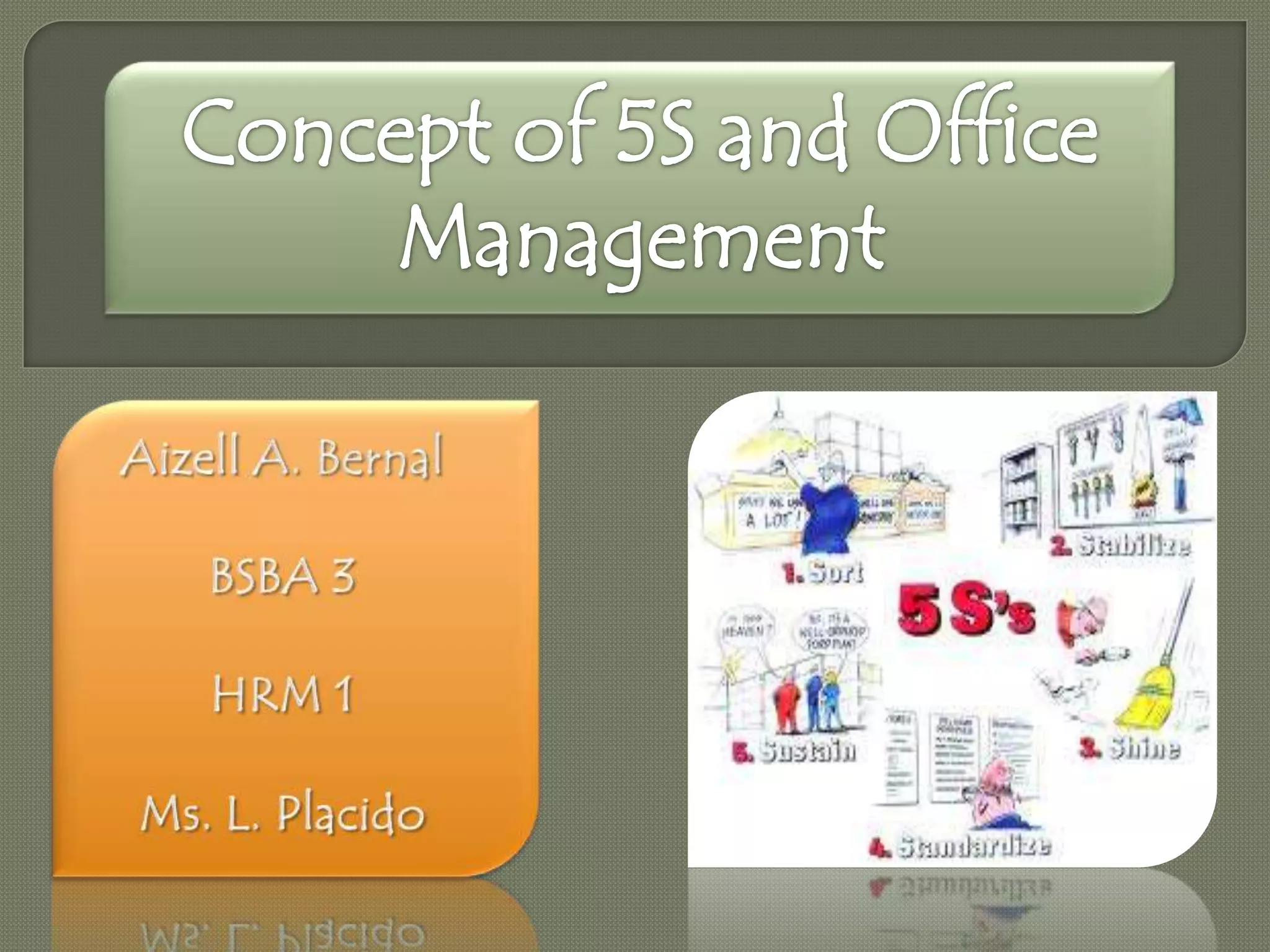
Concept of 5S and Office Management

Concept of 5S and Office Management

  • 2.
    5S is thename of a workplace organization method that uses a list of five Japanese words.  It was translated into English words that all star ted with letter “S”.  The list describes how to organize a work space for efficiency and effectiveness by identifying and storing the items used, maintaining the area and items, and sustaining the new order. 
  • 3.
    5S was developedin Japan. It was first heard of as one of the techniques that enabled what was then termed 'Just in Time Manufacturing'.  5S was developed by Hiroyuki Hirano within his overall approach to production systems.  Hirano provided a structure for improvement programs. He pointed out a series of identifiable steps, each building on its predecessor. 
  • 4.
  • 5.
     Helps work area tidy,improves searching and fetching efficiency, and generally clears much space.
  • 6.
     There should bea place for everything and everything should be in its place. The place for each item should be clearly indicated.
  • 7.
     Cleanliness is also helpfulto notice damages on equipment such as leaks, breakage and misalignment.
  • 8.
     Once the first threeS have been implemented, it should set as a standard so to keep these good practice work area.
  • 9.
     Finally, to keepfirst 4S alive, it is necessary to educate people to maintain standards. By setting up a formal system, with display of results, followup, the now complete 5S.
  • 10.
    It is aJapanese word constructed from two ideographs, the first of which represents change and the second goodness or virtue. Kaizen is commonly used to indicate the long-tem betterment of something or someone as in the phrase Seiketsu or kaizen suru which means to “better one’s life”.
  • 11.
  • 12.
    Safety A sixth phase,"Safety", is sometimes added. There is debate over whether including this sixth "S" promotes safety by stating this value explicitly, or if a comprehensive safety program is undermined when it is relegated to a single item in an efficiency-focused business methodology. 
  • 13.
    Security A seventh phase,"Security", can also be added. To leverage security as an investment rather than an expense, the seventh "S" identifies and addresses risks to key business categories including fixed assets, material, human capital, brand equity, intellectual property, information technology, assets-in-transit and the extended supply chain. 
  • 14.
    Satisfaction An eight phase, "Satisfaction",can be included. Employee Satisfaction and engagement in continuous improvement activities ensures the improvements will be sustained and improved upon. 
  • 15.
    1. 2. 3. 4. 5. 6. 7. 8. 9. 10. 11. Improved quality Achieve workstandardization Decreased changeover time Improved safety Reduced storage costs Reduced cycle time Reduced machine down time Boost employee morale as well as work environment Helps to quickly identify the root cause of a problem. Helps to determine the relationship between root causes of a problem. Can be learned quickly and does not require statistical analysis to be used.
  • 16.
    1. 2. 3. 4. 5. 6. 7. 5S reduces thewastages of tools and materials. It cuts down time spent for ordering and saves time for productive works; 5S is also time keeper. It can be reduced production time and prevent late delivery. It contributes positively to safety. It establishes spacious, comfortable and visually excellent work place. It requires faithful compliance to ruling. Passage ways are clearly defined, preventing disorderliness of flow.
  • 17.
    1. 2. 3. 4. 5. It requires everyoneto follow procedure ruling to execute his duty. It makes procedure clear. 5S standardization stabilizes process work, quality and cost. It promotes work satisfaction and work moral. It provides a clean, bright work environment.