5S Advanced Management Institute  Searchtec Consulting Group
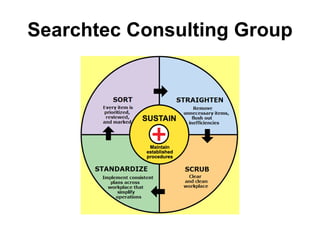
Searchtec Consulting Group
Japanese’s manufacturing plants like Toyota established a waste reduction theory we commonly call the 5S 5S is a reference to a list of five Japanese words which 'start' with S 5S is a philosophy and a way of organizing and managing the workspace. The key impacts of 5S is upon workplace morale and efficiency. By ensuring everything has a place and everything is in its place then time is not wasted looking for things and it can be made immediately obvious when something missing The real power of this methodology is in deciding what should be kept and where and how it should be stored Definition
5S Philosophy  focuses on effective work place organization and standardized work procedures. 5S simplifies your work environment, reduces waste  and non-value activity while improving quality efficiency and safety. 5S Philosophy If you’re going to do it, do it RIGHT!
Once fully implemented, the 5S process can increase moral, create positive impressions on customers, and increase efficiency and organization.  Not only will employees feel better about where they work, the effect on continuous improvement can lead to less waste, better quality and shorter lead times. Any of which will make organization more profitable and competitive in the market place 5S Philosophy
The Gold Standard for 5S is that anyone should be able to find anything in their own workplace in less than 30 seconds, and anywhere else in the workplace in less than 5 minutes without talking to anyone, opening a book, or turning on a computer.  5S is the foundation for successful lean implementation. 5S is the tool to begin, support, and sustain the lean journey.  5S Goal
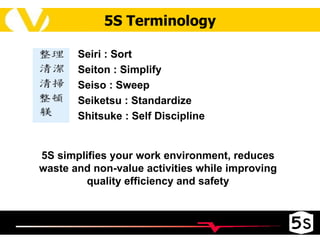
5S Terminology Seiri : Sort Seiton : Simplify Seiso : Sweep Seiketsu : Standardize Shitsuke : Self Discipline 5S simplifies your work environment, reduces waste and non-value activities while improving quality efficiency and safety
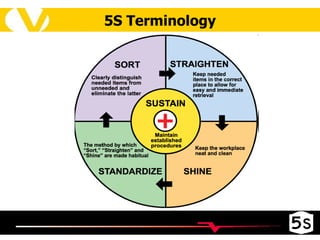
5S Terminology
Seiri Organizing the essential materials. It allows the operator to find materials when needed because the materials are in the proper location. It focuses on eliminating unnecessary items from the workplace. An effective visual method to identify these unneeded items is called red tagging. A red tag is placed on all items not required to complete your job. These items are then moved to a central holding area. This process is for evaluation of the  red tag  items . If you don’t use it, move it!
Seiri Organizing the essential materials. It allows the operator to find materials when needed because the materials are in the proper location. It focuses on eliminating unnecessary items from the workplace. An effective visual method to identify these unneeded items is called red tagging. A red tag is placed on all items not required to complete your job. These items are then moved to a central holding area. This process is for evaluation of the  red tag  items .
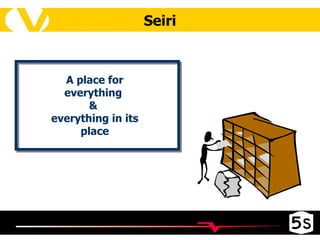
Seiri A place for everything  &  everything in its place
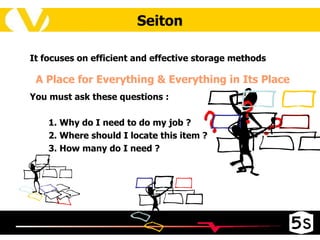
Seiton It focuses on efficient and effective storage methods You must ask these questions : 1. Why do I need to do my job ? 2. Where should I locate this item ? 3. How many do I need ? A Place for Everything & Everything in Its Place
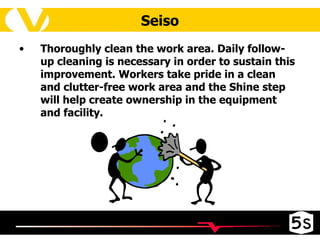
Seiso Thoroughly clean the work area. Daily follow-up cleaning is necessary in order to sustain this improvement. Workers take pride in a clean and clutter-free work area and the Shine step will help create ownership in the equipment and facility.
Seiketsu Once the first three of the 5S’s have been implemented, you should concentrate on standardizing best practice in your work area.
Seiketsu Documentation   Allow your employees to participate in the development  and documentation of such standards. They are a valuable but often overlooked source of information regarding their work.
Shitsuke This is by far the most difficult S to implement and achieve.  Human nature is to resist change and more than a few organizations have found themselves with a  dirty cluttered shop a few months following their attempt to implement 5S. The tendency is to return to the status quo and the comfort zone of the "old way" of doing things.  Sustain focuses on defining a new status quo and standard of work place organization.
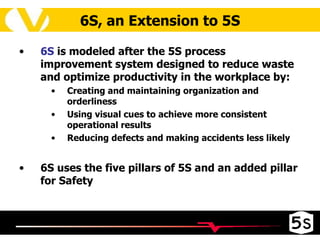
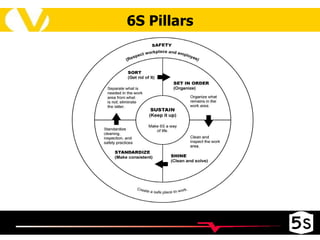
6S, an Extension to 5S 6S  is  modeled after the 5S process improvement system designed to reduce waste and optimize productivity in the workplace by : Creating and maintaining organization and orderliness Using visual cues to achieve more consistent operational results Reducing defects and making accidents less likely 6S uses the five pillars of 5S and an added pillar for Safety
6S Pillars
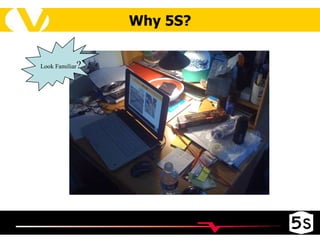
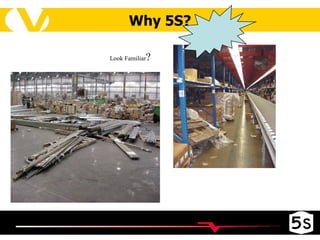
Why 5S? Look Familiar ?
Why 5S To eliminate the Waste  that result from “uncontrolled” processes To gain control on equipment, material & inventory placement and position Apply Control Techniques to Eliminate Erosion of Improvements Standardize Improvements for Maintenance of Critical Process Parameters
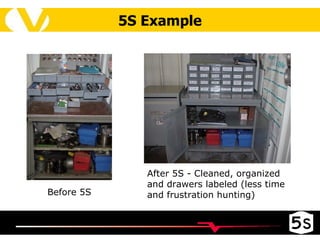
5S Example Before 5S After 5S - Cleaned, organized and drawers labeled (less time and frustration hunting)
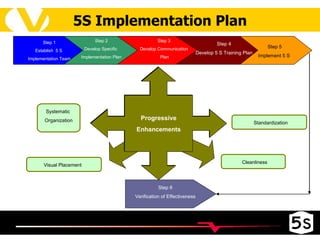
5S Implementation Plan Systematic  Organization Cleanliness Visual Placement Standardization Progressive Enhancements Step 1 Establish  5 S  Implementation Team Step 2 Develop Specific  Implementation Plan Step 3 Develop Communication Plan Step 4 Develop 5 S Training Plan Step 5 Implement 5 S  Step 6 Verification of Effectiveness
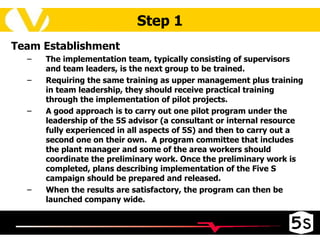
Step 1 Team Establishment The implementation team, typically consisting of supervisors and team leaders, is the next group to be trained.  Requiring the same training as upper management plus training in team leadership, they should receive practical training through the implementation of pilot projects.  A good approach is to carry out one pilot program under the leadership of the 5S advisor (a consultant or internal resource fully experienced in all aspects of 5S) and then to carry out a second one on their own.  A program committee that includes the plant manager and some of the area workers should coordinate the preliminary work. Once the preliminary work is completed, plans describing implementation of the Five S campaign should be prepared and released.  When the results are satisfactory, the program can then be launched company wide.
Step 2 Develop Implementation Plan 5S, like all other quality and prevention initiatives, requires commitment from top management and participation by everyone in the organization.  Requiring plans tailored to each facility, a 5S program cannot be implemented using a “one-size-fits-all" approach.  5S is best implemented very gradually over a period of time. Because implementing five S can be such an overwhelming task, some companies decide to institute it department-by-department
Step 3 Develop Communication Plan Conducting a research communication audit Defining objectives Defining audiences Defining goals Identifying tools Establishing a timetable Evaluating the results
Step 4 Develop 5S Training Plan The most common mistake companies make when implementing 5S is the failure to train adequately at the outset.  Upper management and other members of the steering group must have a working knowledge of 5S Starts with a thorough review of the 5S program, implementation methods, team concepts, and the role of management.
Step 4 Develop 5S Training Plan should follow practical exercises, or a real world pilot project Apply 5S to their own office or work area  will provide a practical understanding of 5S and the kinds of issues that will need to be addressed throughout the implementation also communicates the commitment of upper management to a company-wide 5S implementation At this point, management should endorse the formal Five S plan and set dates for implementation.
Step 5 Implement 5S Make trainings come true Let people implement 5S in their work area Control the progress and manage the changes Make people accompany you by considering appropriate rewards in the form of additional payments or gifts
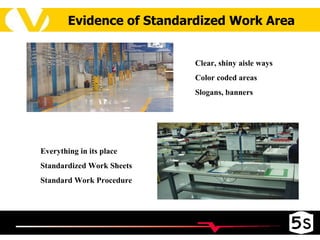
Evidence of Standardized Work Area Clear, shiny aisle ways Color coded areas Slogans, banners Everything in its place Standardized Work Sheets Standard Work Procedure
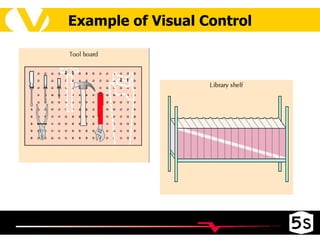
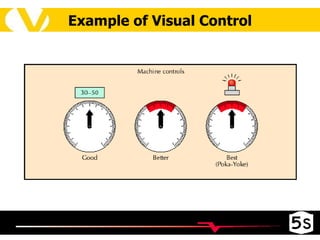
Example of Visual Control
Conclusion
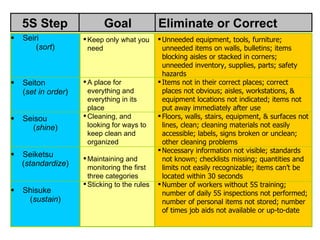
Unneeded equipment, tools, furniture; unneeded items on walls, bulletins; items blocking aisles or stacked in corners; unneeded inventory, supplies, parts; safety hazards Items not in their correct places; correct places not obvious; aisles, workstations, & equipment locations not indicated; items not put away immediately after use Floors, walls, stairs, equipment, & surfaces not lines, clean; cleaning materials not easily accessible; labels, signs broken or unclean; other cleaning problems Necessary information not visible; standards not known; checklists missing; quantities and limits not easily recognizable; items can’t be located within 30 seconds Number of workers without 5S training; number of daily 5S inspections not performed; number of personal items not stored; number of times job aids not available or up-to-date Keep only what you need  A place for everything and everything in its place  Cleaning, and looking for ways to keep clean and organized Maintaining and monitoring the first three categories Sticking to the rules Seiri ( sort ) Seiton ( set in order ) Seisou ( shine ) Seiketsu ( standardize ) Shisuke ( sustain ) 5S Step Goal Eliminate or Correct
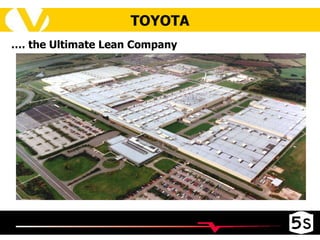
TOYOTA … . the Ultimate Lean Company
Questions – Call Us Searchtec

5s From Searchtec

  • 1.
    5S Advanced ManagementInstitute Searchtec Consulting Group
  • 2.
  • 3.
    Japanese’s manufacturing plantslike Toyota established a waste reduction theory we commonly call the 5S 5S is a reference to a list of five Japanese words which 'start' with S 5S is a philosophy and a way of organizing and managing the workspace. The key impacts of 5S is upon workplace morale and efficiency. By ensuring everything has a place and everything is in its place then time is not wasted looking for things and it can be made immediately obvious when something missing The real power of this methodology is in deciding what should be kept and where and how it should be stored Definition
  • 4.
    5S Philosophy focuses on effective work place organization and standardized work procedures. 5S simplifies your work environment, reduces waste and non-value activity while improving quality efficiency and safety. 5S Philosophy If you’re going to do it, do it RIGHT!
  • 5.
    Once fully implemented,the 5S process can increase moral, create positive impressions on customers, and increase efficiency and organization. Not only will employees feel better about where they work, the effect on continuous improvement can lead to less waste, better quality and shorter lead times. Any of which will make organization more profitable and competitive in the market place 5S Philosophy
  • 6.
    The Gold Standardfor 5S is that anyone should be able to find anything in their own workplace in less than 30 seconds, and anywhere else in the workplace in less than 5 minutes without talking to anyone, opening a book, or turning on a computer. 5S is the foundation for successful lean implementation. 5S is the tool to begin, support, and sustain the lean journey. 5S Goal
  • 7.
    5S Terminology Seiri: Sort Seiton : Simplify Seiso : Sweep Seiketsu : Standardize Shitsuke : Self Discipline 5S simplifies your work environment, reduces waste and non-value activities while improving quality efficiency and safety
  • 8.
  • 9.
    Seiri Organizing theessential materials. It allows the operator to find materials when needed because the materials are in the proper location. It focuses on eliminating unnecessary items from the workplace. An effective visual method to identify these unneeded items is called red tagging. A red tag is placed on all items not required to complete your job. These items are then moved to a central holding area. This process is for evaluation of the red tag items . If you don’t use it, move it!
  • 10.
    Seiri Organizing theessential materials. It allows the operator to find materials when needed because the materials are in the proper location. It focuses on eliminating unnecessary items from the workplace. An effective visual method to identify these unneeded items is called red tagging. A red tag is placed on all items not required to complete your job. These items are then moved to a central holding area. This process is for evaluation of the red tag items .
  • 11.
    Seiri A placefor everything & everything in its place
  • 12.
    Seiton It focuseson efficient and effective storage methods You must ask these questions : 1. Why do I need to do my job ? 2. Where should I locate this item ? 3. How many do I need ? A Place for Everything & Everything in Its Place
  • 13.
    Seiso Thoroughly cleanthe work area. Daily follow-up cleaning is necessary in order to sustain this improvement. Workers take pride in a clean and clutter-free work area and the Shine step will help create ownership in the equipment and facility.
  • 14.
    Seiketsu Once thefirst three of the 5S’s have been implemented, you should concentrate on standardizing best practice in your work area.
  • 15.
    Seiketsu Documentation Allow your employees to participate in the development and documentation of such standards. They are a valuable but often overlooked source of information regarding their work.
  • 16.
    Shitsuke This isby far the most difficult S to implement and achieve. Human nature is to resist change and more than a few organizations have found themselves with a dirty cluttered shop a few months following their attempt to implement 5S. The tendency is to return to the status quo and the comfort zone of the "old way" of doing things. Sustain focuses on defining a new status quo and standard of work place organization.
  • 17.
    6S, an Extensionto 5S 6S is modeled after the 5S process improvement system designed to reduce waste and optimize productivity in the workplace by : Creating and maintaining organization and orderliness Using visual cues to achieve more consistent operational results Reducing defects and making accidents less likely 6S uses the five pillars of 5S and an added pillar for Safety
  • 18.
  • 19.
    Why 5S? LookFamiliar ?
  • 20.
    Why 5S? LookFamiliar ?
  • 21.
    Why 5S Toeliminate the Waste that result from “uncontrolled” processes To gain control on equipment, material & inventory placement and position Apply Control Techniques to Eliminate Erosion of Improvements Standardize Improvements for Maintenance of Critical Process Parameters
  • 22.
    5S Example Before5S After 5S - Cleaned, organized and drawers labeled (less time and frustration hunting)
  • 23.
    5S Implementation PlanSystematic Organization Cleanliness Visual Placement Standardization Progressive Enhancements Step 1 Establish 5 S Implementation Team Step 2 Develop Specific Implementation Plan Step 3 Develop Communication Plan Step 4 Develop 5 S Training Plan Step 5 Implement 5 S Step 6 Verification of Effectiveness
  • 24.
    Step 1 TeamEstablishment The implementation team, typically consisting of supervisors and team leaders, is the next group to be trained. Requiring the same training as upper management plus training in team leadership, they should receive practical training through the implementation of pilot projects. A good approach is to carry out one pilot program under the leadership of the 5S advisor (a consultant or internal resource fully experienced in all aspects of 5S) and then to carry out a second one on their own. A program committee that includes the plant manager and some of the area workers should coordinate the preliminary work. Once the preliminary work is completed, plans describing implementation of the Five S campaign should be prepared and released. When the results are satisfactory, the program can then be launched company wide.
  • 25.
    Step 2 DevelopImplementation Plan 5S, like all other quality and prevention initiatives, requires commitment from top management and participation by everyone in the organization. Requiring plans tailored to each facility, a 5S program cannot be implemented using a “one-size-fits-all" approach. 5S is best implemented very gradually over a period of time. Because implementing five S can be such an overwhelming task, some companies decide to institute it department-by-department
  • 26.
    Step 3 DevelopCommunication Plan Conducting a research communication audit Defining objectives Defining audiences Defining goals Identifying tools Establishing a timetable Evaluating the results
  • 27.
    Step 4 Develop5S Training Plan The most common mistake companies make when implementing 5S is the failure to train adequately at the outset. Upper management and other members of the steering group must have a working knowledge of 5S Starts with a thorough review of the 5S program, implementation methods, team concepts, and the role of management.
  • 28.
    Step 4 Develop5S Training Plan should follow practical exercises, or a real world pilot project Apply 5S to their own office or work area will provide a practical understanding of 5S and the kinds of issues that will need to be addressed throughout the implementation also communicates the commitment of upper management to a company-wide 5S implementation At this point, management should endorse the formal Five S plan and set dates for implementation.
  • 29.
    Step 5 Implement5S Make trainings come true Let people implement 5S in their work area Control the progress and manage the changes Make people accompany you by considering appropriate rewards in the form of additional payments or gifts
  • 30.
    Evidence of StandardizedWork Area Clear, shiny aisle ways Color coded areas Slogans, banners Everything in its place Standardized Work Sheets Standard Work Procedure
  • 31.
  • 32.
  • 33.
  • 34.
    Unneeded equipment, tools,furniture; unneeded items on walls, bulletins; items blocking aisles or stacked in corners; unneeded inventory, supplies, parts; safety hazards Items not in their correct places; correct places not obvious; aisles, workstations, & equipment locations not indicated; items not put away immediately after use Floors, walls, stairs, equipment, & surfaces not lines, clean; cleaning materials not easily accessible; labels, signs broken or unclean; other cleaning problems Necessary information not visible; standards not known; checklists missing; quantities and limits not easily recognizable; items can’t be located within 30 seconds Number of workers without 5S training; number of daily 5S inspections not performed; number of personal items not stored; number of times job aids not available or up-to-date Keep only what you need A place for everything and everything in its place Cleaning, and looking for ways to keep clean and organized Maintaining and monitoring the first three categories Sticking to the rules Seiri ( sort ) Seiton ( set in order ) Seisou ( shine ) Seiketsu ( standardize ) Shisuke ( sustain ) 5S Step Goal Eliminate or Correct
  • 35.
    TOYOTA … .the Ultimate Lean Company
  • 36.
    Questions – CallUs Searchtec