To Introduce …..
              To Introduce …..

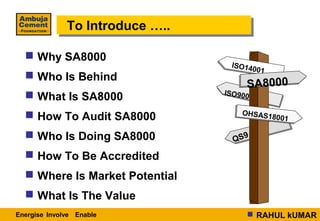
   Why SA8000
                                  ISO14
                                       001
   Who Is Behind
                                      SA8000
                                 ISO900
   What Is SA8000
                                     OHSAS1
   How To Audit SA8000                    8001

   Who Is Doing SA8000            QS9
   How To Be Accredited
   Where Is Market Potential
   What Is The Value
Energise Involve Enable                RAHUL kUMAR
Why SA8000
             Why SA8000

   Governments, shareholders, customers, and
     other interested parties expect to purchase
     from socially responsible organizations.


           Do The Right Things Right


Energise Involve Enable
Business Response
             Business Response
   Try to give confidence that goods or services
     have been produced and delivered within a
     socially acceptable set of values
   Try to demonstrate their commitment in social
     responsibility , legally compliant workplace and
     purchasing practices
   Try to handle the unique requirements and
     routine monitoring audits from each buyer
Energise Involve Enable
CEPAA ,, 1997
             CEPAA 1997

   Trade Unions
   NGOs
   Business


Energise Involve Enable
What Is SA8000
              What Is SA8000

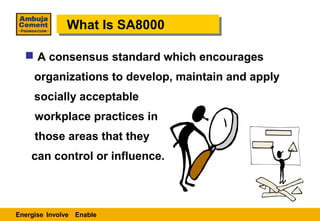
   A consensus standard which encourages
     organizations to develop, maintain and apply
     socially acceptable
     workplace practices in
     those areas that they
    can control or influence.


Energise Involve Enable
What Is SA8000
              What Is SA8000
   Based on:
        Universal declaration of Human Rights
        UN Convention on the Rights of the Child
        11 Conventions of the
           International Labour Organization ( ILO )

   Auditable standard, modelled after the
     established ISO 9001 and ISO 14001

Energise Involve Enable
Mission of SA8000
             Mission of SA8000

   Ensures ethical sourcing of goods and services
   Improve working conditions globally
   Provide universal standard in all business and
     country sectors
   Work in parallel with human rights and labor
     organizations worldwide
   Provide a beneficial incentive though a
     “ win / win ” approach

Energise Involve Enable
What Is SA8000
             What Is SA8000
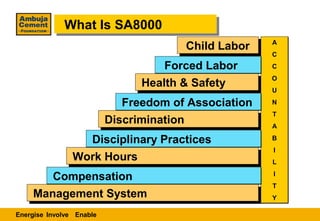
                                                      A
                                        Child Labor
                                        Child Labor   C
                                    Forced Labor      C
                                                      O
                                Health & Safety
                                Health & Safety       U

                             Freedom of Association   N
                                                      T
                          Discrimination
                          Discrimination              A

                  Disciplinary Practices              B
                                                      I
                Work Hours
                Work Hours                            L

       Compensation                                   I
                                                      T
    Management System
    Management System                                 Y

Energise Involve Enable
Child Labor
             Child Labor
     Minimum work age of 15 unless local min.

       age law stipulates a higher age
     Minimum work age of 14 if the law follows

       ILO Convention 138
     Children or young workers put in safe and

        health workplace
     Provision of the Policies and Procedure for

       remediation of Children
Energise Involve Enable
Forced Labor
             Forced Labor

     No forced or indentured labor
     No deposits or lodge of identity
      documents


Energise Involve Enable
Health and Safety
             Health and Safety
    Ensure a safe and healthy working environment
    A senior management staff appointed for health
      & safety Issues
    Adequate safety training provided for staff
    A system to detect, avoid or respond to safety threats
    Clean bathrooms & potable water & food
      storage facility
    Dormitories meet basic needs of workers


Energise Involve Enable
Freedom of Association
            Freedom of Association

   Respect trade unions & right of workers to
     bargain collectively
   If legally restricted , there shall be parallel
     means of free association
   No discrimination against
     union reps and members


Energise Involve Enable
Discrimination
             Discrimination

   Not engage in or support discrimination
   No interference with individual rights to
     observe tenets or practices
   No form of worker
     harassment allowed


Energise Involve Enable
Disciplinary Practices
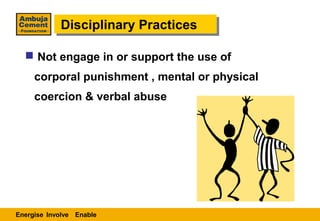
            Disciplinary Practices

   Not engage in or support the use of
     corporal punishment , mental or physical
     coercion & verbal abuse


Energise Involve Enable
Working Hours
               Working Hours
   Not exceed 48 hrs per week for normal
     working hrs
   At least one day off in every seven days
   Overtime not more than 12 hrs per week
   Overtime paid at a premium rate


Energise Involve Enable
Compensation
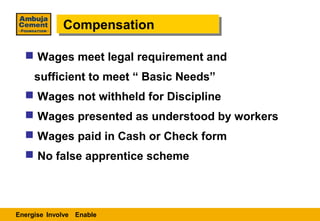
             Compensation

   Wages meet legal requirement and
     sufficient to meet “ Basic Needs”
   Wages not withheld for Discipline
   Wages presented as understood by workers
   Wages paid in Cash or Check form
   No false apprentice scheme


Energise Involve Enable
Management System
              Management System
   Policy
   Management Review
   Company Representatives
   Planning and Implementation
   Control of Suppliers


Energise Involve Enable
Management System
              Management System

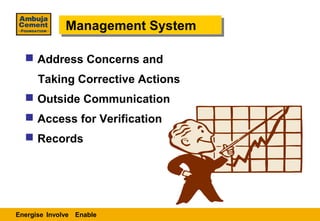
   Address Concerns and
      Taking Corrective Actions
   Outside Communication
   Access for Verification
   Records


Energise Involve Enable
How To Audit SA8000
                             How To Audit SA8000
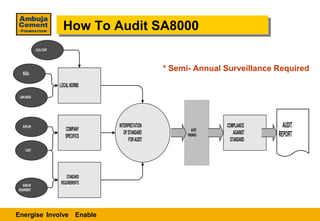
              LOCAL STAFF


                                                             * Semi- Annual Surveillance Required
   NGOs

                            LOCAL NORMS
 LAWS &REGS


   SUPPLIER
                               COMPANY
                                           INTERPRETATION                     COMPLIANCE      AUDIT
                                                                      AUDIT
                                              OF STANDARD                         AGAINST   REPORT
                               SPECIFICS                           FINDINGS
                                                 FOR AUDIT                      STANDARD
     CLIENT


                                STANDARD
   BASELINE
                            REQUIREMENTS
REQUIREMENT


Energise Involve Enable
Critical Data Gathering
             Critical Data Gathering
   Applicable laws          Local NGOs
   Political situation      Industry profile
   Union situation          Chronic industry
   Food costs                problems
     (market basket)
   Average family size
      for country


Energise Involve Enable
Worker Interview
            Worker Interview
   Anonymity critical for accurate response
   Focus group and individual interviews
   Setting the stage with worker
   Off-site interviews for anonymity
   Indirect questioning techniques
   Notes should be taken for reference
   Female auditors crucial element
   Audit team selects workers
Energise Involve Enable
Who Is Doing SA8000
              Who Is Doing SA8000


               BVQI

               DNV

               ITS

               SGS

               UL


Energise Involve Enable
How To Be Accredited
             How To Be Accredited

   ISO / IEC GUIDE 62
   CEPAA GUIDELINE 1


Energise Involve Enable
CEPAA GUIDELINE 1
             CEPAA GUIDELINE 1
     An appropriate summary of confirmation
       and application for following items :
           Information of working conditions
             from local interested parties, NGOs,
             and workers
           To determine the sufficient wage level
           To ascertain the languages spoken
             on site before accepting a client

Energise Involve Enable
CEPAA GUIDELINE 1
               CEPAA GUIDELINE 1

 Successful completion of an approved
    accredited SA 8000 Lead Assessor course
 The use of certified SA 8000 auditors /
    Selection of a qualified team of auditors
 To obtain factual information sensitive to local
    cultural norms, and protect the confidentiality
    of workers who are interviewed


Energise Involve Enable
CEPAA GUIDELINE 1
             CEPAA GUIDELINE 1

 A documented procedure for ensuring auditor
   possession of appropriate local language and
   interview skills
 Where a subcontractor, auditor or translator, is
   engaged, the certification body shall have
   procedures to confirm that person's impartiality,
   including that such subcontractor is not an
   employee or recent ex-employee of the auditee
Energise Involve Enable
Accreditation Process
             Accreditation Process

   Capacility Evaluation by CEPAA
        An audit of policies , procedures and
       documentation
        A witness audit
        Periodical reevaluations / Surveillance audits

   NGOs encouraged


Energise Involve Enable
Value of SA8000
              Value of SA8000

   Cost Reduction in monitoring
   Better Corporate Image when products are
     from a safer and fairer working environment.
   Trust-building to investors and bank-analysts
     when evaluating social performance
   Sustainable Development from Continuous
     Improvement


Energise Involve Enable
Value of SA8000
            Value of SA8000

   Marketing advantage of a selling point
   Improvement of the relationship with
     the public, governments and NGO’s
   Better position in the labour market
   Enhancing organisation’s productivity through
     Risk Management


Energise Involve Enable

SA 8000

  • 1.
    To Introduce ….. To Introduce …..  Why SA8000 ISO14 001  Who Is Behind SA8000 ISO900  What Is SA8000 OHSAS1  How To Audit SA8000 8001  Who Is Doing SA8000 QS9  How To Be Accredited  Where Is Market Potential  What Is The Value Energise Involve Enable  RAHUL kUMAR
  • 2.
    Why SA8000 Why SA8000  Governments, shareholders, customers, and other interested parties expect to purchase from socially responsible organizations.  Do The Right Things Right Energise Involve Enable
  • 3.
    Business Response Business Response  Try to give confidence that goods or services have been produced and delivered within a socially acceptable set of values  Try to demonstrate their commitment in social responsibility , legally compliant workplace and purchasing practices  Try to handle the unique requirements and routine monitoring audits from each buyer Energise Involve Enable
  • 4.
    CEPAA ,, 1997 CEPAA 1997  Trade Unions  NGOs  Business Energise Involve Enable
  • 5.
    What Is SA8000 What Is SA8000  A consensus standard which encourages organizations to develop, maintain and apply socially acceptable workplace practices in those areas that they can control or influence. Energise Involve Enable
  • 6.
    What Is SA8000 What Is SA8000  Based on:  Universal declaration of Human Rights  UN Convention on the Rights of the Child  11 Conventions of the International Labour Organization ( ILO )  Auditable standard, modelled after the established ISO 9001 and ISO 14001 Energise Involve Enable
  • 7.
    Mission of SA8000 Mission of SA8000  Ensures ethical sourcing of goods and services  Improve working conditions globally  Provide universal standard in all business and country sectors  Work in parallel with human rights and labor organizations worldwide  Provide a beneficial incentive though a “ win / win ” approach Energise Involve Enable
  • 8.
    What Is SA8000 What Is SA8000 A Child Labor Child Labor C Forced Labor C O Health & Safety Health & Safety U Freedom of Association N T Discrimination Discrimination A Disciplinary Practices B I Work Hours Work Hours L Compensation I T Management System Management System Y Energise Involve Enable
  • 9.
    Child Labor Child Labor  Minimum work age of 15 unless local min. age law stipulates a higher age  Minimum work age of 14 if the law follows ILO Convention 138  Children or young workers put in safe and health workplace  Provision of the Policies and Procedure for remediation of Children Energise Involve Enable
  • 10.
    Forced Labor Forced Labor  No forced or indentured labor  No deposits or lodge of identity documents Energise Involve Enable
  • 11.
    Health and Safety Health and Safety  Ensure a safe and healthy working environment  A senior management staff appointed for health & safety Issues  Adequate safety training provided for staff  A system to detect, avoid or respond to safety threats  Clean bathrooms & potable water & food storage facility  Dormitories meet basic needs of workers Energise Involve Enable
  • 12.
    Freedom of Association Freedom of Association  Respect trade unions & right of workers to bargain collectively  If legally restricted , there shall be parallel means of free association  No discrimination against union reps and members Energise Involve Enable
  • 13.
    Discrimination Discrimination  Not engage in or support discrimination  No interference with individual rights to observe tenets or practices  No form of worker harassment allowed Energise Involve Enable
  • 14.
    Disciplinary Practices Disciplinary Practices  Not engage in or support the use of corporal punishment , mental or physical coercion & verbal abuse Energise Involve Enable
  • 15.
    Working Hours Working Hours  Not exceed 48 hrs per week for normal working hrs  At least one day off in every seven days  Overtime not more than 12 hrs per week  Overtime paid at a premium rate Energise Involve Enable
  • 16.
    Compensation Compensation  Wages meet legal requirement and sufficient to meet “ Basic Needs”  Wages not withheld for Discipline  Wages presented as understood by workers  Wages paid in Cash or Check form  No false apprentice scheme Energise Involve Enable
  • 17.
    Management System Management System  Policy  Management Review  Company Representatives  Planning and Implementation  Control of Suppliers Energise Involve Enable
  • 18.
    Management System Management System  Address Concerns and Taking Corrective Actions  Outside Communication  Access for Verification  Records Energise Involve Enable
  • 19.
    How To AuditSA8000 How To Audit SA8000 LOCAL STAFF * Semi- Annual Surveillance Required NGOs LOCAL NORMS LAWS &REGS SUPPLIER COMPANY INTERPRETATION COMPLIANCE AUDIT AUDIT OF STANDARD AGAINST REPORT SPECIFICS FINDINGS FOR AUDIT STANDARD CLIENT STANDARD BASELINE REQUIREMENTS REQUIREMENT Energise Involve Enable
  • 20.
    Critical Data Gathering Critical Data Gathering  Applicable laws  Local NGOs  Political situation  Industry profile  Union situation  Chronic industry  Food costs problems (market basket)  Average family size for country Energise Involve Enable
  • 21.
    Worker Interview Worker Interview  Anonymity critical for accurate response  Focus group and individual interviews  Setting the stage with worker  Off-site interviews for anonymity  Indirect questioning techniques  Notes should be taken for reference  Female auditors crucial element  Audit team selects workers Energise Involve Enable
  • 22.
    Who Is DoingSA8000 Who Is Doing SA8000  BVQI  DNV  ITS  SGS  UL Energise Involve Enable
  • 23.
    How To BeAccredited How To Be Accredited  ISO / IEC GUIDE 62  CEPAA GUIDELINE 1 Energise Involve Enable
  • 24.
    CEPAA GUIDELINE 1 CEPAA GUIDELINE 1  An appropriate summary of confirmation and application for following items :  Information of working conditions from local interested parties, NGOs, and workers  To determine the sufficient wage level  To ascertain the languages spoken on site before accepting a client Energise Involve Enable
  • 25.
    CEPAA GUIDELINE 1 CEPAA GUIDELINE 1  Successful completion of an approved accredited SA 8000 Lead Assessor course  The use of certified SA 8000 auditors / Selection of a qualified team of auditors  To obtain factual information sensitive to local cultural norms, and protect the confidentiality of workers who are interviewed Energise Involve Enable
  • 26.
    CEPAA GUIDELINE 1 CEPAA GUIDELINE 1  A documented procedure for ensuring auditor possession of appropriate local language and interview skills  Where a subcontractor, auditor or translator, is engaged, the certification body shall have procedures to confirm that person's impartiality, including that such subcontractor is not an employee or recent ex-employee of the auditee Energise Involve Enable
  • 27.
    Accreditation Process Accreditation Process  Capacility Evaluation by CEPAA  An audit of policies , procedures and documentation  A witness audit  Periodical reevaluations / Surveillance audits  NGOs encouraged Energise Involve Enable
  • 28.
    Value of SA8000 Value of SA8000  Cost Reduction in monitoring  Better Corporate Image when products are from a safer and fairer working environment.  Trust-building to investors and bank-analysts when evaluating social performance  Sustainable Development from Continuous Improvement Energise Involve Enable
  • 29.
    Value of SA8000 Value of SA8000  Marketing advantage of a selling point  Improvement of the relationship with the public, governments and NGO’s  Better position in the labour market  Enhancing organisation’s productivity through Risk Management Energise Involve Enable