
Supply Chain
M
anagement
Aizell A. B
ernal
102

M
GNT
Supply Chains
Generic Supply Chain
Supply Chain
T F
he lows of the
Supply Chain
M
aterial
flows

Information
flows
F
inancial
flows
Supply Chain
Supply Chain M
anagement (SCM - is the
)
M of a network of
anagement
management

interconnected businesses  involved in the
provision of product and service packages
required by the end customers in a supply
chain. Supply chain management spans all
movement and storage of raw materials, workin-process inventory, and finished goods from
point of origin to point of consumption.
Interorganizational Information System
(IOS) - is one which allows the flow of
P
ush M
odel
M
ass
production

F
orecast

H
appy

Salesper
son
P M
ull odel

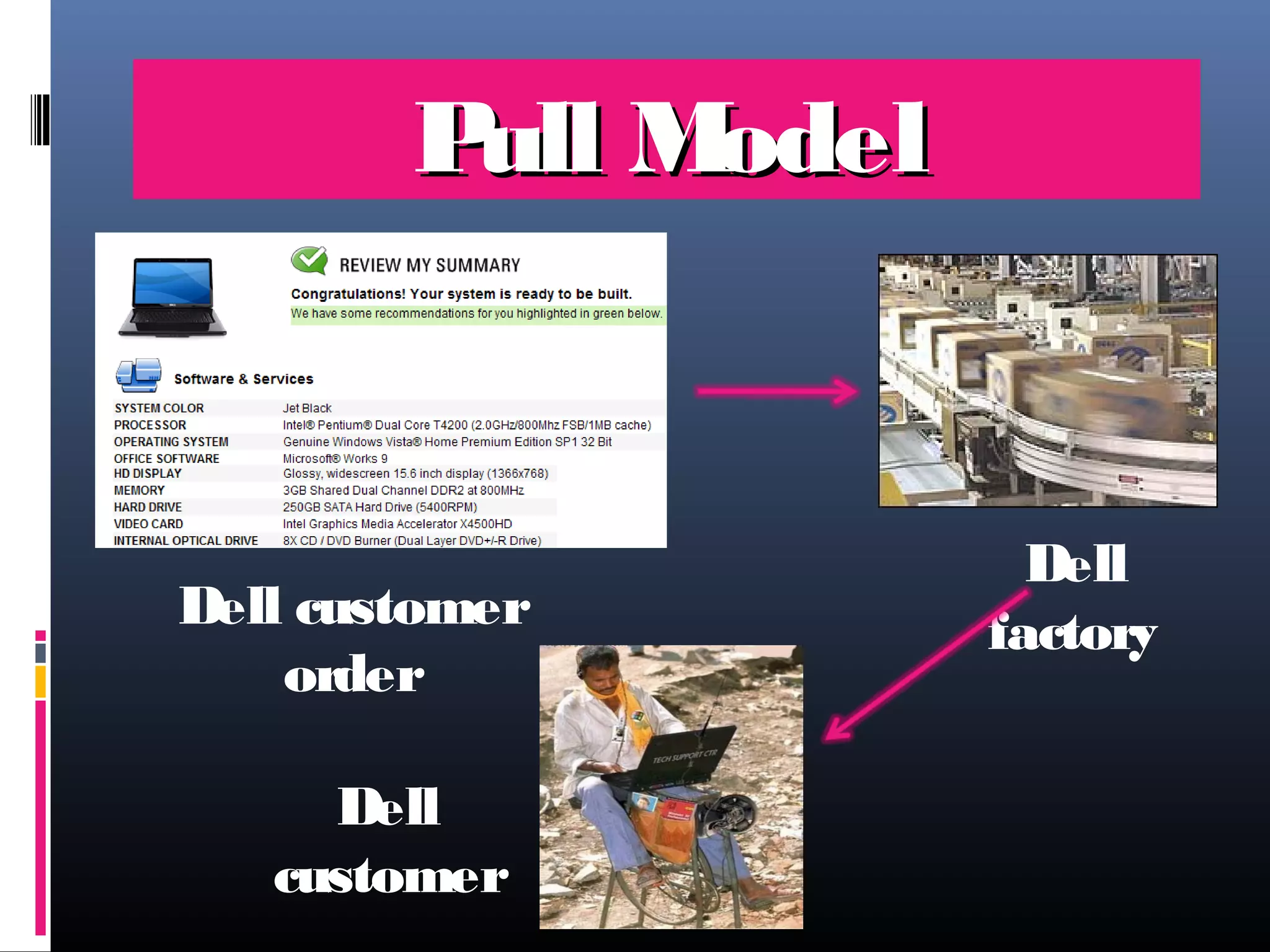
Dell customer
order
Dell
customer

Dell
factory
P
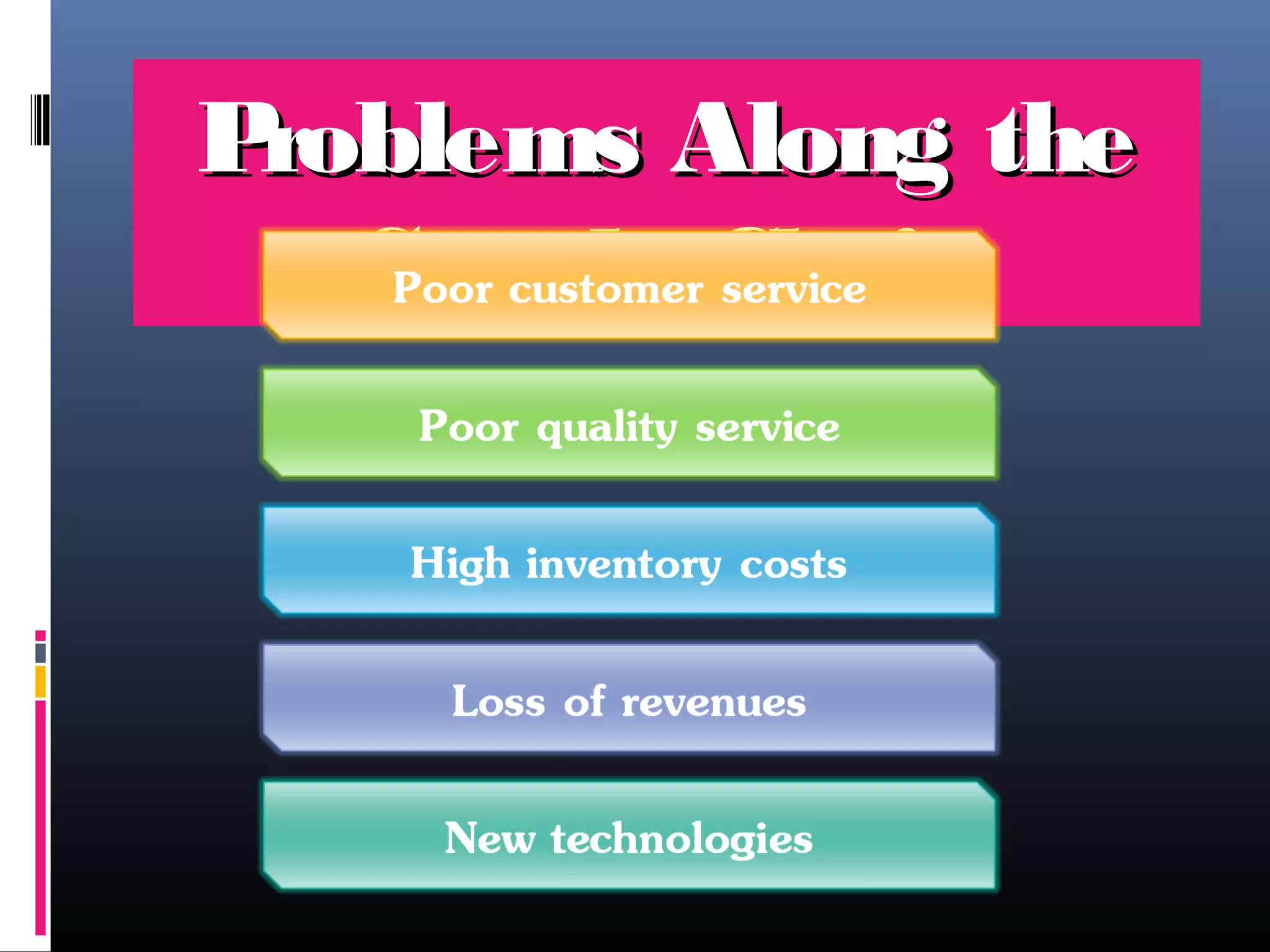
roblems Along the
Supply Chain
Solutions to Supply
Chain P
roblems
Using inventories
 Just-in-time

inventory

Information sharing
 Vendor-managed

inventory
Information T
echnology Support
for Supply Chain M
anagement
E
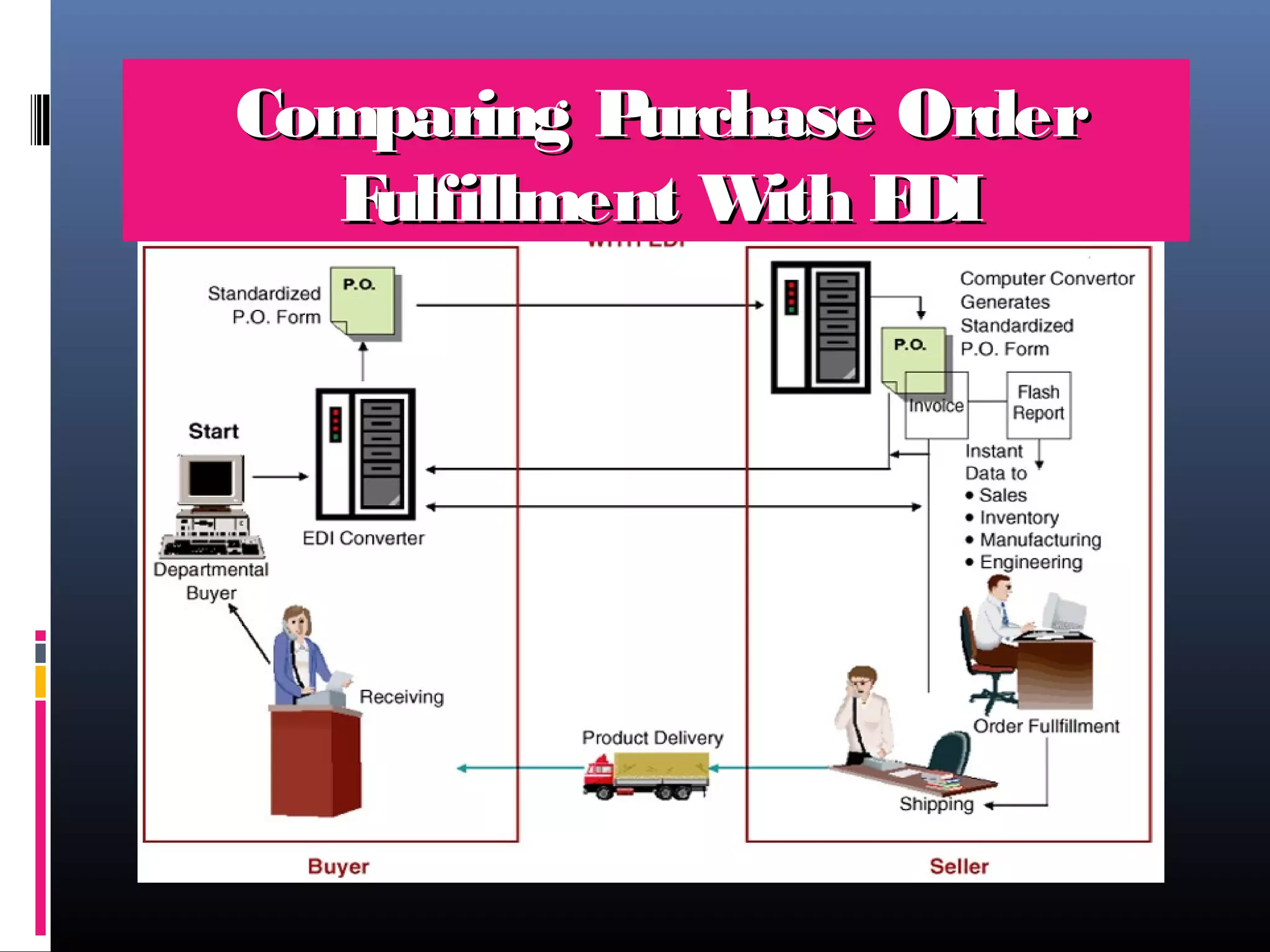
lectronic data interchange (E DI)
 is the structured transmission of data
between organizations by electronic
means. It is used to transfer electronic
documents or business data from one
computer system to another computer
system
E
xtranets - is a computer network that
allows controlled access from the
E B
DI enefits
 Minimize data entry errors
 Length of messages are shorter
 Messages are secured
 Reduces cycle time
 Increases productivity
 Enhances customer service
 Minimizes paper usage and storage
E L
DI imitations
 Significant initial investment to

implement
 Ongoing operating costs are high
due to the use of expensive,
private VANs
 Traditional EDI system is
inflexible
 Long startup period
Comparing P
urchase Order
F
ulfillment W
ithout E
DI
Comparing P
urchase Order
F
ulfillment W E
ith DI
E
xtranets
 The main goal of extranets is

to foster collaboration
between business partners.
 An extranet is open to
selected B2B suppliers,
customers and other business
T Structure of an
he
E
xtranet
T
ypes of E
xtranets
A company and its dealers,
customers or suppliers
An industry’ s extranet
Joint ventures and other business
partnerships

Supply Chain Management

Editor's Notes

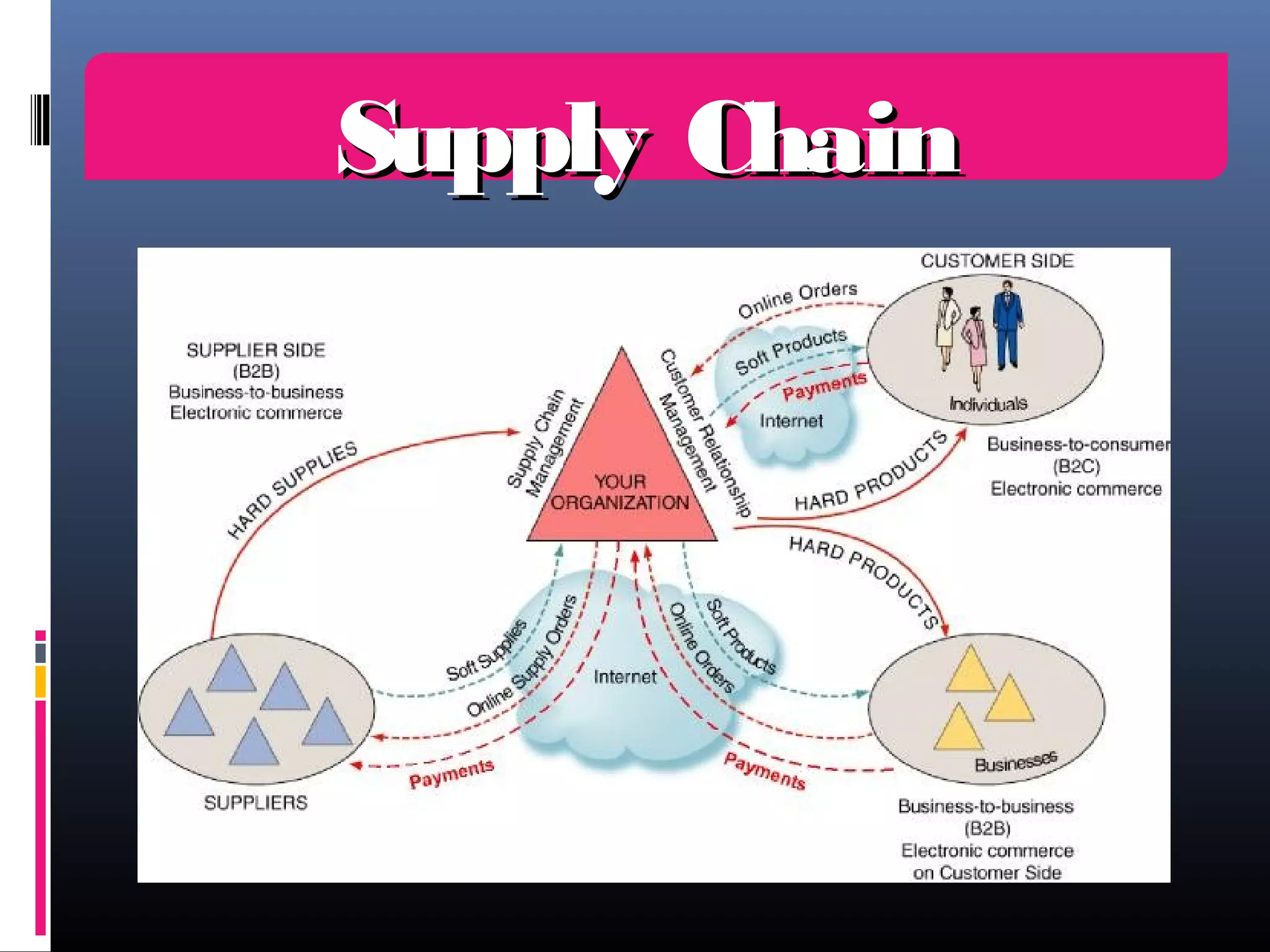
  • #4 Supply chain: refers to the flow of materials, information, money, and services from raw material suppliers, through factories and warehouses, to the end consumers. Upstream component of a supply chain: sourcing or procurement takes place. Internal component of a supply chain: packaging, assembly, or manufacturing takes place. Downstream component of a supply chain: distribution takes place.
  • #5 Another look at a supply chain (from Figure 2.2).
  • #6 Material flows are the physical products, raw materials, supplies and so forth that flow along the chain. Information flows are all data related to demand, shipments, orders, returns and schedules as well as changes in any of these data. Financial flows are all transfers of money, payments and credit-related data. A supply chain involves a product life cycle approach, from “dirt to dust”.
  • #7 Supply chain management (SCM) is the function of planning, organizing and optimizing the supply chain’s activities. Interorganizational information system (IOS) involves information flows among two or more organizations.
  • #11 Just-in-time inventory: a system in which a supplier delivers the precise number of parts to be assembled into a finished product at precisely the right time. Vendor-managed inventory: an inventory strategy where the supplier monitors a vendor’s inventory for a product or group of products and replenishes products when needed.
  • #12 Electronic data interchange (EDI) is a communication standard that enables business partners to exchange routine documents, such as purchase orders, electronically. Extranets link business partners to one another over the Internet by providing access to certain areas of each other’s corporate intranets.
  • #15 See Figure 10.3.
  • #18 See Figure 10.4.
  • #19 A company and its dealers, customers or suppliers – centers around one company. An industry’s extranet – major players in an industry team up to create an extranet. Joint ventures and other business partnerships – partners in a joint venture use extranet as a vehicle for communications and collaboration.