5S
Production Management
BY
NIKITA SEHGAL
ABHIMANYU RATHI
MUQSIT PATEL
MANDAR PAPADKAR
INTRODUCTION
 5S is the name of a workplace organization method that
uses a list of five Japanese words.
 It was translated into English words that all started with
the letter “S”
 The list describes how to organize a work space for
efficiency and effectiveness by identifying and storing the
items used, maintaining the area and items, and sustaining
the new order
DISCOVERY OF 5S
 Thirty years ago researchers started studying the
secret of success of Japanese manufacturing
companies
 5S turned out to be the most impressive "secret"
 The factories were so well organized that abnormal
situations were readily apparent
 Equipment were so clean and well maintained that
any problem such as a loose bolt or leaking oil could
be easily seen
 This passion of cleanliness and orderliness became a
hallmark of Japanese organizations
4
• Overproduction
• Delays (waiting time)
• Transportation
• Process
• Inventories
• Motions
• Defective products
• Untapped Resources
• Misused Resources
DIFFERENT TYPES OF
WASTES
THE 5S PRINCIPLES
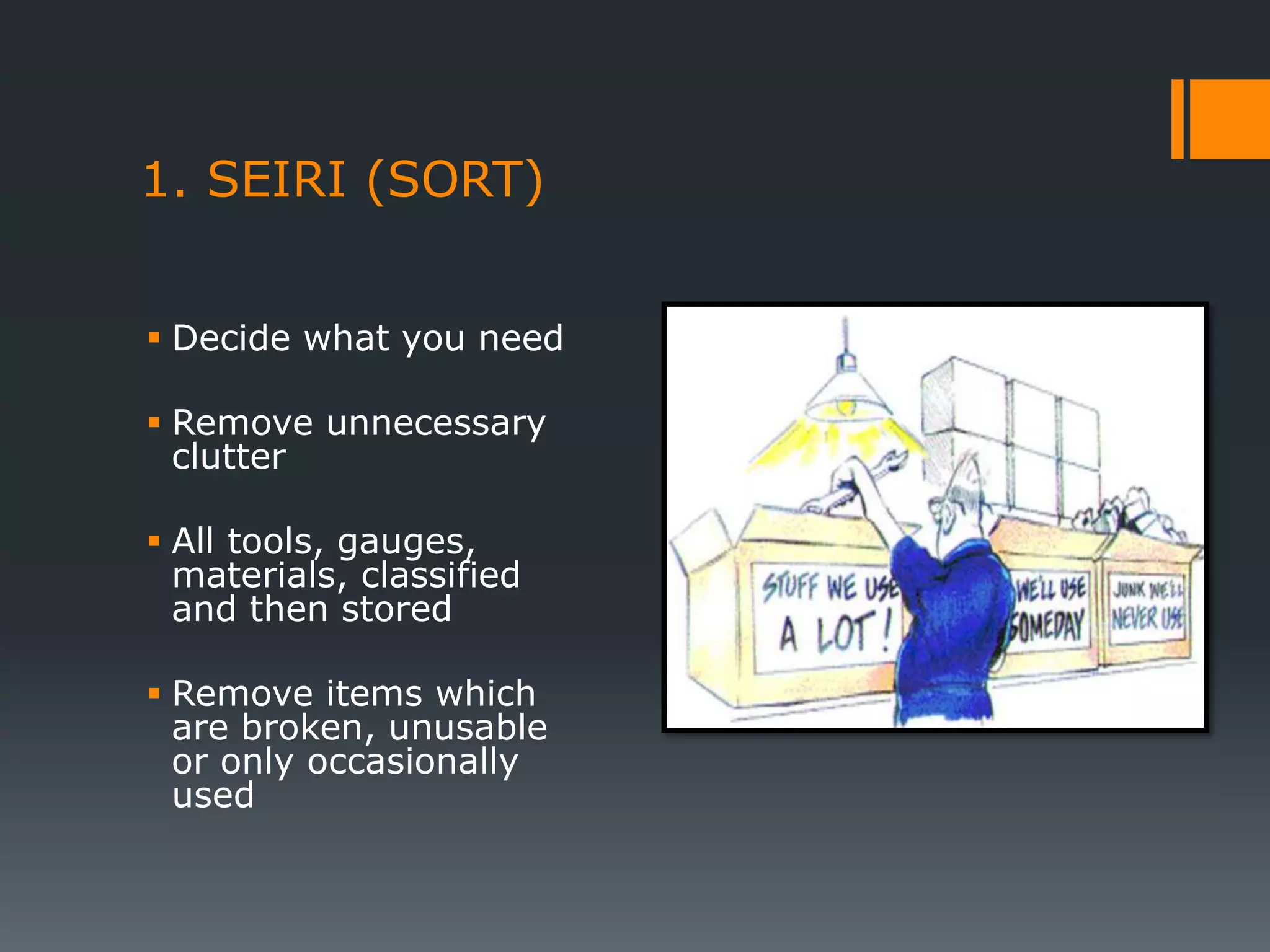
1. SEIRI (SORT)
 Decide what you need
 Remove unnecessary
clutter
 All tools, gauges,
materials, classified
and then stored
 Remove items which
are broken, unusable
or only occasionally
used
RED TAG TECHNIQUE
 Give staff red labels
 Ask staff to go
through every item in
the work place
 Ask if needed & those
that are needed, in
what quantity
 not needed red tag it
 store in the red tag
area
PRIORITY FREQUENCY OF USE HOW TO USE
Low Less than once per
year
Once per year
Throw away
Store away
from the
workplace
Avg. Once per month
Once per week
Store together
but offline
High Once Per Day Locate at the
workplace
2. SEITON (SYSTEMATIC ARRANGEMENT)
 Once you have eliminated the unnecessary items,
return to the left over items
 Organise layout of tools and equipment
Designated locations
Use tapes and labels
Ensure everything is available as it is needed and at the
“point of use”
SEITON
Workplace Checkpoints:
 Positions of aisles and storage places clearly marked?
 Tools classified and stored by frequency of use?
 Pallets stacked correctly?
 Safety equipment easily accessible?
 Floors in good condition?
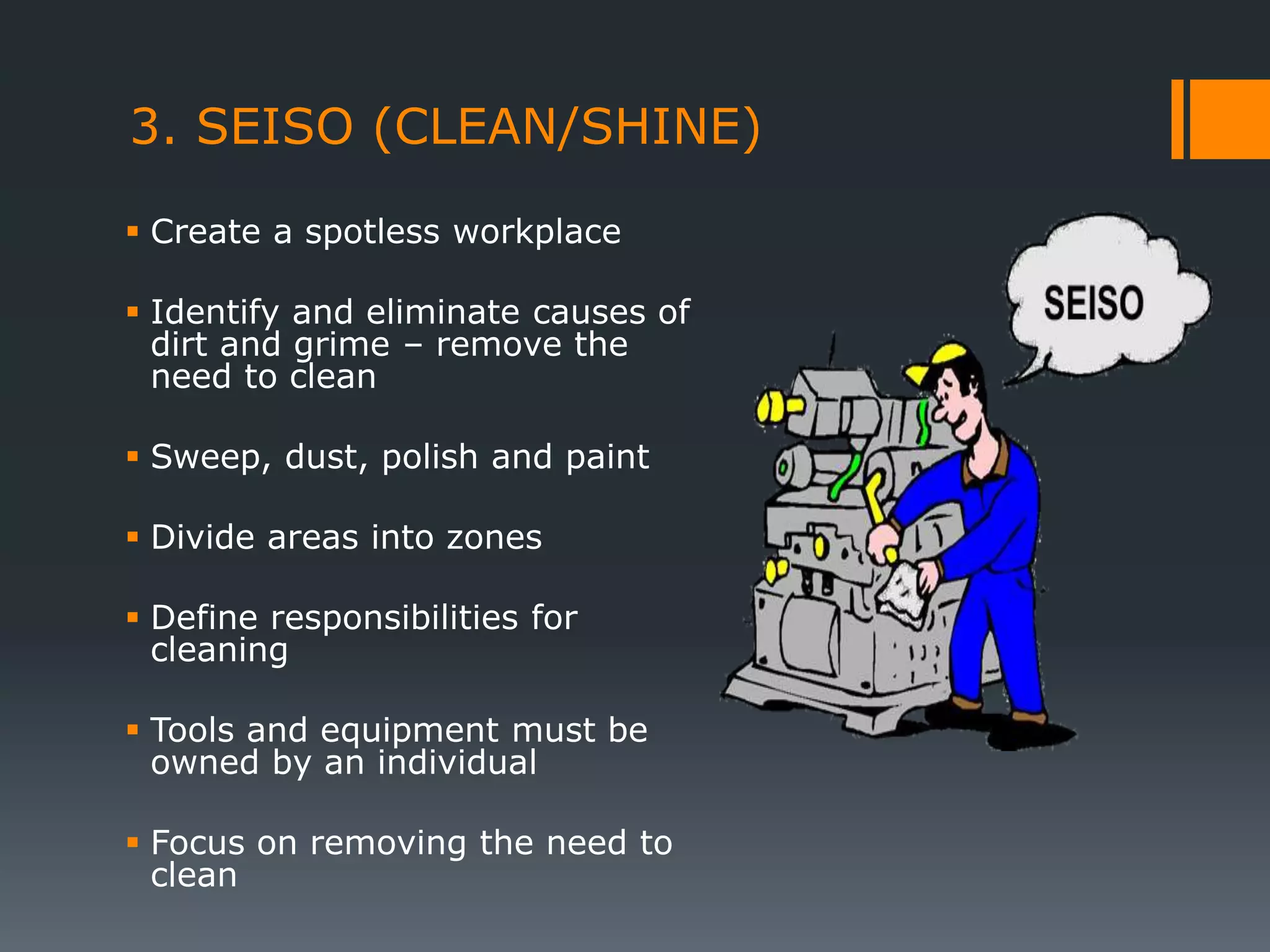
3. SEISO (CLEAN/SHINE)
 Create a spotless workplace
 Identify and eliminate causes of
dirt and grime – remove the
need to clean
 Sweep, dust, polish and paint
 Divide areas into zones
 Define responsibilities for
cleaning
 Tools and equipment must be
owned by an individual
 Focus on removing the need to
clean
4. SEIKETSU (STANDARDISE)
 Generate a maintenance
system for the first three
 Develop procedures,
schedules, practices
 Continue to assess the use
and disposal of items
 Regularly audit using
checklists and measures of
housekeeping
 Real challenge is to keep it
clean
5. SHITSUKE (SUSTAIN / DISCIPLINE)
 Means inoculate courtesy & good habits
 Driving force behind all 5S
 Deming’s point number 1: Constancy of purpose
 Make it a way of life
 Part of health and safety
 Involve the whole workforce
 Develop and keep good habits
IMPLEMENTATION OF 5S
Phase 1: Prepare the Project
 Step 1: Get management involvement
 Step 2: Identify target areas(s)
 Step 3: Form an implementation team
Phase 2: Perform an office scan
 Step 4: Select project measures and collect baseline
data
 Step 5: Photograph current conditions
 Step 6: Apply the office scan checklist
 Step 7: Post a project storyboard
Phase 3: Sort through and sort out
 Step 8: Determine a criteria for sort
 Step 9: Prepare a holding area
 Step 10: Apply sort
IMPLEMENTATION OF 5S
Phase 4: Set things in order and set limits
 Step 11: Map the current state
 Step 12: Create a set-in-order plan
 Step 13: Apply set-in-order
Phase 5: Shine and inspect through cleaning
 Step 14: Determine the criteria for shine
 Step 15: Develop and implement a plan for shine
Phase 6: Standardize conditions and share information
 Step 16: Determine and implement standards
 Step 17: Implement visual control
Phase 7: Sustain the gains
 Step 18: Train everyone
 Step 19: Make 5S a habit
 Step 20: Continue to improve
5S STEERING COMMITTEE
 The governing body of all 5S related activities in your
organization
 Responsibility of the overall planning, implementation
and sustenance of the process
 Membership – Representatives – All organization
levels
 Master implementation plan by the committee
 Bottom up approach – members from different
departments
5S STEERING COMMITTEE
Some examples of ways to keep your 5S moving
forward:
 Create a Code of Conduct
 Have a dedicated 5S area
 Create a 5S checklist
 Committee meetings
 Internal Competitions
5S STEERING COMMITTEE
A successful 5S safety committee will establish the
following:
 Develop lean minded people within the workplace
 Build good teamwork by encouraging participation
 Develop managers and supervisors for practical
leadership
 Improve infrastructures for introduction of advanced
lean methods
AT THE END OF THE DAY
Following can be harnessed form the 5S
1. Neat & clean workplace
2. Smooth working
3. No obstruction
4. Safety increases
5. Quality improves
6. Wastage decrease
7. Machine maintenance
8. Employees motivated
9. Workstations become spacious
ADVANTAGES OF 5S
 Health and Safety is ensured
 Quality
 Productivity
 Lean Manufacturing
 No deviation, no problems
 Because everyone knows where the things are
supposed to be, it is time saving
 Quick retrieval
 Accidents & mistakes minimized
 Increases space

5s of Production

  • 1.
    5S Production Management BY NIKITA SEHGAL ABHIMANYURATHI MUQSIT PATEL MANDAR PAPADKAR
  • 2.
    INTRODUCTION  5S isthe name of a workplace organization method that uses a list of five Japanese words.  It was translated into English words that all started with the letter “S”  The list describes how to organize a work space for efficiency and effectiveness by identifying and storing the items used, maintaining the area and items, and sustaining the new order
  • 3.
    DISCOVERY OF 5S Thirty years ago researchers started studying the secret of success of Japanese manufacturing companies  5S turned out to be the most impressive "secret"  The factories were so well organized that abnormal situations were readily apparent  Equipment were so clean and well maintained that any problem such as a loose bolt or leaking oil could be easily seen  This passion of cleanliness and orderliness became a hallmark of Japanese organizations
  • 4.
    4 • Overproduction • Delays(waiting time) • Transportation • Process • Inventories • Motions • Defective products • Untapped Resources • Misused Resources DIFFERENT TYPES OF WASTES
  • 5.
  • 6.
    1. SEIRI (SORT) Decide what you need  Remove unnecessary clutter  All tools, gauges, materials, classified and then stored  Remove items which are broken, unusable or only occasionally used
  • 7.
    RED TAG TECHNIQUE Give staff red labels  Ask staff to go through every item in the work place  Ask if needed & those that are needed, in what quantity  not needed red tag it  store in the red tag area
  • 8.
    PRIORITY FREQUENCY OFUSE HOW TO USE Low Less than once per year Once per year Throw away Store away from the workplace Avg. Once per month Once per week Store together but offline High Once Per Day Locate at the workplace
  • 9.
    2. SEITON (SYSTEMATICARRANGEMENT)  Once you have eliminated the unnecessary items, return to the left over items  Organise layout of tools and equipment Designated locations Use tapes and labels Ensure everything is available as it is needed and at the “point of use”
  • 10.
    SEITON Workplace Checkpoints:  Positionsof aisles and storage places clearly marked?  Tools classified and stored by frequency of use?  Pallets stacked correctly?  Safety equipment easily accessible?  Floors in good condition?
  • 11.
    3. SEISO (CLEAN/SHINE) Create a spotless workplace  Identify and eliminate causes of dirt and grime – remove the need to clean  Sweep, dust, polish and paint  Divide areas into zones  Define responsibilities for cleaning  Tools and equipment must be owned by an individual  Focus on removing the need to clean
  • 12.
    4. SEIKETSU (STANDARDISE) Generate a maintenance system for the first three  Develop procedures, schedules, practices  Continue to assess the use and disposal of items  Regularly audit using checklists and measures of housekeeping  Real challenge is to keep it clean
  • 13.
    5. SHITSUKE (SUSTAIN/ DISCIPLINE)  Means inoculate courtesy & good habits  Driving force behind all 5S  Deming’s point number 1: Constancy of purpose  Make it a way of life  Part of health and safety  Involve the whole workforce  Develop and keep good habits
  • 14.
    IMPLEMENTATION OF 5S Phase1: Prepare the Project  Step 1: Get management involvement  Step 2: Identify target areas(s)  Step 3: Form an implementation team Phase 2: Perform an office scan  Step 4: Select project measures and collect baseline data  Step 5: Photograph current conditions  Step 6: Apply the office scan checklist  Step 7: Post a project storyboard Phase 3: Sort through and sort out  Step 8: Determine a criteria for sort  Step 9: Prepare a holding area  Step 10: Apply sort
  • 15.
    IMPLEMENTATION OF 5S Phase4: Set things in order and set limits  Step 11: Map the current state  Step 12: Create a set-in-order plan  Step 13: Apply set-in-order Phase 5: Shine and inspect through cleaning  Step 14: Determine the criteria for shine  Step 15: Develop and implement a plan for shine Phase 6: Standardize conditions and share information  Step 16: Determine and implement standards  Step 17: Implement visual control Phase 7: Sustain the gains  Step 18: Train everyone  Step 19: Make 5S a habit  Step 20: Continue to improve
  • 16.
    5S STEERING COMMITTEE The governing body of all 5S related activities in your organization  Responsibility of the overall planning, implementation and sustenance of the process  Membership – Representatives – All organization levels  Master implementation plan by the committee  Bottom up approach – members from different departments
  • 17.
    5S STEERING COMMITTEE Someexamples of ways to keep your 5S moving forward:  Create a Code of Conduct  Have a dedicated 5S area  Create a 5S checklist  Committee meetings  Internal Competitions
  • 18.
    5S STEERING COMMITTEE Asuccessful 5S safety committee will establish the following:  Develop lean minded people within the workplace  Build good teamwork by encouraging participation  Develop managers and supervisors for practical leadership  Improve infrastructures for introduction of advanced lean methods
  • 19.
    AT THE ENDOF THE DAY Following can be harnessed form the 5S 1. Neat & clean workplace 2. Smooth working 3. No obstruction 4. Safety increases 5. Quality improves 6. Wastage decrease 7. Machine maintenance 8. Employees motivated 9. Workstations become spacious
  • 20.
    ADVANTAGES OF 5S Health and Safety is ensured  Quality  Productivity  Lean Manufacturing  No deviation, no problems  Because everyone knows where the things are supposed to be, it is time saving  Quick retrieval  Accidents & mistakes minimized  Increases space