Introduction
• The primary purpose of the vibration measuring instrument is to give an output signal
which represents the vibration phenomenon.
• The phenomenon may be displacement, velocity or acceleration of a vibrating system.
• Vibration measuring devices having mass, spring, dash pot, etc. are known as seismic
instruments.
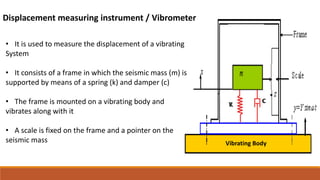
K
C
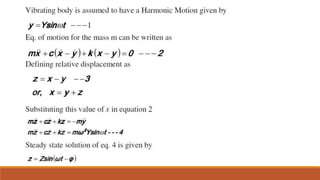
• It is used to measure the displacement of a vibrating
System
• It consists of a frame in which the seismic mass (m) is
supported by means of a spring (k) and damper (c)
• The frame is mounted on a vibrating body and
vibrates along with it
• A scale is fixed on the frame and a pointer on the
seismic mass
Displacement measuring instrument / Vibrometer
Vibrating Body
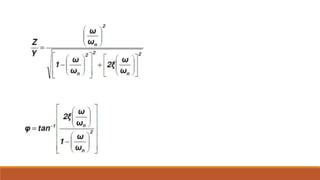
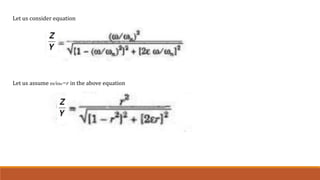
Let us consider equation
Let us assume ω/ωn=r in the above equation
Y
Y
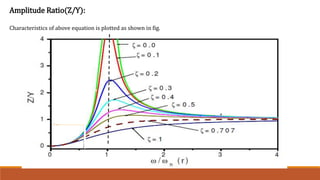
Amplitude Ratio(Z/Y):
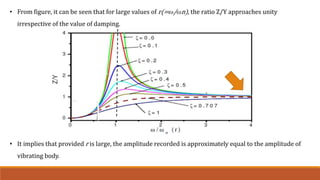
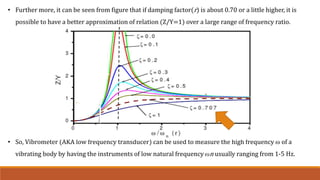
Characteristics of above equation is plotted as shown in fig.
• From figure, it can be seen that for large values of r(=ω/ωn), the ratio Z/Y approaches unity
irrespective of the value of damping.
• It implies that provided r is large, the amplitude recorded is approximately equal to the amplitude of
vibrating body.
• Further more, it can be seen from figure that if damping factor(r) is about 0.70 or a little higher, it is
possible to have a better approximation of relation (Z/Y=1) over a large range of frequency ratio.
• So, Vibrometer (AKA low frequency transducer) can be used to measure the high frequency ω of a
vibrating body by having the instruments of low natural frequency ωn usually ranging from 1-5 Hz.
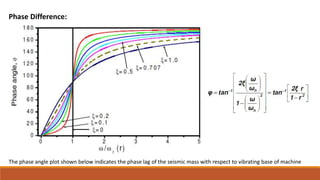
Phase Difference:
The phase angle plot shown below indicates the phase lag of the seismic mass with respect to vibrating base of machine
Vibration measuring instrument - Vibrometer

Vibration measuring instrument - Vibrometer

  • 2.
    Introduction • The primarypurpose of the vibration measuring instrument is to give an output signal which represents the vibration phenomenon. • The phenomenon may be displacement, velocity or acceleration of a vibrating system. • Vibration measuring devices having mass, spring, dash pot, etc. are known as seismic instruments.
  • 3.
    K C • It isused to measure the displacement of a vibrating System • It consists of a frame in which the seismic mass (m) is supported by means of a spring (k) and damper (c) • The frame is mounted on a vibrating body and vibrates along with it • A scale is fixed on the frame and a pointer on the seismic mass Displacement measuring instrument / Vibrometer Vibrating Body
  • 6.
    Let us considerequation Let us assume ω/ωn=r in the above equation Y Y
  • 7.
    Amplitude Ratio(Z/Y): Characteristics ofabove equation is plotted as shown in fig.
  • 8.
    • From figure,it can be seen that for large values of r(=ω/ωn), the ratio Z/Y approaches unity irrespective of the value of damping. • It implies that provided r is large, the amplitude recorded is approximately equal to the amplitude of vibrating body.
  • 9.
    • Further more,it can be seen from figure that if damping factor(r) is about 0.70 or a little higher, it is possible to have a better approximation of relation (Z/Y=1) over a large range of frequency ratio. • So, Vibrometer (AKA low frequency transducer) can be used to measure the high frequency ω of a vibrating body by having the instruments of low natural frequency ωn usually ranging from 1-5 Hz.
  • 10.
    Phase Difference: The phaseangle plot shown below indicates the phase lag of the seismic mass with respect to vibrating base of machine