Dr.V.Sharon Samyuktha M.Sc., Ph.D
Lecturer in Physics,
Maris Stella College,
Vijayawada,
Andhra Pradesh,
India.
Experience-13 yrs
Research Interest: Ceramics
Mechanics and Properties of Matter
Course Code: PHYC039
CENTRAL FORCES
• A central force is defined as a force which
always acts on a particle or body towards or
away from a fixed point and whose magnitude
depends upon only on the distance from the
fixed point.
• A central force on an object is a force that is
directed along the line joining the object and
the origin
• Central Force on a particle P is expressed by
F.
• Mathematically , F can be expressed as
F = r f(r)
• Where f(r) is a function of the distance r of
the particle from the fixed point.
• r is the unit vector along the radius vector r
of the particle with respect to that point.
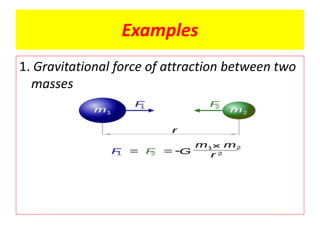
Examples
1. Gravitational force of attraction between two
masses
2. The electrostatic force between two
charges.
Features of Central Forces
• The general form of central force is given by
F = r f(r)
• Where f(r) is a function of the distance r of the
particle from the fixed point and r is the unit
vector along the radius vector r of the particle
with respect to that point.
• Central Force is a conservative force. (work done
by a force in moving a particle from one point to
another is independent of path followed)
• Under a central force, torque acting on a
particle is always zero.
• Under a central force, the angular
momentum of a particle remains constant.
• The central force is attractive when f(r)<0
i.e., negative.
• The central force is repulsive when f(r)>0
i.e., positive.
Conservation of Angular Momentum
• According to this law, if no external torque acts
on a body rotating about a fixed point, the
angular momentum of the boby remains
constant.
• According to definition of torque
• τ = dL/dt = r X F
• dL/dt = 0
• Integrating we get L = constant
Examples of Conservation of Angular
Momentum
1. Motion of Planet in its orbit.
2. Scattering of α –particles by a heavy
nucleus.
Central force

Central force

  • 2.
    Dr.V.Sharon Samyuktha M.Sc.,Ph.D Lecturer in Physics, Maris Stella College, Vijayawada, Andhra Pradesh, India. Experience-13 yrs Research Interest: Ceramics
  • 3.
    Mechanics and Propertiesof Matter Course Code: PHYC039
  • 4.
    CENTRAL FORCES • Acentral force is defined as a force which always acts on a particle or body towards or away from a fixed point and whose magnitude depends upon only on the distance from the fixed point. • A central force on an object is a force that is directed along the line joining the object and the origin
  • 6.
    • Central Forceon a particle P is expressed by F. • Mathematically , F can be expressed as F = r f(r) • Where f(r) is a function of the distance r of the particle from the fixed point. • r is the unit vector along the radius vector r of the particle with respect to that point.
  • 7.
    Examples 1. Gravitational forceof attraction between two masses
  • 8.
    2. The electrostaticforce between two charges.
  • 9.
    Features of CentralForces • The general form of central force is given by F = r f(r) • Where f(r) is a function of the distance r of the particle from the fixed point and r is the unit vector along the radius vector r of the particle with respect to that point. • Central Force is a conservative force. (work done by a force in moving a particle from one point to another is independent of path followed)
  • 10.
    • Under acentral force, torque acting on a particle is always zero. • Under a central force, the angular momentum of a particle remains constant. • The central force is attractive when f(r)<0 i.e., negative. • The central force is repulsive when f(r)>0 i.e., positive.
  • 11.
    Conservation of AngularMomentum • According to this law, if no external torque acts on a body rotating about a fixed point, the angular momentum of the boby remains constant. • According to definition of torque • τ = dL/dt = r X F • dL/dt = 0 • Integrating we get L = constant
  • 12.
    Examples of Conservationof Angular Momentum 1. Motion of Planet in its orbit.
  • 13.
    2. Scattering ofα –particles by a heavy nucleus.