Topic 1-3 Forced Oscillator
1
UEEP1033 Oscillations and Waves
Topic 3:
Forced Oscillator
Topic 1-3 Forced Oscillator
2
UEEP1033 Oscillations and Waves
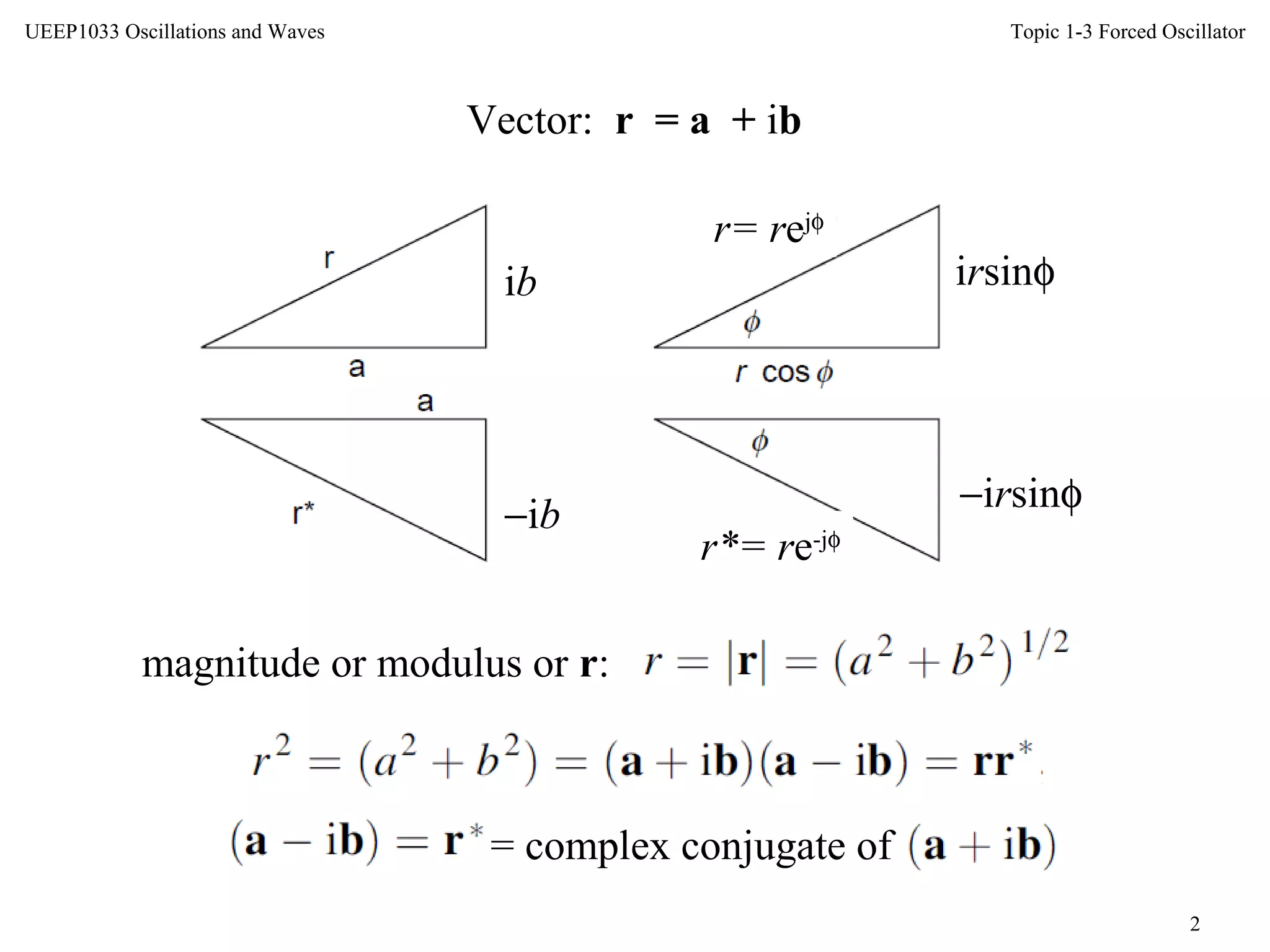
Vector: r = a + ib
irsinφ
−irsinφ
r= rejφ
r*= re-jφ
−ib
ib
magnitude or modulus or r:
= complex conjugate of
Topic 1-3 Forced Oscillator
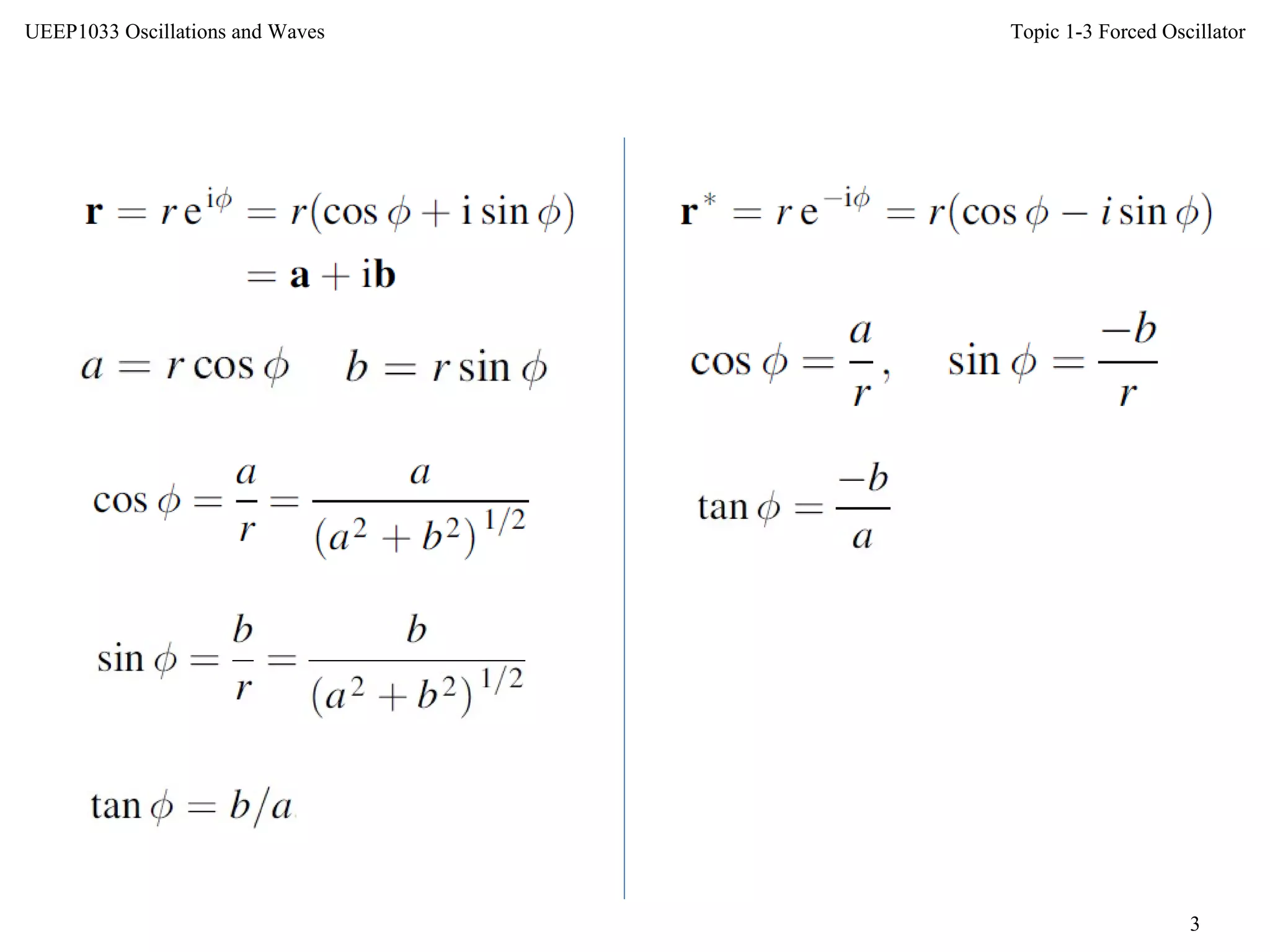
3
UEEP1033 Oscillations and Waves
Topic 1-3 Forced Oscillator
4
UEEP1033 Oscillations and Waves
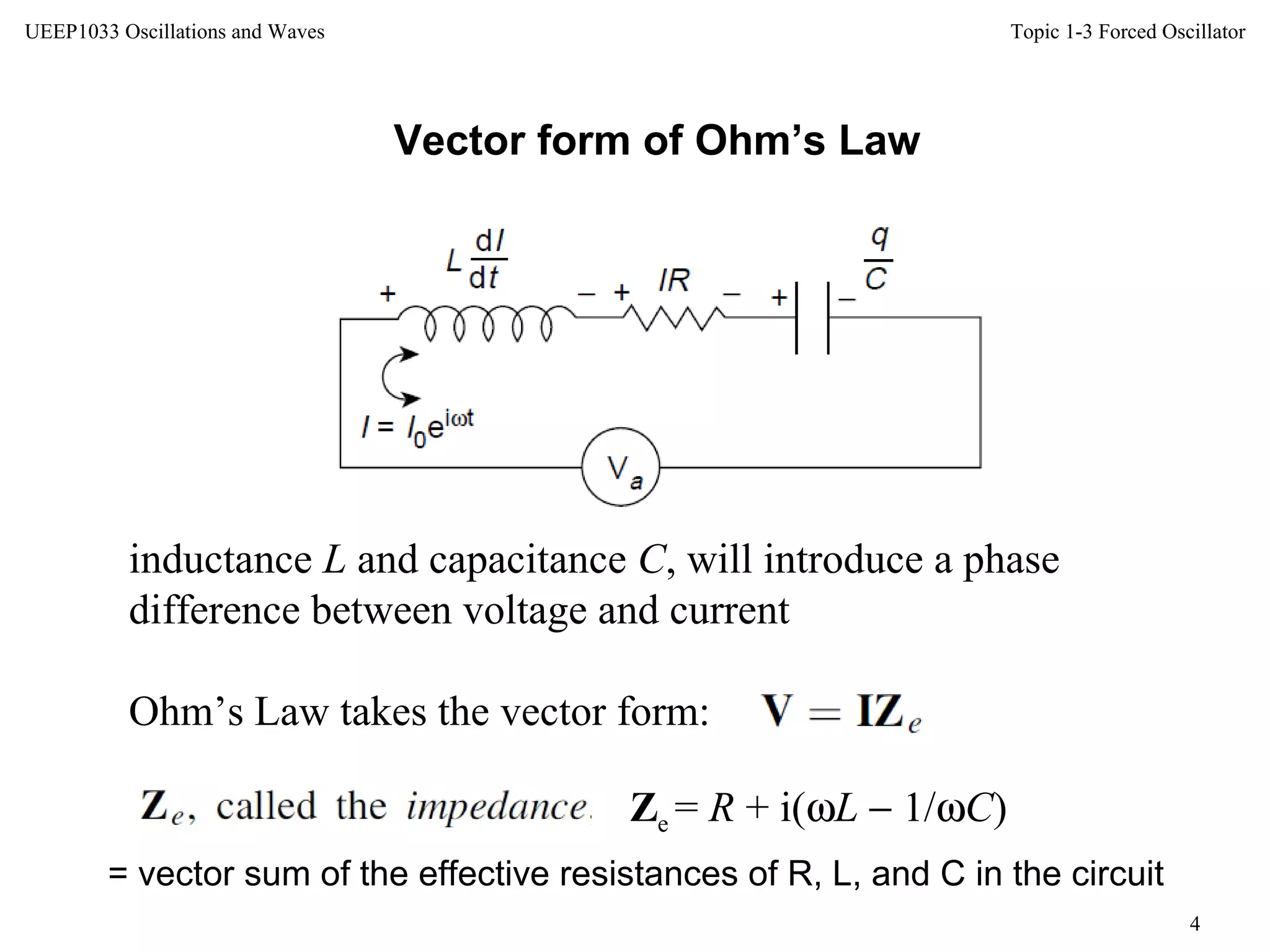
Vector form of Ohm’s Law
inductance L and capacitance C, will introduce a phase
difference between voltage and current
Ohm’s Law takes the vector form:
Ze = R + i(ωL − 1/ωC)
= vector sum of the effective resistances of R, L, and C in the circuit
Topic 1-3 Forced Oscillator
5
UEEP1033 Oscillations and Waves
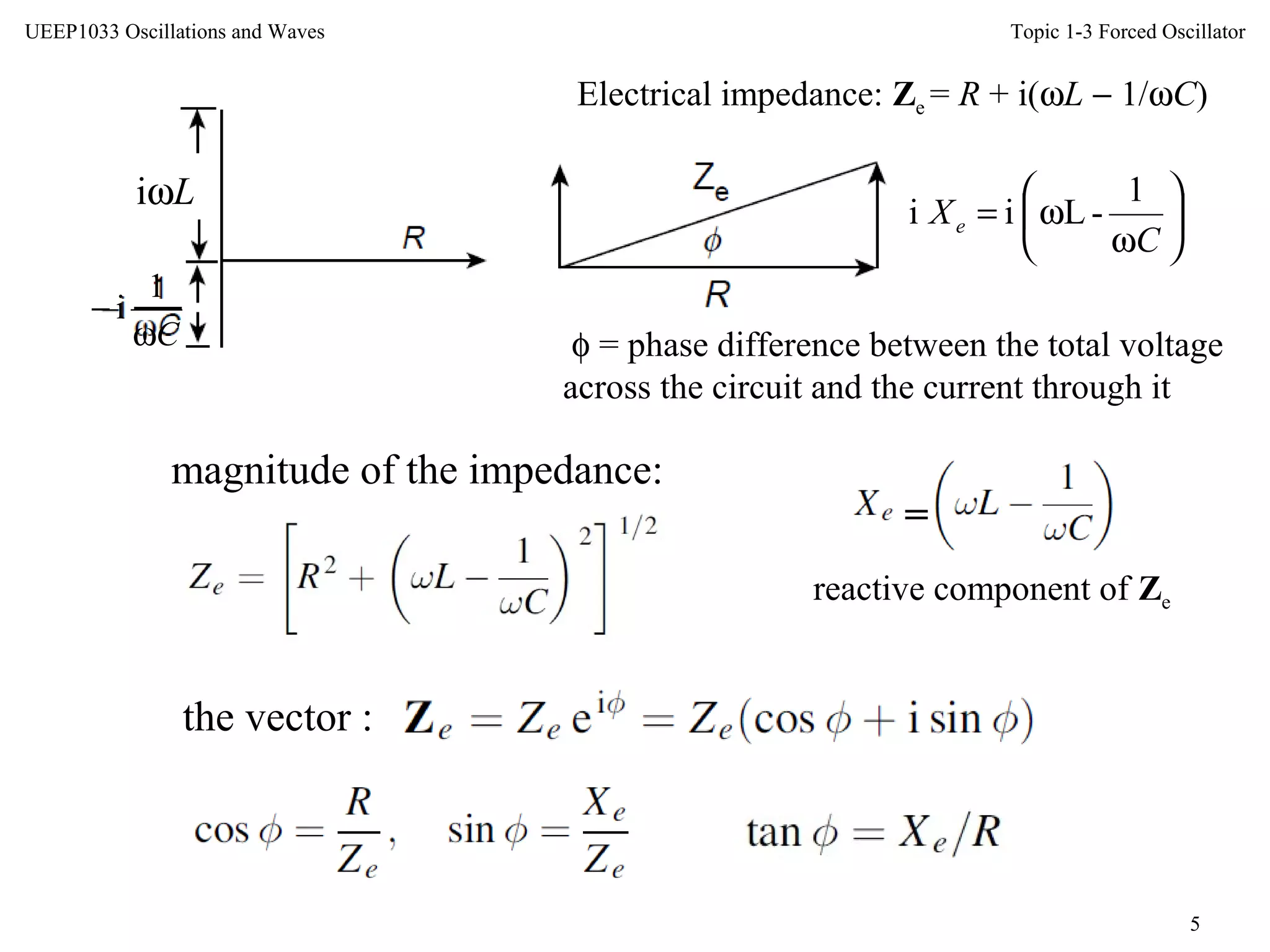
magnitude of the impedance:
the vector :
φ = phase difference between the total voltage
across the circuit and the current through it
iωL
Cω
−
1
i






ω
ω=
C
Xe
1
-Lii
=
reactive component of Ze
Electrical impedance: Ze = R + i(ωL − 1/ωC)
Topic 1-3 Forced Oscillator
6
UEEP1033 Oscillations and Waves
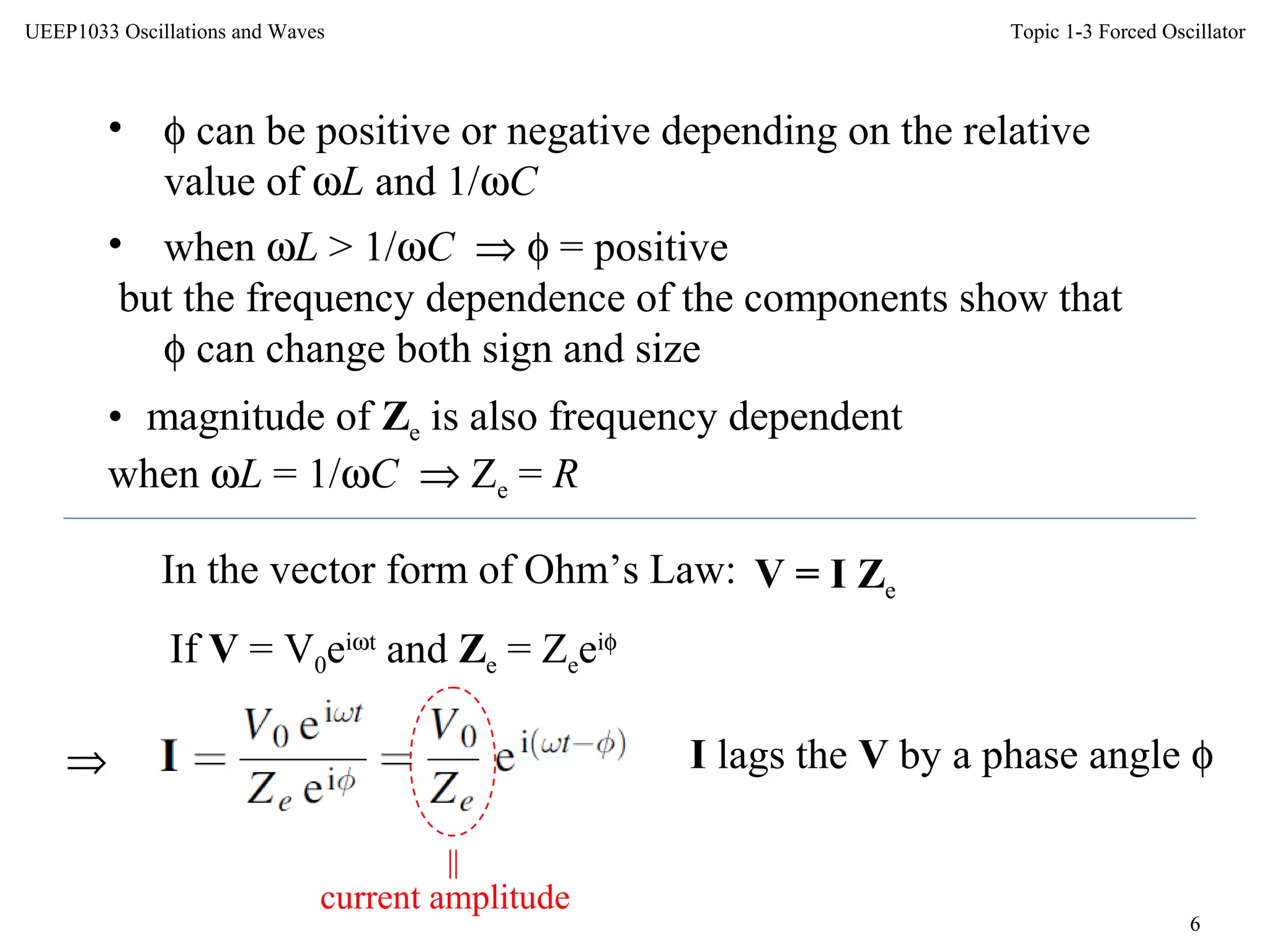
• φ can be positive or negative depending on the relative
value of ωL and 1/ωC
• when ωL > 1/ωC ⇒ φ = positive
but the frequency dependence of the components show that
φ can change both sign and size
• magnitude of Ze is also frequency dependent
when ωL = 1/ωC ⇒ Ze = R
In the vector form of Ohm’s Law: V = I Ze
If V = V0eiωt
and Ze = Zeeiφ
⇒
current amplitude
I lags the V by a phase angle φ
||
Topic 1-3 Forced Oscillator
7
UEEP1033 Oscillations and Waves
Impedance of a Mechanical Circuit
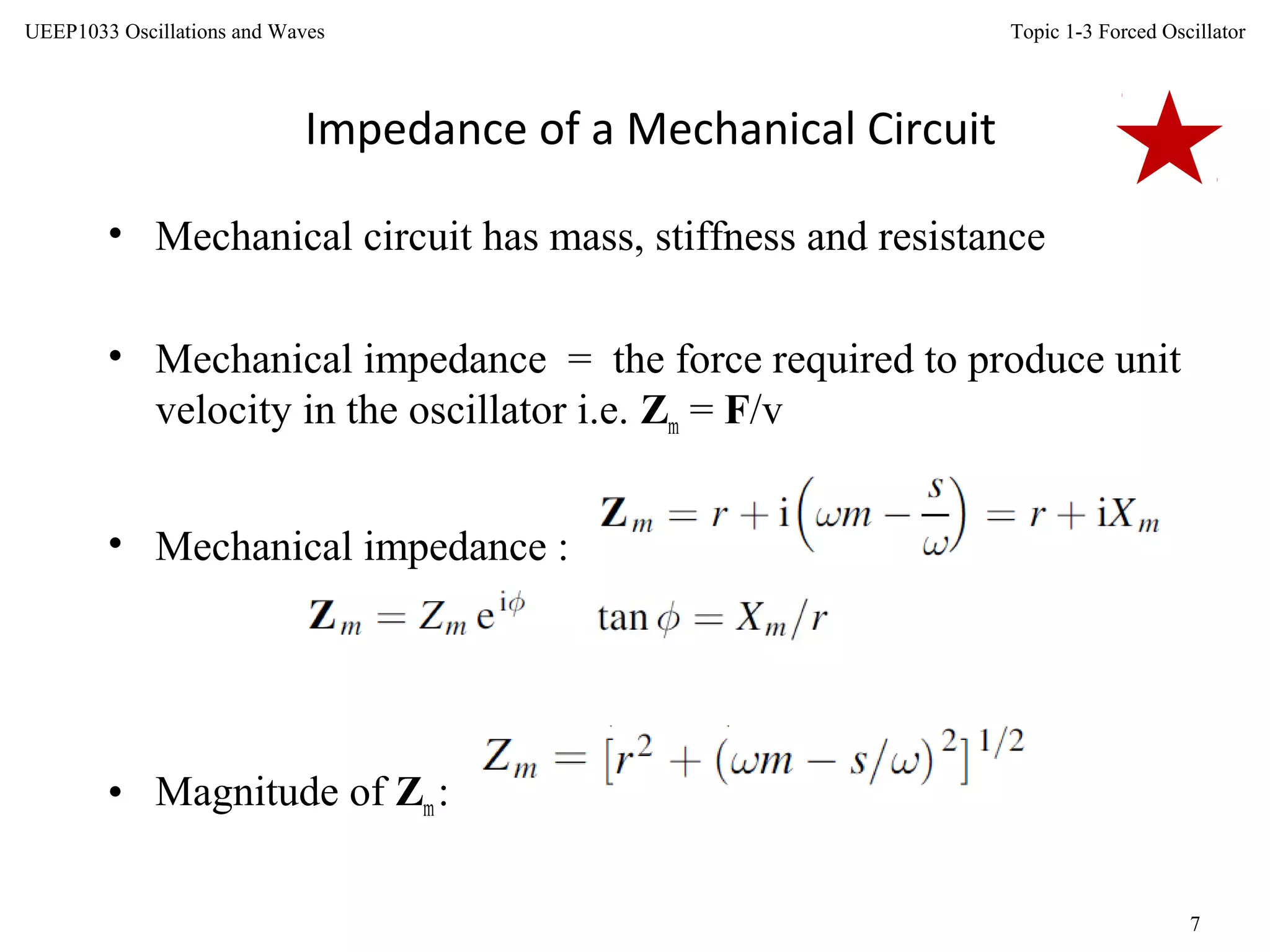
• Mechanical circuit has mass, stiffness and resistance
• Mechanical impedance = the force required to produce unit
velocity in the oscillator i.e. Zm = F/v
• Mechanical impedance :
• Magnitude of Zm:
Topic 1-3 Forced Oscillator
8
UEEP1033 Oscillations and Waves
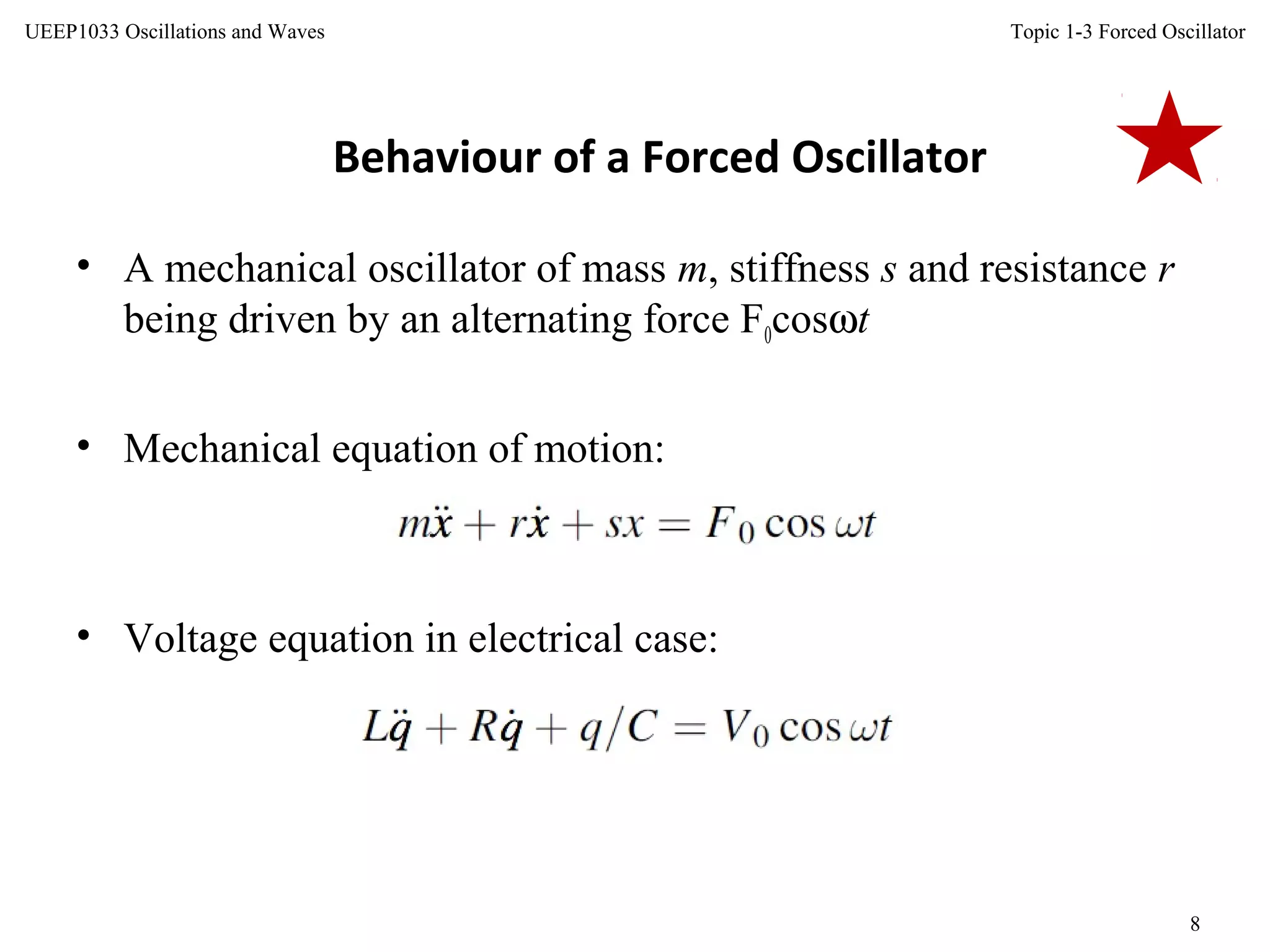
• A mechanical oscillator of mass m, stiffness s and resistance r
being driven by an alternating force F0cosωt
• Mechanical equation of motion:
Behaviour of a Forced Oscillator
• Voltage equation in electrical case:
Topic 1-3 Forced Oscillator
9
UEEP1033 Oscillations and Waves
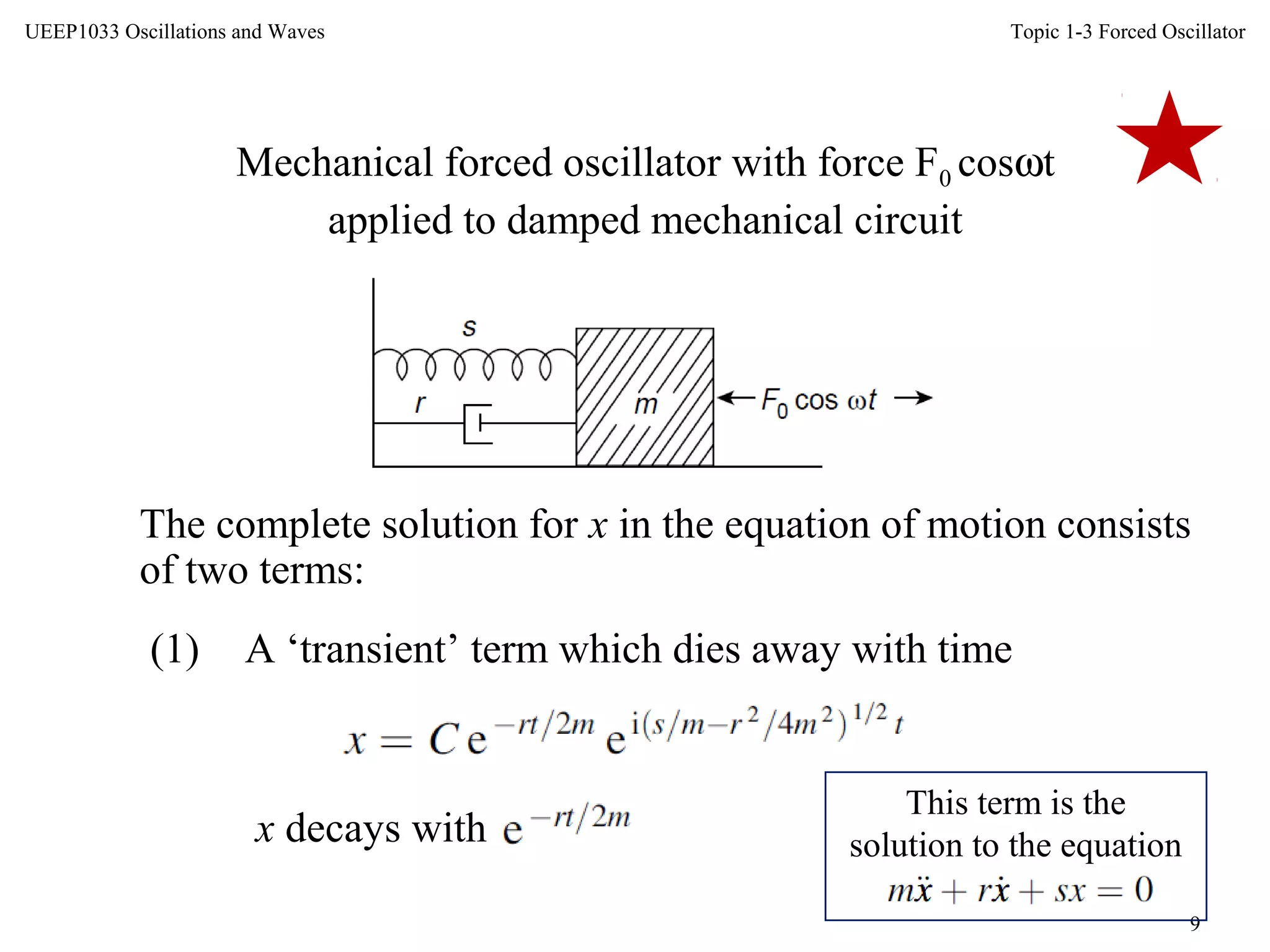
Mechanical forced oscillator with force F0 cosωt
applied to damped mechanical circuit
The complete solution for x in the equation of motion consists
of two terms:
(1) A ‘transient’ term which dies away with time
x decays with
This term is the
solution to the equation
Topic 1-3 Forced Oscillator
10
UEEP1033 Oscillations and Waves
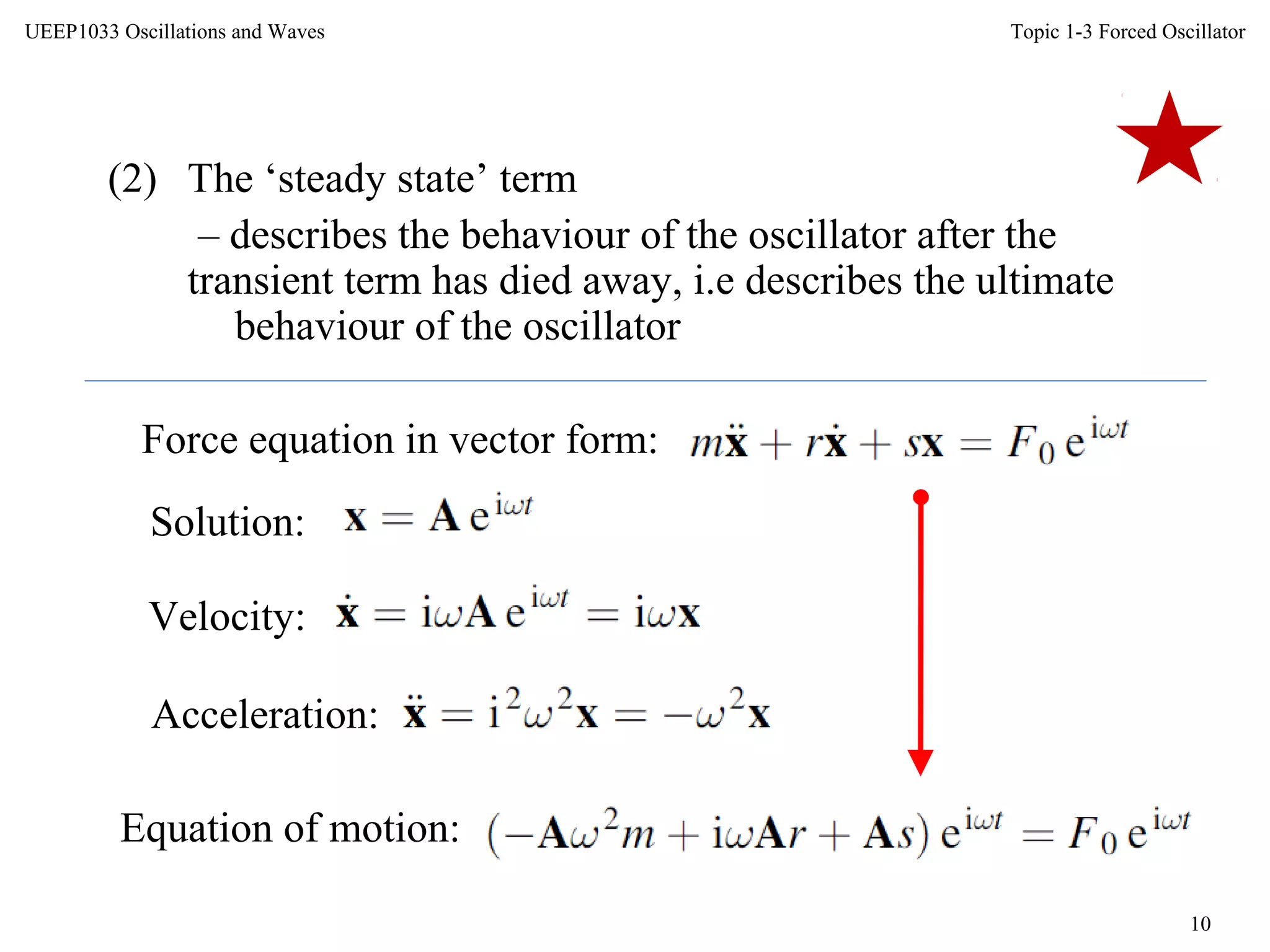
(2) The ‘steady state’ term
– describes the behaviour of the oscillator after the
transient term has died away, i.e describes the ultimate
behaviour of the oscillator
Force equation in vector form:
Solution:
Velocity:
Acceleration:
Equation of motion:
Topic 1-3 Forced Oscillator
11
UEEP1033 Oscillations and Waves
×
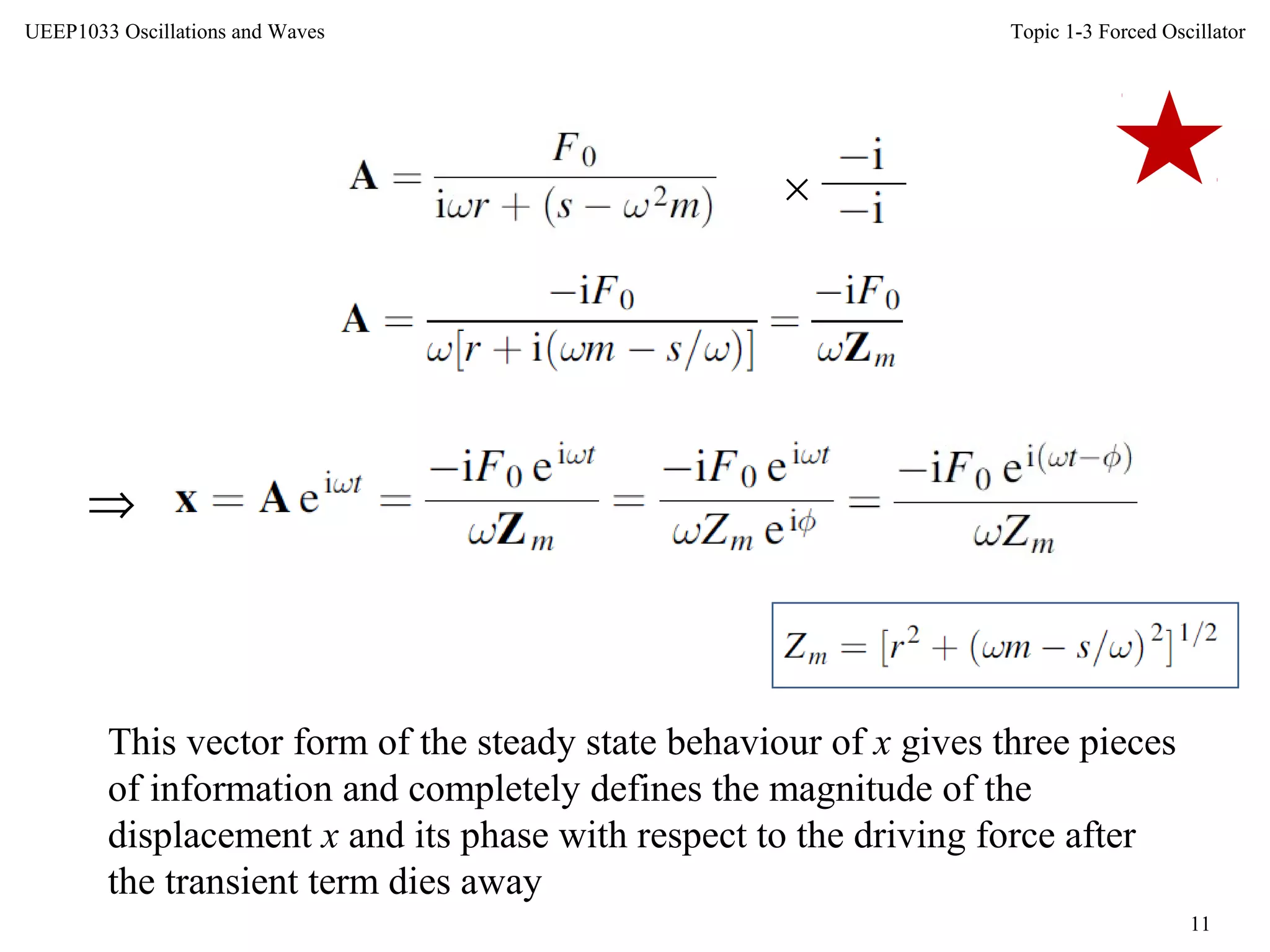
This vector form of the steady state behaviour of x gives three pieces
of information and completely defines the magnitude of the
displacement x and its phase with respect to the driving force after
the transient term dies away
⇒
Topic 1-3 Forced Oscillator
12
UEEP1033 Oscillations and Waves
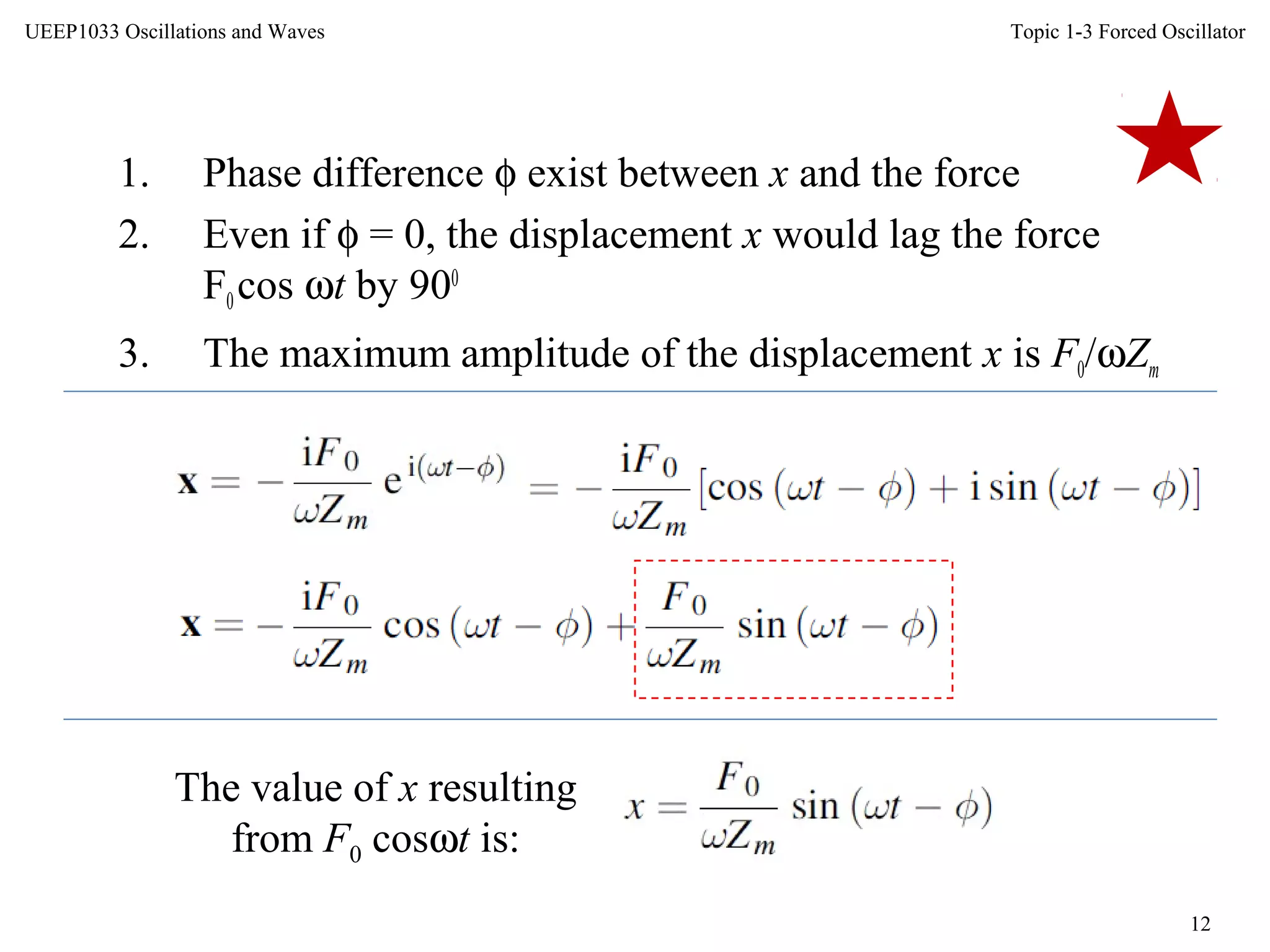
1. Phase difference φ exist between x and the force
2. Even if φ = 0, the displacement x would lag the force
F0cos ωt by 900
3. The maximum amplitude of the displacement x is F0/ωZm
The value of x resulting
from F0 cosωt is:
Topic 1-3 Forced Oscillator
13
UEEP1033 Oscillations and Waves
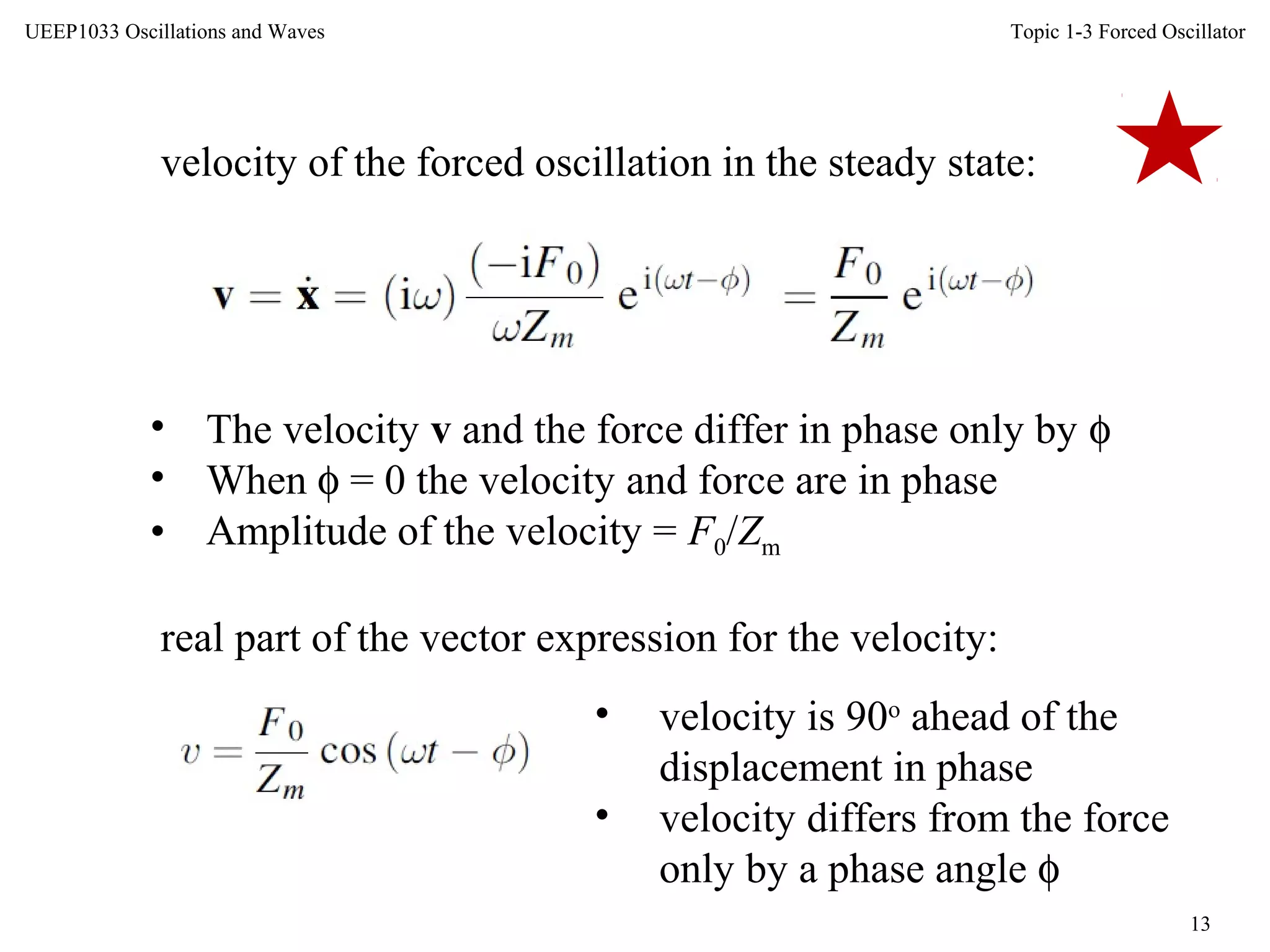
velocity of the forced oscillation in the steady state:
• The velocity v and the force differ in phase only by φ
• When φ = 0 the velocity and force are in phase
• Amplitude of the velocity = F0/Zm
real part of the vector expression for the velocity:
• velocity is 90o
ahead of the
displacement in phase
• velocity differs from the force
only by a phase angle φ
Topic 1-3 Forced Oscillator
14
UEEP1033 Oscillations and Waves
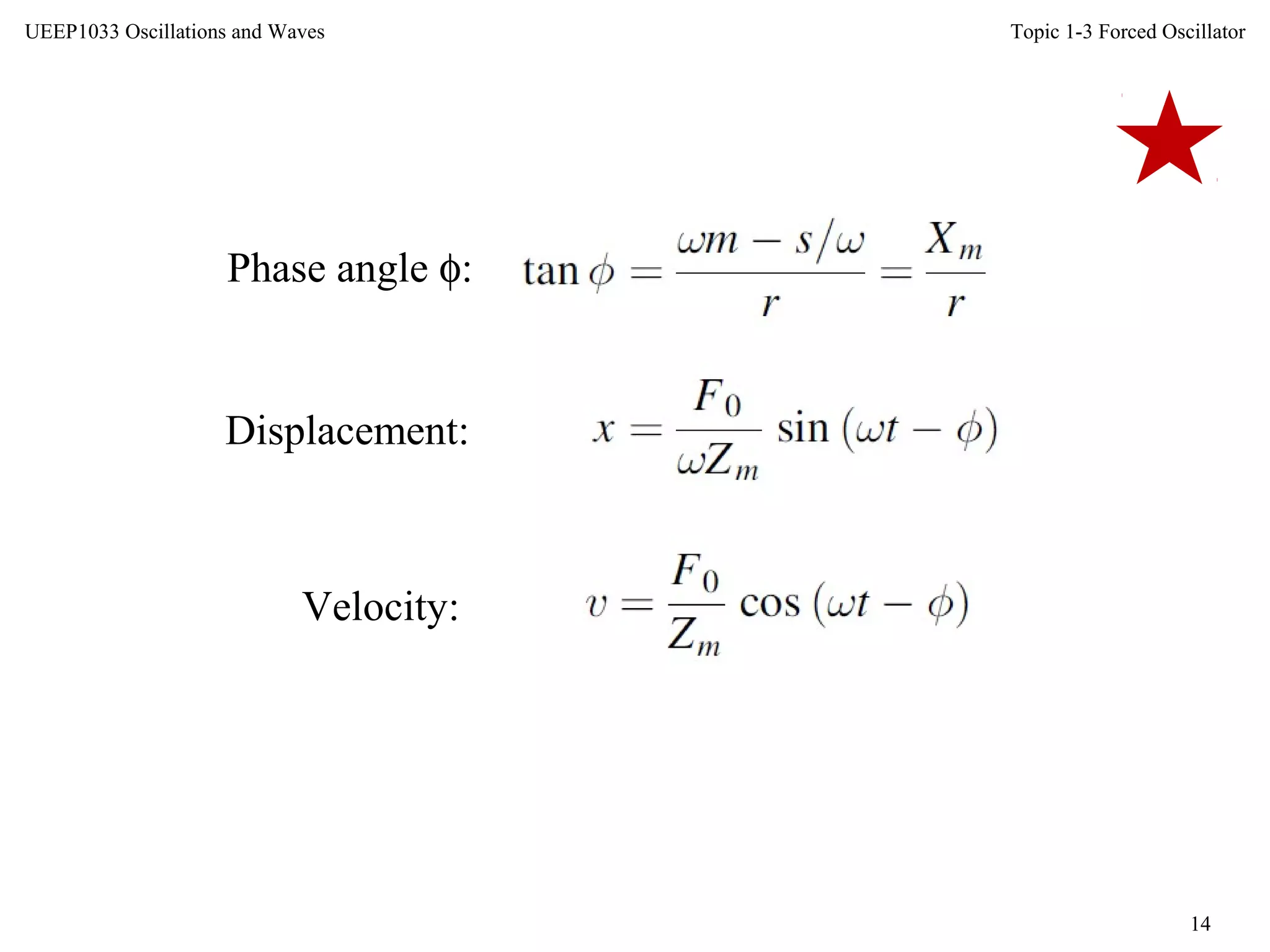
Phase angle φ:
Displacement:
Velocity:
Topic 1-3 Forced Oscillator
15
UEEP1033 Oscillations and Waves
Behaviour of Velocity
in Magnitude and Phase versus Driving Force
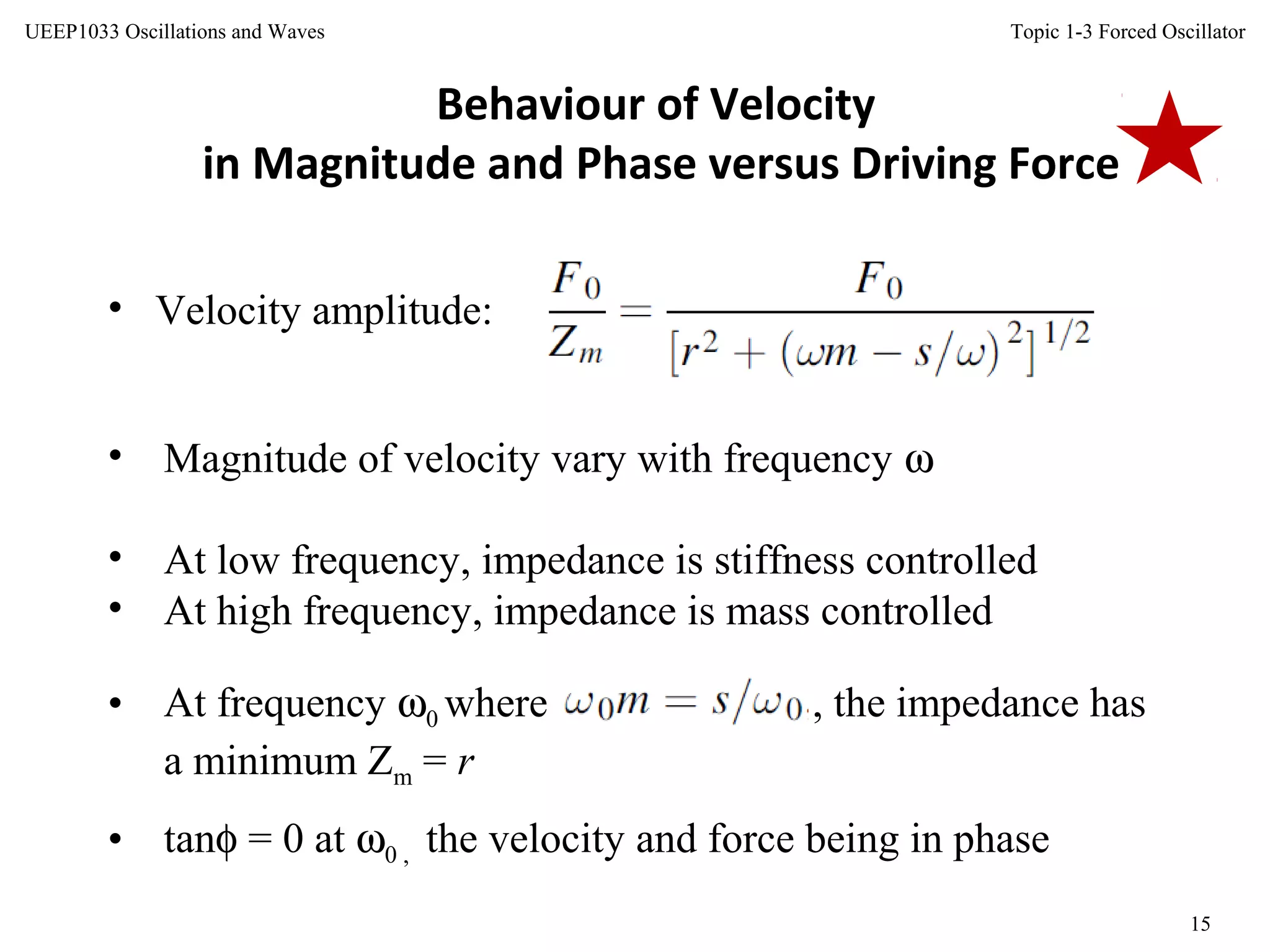
• Velocity amplitude:
• Magnitude of velocity vary with frequency ω
• At low frequency, impedance is stiffness controlled
• At high frequency, impedance is mass controlled
• At frequency ω0 where , the impedance has
a minimum Zm = r
• tanφ = 0 at ω0 , the velocity and force being in phase
Topic 1-3 Forced Oscillator
16
UEEP1033 Oscillations and Waves
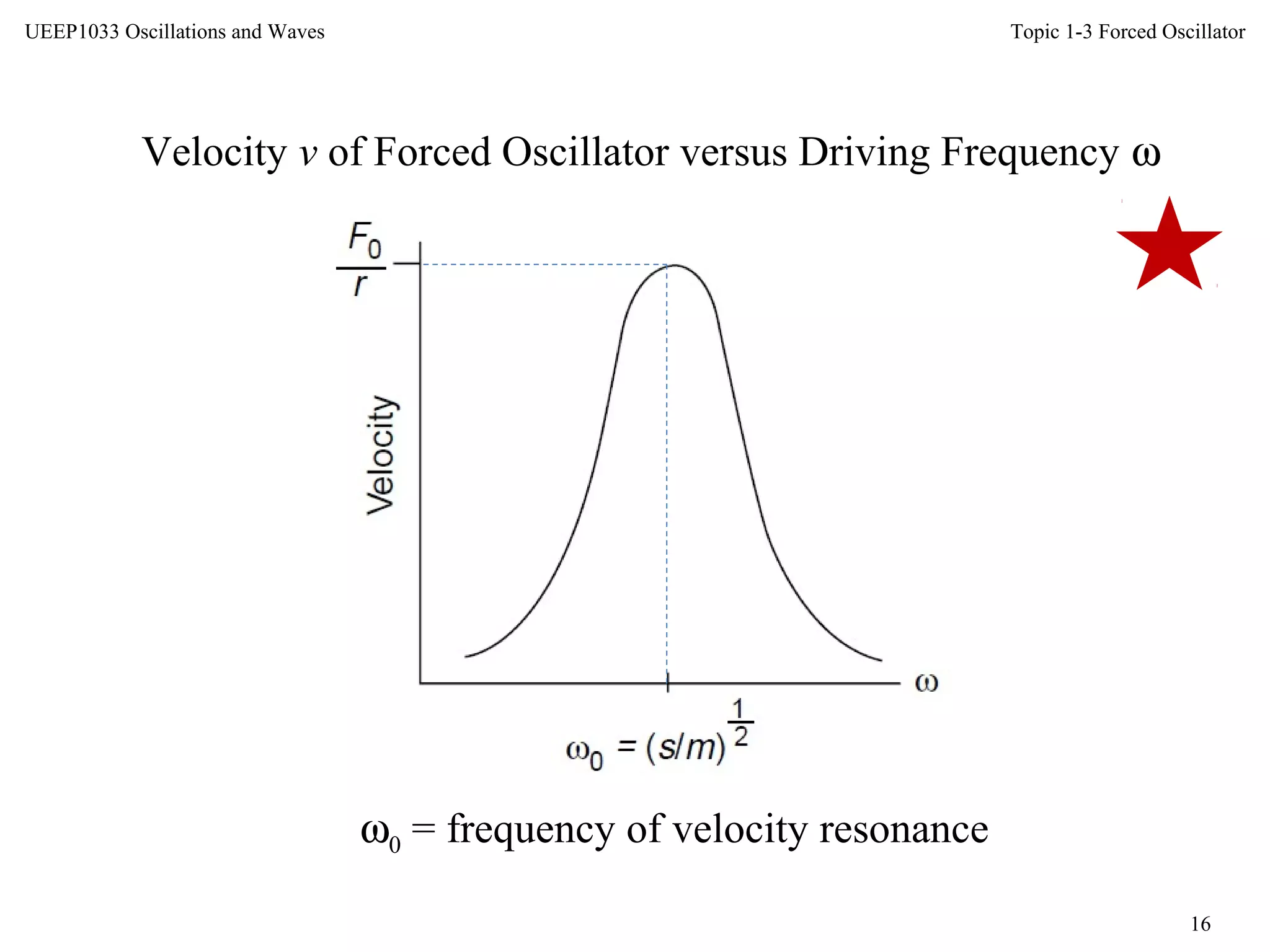
Velocity v of Forced Oscillator versus Driving Frequency ω
ω0 = frequency of velocity resonance
Topic 1-3 Forced Oscillator
17
UEEP1033 Oscillations and Waves
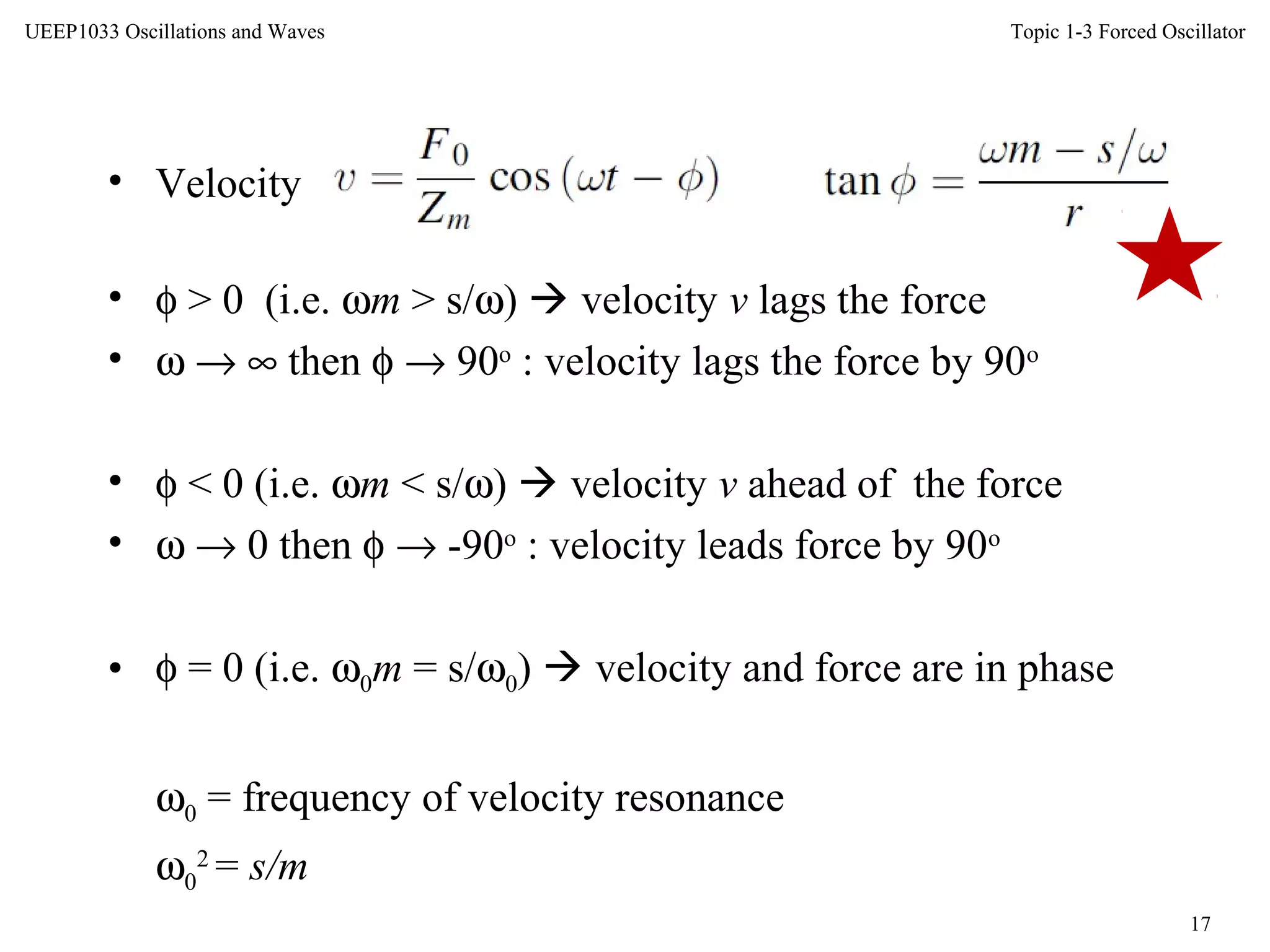
• Velocity
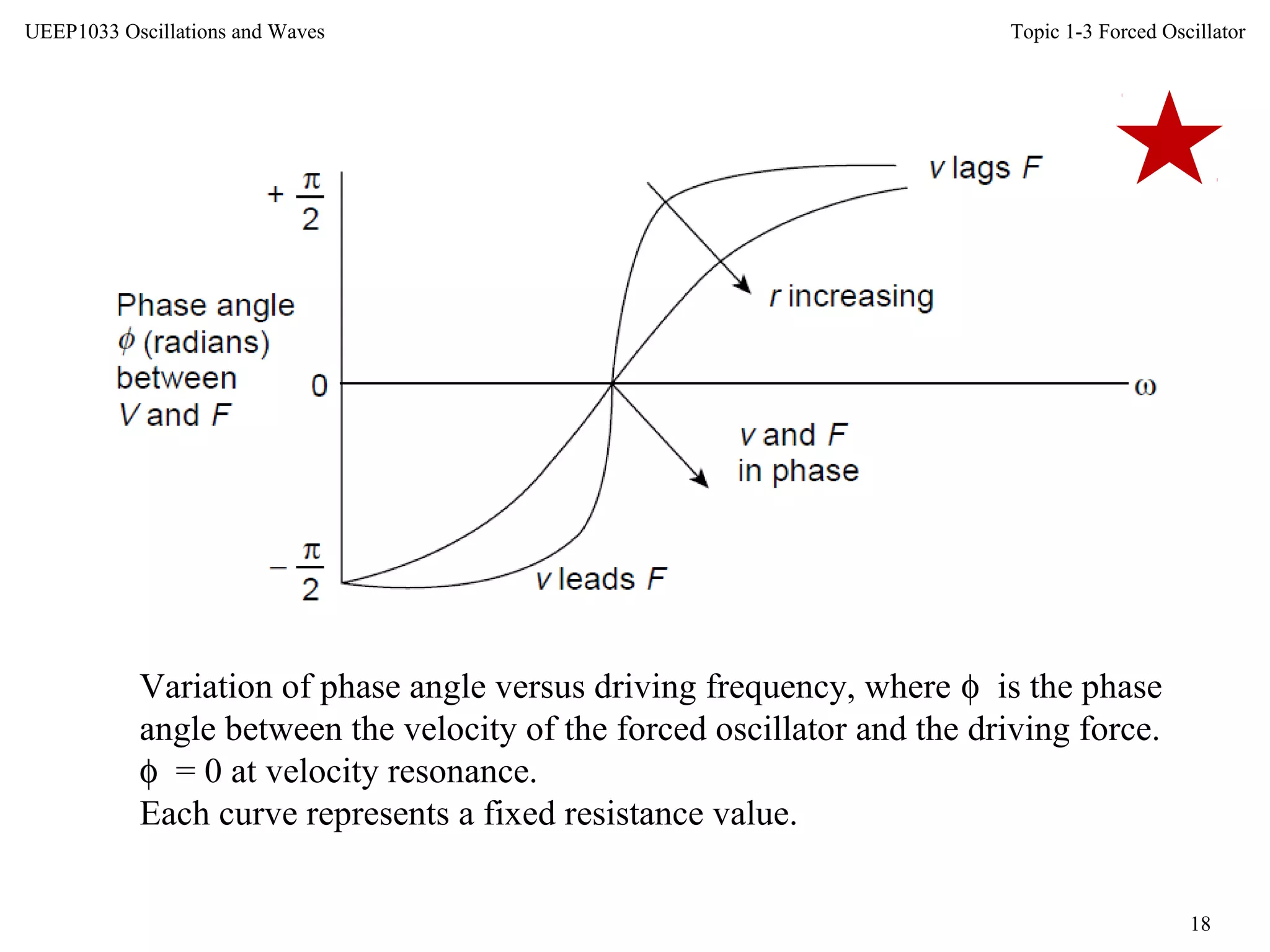
• φ > 0 (i.e. ωm > s/ω)  velocity v lags the force
• ω → ∞ then φ → 90o
: velocity lags the force by 90o
• φ < 0 (i.e. ωm < s/ω)  velocity v ahead of the force
• ω → 0 then φ → -90o
: velocity leads force by 90o
• φ = 0 (i.e. ω0m = s/ω0)  velocity and force are in phase
ω0 = frequency of velocity resonance
ω0
2
= s/m
Topic 1-3 Forced Oscillator
18
UEEP1033 Oscillations and Waves
Variation of phase angle versus driving frequency, where φ is the phase
angle between the velocity of the forced oscillator and the driving force.
φ = 0 at velocity resonance.
Each curve represents a fixed resistance value.
Topic 1-3 Forced Oscillator
19
UEEP1033 Oscillations and Waves
Behaviour of Displacement
versus Driving Force Frequency ω
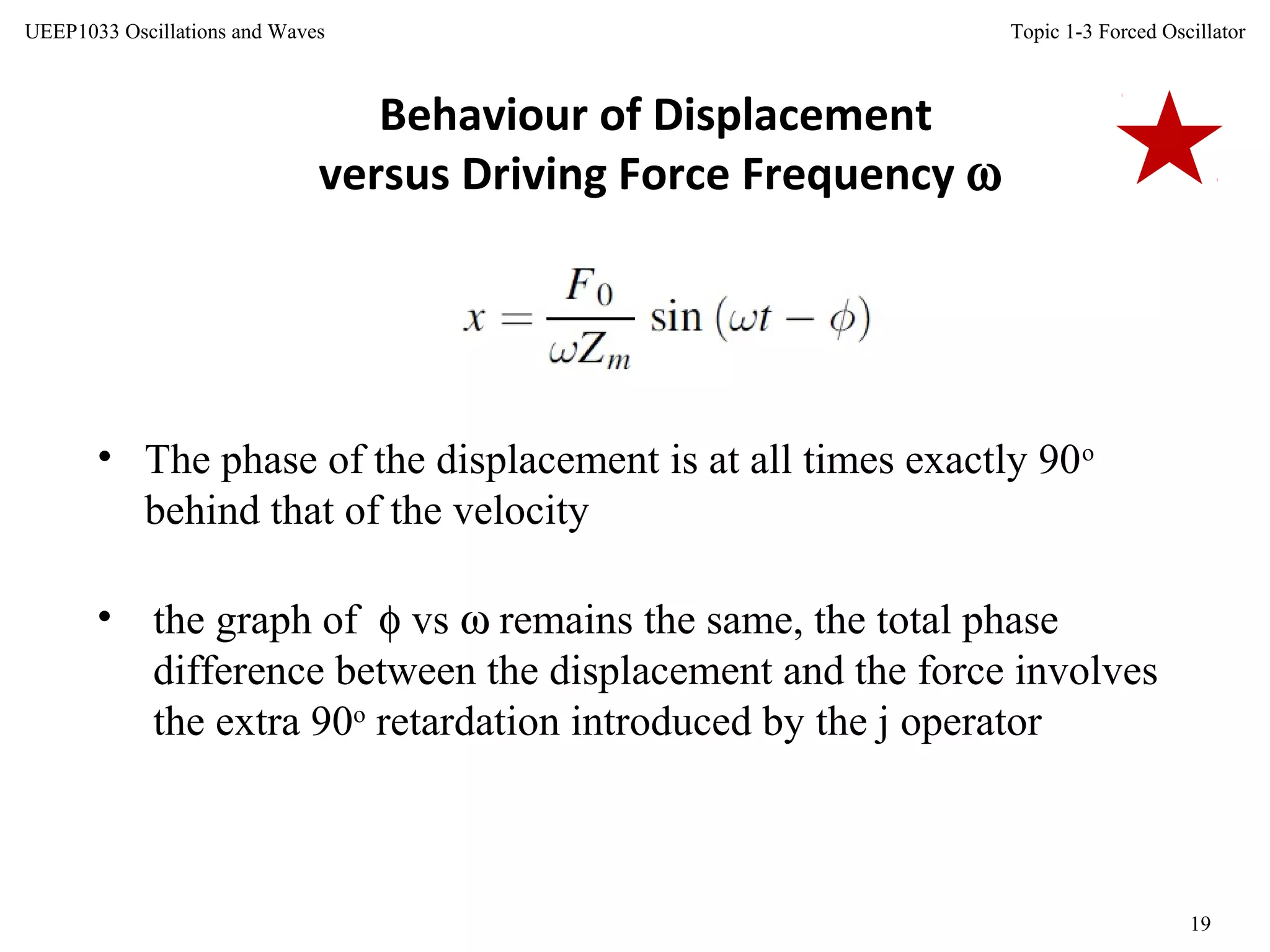
• The phase of the displacement is at all times exactly 90o
behind that of the velocity
• the graph of φ vs ω remains the same, the total phase
difference between the displacement and the force involves
the extra 90o
retardation introduced by the j operator
Topic 1-3 Forced Oscillator
20
UEEP1033 Oscillations and Waves
Behaviour of Displacement
versus Driving Force Frequency ω
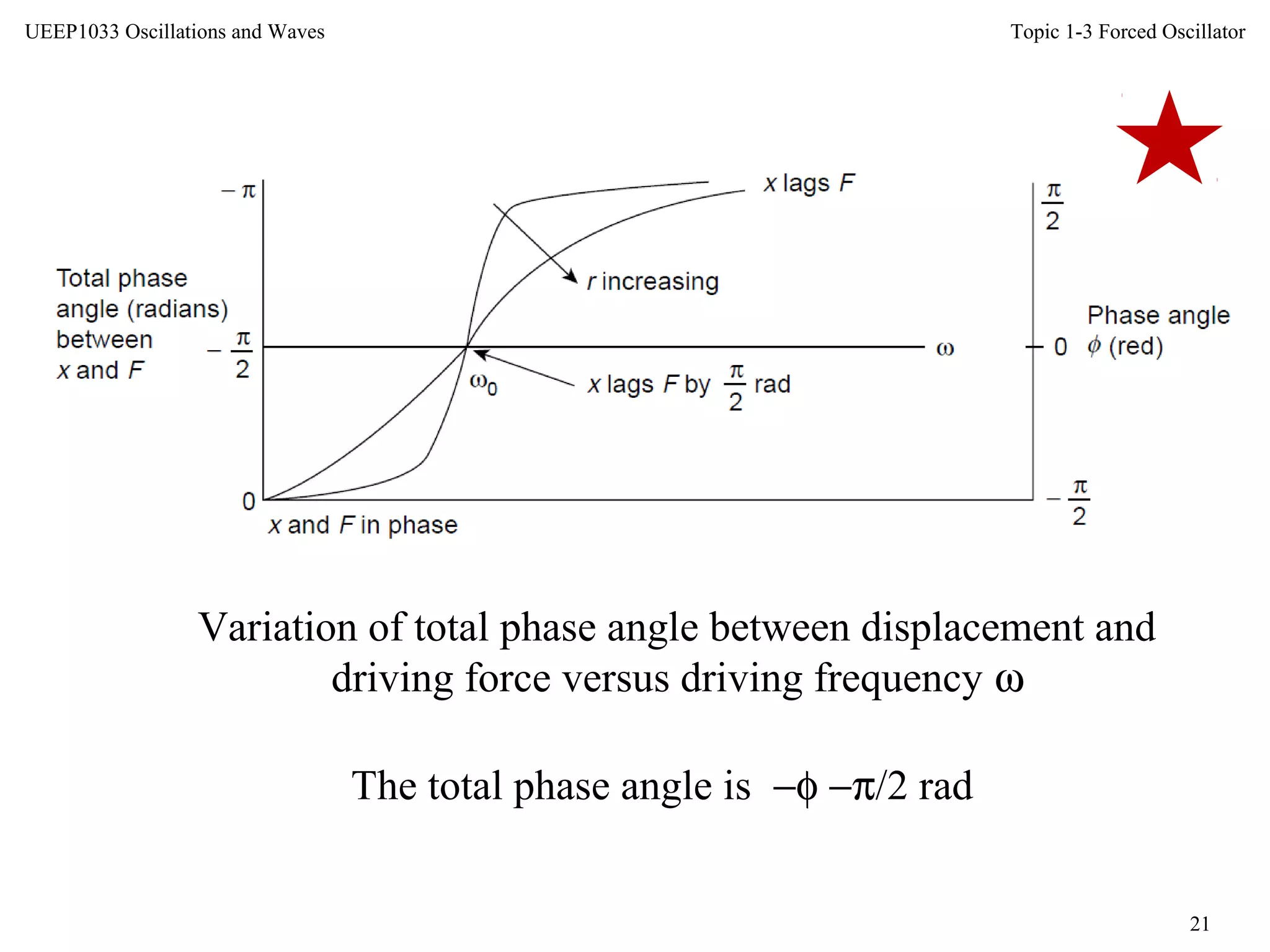
• At high frequencies the displacement lags the force by
π rad and is exactly out of phase
• the curve showing the phase angle between the
displacement and the force is equivalent to the φ versus ω
curve, displaced by an amount equal to π/2 rad
• at very low frequencies, where φ = −π/2 rad
 velocity leads the force
 displacement and the force are in phase
Topic 1-3 Forced Oscillator
21
UEEP1033 Oscillations and Waves
Variation of total phase angle between displacement and
driving force versus driving frequency ω
The total phase angle is −φ −π/2 rad
Topic 1-3 Forced Oscillator
22
UEEP1033 Oscillations and Waves
amplitude of the displacement : x = Fo /ωZm
At low frequencies: Zm = [r2
+ (ωm − s/ω)2
]1/2
→ s/ω
⇒ x ≈ Fo /(ωs/ ω) = Fo /s
At high frequencies: Zm → ωm
⇒ x ≈ Fo /(ω2
m)
At very large frequencies: x → 0
Topic 1-3 Forced Oscillator
23
UEEP1033 Oscillations and Waves
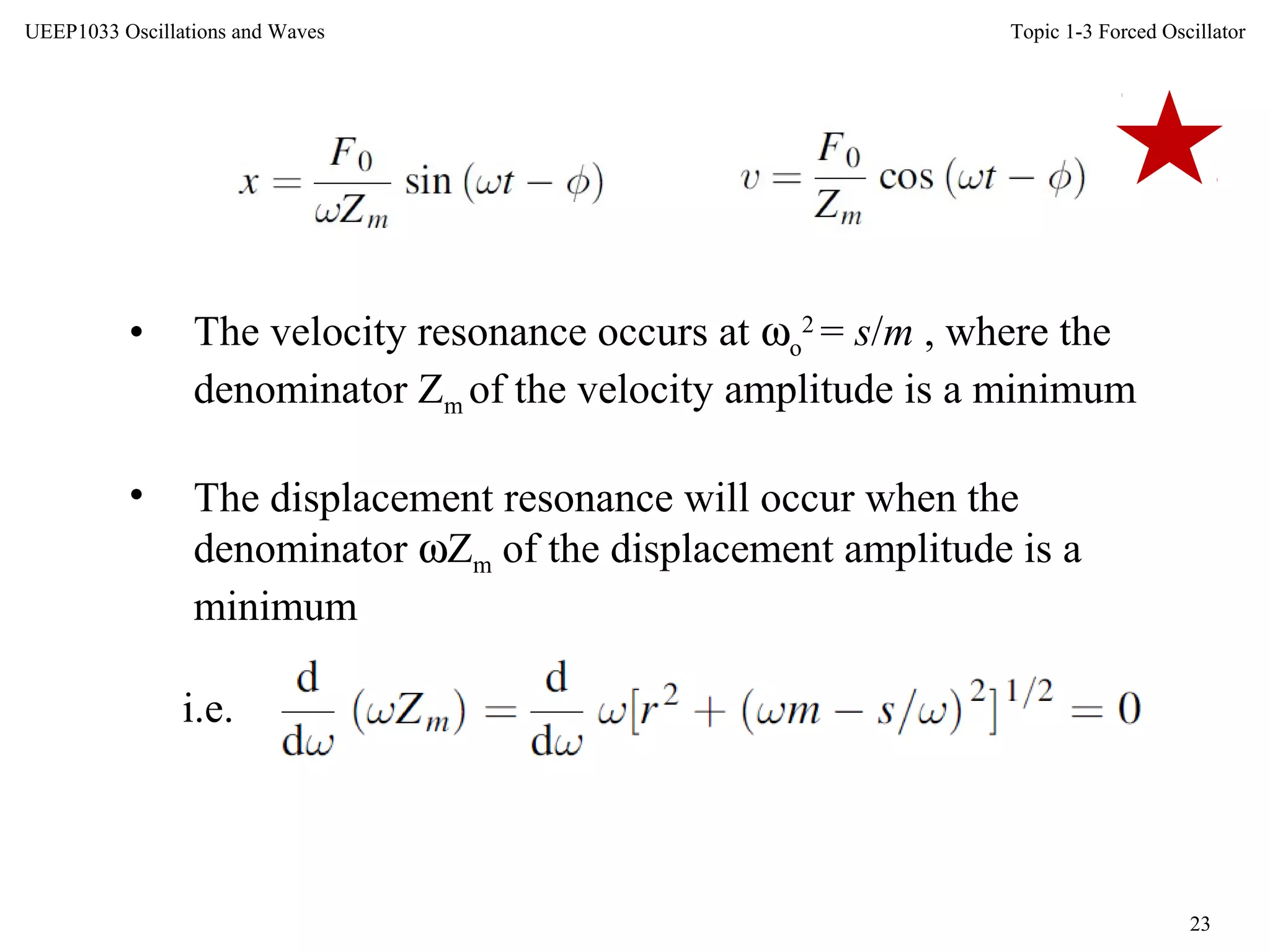
• The velocity resonance occurs at ωo
2
= s/m , where the
denominator Zm of the velocity amplitude is a minimum
• The displacement resonance will occur when the
denominator ωZm of the displacement amplitude is a
minimum
i.e.
Topic 1-3 Forced Oscillator
24
UEEP1033 Oscillations and Waves
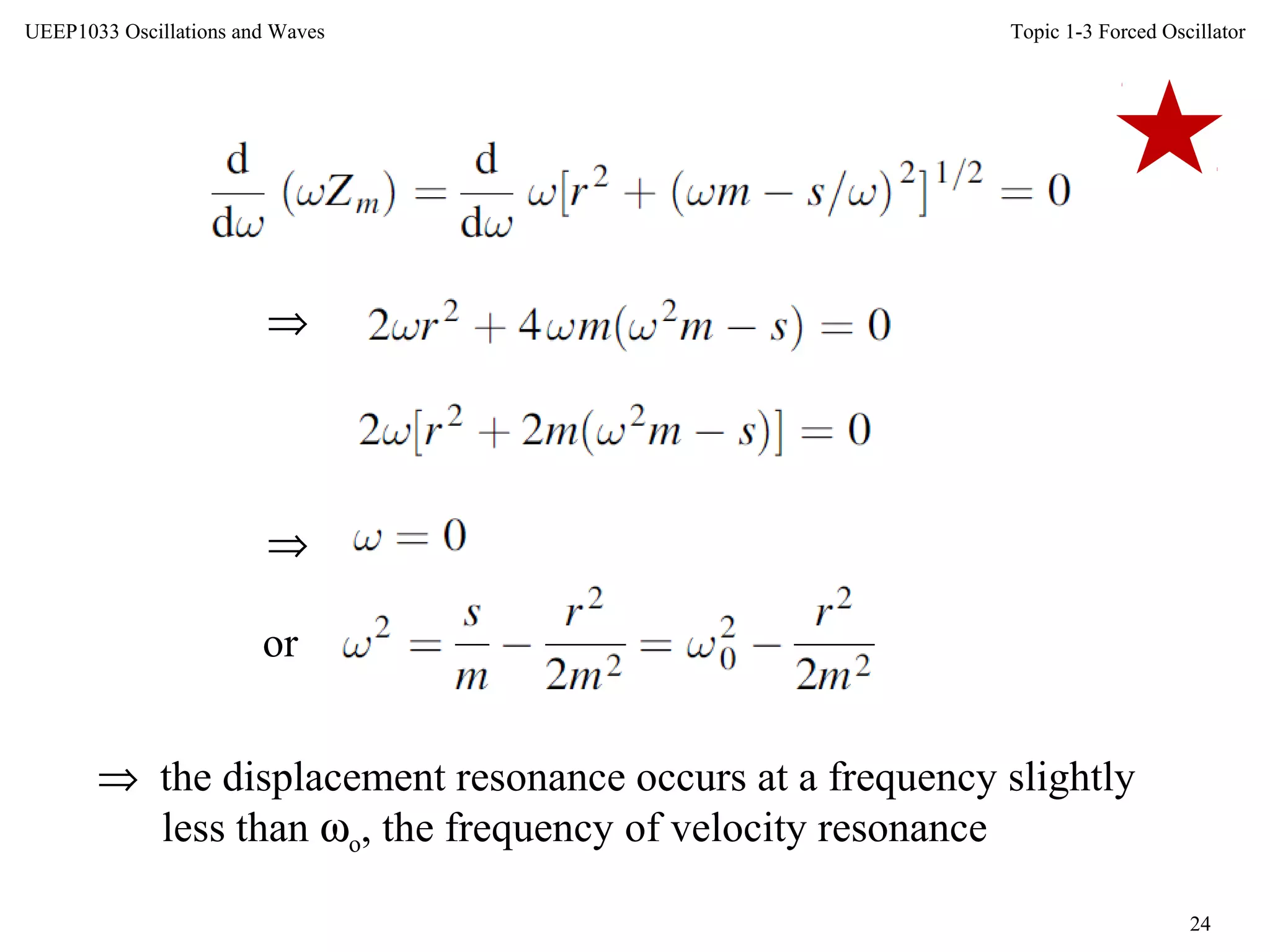
⇒
⇒
or
⇒ the displacement resonance occurs at a frequency slightly
less than ωo, the frequency of velocity resonance
Topic 1-3 Forced Oscillator
25
UEEP1033 Oscillations and Waves
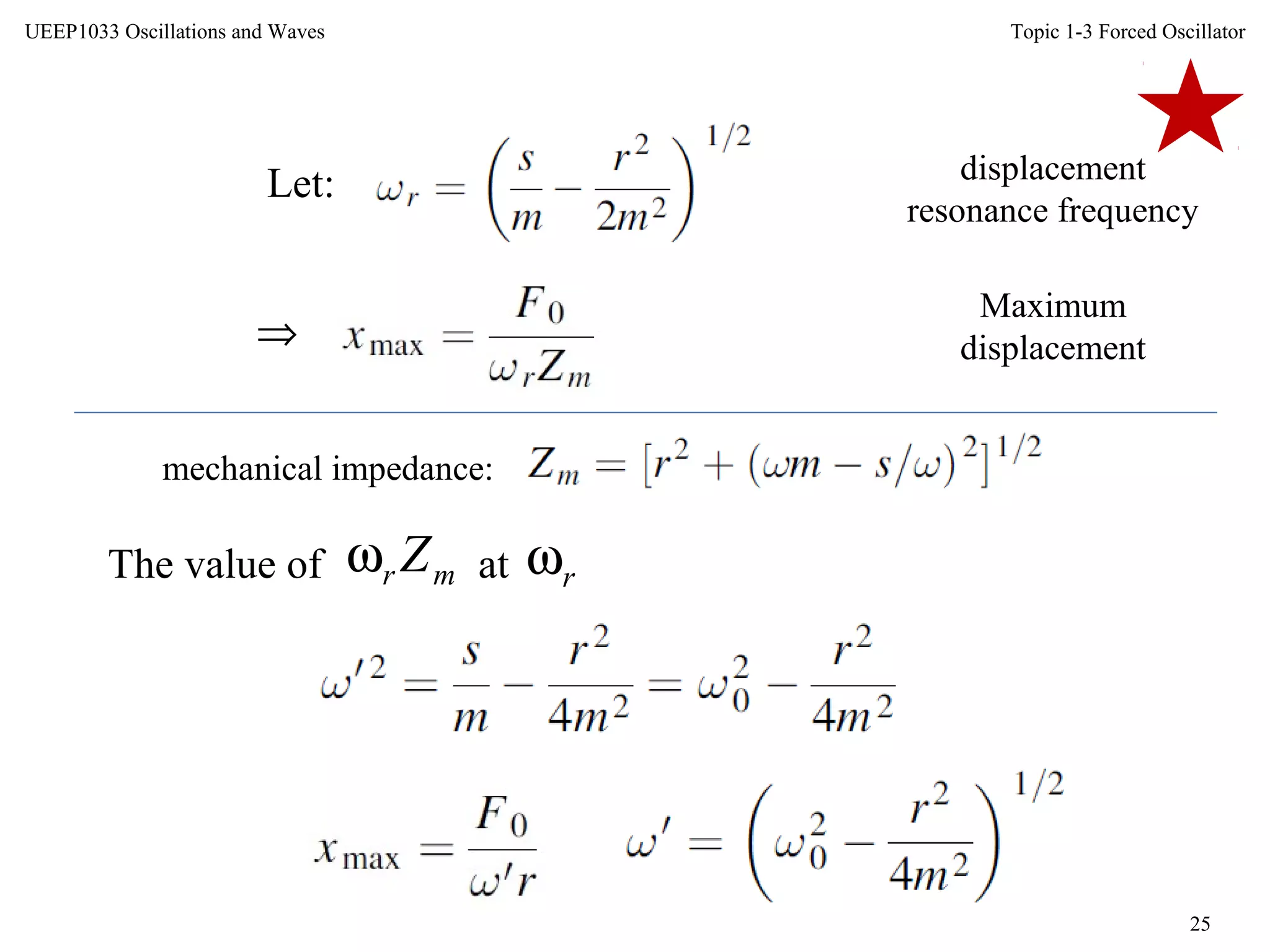
Let: displacement
resonance frequency
⇒
Maximum
displacement
mechanical impedance:
The value of mr Zω at rω
Topic 1-3 Forced Oscillator
26
UEEP1033 Oscillations and Waves
Topic 1-3 Forced Oscillator
27
UEEP1033 Oscillations and Waves
Topic 1-3 Forced Oscillator
28
UEEP1033 Oscillations and Waves
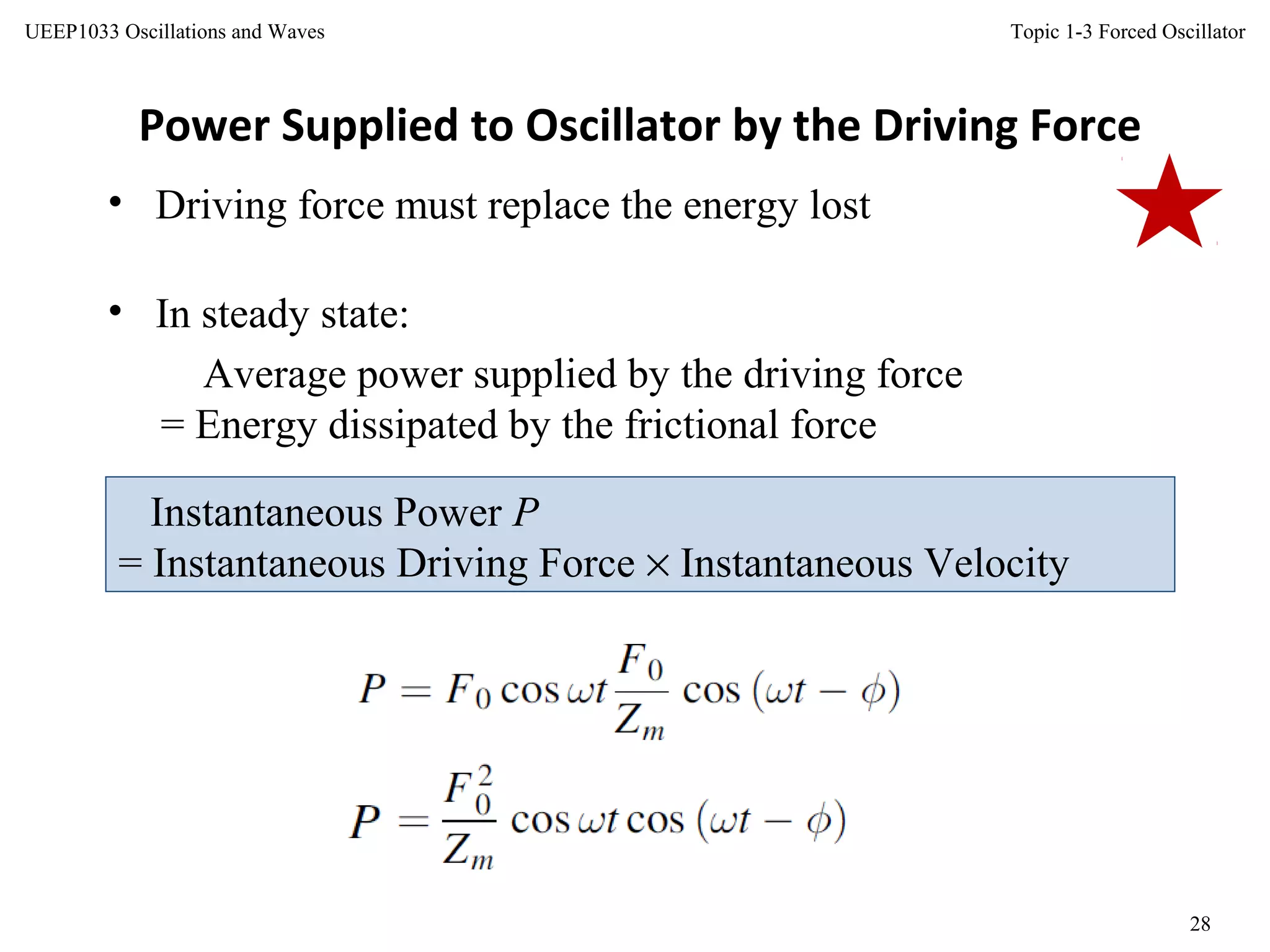
Power Supplied to Oscillator by the Driving Force
• Driving force must replace the energy lost
• In steady state:
Instantaneous Power P
= Instantaneous Driving Force × Instantaneous Velocity
Average power supplied by the driving force
= Energy dissipated by the frictional force
Topic 1-3 Forced Oscillator
29
UEEP1033 Oscillations and Waves
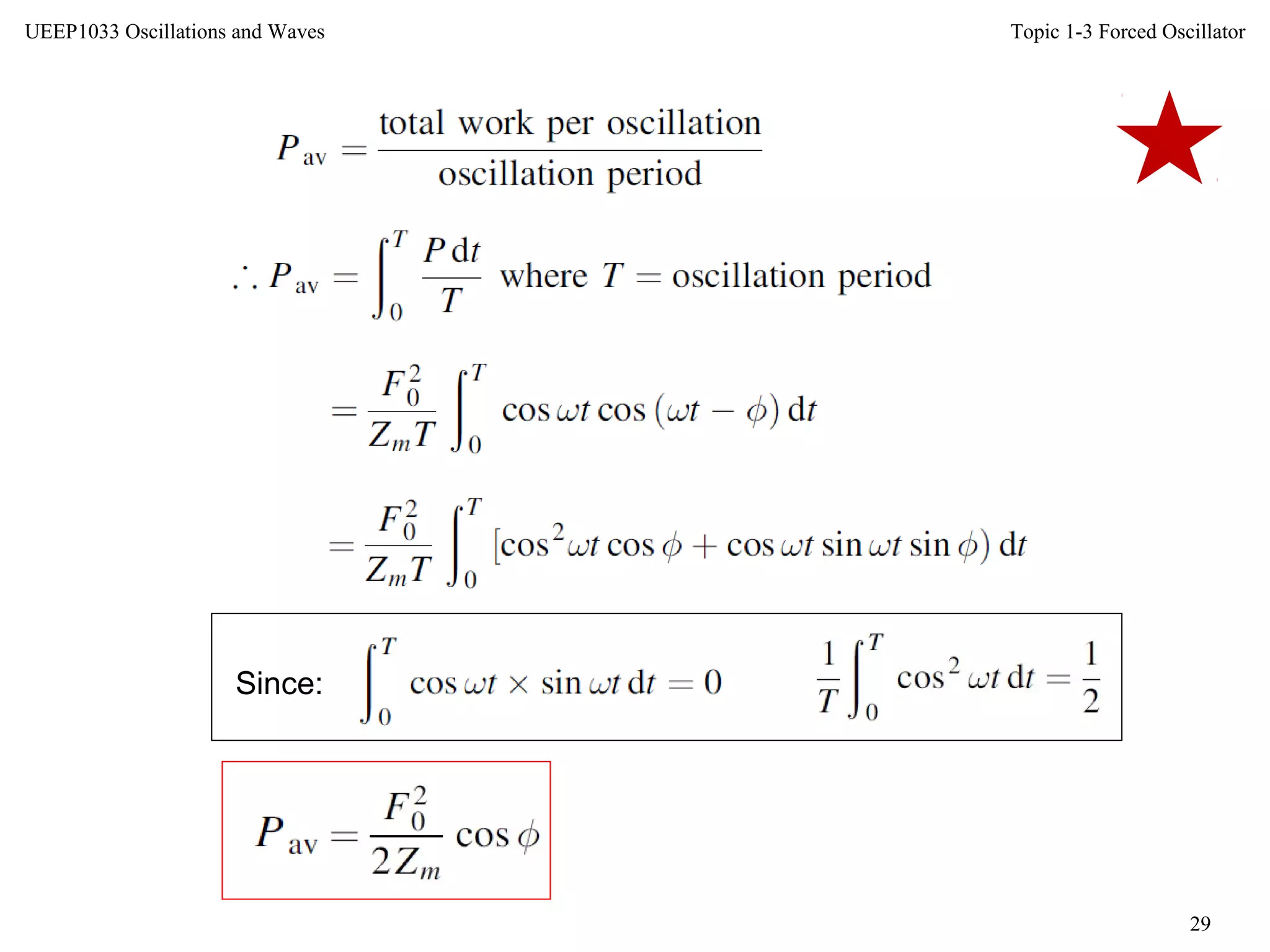
Since:
Topic 1-3 Forced Oscillator
30
UEEP1033 Oscillations and Waves
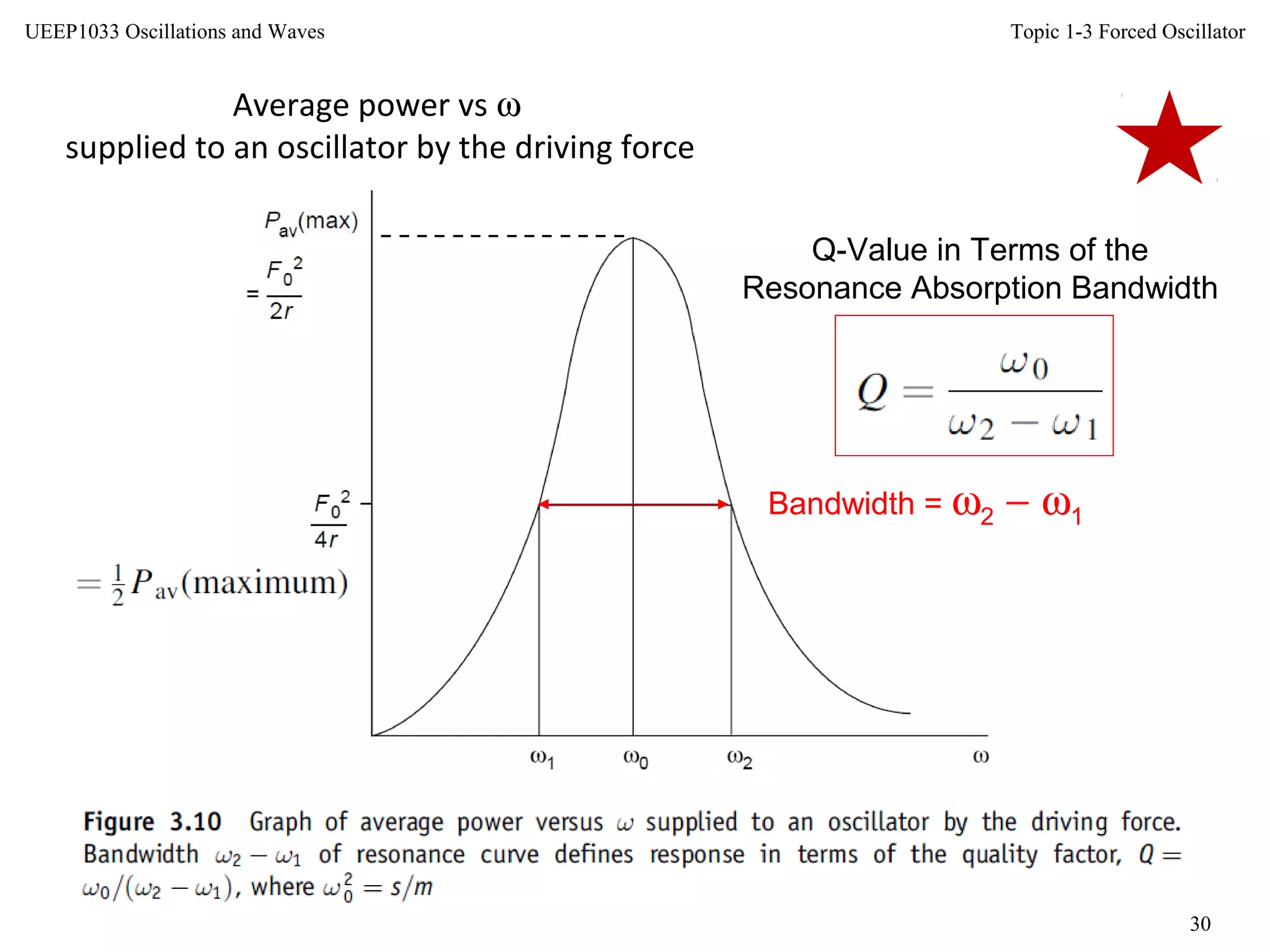
Average power vs ω
supplied to an oscillator by the driving force
Q-Value in Terms of the
Resonance Absorption Bandwidth
Bandwidth = ω2 − ω1
Topic 1-3 Forced Oscillator
31
UEEP1033 Oscillations and Waves
The Q-Value as an Amplification Factor
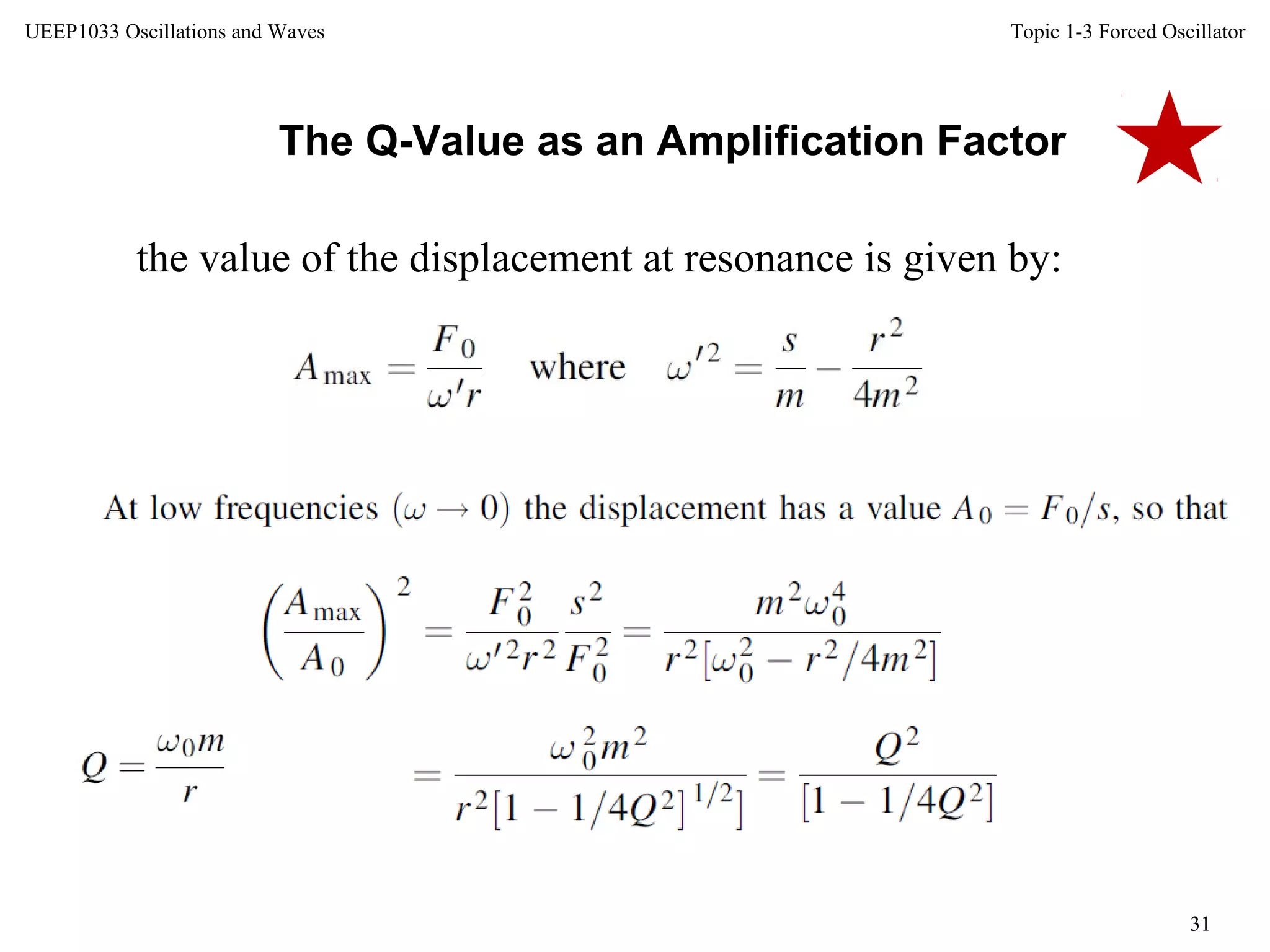
the value of the displacement at resonance is given by:
Topic 1-3 Forced Oscillator
32
UEEP1033 Oscillations and Waves
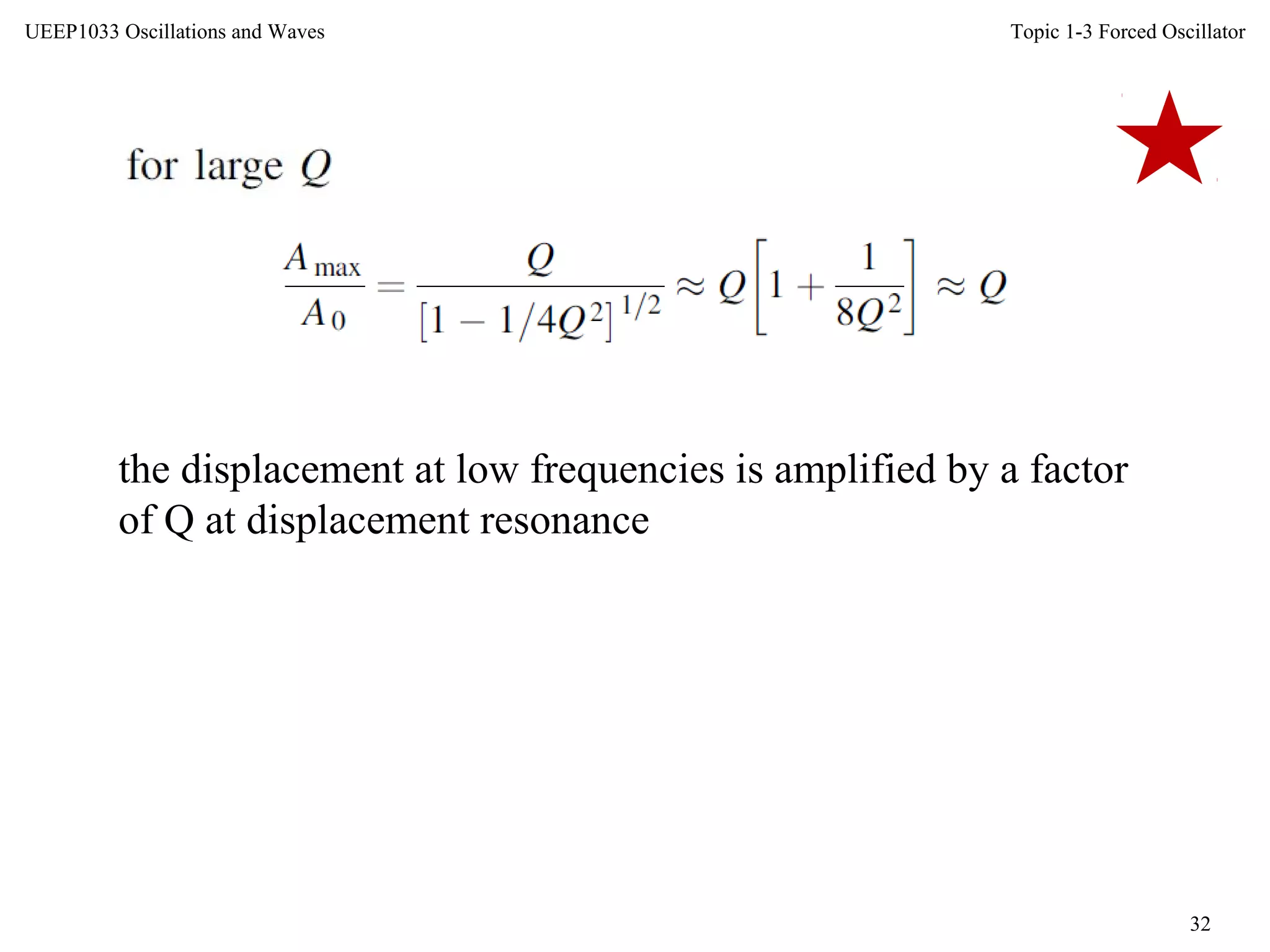
the displacement at low frequencies is amplified by a factor
of Q at displacement resonance
Topic 1-3 Forced Oscillator
33
UEEP1033 Oscillations and Waves
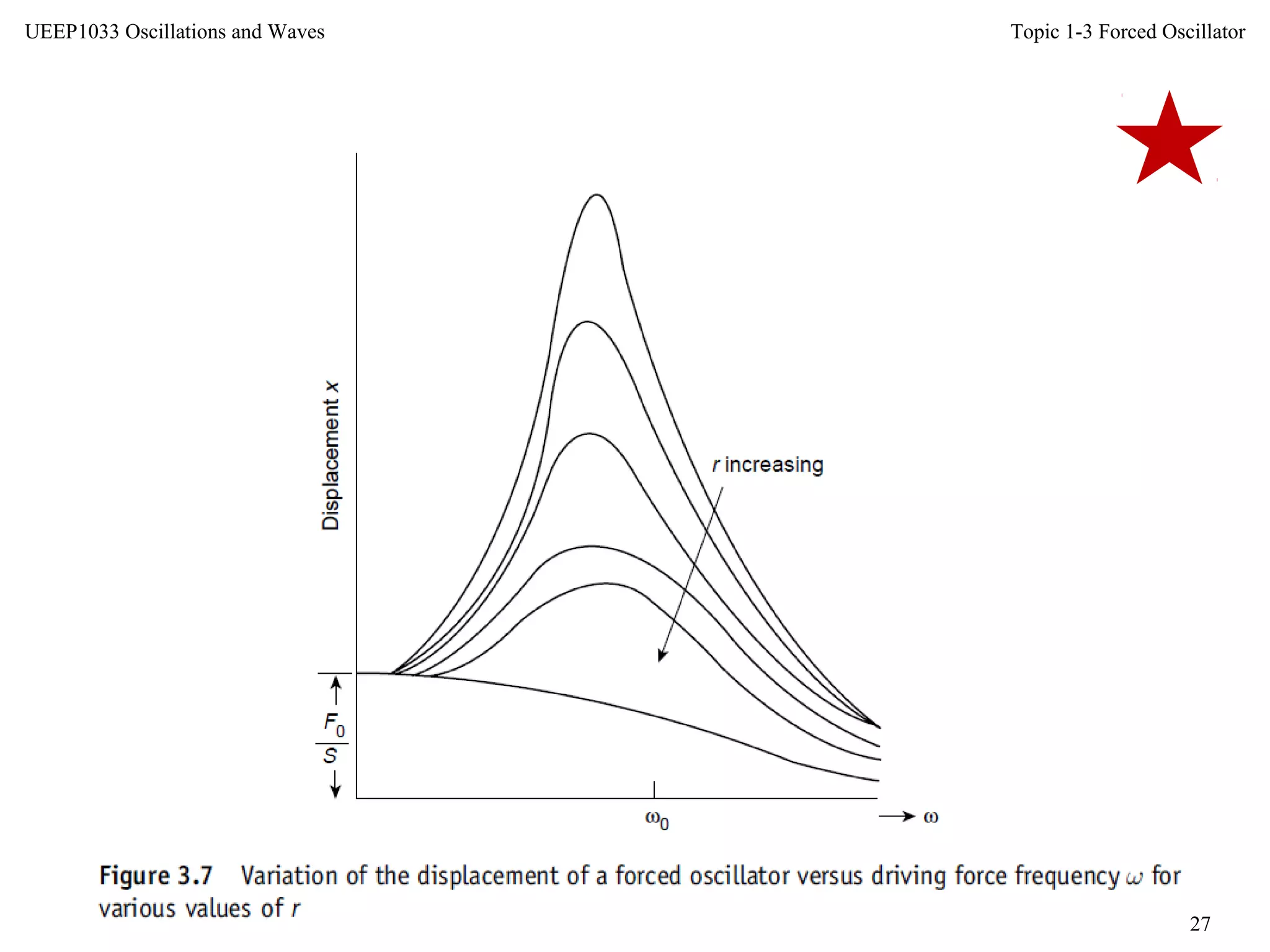
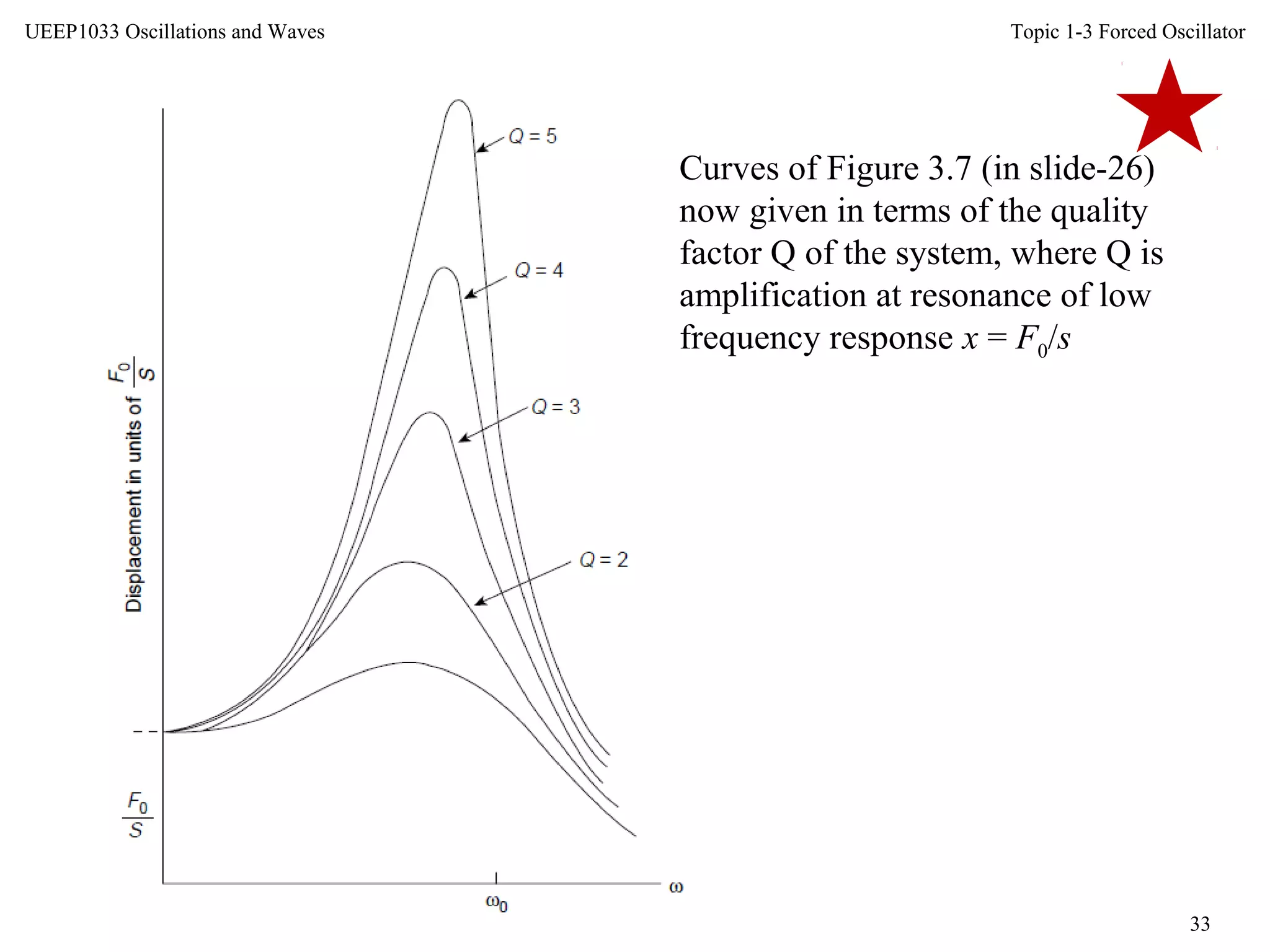
Curves of Figure 3.7 (in slide-26)
now given in terms of the quality
factor Q of the system, where Q is
amplification at resonance of low
frequency response x = F0/s

Topic 3 forced oscillator

  • 1.
    Topic 1-3 ForcedOscillator 1 UEEP1033 Oscillations and Waves Topic 3: Forced Oscillator
  • 2.
    Topic 1-3 ForcedOscillator 2 UEEP1033 Oscillations and Waves Vector: r = a + ib irsinφ −irsinφ r= rejφ r*= re-jφ −ib ib magnitude or modulus or r: = complex conjugate of
  • 3.
    Topic 1-3 ForcedOscillator 3 UEEP1033 Oscillations and Waves
  • 4.
    Topic 1-3 ForcedOscillator 4 UEEP1033 Oscillations and Waves Vector form of Ohm’s Law inductance L and capacitance C, will introduce a phase difference between voltage and current Ohm’s Law takes the vector form: Ze = R + i(ωL − 1/ωC) = vector sum of the effective resistances of R, L, and C in the circuit
  • 5.
    Topic 1-3 ForcedOscillator 5 UEEP1033 Oscillations and Waves magnitude of the impedance: the vector : φ = phase difference between the total voltage across the circuit and the current through it iωL Cω − 1 i       ω ω= C Xe 1 -Lii = reactive component of Ze Electrical impedance: Ze = R + i(ωL − 1/ωC)
  • 6.
    Topic 1-3 ForcedOscillator 6 UEEP1033 Oscillations and Waves • φ can be positive or negative depending on the relative value of ωL and 1/ωC • when ωL > 1/ωC ⇒ φ = positive but the frequency dependence of the components show that φ can change both sign and size • magnitude of Ze is also frequency dependent when ωL = 1/ωC ⇒ Ze = R In the vector form of Ohm’s Law: V = I Ze If V = V0eiωt and Ze = Zeeiφ ⇒ current amplitude I lags the V by a phase angle φ ||
  • 7.
    Topic 1-3 ForcedOscillator 7 UEEP1033 Oscillations and Waves Impedance of a Mechanical Circuit • Mechanical circuit has mass, stiffness and resistance • Mechanical impedance = the force required to produce unit velocity in the oscillator i.e. Zm = F/v • Mechanical impedance : • Magnitude of Zm:
  • 8.
    Topic 1-3 ForcedOscillator 8 UEEP1033 Oscillations and Waves • A mechanical oscillator of mass m, stiffness s and resistance r being driven by an alternating force F0cosωt • Mechanical equation of motion: Behaviour of a Forced Oscillator • Voltage equation in electrical case:
  • 9.
    Topic 1-3 ForcedOscillator 9 UEEP1033 Oscillations and Waves Mechanical forced oscillator with force F0 cosωt applied to damped mechanical circuit The complete solution for x in the equation of motion consists of two terms: (1) A ‘transient’ term which dies away with time x decays with This term is the solution to the equation
  • 10.
    Topic 1-3 ForcedOscillator 10 UEEP1033 Oscillations and Waves (2) The ‘steady state’ term – describes the behaviour of the oscillator after the transient term has died away, i.e describes the ultimate behaviour of the oscillator Force equation in vector form: Solution: Velocity: Acceleration: Equation of motion:
  • 11.
    Topic 1-3 ForcedOscillator 11 UEEP1033 Oscillations and Waves × This vector form of the steady state behaviour of x gives three pieces of information and completely defines the magnitude of the displacement x and its phase with respect to the driving force after the transient term dies away ⇒
  • 12.
    Topic 1-3 ForcedOscillator 12 UEEP1033 Oscillations and Waves 1. Phase difference φ exist between x and the force 2. Even if φ = 0, the displacement x would lag the force F0cos ωt by 900 3. The maximum amplitude of the displacement x is F0/ωZm The value of x resulting from F0 cosωt is:
  • 13.
    Topic 1-3 ForcedOscillator 13 UEEP1033 Oscillations and Waves velocity of the forced oscillation in the steady state: • The velocity v and the force differ in phase only by φ • When φ = 0 the velocity and force are in phase • Amplitude of the velocity = F0/Zm real part of the vector expression for the velocity: • velocity is 90o ahead of the displacement in phase • velocity differs from the force only by a phase angle φ
  • 14.
    Topic 1-3 ForcedOscillator 14 UEEP1033 Oscillations and Waves Phase angle φ: Displacement: Velocity:
  • 15.
    Topic 1-3 ForcedOscillator 15 UEEP1033 Oscillations and Waves Behaviour of Velocity in Magnitude and Phase versus Driving Force • Velocity amplitude: • Magnitude of velocity vary with frequency ω • At low frequency, impedance is stiffness controlled • At high frequency, impedance is mass controlled • At frequency ω0 where , the impedance has a minimum Zm = r • tanφ = 0 at ω0 , the velocity and force being in phase
  • 16.
    Topic 1-3 ForcedOscillator 16 UEEP1033 Oscillations and Waves Velocity v of Forced Oscillator versus Driving Frequency ω ω0 = frequency of velocity resonance
  • 17.
    Topic 1-3 ForcedOscillator 17 UEEP1033 Oscillations and Waves • Velocity • φ > 0 (i.e. ωm > s/ω)  velocity v lags the force • ω → ∞ then φ → 90o : velocity lags the force by 90o • φ < 0 (i.e. ωm < s/ω)  velocity v ahead of the force • ω → 0 then φ → -90o : velocity leads force by 90o • φ = 0 (i.e. ω0m = s/ω0)  velocity and force are in phase ω0 = frequency of velocity resonance ω0 2 = s/m
  • 18.
    Topic 1-3 ForcedOscillator 18 UEEP1033 Oscillations and Waves Variation of phase angle versus driving frequency, where φ is the phase angle between the velocity of the forced oscillator and the driving force. φ = 0 at velocity resonance. Each curve represents a fixed resistance value.
  • 19.
    Topic 1-3 ForcedOscillator 19 UEEP1033 Oscillations and Waves Behaviour of Displacement versus Driving Force Frequency ω • The phase of the displacement is at all times exactly 90o behind that of the velocity • the graph of φ vs ω remains the same, the total phase difference between the displacement and the force involves the extra 90o retardation introduced by the j operator
  • 20.
    Topic 1-3 ForcedOscillator 20 UEEP1033 Oscillations and Waves Behaviour of Displacement versus Driving Force Frequency ω • At high frequencies the displacement lags the force by π rad and is exactly out of phase • the curve showing the phase angle between the displacement and the force is equivalent to the φ versus ω curve, displaced by an amount equal to π/2 rad • at very low frequencies, where φ = −π/2 rad  velocity leads the force  displacement and the force are in phase
  • 21.
    Topic 1-3 ForcedOscillator 21 UEEP1033 Oscillations and Waves Variation of total phase angle between displacement and driving force versus driving frequency ω The total phase angle is −φ −π/2 rad
  • 22.
    Topic 1-3 ForcedOscillator 22 UEEP1033 Oscillations and Waves amplitude of the displacement : x = Fo /ωZm At low frequencies: Zm = [r2 + (ωm − s/ω)2 ]1/2 → s/ω ⇒ x ≈ Fo /(ωs/ ω) = Fo /s At high frequencies: Zm → ωm ⇒ x ≈ Fo /(ω2 m) At very large frequencies: x → 0
  • 23.
    Topic 1-3 ForcedOscillator 23 UEEP1033 Oscillations and Waves • The velocity resonance occurs at ωo 2 = s/m , where the denominator Zm of the velocity amplitude is a minimum • The displacement resonance will occur when the denominator ωZm of the displacement amplitude is a minimum i.e.
  • 24.
    Topic 1-3 ForcedOscillator 24 UEEP1033 Oscillations and Waves ⇒ ⇒ or ⇒ the displacement resonance occurs at a frequency slightly less than ωo, the frequency of velocity resonance
  • 25.
    Topic 1-3 ForcedOscillator 25 UEEP1033 Oscillations and Waves Let: displacement resonance frequency ⇒ Maximum displacement mechanical impedance: The value of mr Zω at rω
  • 26.
    Topic 1-3 ForcedOscillator 26 UEEP1033 Oscillations and Waves
  • 27.
    Topic 1-3 ForcedOscillator 27 UEEP1033 Oscillations and Waves
  • 28.
    Topic 1-3 ForcedOscillator 28 UEEP1033 Oscillations and Waves Power Supplied to Oscillator by the Driving Force • Driving force must replace the energy lost • In steady state: Instantaneous Power P = Instantaneous Driving Force × Instantaneous Velocity Average power supplied by the driving force = Energy dissipated by the frictional force
  • 29.
    Topic 1-3 ForcedOscillator 29 UEEP1033 Oscillations and Waves Since:
  • 30.
    Topic 1-3 ForcedOscillator 30 UEEP1033 Oscillations and Waves Average power vs ω supplied to an oscillator by the driving force Q-Value in Terms of the Resonance Absorption Bandwidth Bandwidth = ω2 − ω1
  • 31.
    Topic 1-3 ForcedOscillator 31 UEEP1033 Oscillations and Waves The Q-Value as an Amplification Factor the value of the displacement at resonance is given by:
  • 32.
    Topic 1-3 ForcedOscillator 32 UEEP1033 Oscillations and Waves the displacement at low frequencies is amplified by a factor of Q at displacement resonance
  • 33.
    Topic 1-3 ForcedOscillator 33 UEEP1033 Oscillations and Waves Curves of Figure 3.7 (in slide-26) now given in terms of the quality factor Q of the system, where Q is amplification at resonance of low frequency response x = F0/s