Damped Oscillations
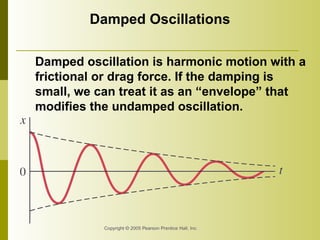
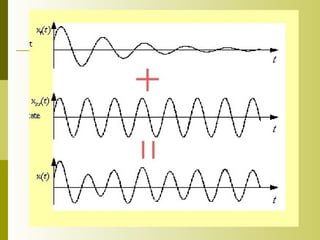
Damped oscillationis harmonic motion with a
frictional or drag force. If the damping is
small, we can treat it as an “envelope” that
modifies the undamped oscillation.
5.
t
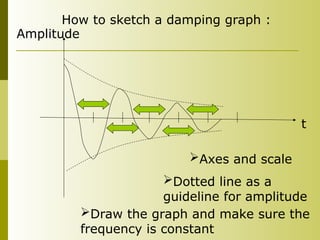
How to sketcha damping graph :
Amplitude
Axes and scale
Dotted line as a
guideline for amplitude
Draw the graph and make sure the
frequency is constant
7.
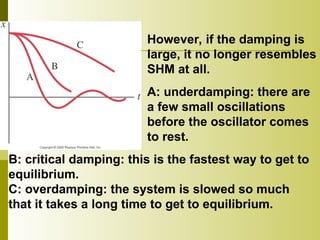
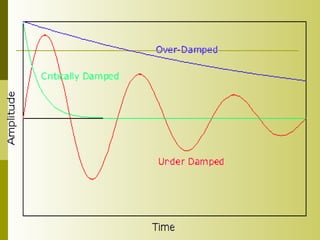
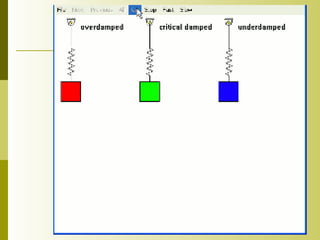
However, if thedamping is
large, it no longer resembles
SHM at all.
A: underdamping: there are
a few small oscillations
before the oscillator comes
to rest.
B: critical damping: this is the fastest way to get to
equilibrium.
C: overdamping: the system is slowed so much
that it takes a long time to get to equilibrium.
10.
Forced Vibrations; Resonance
Forcedvibrations occur when there is a
periodic driving force. This force may or may
not have the same period as the natural
frequency of the system.
If the frequency is the same as the natural
frequency, the amplitude becomes quite large.
This is called resonance.
12.
Examples of resonance.
Pushinga child on a swing – maximum A
when pushing = o
Tuning a radio – electrical resonance occurs
when o of tuning circuit adjusted to match
of incoming signal
Pipe instruments - column of air forced to
vibrate. If reed = o of column loud sound
produced
Rotating machinery – e.g. washing machine.
An out of balance drum will result in violent
vibrations at certain speeds
On November 7,1940,the Tacoma Narrows bridge began
resonating under the influence of strong winds, leading to
its collapse.
15.
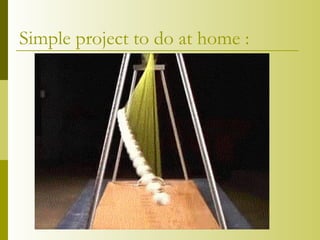
Barton’s Pendulum
All objectshave a natural frequency of
vibration or resonant frequency. If you force
a system - in this case a set of pendulums -
to oscillate, you get a maximum transfer of
energy, i.e. maximum amplitude imparted.
When the driving frequency equals the
resonant frequency of the driven system.
The phase relationship between the driver
and driven oscillator is also related by their
relative frequencies of oscillation.
18.
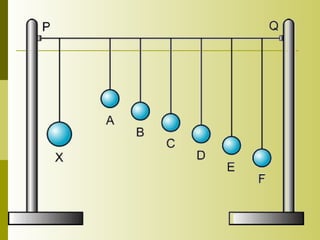
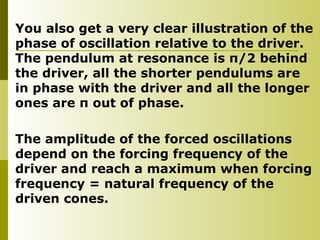
You also geta very clear illustration of the
phase of oscillation relative to the driver.
The pendulum at resonance is π/2 behind
the driver, all the shorter pendulums are
in phase with the driver and all the longer
ones are π out of phase.
The amplitude of the forced oscillations
depend on the forcing frequency of the
driver and reach a maximum when forcing
frequency = natural frequency of the
driven cones.
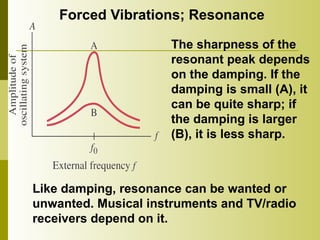
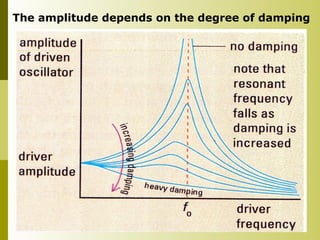
Forced Vibrations; Resonance
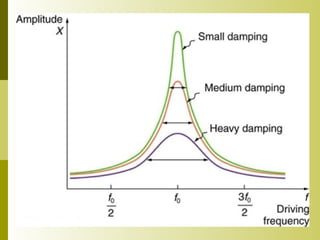
Thesharpness of the
resonant peak depends
on the damping. If the
damping is small (A), it
can be quite sharp; if
the damping is larger
(B), it is less sharp.
Like damping, resonance can be wanted or
unwanted. Musical instruments and TV/radio
receivers depend on it.
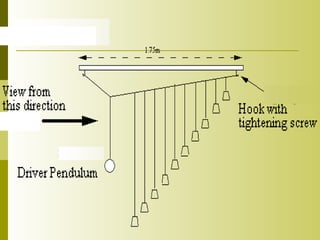
#16 Barton’s Pendulum consists of several pendulums hanging from a single thread that is connected between the two ends of a wooden rod (figure 1). The thread sags in this asymmetric way because the driver pendulum is a wooden ball 5cm in diameter, and the other’s are inverted cones. The lengths of the driven pendulums have a range which includes the length of the driver.
When the driver is given a swing, it sets into motion the other ten pendulums, with the result that the 0.5m driven pendulum has the largest amplitude and the other amplitudes being smaller and smaller the further away from the 0.5m they are.