Course outcomes
After completingthe course the students will be able
To learn about periodic motion.
To define SHM and explain it with various of examples
To learn about the relationship between uniform circular motion and
SHM.
To analyze SHM in terms of potential energy and kinetic energy
To describe effects of damping, forced vibrations and resonance
To solve quantitative problems involving SHM
3.
Challenges of teaching
1.Students should have preliminary knowledge on radians,
trigonometric functions and the small angle approximation .
2. Students must learn to Link the kinematic description of SHM
with an understanding of how the force changes.
3. Students should have good knowledge on the Differentiations of
trigonometric functions.
4.
A brief history
•It is considered that the Galileo’s pendulum experiments (1638, Two
new sciences) is the starting of study of SHM.
• Huygens, Newton & others were further developed the analyses.
• pendulum – clocks, seismometers
• ALL vibrations and waves - sea waves, earthquakes, tides, orbits
of planets and moons, water level in a toilet on a windy day, acoustics,
AC circuits, electromagnetic waves, vibrations molecular and
structural e.g. aircraft fuselage, musical instruments, bridges.
5.
Periodic Motion
• Ifthe motion of a system repeats itself after regular interval, then the
Motion is called periodic motion. The regular interval is called period
of the motion.
• Examples: Motion of celling fan, Motion of the arms of the clocks,
motion of pendulum, rocking chair, bouncing ball, vibrating tuning
fork, Motion of Planets or satellites in their orbits etc.
• If the motion is repeated after a regular interval of time then the
period of the motion is called Time Period (T).
6.
Simple Harmonic Motion
The two and fro periodic motion is called vibration or oscillation
In vibration or oscillation there is always an equilibrium position
The displacement of the vibrating or oscillating particle is measured
from the equilibrium position.
If the acceleration of the vibrating or oscillating particle hence the
force acting on it is proportional to the displacement and always
directed towards equilibrium position then the motion is called
‘SIMPLE HARMONIC MOTION (SHM)’.
All SHM s are periodic but all periodic motions are not SHM.
7.
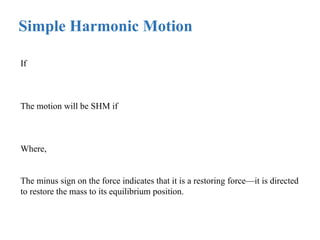
Simple Harmonic Motion
If
Themotion will be SHM if
Where,
The minus sign on the force indicates that it is a restoring force—it is directed
to restore the mass to its equilibrium position.
8.
Some important terms
Meanor Equilibrium position: The point where the oscillating particle
will remain in equilibrium.
Displacement: The distance covered by the oscillating particle from its
mean position at any given instant is known as is displacement at that
instant (x).
Amplitude: The maximum distance covered by an oscillating particle on
either sides of its mean position is called its amplitude (A)
Hence A= maximum x
9.
Some important terms
Timeperiod: Time taken for one complete cycle of its oscillation is
known as its time period (T) of its oscillation.
Frequency: Total number of complete oscillation in unit time (1s)
interval is called its frequency (f) of oscillation.
The relation between the time period and frequency is
Phase: The argument, of the trigonometric function that represent a SHM,
represents the state of the motion i.e., its position, velocity, acceleration
etc. is called its phase.
10.
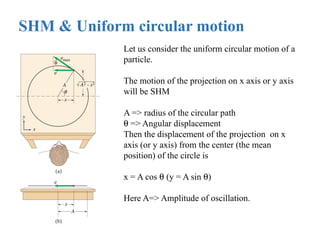
SHM & Uniformcircular motion
Let us consider the uniform circular motion of a
particle.
The motion of the projection on x axis or y axis
will be SHM
A => radius of the circular path
q => Angular displacement
Then the displacement of the projection on x
axis (or y axis) from the center (the mean
position) of the circle is
x = A cos q (y = A sin q)
Here A=> Amplitude of oscillation.
11.
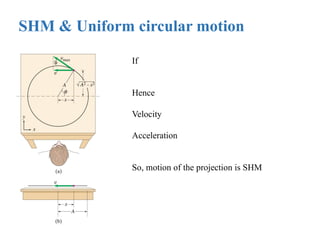
SHM & Uniformcircular motion
If
Hence
Velocity
Acceleration
So, motion of the projection is SHM
12.
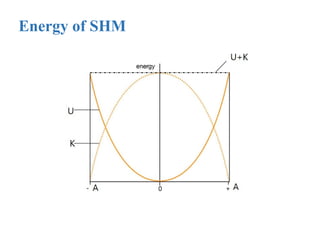
Energy of SHM
Totalenergy of SHM = Kinetic Energy (K.E) + Potential Energy (P.E)
Kinetic Energy:
Hence K.E =
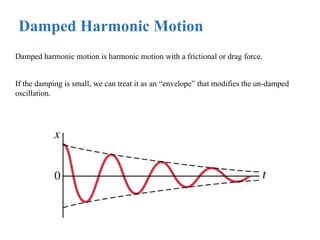
Damped Harmonic Motion
Dampedharmonic motion is harmonic motion with a frictional or drag force.
If the damping is small, we can treat it as an “envelope” that modifies the un-damped
oscillation.
16.
Damped Harmonic Motion
Ifthe damping is large, it no longer resembles SHM at all.
A: underdamping: there are a few small oscillations before the oscillator comes to rest.
B: critical damping: this is the fastest way to get to equilibrium.
C: over-damping: the system is slowed so much that it takes a long time to get to
equilibrium.
17.
Damped Harmonic Motion
Thereare systems where damping is unwanted, such as clocks and watches.
Then there are systems in which it is wanted, and often needs to be as close to
critical damping as possible, such as automobile shock absorbers and earthquake
protection for buildings.
18.
In damped harmonicmotion due to damping, energy of the oscillating
particle will decrees continuously and as a result the amplitude of oscillation
will decrees continuously to zero
For sustained oscillation for overcoming the damping we need to supply
external periodic force.
Forced vibrations occur when there is a periodic driving force. This force
may or may not have the same period as the natural frequency of the system.
If the frequency is the same as the natural frequency, the amplitude becomes
quite large. This is called resonance.
Forced Oscillation: Resonance
19.
Forced Oscillation: Resonance
Thesharpness of the resonant peak depends on
the damping. If the damping is small (A), it can
be quite sharp; if the damping is larger (B), it is
less sharp.
Like damping, resonance can be wanted or unwanted. Musical instruments and
TV/radio receivers depend on it.
20.
Numerical problems onSHM
A separate problem set is available along with this
video lecture.