SMES1201: VIBRATION AND WAVES (GROUP 8)
TUTORIAL #2
NAME : WAN MOHAMAD FARHAN BIN AB RAHMAN
MATRICES NO : SEU110024
DATE : 12 MAY 2014
QUESTION 1
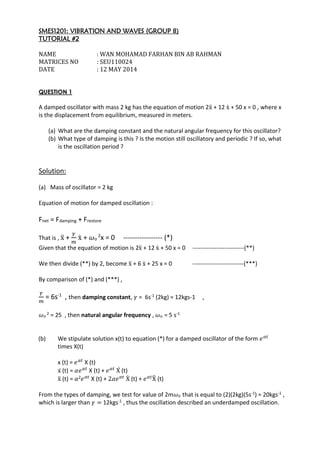
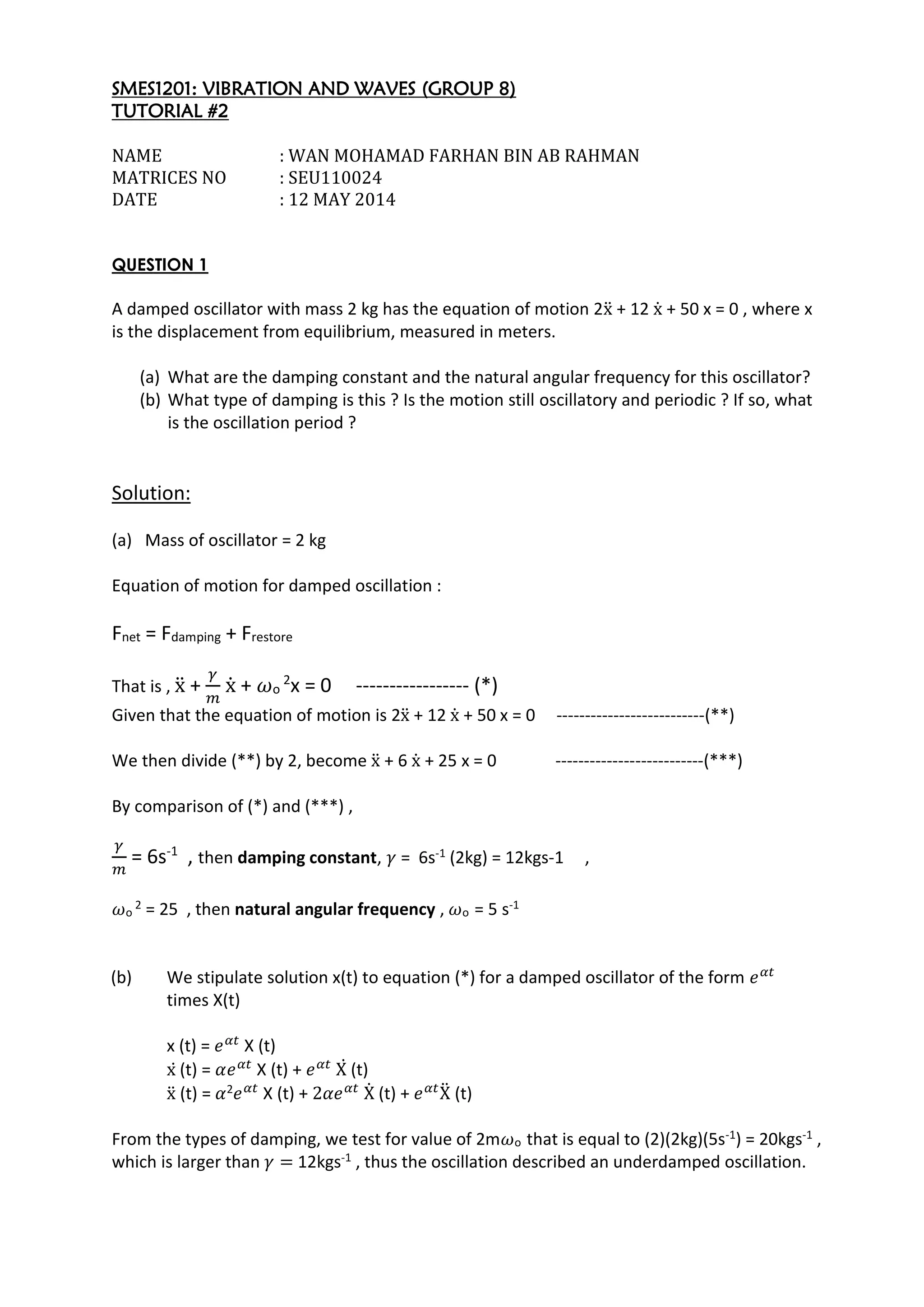
A damped oscillator with mass 2 kg has the equation of motion 2ẍ + 12 ẋ + 50 x = 0 , where x
is the displacement from equilibrium, measured in meters.
(a) What are the damping constant and the natural angular frequency for this oscillator?
(b) What type of damping is this ? Is the motion still oscillatory and periodic ? If so, what
is the oscillation period ?
Solution:
(a) Mass of oscillator = 2 kg
Equation of motion for damped oscillation :
Fnet = Fdamping + Frestore
That is , ẍ +
𝛾
𝑚
ẋ + 𝜔o
2
x = 0 ----------------- (*)
Given that the equation of motion is 2ẍ + 12 ẋ + 50 x = 0 --------------------------(**)
We then divide (**) by 2, become ẍ + 6 ẋ + 25 x = 0 --------------------------(***)
By comparison of (*) and (***) ,
𝛾
𝑚
= 6s-1
, then damping constant, 𝛾 = 6s-1 (2kg) = 12kgs-1 ,
𝜔o
2 = 25 , then natural angular frequency , 𝜔o = 5 s-1
(b) We stipulate solution x(t) to equation (*) for a damped oscillator of the form 𝑒 𝛼𝑡
times X(t)
x (t) = 𝑒 𝛼𝑡
X (t)
ẋ (t) = 𝛼𝑒 𝛼𝑡
X (t) + 𝑒 𝛼𝑡
Ẋ (t)
ẍ (t) = 𝛼2 𝑒 𝛼𝑡
X (t) + 2𝛼𝑒 𝛼𝑡
Ẋ (t) + 𝑒 𝛼𝑡
Ẍ (t)
From the types of damping, we test for value of 2m𝜔o that is equal to (2)(2kg)(5s-1) = 20kgs-1 ,
which is larger than 𝛾 = 12kgs-1 , thus the oscillation described an underdamped oscillation.
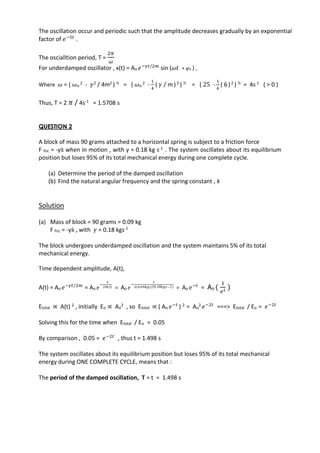
The oscillation occur and periodic such that the amplitude decreases gradually by an exponential
factor of 𝑒−5𝑡
.
The oscialltion period, T =
2𝜋
𝜔
For underdamped oscillator , x(t) = Ao 𝑒−𝛾𝑡/2𝑚
sin (𝜔𝑡 + 𝜑o ) ,
Where 𝜔 = ( 𝜔o
2 - 𝛾2 / 4m2 ) ½ = ( 𝜔o
2 -
1
4
( 𝛾 / m )2 ) ½ = ( 25 -
1
4
( 6 )2 ) ½ = 4s-1 ( > 0 )
Thus, T = 2 𝜋 / 4s-1 = 1.5708 s
QUESTION 2
A block of mass 90 grams attached to a horizontal spring is subject to a friction force
F fric = -γẋ when in motion , with γ = 0.18 kg s-1 . The system oscillates about its equilibrium
position but loses 95% of its total mechanical energy during one complete cycle.
(a) Determine the period of the damped oscillation
(b) Find the natural angular frequency and the spring constant , k
Solution
(a) Mass of block = 90 grams = 0.09 kg
F fric = -γẋ , with 𝛾 = 0.18 kgs-1
The block undergoes underdamped oscillation and the system maintains 5% of its total
mechanical energy.
Time dependent amplitude, A(t),
A(t) = Ao 𝑒−𝛾𝑡/2𝑚
= Ao 𝑒
−
𝑡
2𝑚/ 𝛾 = Ao 𝑒
−
𝑡
2(0.09𝑘𝑔)/(0.18𝑘𝑔𝑠−1) = Ao 𝑒−𝑡
= Ao (
1
𝑒 𝑡
)
Etotal ∝ A(t) 2 , initially Eo ∝ Ao
2 , so Etotal ∝ ( Ao 𝑒−𝑡
) 2 = Ao
2 𝑒−2𝑡
===> Etotal / Eo = 𝑒−2𝑡
Solving this for the time when Etotal / Eo = 0.05
By comparison , 0.05 = 𝑒−2𝑡
, thus t = 1.498 s
The system oscillates about its equilibrium position but loses 95% of its total mechanical
energy during ONE COMPLETE CYCLE, means that :
The period of the damped oscillation, T = t = 1.498 s
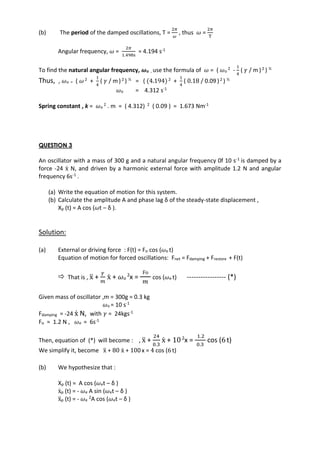
(b) The period of the damped oscillations, T =
2𝜋
𝜔
, thus 𝜔 =
2𝜋
T
Angular frequency, 𝜔 =
2𝜋
1.498s
= 4.194 s-1
To find the natural angular frequency, 𝝎o , use the formula of 𝜔 = ( 𝜔o
2 -
1
4
( 𝛾 / m )2 ) ½
Thus, , 𝜔o = ( 𝜔 2 +
1
4
( 𝛾 / m)2 ) ½ = ( (4.194) 2 +
1
4
( 0.18 / 0.09 )2 ) ½
𝜔o = 4.312 s-1
Spring constant , k = 𝜔o
2 . m = ( 4.312) 2 ( 0.09 ) = 1.673 Nm-1
QUESTION 3
An oscillator with a mass of 300 g and a natural angular frequency 0f 10 s-1 is damped by a
force -24 ẋ N, and driven by a harmonic external force with amplitude 1.2 N and angular
frequency 6s-1 .
(a) Write the equation of motion for this system.
(b) Calculate the amplitude A and phase lag δ of the steady-state displacement ,
Xp (t) = A cos (𝜔t – δ ).
Solution:
(a) External or driving force : F(t) = Fo cos (𝜔e t)
Equation of motion for forced oscillations: Fnet = Fdamping + Frestore + F(t)
 That is , ẍ +
𝛾
𝑚
ẋ + 𝜔o
2
x =
Fo
𝑚
cos (𝜔e t) ----------------- (*)
Given mass of oscillator ,m = 300g = 0.3 kg
𝜔o = 10 s-1
Fdamping = -24 ẋ N, with 𝛾 = 24kgs-1
Fo = 1.2 N , 𝜔e = 6s-1
Then, equation of (*) will become : , ẍ +
24
0.3
ẋ + 102
x =
1.2
0.3
cos (6t)
We simplify it, become ẍ + 80 ẋ + 100 x = 4 cos (6t)
(b) We hypothesize that :
Xp (t) = A cos (𝜔et – δ )
ẋp (t) = - 𝜔e A sin (𝜔et – δ )
ẍp (t) = - 𝜔e
2A cos (𝜔et – δ )
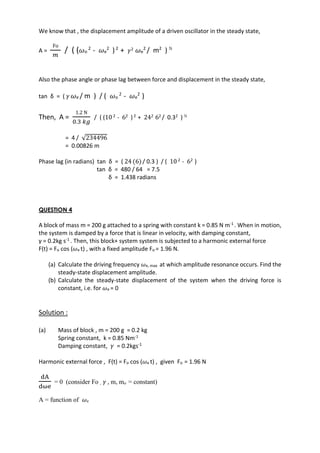
We know that , the displacement amplitude of a driven oscillator in the steady state,
A =
Fo
𝑚
/ ( ( 𝜔o
2
- 𝜔e
2
)2
+ 𝛾2 𝜔e
2
/ m2
) ½
Also the phase angle or phase lag between force and displacement in the steady state,
tan δ = ( 𝛾 𝜔e / m ) / ( 𝜔o
2
- 𝜔e
2
)
Then, A =
1.2 N
0.3 𝑘𝑔
/ ( (10 2 - 62 )2 + 242 62 / 0.32 ) ½
= 4 / √234496
= 0.00826 m
Phase lag (in radians) tan δ = ( 24 (6)/ 0.3 ) / ( 10 2 - 62 )
tan δ = 480 / 64 = 7.5
δ = 1.438 radians
QUESTION 4
A block of mass m = 200 g attached to a spring with constant k = 0.85 N m-1 . When in motion,
the system is damped by a force that is linear in velocity, with damping constant,
γ = 0.2kg s-1 . Then, this block+ system system is subjected to a harmonic external force
F(t) = Fo cos (𝜔e t) , with a fixed amplitude Fo = 1.96 N.
(a) Calculate the driving frequency 𝜔e, max at which amplitude resonance occurs. Find the
steady-state displacement amplitude.
(b) Calculate the steady-state displacement of the system when the driving force is
constant, i.e. for 𝜔e = 0
Solution :
(a) Mass of block , m = 200 g = 0.2 kg
Spring constant, k = 0.85 Nm-1
Damping constant, 𝛾 = 0.2kgs-1
Harmonic external force , F(t) = Fo cos (𝜔e t) , given Fo = 1.96 N
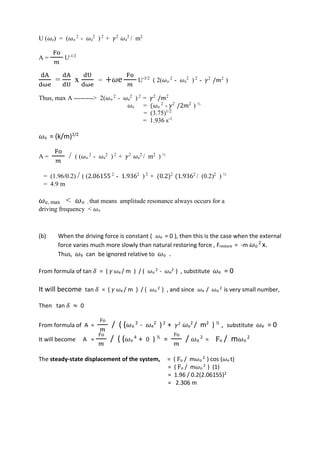
dA
dωe
= 0 (consider Fo , 𝛾 , m, mo = constant)
A = function of 𝜔e
U (𝜔e) = (𝜔o
2
- 𝜔e
2
) 2
+ 𝛾2
𝜔e
2
/ m2
A =
Fo
𝑚
U-1/2
dA
dωe
=
dA
dU
x
dU
dωe
= +𝜔e
Fo
𝑚
U-3/2
( 2(𝜔o
2
- 𝜔e
2
) 2
- 𝛾2
/𝑚2
)
Thus, max A ---------> 2(𝜔o
2
- 𝜔e
2
) 2
= 𝛾2
/𝑚2
𝜔e = (𝜔o
2
- 𝛾2
/2𝑚2
) ½
= (3.75)1/2
= 1.936 s-1
𝜔o = (k/m)1/2
A =
Fo
𝑚
/ ( (𝜔o
2
- 𝜔e
2
) 2
+ 𝛾2
𝜔e
2
/ m2
) ½
= (1.96/0.2) / ( (2.06155 2
- 1.9362
) 2
+ (0.2)2
(1.9362
/ (0.2)2
) ½
= 4.9 m
𝜔e, max < 𝜔o , that means amplitude resonance always occurs for a
driving frequency < 𝜔o
(b) When the driving force is constant ( 𝜔e = 0 ), then this is the case when the external
force varies much more slowly than natural restoring force , Frestore = -m 𝜔o
2
x.
Thus, 𝜔e can be ignored relative to 𝜔o .
From formula of tan 𝛿 = ( 𝛾 𝜔e / m ) / ( 𝜔o
2 - 𝜔e
2 ) , substitute 𝜔e = 0
It will become tan 𝛿 = ( 𝛾 𝜔e / m ) / ( 𝜔o
2 ) , and since 𝜔e / 𝜔o
2 is very small number,
Then tan 𝛿 ≈ 0
From formula of A =
Fo
𝑚
/ ( ( 𝜔o
2
- 𝜔e
2
)2
+ 𝛾2 𝜔e
2
/ m2
) ½
, substitute 𝜔e = 0
It will become A =
Fo
𝑚
/ ( ( 𝜔o
4
+ 0 ) ½
=
Fo
𝑚
/ 𝜔o
2
= Fo / m 𝜔o
2
The steady-state displacement of the system, = ( Fo / m𝜔o
2 ) cos (𝜔e t)
= ( Fo / m𝜔o
2 ) (1)
= 1.96 / 0.2(2.06155)2
= 2.306 m

VIBRATIONS AND WAVES TUTORIAL#2

  • 1.
    SMES1201: VIBRATION ANDWAVES (GROUP 8) TUTORIAL #2 NAME : WAN MOHAMAD FARHAN BIN AB RAHMAN MATRICES NO : SEU110024 DATE : 12 MAY 2014 QUESTION 1 A damped oscillator with mass 2 kg has the equation of motion 2ẍ + 12 ẋ + 50 x = 0 , where x is the displacement from equilibrium, measured in meters. (a) What are the damping constant and the natural angular frequency for this oscillator? (b) What type of damping is this ? Is the motion still oscillatory and periodic ? If so, what is the oscillation period ? Solution: (a) Mass of oscillator = 2 kg Equation of motion for damped oscillation : Fnet = Fdamping + Frestore That is , ẍ + 𝛾 𝑚 ẋ + 𝜔o 2 x = 0 ----------------- (*) Given that the equation of motion is 2ẍ + 12 ẋ + 50 x = 0 --------------------------(**) We then divide (**) by 2, become ẍ + 6 ẋ + 25 x = 0 --------------------------(***) By comparison of (*) and (***) , 𝛾 𝑚 = 6s-1 , then damping constant, 𝛾 = 6s-1 (2kg) = 12kgs-1 , 𝜔o 2 = 25 , then natural angular frequency , 𝜔o = 5 s-1 (b) We stipulate solution x(t) to equation (*) for a damped oscillator of the form 𝑒 𝛼𝑡 times X(t) x (t) = 𝑒 𝛼𝑡 X (t) ẋ (t) = 𝛼𝑒 𝛼𝑡 X (t) + 𝑒 𝛼𝑡 Ẋ (t) ẍ (t) = 𝛼2 𝑒 𝛼𝑡 X (t) + 2𝛼𝑒 𝛼𝑡 Ẋ (t) + 𝑒 𝛼𝑡 Ẍ (t) From the types of damping, we test for value of 2m𝜔o that is equal to (2)(2kg)(5s-1) = 20kgs-1 , which is larger than 𝛾 = 12kgs-1 , thus the oscillation described an underdamped oscillation.
  • 2.
    The oscillation occurand periodic such that the amplitude decreases gradually by an exponential factor of 𝑒−5𝑡 . The oscialltion period, T = 2𝜋 𝜔 For underdamped oscillator , x(t) = Ao 𝑒−𝛾𝑡/2𝑚 sin (𝜔𝑡 + 𝜑o ) , Where 𝜔 = ( 𝜔o 2 - 𝛾2 / 4m2 ) ½ = ( 𝜔o 2 - 1 4 ( 𝛾 / m )2 ) ½ = ( 25 - 1 4 ( 6 )2 ) ½ = 4s-1 ( > 0 ) Thus, T = 2 𝜋 / 4s-1 = 1.5708 s QUESTION 2 A block of mass 90 grams attached to a horizontal spring is subject to a friction force F fric = -γẋ when in motion , with γ = 0.18 kg s-1 . The system oscillates about its equilibrium position but loses 95% of its total mechanical energy during one complete cycle. (a) Determine the period of the damped oscillation (b) Find the natural angular frequency and the spring constant , k Solution (a) Mass of block = 90 grams = 0.09 kg F fric = -γẋ , with 𝛾 = 0.18 kgs-1 The block undergoes underdamped oscillation and the system maintains 5% of its total mechanical energy. Time dependent amplitude, A(t), A(t) = Ao 𝑒−𝛾𝑡/2𝑚 = Ao 𝑒 − 𝑡 2𝑚/ 𝛾 = Ao 𝑒 − 𝑡 2(0.09𝑘𝑔)/(0.18𝑘𝑔𝑠−1) = Ao 𝑒−𝑡 = Ao ( 1 𝑒 𝑡 ) Etotal ∝ A(t) 2 , initially Eo ∝ Ao 2 , so Etotal ∝ ( Ao 𝑒−𝑡 ) 2 = Ao 2 𝑒−2𝑡 ===> Etotal / Eo = 𝑒−2𝑡 Solving this for the time when Etotal / Eo = 0.05 By comparison , 0.05 = 𝑒−2𝑡 , thus t = 1.498 s The system oscillates about its equilibrium position but loses 95% of its total mechanical energy during ONE COMPLETE CYCLE, means that : The period of the damped oscillation, T = t = 1.498 s
  • 3.
    (b) The periodof the damped oscillations, T = 2𝜋 𝜔 , thus 𝜔 = 2𝜋 T Angular frequency, 𝜔 = 2𝜋 1.498s = 4.194 s-1 To find the natural angular frequency, 𝝎o , use the formula of 𝜔 = ( 𝜔o 2 - 1 4 ( 𝛾 / m )2 ) ½ Thus, , 𝜔o = ( 𝜔 2 + 1 4 ( 𝛾 / m)2 ) ½ = ( (4.194) 2 + 1 4 ( 0.18 / 0.09 )2 ) ½ 𝜔o = 4.312 s-1 Spring constant , k = 𝜔o 2 . m = ( 4.312) 2 ( 0.09 ) = 1.673 Nm-1 QUESTION 3 An oscillator with a mass of 300 g and a natural angular frequency 0f 10 s-1 is damped by a force -24 ẋ N, and driven by a harmonic external force with amplitude 1.2 N and angular frequency 6s-1 . (a) Write the equation of motion for this system. (b) Calculate the amplitude A and phase lag δ of the steady-state displacement , Xp (t) = A cos (𝜔t – δ ). Solution: (a) External or driving force : F(t) = Fo cos (𝜔e t) Equation of motion for forced oscillations: Fnet = Fdamping + Frestore + F(t)  That is , ẍ + 𝛾 𝑚 ẋ + 𝜔o 2 x = Fo 𝑚 cos (𝜔e t) ----------------- (*) Given mass of oscillator ,m = 300g = 0.3 kg 𝜔o = 10 s-1 Fdamping = -24 ẋ N, with 𝛾 = 24kgs-1 Fo = 1.2 N , 𝜔e = 6s-1 Then, equation of (*) will become : , ẍ + 24 0.3 ẋ + 102 x = 1.2 0.3 cos (6t) We simplify it, become ẍ + 80 ẋ + 100 x = 4 cos (6t) (b) We hypothesize that : Xp (t) = A cos (𝜔et – δ ) ẋp (t) = - 𝜔e A sin (𝜔et – δ ) ẍp (t) = - 𝜔e 2A cos (𝜔et – δ )
  • 4.
    We know that, the displacement amplitude of a driven oscillator in the steady state, A = Fo 𝑚 / ( ( 𝜔o 2 - 𝜔e 2 )2 + 𝛾2 𝜔e 2 / m2 ) ½ Also the phase angle or phase lag between force and displacement in the steady state, tan δ = ( 𝛾 𝜔e / m ) / ( 𝜔o 2 - 𝜔e 2 ) Then, A = 1.2 N 0.3 𝑘𝑔 / ( (10 2 - 62 )2 + 242 62 / 0.32 ) ½ = 4 / √234496 = 0.00826 m Phase lag (in radians) tan δ = ( 24 (6)/ 0.3 ) / ( 10 2 - 62 ) tan δ = 480 / 64 = 7.5 δ = 1.438 radians QUESTION 4 A block of mass m = 200 g attached to a spring with constant k = 0.85 N m-1 . When in motion, the system is damped by a force that is linear in velocity, with damping constant, γ = 0.2kg s-1 . Then, this block+ system system is subjected to a harmonic external force F(t) = Fo cos (𝜔e t) , with a fixed amplitude Fo = 1.96 N. (a) Calculate the driving frequency 𝜔e, max at which amplitude resonance occurs. Find the steady-state displacement amplitude. (b) Calculate the steady-state displacement of the system when the driving force is constant, i.e. for 𝜔e = 0 Solution : (a) Mass of block , m = 200 g = 0.2 kg Spring constant, k = 0.85 Nm-1 Damping constant, 𝛾 = 0.2kgs-1 Harmonic external force , F(t) = Fo cos (𝜔e t) , given Fo = 1.96 N dA dωe = 0 (consider Fo , 𝛾 , m, mo = constant) A = function of 𝜔e
  • 5.
    U (𝜔e) =(𝜔o 2 - 𝜔e 2 ) 2 + 𝛾2 𝜔e 2 / m2 A = Fo 𝑚 U-1/2 dA dωe = dA dU x dU dωe = +𝜔e Fo 𝑚 U-3/2 ( 2(𝜔o 2 - 𝜔e 2 ) 2 - 𝛾2 /𝑚2 ) Thus, max A ---------> 2(𝜔o 2 - 𝜔e 2 ) 2 = 𝛾2 /𝑚2 𝜔e = (𝜔o 2 - 𝛾2 /2𝑚2 ) ½ = (3.75)1/2 = 1.936 s-1 𝜔o = (k/m)1/2 A = Fo 𝑚 / ( (𝜔o 2 - 𝜔e 2 ) 2 + 𝛾2 𝜔e 2 / m2 ) ½ = (1.96/0.2) / ( (2.06155 2 - 1.9362 ) 2 + (0.2)2 (1.9362 / (0.2)2 ) ½ = 4.9 m 𝜔e, max < 𝜔o , that means amplitude resonance always occurs for a driving frequency < 𝜔o (b) When the driving force is constant ( 𝜔e = 0 ), then this is the case when the external force varies much more slowly than natural restoring force , Frestore = -m 𝜔o 2 x. Thus, 𝜔e can be ignored relative to 𝜔o . From formula of tan 𝛿 = ( 𝛾 𝜔e / m ) / ( 𝜔o 2 - 𝜔e 2 ) , substitute 𝜔e = 0 It will become tan 𝛿 = ( 𝛾 𝜔e / m ) / ( 𝜔o 2 ) , and since 𝜔e / 𝜔o 2 is very small number, Then tan 𝛿 ≈ 0 From formula of A = Fo 𝑚 / ( ( 𝜔o 2 - 𝜔e 2 )2 + 𝛾2 𝜔e 2 / m2 ) ½ , substitute 𝜔e = 0 It will become A = Fo 𝑚 / ( ( 𝜔o 4 + 0 ) ½ = Fo 𝑚 / 𝜔o 2 = Fo / m 𝜔o 2 The steady-state displacement of the system, = ( Fo / m𝜔o 2 ) cos (𝜔e t) = ( Fo / m𝜔o 2 ) (1) = 1.96 / 0.2(2.06155)2 = 2.306 m