B.Sc. MLT Syllabus
Attuluri Vamsi Kumar I Assistant professor I Dept of MLT I Ph No: 7416660584 I Website: mltmaster.com
Website: www.mltmaster.com I YouTube: https://www.youtube.com/@vamsiMLT
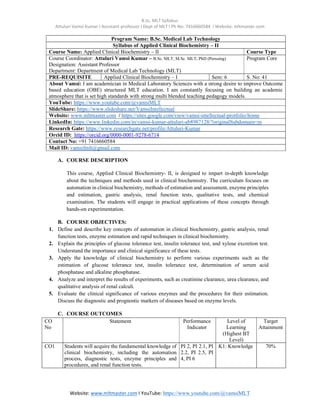
Program Name: B.Sc. Medical Lab Technology
Syllabus of Applied Clinical Biochemistry – II
Course Name: Applied Clinical Biochemistry – II Course Type
Course Coordinator: Attuluri Vamsi Kumar – B.Sc. MLT, M.Sc. MLT, PhD (Perusing)
Designation: Assistant Professor
Department: Department of Medical Lab Technology (MLT)
Program Core
PRE-REQUISITE Applied Clinical Biochemistry – I Sem: 6 S. No: 41
About Vamsi: I am academician in Medical Laboratory Sciences with a strong desire to improve Outcome
based education (OBE) structured MLT education. I am constantly focusing on building an academic
atmosphere that is set high standards with strong multi blended teaching pedagogy models.
YouTube: https://www.youtube.com/@vamsiMLT
SlideShare: https://www.slideshare.net/VamsiIntellectual
Website: www.mltmaster.com / https://sites.google.com/view/vamsi-intellectual-protfolio/home
LinkedIn: https://www.linkedin.com/in/vamsi-kumar-attuluri-ab8987128/?originalSubdomain=in
Research Gate: https://www.researchgate.net/profile/Attuluri-Kumar
Orcid ID: https://orcid.org/0000-0001-9278-6714
Contact No: +91 7416660584
Mail ID: vamsifmlt@gmail.com
A. COURSE DESCRIPTION
This course, Applied Clinical Biochemistry- II, is designed to impart in-depth knowledge
about the techniques and methods used in clinical biochemistry. The curriculum focuses on
automation in clinical biochemistry, methods of estimation and assessment, enzyme principles
and estimation, gastric analysis, renal function tests, qualitative tests, and chemical
examination. The students will engage in practical applications of these concepts through
hands-on experimentation.
B. COURSE OBJECTIVES:
1. Define and describe key concepts of automation in clinical biochemistry, gastric analysis, renal
function tests, enzyme estimation and rapid techniques in clinical biochemistry.
2. Explain the principles of glucose tolerance test, insulin tolerance test, and xylose excretion test.
Understand the importance and clinical significance of these tests.
3. Apply the knowledge of clinical biochemistry to perform various experiments such as the
estimation of glucose tolerance test, insulin tolerance test, determination of serum acid
phosphatase and alkaline phosphatase.
4. Analyze and interpret the results of experiments, such as creatinine clearance, urea clearance, and
qualitative analysis of renal calculi.
5. Evaluate the clinical significance of various enzymes and the procedures for their estimation.
Discuss the diagnostic and prognostic markers of diseases based on enzyme levels.
C. COURSE OUTCOMES
CO
No
Statement Performance
Indicator
Level of
Learning
(Highest BT
Level)
Target
Attainment
CO1 Students will acquire the fundamental knowledge of
clinical biochemistry, including the automation
process, diagnostic tests, enzyme principles and
procedures, and renal function tests.
PI 2, PI 2.1, PI
2.2, PI 2.5, PI
4, PI 6
K1: Knowledge 70%
B.Sc. MLT Syllabus
Attuluri Vamsi Kumar I Assistant professor I Dept of MLT I Ph No: 7416660584 I Website: mltmaster.com
Website: www.mltmaster.com I YouTube: https://www.youtube.com/@vamsiMLT
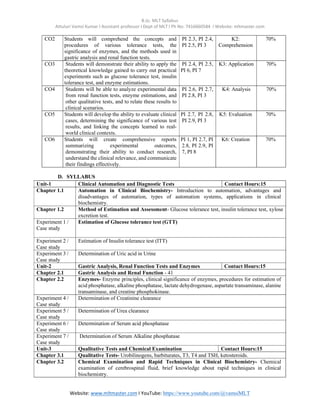
CO2 Students will comprehend the concepts and
procedures of various tolerance tests, the
significance of enzymes, and the methods used in
gastric analysis and renal function tests.
PI 2.3, PI 2.4,
PI 2.5, PI 3
K2:
Comprehension
70%
CO3 Students will demonstrate their ability to apply the
theoretical knowledge gained to carry out practical
experiments such as glucose tolerance test, insulin
tolerance test, and enzyme estimations.
PI 2.4, PI 2.5,
PI 6, PI 7
K3: Application 70%
CO4 Students will be able to analyze experimental data
from renal function tests, enzyme estimations, and
other qualitative tests, and to relate these results to
clinical scenarios.
PI 2.6, PI 2.7,
PI 2.8, PI 3
K4: Analysis 70%
CO5 Students will develop the ability to evaluate clinical
cases, determining the significance of various test
results, and linking the concepts learned to real-
world clinical contexts.
PI 2.7, PI 2.8,
PI 2.9, PI 3
K5: Evaluation 70%
CO6 Students will create comprehensive reports
summarizing experimental outcomes,
demonstrating their ability to conduct research,
understand the clinical relevance, and communicate
their findings effectively.
PI 1, PI 2.7, PI
2.8, PI 2.9, PI
7, PI 8
K6: Creation 70%
D. SYLLABUS
Unit-1 Clinical Automation and Diagnostic Tests Contact Hours:15
Chapter 1.1 Automation in Clinical Biochemistry- Introduction to automation, advantages and
disadvantages of automation, types of automation systems, applications in clinical
biochemistry.
Chapter 1.2 Method of Estimation and Assessment- Glucose tolerance test, insulin tolerance test, xylose
excretion test.
Experiment 1 /
Case study
Estimation of Glucose tolerance test (GTT)
Experiment 2 /
Case study
Estimation of Insulin tolerance test (ITT)
Experiment 3 /
Case study
Determination of Uric acid in Urine
Unit-2 Gastric Analysis, Renal Function Tests and Enzymes Contact Hours:15
Chapter 2.1 Gastric Analysis and Renal Function - 41
Chapter 2.2 Enzymes- Enzyme principles, clinical significance of enzymes, procedures for estimation of
acid phosphatase, alkaline phosphatase, lactate dehydrogenase, aspartate transaminase, alanine
transaminase, and creatine phosphokinase.
Experiment 4 /
Case study
Determination of Creatinine clearance
Experiment 5 /
Case study
Determination of Urea clearance
Experiment 6 /
Case study
Determination of Serum acid phosphatase
Experiment 7 /
Case study
Determination of Serum Alkaline phosphatase
Unit-3 Qualitative Tests and Chemical Examination Contact Hours:15
Chapter 3.1 Qualitative Tests- Urobilinogens, barbiturates, T3, T4 and TSH, ketosteroids.
Chapter 3.2 Chemical Examination and Rapid Techniques in Clinical Biochemistry- Chemical
examination of cerebrospinal fluid, brief knowledge about rapid techniques in clinical
biochemistry.
B.Sc. MLT Syllabus
Attuluri Vamsi Kumar I Assistant professor I Dept of MLT I Ph No: 7416660584 I Website: mltmaster.com
Website: www.mltmaster.com I YouTube: https://www.youtube.com/@vamsiMLT
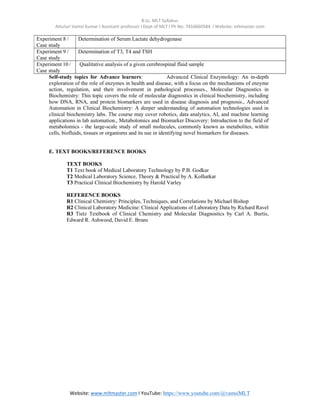
Experiment 8 /
Case study
Determination of Serum Lactate dehydrogenase
Experiment 9 /
Case study
Determination of T3, T4 and TSH
Experiment 10 /
Case study
Qualitative analysis of a given cerebrospinal fluid sample
Self-study topics for Advance learners: Advanced Clinical Enzymology: An in-depth
exploration of the role of enzymes in health and disease, with a focus on the mechanisms of enzyme
action, regulation, and their involvement in pathological processes., Molecular Diagnostics in
Biochemistry: This topic covers the role of molecular diagnostics in clinical biochemistry, including
how DNA, RNA, and protein biomarkers are used in disease diagnosis and prognosis., Advanced
Automation in Clinical Biochemistry: A deeper understanding of automation technologies used in
clinical biochemistry labs. The course may cover robotics, data analytics, AI, and machine learning
applications in lab automation., Metabolomics and Biomarker Discovery: Introduction to the field of
metabolomics - the large-scale study of small molecules, commonly known as metabolites, within
cells, biofluids, tissues or organisms and its use in identifying novel biomarkers for diseases.
E. TEXT BOOKS/REFERENCE BOOKS
TEXT BOOKS
T1 Text book of Medical Laboratory Technology by P.B. Godkar
T2 Medical Laboratory Science, Theory & Practical by A. Kolhatkar
T3 Practical Clinical Biochemistry by Harold Varley
REFERENCE BOOKS
R1 Clinical Chemistry: Principles, Techniques, and Correlations by Michael Bishop
R2 Clinical Laboratory Medicine: Clinical Applications of Laboratory Data by Richard Ravel
R3 Tietz Textbook of Clinical Chemistry and Molecular Diagnostics by Carl A. Burtis,
Edward R. Ashwood, David E. Bruns
B.Sc. MLT Syllabus
Attuluri Vamsi Kumar I Assistant professor I Dept of MLT I Ph No: 7416660584 I Website: mltmaster.com
Website: www.mltmaster.com I YouTube: https://www.youtube.com/@vamsiMLT
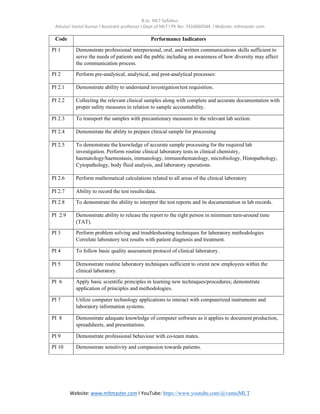
Code Performance Indicators
PI 1 Demonstrate professional interpersonal, oral, and written communications skills sufficient to
serve the needs of patients and the public including an awareness of how diversity may affect
the communication process.
PI 2 Perform pre-analytical, analytical, and post-analytical processes:
PI 2.1 Demonstrate ability to understand investigation/test requisition.
PI 2.2 Collecting the relevant clinical samples along with complete and accurate documentation with
proper safety measures in relation to sample accountability.
PI 2.3 To transport the samples with precautionary measures to the relevant lab section.
PI 2.4 Demonstrate the ability to prepare clinical sample for processing
PI 2.5 To demonstrate the knowledge of accurate sample processing for the required lab
investigation. Perform routine clinical laboratory tests in clinical chemistry,
haematology/haemostasis, immunology, immunohematology, microbiology, Histopathology,
Cytopathology, body fluid analysis, and laboratory operations.
PI 2.6 Perform mathematical calculations related to all areas of the clinical laboratory
PI 2.7 Ability to record the test results/data.
PI 2.8 To demonstrate the ability to interpret the test reports and its documentation in lab records.
PI 2.9 Demonstrate ability to release the report to the right person in minimum turn-around time
(TAT).
PI 3 Perform problem solving and troubleshooting techniques for laboratory methodologies
Correlate laboratory test results with patient diagnosis and treatment.
PI 4 To follow basic quality assessment protocol of clinical laboratory.
PI 5 Demonstrate routine laboratory techniques sufficient to orient new employees within the
clinical laboratory.
PI 6 Apply basic scientific principles in learning new techniques/procedures; demonstrate
application of principles and methodologies.
PI 7 Utilize computer technology applications to interact with computerized instruments and
laboratory information systems.
PI 8 Demonstrate adequate knowledge of computer software as it applies to document production,
spreadsheets, and presentations.
PI 9 Demonstrate professional behaviour with co-team mates.
PI 10 Demonstrate sensitivity and compassion towards patients.

41_Applied Clinical Biochemistry – II.pdf

  • 1.
    B.Sc. MLT Syllabus AttuluriVamsi Kumar I Assistant professor I Dept of MLT I Ph No: 7416660584 I Website: mltmaster.com Website: www.mltmaster.com I YouTube: https://www.youtube.com/@vamsiMLT Program Name: B.Sc. Medical Lab Technology Syllabus of Applied Clinical Biochemistry – II Course Name: Applied Clinical Biochemistry – II Course Type Course Coordinator: Attuluri Vamsi Kumar – B.Sc. MLT, M.Sc. MLT, PhD (Perusing) Designation: Assistant Professor Department: Department of Medical Lab Technology (MLT) Program Core PRE-REQUISITE Applied Clinical Biochemistry – I Sem: 6 S. No: 41 About Vamsi: I am academician in Medical Laboratory Sciences with a strong desire to improve Outcome based education (OBE) structured MLT education. I am constantly focusing on building an academic atmosphere that is set high standards with strong multi blended teaching pedagogy models. YouTube: https://www.youtube.com/@vamsiMLT SlideShare: https://www.slideshare.net/VamsiIntellectual Website: www.mltmaster.com / https://sites.google.com/view/vamsi-intellectual-protfolio/home LinkedIn: https://www.linkedin.com/in/vamsi-kumar-attuluri-ab8987128/?originalSubdomain=in Research Gate: https://www.researchgate.net/profile/Attuluri-Kumar Orcid ID: https://orcid.org/0000-0001-9278-6714 Contact No: +91 7416660584 Mail ID: vamsifmlt@gmail.com A. COURSE DESCRIPTION This course, Applied Clinical Biochemistry- II, is designed to impart in-depth knowledge about the techniques and methods used in clinical biochemistry. The curriculum focuses on automation in clinical biochemistry, methods of estimation and assessment, enzyme principles and estimation, gastric analysis, renal function tests, qualitative tests, and chemical examination. The students will engage in practical applications of these concepts through hands-on experimentation. B. COURSE OBJECTIVES: 1. Define and describe key concepts of automation in clinical biochemistry, gastric analysis, renal function tests, enzyme estimation and rapid techniques in clinical biochemistry. 2. Explain the principles of glucose tolerance test, insulin tolerance test, and xylose excretion test. Understand the importance and clinical significance of these tests. 3. Apply the knowledge of clinical biochemistry to perform various experiments such as the estimation of glucose tolerance test, insulin tolerance test, determination of serum acid phosphatase and alkaline phosphatase. 4. Analyze and interpret the results of experiments, such as creatinine clearance, urea clearance, and qualitative analysis of renal calculi. 5. Evaluate the clinical significance of various enzymes and the procedures for their estimation. Discuss the diagnostic and prognostic markers of diseases based on enzyme levels. C. COURSE OUTCOMES CO No Statement Performance Indicator Level of Learning (Highest BT Level) Target Attainment CO1 Students will acquire the fundamental knowledge of clinical biochemistry, including the automation process, diagnostic tests, enzyme principles and procedures, and renal function tests. PI 2, PI 2.1, PI 2.2, PI 2.5, PI 4, PI 6 K1: Knowledge 70%
  • 2.
    B.Sc. MLT Syllabus AttuluriVamsi Kumar I Assistant professor I Dept of MLT I Ph No: 7416660584 I Website: mltmaster.com Website: www.mltmaster.com I YouTube: https://www.youtube.com/@vamsiMLT CO2 Students will comprehend the concepts and procedures of various tolerance tests, the significance of enzymes, and the methods used in gastric analysis and renal function tests. PI 2.3, PI 2.4, PI 2.5, PI 3 K2: Comprehension 70% CO3 Students will demonstrate their ability to apply the theoretical knowledge gained to carry out practical experiments such as glucose tolerance test, insulin tolerance test, and enzyme estimations. PI 2.4, PI 2.5, PI 6, PI 7 K3: Application 70% CO4 Students will be able to analyze experimental data from renal function tests, enzyme estimations, and other qualitative tests, and to relate these results to clinical scenarios. PI 2.6, PI 2.7, PI 2.8, PI 3 K4: Analysis 70% CO5 Students will develop the ability to evaluate clinical cases, determining the significance of various test results, and linking the concepts learned to real- world clinical contexts. PI 2.7, PI 2.8, PI 2.9, PI 3 K5: Evaluation 70% CO6 Students will create comprehensive reports summarizing experimental outcomes, demonstrating their ability to conduct research, understand the clinical relevance, and communicate their findings effectively. PI 1, PI 2.7, PI 2.8, PI 2.9, PI 7, PI 8 K6: Creation 70% D. SYLLABUS Unit-1 Clinical Automation and Diagnostic Tests Contact Hours:15 Chapter 1.1 Automation in Clinical Biochemistry- Introduction to automation, advantages and disadvantages of automation, types of automation systems, applications in clinical biochemistry. Chapter 1.2 Method of Estimation and Assessment- Glucose tolerance test, insulin tolerance test, xylose excretion test. Experiment 1 / Case study Estimation of Glucose tolerance test (GTT) Experiment 2 / Case study Estimation of Insulin tolerance test (ITT) Experiment 3 / Case study Determination of Uric acid in Urine Unit-2 Gastric Analysis, Renal Function Tests and Enzymes Contact Hours:15 Chapter 2.1 Gastric Analysis and Renal Function - 41 Chapter 2.2 Enzymes- Enzyme principles, clinical significance of enzymes, procedures for estimation of acid phosphatase, alkaline phosphatase, lactate dehydrogenase, aspartate transaminase, alanine transaminase, and creatine phosphokinase. Experiment 4 / Case study Determination of Creatinine clearance Experiment 5 / Case study Determination of Urea clearance Experiment 6 / Case study Determination of Serum acid phosphatase Experiment 7 / Case study Determination of Serum Alkaline phosphatase Unit-3 Qualitative Tests and Chemical Examination Contact Hours:15 Chapter 3.1 Qualitative Tests- Urobilinogens, barbiturates, T3, T4 and TSH, ketosteroids. Chapter 3.2 Chemical Examination and Rapid Techniques in Clinical Biochemistry- Chemical examination of cerebrospinal fluid, brief knowledge about rapid techniques in clinical biochemistry.
  • 3.
    B.Sc. MLT Syllabus AttuluriVamsi Kumar I Assistant professor I Dept of MLT I Ph No: 7416660584 I Website: mltmaster.com Website: www.mltmaster.com I YouTube: https://www.youtube.com/@vamsiMLT Experiment 8 / Case study Determination of Serum Lactate dehydrogenase Experiment 9 / Case study Determination of T3, T4 and TSH Experiment 10 / Case study Qualitative analysis of a given cerebrospinal fluid sample Self-study topics for Advance learners: Advanced Clinical Enzymology: An in-depth exploration of the role of enzymes in health and disease, with a focus on the mechanisms of enzyme action, regulation, and their involvement in pathological processes., Molecular Diagnostics in Biochemistry: This topic covers the role of molecular diagnostics in clinical biochemistry, including how DNA, RNA, and protein biomarkers are used in disease diagnosis and prognosis., Advanced Automation in Clinical Biochemistry: A deeper understanding of automation technologies used in clinical biochemistry labs. The course may cover robotics, data analytics, AI, and machine learning applications in lab automation., Metabolomics and Biomarker Discovery: Introduction to the field of metabolomics - the large-scale study of small molecules, commonly known as metabolites, within cells, biofluids, tissues or organisms and its use in identifying novel biomarkers for diseases. E. TEXT BOOKS/REFERENCE BOOKS TEXT BOOKS T1 Text book of Medical Laboratory Technology by P.B. Godkar T2 Medical Laboratory Science, Theory & Practical by A. Kolhatkar T3 Practical Clinical Biochemistry by Harold Varley REFERENCE BOOKS R1 Clinical Chemistry: Principles, Techniques, and Correlations by Michael Bishop R2 Clinical Laboratory Medicine: Clinical Applications of Laboratory Data by Richard Ravel R3 Tietz Textbook of Clinical Chemistry and Molecular Diagnostics by Carl A. Burtis, Edward R. Ashwood, David E. Bruns
  • 4.
    B.Sc. MLT Syllabus AttuluriVamsi Kumar I Assistant professor I Dept of MLT I Ph No: 7416660584 I Website: mltmaster.com Website: www.mltmaster.com I YouTube: https://www.youtube.com/@vamsiMLT Code Performance Indicators PI 1 Demonstrate professional interpersonal, oral, and written communications skills sufficient to serve the needs of patients and the public including an awareness of how diversity may affect the communication process. PI 2 Perform pre-analytical, analytical, and post-analytical processes: PI 2.1 Demonstrate ability to understand investigation/test requisition. PI 2.2 Collecting the relevant clinical samples along with complete and accurate documentation with proper safety measures in relation to sample accountability. PI 2.3 To transport the samples with precautionary measures to the relevant lab section. PI 2.4 Demonstrate the ability to prepare clinical sample for processing PI 2.5 To demonstrate the knowledge of accurate sample processing for the required lab investigation. Perform routine clinical laboratory tests in clinical chemistry, haematology/haemostasis, immunology, immunohematology, microbiology, Histopathology, Cytopathology, body fluid analysis, and laboratory operations. PI 2.6 Perform mathematical calculations related to all areas of the clinical laboratory PI 2.7 Ability to record the test results/data. PI 2.8 To demonstrate the ability to interpret the test reports and its documentation in lab records. PI 2.9 Demonstrate ability to release the report to the right person in minimum turn-around time (TAT). PI 3 Perform problem solving and troubleshooting techniques for laboratory methodologies Correlate laboratory test results with patient diagnosis and treatment. PI 4 To follow basic quality assessment protocol of clinical laboratory. PI 5 Demonstrate routine laboratory techniques sufficient to orient new employees within the clinical laboratory. PI 6 Apply basic scientific principles in learning new techniques/procedures; demonstrate application of principles and methodologies. PI 7 Utilize computer technology applications to interact with computerized instruments and laboratory information systems. PI 8 Demonstrate adequate knowledge of computer software as it applies to document production, spreadsheets, and presentations. PI 9 Demonstrate professional behaviour with co-team mates. PI 10 Demonstrate sensitivity and compassion towards patients.