B.Sc. MLT Syllabus
Attuluri Vamsi Kumar I Assistant professor I Dept of MLT I Ph No: 7416660584 I Website: mltmaster.com
Website: www.mltmaster.com I YouTube: https://www.youtube.com/@vamsiMLT
Program Name: B.Sc. Medical Lab Technology
Syllabus of MLT Internship
Course Name: MLT Internship Course Type
Course Coordinator: Attuluri Vamsi Kumar – B.Sc. MLT, M.Sc. MLT, PhD (Perusing)
Designation: Assistant Professor
Department: Department of Medical Lab Technology (MLT)
Program Core
PRE-REQUISITE Completed Semesters 1-7 Sem: 8 S. No: 53
About Vamsi: I am academician in Medical Laboratory Sciences with a strong desire to improve Outcome
based education (OBE) structured MLT education. I am constantly focusing on building an academic
atmosphere that is set high standards with strong multi blended teaching pedagogy models.
YouTube: https://www.youtube.com/@vamsiMLT
SlideShare: https://www.slideshare.net/VamsiIntellectual
Website: www.mltmaster.com / https://sites.google.com/view/vamsi-intellectual-protfolio/home
LinkedIn: https://www.linkedin.com/in/vamsi-kumar-attuluri-ab8987128/?originalSubdomain=in
Research Gate: https://www.researchgate.net/profile/Attuluri-Kumar
Orcid ID: https://orcid.org/0000-0001-9278-6714
Contact No: +91 7416660584
Mail ID: vamsifmlt@gmail.com
A. COURSE DESCRIPTION
This Medical Lab Technology Internship syllabus is intended to provide students with the
opportunity to apply and enhance their knowledge and skills in the context of real-world
laboratory settings. Over the course of six months, interns will gain hands-on experience in
essential and advanced laboratory techniques, laboratory safety practices, quality assurance
processes, and professional and ethical considerations in the field. Through practical learning
and critical examination of case studies, students will emerge better prepared for their careers
as Medical Lab Technologists.
B. COURSE OBJECTIVES:
1. Understand and demonstrate safe and effective use of laboratory equipment and procedures.
2. Apply standard clinical laboratory techniques in the analysis of blood, urine, and other clinical
samples.
3. Analyze case studies to identify best practices in laboratory safety and quality control.
4. Evaluate the use of advanced molecular diagnostic and histopathological techniques in medical
laboratories.
5. Develop and demonstrate professional and ethical conduct in laboratory settings.
C. COURSE OUTCOMES
CO
No
Statement Performance
Indicator
Level of
Learning
(Highest BT
Level)
Target
Attainment
CO1 Recall and describe the fundamental aspects of
medical laboratory technology, including the role of
technologists, types of laboratories, essential
equipment, and safety protocols.
PI 2.5, PI 4 K1:
Remembering
70%
CO2 Understand the principles of clinical laboratory
techniques, quality assurance processes, and
advanced laboratory techniques such as PCR and
sequencing.
PI 2, PI 2.1, PI
4, PI 6
K2:
Understanding
70%
B.Sc. MLT Syllabus
Attuluri Vamsi Kumar I Assistant professor I Dept of MLT I Ph No: 7416660584 I Website: mltmaster.com
Website: www.mltmaster.com I YouTube: https://www.youtube.com/@vamsiMLT
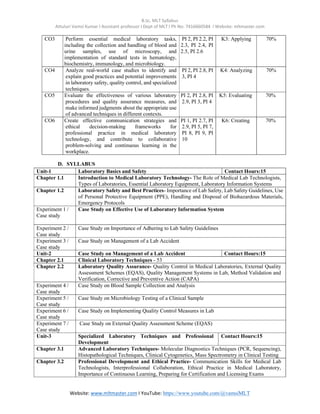
CO3 Perform essential medical laboratory tasks,
including the collection and handling of blood and
urine samples, use of microscopy, and
implementation of standard tests in hematology,
biochemistry, immunology, and microbiology.
PI 2, PI 2.2, PI
2.3, PI 2.4, PI
2.5, PI 2.6
K3: Applying 70%
CO4 Analyze real-world case studies to identify and
explain good practices and potential improvements
in laboratory safety, quality control, and specialized
techniques.
PI 2, PI 2.8, PI
3, PI 4
K4: Analyzing 70%
CO5 Evaluate the effectiveness of various laboratory
procedures and quality assurance measures, and
make informed judgments about the appropriate use
of advanced techniques in different contexts.
PI 2, PI 2.8, PI
2.9, PI 3, PI 4
K5: Evaluating 70%
CO6 Create effective communication strategies and
ethical decision-making frameworks for
professional practice in medical laboratory
technology, and contribute to collaborative
problem-solving and continuous learning in the
workplace.
PI 1, PI 2.7, PI
2.9, PI 5, PI 7,
PI 8, PI 9, PI
10
K6: Creating 70%
D. SYLLABUS
Unit-1 Laboratory Basics and Safety Contact Hours:15
Chapter 1.1 Introduction to Medical Laboratory Technology- The Role of Medical Lab Technologists,
Types of Laboratories, Essential Laboratory Equipment, Laboratory Information Systems
Chapter 1.2 Laboratory Safety and Best Practices- Importance of Lab Safety, Lab Safety Guidelines, Use
of Personal Protective Equipment (PPE), Handling and Disposal of Biohazardous Materials,
Emergency Protocols
Experiment 1 /
Case study
Case Study on Effective Use of Laboratory Information System
Experiment 2 /
Case study
Case Study on Importance of Adhering to Lab Safety Guidelines
Experiment 3 /
Case study
Case Study on Management of a Lab Accident
Unit-2 Case Study on Management of a Lab Accident Contact Hours:15
Chapter 2.1 Clinical Laboratory Techniques - 53
Chapter 2.2 Laboratory Quality Assurance- Quality Control in Medical Laboratories, External Quality
Assessment Schemes (EQAS), Quality Management Systems in Lab, Method Validation and
Verification, Corrective and Preventive Action (CAPA)
Experiment 4 /
Case study
Case Study on Blood Sample Collection and Analysis
Experiment 5 /
Case study
Case Study on Microbiology Testing of a Clinical Sample
Experiment 6 /
Case study
Case Study on Implementing Quality Control Measures in Lab
Experiment 7 /
Case study
Case Study on External Quality Assessment Scheme (EQAS)
Unit-3 Specialized Laboratory Techniques and Professional
Development
Contact Hours:15
Chapter 3.1 Advanced Laboratory Techniques- Molecular Diagnostics Techniques (PCR, Sequencing),
Histopathological Techniques, Clinical Cytogenetics, Mass Spectrometry in Clinical Testing
Chapter 3.2 Professional Development and Ethical Practice- Communication Skills for Medical Lab
Technologists, Interprofessional Collaboration, Ethical Practice in Medical Laboratory,
Importance of Continuous Learning, Preparing for Certification and Licensing Exams
B.Sc. MLT Syllabus
Attuluri Vamsi Kumar I Assistant professor I Dept of MLT I Ph No: 7416660584 I Website: mltmaster.com
Website: www.mltmaster.com I YouTube: https://www.youtube.com/@vamsiMLT
Experiment 8 /
Case study
Case Study on PCR-based Diagnosis of Infectious Disease
Experiment 9 /
Case study
Case Study on Histopathological Examination of a Biopsy Sample
Experiment 10 /
Case study
Case Study on Ethical Dilemma in Medical Laboratory Practice
Self-study topics for Advance learners:
E. TEXT BOOKS/REFERENCE BOOKS
TEXT BOOKS
T1 Harmening DM. Clinical Hematology and Fundamentals of Hemostasis. 5th ed. F.A. Davis
Company; 2008.
T2 Garcia LS, editor. Clinical Microbiology Procedures Handbook. 4th ed. ASM Press; 2016.
T3 Strasinger SK, Di Lorenzo MS. Urinalysis and Body Fluids. 6th ed. F.A. Davis Company;
2014.
REFERENCE BOOKS
R1 Cheesbrough M. District Laboratory Practice in Tropical Countries. 2nd ed. Cambridge
University Press; 2005.
R2 Harmening DM, Firestone D. Phlebotomy: Worktext and Procedures Manual. 4th ed.
Saunders; 2015.
R3 McPherson RA, Pincus MR. Henry's Clinical Diagnosis and Management by Laboratory
Methods. 23rd ed. Elsevier; 2017.
B.Sc. MLT Syllabus
Attuluri Vamsi Kumar I Assistant professor I Dept of MLT I Ph No: 7416660584 I Website: mltmaster.com
Website: www.mltmaster.com I YouTube: https://www.youtube.com/@vamsiMLT
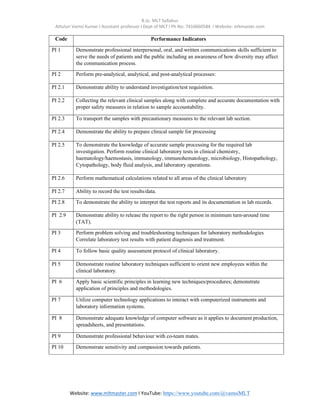
Code Performance Indicators
PI 1 Demonstrate professional interpersonal, oral, and written communications skills sufficient to
serve the needs of patients and the public including an awareness of how diversity may affect
the communication process.
PI 2 Perform pre-analytical, analytical, and post-analytical processes:
PI 2.1 Demonstrate ability to understand investigation/test requisition.
PI 2.2 Collecting the relevant clinical samples along with complete and accurate documentation with
proper safety measures in relation to sample accountability.
PI 2.3 To transport the samples with precautionary measures to the relevant lab section.
PI 2.4 Demonstrate the ability to prepare clinical sample for processing
PI 2.5 To demonstrate the knowledge of accurate sample processing for the required lab
investigation. Perform routine clinical laboratory tests in clinical chemistry,
haematology/haemostasis, immunology, immunohematology, microbiology, Histopathology,
Cytopathology, body fluid analysis, and laboratory operations.
PI 2.6 Perform mathematical calculations related to all areas of the clinical laboratory
PI 2.7 Ability to record the test results/data.
PI 2.8 To demonstrate the ability to interpret the test reports and its documentation in lab records.
PI 2.9 Demonstrate ability to release the report to the right person in minimum turn-around time
(TAT).
PI 3 Perform problem solving and troubleshooting techniques for laboratory methodologies
Correlate laboratory test results with patient diagnosis and treatment.
PI 4 To follow basic quality assessment protocol of clinical laboratory.
PI 5 Demonstrate routine laboratory techniques sufficient to orient new employees within the
clinical laboratory.
PI 6 Apply basic scientific principles in learning new techniques/procedures; demonstrate
application of principles and methodologies.
PI 7 Utilize computer technology applications to interact with computerized instruments and
laboratory information systems.
PI 8 Demonstrate adequate knowledge of computer software as it applies to document production,
spreadsheets, and presentations.
PI 9 Demonstrate professional behaviour with co-team mates.
PI 10 Demonstrate sensitivity and compassion towards patients.

53_MLT Internship.pdf

  • 1.
    B.Sc. MLT Syllabus AttuluriVamsi Kumar I Assistant professor I Dept of MLT I Ph No: 7416660584 I Website: mltmaster.com Website: www.mltmaster.com I YouTube: https://www.youtube.com/@vamsiMLT Program Name: B.Sc. Medical Lab Technology Syllabus of MLT Internship Course Name: MLT Internship Course Type Course Coordinator: Attuluri Vamsi Kumar – B.Sc. MLT, M.Sc. MLT, PhD (Perusing) Designation: Assistant Professor Department: Department of Medical Lab Technology (MLT) Program Core PRE-REQUISITE Completed Semesters 1-7 Sem: 8 S. No: 53 About Vamsi: I am academician in Medical Laboratory Sciences with a strong desire to improve Outcome based education (OBE) structured MLT education. I am constantly focusing on building an academic atmosphere that is set high standards with strong multi blended teaching pedagogy models. YouTube: https://www.youtube.com/@vamsiMLT SlideShare: https://www.slideshare.net/VamsiIntellectual Website: www.mltmaster.com / https://sites.google.com/view/vamsi-intellectual-protfolio/home LinkedIn: https://www.linkedin.com/in/vamsi-kumar-attuluri-ab8987128/?originalSubdomain=in Research Gate: https://www.researchgate.net/profile/Attuluri-Kumar Orcid ID: https://orcid.org/0000-0001-9278-6714 Contact No: +91 7416660584 Mail ID: vamsifmlt@gmail.com A. COURSE DESCRIPTION This Medical Lab Technology Internship syllabus is intended to provide students with the opportunity to apply and enhance their knowledge and skills in the context of real-world laboratory settings. Over the course of six months, interns will gain hands-on experience in essential and advanced laboratory techniques, laboratory safety practices, quality assurance processes, and professional and ethical considerations in the field. Through practical learning and critical examination of case studies, students will emerge better prepared for their careers as Medical Lab Technologists. B. COURSE OBJECTIVES: 1. Understand and demonstrate safe and effective use of laboratory equipment and procedures. 2. Apply standard clinical laboratory techniques in the analysis of blood, urine, and other clinical samples. 3. Analyze case studies to identify best practices in laboratory safety and quality control. 4. Evaluate the use of advanced molecular diagnostic and histopathological techniques in medical laboratories. 5. Develop and demonstrate professional and ethical conduct in laboratory settings. C. COURSE OUTCOMES CO No Statement Performance Indicator Level of Learning (Highest BT Level) Target Attainment CO1 Recall and describe the fundamental aspects of medical laboratory technology, including the role of technologists, types of laboratories, essential equipment, and safety protocols. PI 2.5, PI 4 K1: Remembering 70% CO2 Understand the principles of clinical laboratory techniques, quality assurance processes, and advanced laboratory techniques such as PCR and sequencing. PI 2, PI 2.1, PI 4, PI 6 K2: Understanding 70%
  • 2.
    B.Sc. MLT Syllabus AttuluriVamsi Kumar I Assistant professor I Dept of MLT I Ph No: 7416660584 I Website: mltmaster.com Website: www.mltmaster.com I YouTube: https://www.youtube.com/@vamsiMLT CO3 Perform essential medical laboratory tasks, including the collection and handling of blood and urine samples, use of microscopy, and implementation of standard tests in hematology, biochemistry, immunology, and microbiology. PI 2, PI 2.2, PI 2.3, PI 2.4, PI 2.5, PI 2.6 K3: Applying 70% CO4 Analyze real-world case studies to identify and explain good practices and potential improvements in laboratory safety, quality control, and specialized techniques. PI 2, PI 2.8, PI 3, PI 4 K4: Analyzing 70% CO5 Evaluate the effectiveness of various laboratory procedures and quality assurance measures, and make informed judgments about the appropriate use of advanced techniques in different contexts. PI 2, PI 2.8, PI 2.9, PI 3, PI 4 K5: Evaluating 70% CO6 Create effective communication strategies and ethical decision-making frameworks for professional practice in medical laboratory technology, and contribute to collaborative problem-solving and continuous learning in the workplace. PI 1, PI 2.7, PI 2.9, PI 5, PI 7, PI 8, PI 9, PI 10 K6: Creating 70% D. SYLLABUS Unit-1 Laboratory Basics and Safety Contact Hours:15 Chapter 1.1 Introduction to Medical Laboratory Technology- The Role of Medical Lab Technologists, Types of Laboratories, Essential Laboratory Equipment, Laboratory Information Systems Chapter 1.2 Laboratory Safety and Best Practices- Importance of Lab Safety, Lab Safety Guidelines, Use of Personal Protective Equipment (PPE), Handling and Disposal of Biohazardous Materials, Emergency Protocols Experiment 1 / Case study Case Study on Effective Use of Laboratory Information System Experiment 2 / Case study Case Study on Importance of Adhering to Lab Safety Guidelines Experiment 3 / Case study Case Study on Management of a Lab Accident Unit-2 Case Study on Management of a Lab Accident Contact Hours:15 Chapter 2.1 Clinical Laboratory Techniques - 53 Chapter 2.2 Laboratory Quality Assurance- Quality Control in Medical Laboratories, External Quality Assessment Schemes (EQAS), Quality Management Systems in Lab, Method Validation and Verification, Corrective and Preventive Action (CAPA) Experiment 4 / Case study Case Study on Blood Sample Collection and Analysis Experiment 5 / Case study Case Study on Microbiology Testing of a Clinical Sample Experiment 6 / Case study Case Study on Implementing Quality Control Measures in Lab Experiment 7 / Case study Case Study on External Quality Assessment Scheme (EQAS) Unit-3 Specialized Laboratory Techniques and Professional Development Contact Hours:15 Chapter 3.1 Advanced Laboratory Techniques- Molecular Diagnostics Techniques (PCR, Sequencing), Histopathological Techniques, Clinical Cytogenetics, Mass Spectrometry in Clinical Testing Chapter 3.2 Professional Development and Ethical Practice- Communication Skills for Medical Lab Technologists, Interprofessional Collaboration, Ethical Practice in Medical Laboratory, Importance of Continuous Learning, Preparing for Certification and Licensing Exams
  • 3.
    B.Sc. MLT Syllabus AttuluriVamsi Kumar I Assistant professor I Dept of MLT I Ph No: 7416660584 I Website: mltmaster.com Website: www.mltmaster.com I YouTube: https://www.youtube.com/@vamsiMLT Experiment 8 / Case study Case Study on PCR-based Diagnosis of Infectious Disease Experiment 9 / Case study Case Study on Histopathological Examination of a Biopsy Sample Experiment 10 / Case study Case Study on Ethical Dilemma in Medical Laboratory Practice Self-study topics for Advance learners: E. TEXT BOOKS/REFERENCE BOOKS TEXT BOOKS T1 Harmening DM. Clinical Hematology and Fundamentals of Hemostasis. 5th ed. F.A. Davis Company; 2008. T2 Garcia LS, editor. Clinical Microbiology Procedures Handbook. 4th ed. ASM Press; 2016. T3 Strasinger SK, Di Lorenzo MS. Urinalysis and Body Fluids. 6th ed. F.A. Davis Company; 2014. REFERENCE BOOKS R1 Cheesbrough M. District Laboratory Practice in Tropical Countries. 2nd ed. Cambridge University Press; 2005. R2 Harmening DM, Firestone D. Phlebotomy: Worktext and Procedures Manual. 4th ed. Saunders; 2015. R3 McPherson RA, Pincus MR. Henry's Clinical Diagnosis and Management by Laboratory Methods. 23rd ed. Elsevier; 2017.
  • 4.
    B.Sc. MLT Syllabus AttuluriVamsi Kumar I Assistant professor I Dept of MLT I Ph No: 7416660584 I Website: mltmaster.com Website: www.mltmaster.com I YouTube: https://www.youtube.com/@vamsiMLT Code Performance Indicators PI 1 Demonstrate professional interpersonal, oral, and written communications skills sufficient to serve the needs of patients and the public including an awareness of how diversity may affect the communication process. PI 2 Perform pre-analytical, analytical, and post-analytical processes: PI 2.1 Demonstrate ability to understand investigation/test requisition. PI 2.2 Collecting the relevant clinical samples along with complete and accurate documentation with proper safety measures in relation to sample accountability. PI 2.3 To transport the samples with precautionary measures to the relevant lab section. PI 2.4 Demonstrate the ability to prepare clinical sample for processing PI 2.5 To demonstrate the knowledge of accurate sample processing for the required lab investigation. Perform routine clinical laboratory tests in clinical chemistry, haematology/haemostasis, immunology, immunohematology, microbiology, Histopathology, Cytopathology, body fluid analysis, and laboratory operations. PI 2.6 Perform mathematical calculations related to all areas of the clinical laboratory PI 2.7 Ability to record the test results/data. PI 2.8 To demonstrate the ability to interpret the test reports and its documentation in lab records. PI 2.9 Demonstrate ability to release the report to the right person in minimum turn-around time (TAT). PI 3 Perform problem solving and troubleshooting techniques for laboratory methodologies Correlate laboratory test results with patient diagnosis and treatment. PI 4 To follow basic quality assessment protocol of clinical laboratory. PI 5 Demonstrate routine laboratory techniques sufficient to orient new employees within the clinical laboratory. PI 6 Apply basic scientific principles in learning new techniques/procedures; demonstrate application of principles and methodologies. PI 7 Utilize computer technology applications to interact with computerized instruments and laboratory information systems. PI 8 Demonstrate adequate knowledge of computer software as it applies to document production, spreadsheets, and presentations. PI 9 Demonstrate professional behaviour with co-team mates. PI 10 Demonstrate sensitivity and compassion towards patients.