B.Sc. MLT Syllabus
Attuluri Vamsi Kumar I Assistant professor I Dept of MLT I Ph No: 7416660584 I Website: mltmaster.com
Website: www.mltmaster.com I YouTube: https://www.youtube.com/@vamsiMLT
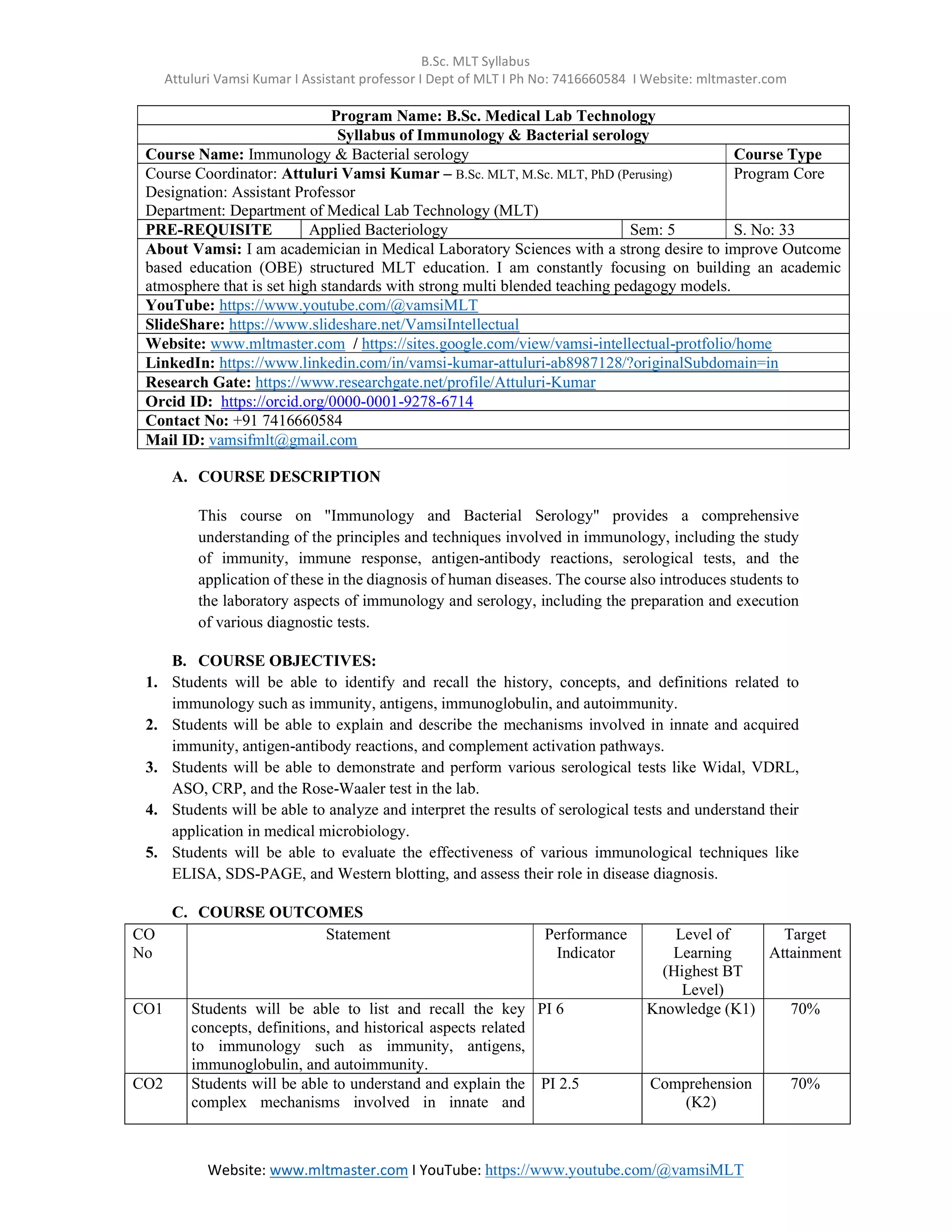
Program Name: B.Sc. Medical Lab Technology
Syllabus of Immunology & Bacterial serology
Course Name: Immunology & Bacterial serology Course Type
Course Coordinator: Attuluri Vamsi Kumar – B.Sc. MLT, M.Sc. MLT, PhD (Perusing)
Designation: Assistant Professor
Department: Department of Medical Lab Technology (MLT)
Program Core
PRE-REQUISITE Applied Bacteriology Sem: 5 S. No: 33
About Vamsi: I am academician in Medical Laboratory Sciences with a strong desire to improve Outcome
based education (OBE) structured MLT education. I am constantly focusing on building an academic
atmosphere that is set high standards with strong multi blended teaching pedagogy models.
YouTube: https://www.youtube.com/@vamsiMLT
SlideShare: https://www.slideshare.net/VamsiIntellectual
Website: www.mltmaster.com / https://sites.google.com/view/vamsi-intellectual-protfolio/home
LinkedIn: https://www.linkedin.com/in/vamsi-kumar-attuluri-ab8987128/?originalSubdomain=in
Research Gate: https://www.researchgate.net/profile/Attuluri-Kumar
Orcid ID: https://orcid.org/0000-0001-9278-6714
Contact No: +91 7416660584
Mail ID: vamsifmlt@gmail.com
A. COURSE DESCRIPTION
This course on "Immunology and Bacterial Serology" provides a comprehensive
understanding of the principles and techniques involved in immunology, including the study
of immunity, immune response, antigen-antibody reactions, serological tests, and the
application of these in the diagnosis of human diseases. The course also introduces students to
the laboratory aspects of immunology and serology, including the preparation and execution
of various diagnostic tests.
B. COURSE OBJECTIVES:
1. Students will be able to identify and recall the history, concepts, and definitions related to
immunology such as immunity, antigens, immunoglobulin, and autoimmunity.
2. Students will be able to explain and describe the mechanisms involved in innate and acquired
immunity, antigen-antibody reactions, and complement activation pathways.
3. Students will be able to demonstrate and perform various serological tests like Widal, VDRL,
ASO, CRP, and the Rose-Waaler test in the lab.
4. Students will be able to analyze and interpret the results of serological tests and understand their
application in medical microbiology.
5. Students will be able to evaluate the effectiveness of various immunological techniques like
ELISA, SDS-PAGE, and Western blotting, and assess their role in disease diagnosis.
C. COURSE OUTCOMES
CO
No
Statement Performance
Indicator
Level of
Learning
(Highest BT
Level)
Target
Attainment
CO1 Students will be able to list and recall the key
concepts, definitions, and historical aspects related
to immunology such as immunity, antigens,
immunoglobulin, and autoimmunity.
PI 6 Knowledge (K1) 70%
CO2 Students will be able to understand and explain the
complex mechanisms involved in innate and
PI 2.5 Comprehension
(K2)
70%
B.Sc. MLT Syllabus
Attuluri Vamsi Kumar I Assistant professor I Dept of MLT I Ph No: 7416660584 I Website: mltmaster.com
Website: www.mltmaster.com I YouTube: https://www.youtube.com/@vamsiMLT
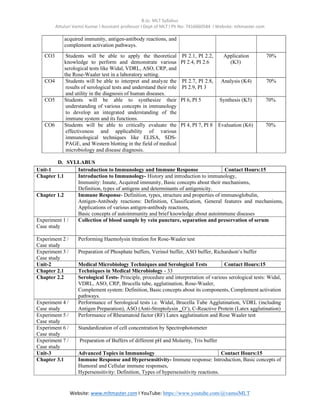
acquired immunity, antigen-antibody reactions, and
complement activation pathways.
CO3 Students will be able to apply the theoretical
knowledge to perform and demonstrate various
serological tests like Widal, VDRL, ASO, CRP, and
the Rose-Waaler test in a laboratory setting.
PI 2.1, PI 2.2,
PI 2.4, PI 2.6
Application
(K3)
70%
CO4 Students will be able to interpret and analyze the
results of serological tests and understand their role
and utility in the diagnosis of human diseases.
PI 2.7, PI 2.8,
PI 2.9, PI 3
Analysis (K4) 70%
CO5 Students will be able to synthesize their
understanding of various concepts in immunology
to develop an integrated understanding of the
immune system and its functions.
PI 6, PI 5 Synthesis (K5) 70%
CO6 Students will be able to critically evaluate the
effectiveness and applicability of various
immunological techniques like ELISA, SDS-
PAGE, and Western blotting in the field of medical
microbiology and disease diagnosis.
PI 4, PI 7, PI 8 Evaluation (K6) 70%
D. SYLLABUS
Unit-1 Introduction to Immunology and Immune Response Contact Hours:15
Chapter 1.1 Introduction to Immunology- History and introduction to immunology,
Immunity: Innate, Acquired immunity, Basic concepts about their mechanisms,
Definition, types of antigens and determinants of antigenicity.
Chapter 1.2 Immune Response- Definition, types, structure and properties of immunoglobulin,
Antigen-Antibody reactions: Definition, Classification, General features and mechanisms,
Applications of various antigen-antibody reactions,
Basic concepts of autoimmunity and brief knowledge about autoimmune diseases
Experiment 1 /
Case study
Collection of blood sample by vein puncture, separation and preservation of serum
Experiment 2 /
Case study
Performing Haemolysin titration for Rose-Waaler test
Experiment 3 /
Case study
Preparation of Phosphate buffers, Verinol buffer, ASO buffer, Richardson‘s buffer
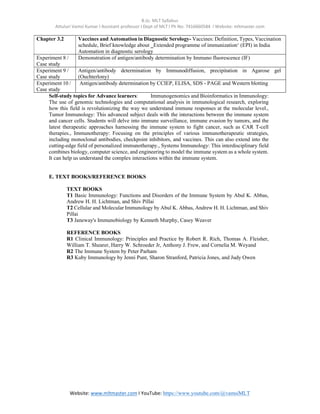
Unit-2 Medical Microbiology Techniques and Serological Tests Contact Hours:15
Chapter 2.1 Techniques in Medical Microbiology - 33
Chapter 2.2 Serological Tests- Principle, procedure and interpretation of various serological tests: Widal,
VDRL, ASO, CRP, Brucella tube, agglutination, Rose-Waaler,
Complement system: Definition, Basic concepts about its components, Complement activation
pathways.
Experiment 4 /
Case study
Performance of Serological tests i.e. Widal, Brucella Tube Agglutination, VDRL (including
Antigen Preparation), ASO (Anti-Streptolysin ‗O‘), C-Reactive Protein (Latex agglutination)
Experiment 5 /
Case study
Performance of Rheumatoid factor (RF) Latex agglutination and Rose Waaler test
Experiment 6 /
Case study
Standardization of cell concentration by Spectrophotometer
Experiment 7 /
Case study
Preparation of Buffers of different pH and Molarity, Tris buffer
Unit-3 Advanced Topics in Immunology Contact Hours:15
Chapter 3.1 Immune Response and Hypersensitivity- Immune response: Introduction, Basic concepts of
Humoral and Cellular immune responses,
Hypersensitivity: Definition, Types of hypersensitivity reactions.
B.Sc. MLT Syllabus
Attuluri Vamsi Kumar I Assistant professor I Dept of MLT I Ph No: 7416660584 I Website: mltmaster.com
Website: www.mltmaster.com I YouTube: https://www.youtube.com/@vamsiMLT
Chapter 3.2 Vaccines and Automation in Diagnostic Serology- Vaccines: Definition, Types, Vaccination
schedule, Brief knowledge about ‗Extended programme of immunization‘ (EPI) in India
Automation in diagnostic serology
Experiment 8 /
Case study
Demonstration of antigen/antibody determination by Immuno fluorescence (IF)
Experiment 9 /
Case study
Antigen/antibody determination by Immunodiffusion, precipitation in Agarose gel
(Ouchterlony)
Experiment 10 /
Case study
Antigen/antibody determination by CCIEP, ELISA, SDS - PAGE and Western blotting
Self-study topics for Advance learners: Immunogenomics and Bioinformatics in Immunology:
The use of genomic technologies and computational analysis in immunological research, exploring
how this field is revolutionizing the way we understand immune responses at the molecular level.,
Tumor Immunology: This advanced subject deals with the interactions between the immune system
and cancer cells. Students will delve into immune surveillance, immune evasion by tumors, and the
latest therapeutic approaches harnessing the immune system to fight cancer, such as CAR T-cell
therapies., Immunotherapy: Focusing on the principles of various immunotherapeutic strategies,
including monoclonal antibodies, checkpoint inhibitors, and vaccines. This can also extend into the
cutting-edge field of personalized immunotherapy., Systems Immunology: This interdisciplinary field
combines biology, computer science, and engineering to model the immune system as a whole system.
It can help us understand the complex interactions within the immune system.
E. TEXT BOOKS/REFERENCE BOOKS
TEXT BOOKS
T1 Basic Immunology: Functions and Disorders of the Immune System by Abul K. Abbas,
Andrew H. H. Lichtman, and Shiv Pillai
T2 Cellular and Molecular Immunology by Abul K. Abbas, Andrew H. H. Lichtman, and Shiv
Pillai
T3 Janeway's Immunobiology by Kenneth Murphy, Casey Weaver
REFERENCE BOOKS
R1 Clinical Immunology: Principles and Practice by Robert R. Rich, Thomas A. Fleisher,
William T. Shearer, Harry W. Schroeder Jr, Anthony J. Frew, and Cornelia M. Weyand
R2 The Immune System by Peter Parham
R3 Kuby Immunology by Jenni Punt, Sharon Stranford, Patricia Jones, and Judy Owen
B.Sc. MLT Syllabus
Attuluri Vamsi Kumar I Assistant professor I Dept of MLT I Ph No: 7416660584 I Website: mltmaster.com
Website: www.mltmaster.com I YouTube: https://www.youtube.com/@vamsiMLT
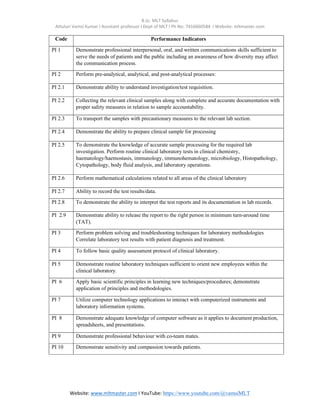
Code Performance Indicators
PI 1 Demonstrate professional interpersonal, oral, and written communications skills sufficient to
serve the needs of patients and the public including an awareness of how diversity may affect
the communication process.
PI 2 Perform pre-analytical, analytical, and post-analytical processes:
PI 2.1 Demonstrate ability to understand investigation/test requisition.
PI 2.2 Collecting the relevant clinical samples along with complete and accurate documentation with
proper safety measures in relation to sample accountability.
PI 2.3 To transport the samples with precautionary measures to the relevant lab section.
PI 2.4 Demonstrate the ability to prepare clinical sample for processing
PI 2.5 To demonstrate the knowledge of accurate sample processing for the required lab
investigation. Perform routine clinical laboratory tests in clinical chemistry,
haematology/haemostasis, immunology, immunohematology, microbiology, Histopathology,
Cytopathology, body fluid analysis, and laboratory operations.
PI 2.6 Perform mathematical calculations related to all areas of the clinical laboratory
PI 2.7 Ability to record the test results/data.
PI 2.8 To demonstrate the ability to interpret the test reports and its documentation in lab records.
PI 2.9 Demonstrate ability to release the report to the right person in minimum turn-around time
(TAT).
PI 3 Perform problem solving and troubleshooting techniques for laboratory methodologies
Correlate laboratory test results with patient diagnosis and treatment.
PI 4 To follow basic quality assessment protocol of clinical laboratory.
PI 5 Demonstrate routine laboratory techniques sufficient to orient new employees within the
clinical laboratory.
PI 6 Apply basic scientific principles in learning new techniques/procedures; demonstrate
application of principles and methodologies.
PI 7 Utilize computer technology applications to interact with computerized instruments and
laboratory information systems.
PI 8 Demonstrate adequate knowledge of computer software as it applies to document production,
spreadsheets, and presentations.
PI 9 Demonstrate professional behaviour with co-team mates.
PI 10 Demonstrate sensitivity and compassion towards patients.

33_Immunology & Bacterial serology.pdf

  • 1.
    B.Sc. MLT Syllabus AttuluriVamsi Kumar I Assistant professor I Dept of MLT I Ph No: 7416660584 I Website: mltmaster.com Website: www.mltmaster.com I YouTube: https://www.youtube.com/@vamsiMLT Program Name: B.Sc. Medical Lab Technology Syllabus of Immunology & Bacterial serology Course Name: Immunology & Bacterial serology Course Type Course Coordinator: Attuluri Vamsi Kumar – B.Sc. MLT, M.Sc. MLT, PhD (Perusing) Designation: Assistant Professor Department: Department of Medical Lab Technology (MLT) Program Core PRE-REQUISITE Applied Bacteriology Sem: 5 S. No: 33 About Vamsi: I am academician in Medical Laboratory Sciences with a strong desire to improve Outcome based education (OBE) structured MLT education. I am constantly focusing on building an academic atmosphere that is set high standards with strong multi blended teaching pedagogy models. YouTube: https://www.youtube.com/@vamsiMLT SlideShare: https://www.slideshare.net/VamsiIntellectual Website: www.mltmaster.com / https://sites.google.com/view/vamsi-intellectual-protfolio/home LinkedIn: https://www.linkedin.com/in/vamsi-kumar-attuluri-ab8987128/?originalSubdomain=in Research Gate: https://www.researchgate.net/profile/Attuluri-Kumar Orcid ID: https://orcid.org/0000-0001-9278-6714 Contact No: +91 7416660584 Mail ID: vamsifmlt@gmail.com A. COURSE DESCRIPTION This course on "Immunology and Bacterial Serology" provides a comprehensive understanding of the principles and techniques involved in immunology, including the study of immunity, immune response, antigen-antibody reactions, serological tests, and the application of these in the diagnosis of human diseases. The course also introduces students to the laboratory aspects of immunology and serology, including the preparation and execution of various diagnostic tests. B. COURSE OBJECTIVES: 1. Students will be able to identify and recall the history, concepts, and definitions related to immunology such as immunity, antigens, immunoglobulin, and autoimmunity. 2. Students will be able to explain and describe the mechanisms involved in innate and acquired immunity, antigen-antibody reactions, and complement activation pathways. 3. Students will be able to demonstrate and perform various serological tests like Widal, VDRL, ASO, CRP, and the Rose-Waaler test in the lab. 4. Students will be able to analyze and interpret the results of serological tests and understand their application in medical microbiology. 5. Students will be able to evaluate the effectiveness of various immunological techniques like ELISA, SDS-PAGE, and Western blotting, and assess their role in disease diagnosis. C. COURSE OUTCOMES CO No Statement Performance Indicator Level of Learning (Highest BT Level) Target Attainment CO1 Students will be able to list and recall the key concepts, definitions, and historical aspects related to immunology such as immunity, antigens, immunoglobulin, and autoimmunity. PI 6 Knowledge (K1) 70% CO2 Students will be able to understand and explain the complex mechanisms involved in innate and PI 2.5 Comprehension (K2) 70%
  • 2.
    B.Sc. MLT Syllabus AttuluriVamsi Kumar I Assistant professor I Dept of MLT I Ph No: 7416660584 I Website: mltmaster.com Website: www.mltmaster.com I YouTube: https://www.youtube.com/@vamsiMLT acquired immunity, antigen-antibody reactions, and complement activation pathways. CO3 Students will be able to apply the theoretical knowledge to perform and demonstrate various serological tests like Widal, VDRL, ASO, CRP, and the Rose-Waaler test in a laboratory setting. PI 2.1, PI 2.2, PI 2.4, PI 2.6 Application (K3) 70% CO4 Students will be able to interpret and analyze the results of serological tests and understand their role and utility in the diagnosis of human diseases. PI 2.7, PI 2.8, PI 2.9, PI 3 Analysis (K4) 70% CO5 Students will be able to synthesize their understanding of various concepts in immunology to develop an integrated understanding of the immune system and its functions. PI 6, PI 5 Synthesis (K5) 70% CO6 Students will be able to critically evaluate the effectiveness and applicability of various immunological techniques like ELISA, SDS- PAGE, and Western blotting in the field of medical microbiology and disease diagnosis. PI 4, PI 7, PI 8 Evaluation (K6) 70% D. SYLLABUS Unit-1 Introduction to Immunology and Immune Response Contact Hours:15 Chapter 1.1 Introduction to Immunology- History and introduction to immunology, Immunity: Innate, Acquired immunity, Basic concepts about their mechanisms, Definition, types of antigens and determinants of antigenicity. Chapter 1.2 Immune Response- Definition, types, structure and properties of immunoglobulin, Antigen-Antibody reactions: Definition, Classification, General features and mechanisms, Applications of various antigen-antibody reactions, Basic concepts of autoimmunity and brief knowledge about autoimmune diseases Experiment 1 / Case study Collection of blood sample by vein puncture, separation and preservation of serum Experiment 2 / Case study Performing Haemolysin titration for Rose-Waaler test Experiment 3 / Case study Preparation of Phosphate buffers, Verinol buffer, ASO buffer, Richardson‘s buffer Unit-2 Medical Microbiology Techniques and Serological Tests Contact Hours:15 Chapter 2.1 Techniques in Medical Microbiology - 33 Chapter 2.2 Serological Tests- Principle, procedure and interpretation of various serological tests: Widal, VDRL, ASO, CRP, Brucella tube, agglutination, Rose-Waaler, Complement system: Definition, Basic concepts about its components, Complement activation pathways. Experiment 4 / Case study Performance of Serological tests i.e. Widal, Brucella Tube Agglutination, VDRL (including Antigen Preparation), ASO (Anti-Streptolysin ‗O‘), C-Reactive Protein (Latex agglutination) Experiment 5 / Case study Performance of Rheumatoid factor (RF) Latex agglutination and Rose Waaler test Experiment 6 / Case study Standardization of cell concentration by Spectrophotometer Experiment 7 / Case study Preparation of Buffers of different pH and Molarity, Tris buffer Unit-3 Advanced Topics in Immunology Contact Hours:15 Chapter 3.1 Immune Response and Hypersensitivity- Immune response: Introduction, Basic concepts of Humoral and Cellular immune responses, Hypersensitivity: Definition, Types of hypersensitivity reactions.
  • 3.
    B.Sc. MLT Syllabus AttuluriVamsi Kumar I Assistant professor I Dept of MLT I Ph No: 7416660584 I Website: mltmaster.com Website: www.mltmaster.com I YouTube: https://www.youtube.com/@vamsiMLT Chapter 3.2 Vaccines and Automation in Diagnostic Serology- Vaccines: Definition, Types, Vaccination schedule, Brief knowledge about ‗Extended programme of immunization‘ (EPI) in India Automation in diagnostic serology Experiment 8 / Case study Demonstration of antigen/antibody determination by Immuno fluorescence (IF) Experiment 9 / Case study Antigen/antibody determination by Immunodiffusion, precipitation in Agarose gel (Ouchterlony) Experiment 10 / Case study Antigen/antibody determination by CCIEP, ELISA, SDS - PAGE and Western blotting Self-study topics for Advance learners: Immunogenomics and Bioinformatics in Immunology: The use of genomic technologies and computational analysis in immunological research, exploring how this field is revolutionizing the way we understand immune responses at the molecular level., Tumor Immunology: This advanced subject deals with the interactions between the immune system and cancer cells. Students will delve into immune surveillance, immune evasion by tumors, and the latest therapeutic approaches harnessing the immune system to fight cancer, such as CAR T-cell therapies., Immunotherapy: Focusing on the principles of various immunotherapeutic strategies, including monoclonal antibodies, checkpoint inhibitors, and vaccines. This can also extend into the cutting-edge field of personalized immunotherapy., Systems Immunology: This interdisciplinary field combines biology, computer science, and engineering to model the immune system as a whole system. It can help us understand the complex interactions within the immune system. E. TEXT BOOKS/REFERENCE BOOKS TEXT BOOKS T1 Basic Immunology: Functions and Disorders of the Immune System by Abul K. Abbas, Andrew H. H. Lichtman, and Shiv Pillai T2 Cellular and Molecular Immunology by Abul K. Abbas, Andrew H. H. Lichtman, and Shiv Pillai T3 Janeway's Immunobiology by Kenneth Murphy, Casey Weaver REFERENCE BOOKS R1 Clinical Immunology: Principles and Practice by Robert R. Rich, Thomas A. Fleisher, William T. Shearer, Harry W. Schroeder Jr, Anthony J. Frew, and Cornelia M. Weyand R2 The Immune System by Peter Parham R3 Kuby Immunology by Jenni Punt, Sharon Stranford, Patricia Jones, and Judy Owen
  • 4.
    B.Sc. MLT Syllabus AttuluriVamsi Kumar I Assistant professor I Dept of MLT I Ph No: 7416660584 I Website: mltmaster.com Website: www.mltmaster.com I YouTube: https://www.youtube.com/@vamsiMLT Code Performance Indicators PI 1 Demonstrate professional interpersonal, oral, and written communications skills sufficient to serve the needs of patients and the public including an awareness of how diversity may affect the communication process. PI 2 Perform pre-analytical, analytical, and post-analytical processes: PI 2.1 Demonstrate ability to understand investigation/test requisition. PI 2.2 Collecting the relevant clinical samples along with complete and accurate documentation with proper safety measures in relation to sample accountability. PI 2.3 To transport the samples with precautionary measures to the relevant lab section. PI 2.4 Demonstrate the ability to prepare clinical sample for processing PI 2.5 To demonstrate the knowledge of accurate sample processing for the required lab investigation. Perform routine clinical laboratory tests in clinical chemistry, haematology/haemostasis, immunology, immunohematology, microbiology, Histopathology, Cytopathology, body fluid analysis, and laboratory operations. PI 2.6 Perform mathematical calculations related to all areas of the clinical laboratory PI 2.7 Ability to record the test results/data. PI 2.8 To demonstrate the ability to interpret the test reports and its documentation in lab records. PI 2.9 Demonstrate ability to release the report to the right person in minimum turn-around time (TAT). PI 3 Perform problem solving and troubleshooting techniques for laboratory methodologies Correlate laboratory test results with patient diagnosis and treatment. PI 4 To follow basic quality assessment protocol of clinical laboratory. PI 5 Demonstrate routine laboratory techniques sufficient to orient new employees within the clinical laboratory. PI 6 Apply basic scientific principles in learning new techniques/procedures; demonstrate application of principles and methodologies. PI 7 Utilize computer technology applications to interact with computerized instruments and laboratory information systems. PI 8 Demonstrate adequate knowledge of computer software as it applies to document production, spreadsheets, and presentations. PI 9 Demonstrate professional behaviour with co-team mates. PI 10 Demonstrate sensitivity and compassion towards patients.