B.Sc. MLT Syllabus
Attuluri Vamsi Kumar I Assistant professor I Dept of MLT I Ph No: 7416660584 I Website: mltmaster.com
Website: www.mltmaster.com I YouTube: https://www.youtube.com/@vamsiMLT
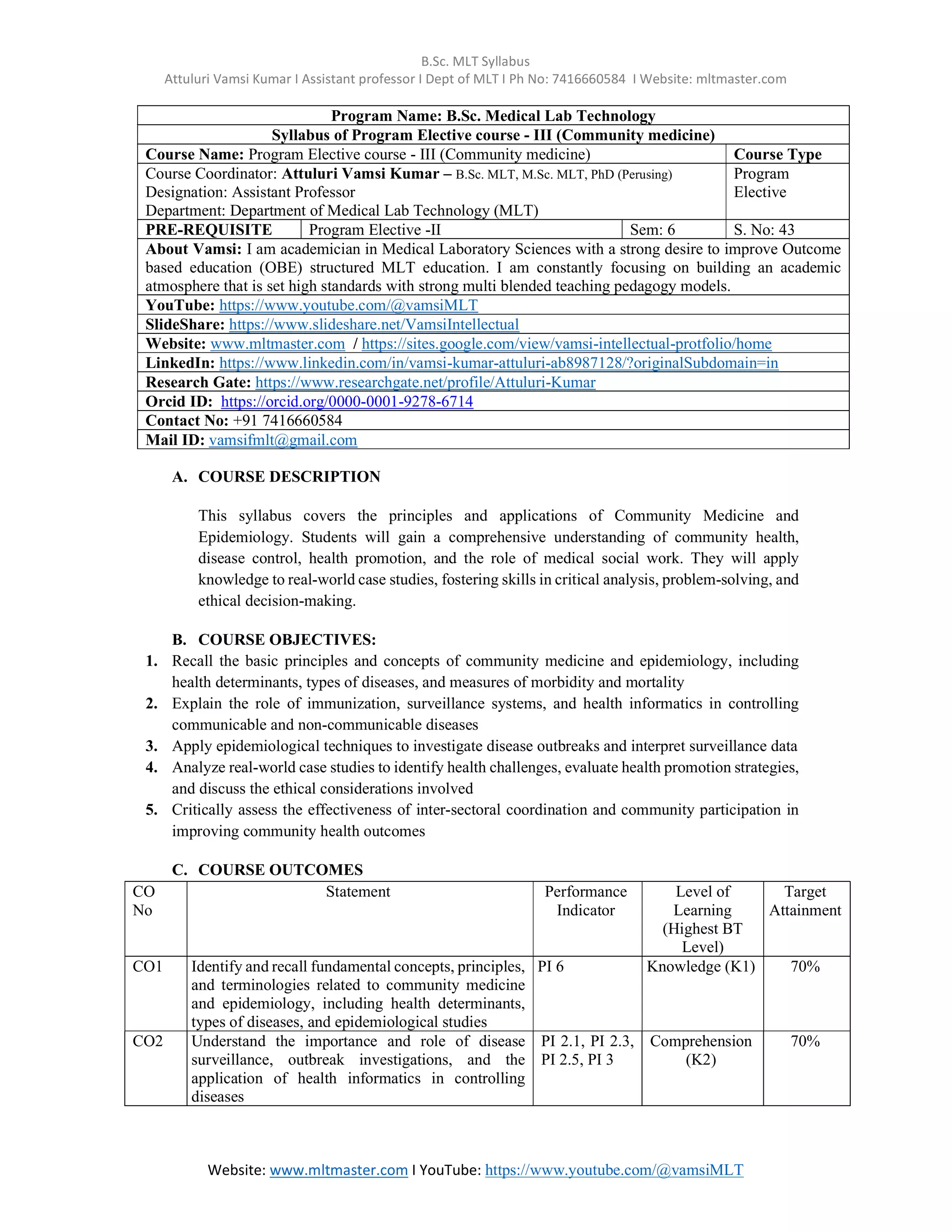
Program Name: B.Sc. Medical Lab Technology
Syllabus of Program Elective course - III (Community medicine)
Course Name: Program Elective course - III (Community medicine) Course Type
Course Coordinator: Attuluri Vamsi Kumar – B.Sc. MLT, M.Sc. MLT, PhD (Perusing)
Designation: Assistant Professor
Department: Department of Medical Lab Technology (MLT)
Program
Elective
PRE-REQUISITE Program Elective -II Sem: 6 S. No: 43
About Vamsi: I am academician in Medical Laboratory Sciences with a strong desire to improve Outcome
based education (OBE) structured MLT education. I am constantly focusing on building an academic
atmosphere that is set high standards with strong multi blended teaching pedagogy models.
YouTube: https://www.youtube.com/@vamsiMLT
SlideShare: https://www.slideshare.net/VamsiIntellectual
Website: www.mltmaster.com / https://sites.google.com/view/vamsi-intellectual-protfolio/home
LinkedIn: https://www.linkedin.com/in/vamsi-kumar-attuluri-ab8987128/?originalSubdomain=in
Research Gate: https://www.researchgate.net/profile/Attuluri-Kumar
Orcid ID: https://orcid.org/0000-0001-9278-6714
Contact No: +91 7416660584
Mail ID: vamsifmlt@gmail.com
A. COURSE DESCRIPTION
This syllabus covers the principles and applications of Community Medicine and
Epidemiology. Students will gain a comprehensive understanding of community health,
disease control, health promotion, and the role of medical social work. They will apply
knowledge to real-world case studies, fostering skills in critical analysis, problem-solving, and
ethical decision-making.
B. COURSE OBJECTIVES:
1. Recall the basic principles and concepts of community medicine and epidemiology, including
health determinants, types of diseases, and measures of morbidity and mortality
2. Explain the role of immunization, surveillance systems, and health informatics in controlling
communicable and non-communicable diseases
3. Apply epidemiological techniques to investigate disease outbreaks and interpret surveillance data
4. Analyze real-world case studies to identify health challenges, evaluate health promotion strategies,
and discuss the ethical considerations involved
5. Critically assess the effectiveness of inter-sectoral coordination and community participation in
improving community health outcomes
C. COURSE OUTCOMES
CO
No
Statement Performance
Indicator
Level of
Learning
(Highest BT
Level)
Target
Attainment
CO1 Identify and recall fundamental concepts, principles,
and terminologies related to community medicine
and epidemiology, including health determinants,
types of diseases, and epidemiological studies
PI 6 Knowledge (K1) 70%
CO2 Understand the importance and role of disease
surveillance, outbreak investigations, and the
application of health informatics in controlling
diseases
PI 2.1, PI 2.3,
PI 2.5, PI 3
Comprehension
(K2)
70%
B.Sc. MLT Syllabus
Attuluri Vamsi Kumar I Assistant professor I Dept of MLT I Ph No: 7416660584 I Website: mltmaster.com
Website: www.mltmaster.com I YouTube: https://www.youtube.com/@vamsiMLT
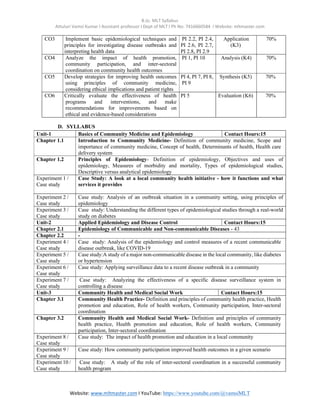
CO3 Implement basic epidemiological techniques and
principles for investigating disease outbreaks and
interpreting health data
PI 2.2, PI 2.4,
PI 2.6, PI 2.7,
PI 2.8, PI 2.9
Application
(K3)
70%
CO4 Analyze the impact of health promotion,
community participation, and inter-sectoral
coordination on community health outcomes
PI 1, PI 10 Analysis (K4) 70%
CO5 Develop strategies for improving health outcomes
using principles of community medicine,
considering ethical implications and patient rights
PI 4, PI 7, PI 8,
PI 9
Synthesis (K5) 70%
CO6 Critically evaluate the effectiveness of health
programs and interventions, and make
recommendations for improvements based on
ethical and evidence-based considerations
PI 5 Evaluation (K6) 70%
D. SYLLABUS
Unit-1 Basics of Community Medicine and Epidemiology Contact Hours:15
Chapter 1.1 Introduction to Community Medicine- Definition of community medicine, Scope and
importance of community medicine, Concept of health, Determinants of health, Health care
delivery system
Chapter 1.2 Principles of Epidemiology- Definition of epidemiology, Objectives and uses of
epidemiology, Measures of morbidity and mortality, Types of epidemiological studies,
Descriptive versus analytical epidemiology
Experiment 1 /
Case study
Case Study: A look at a local community health initiative - how it functions and what
services it provides
Experiment 2 /
Case study
Case study: Analysis of an outbreak situation in a community setting, using principles of
epidemiology
Experiment 3 /
Case study
Case study: Understanding the different types of epidemiological studies through a real-world
study on diabetes
Unit-2 Applied Epidemiology and Disease Control Contact Hours:15
Chapter 2.1 Epidemiology of Communicable and Non-communicable Diseases - 43
Chapter 2.2 -
Experiment 4 /
Case study
Case study: Analysis of the epidemiology and control measures of a recent communicable
disease outbreak, like COVID-19
Experiment 5 /
Case study
Case study:A study of a major non-communicable disease in the local community, like diabetes
or hypertension
Experiment 6 /
Case study
Case study: Applying surveillance data to a recent disease outbreak in a community
Experiment 7 /
Case study
Case study: Analyzing the effectiveness of a specific disease surveillance system in
controlling a disease
Unit-3 Community Health and Medical Social Work Contact Hours:15
Chapter 3.1 Community Health Practice- Definition and principles of community health practice, Health
promotion and education, Role of health workers, Community participation, Inter-sectoral
coordination
Chapter 3.2 Community Health and Medical Social Work- Definition and principles of community
health practice, Health promotion and education, Role of health workers, Community
participation, Inter-sectoral coordination
Experiment 8 /
Case study
Case study: The impact of health promotion and education in a local community
Experiment 9 /
Case study
Case study: How community participation improved health outcomes in a given scenario
Experiment 10 /
Case study
Case study: A study of the role of inter-sectoral coordination in a successful community
health program
B.Sc. MLT Syllabus
Attuluri Vamsi Kumar I Assistant professor I Dept of MLT I Ph No: 7416660584 I Website: mltmaster.com
Website: www.mltmaster.com I YouTube: https://www.youtube.com/@vamsiMLT
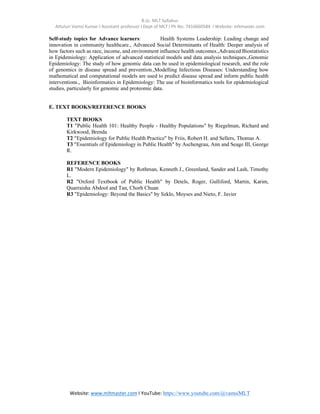
Self-study topics for Advance learners: Health Systems Leadership: Leading change and
innovation in community healthcare., Advanced Social Determinants of Health: Deeper analysis of
how factors such as race, income, and environment influence health outcomes.,Advanced Biostatistics
in Epidemiology: Application of advanced statistical models and data analysis techniques.,Genomic
Epidemiology: The study of how genomic data can be used in epidemiological research, and the role
of genomics in disease spread and prevention.,Modelling Infectious Diseases: Understanding how
mathematical and computational models are used to predict disease spread and inform public health
interventions., Bioinformatics in Epidemiology: The use of bioinformatics tools for epidemiological
studies, particularly for genomic and proteomic data.
E. TEXT BOOKS/REFERENCE BOOKS
TEXT BOOKS
T1 "Public Health 101: Healthy People - Healthy Populations" by Riegelman, Richard and
Kirkwood, Brenda
T2 "Epidemiology for Public Health Practice" by Friis, Robert H. and Sellers, Thomas A.
T3 "Essentials of Epidemiology in Public Health" by Aschengrau, Ann and Seage III, George
R.
REFERENCE BOOKS
R1 "Modern Epidemiology" by Rothman, Kenneth J., Greenland, Sander and Lash, Timothy
L.
R2 "Oxford Textbook of Public Health" by Detels, Roger, Gulliford, Martin, Karim,
Quarraisha Abdool and Tan, Chorh Chuan
R3 "Epidemiology: Beyond the Basics" by Szklo, Moyses and Nieto, F. Javier
B.Sc. MLT Syllabus
Attuluri Vamsi Kumar I Assistant professor I Dept of MLT I Ph No: 7416660584 I Website: mltmaster.com
Website: www.mltmaster.com I YouTube: https://www.youtube.com/@vamsiMLT
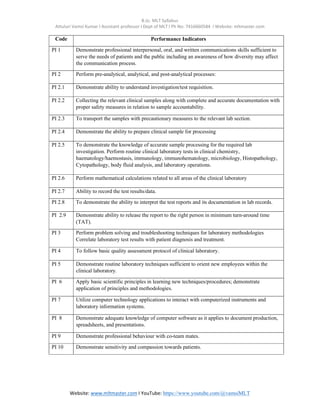
Code Performance Indicators
PI 1 Demonstrate professional interpersonal, oral, and written communications skills sufficient to
serve the needs of patients and the public including an awareness of how diversity may affect
the communication process.
PI 2 Perform pre-analytical, analytical, and post-analytical processes:
PI 2.1 Demonstrate ability to understand investigation/test requisition.
PI 2.2 Collecting the relevant clinical samples along with complete and accurate documentation with
proper safety measures in relation to sample accountability.
PI 2.3 To transport the samples with precautionary measures to the relevant lab section.
PI 2.4 Demonstrate the ability to prepare clinical sample for processing
PI 2.5 To demonstrate the knowledge of accurate sample processing for the required lab
investigation. Perform routine clinical laboratory tests in clinical chemistry,
haematology/haemostasis, immunology, immunohematology, microbiology, Histopathology,
Cytopathology, body fluid analysis, and laboratory operations.
PI 2.6 Perform mathematical calculations related to all areas of the clinical laboratory
PI 2.7 Ability to record the test results/data.
PI 2.8 To demonstrate the ability to interpret the test reports and its documentation in lab records.
PI 2.9 Demonstrate ability to release the report to the right person in minimum turn-around time
(TAT).
PI 3 Perform problem solving and troubleshooting techniques for laboratory methodologies
Correlate laboratory test results with patient diagnosis and treatment.
PI 4 To follow basic quality assessment protocol of clinical laboratory.
PI 5 Demonstrate routine laboratory techniques sufficient to orient new employees within the
clinical laboratory.
PI 6 Apply basic scientific principles in learning new techniques/procedures; demonstrate
application of principles and methodologies.
PI 7 Utilize computer technology applications to interact with computerized instruments and
laboratory information systems.
PI 8 Demonstrate adequate knowledge of computer software as it applies to document production,
spreadsheets, and presentations.
PI 9 Demonstrate professional behaviour with co-team mates.
PI 10 Demonstrate sensitivity and compassion towards patients.

43_Program Elective course - III (Community medicine).pdf

  • 1.
    B.Sc. MLT Syllabus AttuluriVamsi Kumar I Assistant professor I Dept of MLT I Ph No: 7416660584 I Website: mltmaster.com Website: www.mltmaster.com I YouTube: https://www.youtube.com/@vamsiMLT Program Name: B.Sc. Medical Lab Technology Syllabus of Program Elective course - III (Community medicine) Course Name: Program Elective course - III (Community medicine) Course Type Course Coordinator: Attuluri Vamsi Kumar – B.Sc. MLT, M.Sc. MLT, PhD (Perusing) Designation: Assistant Professor Department: Department of Medical Lab Technology (MLT) Program Elective PRE-REQUISITE Program Elective -II Sem: 6 S. No: 43 About Vamsi: I am academician in Medical Laboratory Sciences with a strong desire to improve Outcome based education (OBE) structured MLT education. I am constantly focusing on building an academic atmosphere that is set high standards with strong multi blended teaching pedagogy models. YouTube: https://www.youtube.com/@vamsiMLT SlideShare: https://www.slideshare.net/VamsiIntellectual Website: www.mltmaster.com / https://sites.google.com/view/vamsi-intellectual-protfolio/home LinkedIn: https://www.linkedin.com/in/vamsi-kumar-attuluri-ab8987128/?originalSubdomain=in Research Gate: https://www.researchgate.net/profile/Attuluri-Kumar Orcid ID: https://orcid.org/0000-0001-9278-6714 Contact No: +91 7416660584 Mail ID: vamsifmlt@gmail.com A. COURSE DESCRIPTION This syllabus covers the principles and applications of Community Medicine and Epidemiology. Students will gain a comprehensive understanding of community health, disease control, health promotion, and the role of medical social work. They will apply knowledge to real-world case studies, fostering skills in critical analysis, problem-solving, and ethical decision-making. B. COURSE OBJECTIVES: 1. Recall the basic principles and concepts of community medicine and epidemiology, including health determinants, types of diseases, and measures of morbidity and mortality 2. Explain the role of immunization, surveillance systems, and health informatics in controlling communicable and non-communicable diseases 3. Apply epidemiological techniques to investigate disease outbreaks and interpret surveillance data 4. Analyze real-world case studies to identify health challenges, evaluate health promotion strategies, and discuss the ethical considerations involved 5. Critically assess the effectiveness of inter-sectoral coordination and community participation in improving community health outcomes C. COURSE OUTCOMES CO No Statement Performance Indicator Level of Learning (Highest BT Level) Target Attainment CO1 Identify and recall fundamental concepts, principles, and terminologies related to community medicine and epidemiology, including health determinants, types of diseases, and epidemiological studies PI 6 Knowledge (K1) 70% CO2 Understand the importance and role of disease surveillance, outbreak investigations, and the application of health informatics in controlling diseases PI 2.1, PI 2.3, PI 2.5, PI 3 Comprehension (K2) 70%
  • 2.
    B.Sc. MLT Syllabus AttuluriVamsi Kumar I Assistant professor I Dept of MLT I Ph No: 7416660584 I Website: mltmaster.com Website: www.mltmaster.com I YouTube: https://www.youtube.com/@vamsiMLT CO3 Implement basic epidemiological techniques and principles for investigating disease outbreaks and interpreting health data PI 2.2, PI 2.4, PI 2.6, PI 2.7, PI 2.8, PI 2.9 Application (K3) 70% CO4 Analyze the impact of health promotion, community participation, and inter-sectoral coordination on community health outcomes PI 1, PI 10 Analysis (K4) 70% CO5 Develop strategies for improving health outcomes using principles of community medicine, considering ethical implications and patient rights PI 4, PI 7, PI 8, PI 9 Synthesis (K5) 70% CO6 Critically evaluate the effectiveness of health programs and interventions, and make recommendations for improvements based on ethical and evidence-based considerations PI 5 Evaluation (K6) 70% D. SYLLABUS Unit-1 Basics of Community Medicine and Epidemiology Contact Hours:15 Chapter 1.1 Introduction to Community Medicine- Definition of community medicine, Scope and importance of community medicine, Concept of health, Determinants of health, Health care delivery system Chapter 1.2 Principles of Epidemiology- Definition of epidemiology, Objectives and uses of epidemiology, Measures of morbidity and mortality, Types of epidemiological studies, Descriptive versus analytical epidemiology Experiment 1 / Case study Case Study: A look at a local community health initiative - how it functions and what services it provides Experiment 2 / Case study Case study: Analysis of an outbreak situation in a community setting, using principles of epidemiology Experiment 3 / Case study Case study: Understanding the different types of epidemiological studies through a real-world study on diabetes Unit-2 Applied Epidemiology and Disease Control Contact Hours:15 Chapter 2.1 Epidemiology of Communicable and Non-communicable Diseases - 43 Chapter 2.2 - Experiment 4 / Case study Case study: Analysis of the epidemiology and control measures of a recent communicable disease outbreak, like COVID-19 Experiment 5 / Case study Case study:A study of a major non-communicable disease in the local community, like diabetes or hypertension Experiment 6 / Case study Case study: Applying surveillance data to a recent disease outbreak in a community Experiment 7 / Case study Case study: Analyzing the effectiveness of a specific disease surveillance system in controlling a disease Unit-3 Community Health and Medical Social Work Contact Hours:15 Chapter 3.1 Community Health Practice- Definition and principles of community health practice, Health promotion and education, Role of health workers, Community participation, Inter-sectoral coordination Chapter 3.2 Community Health and Medical Social Work- Definition and principles of community health practice, Health promotion and education, Role of health workers, Community participation, Inter-sectoral coordination Experiment 8 / Case study Case study: The impact of health promotion and education in a local community Experiment 9 / Case study Case study: How community participation improved health outcomes in a given scenario Experiment 10 / Case study Case study: A study of the role of inter-sectoral coordination in a successful community health program
  • 3.
    B.Sc. MLT Syllabus AttuluriVamsi Kumar I Assistant professor I Dept of MLT I Ph No: 7416660584 I Website: mltmaster.com Website: www.mltmaster.com I YouTube: https://www.youtube.com/@vamsiMLT Self-study topics for Advance learners: Health Systems Leadership: Leading change and innovation in community healthcare., Advanced Social Determinants of Health: Deeper analysis of how factors such as race, income, and environment influence health outcomes.,Advanced Biostatistics in Epidemiology: Application of advanced statistical models and data analysis techniques.,Genomic Epidemiology: The study of how genomic data can be used in epidemiological research, and the role of genomics in disease spread and prevention.,Modelling Infectious Diseases: Understanding how mathematical and computational models are used to predict disease spread and inform public health interventions., Bioinformatics in Epidemiology: The use of bioinformatics tools for epidemiological studies, particularly for genomic and proteomic data. E. TEXT BOOKS/REFERENCE BOOKS TEXT BOOKS T1 "Public Health 101: Healthy People - Healthy Populations" by Riegelman, Richard and Kirkwood, Brenda T2 "Epidemiology for Public Health Practice" by Friis, Robert H. and Sellers, Thomas A. T3 "Essentials of Epidemiology in Public Health" by Aschengrau, Ann and Seage III, George R. REFERENCE BOOKS R1 "Modern Epidemiology" by Rothman, Kenneth J., Greenland, Sander and Lash, Timothy L. R2 "Oxford Textbook of Public Health" by Detels, Roger, Gulliford, Martin, Karim, Quarraisha Abdool and Tan, Chorh Chuan R3 "Epidemiology: Beyond the Basics" by Szklo, Moyses and Nieto, F. Javier
  • 4.
    B.Sc. MLT Syllabus AttuluriVamsi Kumar I Assistant professor I Dept of MLT I Ph No: 7416660584 I Website: mltmaster.com Website: www.mltmaster.com I YouTube: https://www.youtube.com/@vamsiMLT Code Performance Indicators PI 1 Demonstrate professional interpersonal, oral, and written communications skills sufficient to serve the needs of patients and the public including an awareness of how diversity may affect the communication process. PI 2 Perform pre-analytical, analytical, and post-analytical processes: PI 2.1 Demonstrate ability to understand investigation/test requisition. PI 2.2 Collecting the relevant clinical samples along with complete and accurate documentation with proper safety measures in relation to sample accountability. PI 2.3 To transport the samples with precautionary measures to the relevant lab section. PI 2.4 Demonstrate the ability to prepare clinical sample for processing PI 2.5 To demonstrate the knowledge of accurate sample processing for the required lab investigation. Perform routine clinical laboratory tests in clinical chemistry, haematology/haemostasis, immunology, immunohematology, microbiology, Histopathology, Cytopathology, body fluid analysis, and laboratory operations. PI 2.6 Perform mathematical calculations related to all areas of the clinical laboratory PI 2.7 Ability to record the test results/data. PI 2.8 To demonstrate the ability to interpret the test reports and its documentation in lab records. PI 2.9 Demonstrate ability to release the report to the right person in minimum turn-around time (TAT). PI 3 Perform problem solving and troubleshooting techniques for laboratory methodologies Correlate laboratory test results with patient diagnosis and treatment. PI 4 To follow basic quality assessment protocol of clinical laboratory. PI 5 Demonstrate routine laboratory techniques sufficient to orient new employees within the clinical laboratory. PI 6 Apply basic scientific principles in learning new techniques/procedures; demonstrate application of principles and methodologies. PI 7 Utilize computer technology applications to interact with computerized instruments and laboratory information systems. PI 8 Demonstrate adequate knowledge of computer software as it applies to document production, spreadsheets, and presentations. PI 9 Demonstrate professional behaviour with co-team mates. PI 10 Demonstrate sensitivity and compassion towards patients.