B.Sc. MLT Syllabus
Attuluri Vamsi Kumar I Assistant professor I Dept of MLT I Ph No: 7416660584 I Website: mltmaster.com
Website: www.mltmaster.com I YouTube: https://www.youtube.com/@vamsiMLT
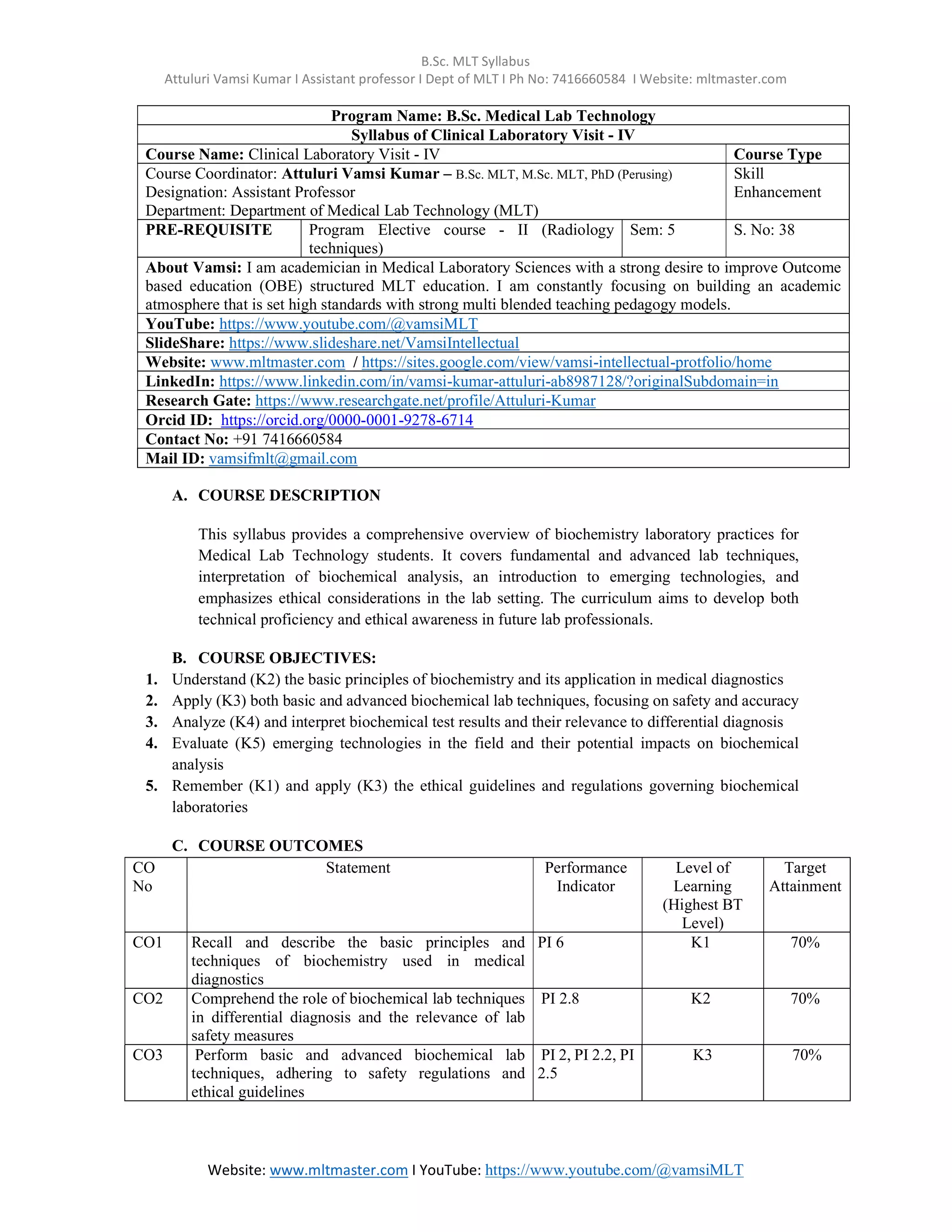
Program Name: B.Sc. Medical Lab Technology
Syllabus of Clinical Laboratory Visit - IV
Course Name: Clinical Laboratory Visit - IV Course Type
Course Coordinator: Attuluri Vamsi Kumar – B.Sc. MLT, M.Sc. MLT, PhD (Perusing)
Designation: Assistant Professor
Department: Department of Medical Lab Technology (MLT)
Skill
Enhancement
PRE-REQUISITE Program Elective course - II (Radiology
techniques)
Sem: 5 S. No: 38
About Vamsi: I am academician in Medical Laboratory Sciences with a strong desire to improve Outcome
based education (OBE) structured MLT education. I am constantly focusing on building an academic
atmosphere that is set high standards with strong multi blended teaching pedagogy models.
YouTube: https://www.youtube.com/@vamsiMLT
SlideShare: https://www.slideshare.net/VamsiIntellectual
Website: www.mltmaster.com / https://sites.google.com/view/vamsi-intellectual-protfolio/home
LinkedIn: https://www.linkedin.com/in/vamsi-kumar-attuluri-ab8987128/?originalSubdomain=in
Research Gate: https://www.researchgate.net/profile/Attuluri-Kumar
Orcid ID: https://orcid.org/0000-0001-9278-6714
Contact No: +91 7416660584
Mail ID: vamsifmlt@gmail.com
A. COURSE DESCRIPTION
This syllabus provides a comprehensive overview of biochemistry laboratory practices for
Medical Lab Technology students. It covers fundamental and advanced lab techniques,
interpretation of biochemical analysis, an introduction to emerging technologies, and
emphasizes ethical considerations in the lab setting. The curriculum aims to develop both
technical proficiency and ethical awareness in future lab professionals.
B. COURSE OBJECTIVES:
1. Understand (K2) the basic principles of biochemistry and its application in medical diagnostics
2. Apply (K3) both basic and advanced biochemical lab techniques, focusing on safety and accuracy
3. Analyze (K4) and interpret biochemical test results and their relevance to differential diagnosis
4. Evaluate (K5) emerging technologies in the field and their potential impacts on biochemical
analysis
5. Remember (K1) and apply (K3) the ethical guidelines and regulations governing biochemical
laboratories
C. COURSE OUTCOMES
CO
No
Statement Performance
Indicator
Level of
Learning
(Highest BT
Level)
Target
Attainment
CO1 Recall and describe the basic principles and
techniques of biochemistry used in medical
diagnostics
PI 6 K1 70%
CO2 Comprehend the role of biochemical lab techniques
in differential diagnosis and the relevance of lab
safety measures
PI 2.8 K2 70%
CO3 Perform basic and advanced biochemical lab
techniques, adhering to safety regulations and
ethical guidelines
PI 2, PI 2.2, PI
2.5
K3 70%
B.Sc. MLT Syllabus
Attuluri Vamsi Kumar I Assistant professor I Dept of MLT I Ph No: 7416660584 I Website: mltmaster.com
Website: www.mltmaster.com I YouTube: https://www.youtube.com/@vamsiMLT
CO4 Interpret biochemical test results and their
relevance to medical conditions and differential
diagnosis
PI 2.6, PI 2.8 K4 70%
CO5 Assess the impact and potential of emerging
technologies in biochemical analysis
PI 7 K5 70%
CO6 Design hypothetical scenarios to solve real-world
problems by integrating knowledge of
biochemistry, lab techniques, and ethical
considerations
PI 3 K6 70%
D. SYLLABUS
Unit-1 Fundamentals of Biochemistry and Laboratory Techniques Contact Hours:15
Chapter 1.1 Introduction to Biochemistry- Overview of biochemistry, Importance of biochemistry in
medicine, Basic biochemistry concepts
Chapter 1.2 Laboratory Safety and Basic Techniques- Topics: Laboratory safety measures, Equipment
handling, Basic biochemistry lab techniques
Experiment 1 /
Case study
Case Study 1.1: "Real-world Lab Safety Incident: Causes and Lessons"
Experiment 2 /
Case study
Case Study 1.2: "Introduction to Clinical Biochemistry: A Case of Metabolic Disorder"
Experiment 3 /
Case study
Case Study 1.3: "The Role of Biochemistry in Diagnosis: A Case of Nutritional Deficiency"
Unit-2 Advanced Laboratory Techniques and Analysis Contact Hours:15
Chapter 2.1 Advanced Biochemical Techniques - 38
Chapter 2.2 Biochemical Analysis and Interpretation- Biochemical test interpretation, Diagnostic
markers, Role of biochemistry in differential diagnosis
Experiment 4 /
Case study
Case Study 2.1: "Practical Applications of Chromatography in Disease Diagnosis"
Experiment 5 /
Case study
Case Study 2.2: "Role of Spectrophotometry in Drug Monitoring"
Experiment 6 /
Case study
Case Study 2.3: "Use of Electrophoresis in Genetic Disorders"
Experiment 7 /
Case study
Case Study 2.4: "Interpreting Biochemical Analysis: A Case of Endocrine Disorder"
Unit-3 Emerging Technologies in Biochemical Labs and Ethical
Considerations
Contact Hours:15
Chapter 3.1 Emerging Technologies in Biochemical Labs- Genomic sequencing, Proteomics,
Metabolomics, Bioinformatics
Chapter 3.2 Ethics and Regulations in Biochemical Laboratories- Importance of ethics in biochemistry,
Ethical challenges, Biochemical lab regulations
Experiment 8 /
Case study
Case Study 3.1: "The Future of Diagnosis: Genomic Sequencing in Action"
Experiment 9 /
Case study
Case Study 3.2: "Exploring Proteomics: A Case of Cancer Diagnosis"
Experiment 10 /
Case study
Case Study 3.3: "Ethical Dilemma in Biochemical Testing: A Hypothetical Scenario"
Self-study topics for Advance learners: -
E. TEXT BOOKS/REFERENCE BOOKS
TEXT BOOKS
T1 "Biochemistry" by Berg, Tymoczko, and Gatto
B.Sc. MLT Syllabus
Attuluri Vamsi Kumar I Assistant professor I Dept of MLT I Ph No: 7416660584 I Website: mltmaster.com
Website: www.mltmaster.com I YouTube: https://www.youtube.com/@vamsiMLT
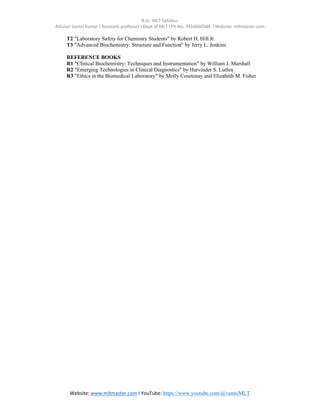
T2 "Laboratory Safety for Chemistry Students" by Robert H. Hill Jr.
T3 "Advanced Biochemistry: Structure and Function" by Jerry L. Jenkins
REFERENCE BOOKS
R1 "Clinical Biochemistry: Techniques and Instrumentation" by William J. Marshall
R2 "Emerging Technologies in Clinical Diagnostics" by Harvinder S. Luthra
R3 "Ethics in the Biomedical Laboratory" by Molly Courtenay and Elizabeth M. Fisher
B.Sc. MLT Syllabus
Attuluri Vamsi Kumar I Assistant professor I Dept of MLT I Ph No: 7416660584 I Website: mltmaster.com
Website: www.mltmaster.com I YouTube: https://www.youtube.com/@vamsiMLT
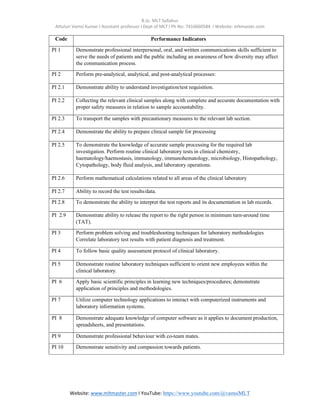
Code Performance Indicators
PI 1 Demonstrate professional interpersonal, oral, and written communications skills sufficient to
serve the needs of patients and the public including an awareness of how diversity may affect
the communication process.
PI 2 Perform pre-analytical, analytical, and post-analytical processes:
PI 2.1 Demonstrate ability to understand investigation/test requisition.
PI 2.2 Collecting the relevant clinical samples along with complete and accurate documentation with
proper safety measures in relation to sample accountability.
PI 2.3 To transport the samples with precautionary measures to the relevant lab section.
PI 2.4 Demonstrate the ability to prepare clinical sample for processing
PI 2.5 To demonstrate the knowledge of accurate sample processing for the required lab
investigation. Perform routine clinical laboratory tests in clinical chemistry,
haematology/haemostasis, immunology, immunohematology, microbiology, Histopathology,
Cytopathology, body fluid analysis, and laboratory operations.
PI 2.6 Perform mathematical calculations related to all areas of the clinical laboratory
PI 2.7 Ability to record the test results/data.
PI 2.8 To demonstrate the ability to interpret the test reports and its documentation in lab records.
PI 2.9 Demonstrate ability to release the report to the right person in minimum turn-around time
(TAT).
PI 3 Perform problem solving and troubleshooting techniques for laboratory methodologies
Correlate laboratory test results with patient diagnosis and treatment.
PI 4 To follow basic quality assessment protocol of clinical laboratory.
PI 5 Demonstrate routine laboratory techniques sufficient to orient new employees within the
clinical laboratory.
PI 6 Apply basic scientific principles in learning new techniques/procedures; demonstrate
application of principles and methodologies.
PI 7 Utilize computer technology applications to interact with computerized instruments and
laboratory information systems.
PI 8 Demonstrate adequate knowledge of computer software as it applies to document production,
spreadsheets, and presentations.
PI 9 Demonstrate professional behaviour with co-team mates.
PI 10 Demonstrate sensitivity and compassion towards patients.

38_Clinical Laboratory Visit - IV.pdf

  • 1.
    B.Sc. MLT Syllabus AttuluriVamsi Kumar I Assistant professor I Dept of MLT I Ph No: 7416660584 I Website: mltmaster.com Website: www.mltmaster.com I YouTube: https://www.youtube.com/@vamsiMLT Program Name: B.Sc. Medical Lab Technology Syllabus of Clinical Laboratory Visit - IV Course Name: Clinical Laboratory Visit - IV Course Type Course Coordinator: Attuluri Vamsi Kumar – B.Sc. MLT, M.Sc. MLT, PhD (Perusing) Designation: Assistant Professor Department: Department of Medical Lab Technology (MLT) Skill Enhancement PRE-REQUISITE Program Elective course - II (Radiology techniques) Sem: 5 S. No: 38 About Vamsi: I am academician in Medical Laboratory Sciences with a strong desire to improve Outcome based education (OBE) structured MLT education. I am constantly focusing on building an academic atmosphere that is set high standards with strong multi blended teaching pedagogy models. YouTube: https://www.youtube.com/@vamsiMLT SlideShare: https://www.slideshare.net/VamsiIntellectual Website: www.mltmaster.com / https://sites.google.com/view/vamsi-intellectual-protfolio/home LinkedIn: https://www.linkedin.com/in/vamsi-kumar-attuluri-ab8987128/?originalSubdomain=in Research Gate: https://www.researchgate.net/profile/Attuluri-Kumar Orcid ID: https://orcid.org/0000-0001-9278-6714 Contact No: +91 7416660584 Mail ID: vamsifmlt@gmail.com A. COURSE DESCRIPTION This syllabus provides a comprehensive overview of biochemistry laboratory practices for Medical Lab Technology students. It covers fundamental and advanced lab techniques, interpretation of biochemical analysis, an introduction to emerging technologies, and emphasizes ethical considerations in the lab setting. The curriculum aims to develop both technical proficiency and ethical awareness in future lab professionals. B. COURSE OBJECTIVES: 1. Understand (K2) the basic principles of biochemistry and its application in medical diagnostics 2. Apply (K3) both basic and advanced biochemical lab techniques, focusing on safety and accuracy 3. Analyze (K4) and interpret biochemical test results and their relevance to differential diagnosis 4. Evaluate (K5) emerging technologies in the field and their potential impacts on biochemical analysis 5. Remember (K1) and apply (K3) the ethical guidelines and regulations governing biochemical laboratories C. COURSE OUTCOMES CO No Statement Performance Indicator Level of Learning (Highest BT Level) Target Attainment CO1 Recall and describe the basic principles and techniques of biochemistry used in medical diagnostics PI 6 K1 70% CO2 Comprehend the role of biochemical lab techniques in differential diagnosis and the relevance of lab safety measures PI 2.8 K2 70% CO3 Perform basic and advanced biochemical lab techniques, adhering to safety regulations and ethical guidelines PI 2, PI 2.2, PI 2.5 K3 70%
  • 2.
    B.Sc. MLT Syllabus AttuluriVamsi Kumar I Assistant professor I Dept of MLT I Ph No: 7416660584 I Website: mltmaster.com Website: www.mltmaster.com I YouTube: https://www.youtube.com/@vamsiMLT CO4 Interpret biochemical test results and their relevance to medical conditions and differential diagnosis PI 2.6, PI 2.8 K4 70% CO5 Assess the impact and potential of emerging technologies in biochemical analysis PI 7 K5 70% CO6 Design hypothetical scenarios to solve real-world problems by integrating knowledge of biochemistry, lab techniques, and ethical considerations PI 3 K6 70% D. SYLLABUS Unit-1 Fundamentals of Biochemistry and Laboratory Techniques Contact Hours:15 Chapter 1.1 Introduction to Biochemistry- Overview of biochemistry, Importance of biochemistry in medicine, Basic biochemistry concepts Chapter 1.2 Laboratory Safety and Basic Techniques- Topics: Laboratory safety measures, Equipment handling, Basic biochemistry lab techniques Experiment 1 / Case study Case Study 1.1: "Real-world Lab Safety Incident: Causes and Lessons" Experiment 2 / Case study Case Study 1.2: "Introduction to Clinical Biochemistry: A Case of Metabolic Disorder" Experiment 3 / Case study Case Study 1.3: "The Role of Biochemistry in Diagnosis: A Case of Nutritional Deficiency" Unit-2 Advanced Laboratory Techniques and Analysis Contact Hours:15 Chapter 2.1 Advanced Biochemical Techniques - 38 Chapter 2.2 Biochemical Analysis and Interpretation- Biochemical test interpretation, Diagnostic markers, Role of biochemistry in differential diagnosis Experiment 4 / Case study Case Study 2.1: "Practical Applications of Chromatography in Disease Diagnosis" Experiment 5 / Case study Case Study 2.2: "Role of Spectrophotometry in Drug Monitoring" Experiment 6 / Case study Case Study 2.3: "Use of Electrophoresis in Genetic Disorders" Experiment 7 / Case study Case Study 2.4: "Interpreting Biochemical Analysis: A Case of Endocrine Disorder" Unit-3 Emerging Technologies in Biochemical Labs and Ethical Considerations Contact Hours:15 Chapter 3.1 Emerging Technologies in Biochemical Labs- Genomic sequencing, Proteomics, Metabolomics, Bioinformatics Chapter 3.2 Ethics and Regulations in Biochemical Laboratories- Importance of ethics in biochemistry, Ethical challenges, Biochemical lab regulations Experiment 8 / Case study Case Study 3.1: "The Future of Diagnosis: Genomic Sequencing in Action" Experiment 9 / Case study Case Study 3.2: "Exploring Proteomics: A Case of Cancer Diagnosis" Experiment 10 / Case study Case Study 3.3: "Ethical Dilemma in Biochemical Testing: A Hypothetical Scenario" Self-study topics for Advance learners: - E. TEXT BOOKS/REFERENCE BOOKS TEXT BOOKS T1 "Biochemistry" by Berg, Tymoczko, and Gatto
  • 3.
    B.Sc. MLT Syllabus AttuluriVamsi Kumar I Assistant professor I Dept of MLT I Ph No: 7416660584 I Website: mltmaster.com Website: www.mltmaster.com I YouTube: https://www.youtube.com/@vamsiMLT T2 "Laboratory Safety for Chemistry Students" by Robert H. Hill Jr. T3 "Advanced Biochemistry: Structure and Function" by Jerry L. Jenkins REFERENCE BOOKS R1 "Clinical Biochemistry: Techniques and Instrumentation" by William J. Marshall R2 "Emerging Technologies in Clinical Diagnostics" by Harvinder S. Luthra R3 "Ethics in the Biomedical Laboratory" by Molly Courtenay and Elizabeth M. Fisher
  • 4.
    B.Sc. MLT Syllabus AttuluriVamsi Kumar I Assistant professor I Dept of MLT I Ph No: 7416660584 I Website: mltmaster.com Website: www.mltmaster.com I YouTube: https://www.youtube.com/@vamsiMLT Code Performance Indicators PI 1 Demonstrate professional interpersonal, oral, and written communications skills sufficient to serve the needs of patients and the public including an awareness of how diversity may affect the communication process. PI 2 Perform pre-analytical, analytical, and post-analytical processes: PI 2.1 Demonstrate ability to understand investigation/test requisition. PI 2.2 Collecting the relevant clinical samples along with complete and accurate documentation with proper safety measures in relation to sample accountability. PI 2.3 To transport the samples with precautionary measures to the relevant lab section. PI 2.4 Demonstrate the ability to prepare clinical sample for processing PI 2.5 To demonstrate the knowledge of accurate sample processing for the required lab investigation. Perform routine clinical laboratory tests in clinical chemistry, haematology/haemostasis, immunology, immunohematology, microbiology, Histopathology, Cytopathology, body fluid analysis, and laboratory operations. PI 2.6 Perform mathematical calculations related to all areas of the clinical laboratory PI 2.7 Ability to record the test results/data. PI 2.8 To demonstrate the ability to interpret the test reports and its documentation in lab records. PI 2.9 Demonstrate ability to release the report to the right person in minimum turn-around time (TAT). PI 3 Perform problem solving and troubleshooting techniques for laboratory methodologies Correlate laboratory test results with patient diagnosis and treatment. PI 4 To follow basic quality assessment protocol of clinical laboratory. PI 5 Demonstrate routine laboratory techniques sufficient to orient new employees within the clinical laboratory. PI 6 Apply basic scientific principles in learning new techniques/procedures; demonstrate application of principles and methodologies. PI 7 Utilize computer technology applications to interact with computerized instruments and laboratory information systems. PI 8 Demonstrate adequate knowledge of computer software as it applies to document production, spreadsheets, and presentations. PI 9 Demonstrate professional behaviour with co-team mates. PI 10 Demonstrate sensitivity and compassion towards patients.