Chapter 5
Oscillations
Tanpura
Pendulum
Clock
Swinging of
swing
Spring with load
Swing
Machine
Periodic Motion
Any motion which repeats itself after definite interval of time
is called periodic motion.
Periodic Time(T)
The time taken for one such set of movements(1 Oscillation)
is called its period or periodic time.
Ex:-Motion of the moon around the earth,
Motion of other planets around the sun,
Motion of electrons around the nucleus etc.
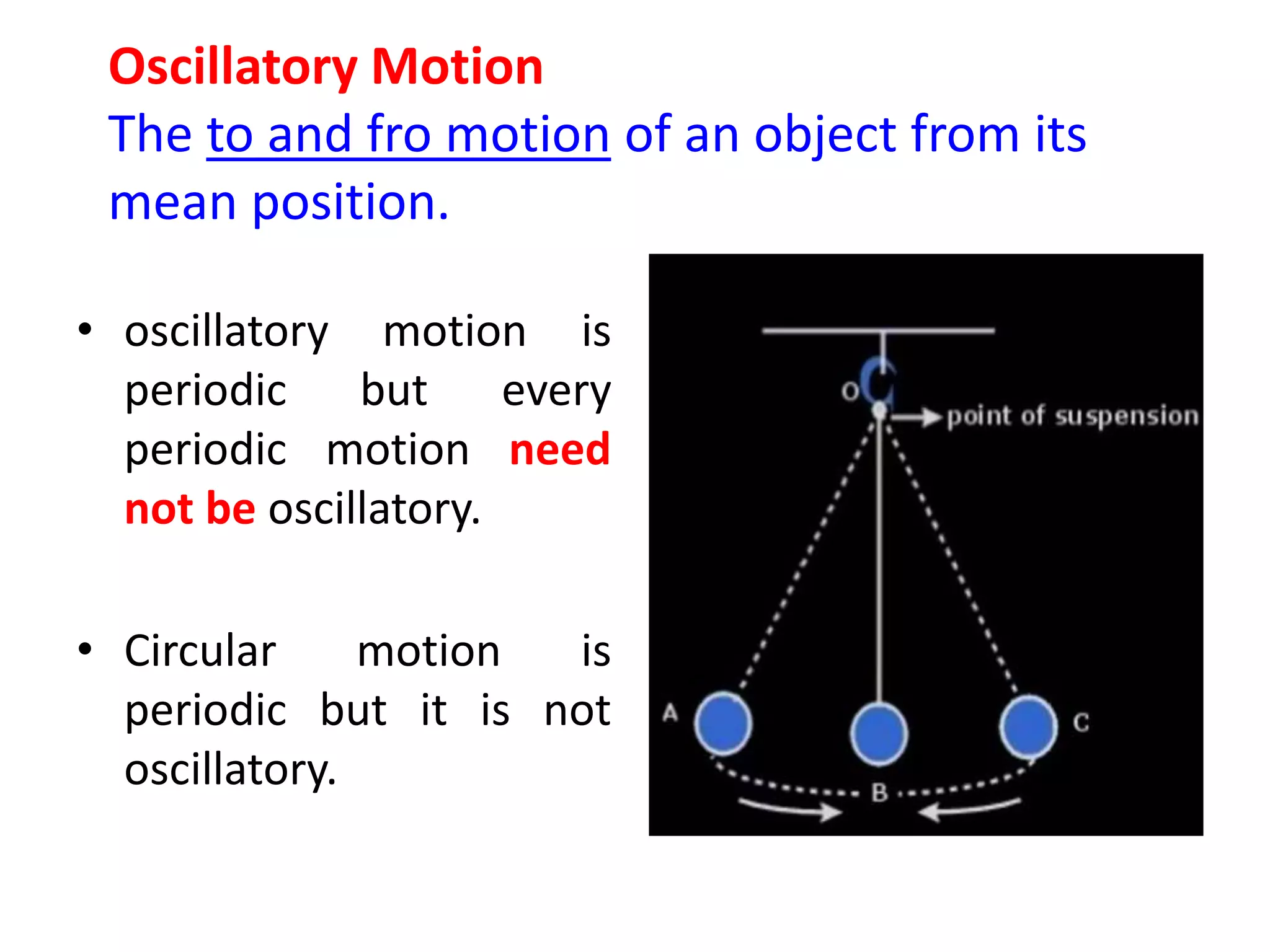
Oscillatory Motion
The to and fro motion of an object from its
mean position.
• oscillatory motion is
periodic but every
periodic motion need
not be oscillatory.
• Circular motion is
periodic but it is not
oscillatory.
Linear Simple Harmonic
Path of motion is a straight
line.
Angular Simple Harmonic
Path of motion is an arc of a
circle.
Frequency:
The number of oscillations completed per unit time is called
the frequency (n).
Mean Position:
Any position that is a moderate position between two other
extreme positions.
Linear Simple Harmonic Motion(S.H.M.)
LINEAR S.H.M.
The linear periodic motion of a body, in which force (or
acceleration) is always directed towards the mean position
and its magnitude is proportional to the displacement
from the mean position.
F = -kx
DIFFERENTIAL EQUATION OF S.H.M.
F = -kx ………………………..(5.1)
F = ma ………………………….(5.2)
From Eq. 1 & 2 we get,
ma = -kx …………………..(5.3)
a = dv/dx =d2v/dx2
Acceleration (a) of S.H.M.
Velocity (v) of S.H.M.
Displacement (x) of S.H.M.
Extreme values of displacement (x), velocity
(v) and acceleration (a)
X = (+ - )A
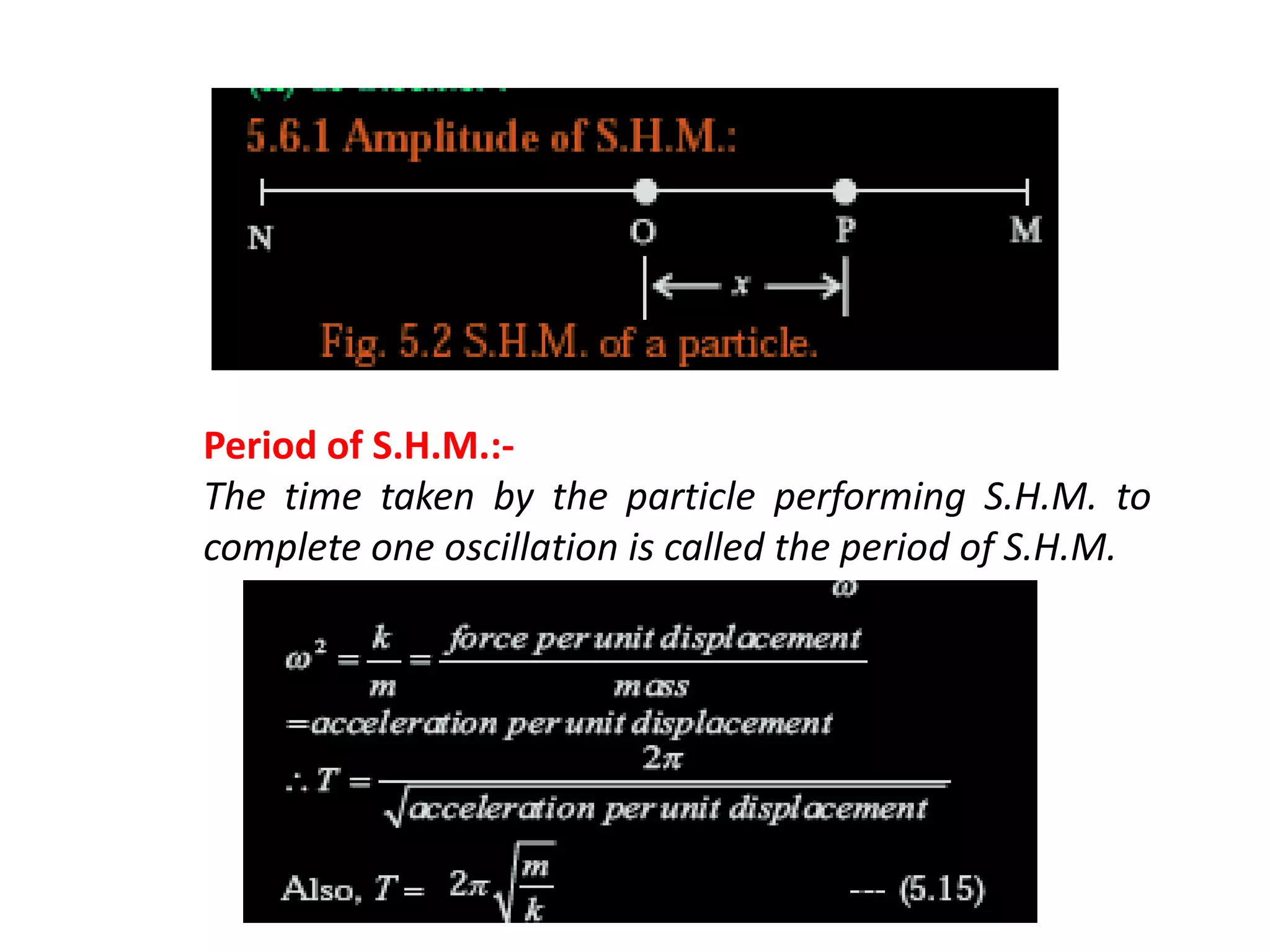
Period of S.H.M.:-
The time taken by the particle performing S.H.M. to
complete one oscillation is called the period of S.H.M.
Frequency of S.H.M.:
The number of oscillations performed by a
particle performing S.H.M. per unit time is called
the frequency of S.H.M.
At t = 0, let the particle be at P0 with reference
angle φ . During time t, it has angular displacement
ωt . Thus, the reference angle at time t is ωt+ φ.
Projection of velocity: Instantaneous velocity of the particle
P in the circular motion is the tangential velocity of
magnitude rω as shown in the Fig. 5.5.
PHASE IN S.H.M.
Phase in S.H.M. (or for any motion) is basically the
state of oscillation.
If the displacement (position), direction of velocity
and oscillation number(during which oscillation) at
that instant of time.
X = A sin(ωt+φ)
X = A sinθ
Phase θ = 0 :-
The particle is at the mean position, moving to the positive,
during the beginning of the first oscillation.
θ = 3600 or 2π rad:-
It is the beginning of the second oscillation.
Phase 1800 or π rad :-
During its first oscillation, the particle is at the mean
position and moving to the negative.
Phase 90o or π/2 :-
The particle is at the positive extreme position during
first oscillation.
Phase 270o or 3π/2 :-
The particle is at the negative extreme position during
the first oscillation.
A
B
C
D
Mean Position Line
E
Graphical Representation of S.H.M.
(a) Particle executing S.H.M., starting from
mean position, towards positive:
X = A sin(ωt+φ)
As particle starts from mean position so φ =0
X = Asin(ωt)
V = Acos(ωt).ω
a = - Aω2sin(ωt)
X = Asin(ωt)
V = Acos(ωt).ω
A = - Aω2sin(ωt)
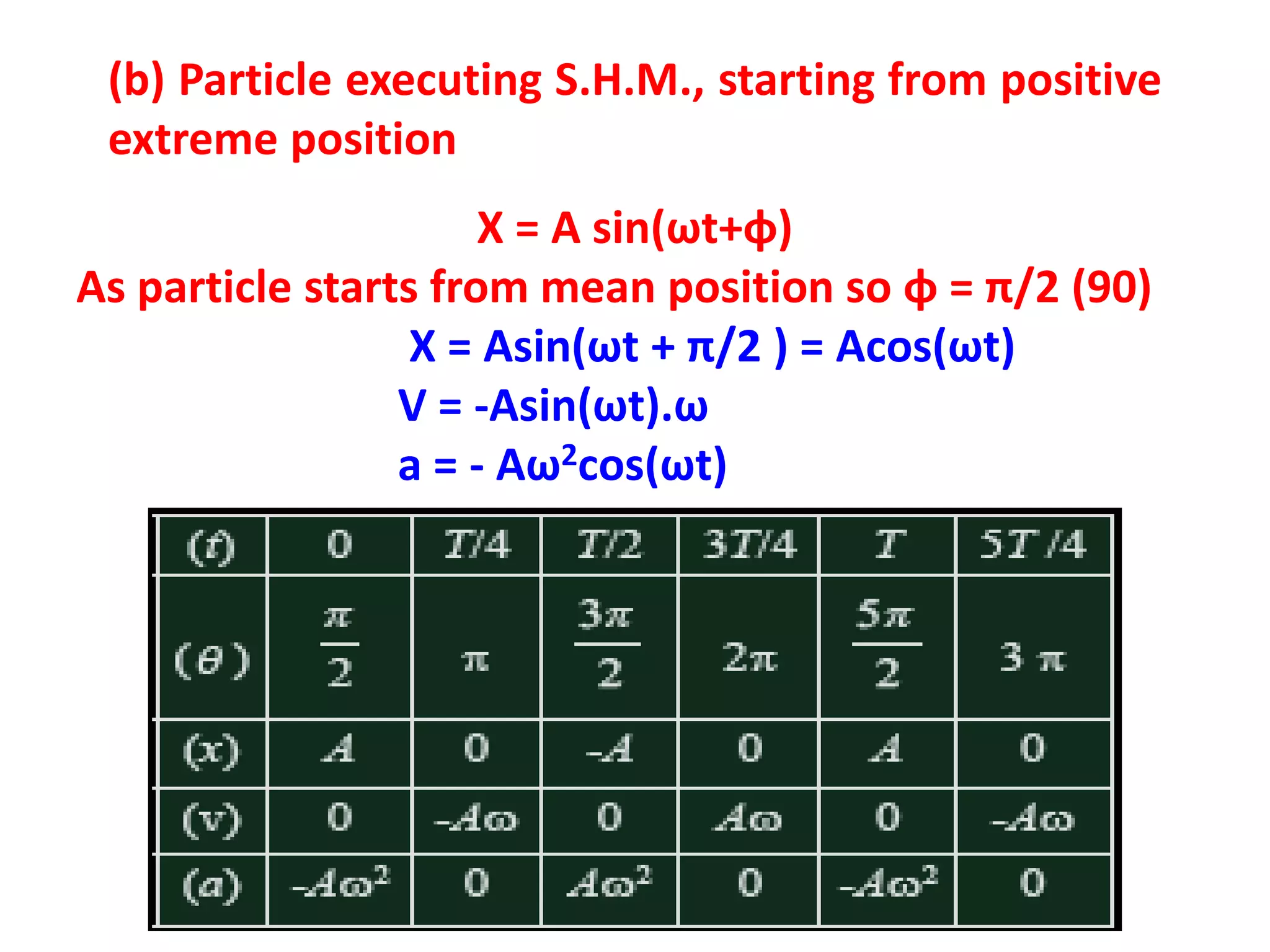
(b) Particle executing S.H.M., starting from positive
extreme position
X = A sin(ωt+φ)
As particle starts from mean position so φ = π/2 (90)
X = Asin(ωt + π/2 ) = Acos(ωt)
V = -Asin(ωt).ω
a = - Aω2cos(ωt)
Composition of two S.H.M.s
(having same period and along the same path, but different
amplitudes and initial phases)
Energy of a Particle Performing S.H.M.
Kinetic Energy
SIMPLE PENDULUM
An ideal simple pendulum is a heavy particle
suspended by a massless, inextensible, flexible string
from a rigid support.
Weight mg is resolved into two components;
(i) The component mg cosϴ along the string, which is
balanced by the tension ‘T ‘.
(ii) The component mg sinϴ perpendicular to the string is
the restoring force.
F = ma ………………..(5.28)
From Equation (5.27) & (5.28) we get,
ma = -(mgx)/L
a = -gx/L
a/x = -g/L
a/x = g/L …………………..if magnitude is considered
T = 2π/ω
a = ω2x ω = √(a/x) = √(g/L)
T = 2π/ √(g/L)
Angular S.H.M. and its Differential Equation
Restoring torque is,
If I is the moment of inertia of the body, the torque acting
on the body is given by, τ = I.α
Where,
α is the angular acceleration
τ = I.α = Id2ϴ/dt2
Angular S.H.M. is defined as the oscillatory motion of a
body in which the torque for angular acceleration is
directly proportional to the angular displacement and
its direction is opposite to that of angular displacement.
Magnet Vibrating in Uniform Magnetic Field
Oscillation
Oscillation
Oscillation
Oscillation
Oscillation

Oscillation

  • 1.
  • 2.
  • 3.
    Periodic Motion Any motionwhich repeats itself after definite interval of time is called periodic motion. Periodic Time(T) The time taken for one such set of movements(1 Oscillation) is called its period or periodic time. Ex:-Motion of the moon around the earth, Motion of other planets around the sun, Motion of electrons around the nucleus etc.
  • 4.
    Oscillatory Motion The toand fro motion of an object from its mean position. • oscillatory motion is periodic but every periodic motion need not be oscillatory. • Circular motion is periodic but it is not oscillatory.
  • 5.
    Linear Simple Harmonic Pathof motion is a straight line. Angular Simple Harmonic Path of motion is an arc of a circle.
  • 6.
    Frequency: The number ofoscillations completed per unit time is called the frequency (n). Mean Position: Any position that is a moderate position between two other extreme positions.
  • 7.
    Linear Simple HarmonicMotion(S.H.M.)
  • 8.
    LINEAR S.H.M. The linearperiodic motion of a body, in which force (or acceleration) is always directed towards the mean position and its magnitude is proportional to the displacement from the mean position. F = -kx
  • 9.
    DIFFERENTIAL EQUATION OFS.H.M. F = -kx ………………………..(5.1) F = ma ………………………….(5.2) From Eq. 1 & 2 we get, ma = -kx …………………..(5.3) a = dv/dx =d2v/dx2
  • 10.
  • 11.
  • 13.
  • 16.
    Extreme values ofdisplacement (x), velocity (v) and acceleration (a) X = (+ - )A
  • 20.
    Period of S.H.M.:- Thetime taken by the particle performing S.H.M. to complete one oscillation is called the period of S.H.M.
  • 21.
    Frequency of S.H.M.: Thenumber of oscillations performed by a particle performing S.H.M. per unit time is called the frequency of S.H.M.
  • 22.
    At t =0, let the particle be at P0 with reference angle φ . During time t, it has angular displacement ωt . Thus, the reference angle at time t is ωt+ φ.
  • 23.
    Projection of velocity:Instantaneous velocity of the particle P in the circular motion is the tangential velocity of magnitude rω as shown in the Fig. 5.5.
  • 24.
    PHASE IN S.H.M. Phasein S.H.M. (or for any motion) is basically the state of oscillation. If the displacement (position), direction of velocity and oscillation number(during which oscillation) at that instant of time. X = A sin(ωt+φ) X = A sinθ Phase θ = 0 :- The particle is at the mean position, moving to the positive, during the beginning of the first oscillation. θ = 3600 or 2π rad:- It is the beginning of the second oscillation.
  • 25.
    Phase 1800 orπ rad :- During its first oscillation, the particle is at the mean position and moving to the negative. Phase 90o or π/2 :- The particle is at the positive extreme position during first oscillation. Phase 270o or 3π/2 :- The particle is at the negative extreme position during the first oscillation.
  • 26.
  • 28.
    Graphical Representation ofS.H.M. (a) Particle executing S.H.M., starting from mean position, towards positive: X = A sin(ωt+φ) As particle starts from mean position so φ =0 X = Asin(ωt) V = Acos(ωt).ω a = - Aω2sin(ωt)
  • 29.
    X = Asin(ωt) V= Acos(ωt).ω A = - Aω2sin(ωt)
  • 31.
    (b) Particle executingS.H.M., starting from positive extreme position X = A sin(ωt+φ) As particle starts from mean position so φ = π/2 (90) X = Asin(ωt + π/2 ) = Acos(ωt) V = -Asin(ωt).ω a = - Aω2cos(ωt)
  • 33.
    Composition of twoS.H.M.s (having same period and along the same path, but different amplitudes and initial phases)
  • 37.
    Energy of aParticle Performing S.H.M. Kinetic Energy
  • 43.
    SIMPLE PENDULUM An idealsimple pendulum is a heavy particle suspended by a massless, inextensible, flexible string from a rigid support.
  • 44.
    Weight mg isresolved into two components; (i) The component mg cosϴ along the string, which is balanced by the tension ‘T ‘. (ii) The component mg sinϴ perpendicular to the string is the restoring force.
  • 45.
    F = ma………………..(5.28) From Equation (5.27) & (5.28) we get, ma = -(mgx)/L a = -gx/L a/x = -g/L a/x = g/L …………………..if magnitude is considered T = 2π/ω a = ω2x ω = √(a/x) = √(g/L) T = 2π/ √(g/L)
  • 48.
    Angular S.H.M. andits Differential Equation Restoring torque is,
  • 49.
    If I isthe moment of inertia of the body, the torque acting on the body is given by, τ = I.α Where, α is the angular acceleration τ = I.α = Id2ϴ/dt2
  • 50.
    Angular S.H.M. isdefined as the oscillatory motion of a body in which the torque for angular acceleration is directly proportional to the angular displacement and its direction is opposite to that of angular displacement.
  • 51.
    Magnet Vibrating inUniform Magnetic Field