Unit 2
Vibrational energy
Simple Harmonic Motion
Motion of an object that regularly returns to a given
position after a fixed time interval
A motion which is regularly repeated in equal
periods of time
Periodic Motion
Examples for Periodic Motion
 Oscillatory Motion
 Wave Motion
Examples for Periodic Motion
Earth returning to the same position in its
orbit around the Sun each year
Movement of a Wall Clock
Examples for Periodic Motion
Sound Waves
Seismic Waves
Water Waves
Examples for Periodic Motion
Rotary Bee Vibration of Atoms in a Molecule
Examples for Periodic Motion
Rocking Chair
Bouncing Ball
Examples for Periodic Motion
Simple Pendulum
Vibration of Musical Strings
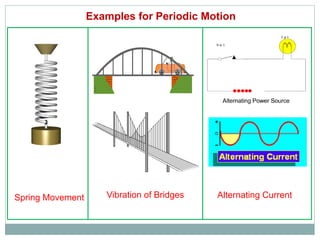
Examples for Periodic Motion
Spring Movement Vibration of Bridges Alternating Current
Examples for Periodic Motion
Movement of a Swing
Tuning
Fork
Are these examples for Periodic Motion?
Behaviour of Springs
Hooke’s Law
Key Concept
The magnitude of the restoring force is proportional to the displacement of
the spring from its equilibrium position (Hooke’s Law)
If you stretch a spring, it pulls back
strongly
If you compress a spring, it pushes back
strongly
Restoring Force
 Force exerted by the spring
 Proportional to the stretch
Equilibrium Position
 Natural position of the spring
Negative sign indicates that the
direction of the restoring force is
opposite to the direction of motion
and always towards the equilibrium
position
Hooke’s law in the form of a equation
Force
Restoring

F
position
m
equilibriu
the
from
Distance

x
constant
Spring

k
Bending of a Plastic Ruler or Flexible Rod
Thus Hooke’s law can be applied to any systems which respond
to deforming forces like springs
(Obey Hooke’s law)
To stretch or compress a spring, an external force must be applied to
overcome the spring’s restoring force
Energy in Hooke’s Law Deformations
Work must be done by this external
force to stretch or compress the spring
The work done on the spring is stored
as energy in the spring
The energy stored is Potential Energy
 

 dx
F
W  


 dx
x
k
2
2
x
k

By stretching a spring attached to a mass, work is done on the spring and
the spring store this work as a potential energy
At Maximum Stretch
PE is maximum
When mass is released
The spring does work to
accelerate the mass
At the equilibrium point
PE drops to zero
PE becomes KE
PEmax
KE = 0
KEmax
PE = 0
PEmax
When compressed
KE is converted into PE
KE = 0
(This cycle will repeat and oscillation will continue)
The spring in a toy gun has k = 50 N m–1, and is compressed 0.15 m to fire a
2 g plastic bullet. With what speed will the plastic bullet will leave the gun?
All of the potential energy (PE) stored in
the spring will be delivered to the plastic
bullet as kinetic energy (KE)
This PE is converted into KE
A special type of periodic motion or oscillation where the restoring
force is directly proportional to the displacement and acts in the
direction opposite to that of displacement
Simple Harmonic Motion (SHM)
 The force acting on the object (restoring
force) is proportional to the displacement
 The restoring force is always directed
towards the equilibrium position
 The restoring force is opposite to the
displacement of the object from equilibrium
According to Hooke’s law
When the block is displaced to the
right of x = 0
Position of the object is positive
Restoring force is directed to the left
When the block is at x = 0
Force on the block is zero
When the block is displaced to the left
of x = 0
Position of the object is negative
Restoring force is directed to the right
Applying Newton’s second law to
the motion of the block
Net force in the x-direction
A body is said to be in SHM, if it
moves to and fro about its mean
position such that at any given
point its
 Acceleration is directly
proportional to its displacement
in magnitude
 Acceleration is opposite in
direction to the displacement
 Acceleration is always directed
towards the mean position
x
a
x
a
0

x
a
rest
from
released
and
A
to
displaced
is
block
the
If 
x
m
kA


on
accelerati
Initial
0
position
m
equilibriu
At the 
x
0
on
Accelerati 
A
x 

m
equilibriu
of
left
the
to
displaced
is
block
the
If
maximum
is
Speed
m
kA


on
Accelerati
A
x 

between
oscillates
block
The
A block on the end of a spring is
pulled to position x = A and released
from rest. In one full cycle of its
motion, what total distance does the
block travel?
(a) A / 2
(b) A
(c) 2A
(d) 4A
The Particle in Simple Harmonic Motion
(Let us find a solution to
this equation)
The oscillation occurs
along x axis
x
m
k
ax 
 

dt
dv
ax 2
2
dt
x
d

2
2
dt
x
d
x
m
k

2
Denote 

m
k

2
2
dt
x
d
x
2


The solution should be a function of t
)
(t
x
(Mathematical representation of the position
of the particle as a function of time )
x
dt
x
d 2
2
2



   

 
 t
A
t
x cos
The solution to this
equation is  
constants
are
,
, 

A
   

 
 t
A
t
x cos
 

 
 t
dt
d
A
dt
dx
cos  


 
 t
Asin
 


 

 t
dt
d
A
dt
x
d
sin
2
2
 

 

 t
Acos
2
x
2


x
dt
x
d 2
2
2



   

 
 t
A
t
x cos
The graphical representation of the motion
 
motion
of
constants
are
,
, 

A
motion
the
of
Amplitude
-
A
s)
/
(rad
frequency
angular
-

(A measure of how rapidly the oscillations
are occurring)

of
value
Higher the
unit time
per
ns
oscillatio
More
m
k


angle
phase
initial
or
constant
phase
-

0
0
and
If 


 
t
A
x
  motion
the
of
phase
-

 
t
(maximum value of the position of the particle or
maximum displacement
2


m
k
t
v
x
at time
particle
for the
and
of
values
The  T
t
v
x

at time
particle
for the
and
of
values
The
(The phase increases by 2π radians in
a time interval of T)
  motion
the
of
phase
-

 
t
  radians
2
by
increases
each time
same
is
of
value
The 
 t
t
x
t
x
0
 
2 
3 
4 
5 
6 
7 
8 
9 
10
Time Period (T)
Time interval required for the particle to go through one full cycle of
motion or oscillation
(Phase increases by 2π
radians in a time
interval of T)
 

 
 t
t
at time
motion
the
of
Phase
 

 t 2

t


 2

T


2

T
t
x
0
 
2 
3 
4 
5 
6 
7 
8 
9 
10
 
 

 


 )
(
T
t
at time
motion
the
of
Phase T
t
 
 

 
 )
T
t 

T
 
 
t
 
 2
Frequency (f)
The number of oscillations per unit time interval
Angular Frequency (ω)
Time Period & Frequency
depend only on the
 Mass of the Particle
 Force (spring) Constant
Maximum Velocity and Maximum Acceleration
1
between
oscillates
functions
cosine
and
sine
The 
A
are
of
values
extreme
The 

v A
are
of
values
extreme
The 2


a
6
4
2
-2
- 4
-6
0
Displacement
Time
1 2 3 4 5 6 7 8
t (s) x (m) v (m/s) a (m/s2)
0 6.00 0.00 – 3.70
1 4.25 – 3.33 – 2.62
2 0.00 – 4.71 0.00
3 – 4.25 – 3.33 2.62
4 – 6.00 0 3.70
5 – 4.25 3.33 2.62
6 0.00 4.71 0.00
7 4.25 3.33 – 2.62
8 6.00 0.00 – 3.70
   

 
 t
A
t
x cos
-6 -5 -4 -3 -2 -1 0 1 2 3 4 5 6
t = 0 s
-6 -5 -4 -3 -2 -1 0 1 2 3 4 5 6
t = 1 s
-6 -5 -4 -3 -2 -1 0 1 2 3 4 5 6
t = 2 s
-6 -5 -4 -3 -2 -1 0 1 2 3 4 5 6
t = 3 s
-6 -5 -4 -3 -2 -1 0 1 2 3 4 5 6
t = 4 s
-6 -5 -4 -3 -2 -1 0 1 2 3 4 5 6
t = 5 s
-6 -5 -4 -3 -2 -1 0 1 2 3 4 5 6
t = 6 s
-6 -5 -4 -3 -2 -1 0 1 2 3 4 5 6
t = 7 s
-6 -5 -4 -3 -2 -1 0 1 2 3 4 5 6
t = 8 s
t (s) x (m) v (m/s)
0 6.00 0.00
1 4.25 – 3.33
2 0.00 – 4.71
3 – 4.25 – 3.33
4 – 6.00 0
5 – 4.25 3.33
6 0.00 4.71
7 4.25 3.33
8 6.00 0.00
t (s) x (m) a (m/s2)
0 6.00 – 3.70
1 4.25 – 2.62
2 0.00 0.00
3 – 4.25 2.62
4 – 6.00 3.70
5 – 4.25 2.62
6 0.00 0.00
7 4.25 – 2.62
8 6.00 – 3.70
t (s) x (m) v (m/s) a (m/s2)
0 6.00 0.00 – 3.70
1 4.25 – 3.33 – 2.62
2 0.00 – 4.71 0.00
3 – 4.25 – 3.33 2.62
4 – 6.00 0 3.70
5 – 4.25 3.33 2.62
6 0.00 4.71 0.00
7 4.25 3.33 – 2.62
8 6.00 0.00 – 3.70
(Velocity is Negative)
(Velocity is Positive)
(Acceleration is
Negative)
(Acceleration is
Negative)
(Acceleration is
Positive)
(Acceleration is
Positive)
A block-spring system that
begins its motion from rest
with the block at
Find out the corresponding graph for position, velocity and acceleration
x
a

Amplitude
Acceleration
Velocity
A block-spring system is undergoing
oscillation, and t = 0 is defined at an
instant when the block passes through
the equilibrium position x = 0 and is
moving to the right with speed vi.
Find out the corresponding graph for position, velocity and acceleration
Acceleration
Velocity
Amplitude

x
a
(a) The position and velocity are both positive
Consider a graphical representation of
a SHM. When the object is at point A
on the graph, what can you say about
its position and velocity?
(b) The position and velocity are both negative
(c) The position is positive and velocity is zero
(d) The position is negative and velocity is zero
(e) The position is positive and velocity is negative
(f) The position is negative and velocity is positive
The object is in the
region x < 0 and so the
position is negative
Object is moving towards
the equilibrium position
and so velocity is
positive
The figure shows two curves
representing objects undergoing
simple harmonic motion.
(a) of larger angular frequency and larger amplitude than that of object A
(b) of larger angular frequency and smaller amplitude than that of object A
(c) of smaller angular frequency and larger amplitude than that of object A
(d) of smaller angular frequency and smaller amplitude than that of object A
The correct description of these two
motions is that
The simple harmonic motion of object B is
T
T
(More oscillations
per unit time)
m
2m
An object of mass m is hung from a spring and set
into oscillation. The period of the oscillation is
measured and recorded as T. The object of m is
removed and replaced with an object of mass 2m.
When this object is set into oscillation, what is the
period of the motion?
T
2
)
a
(
T
2
)
b
(
2
)
c
(
T
2
)
d
(
T
Consider the surface is frictionless and the
system is isolated
Energy of the Simple Harmonic Oscillator
Then the total mechanical energy should be
constant
Kinetic Energy
Potential Energy
)
0
(
energy
kinetic
no
is
there
,
When 

 v
A
x
2
2
1
Energy
Total
)
0
(because
0
m,
equilibriu
At kA
x
U 



A
x
t 
 ;
0
0
;
4

 x
T
t
A
x
T
t 

 ;
2
0
;
4
3

 x
T
t
A
x
T
t 
 ;
2 J
2 J
2 J
2 J
0
0
0
A
B
C
D
Write the values of Kinetic Energy (KE) and Potential Energy (PE) at
points A, B, C and D

22PH102_ISE_U2_LP1_-_Notes.pdf

  • 1.
  • 2.
    Motion of anobject that regularly returns to a given position after a fixed time interval A motion which is regularly repeated in equal periods of time Periodic Motion Examples for Periodic Motion  Oscillatory Motion  Wave Motion
  • 3.
    Examples for PeriodicMotion Earth returning to the same position in its orbit around the Sun each year Movement of a Wall Clock
  • 4.
    Examples for PeriodicMotion Sound Waves Seismic Waves Water Waves
  • 5.
    Examples for PeriodicMotion Rotary Bee Vibration of Atoms in a Molecule
  • 6.
    Examples for PeriodicMotion Rocking Chair Bouncing Ball
  • 7.
    Examples for PeriodicMotion Simple Pendulum Vibration of Musical Strings
  • 8.
    Examples for PeriodicMotion Spring Movement Vibration of Bridges Alternating Current
  • 9.
    Examples for PeriodicMotion Movement of a Swing Tuning Fork
  • 10.
    Are these examplesfor Periodic Motion?
  • 11.
    Behaviour of Springs Hooke’sLaw Key Concept The magnitude of the restoring force is proportional to the displacement of the spring from its equilibrium position (Hooke’s Law) If you stretch a spring, it pulls back strongly If you compress a spring, it pushes back strongly Restoring Force  Force exerted by the spring  Proportional to the stretch Equilibrium Position  Natural position of the spring
  • 12.
    Negative sign indicatesthat the direction of the restoring force is opposite to the direction of motion and always towards the equilibrium position Hooke’s law in the form of a equation Force Restoring  F position m equilibriu the from Distance  x constant Spring  k
  • 13.
    Bending of aPlastic Ruler or Flexible Rod Thus Hooke’s law can be applied to any systems which respond to deforming forces like springs (Obey Hooke’s law)
  • 14.
    To stretch orcompress a spring, an external force must be applied to overcome the spring’s restoring force Energy in Hooke’s Law Deformations Work must be done by this external force to stretch or compress the spring The work done on the spring is stored as energy in the spring The energy stored is Potential Energy     dx F W      dx x k 2 2 x k 
  • 15.
    By stretching aspring attached to a mass, work is done on the spring and the spring store this work as a potential energy At Maximum Stretch PE is maximum When mass is released The spring does work to accelerate the mass At the equilibrium point PE drops to zero PE becomes KE PEmax KE = 0 KEmax PE = 0 PEmax When compressed KE is converted into PE KE = 0 (This cycle will repeat and oscillation will continue)
  • 17.
    The spring ina toy gun has k = 50 N m–1, and is compressed 0.15 m to fire a 2 g plastic bullet. With what speed will the plastic bullet will leave the gun? All of the potential energy (PE) stored in the spring will be delivered to the plastic bullet as kinetic energy (KE) This PE is converted into KE
  • 18.
    A special typeof periodic motion or oscillation where the restoring force is directly proportional to the displacement and acts in the direction opposite to that of displacement Simple Harmonic Motion (SHM)  The force acting on the object (restoring force) is proportional to the displacement  The restoring force is always directed towards the equilibrium position  The restoring force is opposite to the displacement of the object from equilibrium
  • 19.
    According to Hooke’slaw When the block is displaced to the right of x = 0 Position of the object is positive Restoring force is directed to the left When the block is at x = 0 Force on the block is zero When the block is displaced to the left of x = 0 Position of the object is negative Restoring force is directed to the right
  • 20.
    Applying Newton’s secondlaw to the motion of the block Net force in the x-direction
  • 21.
    A body issaid to be in SHM, if it moves to and fro about its mean position such that at any given point its  Acceleration is directly proportional to its displacement in magnitude  Acceleration is opposite in direction to the displacement  Acceleration is always directed towards the mean position x a x a 0  x a
  • 22.
    rest from released and A to displaced is block the If  x m kA   on accelerati Initial 0 position m equilibriu At the x 0 on Accelerati  A x   m equilibriu of left the to displaced is block the If maximum is Speed m kA   on Accelerati A x   between oscillates block The
  • 23.
    A block onthe end of a spring is pulled to position x = A and released from rest. In one full cycle of its motion, what total distance does the block travel? (a) A / 2 (b) A (c) 2A (d) 4A
  • 24.
    The Particle inSimple Harmonic Motion (Let us find a solution to this equation) The oscillation occurs along x axis x m k ax     dt dv ax 2 2 dt x d  2 2 dt x d x m k  2 Denote   m k  2 2 dt x d x 2   The solution should be a function of t ) (t x (Mathematical representation of the position of the particle as a function of time )
  • 25.
    x dt x d 2 2 2           t A t x cos The solution to this equation is   constants are , ,   A         t A t x cos       t dt d A dt dx cos        t Asin         t dt d A dt x d sin 2 2        t Acos 2 x 2   x dt x d 2 2 2   
  • 26.
           t A t x cos The graphical representation of the motion   motion of constants are , ,   A motion the of Amplitude - A s) / (rad frequency angular -  (A measure of how rapidly the oscillations are occurring)  of value Higher the unit time per ns oscillatio More m k   angle phase initial or constant phase -  0 0 and If      t A x   motion the of phase -    t (maximum value of the position of the particle or maximum displacement 2   m k
  • 27.
    t v x at time particle for the and of values The T t v x  at time particle for the and of values The (The phase increases by 2π radians in a time interval of T)   motion the of phase -    t   radians 2 by increases each time same is of value The   t t x t x 0   2  3  4  5  6  7  8  9  10 Time Period (T) Time interval required for the particle to go through one full cycle of motion or oscillation
  • 28.
    (Phase increases by2π radians in a time interval of T)       t t at time motion the of Phase     t 2  t    2  T   2  T t x 0   2  3  4  5  6  7  8  9  10           ) ( T t at time motion the of Phase T t         ) T t   T     t    2
  • 29.
    Frequency (f) The numberof oscillations per unit time interval Angular Frequency (ω) Time Period & Frequency depend only on the  Mass of the Particle  Force (spring) Constant
  • 31.
    Maximum Velocity andMaximum Acceleration 1 between oscillates functions cosine and sine The  A are of values extreme The   v A are of values extreme The 2   a
  • 32.
    6 4 2 -2 - 4 -6 0 Displacement Time 1 23 4 5 6 7 8 t (s) x (m) v (m/s) a (m/s2) 0 6.00 0.00 – 3.70 1 4.25 – 3.33 – 2.62 2 0.00 – 4.71 0.00 3 – 4.25 – 3.33 2.62 4 – 6.00 0 3.70 5 – 4.25 3.33 2.62 6 0.00 4.71 0.00 7 4.25 3.33 – 2.62 8 6.00 0.00 – 3.70         t A t x cos
  • 33.
    -6 -5 -4-3 -2 -1 0 1 2 3 4 5 6 t = 0 s -6 -5 -4 -3 -2 -1 0 1 2 3 4 5 6 t = 1 s -6 -5 -4 -3 -2 -1 0 1 2 3 4 5 6 t = 2 s -6 -5 -4 -3 -2 -1 0 1 2 3 4 5 6 t = 3 s -6 -5 -4 -3 -2 -1 0 1 2 3 4 5 6 t = 4 s -6 -5 -4 -3 -2 -1 0 1 2 3 4 5 6 t = 5 s -6 -5 -4 -3 -2 -1 0 1 2 3 4 5 6 t = 6 s -6 -5 -4 -3 -2 -1 0 1 2 3 4 5 6 t = 7 s -6 -5 -4 -3 -2 -1 0 1 2 3 4 5 6 t = 8 s t (s) x (m) v (m/s) 0 6.00 0.00 1 4.25 – 3.33 2 0.00 – 4.71 3 – 4.25 – 3.33 4 – 6.00 0 5 – 4.25 3.33 6 0.00 4.71 7 4.25 3.33 8 6.00 0.00 t (s) x (m) a (m/s2) 0 6.00 – 3.70 1 4.25 – 2.62 2 0.00 0.00 3 – 4.25 2.62 4 – 6.00 3.70 5 – 4.25 2.62 6 0.00 0.00 7 4.25 – 2.62 8 6.00 – 3.70
  • 34.
    t (s) x(m) v (m/s) a (m/s2) 0 6.00 0.00 – 3.70 1 4.25 – 3.33 – 2.62 2 0.00 – 4.71 0.00 3 – 4.25 – 3.33 2.62 4 – 6.00 0 3.70 5 – 4.25 3.33 2.62 6 0.00 4.71 0.00 7 4.25 3.33 – 2.62 8 6.00 0.00 – 3.70 (Velocity is Negative) (Velocity is Positive) (Acceleration is Negative) (Acceleration is Negative) (Acceleration is Positive) (Acceleration is Positive)
  • 35.
    A block-spring systemthat begins its motion from rest with the block at Find out the corresponding graph for position, velocity and acceleration x a  Amplitude Acceleration Velocity
  • 36.
    A block-spring systemis undergoing oscillation, and t = 0 is defined at an instant when the block passes through the equilibrium position x = 0 and is moving to the right with speed vi. Find out the corresponding graph for position, velocity and acceleration Acceleration Velocity Amplitude  x a
  • 37.
    (a) The positionand velocity are both positive Consider a graphical representation of a SHM. When the object is at point A on the graph, what can you say about its position and velocity? (b) The position and velocity are both negative (c) The position is positive and velocity is zero (d) The position is negative and velocity is zero (e) The position is positive and velocity is negative (f) The position is negative and velocity is positive The object is in the region x < 0 and so the position is negative Object is moving towards the equilibrium position and so velocity is positive
  • 38.
    The figure showstwo curves representing objects undergoing simple harmonic motion. (a) of larger angular frequency and larger amplitude than that of object A (b) of larger angular frequency and smaller amplitude than that of object A (c) of smaller angular frequency and larger amplitude than that of object A (d) of smaller angular frequency and smaller amplitude than that of object A The correct description of these two motions is that The simple harmonic motion of object B is T T (More oscillations per unit time)
  • 39.
    m 2m An object ofmass m is hung from a spring and set into oscillation. The period of the oscillation is measured and recorded as T. The object of m is removed and replaced with an object of mass 2m. When this object is set into oscillation, what is the period of the motion? T 2 ) a ( T 2 ) b ( 2 ) c ( T 2 ) d ( T
  • 40.
    Consider the surfaceis frictionless and the system is isolated Energy of the Simple Harmonic Oscillator Then the total mechanical energy should be constant Kinetic Energy Potential Energy
  • 41.
  • 43.
    A x t   ; 0 0 ; 4  x T t A x T t    ; 2 0 ; 4 3   x T t A x T t   ;
  • 47.
    2 J 2 J 2J 2 J 0 0 0 A B C D Write the values of Kinetic Energy (KE) and Potential Energy (PE) at points A, B, C and D