TJMRMHTGRE
HTFEW
GFD
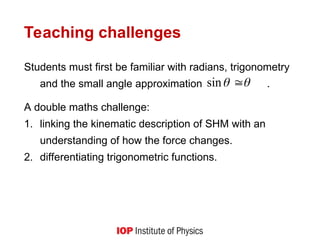
Teaching challenges
Students must first be familiar with radians, trigonometry
and the small angle approximation .
A double maths challenge:
1. linking the kinematic description of SHM with an
understanding of how the force changes.
2. differentiating trigonometric functions.

 
sin
A brief history & contexts
The study of SHM started with Galileo’s pendulum experiments
(1638, Two new sciences).
Huygens, Newton & others developed further analyses.
• pendulum – clocks, seismometers
• ALL vibrations and waves - sea waves, earthquakes, tides,
orbits of planets and moons, water level in a toilet on a windy
day, acoustics, AC circuits, electromagnetic waves, vibrations
molecular and structural e.g. aircraft fuselage, musical
instruments, bridges.
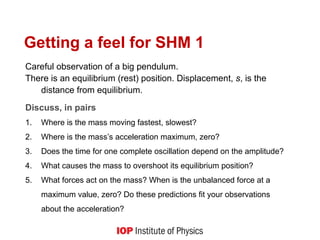
Getting a feel for SHM 1
Careful observation of a big pendulum.
There is an equilibrium (rest) position. Displacement, s, is the
distance from equilibrium.
Discuss, in pairs
1. Where is the mass moving fastest, slowest?
2. Where is the mass’s acceleration maximum, zero?
3. Does the time for one complete oscillation depend on the amplitude?
4. What causes the mass to overshoot its equilibrium position?
5. What forces act on the mass? When is the unbalanced force at a
maximum value, zero? Do these predictions fit your observations
about the acceleration?
Getting a feel for SHM 2
A circus of experiments (in small groups)
• torsional pendulum
• vibrating lath
• oscillating water column
• bouncing ping-pong ball
• ball rolling in a shallow bowl
• wig-wag
• ball-bearing on rails of different shapes
Answer the same set of questions about changing
velocities, accelerations and forces.
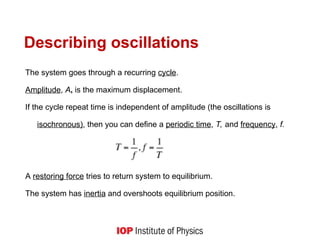
Describing oscillations
The system goes through a recurring cycle.
Amplitude, A, is the maximum displacement.
If the cycle repeat time is independent of amplitude (the oscillations is
isochronous), then you can define a periodic time, T, and frequency, f.
A restoring force tries to return system to equilibrium.
The system has inertia and overshoots equilibrium position.
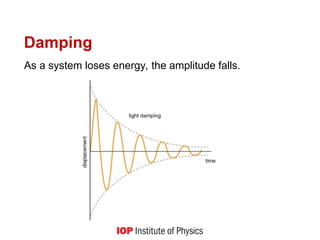
Damping
As a system loses energy, the amplitude falls.
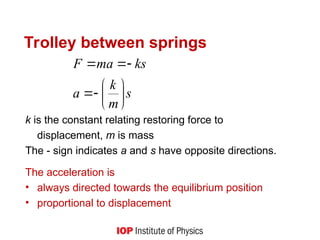
Trolley between springs
k is the constant relating restoring force to
displacement, m is mass
The - sign indicates a and s have opposite directions.
The acceleration is
• always directed towards the equilibrium position
• proportional to displacement
s
m
k
a
ks
ma
F











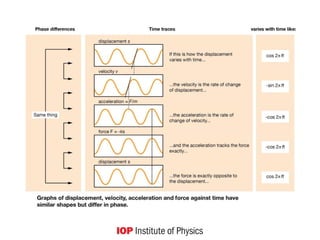
How does displacement vary?
[empirically]
PP experiment:
Broomstick pendulum, sinusoidal motion
Obtain a graph of displacement against time
How does velocity vary?
How does acceleration vary?
[empirical result by datalogging]
PP experiment:
Investigating a mass-on-spring oscillator
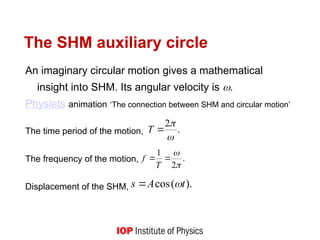
The SHM auxiliary circle
An imaginary circular motion gives a mathematical
insight into SHM. Its angular velocity is .
Physlets animation ‘The connection between SHM and circular motion’
The time period of the motion,
The frequency of the motion,
Displacement of the SHM,
.
2



T
.
2
1




T
f
).
(
cos t
A
s 

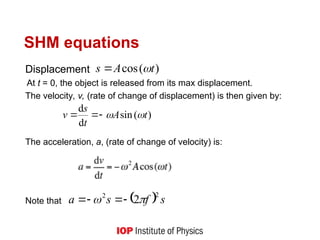
SHM equations
Displacement
At t = 0, the object is released from its max displacement.
The velocity, v, (rate of change of displacement) is then given by:
The acceleration, a, (rate of change of velocity) is:
Note that
)
(
cos t
A
s 

)
(
sin
d
d
t
A
t
s
v 




  s
f
s
a
2
2
2
 



Other symbols, relationships
Displacement,
At t =0, the object passes through its equilibrium position.
Phase relationship, 
Try the Geogebra simulation.
)
2
sin(
)
sin( ft
A
t
A
s 
 

)
sin(
)]
cos(
[
)
cos(
)]
sin(
[
2
t
A
t
A
dt
d
a
t
A
t
A
dt
d
v













)
sin( 
 
 t
A
s
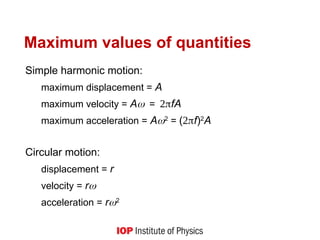
Maximum values of quantities
Simple harmonic motion:
maximum displacement = A
maximum velocity = A=fA
maximum acceleration = A2
= (f)2
A
Circular motion:
displacement = r
velocity = r
acceleration = r2
Problems session 1
Advancing Physics (AP) ‘Quick check’, Q 1 – 4 only.
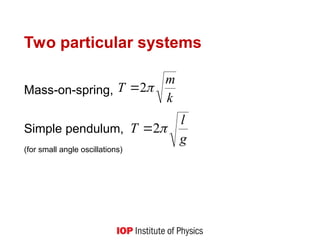
Two particular systems
Mass-on-spring,
Simple pendulum,
(for small angle oscillations)
k
m
T 
2

g
l
T 
2

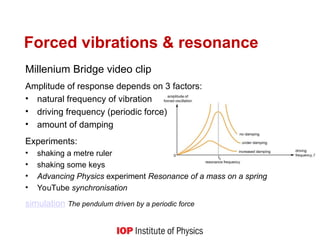
Forced vibrations & resonance
Millenium Bridge video clip
Amplitude of response depends on 3 factors:
• natural frequency of vibration
• driving frequency (periodic force)
• amount of damping
Experiments:
• shaking a metre ruler
• shaking some keys
• Advancing Physics experiment Resonance of a mass on a spring
• YouTube synchronisation
simulation The pendulum driven by a periodic force
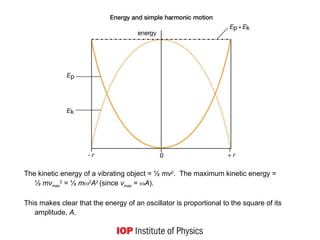
The kinetic energy of a vibrating object = ½ mv2
. The maximum kinetic energy =
½ mvmax
2
= ½ m2
A2
(since vmax = A).
This makes clear that the energy of an oscillator is proportional to the square of its
amplitude, A.
Problems session 2
In order of difficulty:
AP Quick Check Q 5,6
Practice in Physics questions on SHM
AP Oscillator energy and resonance
Energy and pendulums TAP 305-5
Endpoints
Video clip: The Tacoma Narrows bridge disaster
Puget Sound, Washington state, USA, November 1940

Simple-harmoFDGCVEFVFSGRDFGVFSDFFHnic-motion.ppt

  • 1.
  • 2.
  • 3.
  • 6.
    Teaching challenges Students mustfirst be familiar with radians, trigonometry and the small angle approximation . A double maths challenge: 1. linking the kinematic description of SHM with an understanding of how the force changes. 2. differentiating trigonometric functions.    sin
  • 7.
    A brief history& contexts The study of SHM started with Galileo’s pendulum experiments (1638, Two new sciences). Huygens, Newton & others developed further analyses. • pendulum – clocks, seismometers • ALL vibrations and waves - sea waves, earthquakes, tides, orbits of planets and moons, water level in a toilet on a windy day, acoustics, AC circuits, electromagnetic waves, vibrations molecular and structural e.g. aircraft fuselage, musical instruments, bridges.
  • 8.
    Getting a feelfor SHM 1 Careful observation of a big pendulum. There is an equilibrium (rest) position. Displacement, s, is the distance from equilibrium. Discuss, in pairs 1. Where is the mass moving fastest, slowest? 2. Where is the mass’s acceleration maximum, zero? 3. Does the time for one complete oscillation depend on the amplitude? 4. What causes the mass to overshoot its equilibrium position? 5. What forces act on the mass? When is the unbalanced force at a maximum value, zero? Do these predictions fit your observations about the acceleration?
  • 9.
    Getting a feelfor SHM 2 A circus of experiments (in small groups) • torsional pendulum • vibrating lath • oscillating water column • bouncing ping-pong ball • ball rolling in a shallow bowl • wig-wag • ball-bearing on rails of different shapes Answer the same set of questions about changing velocities, accelerations and forces.
  • 10.
    Describing oscillations The systemgoes through a recurring cycle. Amplitude, A, is the maximum displacement. If the cycle repeat time is independent of amplitude (the oscillations is isochronous), then you can define a periodic time, T, and frequency, f. A restoring force tries to return system to equilibrium. The system has inertia and overshoots equilibrium position.
  • 11.
    Damping As a systemloses energy, the amplitude falls.
  • 12.
    Trolley between springs kis the constant relating restoring force to displacement, m is mass The - sign indicates a and s have opposite directions. The acceleration is • always directed towards the equilibrium position • proportional to displacement s m k a ks ma F           
  • 13.
    How does displacementvary? [empirically] PP experiment: Broomstick pendulum, sinusoidal motion Obtain a graph of displacement against time
  • 14.
    How does velocityvary? How does acceleration vary? [empirical result by datalogging] PP experiment: Investigating a mass-on-spring oscillator
  • 16.
    The SHM auxiliarycircle An imaginary circular motion gives a mathematical insight into SHM. Its angular velocity is . Physlets animation ‘The connection between SHM and circular motion’ The time period of the motion, The frequency of the motion, Displacement of the SHM, . 2    T . 2 1     T f ). ( cos t A s  
  • 17.
    SHM equations Displacement At t= 0, the object is released from its max displacement. The velocity, v, (rate of change of displacement) is then given by: The acceleration, a, (rate of change of velocity) is: Note that ) ( cos t A s   ) ( sin d d t A t s v        s f s a 2 2 2     
  • 18.
    Other symbols, relationships Displacement, Att =0, the object passes through its equilibrium position. Phase relationship,  Try the Geogebra simulation. ) 2 sin( ) sin( ft A t A s     ) sin( )] cos( [ ) cos( )] sin( [ 2 t A t A dt d a t A t A dt d v              ) sin(     t A s
  • 19.
    Maximum values ofquantities Simple harmonic motion: maximum displacement = A maximum velocity = A=fA maximum acceleration = A2 = (f)2 A Circular motion: displacement = r velocity = r acceleration = r2
  • 20.
    Problems session 1 AdvancingPhysics (AP) ‘Quick check’, Q 1 – 4 only.
  • 21.
    Two particular systems Mass-on-spring, Simplependulum, (for small angle oscillations) k m T  2  g l T  2 
  • 22.
    Forced vibrations &resonance Millenium Bridge video clip Amplitude of response depends on 3 factors: • natural frequency of vibration • driving frequency (periodic force) • amount of damping Experiments: • shaking a metre ruler • shaking some keys • Advancing Physics experiment Resonance of a mass on a spring • YouTube synchronisation simulation The pendulum driven by a periodic force
  • 23.
    The kinetic energyof a vibrating object = ½ mv2 . The maximum kinetic energy = ½ mvmax 2 = ½ m2 A2 (since vmax = A). This makes clear that the energy of an oscillator is proportional to the square of its amplitude, A.
  • 24.
    Problems session 2 Inorder of difficulty: AP Quick Check Q 5,6 Practice in Physics questions on SHM AP Oscillator energy and resonance Energy and pendulums TAP 305-5
  • 25.
    Endpoints Video clip: TheTacoma Narrows bridge disaster Puget Sound, Washington state, USA, November 1940

Editor's Notes

  • #7 Show Millenium Bridge video clip (5 min).
  • #12 Advancing Physics graphic Motion of a harmonic oscillator
  • #15 Advancing Physics OHT
  • #18 http://slclondon.org.uk/files/SASP/ Simple Harmonic Motion.