PHYSICS
MECHANICS
UNIFORM
MOTION
UNIFORMLY
ACCELERATED
MOTION
VECTORS
MOTION IN A
PLANE
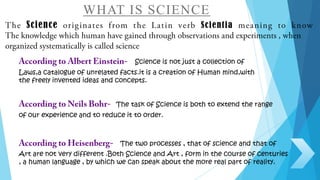
WHAT IS SCIENCE
Science Scientia
Science is not just a collection of
Laws,a catalogue of unrelated facts.it is a creation of Human mind,with
the freely invented ideas and concepts.
The task of Science is both to extend the range
of our experience and to reduce it to order.
The two processes , that of science and that of
Art are not very different .Both Science and Art , form in the course of centuries
, a human language , by which we can speak about the more real part of reality.
The Branch Of Physics Which Deals With The Study Of Motion Of
Material Objects Is Called -- MECHANICS
MECHANICS
Statics
Kinematics
Dynamics
OBJECT IN MOTION
Types of motion-
(1)Rectilinear or Translatory motion
Rectilinear motion-is that motion in which a particle or point
mass body is moving along a straight line.
Translatory motion-is that motion in which a body , which is
not a point mass body is moving such that all constituent
particles move simultaneously along parallel straight lines and
shift through equal distance in a given interval of time
Rectilinear or translator motion can be uniform or non-uniform
(2) Circular or Rotatory motion-
Circular motion-is that motion in which a particle or a point
mass body is moving on a circle.
Rotatory motion-is that motion in which a body , which is not
a point mass body , is moving such that all its constituent
particles move simultaneously along concentric circles ,
whose centre lie on a line, called axis of rotation and shift
through equal angle in a given time.
Circular or rotatory motion can be two dimensional or three
dimensional motion and can be uniform or non-uniform
motion
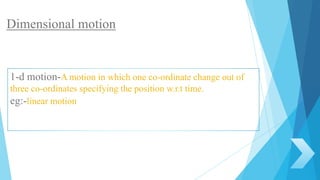
1-d motion-A motion in which one co-ordinate change out of
three co-ordinates specifying the position w.r.t time.
eg:-linear motion
Dimensional motion
2-D MOTION- if the two co-ordinates change out of three co-
ordinates specifying the position of object
Eg:-motion along a plane
3-d motion- if three co-ordinates specifying the position of object w.r.t time
Eg:-motion in a space(motion of gas molecules)
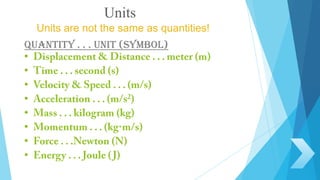
Units
Units are not the same as quantities!
Quantity . . . Unit (symbol)
SI Prefixes
Little Guys Big Guys
Some Physics Quantities
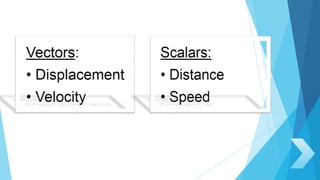
Vector - quantity with both magnitude (size) and direction
Scalar - quantity with magnitude only
Vectors
Vectors are represented with arrows
• The length of the
arrow represents the
magnitude (how far,
how fast, how strong,
etc, depending on the
type of vector).
• The arrow points in
the directions of the
force, motion,
displacement, etc. It
is often specified by
an angle.
42°
Distance vs. Displacement
start
stop
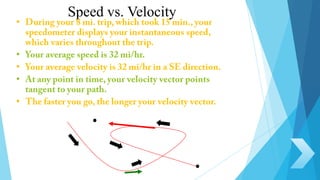
Speed vs. Velocity
Speed vs. Velocity
Kinematics Formula Summary
1-D motion with constant acceleration:
(derivations to follow)
• v = u + at
• v = (u + v)/2
• s = ut +1/2at2
• v2 – u2 = 2 a s

Physics mechanics

  • 1.
  • 2.
  • 4.
    WHAT IS SCIENCE ScienceScientia Science is not just a collection of Laws,a catalogue of unrelated facts.it is a creation of Human mind,with the freely invented ideas and concepts. The task of Science is both to extend the range of our experience and to reduce it to order. The two processes , that of science and that of Art are not very different .Both Science and Art , form in the course of centuries , a human language , by which we can speak about the more real part of reality.
  • 5.
    The Branch OfPhysics Which Deals With The Study Of Motion Of Material Objects Is Called -- MECHANICS MECHANICS Statics Kinematics Dynamics
  • 7.
  • 8.
    Types of motion- (1)Rectilinearor Translatory motion Rectilinear motion-is that motion in which a particle or point mass body is moving along a straight line. Translatory motion-is that motion in which a body , which is not a point mass body is moving such that all constituent particles move simultaneously along parallel straight lines and shift through equal distance in a given interval of time Rectilinear or translator motion can be uniform or non-uniform
  • 9.
    (2) Circular orRotatory motion- Circular motion-is that motion in which a particle or a point mass body is moving on a circle. Rotatory motion-is that motion in which a body , which is not a point mass body , is moving such that all its constituent particles move simultaneously along concentric circles , whose centre lie on a line, called axis of rotation and shift through equal angle in a given time. Circular or rotatory motion can be two dimensional or three dimensional motion and can be uniform or non-uniform motion
  • 10.
    1-d motion-A motionin which one co-ordinate change out of three co-ordinates specifying the position w.r.t time. eg:-linear motion Dimensional motion
  • 11.
    2-D MOTION- ifthe two co-ordinates change out of three co- ordinates specifying the position of object Eg:-motion along a plane 3-d motion- if three co-ordinates specifying the position of object w.r.t time Eg:-motion in a space(motion of gas molecules)
  • 12.
    Units Units are notthe same as quantities! Quantity . . . Unit (symbol)
  • 13.
  • 14.
    Some Physics Quantities Vector- quantity with both magnitude (size) and direction Scalar - quantity with magnitude only Vectors Vectors are represented with arrows • The length of the arrow represents the magnitude (how far, how fast, how strong, etc, depending on the type of vector). • The arrow points in the directions of the force, motion, displacement, etc. It is often specified by an angle. 42°
  • 16.
  • 17.
  • 18.
  • 20.
    Kinematics Formula Summary 1-Dmotion with constant acceleration: (derivations to follow) • v = u + at • v = (u + v)/2 • s = ut +1/2at2 • v2 – u2 = 2 a s