4G Mobile
communications
Presenting by:
Contents:
1. Introduction
2. Existing Technology
3. Disadvantages of 3G
4. Proposed Technology
5. What is 4G?
6. 4G mobile Transceiver
7. 4G mobile Applications
8. 4G Possibilities
9. Advantages
10.Future enhancement
11. conclusion
INTRODUCTION
 Third-generation (3G) mobile networks face a new rival:
so-called 4G. And, astonishingly, the new networks may
even be profitable.
 Even as 3G mobile networks are being switched on around
the world, a couple of years later than planned a group of
newer technologies that are, inevitably, being called
Fourth Generation Mobile Networks (4G)
Existing technology:
3G networks provide the ability to transfer voice
data and non-voice data over the same network
simultaneously.
3G networks deliver broadband capacity and
support greater numbers of voice and data
customers at lower incremental costs than 2G.
Disadvantages of 3G Technology:
 Expensive input fees for the 3G service licenses
 Large amount of debt currently sustained by many
Telecommunication companies, which makes it a challenge to
build the necessary infrastructure for 3G
 Lack of member state support for financially troubled operators
Proposed technology:
4G adds quality streaming video, on-demand
video, and video conferencing, quality Voice over
IP (VoIP) and greater security
 4G offers a speed range from 100Mbps to 1Gbps
and also offers the unusual in that its intended
devices are not restricted to phones and laptops,
but include gaming devices, vending machines,
security and alerting systems.
What is 4G?
 4G is the next generation of wireless
networks that will replace 3G networks
sometimes in future.
 The integrated 4Gmobile system provides
wireless users an affordable broadband
mobile access solutions for the applications
of secured wireless mobile Internet
services with value-added QoS
4G mobile transceiver
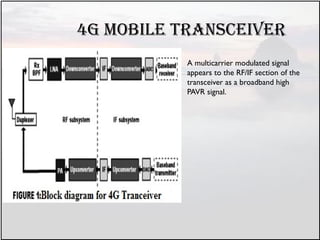
A multicarrier modulated signal
appears to the RF/IF section of the
transceiver as a broadband high
PAVR signal.
4G Mobile Applications
We can send messages in the form of voice, video and other type
multimedia datagram's with the speed of 2mbps
We can access Internet, mobile services in the vehicle travelling
with speed of 200kmph
In 4G we have two cellular Broadband services WI-MAX,LTE
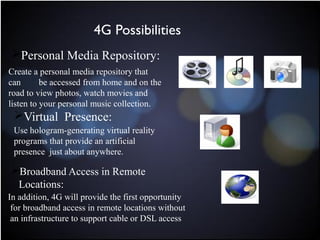
Personal Media Repository:
Create a personal media repository that
can be accessed from home and on the
road to view photos, watch movies and
listen to your personal music collection.
Virtual Presence:
Use hologram-generating virtual reality
programs that provide an artificial
presence just about anywhere.
Broadband Access in Remote
Locations:
In addition, 4G will provide the first opportunity
for broadband access in remote locations without
an infrastructure to support cable or DSL access
4G Possibilities
 Higher bit rates.
 Global mobility and service portability.
 Entirely Packet-Switched networks
Higher band widths to provide multimedia services at
lower cost(up to 100 Mbps).
 Tight network security
4G Advantages
Future Enhancement
Low cost
Faster
 With more reliable synchronization via the cloud
 Easily achievable and searchable
System designers and services providers are looking forward to a
true wireless broadband cellular system, or 4G.
To sketch out a world where mobile devices and services are
ubiquitous and the promise of future fourth generation (4G) mobile
networks enables things only dreamed of, we believe that 4G will
probably become an IP-based network today.
ConClusion
Thank u

4G

  • 1.
  • 3.
    Contents: 1. Introduction 2. ExistingTechnology 3. Disadvantages of 3G 4. Proposed Technology 5. What is 4G? 6. 4G mobile Transceiver 7. 4G mobile Applications 8. 4G Possibilities 9. Advantages 10.Future enhancement 11. conclusion
  • 4.
    INTRODUCTION  Third-generation (3G)mobile networks face a new rival: so-called 4G. And, astonishingly, the new networks may even be profitable.  Even as 3G mobile networks are being switched on around the world, a couple of years later than planned a group of newer technologies that are, inevitably, being called Fourth Generation Mobile Networks (4G)
  • 5.
    Existing technology: 3G networksprovide the ability to transfer voice data and non-voice data over the same network simultaneously. 3G networks deliver broadband capacity and support greater numbers of voice and data customers at lower incremental costs than 2G.
  • 6.
    Disadvantages of 3GTechnology:  Expensive input fees for the 3G service licenses  Large amount of debt currently sustained by many Telecommunication companies, which makes it a challenge to build the necessary infrastructure for 3G  Lack of member state support for financially troubled operators
  • 7.
    Proposed technology: 4G addsquality streaming video, on-demand video, and video conferencing, quality Voice over IP (VoIP) and greater security  4G offers a speed range from 100Mbps to 1Gbps and also offers the unusual in that its intended devices are not restricted to phones and laptops, but include gaming devices, vending machines, security and alerting systems.
  • 8.
    What is 4G? 4G is the next generation of wireless networks that will replace 3G networks sometimes in future.  The integrated 4Gmobile system provides wireless users an affordable broadband mobile access solutions for the applications of secured wireless mobile Internet services with value-added QoS
  • 9.
    4G mobile transceiver Amulticarrier modulated signal appears to the RF/IF section of the transceiver as a broadband high PAVR signal.
  • 10.
    4G Mobile Applications Wecan send messages in the form of voice, video and other type multimedia datagram's with the speed of 2mbps We can access Internet, mobile services in the vehicle travelling with speed of 200kmph In 4G we have two cellular Broadband services WI-MAX,LTE
  • 11.
    Personal Media Repository: Createa personal media repository that can be accessed from home and on the road to view photos, watch movies and listen to your personal music collection. Virtual Presence: Use hologram-generating virtual reality programs that provide an artificial presence just about anywhere. Broadband Access in Remote Locations: In addition, 4G will provide the first opportunity for broadband access in remote locations without an infrastructure to support cable or DSL access 4G Possibilities
  • 12.
     Higher bitrates.  Global mobility and service portability.  Entirely Packet-Switched networks Higher band widths to provide multimedia services at lower cost(up to 100 Mbps).  Tight network security 4G Advantages
  • 13.
    Future Enhancement Low cost Faster With more reliable synchronization via the cloud  Easily achievable and searchable
  • 14.
    System designers andservices providers are looking forward to a true wireless broadband cellular system, or 4G. To sketch out a world where mobile devices and services are ubiquitous and the promise of future fourth generation (4G) mobile networks enables things only dreamed of, we believe that 4G will probably become an IP-based network today. ConClusion
  • 16.

Editor's Notes

  • #4 <number>