
Morphing is tweening between different
images.
Morphing derives from “metamorphosis,” an
ancient Greek word meaning “transformation.”
 How’s Face Morphing done?
 Algorithms explains the extra feature of points on face
and based on these feature points ,images are
partitioned and morphing is performed
 Algorithms has been used to generate morphing
between images of face of different people as well as
between images of face of individuals
 Dissolving (creates transition morphs)
 Warping (creates distortion morphs)
 Where do we use face morphing?
 Hollywood film makers use novel
morphing technologies to generate special
effects
 Disney uses morphing to speed up the
production of cartoons
 photoshop
 Procedures Involved:
 Pre-Processing
 Feature Finding
 Eye-finding
 Mouth-finding
 Image Partitioning
 Coordinate Transformations
 Cross-Dissolving
Feature Finding
 Our goal was to find 4 major feature points, namely the
 two eyes, and
 the two end-points of the mouth.
 Within the scope of this project, we developed an eye-
finding algorithm that successfully detect eyes at 84% rate.
 Eye-finding
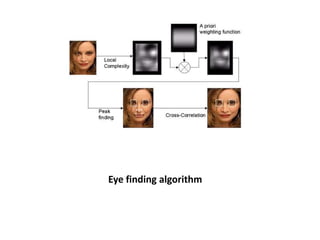
 We assume that the eyes are more complicated than
other parts of the face
 we first compute the complexity map of the facial
image by sliding a fixed-size frame and measuring the
complexity within the frame in a "total variation"
sense.
Eye finding algorithm
 Image Partitioning:
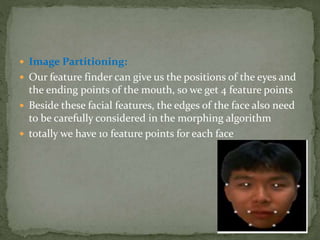
 Our feature finder can give us the positions of the eyes and
the ending points of the mouth, so we get 4 feature points
 Beside these facial features, the edges of the face also need
to be carefully considered in the morphing algorithm
 totally we have 10 feature points for each face
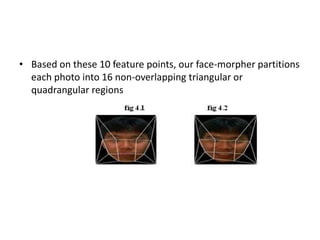
• Based on these 10 feature points, our face-morpher partitions
each photo into 16 non-overlapping triangular or
quadrangular regions
• Cross-Dissolving
• After performing coordinate transformations for each of the
two facial figures, the feature points of these figures are
matched. i.e., the left eye in one figure will be at the same
position as the left eye in the other figure.
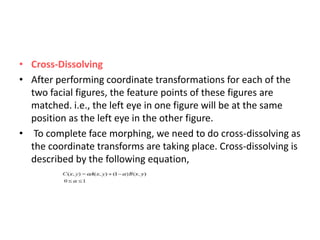
• To complete face morphing, we need to do cross-dissolving as
the coordinate transforms are taking place. Cross-dissolving is
described by the following equation,
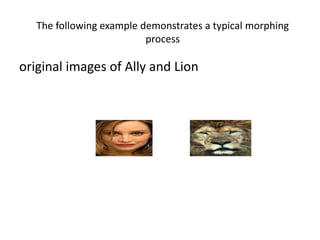
The following example demonstrates a typical morphing
process
original images of Ally and Lion
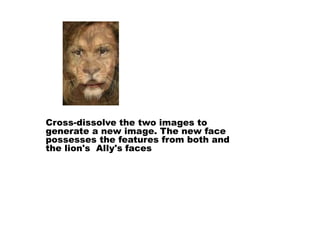
Cross-dissolve the two images to
generate a new image. The new face
possesses the features from both and
the lion's Ally's faces
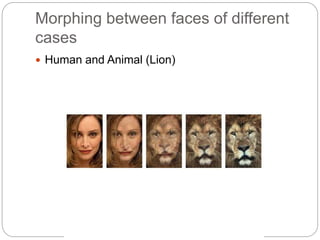
Morphing between faces of different
cases
 Human and Animal (Lion)
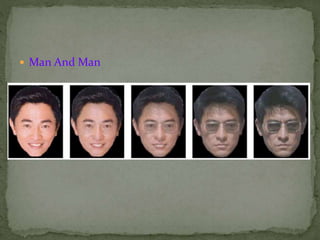
 Man And Man
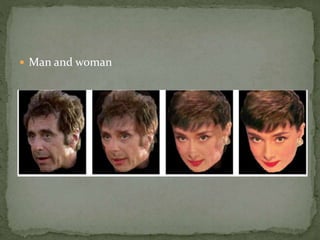
 Man and woman
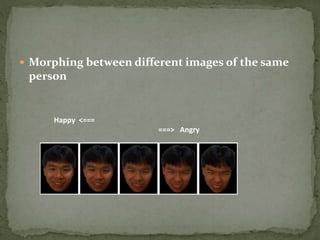
 Morphing between different images of the same
person
Happy <===
===> Angry
 Conclusion
 We believe that feature extraction is the key
technique toward building entirely automatic face
morphing algorithms
 we demonstrated that face morphing algorithm
can help generate animation.
 Ideally speaking , the more feature points we
can specify on the faces, the better morphing
results we can obtain
Face Morphing

Face Morphing

  • 2.
    Morphing is tweeningbetween different images. Morphing derives from “metamorphosis,” an ancient Greek word meaning “transformation.”
  • 3.
     How’s FaceMorphing done?  Algorithms explains the extra feature of points on face and based on these feature points ,images are partitioned and morphing is performed  Algorithms has been used to generate morphing between images of face of different people as well as between images of face of individuals
  • 4.
     Dissolving (createstransition morphs)  Warping (creates distortion morphs)
  • 5.
     Where dowe use face morphing?  Hollywood film makers use novel morphing technologies to generate special effects  Disney uses morphing to speed up the production of cartoons  photoshop
  • 6.
     Procedures Involved: Pre-Processing  Feature Finding  Eye-finding  Mouth-finding  Image Partitioning  Coordinate Transformations  Cross-Dissolving
  • 7.
    Feature Finding  Ourgoal was to find 4 major feature points, namely the  two eyes, and  the two end-points of the mouth.  Within the scope of this project, we developed an eye- finding algorithm that successfully detect eyes at 84% rate.
  • 8.
     Eye-finding  Weassume that the eyes are more complicated than other parts of the face  we first compute the complexity map of the facial image by sliding a fixed-size frame and measuring the complexity within the frame in a "total variation" sense.
  • 9.
  • 10.
     Image Partitioning: Our feature finder can give us the positions of the eyes and the ending points of the mouth, so we get 4 feature points  Beside these facial features, the edges of the face also need to be carefully considered in the morphing algorithm  totally we have 10 feature points for each face
  • 11.
    • Based onthese 10 feature points, our face-morpher partitions each photo into 16 non-overlapping triangular or quadrangular regions
  • 12.
    • Cross-Dissolving • Afterperforming coordinate transformations for each of the two facial figures, the feature points of these figures are matched. i.e., the left eye in one figure will be at the same position as the left eye in the other figure. • To complete face morphing, we need to do cross-dissolving as the coordinate transforms are taking place. Cross-dissolving is described by the following equation,
  • 13.
    The following exampledemonstrates a typical morphing process original images of Ally and Lion
  • 14.
    Cross-dissolve the twoimages to generate a new image. The new face possesses the features from both and the lion's Ally's faces
  • 15.
    Morphing between facesof different cases  Human and Animal (Lion)
  • 16.
  • 17.
  • 18.
     Morphing betweendifferent images of the same person Happy <=== ===> Angry
  • 19.
     Conclusion  Webelieve that feature extraction is the key technique toward building entirely automatic face morphing algorithms  we demonstrated that face morphing algorithm can help generate animation.  Ideally speaking , the more feature points we can specify on the faces, the better morphing results we can obtain

Editor's Notes