Casey Wagner St. Cloud State University
What is wireless? the transfer of  information  over a distance without the use of electrical conductors or "wires".
Electromagnetic Spectrum Light, colors, AM and FM radio, and electronic devices  In US, it is treated like a public resource and regulated by the Federal Communications Commission (FCC) 9 KHz to 300 GHz
Wi-Fi a wireless technology brand owned by the Wi-Fi Alliance intended to improve the interoperability of wireless local area network products based on the IEEE 802.11 standards sometimes called “Wireless Fidelity”
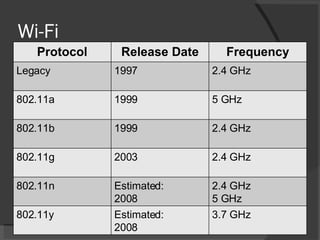
Wi-Fi Protocol Release Date Frequency Legacy 1997 2.4 GHz 802.11a 1999 5 GHz 802.11b 1999 2.4 GHz 802.11g 2003 2.4 GHz 802.11n Estimated:  2008 2.4 GHz 5 GHz 802.11y Estimated:  2008 3.7 GHz
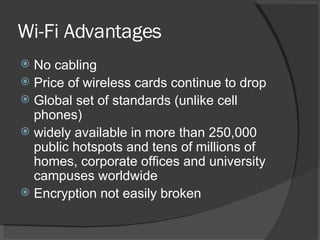
Wi-Fi Advantages No cabling Price of wireless cards continue to drop Global set of standards (unlike cell phones) widely available in more than 250,000 public hotspots and tens of millions of homes, corporate offices and university campuses worldwide Encryption not easily broken
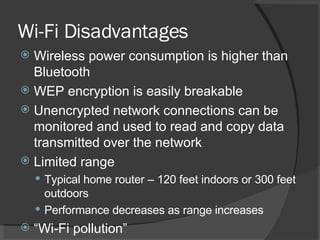
Wi-Fi Disadvantages Wireless power consumption is higher than Bluetooth WEP encryption is easily breakable Unencrypted network connections can be monitored and used to read and copy data transmitted over the network Limited range Typical home router – 120 feet indoors or 300 feet outdoors Performance decreases as range increases “ Wi-Fi pollution”
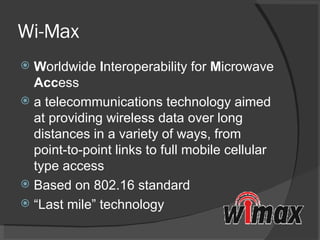
Wi-Max W orldwide  I nteroperability for  M icrowave  Acc ess a telecommunications technology aimed at providing wireless data over long distances in a variety of ways, from point-to-point links to full mobile cellular type access Based on 802.16 standard “Last mile” technology
Wi-Max 30 mile range for fixed stations 5-10 mile range for mobile stations more efficient bandwidth use, interference avoidance, and is intended to allow higher data rates over longer distances
Licensed vs. Unlicensed Services and Applications Generally Offered Over Licensed Spectrum: Carrier-grade, wide-area services (e.g., mobile and fixed telephony, paging, GPRS, EV-DO) Services and Applications Generally Offered Over Unlicensed Spectrum: Low-power/low-range services and consumer and  enterprise applications (e.g., Wi-Fi Internet Access , cordless phones, garage door openers, baby monitors)
What is Licensed? Operation of a wireless transmitter over particular frequencies pursuant to an FCC authorization Commercial spectrum licenses generally come with a frequency assignment; protection from harmful interference; a fixed, renewable term and flexibility in terms of network deployment and the services that can be provided to the public Most commercial spectrum licenses are now auctioned by geographic area
What is Unlicensed? Operation of a wireless transmitter at particular frequencies without an FCC spectrum authorization on a non-harmful interference and unprotected basis covers 902-928 MHz, 2.4 GHz and 5 GHz  Unlicensed bands have been optimized for unlicensed use 1 watt peak transmit power little or no licensed services in band or vicinity
Why Licensed? Manage Interference Issues Protect Investment Better Defined Performance Parameters Higher availability Defined Market for Vendors to Develop Products
Why Unlicensed? 2.4GHz to 22GHz Significantly lower cost Relatively high reliability Promotes a better model of spectrum sharing Why not? Potential Interference Problems Reduction in available bandwidth
Cellular Data CDMA : Code division multiple access  Examples: Verizon & Sprint  EV-DO : Evolution-Data Optimized GSM: Global System for Mobile communications Examples : Cingular & T-Mobile HSDPA : High-Speed Downlink Packet Access GPRS : General Packet Radio Service
Cellular Data Between 800 MHz and 1900 MHz Sometimes slower upload speeds Connectivity anywhere a cell phone has reception Cell Phone data rates can sometimes be high
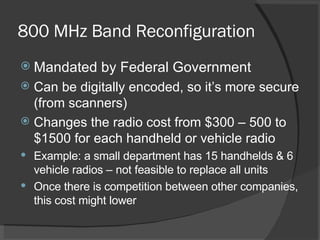
800 MHz Band Reconfiguration Mandated by Federal Government Can be digitally encoded, so it’s more secure (from scanners) Changes the radio cost from $300 – 500 to $1500 for each handheld or vehicle radio Example: a small department has 15 handhelds & 6 vehicle radios – not feasible to replace all units Once there is competition between other companies, this cost might lower
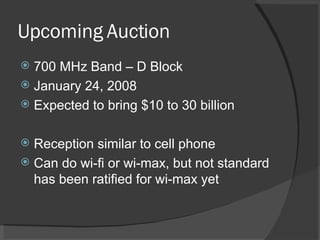
Upcoming Auction 700 MHz Band – D Block January 24, 2008 Expected to bring $10 to 30 billion Reception similar to cell phone Can do wi-fi or wi-max, but not standard has been ratified for wi-max yet
More information… http:// wireless.fcc.gov / US Frequency Allocation Chart http:// www.ntia.doc.gov/osmhome/allochrt.pdf

Casey Wagner

  • 1.
    Casey Wagner St.Cloud State University
  • 2.
    What is wireless?the transfer of information over a distance without the use of electrical conductors or "wires".
  • 3.
    Electromagnetic Spectrum Light,colors, AM and FM radio, and electronic devices In US, it is treated like a public resource and regulated by the Federal Communications Commission (FCC) 9 KHz to 300 GHz
  • 4.
    Wi-Fi a wirelesstechnology brand owned by the Wi-Fi Alliance intended to improve the interoperability of wireless local area network products based on the IEEE 802.11 standards sometimes called “Wireless Fidelity”
  • 5.
    Wi-Fi Protocol ReleaseDate Frequency Legacy 1997 2.4 GHz 802.11a 1999 5 GHz 802.11b 1999 2.4 GHz 802.11g 2003 2.4 GHz 802.11n Estimated: 2008 2.4 GHz 5 GHz 802.11y Estimated: 2008 3.7 GHz
  • 6.
    Wi-Fi Advantages Nocabling Price of wireless cards continue to drop Global set of standards (unlike cell phones) widely available in more than 250,000 public hotspots and tens of millions of homes, corporate offices and university campuses worldwide Encryption not easily broken
  • 7.
    Wi-Fi Disadvantages Wirelesspower consumption is higher than Bluetooth WEP encryption is easily breakable Unencrypted network connections can be monitored and used to read and copy data transmitted over the network Limited range Typical home router – 120 feet indoors or 300 feet outdoors Performance decreases as range increases “ Wi-Fi pollution”
  • 8.
    Wi-Max W orldwide I nteroperability for M icrowave Acc ess a telecommunications technology aimed at providing wireless data over long distances in a variety of ways, from point-to-point links to full mobile cellular type access Based on 802.16 standard “Last mile” technology
  • 9.
    Wi-Max 30 milerange for fixed stations 5-10 mile range for mobile stations more efficient bandwidth use, interference avoidance, and is intended to allow higher data rates over longer distances
  • 10.
    Licensed vs. UnlicensedServices and Applications Generally Offered Over Licensed Spectrum: Carrier-grade, wide-area services (e.g., mobile and fixed telephony, paging, GPRS, EV-DO) Services and Applications Generally Offered Over Unlicensed Spectrum: Low-power/low-range services and consumer and enterprise applications (e.g., Wi-Fi Internet Access , cordless phones, garage door openers, baby monitors)
  • 11.
    What is Licensed?Operation of a wireless transmitter over particular frequencies pursuant to an FCC authorization Commercial spectrum licenses generally come with a frequency assignment; protection from harmful interference; a fixed, renewable term and flexibility in terms of network deployment and the services that can be provided to the public Most commercial spectrum licenses are now auctioned by geographic area
  • 12.
    What is Unlicensed?Operation of a wireless transmitter at particular frequencies without an FCC spectrum authorization on a non-harmful interference and unprotected basis covers 902-928 MHz, 2.4 GHz and 5 GHz Unlicensed bands have been optimized for unlicensed use 1 watt peak transmit power little or no licensed services in band or vicinity
  • 13.
    Why Licensed? ManageInterference Issues Protect Investment Better Defined Performance Parameters Higher availability Defined Market for Vendors to Develop Products
  • 14.
    Why Unlicensed? 2.4GHzto 22GHz Significantly lower cost Relatively high reliability Promotes a better model of spectrum sharing Why not? Potential Interference Problems Reduction in available bandwidth
  • 15.
    Cellular Data CDMA: Code division multiple access Examples: Verizon & Sprint EV-DO : Evolution-Data Optimized GSM: Global System for Mobile communications Examples : Cingular & T-Mobile HSDPA : High-Speed Downlink Packet Access GPRS : General Packet Radio Service
  • 16.
    Cellular Data Between800 MHz and 1900 MHz Sometimes slower upload speeds Connectivity anywhere a cell phone has reception Cell Phone data rates can sometimes be high
  • 17.
    800 MHz BandReconfiguration Mandated by Federal Government Can be digitally encoded, so it’s more secure (from scanners) Changes the radio cost from $300 – 500 to $1500 for each handheld or vehicle radio Example: a small department has 15 handhelds & 6 vehicle radios – not feasible to replace all units Once there is competition between other companies, this cost might lower
  • 18.
    Upcoming Auction 700MHz Band – D Block January 24, 2008 Expected to bring $10 to 30 billion Reception similar to cell phone Can do wi-fi or wi-max, but not standard has been ratified for wi-max yet
  • 19.
    More information… http://wireless.fcc.gov / US Frequency Allocation Chart http:// www.ntia.doc.gov/osmhome/allochrt.pdf

Editor's Notes

  • #2 700mhz – 20mb stream Coverage similar to cell phone Can do wimax but there are no standards established yet