

WHITE SPACE
TECHNOLOGY
By
Havish Chivukula
MBA 1st Year
BSMS, GITAM UNIVERSITY
Introduction
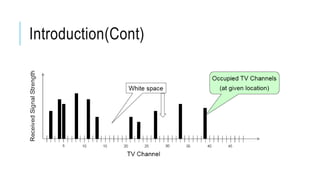
oIn a spectrum band that is licensed to primary users, the part of
spectrum that is unused by the primary user at specific locations and
sometimes at specific time is called White Space.
oUses ‘white space’ or the unused spectrum reserved for broadcasting
TV channels, to provide wireless broadband Internet access to a vast
population, especially rural areas.
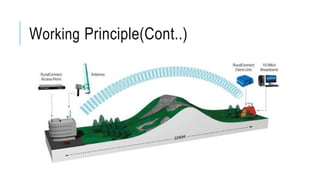
oWhite Space broadband can travel up to 10 kilometres, through
vegetation, buildings, and other obstacles.
Introduction(Cont)
o Spectrum ranges from 470 MHz to 790 MHz.
o Unlike Wi-Fi, which has a range of only about 100 metres, the 200-
300 MHz spectrum in the white space can reach up to 10 km.
o A key requirement is to protect the primary user from any
interference.
Introduction(Cont)
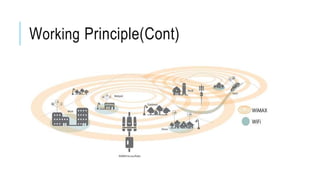
Working Principle
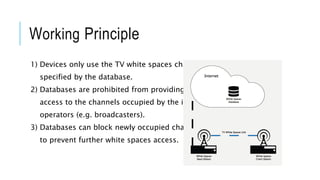
1) Devices only use the TV white spaces channels
specified by the database.
2) Databases are prohibited from providing
access to the channels occupied by the incumbent
operators (e.g. broadcasters).
3) Databases can block newly occupied channels
to prevent further white spaces access.
Working Principle(Cont)
Working Principle(Cont..)
Standards
a. TV White Space follows two standards, IEEE 802.22 and 802.11af
b. IEEE 802 is a family of IEEE standards dealing with local area
networks and metropolitan area networks.
c. IEEE 802.22 deals with Wireless Regional Area Network.
d. IEEE 802.11 deals with Wireless LAN.
e. IEEE 802.11 af is Super Wi-Fi allowing WLAN operation in TV White
Space Spectrum in VHF and UHF bands between 54 and 790 Mhz.
Scope
1. Potential in rural and remote areas
2. Provide portable mobile broadband connectivity across cities and
countries through a variety of devices.
3. Provide a wireless alternative to cable and digital subscriber line
(DSL) broadband access.
4. Provide data, telecommunications (VoIP) and IPTV services.
5. Providing a source of Internet connectivity as part of a business
continuity plan.
6. In India, as a part of Digital India campaign, Microsoft is planning
to provide free Internet services using this technology.
THANK YOU

White space technology

  • 1.
    WHITE SPACE TECHNOLOGY By Havish Chivukula MBA1st Year BSMS, GITAM UNIVERSITY
  • 2.
    Introduction oIn a spectrumband that is licensed to primary users, the part of spectrum that is unused by the primary user at specific locations and sometimes at specific time is called White Space. oUses ‘white space’ or the unused spectrum reserved for broadcasting TV channels, to provide wireless broadband Internet access to a vast population, especially rural areas. oWhite Space broadband can travel up to 10 kilometres, through vegetation, buildings, and other obstacles.
  • 3.
    Introduction(Cont) o Spectrum rangesfrom 470 MHz to 790 MHz. o Unlike Wi-Fi, which has a range of only about 100 metres, the 200- 300 MHz spectrum in the white space can reach up to 10 km. o A key requirement is to protect the primary user from any interference.
  • 4.
  • 5.
    Working Principle 1) Devicesonly use the TV white spaces channels specified by the database. 2) Databases are prohibited from providing access to the channels occupied by the incumbent operators (e.g. broadcasters). 3) Databases can block newly occupied channels to prevent further white spaces access.
  • 6.
  • 7.
  • 8.
    Standards a. TV WhiteSpace follows two standards, IEEE 802.22 and 802.11af b. IEEE 802 is a family of IEEE standards dealing with local area networks and metropolitan area networks. c. IEEE 802.22 deals with Wireless Regional Area Network. d. IEEE 802.11 deals with Wireless LAN. e. IEEE 802.11 af is Super Wi-Fi allowing WLAN operation in TV White Space Spectrum in VHF and UHF bands between 54 and 790 Mhz.
  • 9.
    Scope 1. Potential inrural and remote areas 2. Provide portable mobile broadband connectivity across cities and countries through a variety of devices. 3. Provide a wireless alternative to cable and digital subscriber line (DSL) broadband access. 4. Provide data, telecommunications (VoIP) and IPTV services. 5. Providing a source of Internet connectivity as part of a business continuity plan. 6. In India, as a part of Digital India campaign, Microsoft is planning to provide free Internet services using this technology.
  • 10.