SUBMITTED BY:-
Sudhanshu Saxena
E.C., 3rd Year
1112631049
SUBMITTED TO:-
Mr. Kailash Chandra
 Introduction
 What is Forth Generation?
 Why 4-G Technology
 3-G Technology Vs. 4-G Technology
 Advantages of 4-G Technology
 Disadvantages of 4-G Technology
 Application of 4-G Technology
 India Vs. US in 4-G Technology
 Future Prospects
 Challenges
 Conclusion
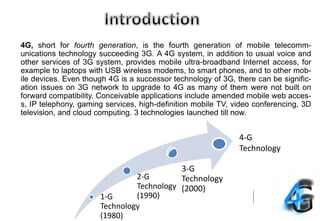
4G, short for fourth generation, is the fourth generation of mobile telecomm-
unications technology succeeding 3G. A 4G system, in addition to usual voice and
other services of 3G system, provides mobile ultra-broadband Internet access, for
example to laptops with USB wireless modems, to smart phones, and to other mob-
ile devices. Even though 4G is a successor technology of 3G, there can be signific-
ation issues on 3G network to upgrade to 4G as many of them were not built on
forward compatibility. Conceivable applications include amended mobile web acces-
s, IP telephony, gaming services, high-definition mobile TV, video conferencing, 3D
television, and cloud computing. 3 technologies launched till now.
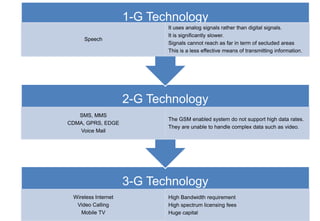
1-G
Technology
(1980)
2-G
Technology
(1990)
3-G
Technology
(2000)
4-G
Technology
3-G Technology
Wireless Internet
Video Calling
Mobile TV
High Bandwidth requirement
High spectrum licensing fees
Huge capital
2-G Technology
SMS, MMS
CDMA, GPRS, EDGE
Voice Mail
The GSM enabled system do not support high data rates.
They are unable to handle complex data such as video.
1-G Technology
Speech
It uses analog signals rather than digital signals.
It is significantly slower.
Signals cannot reach as far in term of secluded areas
This is a less effective means of transmitting information.
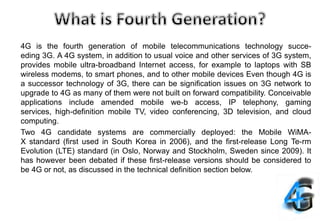
4G is the fourth generation of mobile telecommunications technology succe-
eding 3G. A 4G system, in addition to usual voice and other services of 3G system,
provides mobile ultra-broadband Internet access, for example to laptops with SB
wireless modems, to smart phones, and to other mobile devices Even though 4G is
a successor technology of 3G, there can be signification issues on 3G network to
upgrade to 4G as many of them were not built on forward compatibility. Conceivable
applications include amended mobile we-b access, IP telephony, gaming
services, high-definition mobile TV, video conferencing, 3D television, and cloud
computing.
Two 4G candidate systems are commercially deployed: the Mobile WiMA-
X standard (first used in South Korea in 2006), and the first-release Long Te-rm
Evolution (LTE) standard (in Oslo, Norway and Stockholm, Sweden since 2009). It
has however been debated if these first-release versions should be considered to
be 4G or not, as discussed in the technical definition section below.
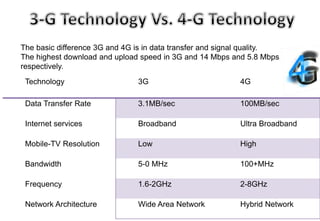
The basic difference 3G and 4G is in data transfer and signal quality.
The highest download and upload speed in 3G and 14 Mbps and 5.8 Mbps
respectively.
Technology 3G 4G
Data Transfer Rate 3.1MB/sec 100MB/sec
Internet services Broadband Ultra Broadband
Mobile-TV Resolution Low High
Bandwidth 5-0 MHz 100+MHz
Frequency 1.6-2GHz 2-8GHz
Network Architecture Wide Area Network Hybrid Network
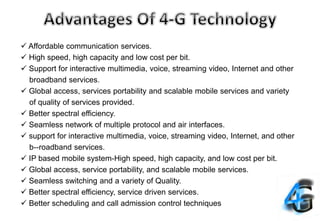
 Affordable communication services.
 High speed, high capacity and low cost per bit.
 Support for interactive multimedia, voice, streaming video, Internet and other
broadband services.
 Global access, services portability and scalable mobile services and variety
of quality of services provided.
 Better spectral efficiency.
 Seamless network of multiple protocol and air interfaces.
 support for interactive multimedia, voice, streaming video, Internet, and other
b--roadband services.
 IP based mobile system-High speed, high capacity, and low cost per bit.
 Global access, service portability, and scalable mobile services.
 Seamless switching and a variety of Quality.
 Better spectral efficiency, service driven services.
 Better scheduling and call admission control techniques
 Battery usage is more.
 Hard to implement.
 Need complicated hardware.
 The equipment required to implement a next generation network is still very expe-
nsive.
 Carrier and provider have to plan carefully to make sure that expenses are kept
realistic.
 Better uses of Multimedia Applications.
 Virtual Presence: 4-G system gives mobile user a “virtual presence” (for exampl-
e, always on connections to keep people on event). Video conferencing.
 Virtual navigation: a remote database contain the graphical representation of st-
reets, buildings, and physical characteristics of a large metropolis. Block of this dat-
abase are transmitted in rapid sequence to a vehicle.
 Tele-geo-processing: Queries dependent on location information of several user
, in addition to temporal aspects have many applications. e.g., GIS, GPS.
 4G in normal life.
• Traffic control.
• Mobile phones.
• Sensor on public vehicles.
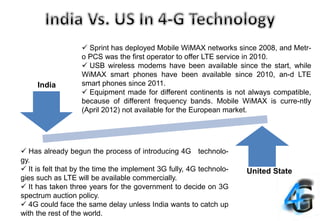
India
United State
 Has already begun the process of introducing 4G technolo-
gy.
 It is felt that by the time the implement 3G fully, 4G technolo-
gies such as LTE will be available commercially.
 It has taken three years for the government to decide on 3G
spectrum auction policy.
 4G could face the same delay unless India wants to catch up
with the rest of the world.
 Sprint has deployed Mobile WiMAX networks since 2008, and Metr-
o PCS was the first operator to offer LTE service in 2010.
 USB wireless modems have been available since the start, while
WiMAX smart phones have been available since 2010, an-d LTE
smart phones since 2011.
 Equipment made for different continents is not always compatible,
because of different frequency bands. Mobile WiMAX is curre-ntly
(April 2012) not available for the European market.
 Future prospects is forth coming 5-G technology.
 5-G technology is providing large broadcasting of data in Gigabit which supports al-
most 65,000 connections.
 5-G technology would provide better use of available bandwidth.
 5-G Technology based on beam division multiple access and relay group corporation.
 Integrating all the promised services is a challenge.
 Challenge in migration to 4-G.
 High data-rate services and low per bit transmission cost.
 Meet the demand of the diverse users.
 The design of intelligent mobility management technique that take advantage of
IP-based technologies to achieve global roaming among various access
technologies.
 Managing Channel quality.
 4G can be best described in one word “MAGIC”, which stands for:
 Mobile multimedia
 Anytime Anywhere
 Global mobility support,
 Integrated wireless and personalized services.
 Through 4G is facing challenges and problems we believed that future research
will overcome these challenges and integrate newly developed services to 4-G net-
works making them available to everyone, anytime and everywhere.

4G (SUD)

  • 1.
    SUBMITTED BY:- Sudhanshu Saxena E.C.,3rd Year 1112631049 SUBMITTED TO:- Mr. Kailash Chandra
  • 2.
     Introduction  Whatis Forth Generation?  Why 4-G Technology  3-G Technology Vs. 4-G Technology  Advantages of 4-G Technology  Disadvantages of 4-G Technology  Application of 4-G Technology  India Vs. US in 4-G Technology  Future Prospects  Challenges  Conclusion
  • 3.
    4G, short forfourth generation, is the fourth generation of mobile telecomm- unications technology succeeding 3G. A 4G system, in addition to usual voice and other services of 3G system, provides mobile ultra-broadband Internet access, for example to laptops with USB wireless modems, to smart phones, and to other mob- ile devices. Even though 4G is a successor technology of 3G, there can be signific- ation issues on 3G network to upgrade to 4G as many of them were not built on forward compatibility. Conceivable applications include amended mobile web acces- s, IP telephony, gaming services, high-definition mobile TV, video conferencing, 3D television, and cloud computing. 3 technologies launched till now. 1-G Technology (1980) 2-G Technology (1990) 3-G Technology (2000) 4-G Technology
  • 4.
    3-G Technology Wireless Internet VideoCalling Mobile TV High Bandwidth requirement High spectrum licensing fees Huge capital 2-G Technology SMS, MMS CDMA, GPRS, EDGE Voice Mail The GSM enabled system do not support high data rates. They are unable to handle complex data such as video. 1-G Technology Speech It uses analog signals rather than digital signals. It is significantly slower. Signals cannot reach as far in term of secluded areas This is a less effective means of transmitting information.
  • 5.
    4G is thefourth generation of mobile telecommunications technology succe- eding 3G. A 4G system, in addition to usual voice and other services of 3G system, provides mobile ultra-broadband Internet access, for example to laptops with SB wireless modems, to smart phones, and to other mobile devices Even though 4G is a successor technology of 3G, there can be signification issues on 3G network to upgrade to 4G as many of them were not built on forward compatibility. Conceivable applications include amended mobile we-b access, IP telephony, gaming services, high-definition mobile TV, video conferencing, 3D television, and cloud computing. Two 4G candidate systems are commercially deployed: the Mobile WiMA- X standard (first used in South Korea in 2006), and the first-release Long Te-rm Evolution (LTE) standard (in Oslo, Norway and Stockholm, Sweden since 2009). It has however been debated if these first-release versions should be considered to be 4G or not, as discussed in the technical definition section below.
  • 6.
    The basic difference3G and 4G is in data transfer and signal quality. The highest download and upload speed in 3G and 14 Mbps and 5.8 Mbps respectively. Technology 3G 4G Data Transfer Rate 3.1MB/sec 100MB/sec Internet services Broadband Ultra Broadband Mobile-TV Resolution Low High Bandwidth 5-0 MHz 100+MHz Frequency 1.6-2GHz 2-8GHz Network Architecture Wide Area Network Hybrid Network
  • 7.
     Affordable communicationservices.  High speed, high capacity and low cost per bit.  Support for interactive multimedia, voice, streaming video, Internet and other broadband services.  Global access, services portability and scalable mobile services and variety of quality of services provided.  Better spectral efficiency.  Seamless network of multiple protocol and air interfaces.  support for interactive multimedia, voice, streaming video, Internet, and other b--roadband services.  IP based mobile system-High speed, high capacity, and low cost per bit.  Global access, service portability, and scalable mobile services.  Seamless switching and a variety of Quality.  Better spectral efficiency, service driven services.  Better scheduling and call admission control techniques
  • 8.
     Battery usageis more.  Hard to implement.  Need complicated hardware.  The equipment required to implement a next generation network is still very expe- nsive.  Carrier and provider have to plan carefully to make sure that expenses are kept realistic.
  • 9.
     Better usesof Multimedia Applications.  Virtual Presence: 4-G system gives mobile user a “virtual presence” (for exampl- e, always on connections to keep people on event). Video conferencing.  Virtual navigation: a remote database contain the graphical representation of st- reets, buildings, and physical characteristics of a large metropolis. Block of this dat- abase are transmitted in rapid sequence to a vehicle.  Tele-geo-processing: Queries dependent on location information of several user , in addition to temporal aspects have many applications. e.g., GIS, GPS.  4G in normal life. • Traffic control. • Mobile phones. • Sensor on public vehicles.
  • 10.
    India United State  Hasalready begun the process of introducing 4G technolo- gy.  It is felt that by the time the implement 3G fully, 4G technolo- gies such as LTE will be available commercially.  It has taken three years for the government to decide on 3G spectrum auction policy.  4G could face the same delay unless India wants to catch up with the rest of the world.  Sprint has deployed Mobile WiMAX networks since 2008, and Metr- o PCS was the first operator to offer LTE service in 2010.  USB wireless modems have been available since the start, while WiMAX smart phones have been available since 2010, an-d LTE smart phones since 2011.  Equipment made for different continents is not always compatible, because of different frequency bands. Mobile WiMAX is curre-ntly (April 2012) not available for the European market.
  • 11.
     Future prospectsis forth coming 5-G technology.  5-G technology is providing large broadcasting of data in Gigabit which supports al- most 65,000 connections.  5-G technology would provide better use of available bandwidth.  5-G Technology based on beam division multiple access and relay group corporation.
  • 12.
     Integrating allthe promised services is a challenge.  Challenge in migration to 4-G.  High data-rate services and low per bit transmission cost.  Meet the demand of the diverse users.  The design of intelligent mobility management technique that take advantage of IP-based technologies to achieve global roaming among various access technologies.  Managing Channel quality.
  • 13.
     4G canbe best described in one word “MAGIC”, which stands for:  Mobile multimedia  Anytime Anywhere  Global mobility support,  Integrated wireless and personalized services.  Through 4G is facing challenges and problems we believed that future research will overcome these challenges and integrate newly developed services to 4-G net- works making them available to everyone, anytime and everywhere.