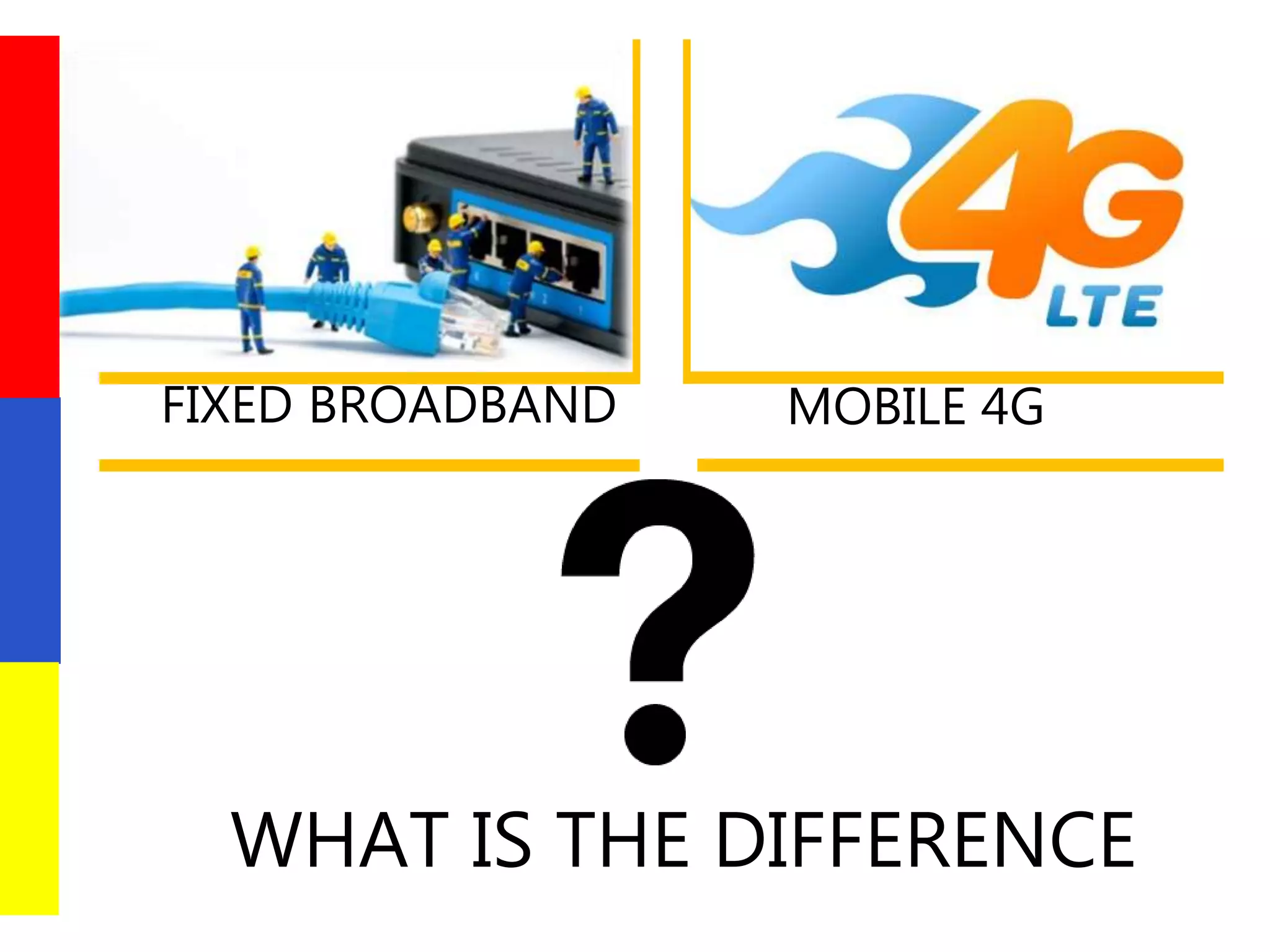
FIXED BROADBAND MOBILE 4G
WHAT IS THE DIFFERENCE
WHAT IS 4G?
(Fourth generation Mobile Communications)
Wireless World Research Forum defines 4G as:
A network that operates on Internet technology, combines it with other
applications and technologies such as Wi-Fi, and runs at speeds ranging
from 100 Mbps (in cell-phone networks) to 1 Gbps (in local Wi-Fi
networks).
Well, the 4G mobile internet works by connecting to a mobile network
with a SIM card. It's the internet you connect to when you're out and
about with your smartphone
Before 4G?......
First Generation (1G) Mobile systems –were designed to offer a single
service i.e speech.
Second Generation (2G) Mobile systems –were also designed primarily
To offer speech with a limited capability to offer data at low rates.
Third Generation (3G) Mobile systems –offer high quality media services
and operate in different environments.
FIXED WIRELESS BROADBAND
Fixed broadband, on the other hand, is a high speed internet connection
in your home or office, delivered via radio OR Fibre through the
provider's network cables.
You'll get it as either Radio signals or superfast fibre optic. It connects to
a router, which you can then connect to all your devices through Wi-Fi or
an Ethernet cable.
Limitations of Fixed Wireless
• The service often requires line of sight access between the subscriber and a
ground station. Obstructions from hills or trees prohibit it being installed in
some locations. Rain or fog can sometimes adversely affect the quality of
the service.
• The cost per Mbps of bandwidth for subscribers tends to be relatively
higher than 4G which is normally pay as you go.
• Unlike mobile Internet services, fixed wireless service is tied to one
physical access point per subscriber and does not support roaming.
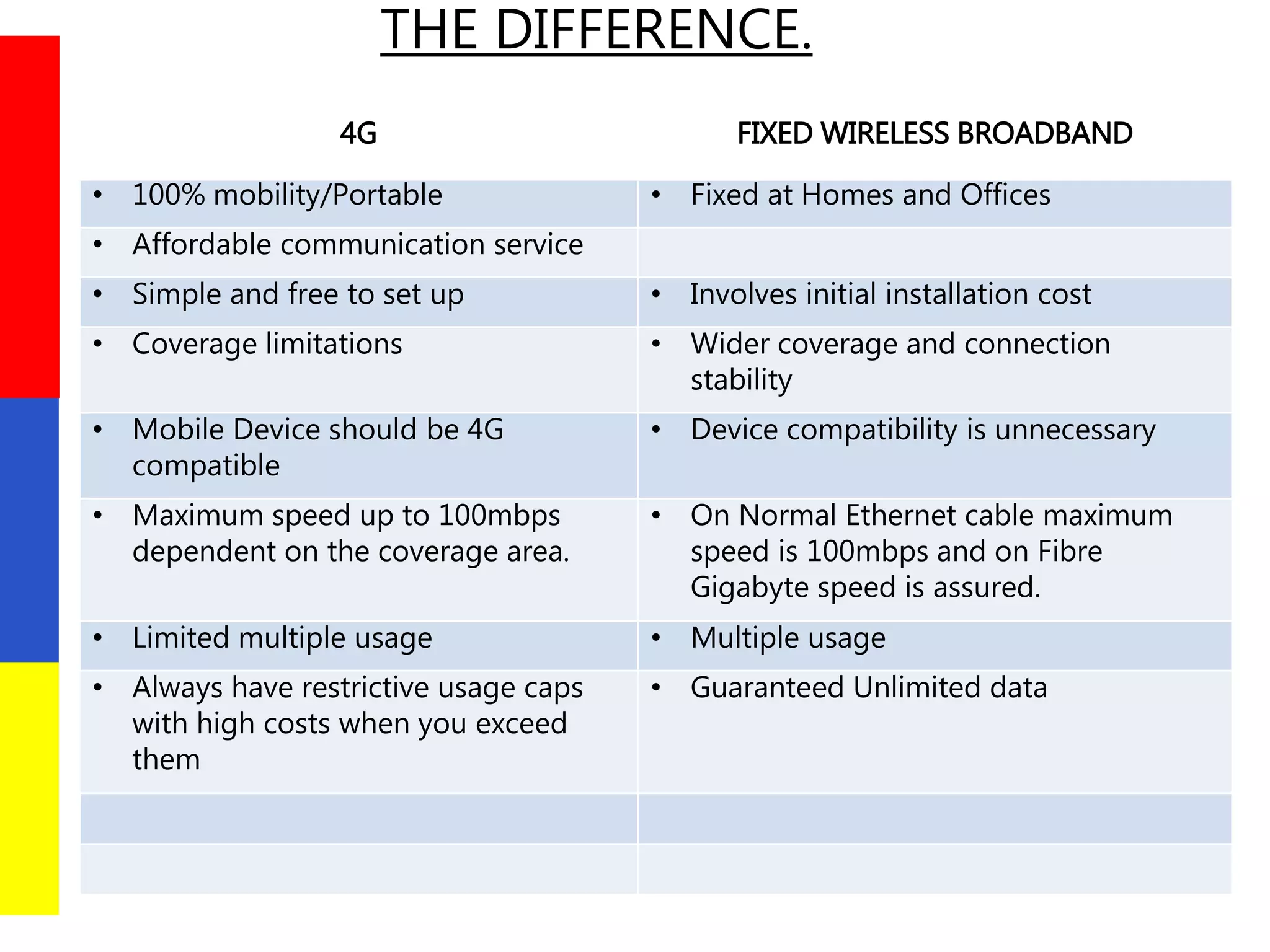
THE DIFFERENCE.
4G FIXED WIRELESS BROADBAND
• 100% mobility/Portable • Fixed at Homes and Offices
• Affordable communication service
• Simple and free to set up • Involves initial installation cost
• Coverage limitations • Wider coverage and connection
stability
• Mobile Device should be 4G
compatible
• Device compatibility is unnecessary
• Maximum speed up to 100mbps
dependent on the coverage area.
• On Normal Ethernet cable maximum
speed is 100mbps and on Fibre
Gigabyte speed is assured.
• Limited multiple usage • Multiple usage
• Always have restrictive usage caps
with high costs when you exceed
them
• Guaranteed Unlimited data
A VIDEO ABOUT 4G
Conclusion
To conclude Teledata’s wireless broadband is backboned on Fiber which
is the highest technology in terms of fixed Wireless broadband internet.
4G on the other hand is the latest technology for mobile Internet. But
Fiber is faster than 4G.
The only different is that 4G mobile internet is portable and Mobile but
Fixed wireless broadband is not.
You are guaranteed of consistent internet connection but 4G operates
within specific areas and dependent with smartphone compatibility with
4G.
DIFFERENCE BETWEEN 4G LTE & FIXED WIRELESS BROADBAND

DIFFERENCE BETWEEN 4G LTE & FIXED WIRELESS BROADBAND

  • 1.
    FIXED BROADBAND MOBILE4G WHAT IS THE DIFFERENCE
  • 2.
    WHAT IS 4G? (Fourthgeneration Mobile Communications) Wireless World Research Forum defines 4G as: A network that operates on Internet technology, combines it with other applications and technologies such as Wi-Fi, and runs at speeds ranging from 100 Mbps (in cell-phone networks) to 1 Gbps (in local Wi-Fi networks). Well, the 4G mobile internet works by connecting to a mobile network with a SIM card. It's the internet you connect to when you're out and about with your smartphone Before 4G?...... First Generation (1G) Mobile systems –were designed to offer a single service i.e speech. Second Generation (2G) Mobile systems –were also designed primarily To offer speech with a limited capability to offer data at low rates. Third Generation (3G) Mobile systems –offer high quality media services and operate in different environments.
  • 3.
    FIXED WIRELESS BROADBAND Fixedbroadband, on the other hand, is a high speed internet connection in your home or office, delivered via radio OR Fibre through the provider's network cables. You'll get it as either Radio signals or superfast fibre optic. It connects to a router, which you can then connect to all your devices through Wi-Fi or an Ethernet cable. Limitations of Fixed Wireless • The service often requires line of sight access between the subscriber and a ground station. Obstructions from hills or trees prohibit it being installed in some locations. Rain or fog can sometimes adversely affect the quality of the service. • The cost per Mbps of bandwidth for subscribers tends to be relatively higher than 4G which is normally pay as you go. • Unlike mobile Internet services, fixed wireless service is tied to one physical access point per subscriber and does not support roaming.
  • 4.
    THE DIFFERENCE. 4G FIXEDWIRELESS BROADBAND • 100% mobility/Portable • Fixed at Homes and Offices • Affordable communication service • Simple and free to set up • Involves initial installation cost • Coverage limitations • Wider coverage and connection stability • Mobile Device should be 4G compatible • Device compatibility is unnecessary • Maximum speed up to 100mbps dependent on the coverage area. • On Normal Ethernet cable maximum speed is 100mbps and on Fibre Gigabyte speed is assured. • Limited multiple usage • Multiple usage • Always have restrictive usage caps with high costs when you exceed them • Guaranteed Unlimited data
  • 5.
  • 6.
    Conclusion To conclude Teledata’swireless broadband is backboned on Fiber which is the highest technology in terms of fixed Wireless broadband internet. 4G on the other hand is the latest technology for mobile Internet. But Fiber is faster than 4G. The only different is that 4G mobile internet is portable and Mobile but Fixed wireless broadband is not. You are guaranteed of consistent internet connection but 4G operates within specific areas and dependent with smartphone compatibility with 4G.